
Life, 1905-01-12 · page 4 of 20
Life — January 12, 1905 — page 4: what you’re looking at
What you’re looking at
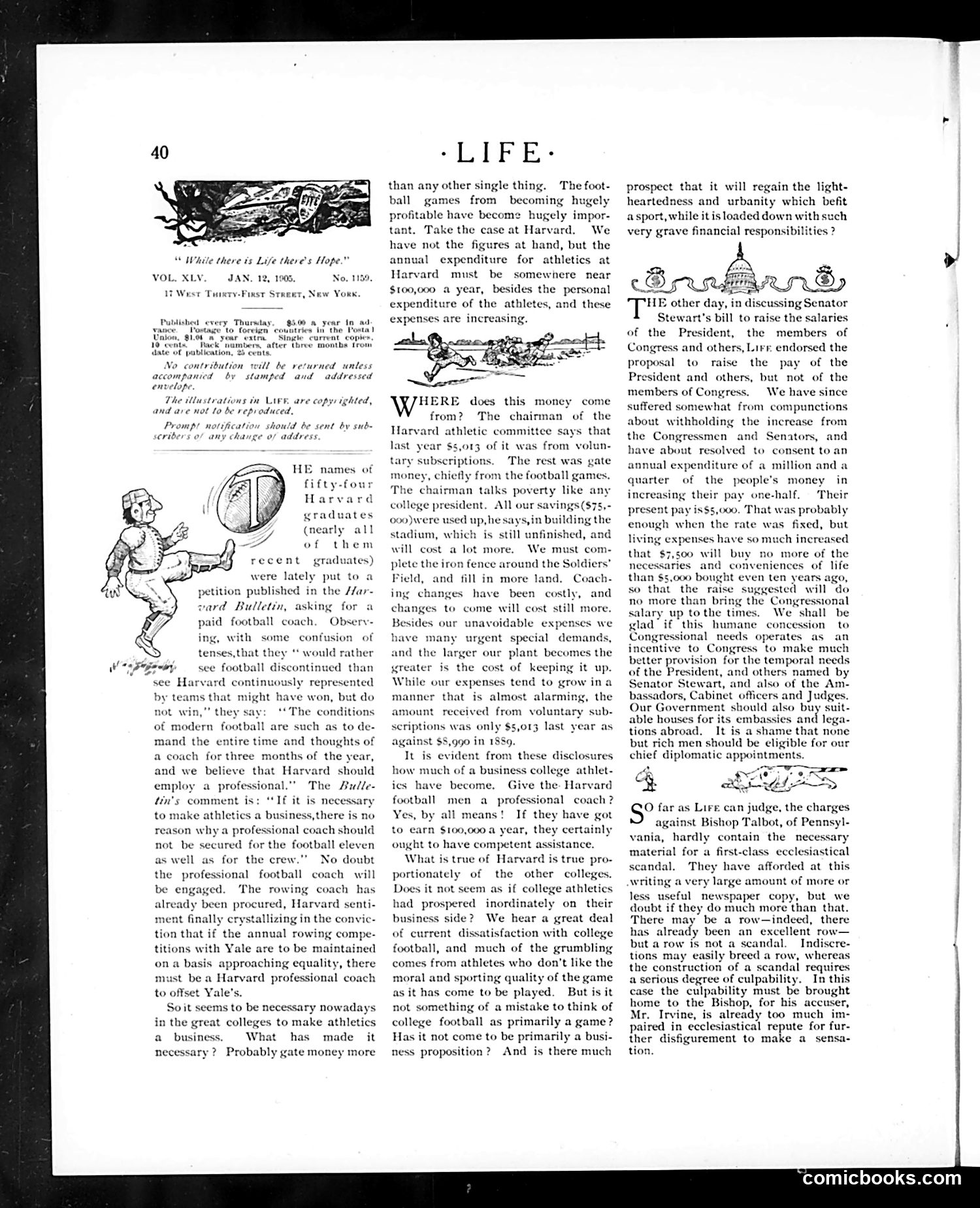
This page critiques Harvard University's athletic spending and professionalization of college football. The text discusses Harvard's substantial annual athletics budget (approximately $100,000) and debates whether hiring a professional football coach is appropriate for an educational institution. The small cartoon at left shows a football player in action, illustrating the athletic focus under discussion. The main satire targets the contradiction between Harvard's academic mission and its increasingly business-like approach to sports. The author argues that while gate receipts are necessary, the university shouldn't sacrifice its "light-heartedness and urbanity" by becoming a purely commercial athletic enterprise. The page also references Senator Stewart's proposal to raise Congressional salaries and criticizes a scandal involving Bishop Talbot of Pennsylvania, using these to suggest that financial impropriety affects multiple institutions.
📄 Transcribed text from this page (OCR, searchable)
Machine-transcribed from the original scan — historical spelling and the odd misread are preserved.
“\ While there ts Life there's Hope.” VOL. XLV. JAN, 12, 1905, No, 1159, 11 West Tatery-Fiest Street, New Yous. Published every Thurstay year tn ad vance. Postage to foreign ries int the Post _ $1.00 m year extra ingle current ¢ it Rack numbers, after three months tf ‘Of pablication, 25 cents Vo contribution will be returned untess accompanied by stamped and addressed envelop The illustrati and ave not 10 b Prompt notification should be sent by sub- cribers o/ any change of address in Lirk, are cproduced, HE names of fifty r Harvard graduates (nearly all of them recent graduates) were lately put to a petition published in the //ar- vard Bulletin, asking for a paid football ¢ ach. Observ- n of ing, with some confusi would rather ¥ see football discontinued than Harvard continuously represented by teams that might have won, but di not win,” they say: ‘The conditions of modern fe tenses,that they tball are such as to de- mand the entire time and thoughts of coach for three months of the year, and we believe that Harvard should employ a professional."”. The Bul/ tin's comment is: “If it is necessary to make athlet ‘sa business,there is no reason why a professional coach should not be secured for the foot as well as for the crew."’ No doubt the professional football will be engaged. ‘The rowing coach has already been procured, Harvard senti- ment finally crystallizing in the convic- tion that if the annual rowing compe- titions with Yale are to be maintained ona basis approaching equality, there must be a Harvard professional coach to offset Y. So it seems to be necessary nowada: in the great colleges to make athletii a business. What has made it necessary? Probably gate money more all eleven le’s. -LIFE- than any other single thing. ‘The foot- ball games from becoming hugely profitable have become hugely impor- tant, Take the case at Harvard. We have not the figures at hand, but the annual expenditure for athletics at Harvard must be somewhere near $100,000 a year, besides the personal expenditure of the athletes, and these expenses are increasing. “Sect Naa HERE does this money come from? The chairman of the Harvard athletic committee says that last year $5,013 of it w from volun- tary subscriptions. The rest was gate money, chiefly from the football games The chairman talks poverty like any college president, All our savings($75,- ooo) were used up, he says, in building the stadium, which is still unfinished, and will cost a lot more. We must com- plete the iron fence around the S oldiers’ ield, and fill in more land. Coach- ing changes have been costly, and changes to come will cost still more. Besides our unavoidable expenses w have many urgent speci al demands, and the larger our plant becomes the wreater is the cost of keeping it up. While our expenses tend to grow ina manner that is almost alarming, the ved from voluntary sub- ions was only $5,013 last y against $8,990 in 189. It is evident from these disclosures how much of a busines unt re scrip college athlet- ics have become, Give the: Harvard football men a_ professional coach? Yes, by all means! If they have got to earn $100,000 a year, they certainly ought to have competent assistance. What is true of Harvard is true pr portionately of the other colleges. Does it not seem as if college athletics had prospered inordinately on their business side? We hear a great deal of current dissatisfaction with college football, and much of the grumbling comes from athletes who don't like the moral and sporting quality of the game as it has come to be played. But is it not something of a mistake to think of college football as primarily a game? Has it not come to be primarily a busi- ion? And is there much ness propos prospect that it will regain the light heartedness and urbanity which befit a sport, while it is loaded down with such very grave financial responsibilities ? HE other day, in discussing Senator Stewart's bill to raise the salaries the President, the members of Congress and others, Lire endorsed the proposal to raise the pay of the President and others, but not of the members of Congress. We have since suffered somewhat from compunctions about withholding the increase from the Congressmen and Senators, and have about resolved to consent to an annual expenditure of a million and a quarter of the people's money in increasing their pay one-half. ‘Their present pay is$s,o00, That was probably enough when the rate was fixed, but living expenses have so much increased that $7,500 will buy no more of the necessaries and conveniences of life than $5,000 bought even ten years ago, so that the raise suggested will do no more than bring the Congressional salary up tothe times. We shall be glad if this humane concession to Congressional needs operates as an incentive to Congress to make much better provision for the temporal needs of the President, and others named by Senator Stewart, and also of the Am- bassadors, Cabinet officers and Judges. Our Government should also buy suit- able houses for its embassies and Jey tions abroad, It is a shame that none but rich men should be eligible for our chief diplomatic appointments Lire can judge, the charges ainst Bishop Talbot, of Pennsyl- vania, hardly contain the necessary material for a first-class ecclesiastical scandal. They have afforded at this writing a very large amount of more or less useful newspaper copy, but we doubt if they do much more than that. There may be a row—indeed, there has already been an excellent row— but a row is not a scandal. Indiscre tions may easily breed a row, wheres the construction of a scandal requires a serious degree of culpability. In this case the culpability must be brought home to the Bishop, for his accuser, Mr. Irvine, is already too much im- paired in ecclesiastical repute for fur- ther disfigurement to make a sensa- tion. “comicbooks.com