
Life, 1905-01-12 · page 13 of 20
Life — January 12, 1905 — page 13: what you’re looking at
What you’re looking at
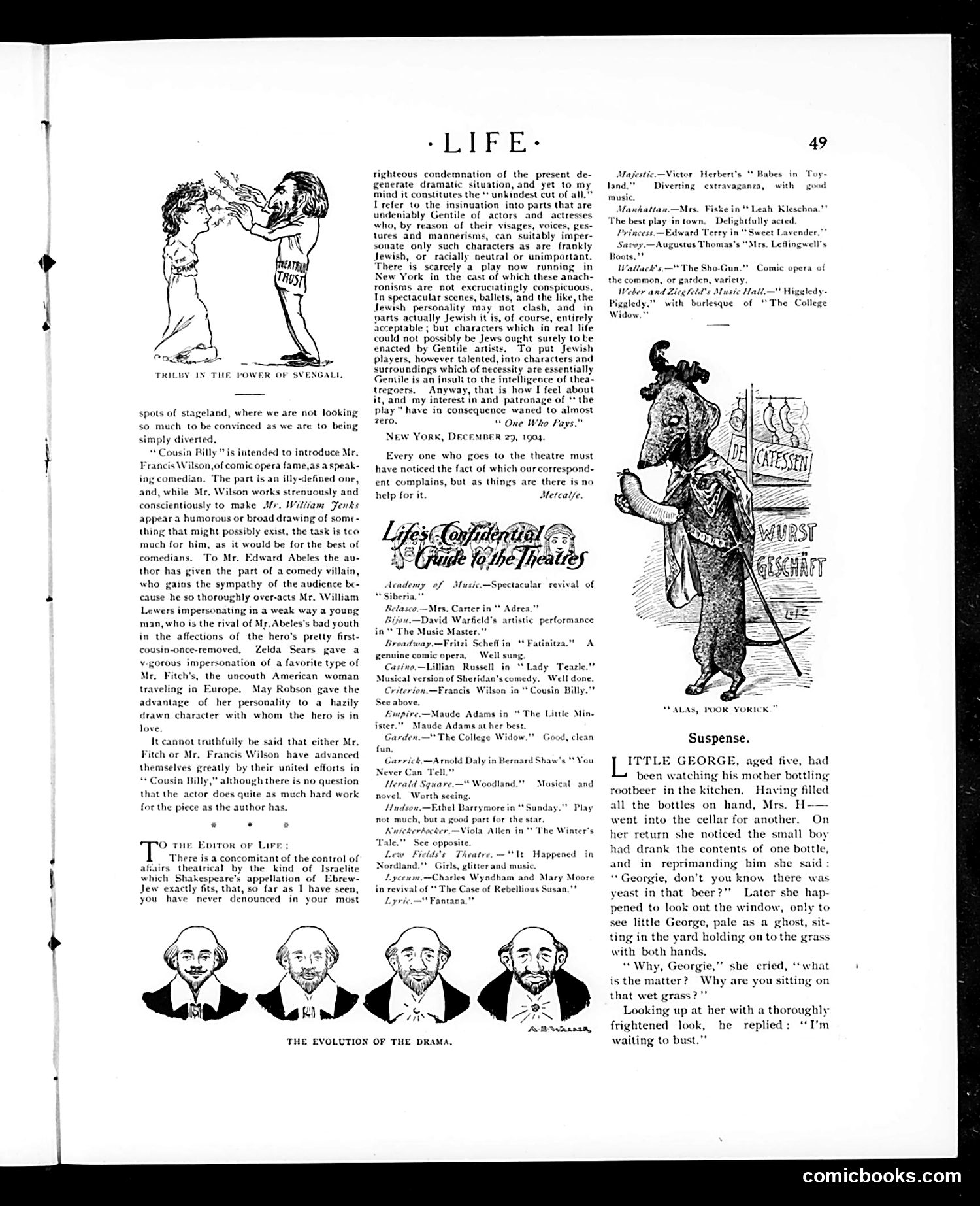
This page contains a letter to the editor complaining about Jewish actors being cast in roles written for Gentile characters. The author argues this creates "anachronisms" and insults theatrical audiences' intelligence, claiming Jewish actors' "visages, voices, gestures and mannerisms" suit only Jewish roles. **The context we'd miss today:** This reflects early-20th-century theatrical discrimination and antisemitic assumptions about ethnic casting. The complainant—signing as "One Who Pays"—represents a period when explicit racial restrictions in theater were considered acceptable public discourse. Notably, the magazine's theater critic "Metcalfe" acknowledges the complaint but dismissively states "there is no help for it." The illustration "Trilby in the Power of Svengali" (top left) references the 1894 novel featuring a villainous Jewish hypnotist character, reinforcing period stereotypes. The page otherwise contains routine theater reviews and advertisements.
📄 Transcribed text from this page (OCR, searchable)
Machine-transcribed from the original scan — historical spelling and the odd misread are preserved.
> C0 te) TRILBY IN THE POWER OF SVENGALI, spots of stageland, where we are not looking so much to be convinced as we are to being simply diverted, * Cousin Billy "is intended to introduce Mr. Francis Wilson,of comic opera fame,as.a speak ing comedian. ‘The part is an illy-defined one, and, while Mr, Wilson works strenuously and conscientiously to make Mr. William Jenks appear a humorous or broad drawing of some- thing that might possibly exist, the task is tco much for him, as it would be for the best of comedians. To Mr, Edward Abeles the au- thor has given the part of a comedy villain, who gains the sympathy of the audience be- cause he so thoroughly over-acts Mr. William Lewers impersonating in a weak way a young man, who is the rival of My.Abeles’s bad youth in the affections of the hero’s pretty first- cousin-once-removed, Zelda Sears gave a v.gorous impersonation of a favorite type of Mr. Fitch's, the uncouth American woman traveling in Europe, May Robson gave the advantage of her personality to a hazily drawn character with whom the hero is in love. It cannot truthfully be said that either Mr. Fitch or Mr, Francis Wilson have advanced themselves greatly y their united efforts in “ Cousin Billy,” although there is no question that the actor does quite as much hard work for the piece as the author has, T° Tie Eprtor oF Lire: ‘There is a concomitant of the control of afiairs theatrical by the kind of Israelite which Shakespeare's appellation of Ebrew- Jew exactly fits, that, so far as I have seen, you have never denounced in your most LITRE righteous condemnation of the present de- generate dramatic situation, and yet to my mind it constitutes the ** unkindest cut of all.” Irefer to the insinuation into parts that are undeniably Gentile of actors and actresses who, by reason of their visages, voices, ges tures and mannerisms, can suitably imper- sonate only such characters as are frankly Jewish, or racially oeutral or unimportant. There ‘is scarcely a play now running in New York in the cast of which these anach- ronisms are not excruciatingly conspicuous. In spectacular scenes, ballets, and the like, the Jewish personality may not clash, and in parts actually Jewish it is, of course, entirely acceptable ; but characters which in’ real life could not possibly be Jews ought surely to be enacted by Gentile artists. To put Jewish players, however talented, into characters and Surroundings which of necessity are essentially Gentile is an insult to the intelligence of thea- tregoers. Anyway, that is how I feel about it, and my interest in and patronage of ** the play "have in consequence waned to almost zero. “One Who Pays.” New York, DECEMBER 29, 1904. Every one who goes to the theatre must have noticed the fact of which our correspond- ent complains, but as things are there is no help for it. Metcalfe. Lifes [oxpiiteril SS Craik Yo Theatres leademy of Music.—Spectacular revival of “ Siberia.” Belasco.—Mrs. Carter in * Ad: f id Warfield’s artistic performance The Music Master."" ritzi Scheff in ** Fati genuine comic opera, Well sung. Casino.—Lillian Russell in “Lady Teazle."* ds Well don Cousin Billy. Sh ( Musical version of Sheridan's com Criterion Francis Wilson in See above. Empire—Maude Adams in “The Little Min- ister." Maude Adams at her best. Garden.—* The College Widow." fun. Garrick.—Atnold Daly in Bernard Shaw's * You Never Can Tell.” Herald Square.—" Woodland.” Musical and novel, Worth seeing. Hudson.—Fahel Barrymore ia not much, but a good part for the st ‘nickerbocker. Viola Allen in The Winter's See opposite. Fields's Theatre. —""\t- Happened in . glitter and om —Charles Wyndham and Mary Moore in revival of * The Lyric—" Fantana,” nd * Play ase of Rebellious Susan, THE EVOLUTION OF THE DRAMA, 49 Majestic. —Victor Herbert's Babes in Toy~ land." Diverting extravaganza, with d MVanhattan.—Mrs. Fiske in Leah Kleschna.’* The best play in town, Delightfully acted. Princess.—Edward Terry in “Sweet Lavender.” Sarey.—Augustus Thomas's “Mrs. Leflingwell’s Boots, Watlack's.—* The Sho-Gun.”" Comic opera of the common, or garden, variety Weber and Ziegfeld's Music Hat Piggledy.” with bi Widow.” Higgledy- esque of “The College SALAS, POOR YORICK.” Suspense. ITTLE GEORGE, aged five, had been watching his mother bottling rootbeer in the kitchen, Having filled all the bottles on hand, Mrs, H-— went into the cellar for another. On her return she noticed the small boy had drank the contents of one bottle, and in reprimanding him she said : “Georgie, don't you know there was yeast in that beer?" Later she hap- pened to look out the window, only to see little George, pale as a ghost, sit- ting in the yard holding on to the grass with both hands. “Why, Georgie,” she cried, “what isthe matter? Why are you sitting on that wet grass?" Looking up at her with a thoroughly frightened look, he replied: “I'm waiting to bust, comicbooks.com