
A complete issue · 20 pages · 1904
Life — September 22, 1904
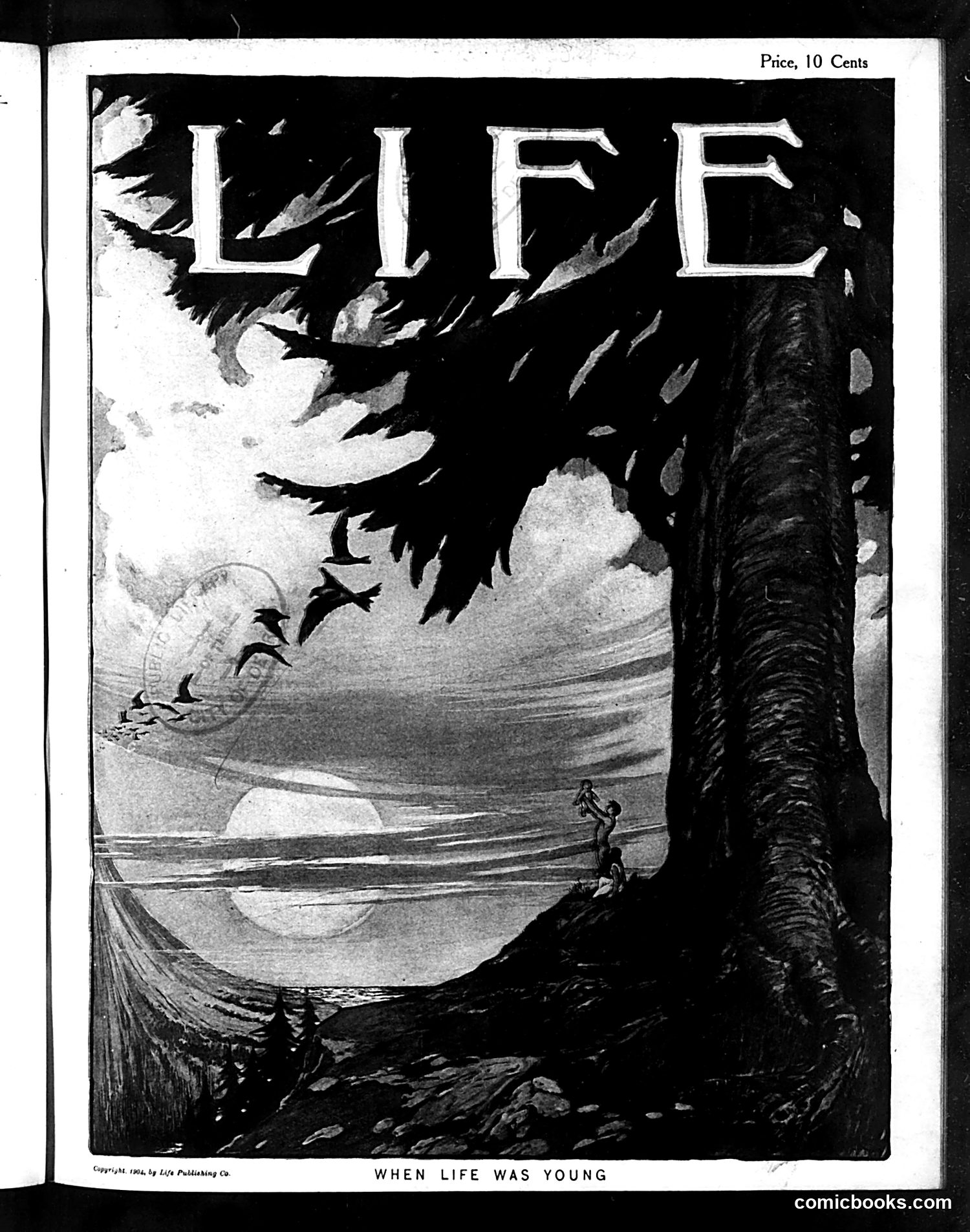
This is a cover from *Life* magazine priced at 10 cents, titled "WHEN LIFE WAS YOUNG." The illustration depicts a dramatic silhouette scene: a massive tree trunk dominates the right side, while a tiny human figure stands on a distant landscape beneath a large moon or sun. Flying creatures (possibly birds or pterosaurs) fill the stormy sky above. The image appears to be a romanticized or fantastical representation of prehistoric or primordial times—suggesting humanity's insignificance against nature's grandeur and ancient forces. The subtitle "WHEN LIFE WAS YOUNG" reinforces this interpretation as commentary on Earth's early epochs or humanity's distant past. Without additional context from the magazine's interior, the specific satirical or social message remains unclear, though the tone seems contemplative rather than overtly political.
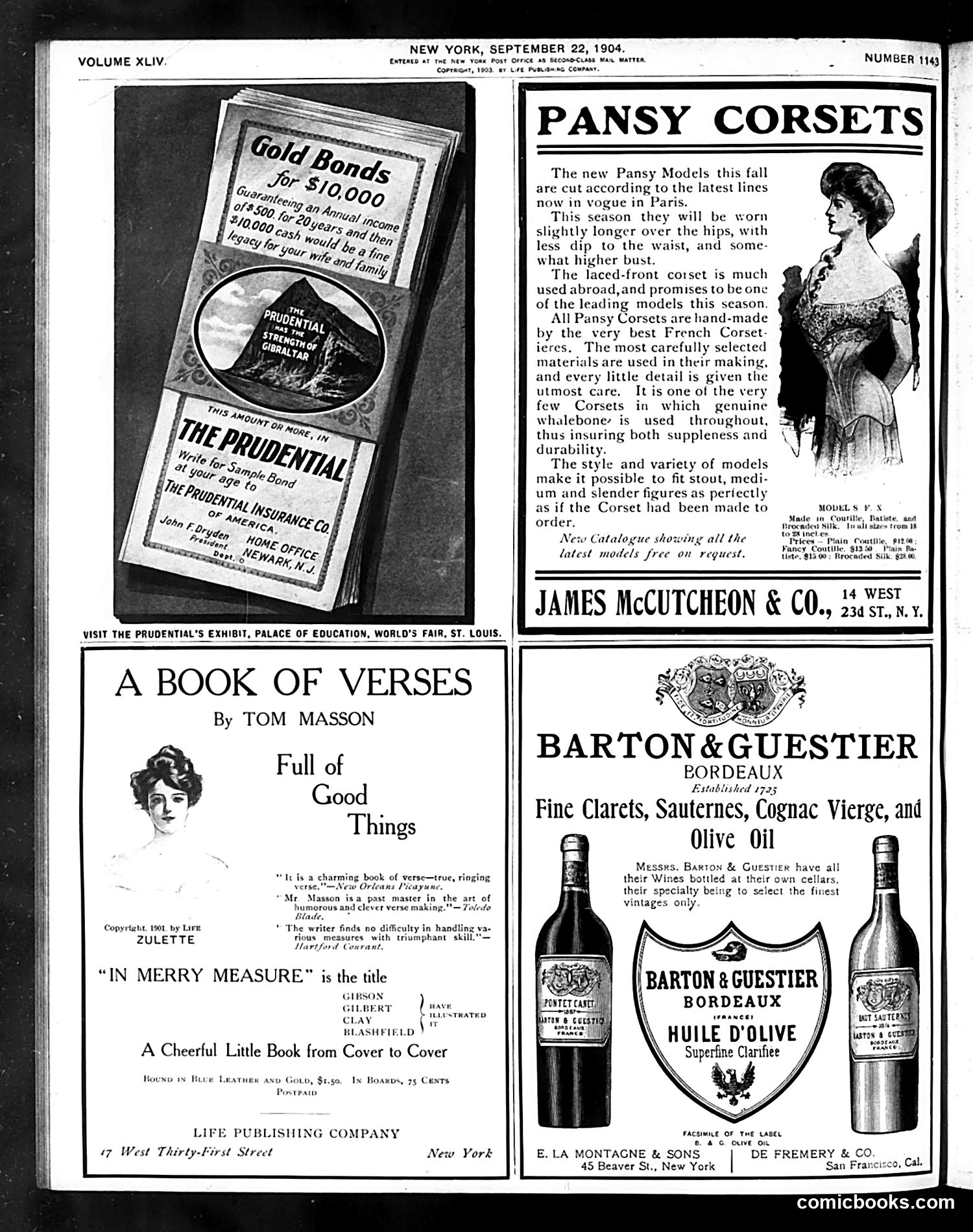
This page is **primarily advertising** rather than political satire or comics. The dominant content includes: 1. **Prudential Insurance ad** (top left) - promoting gold bonds, with an exhibit reference to the 1904 World's Fair in St. Louis 2. **Pansy Corsets ad** (top right) - featuring a fashionable woman, describing new French-influenced corset styles for the 1904 season 3. **"A Book of Verses" by Tom Masson** (bottom left) - promoting a humorous poetry collection 4. **Barton & Guestier wine ad** (bottom right) - advertising French clarets, cognac, and olive oil The page reflects early 1900s consumer culture and advertising design. While Life magazine was known for satire, this particular page serves mainly as a commercial vehicle, with no evident political commentary or satirical cartoons visible.
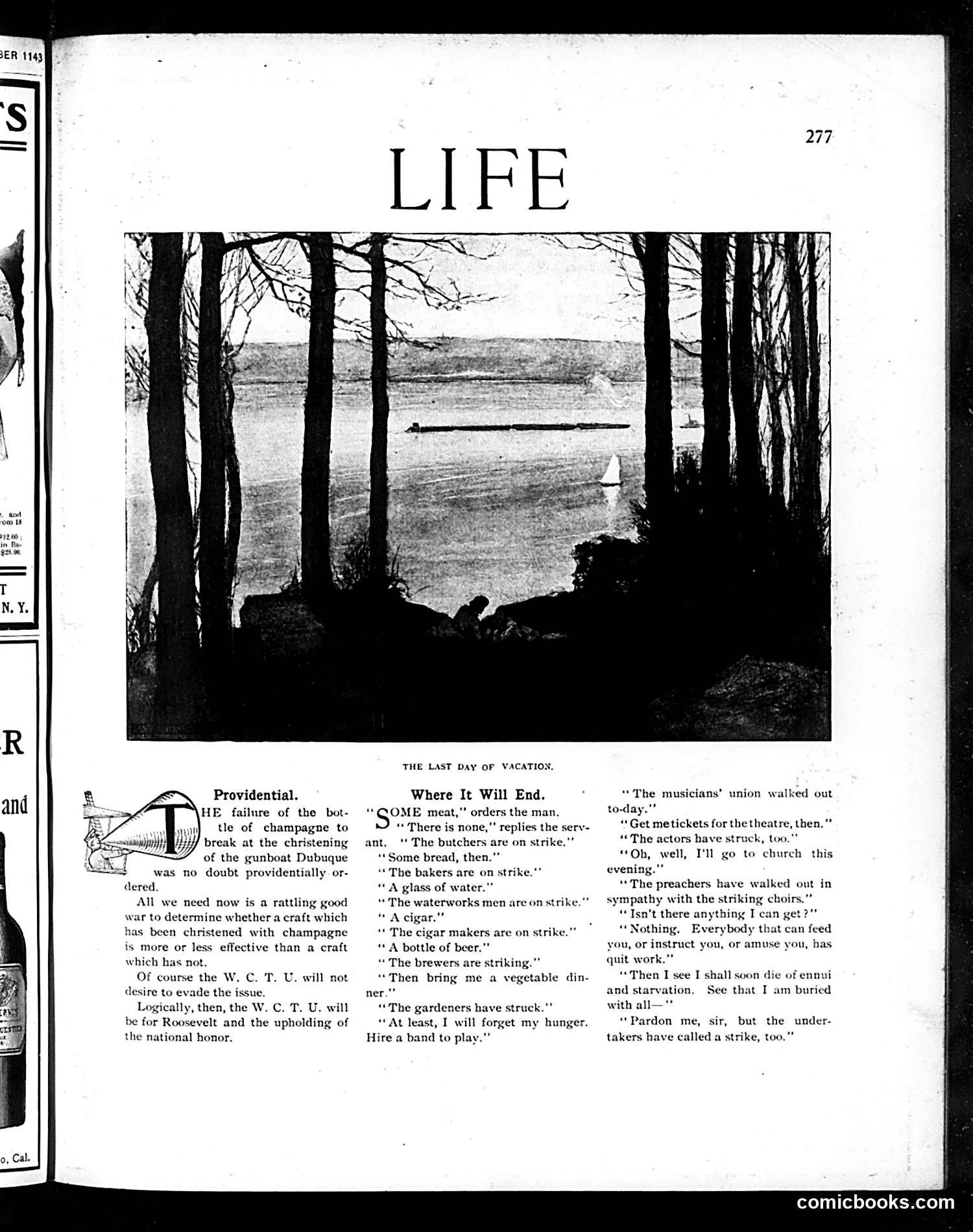
This page from *Life* magazine satirizes a widespread labor strike affecting multiple industries and essential services. The cartoon "Where It Will End" depicts escalating strike demands through a dialogue between a man and a waiter at a restaurant. The joke: as various workers strike—butchers, bakers, waterworks employees, cigar makers, brewers, gardeners, and undertakers—the man realizes there's nothing left to eat or consume. The final punchline reveals even undertakers have struck, suggesting the ultimate absurdity: when death itself becomes unavailable due to labor action. This critiques how widespread strikes paralyze society and eliminate basic necessities, reducing the situation to darkly comic extremes. The accompanying editorial comments on the W.C.T.U. (Women's Christian Temperance Union) and Roosevelt, suggesting this addresses early 20th-century labor unrest and political responses to it.
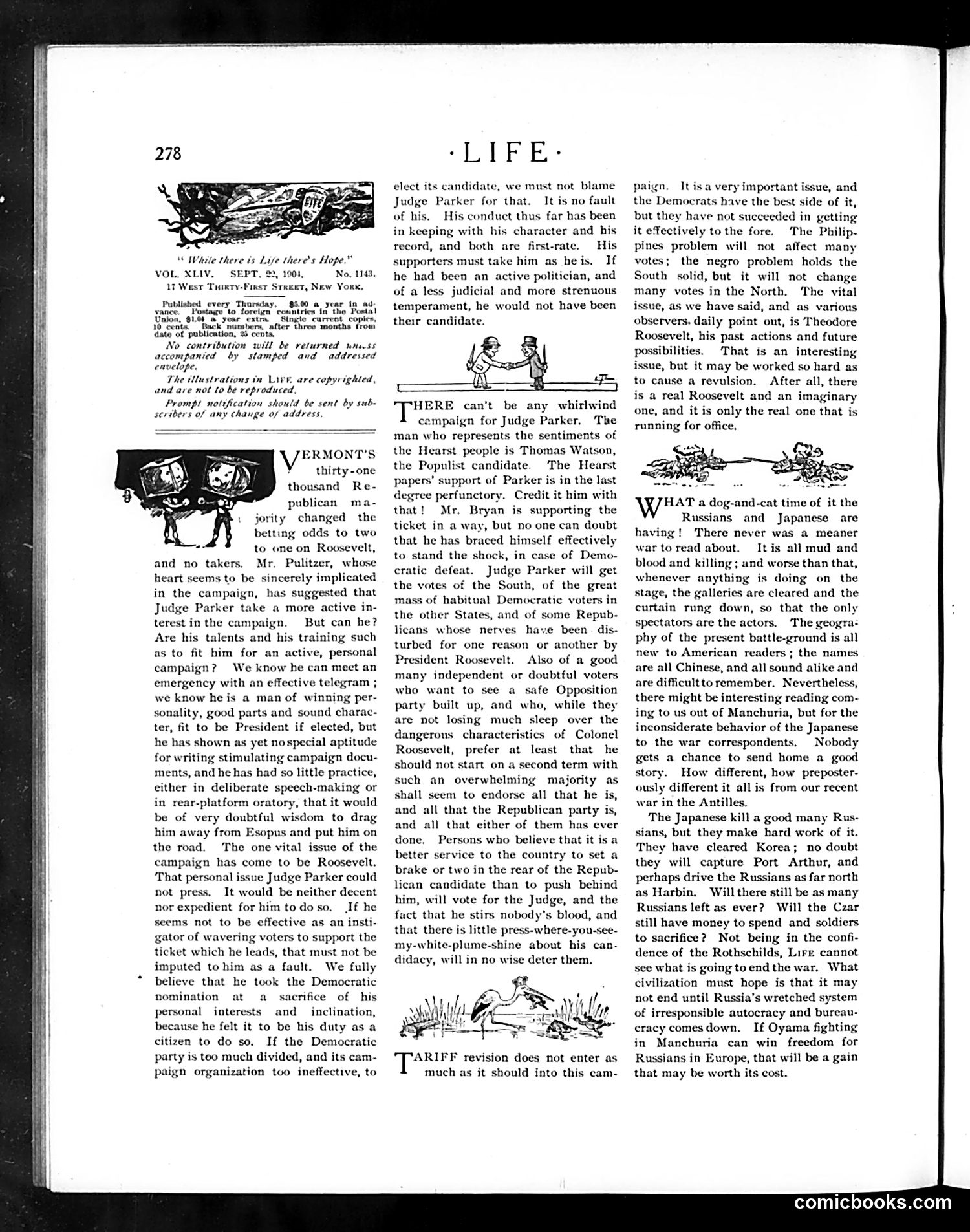
The page discusses the 1904 presidential campaign, focusing on Judge Alton B. Parker (Democratic nominee) versus Theodore Roosevelt (Republican incumbent). The text criticizes Parker as lacking the vigor needed for an active campaign, noting Roosevelt's superior political energy and record. It argues Parker represents "the Hearst people" and Thomas Watson's Populist faction. The cartoon imagery (though small) appears to satirize campaign dynamics of this election. The article emphasizes Roosevelt's personal dynamism as an asset, while suggesting Parker's judicial temperament—though respectable—makes him an uninspiring candidate who cannot generate genuine enthusiasm among voters. The piece ultimately argues Roosevelt's demonstrated leadership transcends typical partisan concerns.
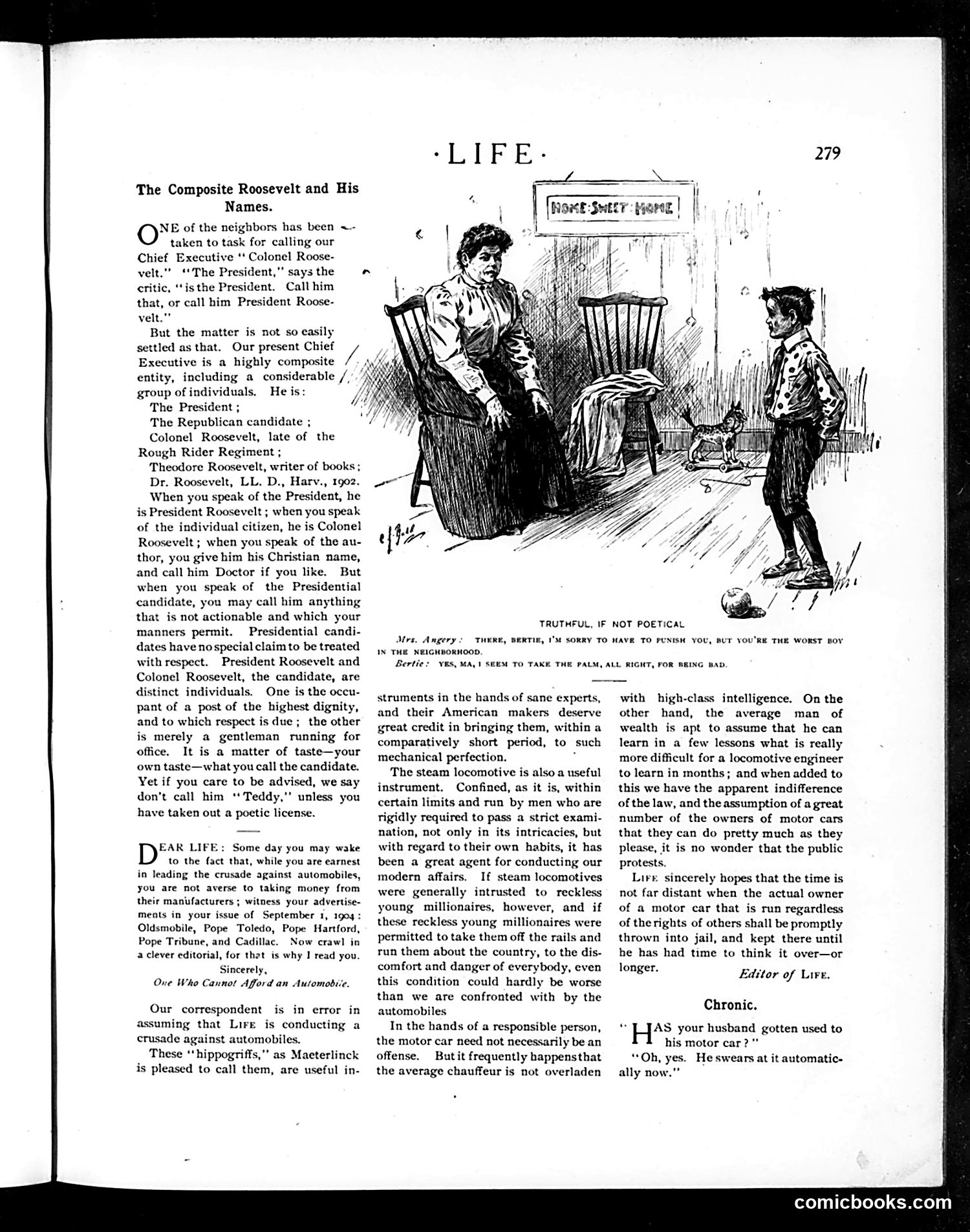
The main cartoon illustrates "The Composite Roosevelt and His Names," a satirical piece about Theodore Roosevelt's complex public identity. The image shows an adult (likely representing Roosevelt in one of his roles) speaking with a young boy in a "Home Sweet Home" setting. The caption jokes that Roosevelt should be called different names depending on context: "President Roosevelt" when discussing policy, "Colonel Roosevelt" when referencing his Rough Rider past, and "Doctor" for his writing career. The satire mocks how Roosevelt's multiple personas and accomplishments made him difficult to categorize simply. The accompanying text discusses automobiles and locomotion—contemporary concerns—suggesting Roosevelt's multifaceted nature mirrors broader American complexity of the era.
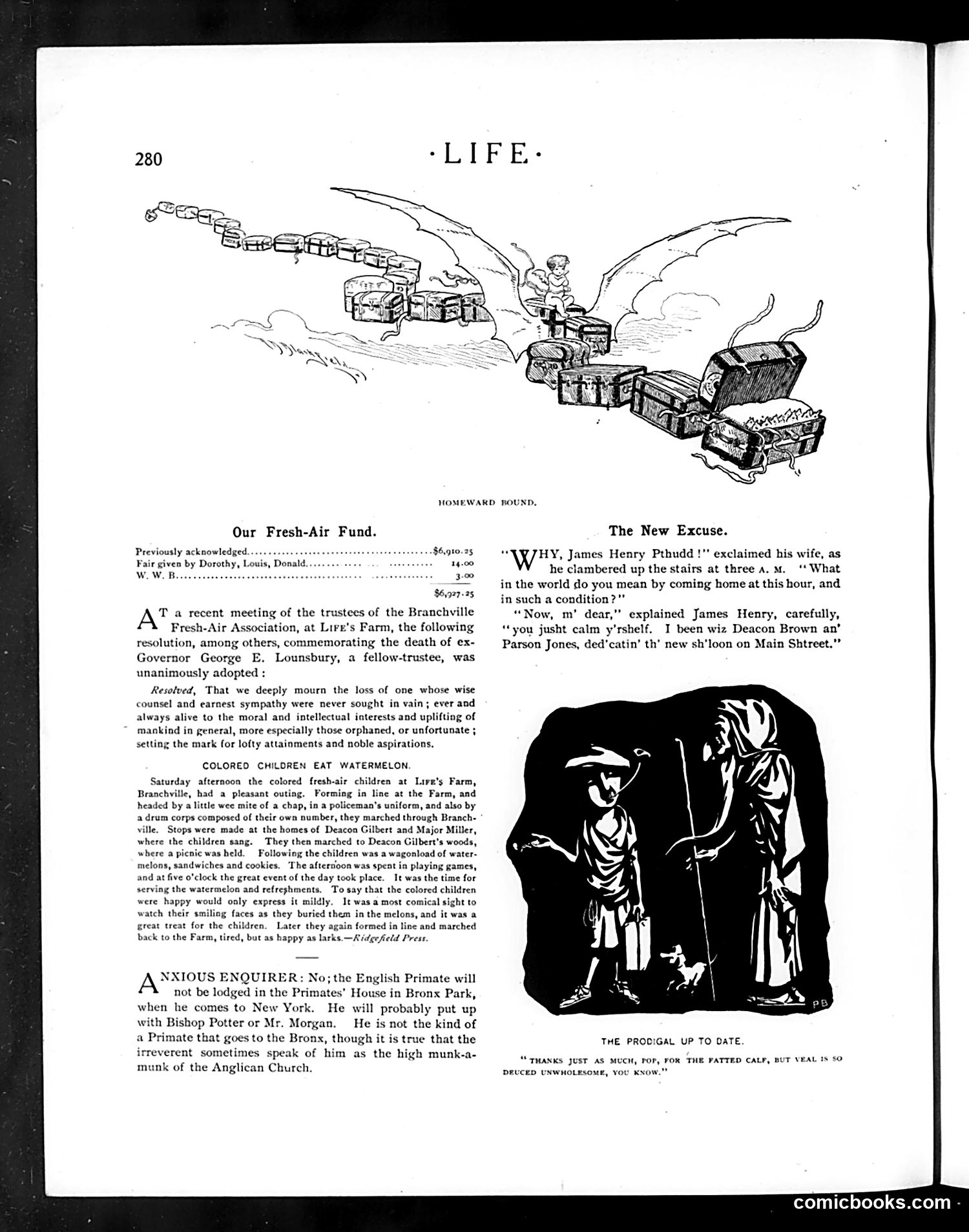
This cartoon illustrates a contemporary take on the Biblical parable of the Prodigal Son. The image shows a woman (the mother) embracing a returning figure, while another woman stands apart—likely representing a wife or romantic interest. The accompanying text "The New Excuse" humorously depicts James Henry Phudd returning home unexpectedly at 3 AM, offering an alibi about visiting Deacon Brewster's new sh*loon on Main Street. His wife questions his disheveled state and late hour. The satire mocks modern domesticity: instead of religious redemption, the "prodigal" seeks forgiveness for dissolute behavior—staying out late at saloons. The joke relies on readers recognizing the absurdity of comparing drinking and carousing to the serious moral failings in scripture, updating ancient morality tales for contemporary urban vices.
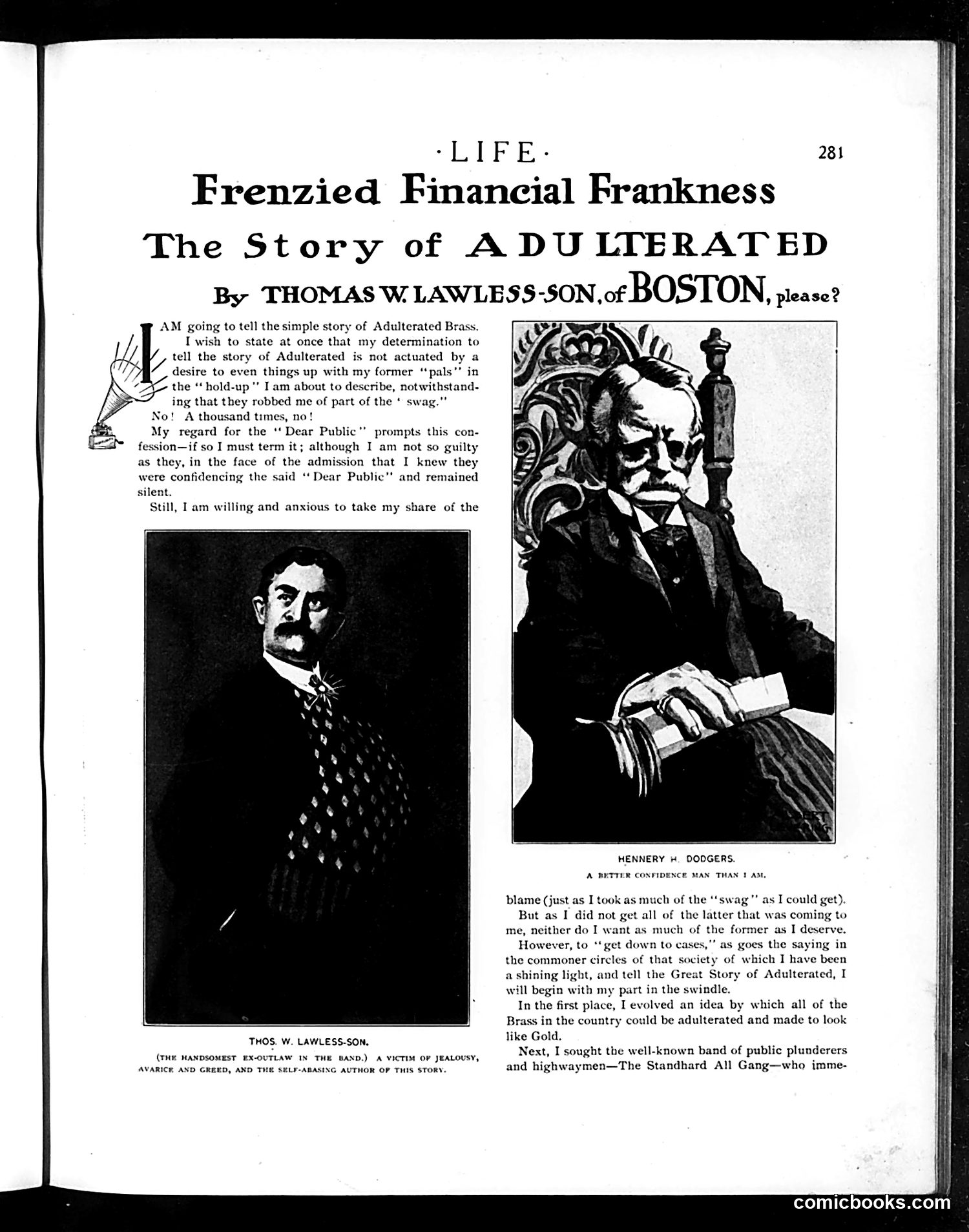
This satirical piece by Thomas W. Lawless-Son of Boston confesses to a brass-adulteration scheme. The two portraits show Lawless himself (left, captioned as "the handsomest ex-outlaw in the band") and Hennery H. Dodgers (right, "a better confidence man than I am"). The satire targets turn-of-the-century financial fraud: Lawless describes evolving a plan to make counterfeit brass look like gold, then recruiting "The Standard All Gang"—a band of public plunderers and highwaymen—to execute the swindle. The piece mocks both the perpetrators' brazen confessions and the "Dear Public" for remaining silent about such schemes, positioning financial crime as entertainment for a morally compromised audience.
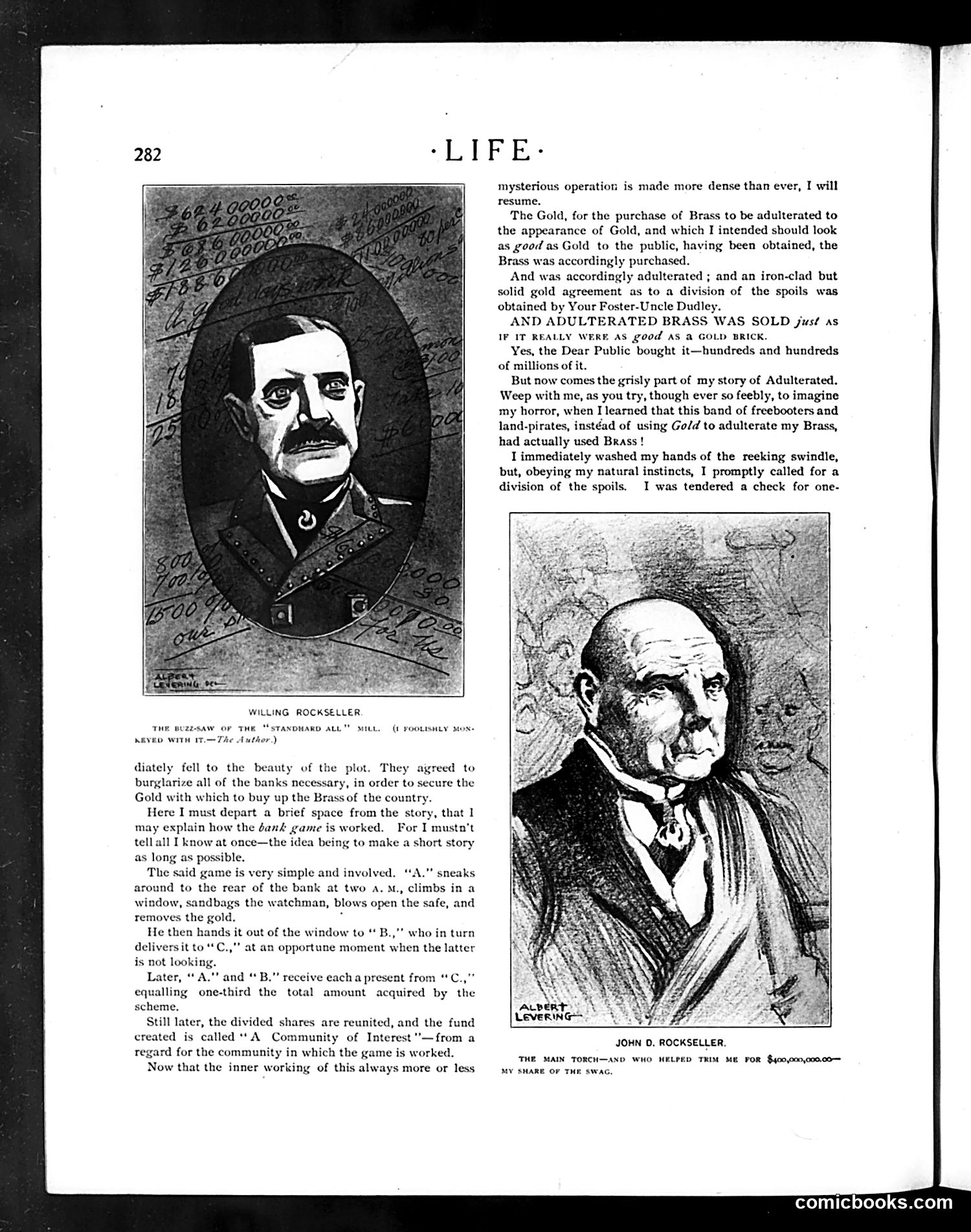
This page satirizes the **Rockefeller family's wealth and business practices**. The two portraits depict "Willing Rockseller" (a caricature of a Rockefeller) and "John D. Rockeseller," identified as someone who "helped trim the fur for $200,000.00" of stolen goods. The accompanying text describes an elaborate scheme involving adulterated brass sold as gold—a metaphor for Rockefeller's Standard Oil monopoly practices. The narrative mocks how the family conducted shady financial dealings and bribery ("Your Foster-Uncle Dudley" facilitated the split). The satire attacks both the Rockefellers' **monopolistic business tactics** and their willingness to substitute inferior products while maintaining appearances of legitimacy—a common Progressive-era criticism of robber barons. The "Community of Interest" mentioned reflects actual corporate consolidation strategies used to disguise monopolistic control.
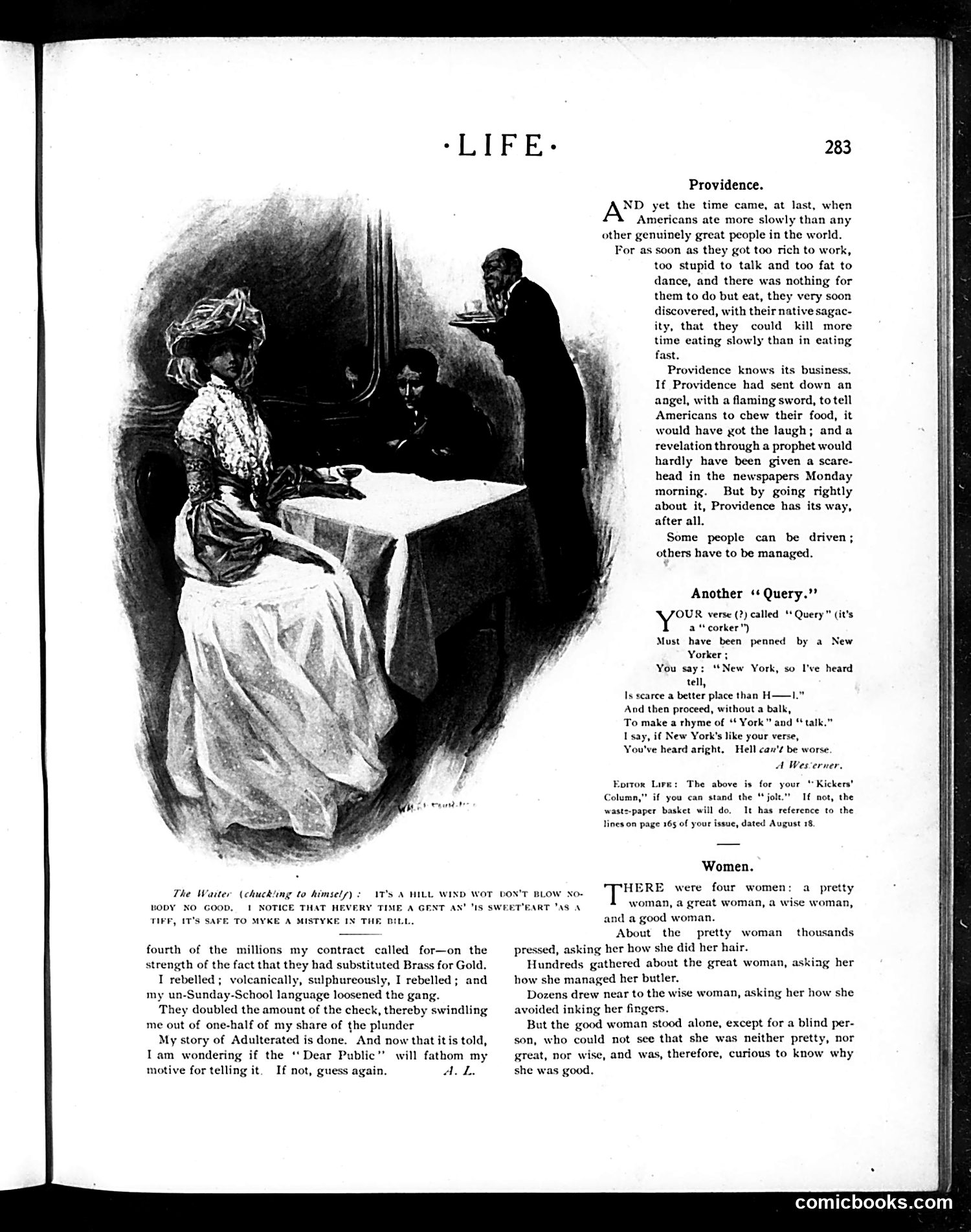
The main illustration depicts a dining scene where a waiter serves an elegantly dressed woman while other diners observe. The accompanying text—titled "Providence"—satirizes American wealth and eating habits. The satire suggests that wealthy Americans, having become "too rich to work" and "too stupid to talk," discovered they could "kill more time eating slowly than in eating fast." The passage mocks how the wealthy use leisurely dining as a status display and time-filler. The caption notes that Providence (divine intervention) works subtly on Americans through their own native nature rather than through dramatic revelation. This is social commentary on American materialism and the idle rich during the Gilded Age or early 20th century.
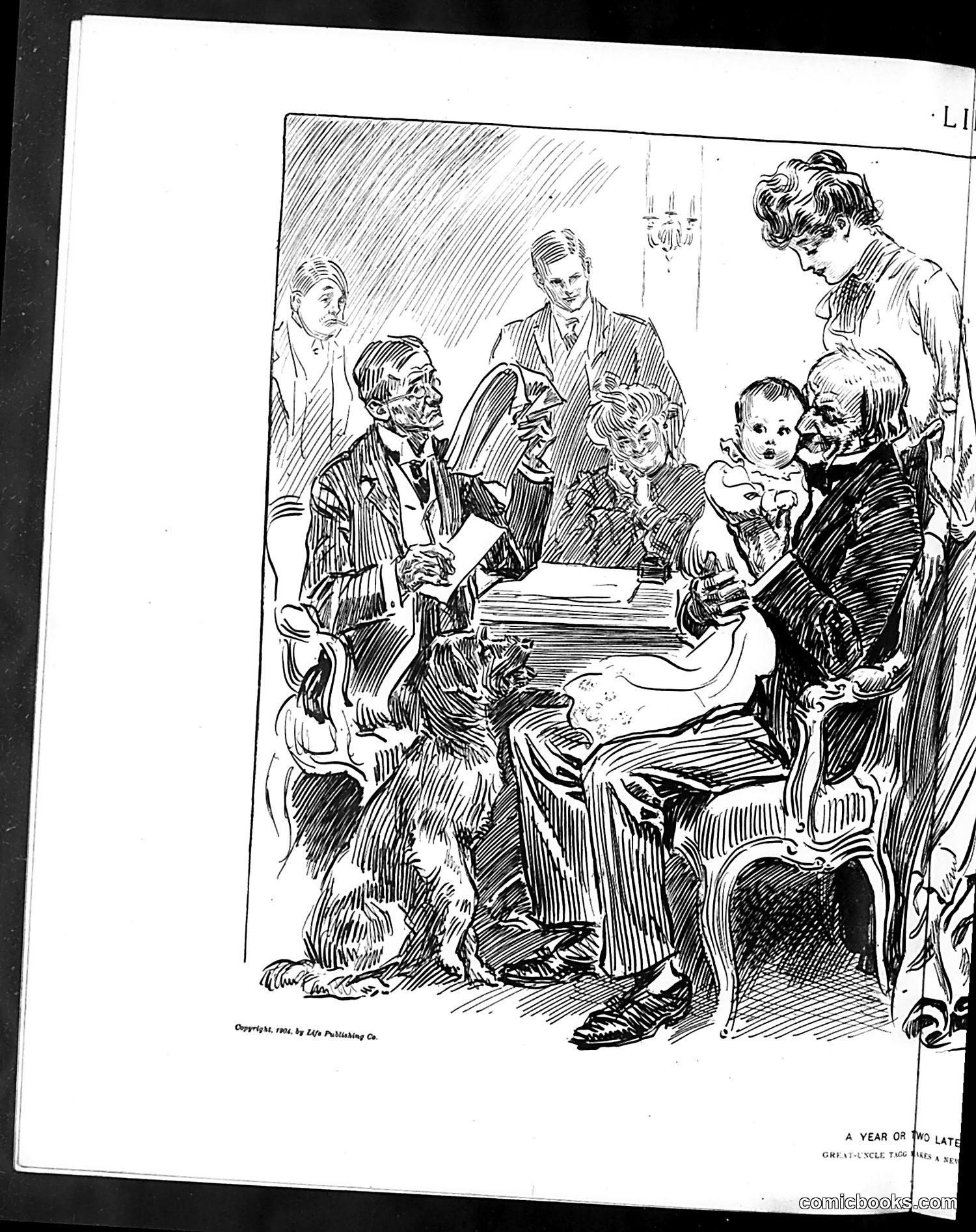
This appears to be a satirical illustration from *Life* magazine (copyright 1904, per the visible credit line). The cartoon depicts what seems to be a formal official or legal proceeding, with well-dressed gentlemen observing a man signing a document at a desk. A woman holds a small child, and a dog is present in the scene. The exact political or social reference is unclear from the visible text alone. However, the formal setting and emphasis on document-signing suggests this satirizes some contemporary legal or governmental matter—possibly related to adoption, custody, marriage, or inheritance proceedings common to early 1900s society. The presence of the child and varied observers implies commentary on family or property matters, though without additional caption text, the specific target of satire cannot be determined with certainty.
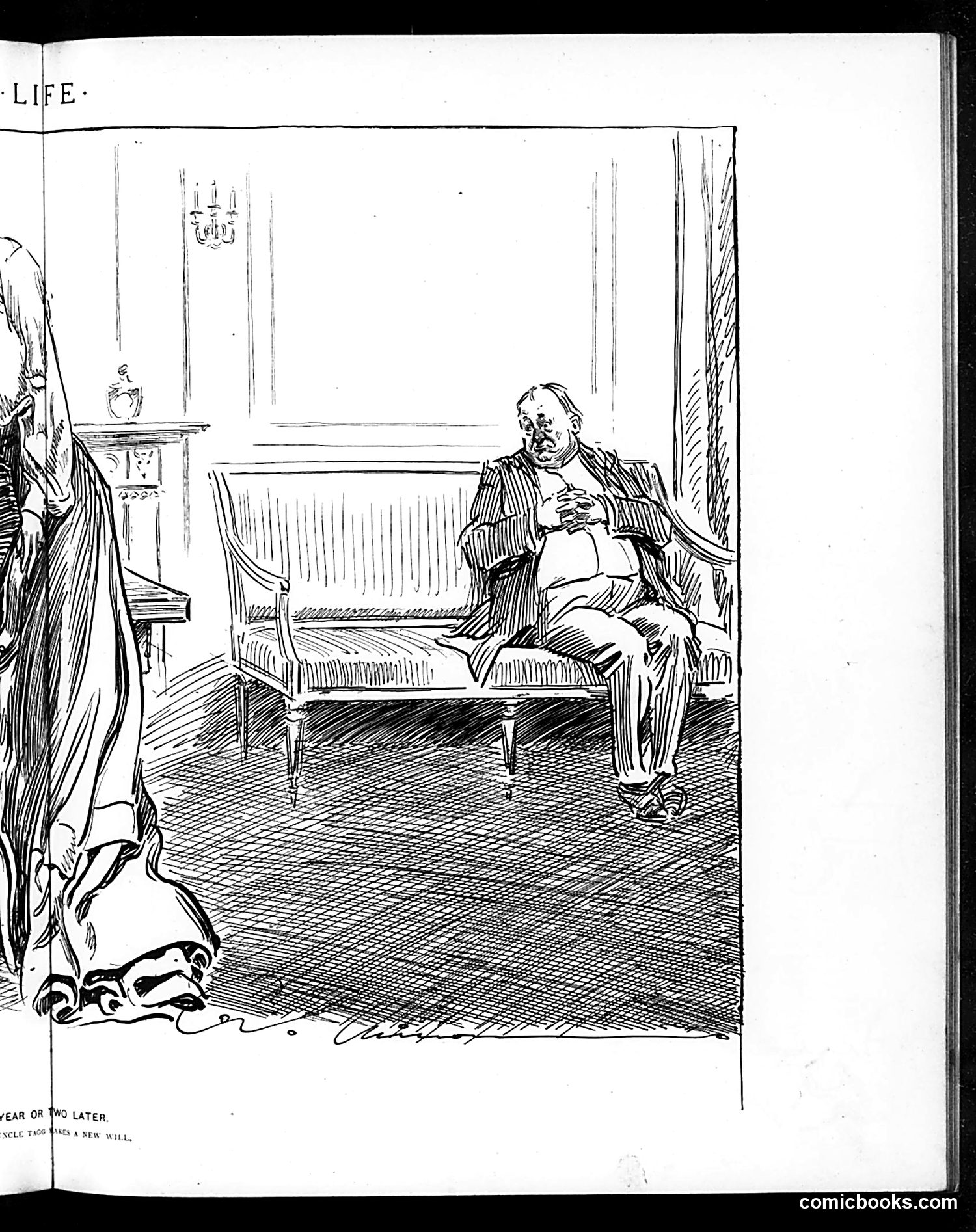
This cartoon depicts a portly, well-dressed gentleman reclining comfortably on a sofa in an elegant interior, with his hand on his chest in a gesture suggesting contentment or self-satisfaction. A woman in fashionable dress stands to the left, appearing to address him. The partial OCR text references "a year or two later" and "makes a new will," suggesting this cartoon satirizes wealthy individuals and inheritance concerns. The cartoon likely mocks the materialism and self-indulgence of the affluent classes—showing a man in obvious comfort while alluding to estate planning and legacy. The satire probably critiques the preoccupations of the wealthy with their possessions and succession arrangements.
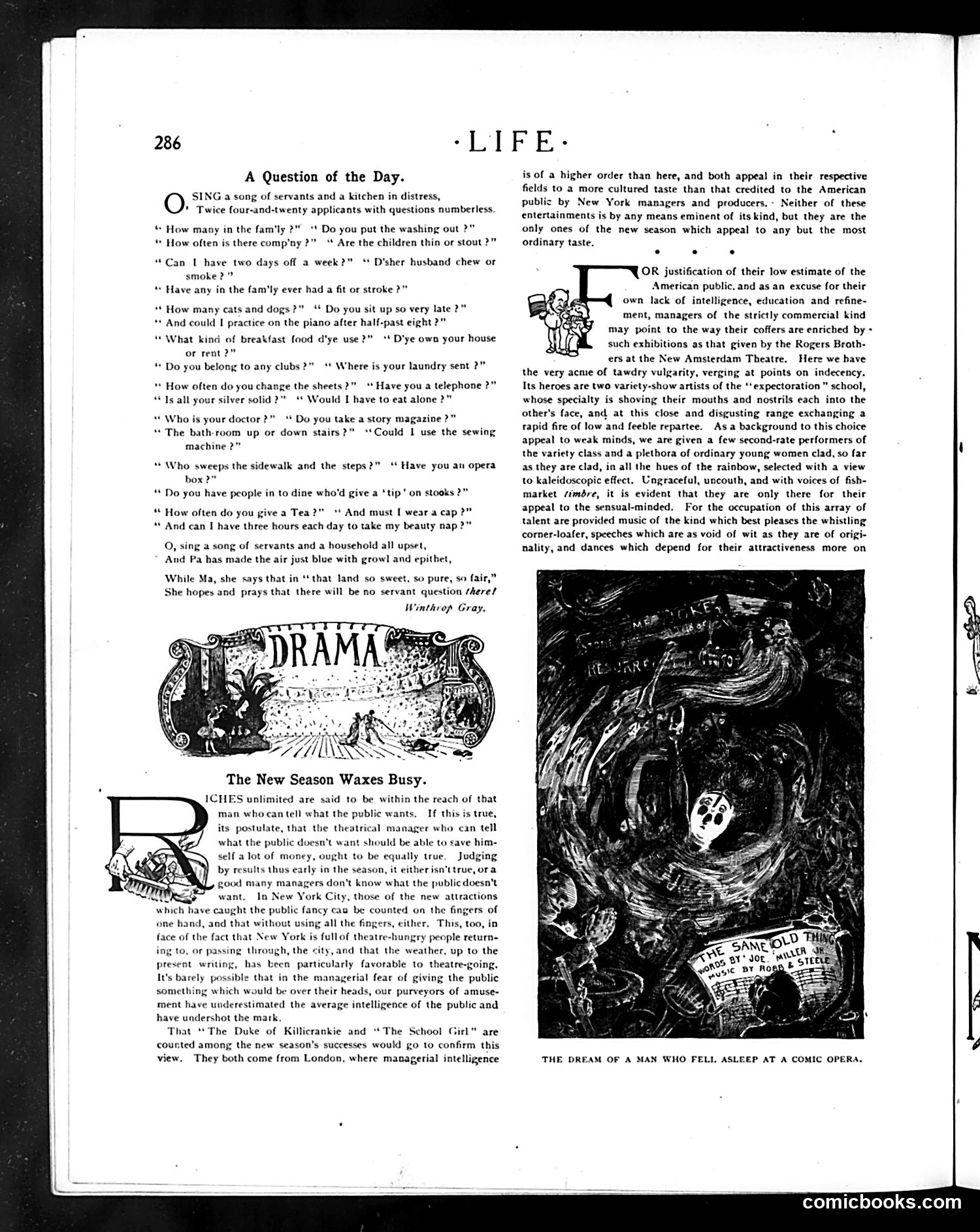
This page contains two distinct sections: **"A Question of the Day"** (left): A humorous poem mocking servants and domestic workers by listing absurd, intrusive questions an employer might ask them—about family size, health, finances, and personal habits. The satire targets the invasive nature of upper-class employers' interrogations of their working-class staff. **"The New Season Waxes Busy"** (right): A drama critique discussing London theatrical imports to New York. The text criticizes managers' assumptions about American public taste, suggesting they underestimate audiences' intelligence. It mentions two specific shows—"The Duke of Killarnankie" and "The School Girl"—as examples of London's "managerial intelligence" being exported. **The illustration** (bottom right) shows "The Dream of a Man Who Fell Asleep at a Comic Opera"—a surreal scene satirizing theatrical absurdity.
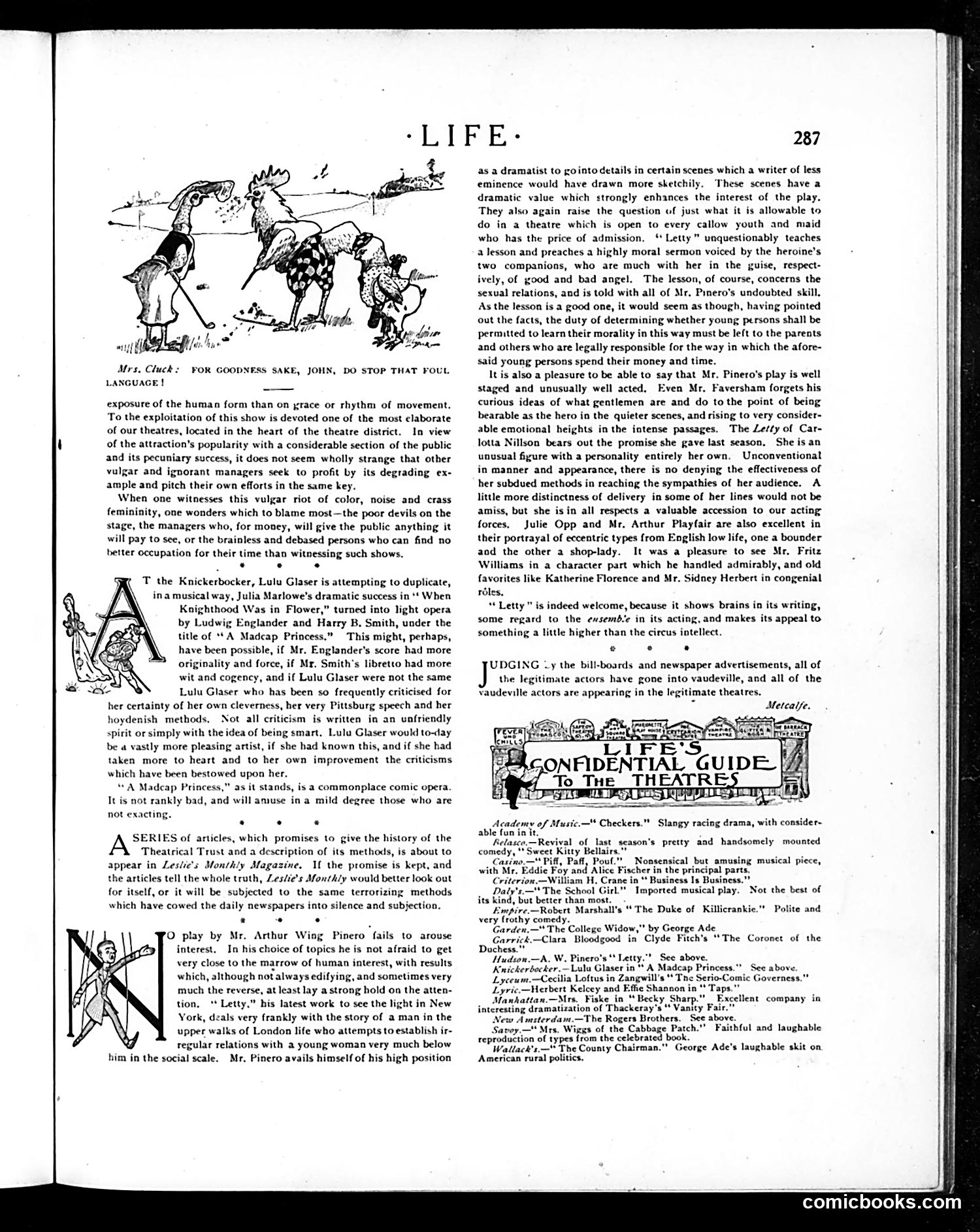
The top cartoon depicts a domestic scene where a woman ("Mrs. Cluck") scolds a man ("John") for using "foul language," establishing a commentary on propriety and gender roles in early 20th-century domestic life. The page's main content critiques theatrical productions and moral standards. It attacks "vulgar" stage shows featuring excessive female exposure and "crass femininity," blaming managers who profit from such spectacles and audiences who patronize them. The text questions what entertainment should be permitted in theaters accessible to "every callow youth and maid." The reviews discuss specific productions: Lulu Glaser's musical adaptation, criticized as derivative and for Glaser's own theatrical arrogance; and Arthur Wing Pinero's play "Letty," which frankly depicts illicit relationships across class lines. The critic debates whether theaters should permit such morally complex content, especially regarding sexuality and social transgression—a central anxiety of the era regarding public decency and youth corruption.
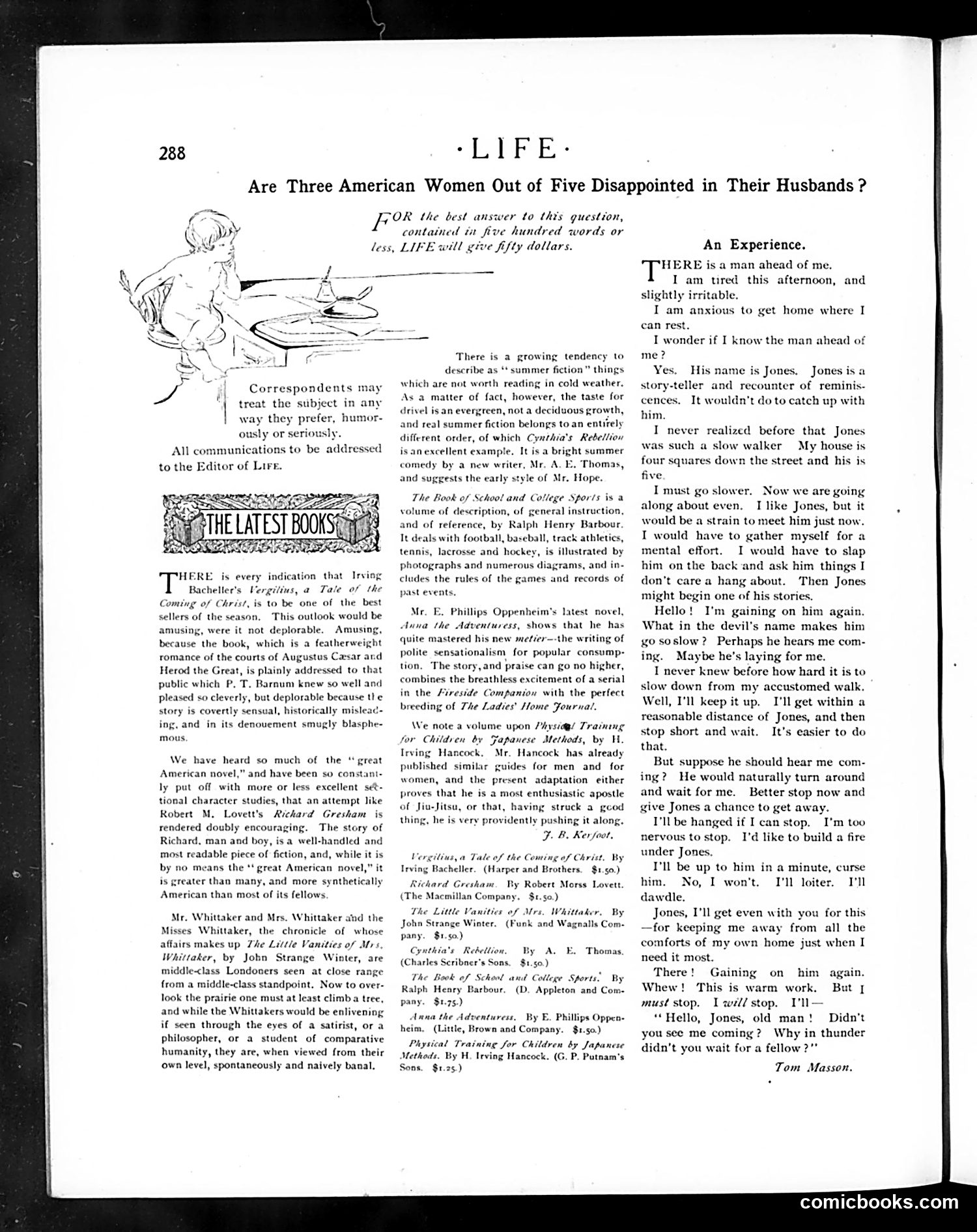
This page contains a satirical book review column and a contest announcement. The cartoon depicts a woman observing a slow-walking man ahead of her—illustrating the accompanying short story "An Experience" about marital frustration. **The Contest:** Life poses a tongue-in-cheek question: "Are Three American Women Out of Five Disappointed in Their Husbands?" This reflects early 20th-century anxieties about marriage and gender relations. **The Book Reviews:** The critic skewers contemporary popular fiction as "summer drivel," mocking Irving Bacheller's *Vergilius* as shallow sensationalism dressed in religious clothing. By contrast, Robert Lovett's *Richard Gresham* receives qualified praise as genuinely American literature. The reviews exemplify Life's self-appointed role as arbiter of taste, dismissing mass-market fiction while championing serious literature—a common stance for educated satirical magazines of the era. The overall tone is mordantly witty about both marriage and literary standards.
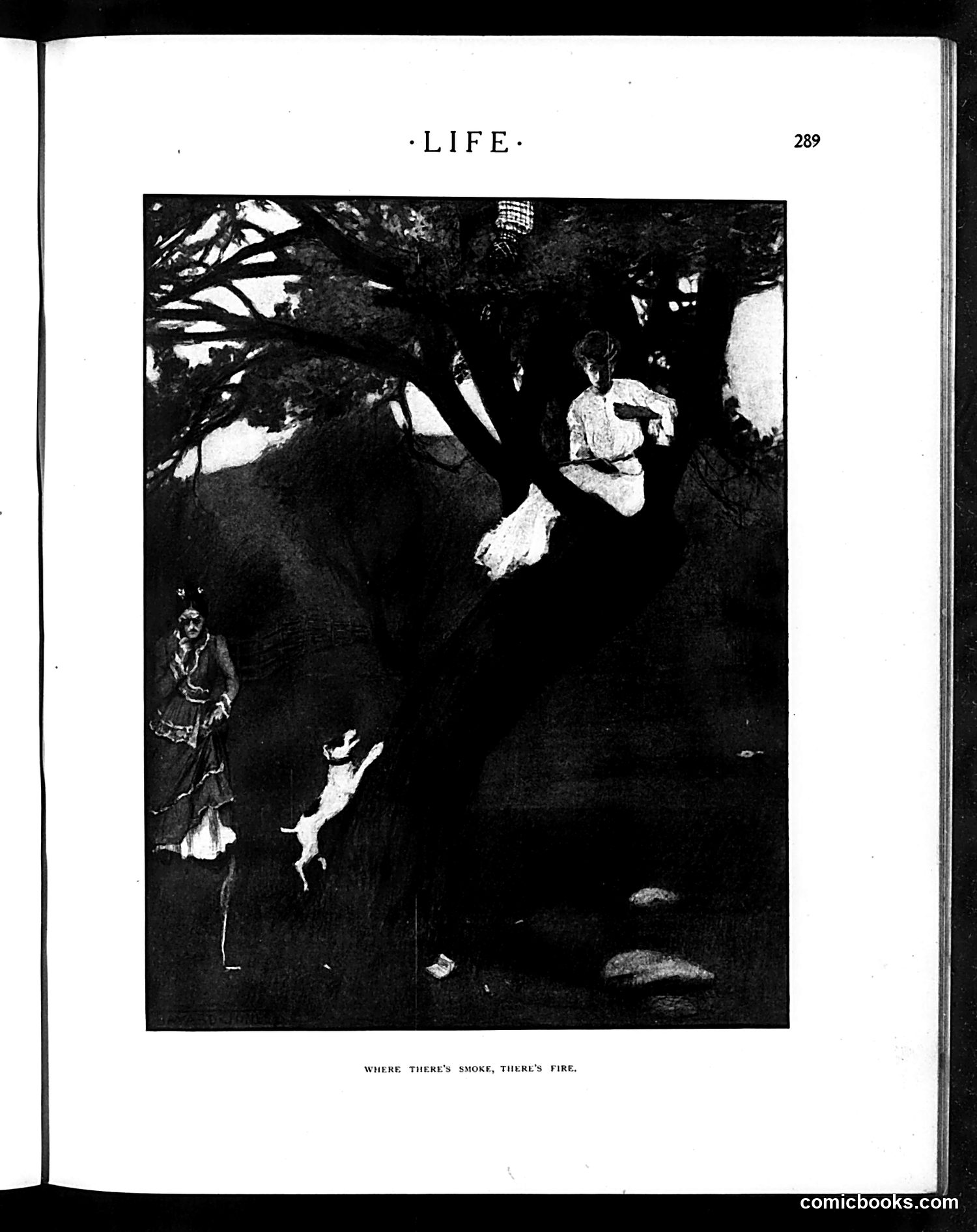
This is a dramatic black-and-white illustration from *Life* magazine showing figures in dark clothing beneath trees. The caption "Where there's smoke, there's fire" is a common proverb suggesting that rumors or suspicions usually have some basis in truth. The image appears to be satirical commentary, likely about scandal or wrongdoing being exposed. However, without additional context—such as the publication date or identifying captions for the figures—I cannot definitively identify which specific political or social figures are depicted or what particular scandal this references. The artistic style and dark, shadowy composition suggest a serious, accusatory tone rather than lighthearted humor, indicating the cartoon addresses a significant controversy of its era.
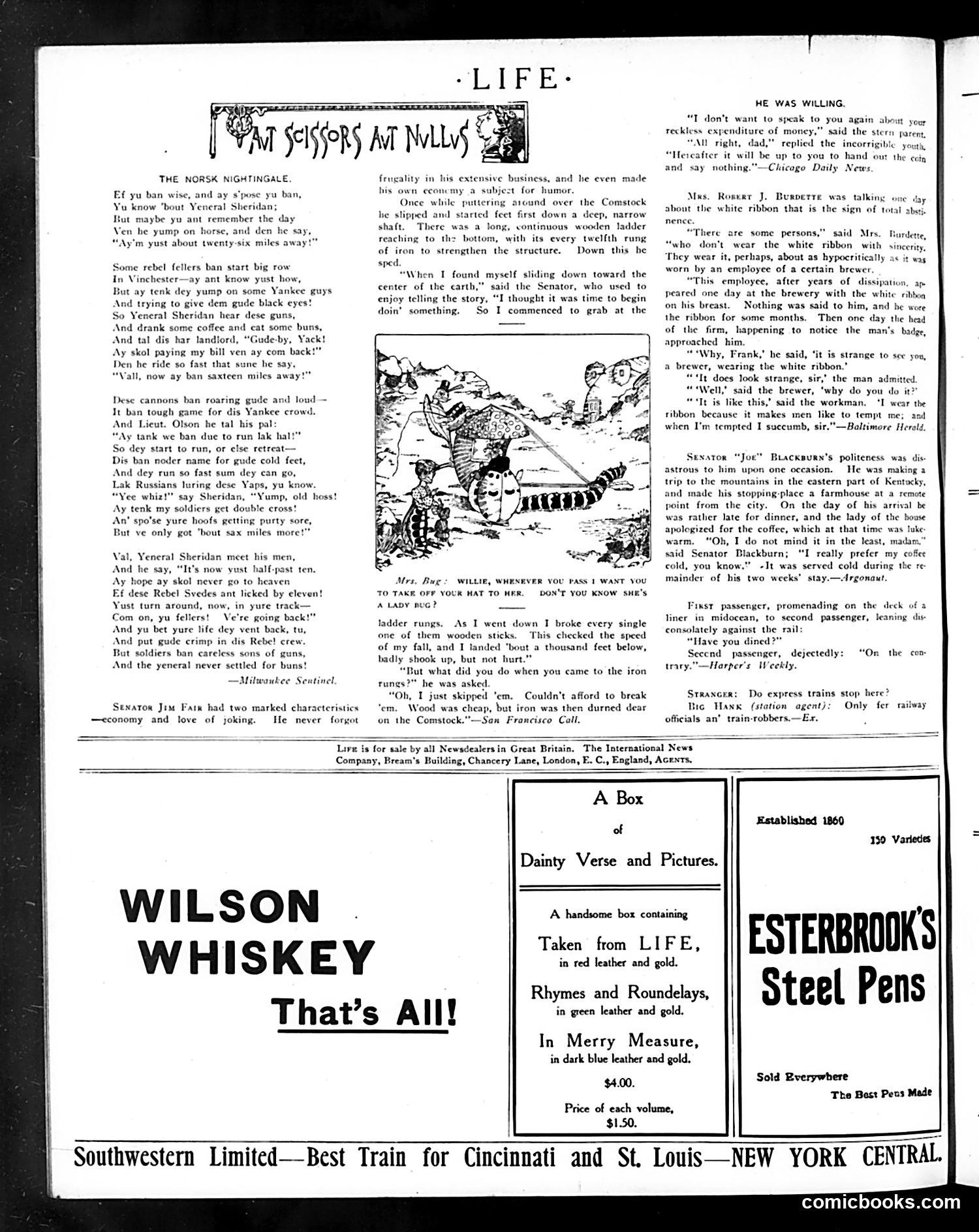
This poem, written in exaggerated Scandinavian-immigrant dialect, celebrates General Philip Sheridan's famous 1864 ride during the American Civil War. The poem references Sheridan's rapid cavalry charge to Winchester, Virginia, which turned a Union retreat into victory. The satire works through ethnic humor: the narrator speaks in heavily stereotyped Norwegian-American dialect ("Yeneral," "ban," "yump"), which was popular comedic fodder in 19th-century American publications. The joke isn't primarily political—it's about the *contrast* between the dignified historical event and its rendering through this comedic voice. The accompanying illustrations and side-stories (about Senator Jim Fair, a young man's defiance, etc.) are typical Life magazine fare: brief anecdotes mixing humor with mild social commentary. The page is otherwise dominated by period advertisements (Wilson Whiskey, Esterbrook's Steel Pens) and a box promoting Life's own merchandise.
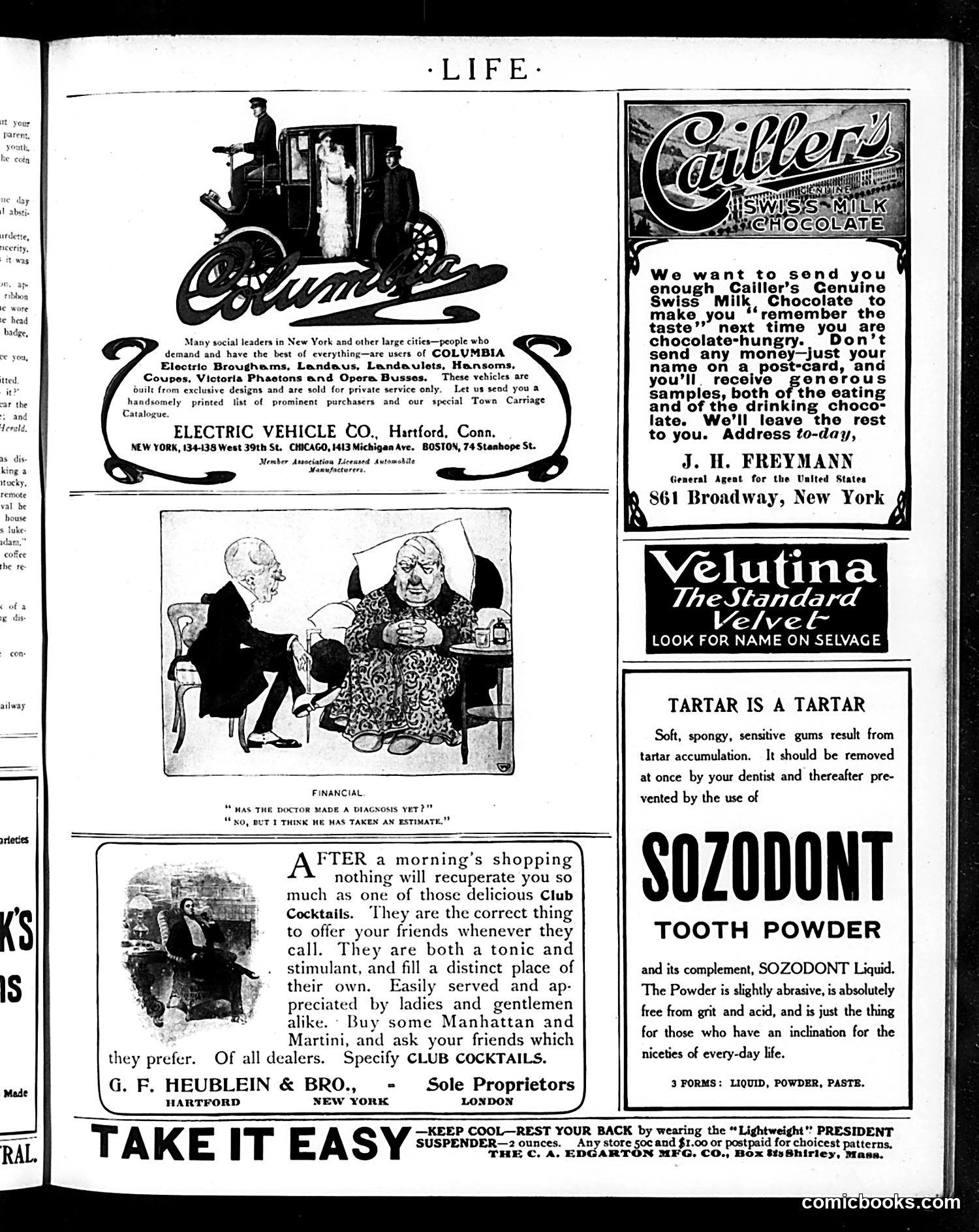
This page is primarily **advertising** with one small cartoon. The main cartoon (labeled "FINANCIAL") depicts two men: an older gentleman consulting a younger man who appears to be a doctor or professional. The caption reads: "HAS THE DOCTOR MADE A DIAGNOSIS YET?" / "NO, BUT I THINK HE HAS TAKEN AN ESTIMATE." **The joke:** This satirizes how expensive professional services (particularly medical care) had become—the humor suggests the doctor's fee-estimate is as important (or more important) than his actual diagnosis. It's a jab at the rising costs of professional expertise in the early 1900s. The rest of the page contains period advertisements for electric vehicles, Swiss chocolate, cocktails, tooth powder, and suspenders—typical consumer goods marketed to affluent readers. These ads reveal the lifestyle aspirations and commercial concerns of the era's middle and upper classes.
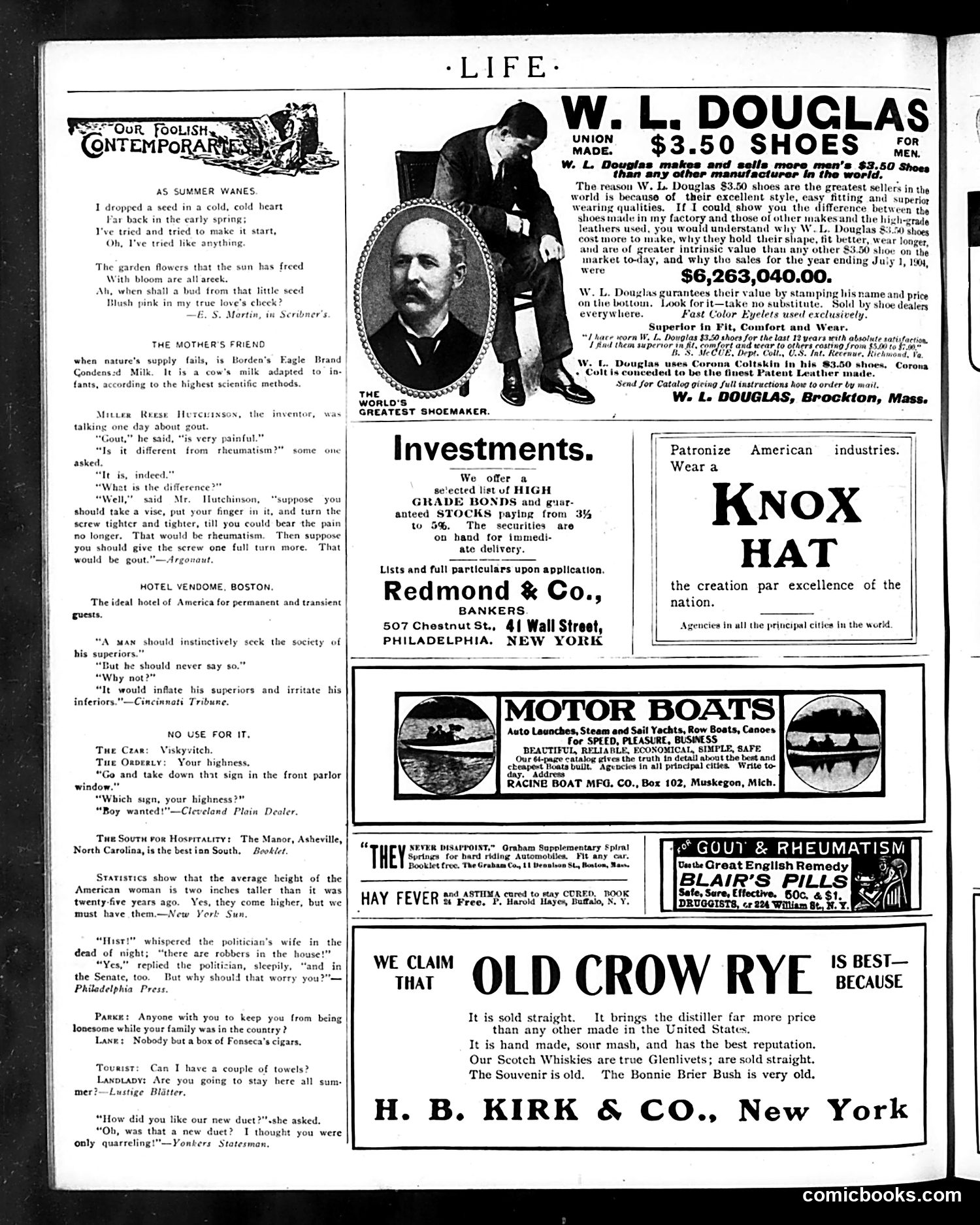
This page is **primarily advertisements** with brief satirical humor pieces scattered throughout. The main content includes: **Humor pieces** (top-left): Short jokes and witticisms typical of *Life* magazine's format—brief observations on courtship, social hierarchy, and absurdist scenarios. One joke contrasts gout versus rheumatism as levels of pain; another mocks a politician who shouldn't admit seeking "superior" company. **W.L. Douglas Shoes** (center-right): A large advertisement featuring the shoe manufacturer's prominent claim to dominance in the market, emphasizing quality and value at $3.50—a significant price point at the time. **Supporting ads** include Borden's condensed milk, Knox Hat, Redmond & Co. investments, motor boats, patent medicines (Blair's Pills for gout/rheumatism), and Old Crow Rye whiskey. The page reflects early 1900s publication style: humor interspersed with extensive advertising, addressing contemporary consumer goods and social attitudes of the era. No political cartoons or caricatures appear on this particular page.
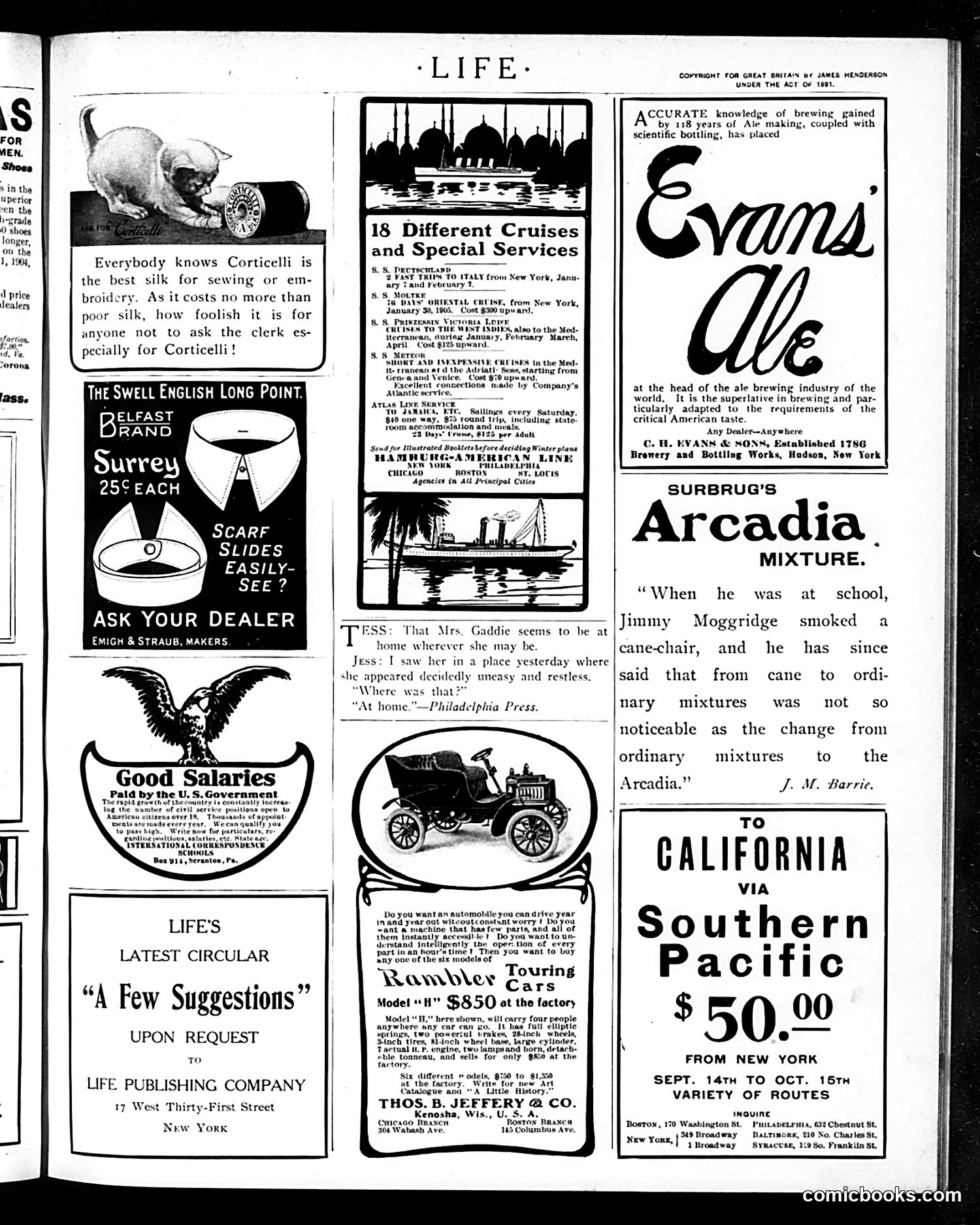
This page is primarily **advertising**, typical of early 1900s Life magazine. Rather than political satire, it contains commercial notices for consumer goods and services. The advertisements include: - **Corticelli silk** for sewing (emphasizing value) - **Belfast Brand scarves** (25¢ each) - **U.S. Government employment** promoting "Good Salaries" - **Hamburg-American cruise lines** offering luxury ocean voyages to Italy and the Mediterranean - **Rambler automobiles** (touted as reliable, understandable machines) - **Evans ale** brewery (established 1786) - **Surbrug's Arcadia tobacco mixture** (endorsed by author J.M. Barrie) - **Southern Pacific Railway** to California ($50 from New York) - **Life Publishing Company's circular** offering suggestions There is one brief joke: a wife appearing "uneasy and restless" when "at home"—suggesting marital discord. The page reflects affluent early-1900s American consumer culture: leisure travel, automobiles, imported goods, and tobacco products.
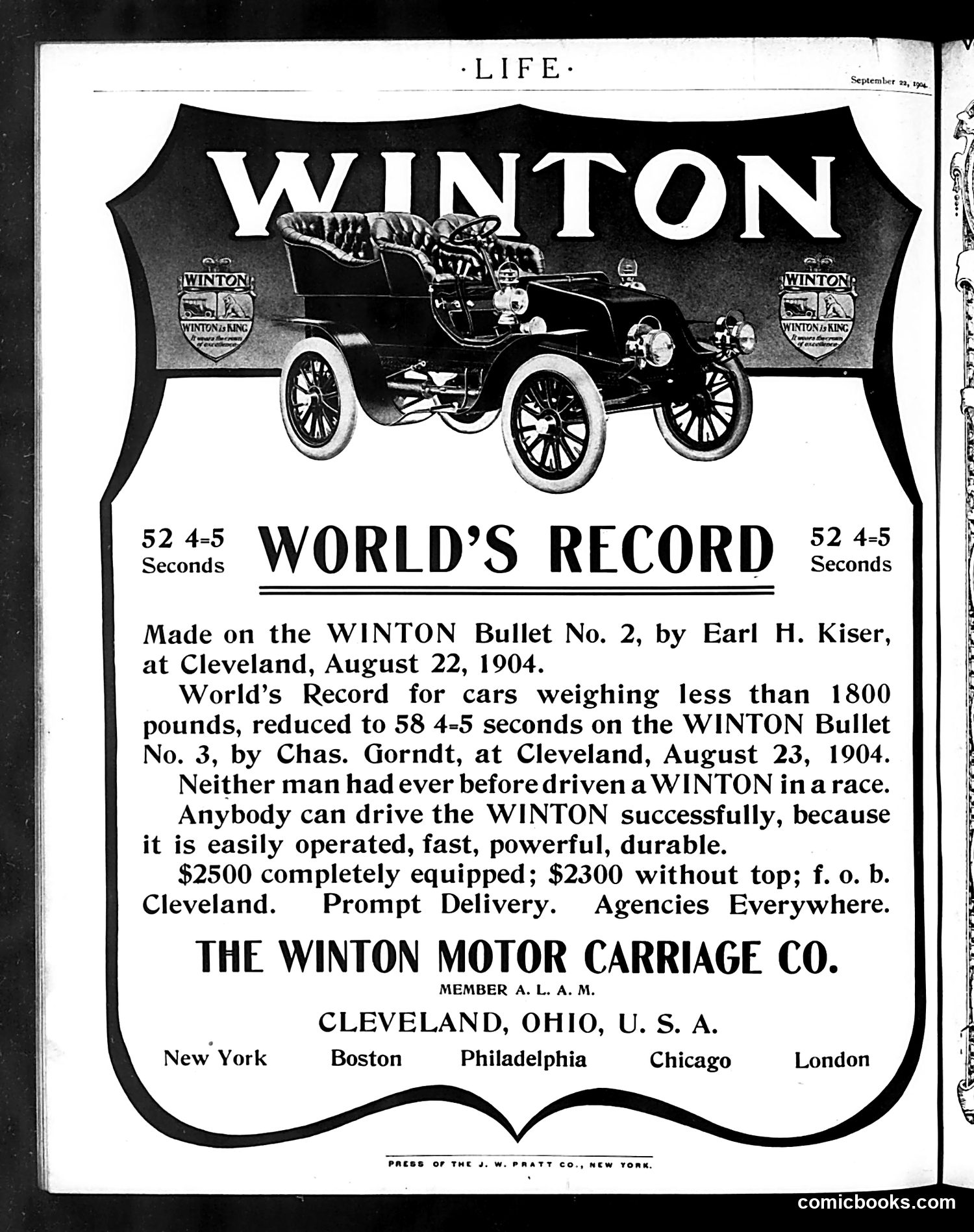
This is not a cartoon or satire, but a straightforward **automobile advertisement** from *Life* magazine (September 29, 1904). The Winton Motor Carriage Company advertises their "Bullet" racing cars by highlighting recent speed records set in Cleveland. Two drivers—Earl H. Kiser and Chas. Gorndt—achieved world records for lightweight vehicles (under 1800 pounds) in consecutive days, with Gorndt's time of 58 4-5 seconds notably beating Kiser's earlier record. The advertisement's key selling point: neither driver had previous racing experience with Wintons, yet both succeeded. This suggests the vehicle is user-friendly and reliable—"anybody can drive the WINTON successfully." The ad emphasizes ease of operation, speed, power, and durability while listing prices ($2500-$2300) and distribution networks across major American cities plus London, positioning Winton as a premium American automotive manufacturer.