
Life, 1904-09-22 · page 12 of 20
Life — September 22, 1904 — page 12: what you’re looking at
What you’re looking at
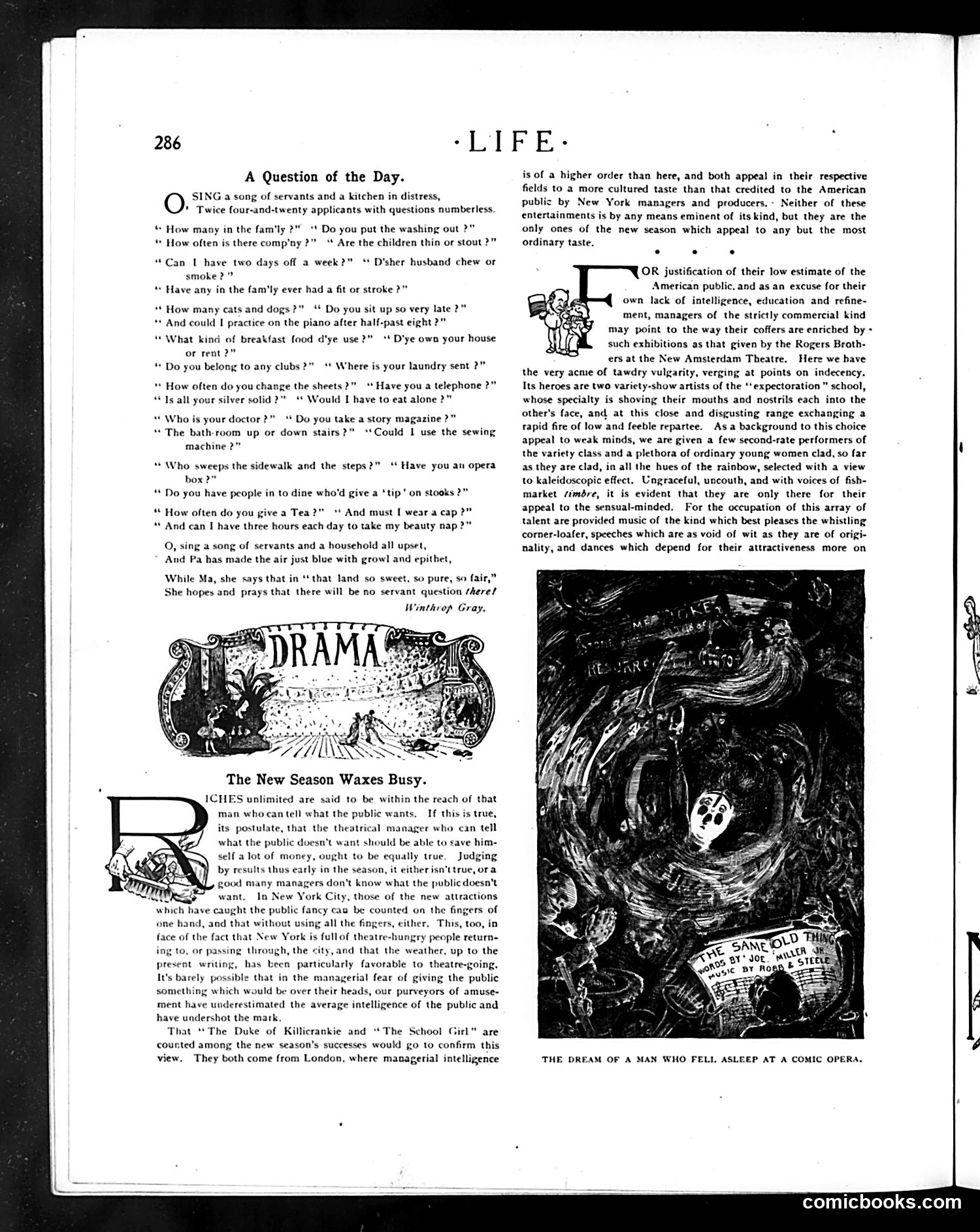
This page contains two distinct sections: **"A Question of the Day"** (left): A humorous poem mocking servants and domestic workers by listing absurd, intrusive questions an employer might ask them—about family size, health, finances, and personal habits. The satire targets the invasive nature of upper-class employers' interrogations of their working-class staff. **"The New Season Waxes Busy"** (right): A drama critique discussing London theatrical imports to New York. The text criticizes managers' assumptions about American public taste, suggesting they underestimate audiences' intelligence. It mentions two specific shows—"The Duke of Killarnankie" and "The School Girl"—as examples of London's "managerial intelligence" being exported. **The illustration** (bottom right) shows "The Dream of a Man Who Fell Asleep at a Comic Opera"—a surreal scene satirizing theatrical absurdity.
📄 Transcribed text from this page (OCR, searchable)
Machine-transcribed from the original scan — historical spelling and the odd misread are preserved.
-LIFE- A Question of the Day. SING a song of servants and a kitchen in distress, Twice four-and-twenty applicants with questions numberless. “ How many in the fam'ly 2" ** Do you put the washing out >" “ How often is there comp'ny 2” “* Are the children thin or stout ?” “Can I have two days off a week?" ‘ D'sher husband chew or smoke?” * Have any in the fam'ly ever had a fit or stroke ?” ** How many cats and dogs?" “ Do you sit up so very late 2” * And could I practice on the piano after half-past eight 2" “What kind of breakfast food d'ye use?” or rent?” * Do you belong to any clubs ?” “Dye own your house “* Where is your laundry sent ?” ** How often do you change the sheets?" * Have you a telephone ?” “Is all your silver solid?‘ Would I have to eat alone ?” “ Who is your doctor ?” “The bath-room up or down stairs?” machine ?” “* Do you take a story magazine ?” **Could 1 use the sewing Who sweeps the sidewalk and the steps?” box?" Do you have people in to dine who'd give a ‘tip’ on stooks 2” “ Have you au opera How often do you give a Tea?" * And must [ wear a cap ?” “And can I have three hours each day to take my beauty nap?” O, sing a song of servants and a household all upset, And Pa has made the air just blue with growl and epithet, While Ma, she says that in “that land so sweet, so pure, so fair,” She hopes and prays that there will be no servant question there? Winthrop Gray. The New Season Waxes Busy. ICHES unlimited are said to be within the reach of that man whocan tell what the public wants, If this is true, its postulate, that the theatrical manager who can tell what the public doesn’t want should be able to save him- self a lot of money, ought to be equally true. Judging by results thus early in the season, it either isn'ttrue, ora good many managers don't know what the publicdoesn't want, In New York City, those of the new attractions which have caught the public fancy caw be counted on the fingers of one hand, and that without using all the fingers, either, This, too, in face of the fact that New York is full of theatre-hungry people return- ing to, or passing through, the city, and that the weather, up to the ech particularly favorable to theatre-going. It's barely possible that in the managerial fear of giving the public something which would be over their heads, our purveyors of amuse- ment have underestimated the average intelligence of the public and have undershot the mark, That “The Duke of Killicrankie and “The School Girl” are coucted among the new season's successes would go to confirm this view. They both come from London, where managerial intelligence present writing, has is of a higher order than here, and both appeal in their respective fields to a more cultured taste than that credited to the American public by New York managers and producers.» Neither of these entertainments is by any means eminent of itskind, but they are the only ones of the new season which appeal to any but the most ordinary taste. . . . OR justification of their low estimate of the American public, and as an excuse for their own lack of intelligence, education and refine- ment, managers of the strictly commercial kind may point to the way their coffers are enriched by + such exhibitions as that given by the Rogers Broth- ers at the New Amsterdam Theatre. Here we have the very acme of tawdry vulgarity, verging at points on indecency. Its heroes are two variety-show artists of the ‘expectoration " school, whose specialty is shoving their mouths and nostrils each into the other's face, and at this close and disgusting range exchanging a rapid fire of low and feeble repartee. As a background to this choice appeal to weak minds, we are given a few second-rate performers of the variety class and a plethora of ordinary young women clad, so far as they are clad, in all the hues of the rainbow, selected with a view to kaleidoscopic effect. Ungraceful, uncouth, and with voices of fish- market simbre, it is evident that they are only there for their appeal to the sensual-minded. For the occupation of this array of talent are provided music of the kind which best pleases the whistling: corner-loafer, speeches which are as void of wit as they are of origi- nality, and dances which depend for their attractiveness more on THE DREAM OF A MAN WHO FELI. ASLEEP AT A COMIC OPERA, comicbooks.com