
Life, 1904-09-22 · page 4 of 20
Life — September 22, 1904 — page 4: what you’re looking at
What you’re looking at
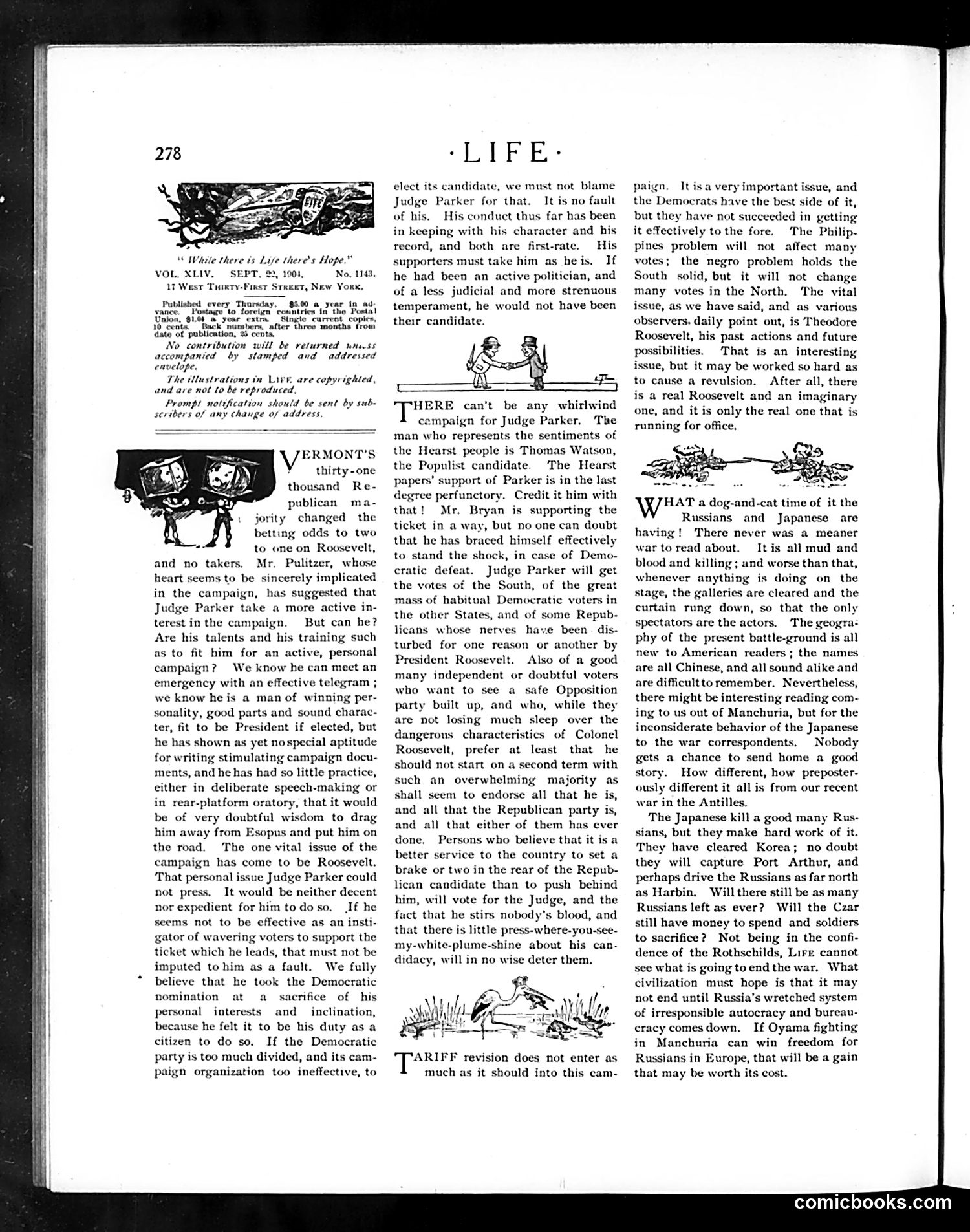
The page discusses the 1904 presidential campaign, focusing on Judge Alton B. Parker (Democratic nominee) versus Theodore Roosevelt (Republican incumbent). The text criticizes Parker as lacking the vigor needed for an active campaign, noting Roosevelt's superior political energy and record. It argues Parker represents "the Hearst people" and Thomas Watson's Populist faction. The cartoon imagery (though small) appears to satirize campaign dynamics of this election. The article emphasizes Roosevelt's personal dynamism as an asset, while suggesting Parker's judicial temperament—though respectable—makes him an uninspiring candidate who cannot generate genuine enthusiasm among voters. The piece ultimately argues Roosevelt's demonstrated leadership transcends typical partisan concerns.
📄 Transcribed text from this page (OCR, searchable)
Machine-transcribed from the original scan — historical spelling and the odd misread are preserved.
VOL. XLV 17 West 1904, No. 1143. st Sree, New Yorn, Published every Thursday. $3.00 a year in ad t ‘o forein ‘countries ta the Postal Single current. copies, dato of publication, 2 No contribution will be returned unwss accompanied by stamped and addressed envelope. The illustrations in Live. are copyrighted, and are not to be reproduced. Prompt notification should be sent by sub- scribers of any change of address. ERMONT'S thirty-one thousand Re- publican ma- jority changed the betting odds to two to one on Roosevelt, and no takers. Mr. Pulitzer, whose heart seems to be sincerely implicated in the campaign, has suggested that Judge Parker take a more active in- terest in the campaign. But can he? Are his talents and his training such as to fit him for an active, personal campaign? We know he can meet an emergency with an effective telegram ; we know he is a man of winning per- sonality, good parts and sound charac- ter, fit to be President if elected, but he has shown as yet nospecial aptitude for writing stimulating campaign docu- ments, and he has had so little practice, either in deliberate speech-making or in rear-platform oratory, that it would be of very doubtful wisdom to drag him away from Esopus and put him on the road, The one vital issue of the campaign has come to be Roosevelt. ‘That personal issue Judge Parker could not press. It would be neither decent nor expedient for him todo so. If he seems not to be effective as an insti- gator of wavering voters to support the ticket which he leads, that must not be imputed to him as a fault. We fully believe that he took the Democratic nomination at a_ sacrifice of his personal interests and inclination, ause he felt it to be his duty as a citizen to do so. If the Democratic party is too much divided, and its cam- paign organization too ineffective, to ‘LIFE- elect its candidate, we must not blame Judge ‘ker for that. It is no fault of his. His conduct thus far has been in keeping with his character and his record, and both are first-rate. His supporters must take him ashe is. he had been an active politician, and of a less judicial and more strenuous temperament, he would not have been their candidate. HERE can’t be any whirlwind cempaign for Judge Parker. The man who represents the sentiments of the Hearst people is Thomas Watson, the Populist candidate. The Hearst papers’ support of Parker is in the last degree perfunctory. Credit it him with that! Mr. Bryan is supporting the ticket in a way, but no one can doubt that he has braced himself effectively to stand the shock, in case of Demo- cratic defeat. Judge Parker will get the votes of the South, of the great mass of habitual Democratic voters in the other States, and of some Repub- licans whose nerves have been. dis- turbed for one reason or another by President Roosevelt. Also of a good many independent or doubtful voters who want to see a safe Opposition party built up, and who, while they are not losing much sleep over the dangerous characteristics of Colonel Roosevelt, prefer at least that he should not start on a second term with such an overwhelming majority as shall seem to endorse all that he is, and all that the Republican party and all that either of them has ever done. Persons who believe that it is a better service to the country to set a brake or two in the rear of the Repub- lican candidate than to push behind him, will vote for the Judge, and the fact that he stirs nobody's blood, and that there is little press-where-you-see- my-white-plume-shine about his can. didacy, will in no wise deter them. ARIFF revision does not enter as much as it should into this cam- It isa very important issue, and : Democrats have the best side of it, but they have not succeeded in getting it efectively tothe fore. The Philip. pines problem will not affect many votes; the negro problem holds the South solid, but it will not change many votes in the North. The vital issue, as we have said, and as various observers. daily point out, is Theodore Roosevelt, his past actions and future possibilities. That is an interesting issue, but it may be worked so hard as to cause a revulsion. After all, there is a real Roosevelt and an imaginary one, and it is only the real one that is running for office. ei £25 HAT a dog-and-cat time of it the Russians and Japanese are having! There never was a meaner war to read about. It is all mud and blood and killing ; and worse than that, whenever anything is doing on the stage, the galleries are cleared and the curtain rung down, so that the only spectators are the actors. The geogra- phy of the present battle-ground is all new to American readers ; the names are all Chinese, and all sound alike and are difficultto remember. Nevertheless, there might be interesting reading com- ing to us out of Manchuria, but for the inconsiderate behavior of the Japanese to the war correspondents, | Nobody gets a chance to send home a good story. How different, how preposter- ously different it all is from our recent war in the Antilles, The Japanese kill a good many Rus- sians, but they make hard work of it. They have cleared Korea; no doubt they will capture Port Arthur, and perhaps drive the Russians as far north as Harbin, Will there still be as many Russians left as ever? Will the Czar still have money to spend and soldiers to sacrifice? Not being in the confi- dence of the Rothschilds, Lire cannot see what is going toend the war. What civilization must hope is that it may not end until Russia’s wretched system of irresponsible autocracy and bureau- cracy comes down. If Oyama fighting in Manchuria can win freedom for Russians in Europe, that will be a gain that may be worth its cost. comicbooks.com