
Life, 1904-09-22 · page 13 of 20
Life — September 22, 1904 — page 13: what you’re looking at
What you’re looking at
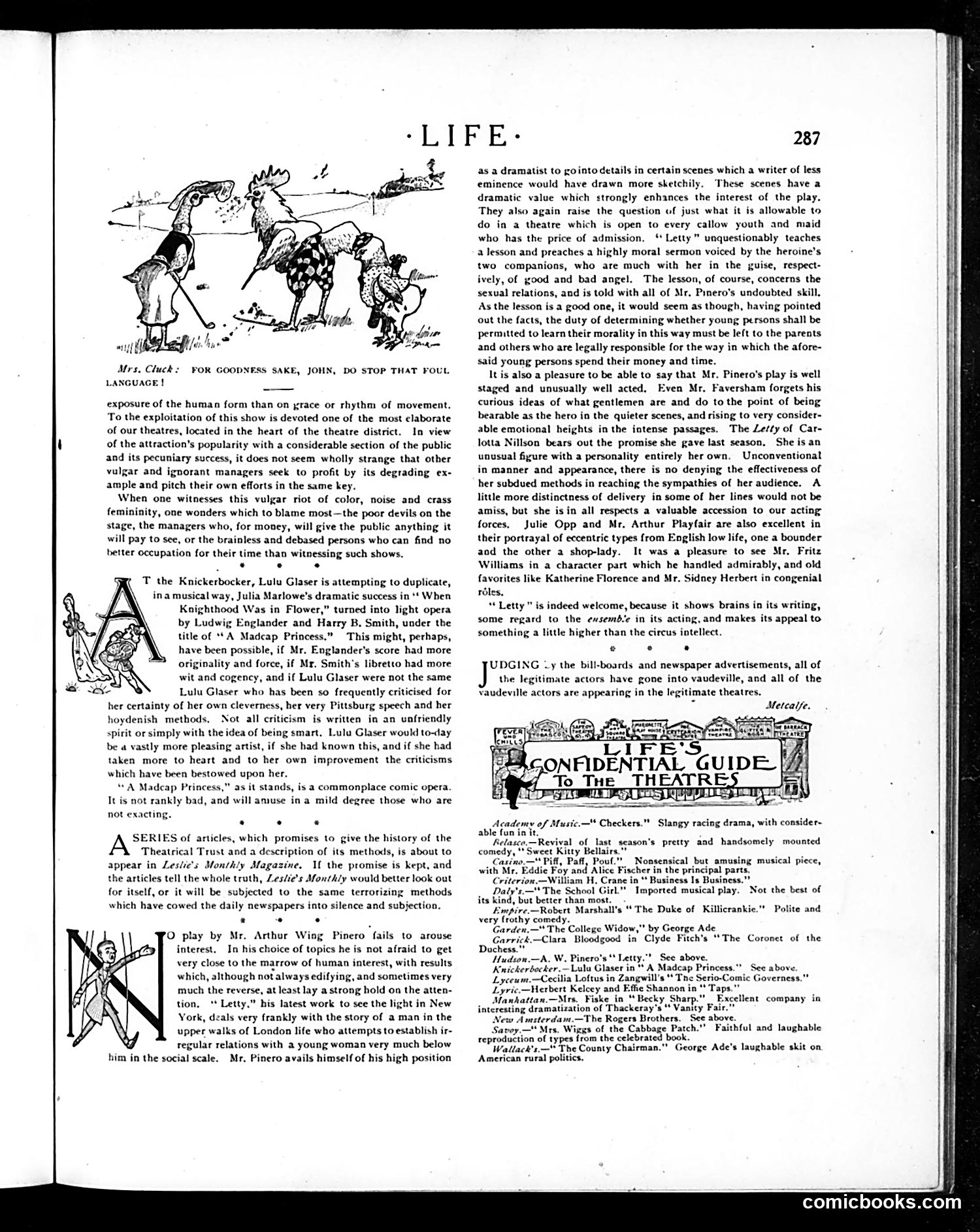
The top cartoon depicts a domestic scene where a woman ("Mrs. Cluck") scolds a man ("John") for using "foul language," establishing a commentary on propriety and gender roles in early 20th-century domestic life. The page's main content critiques theatrical productions and moral standards. It attacks "vulgar" stage shows featuring excessive female exposure and "crass femininity," blaming managers who profit from such spectacles and audiences who patronize them. The text questions what entertainment should be permitted in theaters accessible to "every callow youth and maid." The reviews discuss specific productions: Lulu Glaser's musical adaptation, criticized as derivative and for Glaser's own theatrical arrogance; and Arthur Wing Pinero's play "Letty," which frankly depicts illicit relationships across class lines. The critic debates whether theaters should permit such morally complex content, especially regarding sexuality and social transgression—a central anxiety of the era regarding public decency and youth corruption.
📄 Transcribed text from this page (OCR, searchable)
Machine-transcribed from the original scan — historical spelling and the odd misread are preserved.
-LIFE: 287 Ars, Cluck; FOR GOODNESS SAKE, JON, DO STOP THAT Fout LaNGuaGE ! exposure of the human form than on grace or rhythm of movement. To the exploitation of this show is devoted one of the most elaborate of our theatres, located in the heart of the theatre district. In view of the attraction’s popularity with a considerable section of the public and its pecuniary success, it does not seem wholly strange that other vulgar and ignorant managers seek to profit by its degrading ex- ample and pitch their own efforts in the same key. When one witnesses this vulgar riot of color, noise and crass femininity, one wonders which to blame most—the poor devils on the stage, the managers who, for money, will give the public anything it will pay to see, or the brainless and debased persons who can find no better occupation for their time than witnessing such shows. . ° . T the Knickerbocker, Lulu Glaser is attempting to duplicate, ina musical way, Julia Marlowe's dramatic success in‘ When Knighthood Was in Flower,” turned into light opera by Ludwig Englander and Harry B, Smith, under the title of A Madcap Princess.” This might, perhaps, have been possible, if Mr. Englander's score had more originality and force, if Mr. Smith’s libretto had more wit and cogency, and if Lulu Glaser were not the same Lulu Glaser who has been so frequently criticised for her certainty of her own cleverness, her very Pittsburg speech and her hoydenish methods. Not all criticism is written in an unfriendly spirit or simply with the idea of being smart, Lulu Glaser would to-day be a vastly more pleasing artist, if she had known this, and if she had taken more to heart and to her own improvement the criticisms which have been bestowed upon her. ‘A Madcap Princess, is a commonplace comic opera. Tt is not rankly bad, and will ansuse in a mild degree those who are not exacting. . . . RIES of articles, which promises to give the history of the Theatrical Trust and a description of its methods, is about to appear in Leséie's Monthly Magazine, If the promise is kept, and the articles tell the whole truth, Lestie’s Monthly would better look out for itself, or it will be subjected to the same terrorizing methods which have cowed the daily newspapers into silence and subjection. * ” . . ‘O play by Mr. Arthur Wing Pinero fails to arouse interest, In his choice of topics he is not afraid to get very close to the marrow of human interest, with results which, although not always edifying, and sometimes very much the reverse, at least lay a strong hold on the atten- tion, * Letty,” his latest work to see the light in New York, deals very frankly with the story of a man in the upper walks of London life who attempts to establish ir- regular relations with a young woman very much below him in the social scale. Mr. Pinero avails himself of his high position as a dramatist to gointo details in certain scenes which a writer of less eminence would have drawn more sketchily. These scenes have a dramatic value which strongly enhances the interest of the play. They also again raise the question of just what it is allowable to do in a theatre which is open to every callow youth and maid who has the price of admission. ‘ Letty” unquestionably teaches a lesson and preaches a highly moral sermon voiced by the heroine's two companions, who are much with her in the guise, respect- ively, of good and bad angel. The lesson, of course, concerns the sexual relations, and is told with all of Mr. Pinero's undoubted skill. As the lesson is a good one, it would seem as though, having pointed out the facts, the duty of determining whether young persons shall be permitted to learn their morality in this way must be left to the parents and others who are legally responsible for the way in which the afore- said young persons spend their money and time. It is also a pleasure to be able to say that Mr. Pinero’s play is well staged and unusually well acted, Even Mr. Faversham forgets his curious ideas of what gentlemen are and do to the point of being bearable as the hero in the quieter scenes, and rising to very consider- able emotional heights in the intense passages. The Lefty of Car- lotta Nillson bears out the promise she gave last season, She is an unusual figure with a personality entirely her own, Unconventional in manner and appearance, there is no denying the effectiveness of her subdued methods in reaching the sympathies of her audience. A little more distinctness of delivery in some of her lines would not be amiss, but she isin all respects a valuable accession to our acting forces, Julie Opp and Mr. Arthur Playfair are also excellent in their portrayal of eccentric types from English low life, one a bounder aod the other a shop-lady. It was a pleasure to see Mr, Fritz Williams in a character part which he handled admirably, and old favorites like Katherine Florence and Mr. Sidney Herbert in congenial roles, “ Letty " is indeed welcome, because it shows brains in its writing, some regard to the ensemb‘e in its acting, and makes its appeal to something a little higher than the circus intellect. e ° . UDGING “y the bill-boards and newspaper advertisements, all of the legitimate actors have gone into vaudeville, and all of the Vaudeville actors are appearing in the legitimate theatres. Metcalfe. LIFE'S ONFIDENTIAL GUIDE ‘Tne THEATRE, Academy of Music.— Checkers.” Slangy racing drama, with consider able fun ia it. Relasco.—Revival of last season's pretty and handsomely mounted comedy, "* Sweet Kitty Bellairs."” Casino.—' Piff, Paff, Poul." Nonsensical but amusing musical piece, with Mr. Eddie Foy and Alice Fischer in the principal parts. Criterion.—William H. Crane in Business Is Business. Daly’s.—"* The School Girl” Imported musical play. Not the best of its kind, but better than most. Empire.—Robert Marshall's “ The Duke of Killicrankie." Polite and very frothy comedy. Garden.—" The College Widow,” by George Ade Garrick.—Clara Bloodgood in’ Clyde Fitch's “The Coronet of the Dachess." Hudson.—A. W. Pinero's"* Letty.” See above. Knickerbocker. Lula Glaser in A Madcap Princess.” See above Lyceum.—Cecilia Loftus in Zangwill’s * Tne Serio-Comic Governes: Lyric.—Herbert Kelcey and Effie Shannon in ‘* Taps."” ‘Mankattan.—Mrs. Fiske in “Becky Sharp.” Excellent. company in interesting dramatization of Thackeray's“ Vanity Fair.”” New Amsterdam The Rogers Brothers. See above. Savoy.—" Mrs. Wiggs of the Cabbage Patch."” Faithful and laughable reproduction of types from the celebrated book. Wallack's.—" The County Chairman.” George Ade’s laughable skit on American rural politics. zal comicbooks.com