
A complete issue · 20 pages · 1904
Life — September 8, 1904
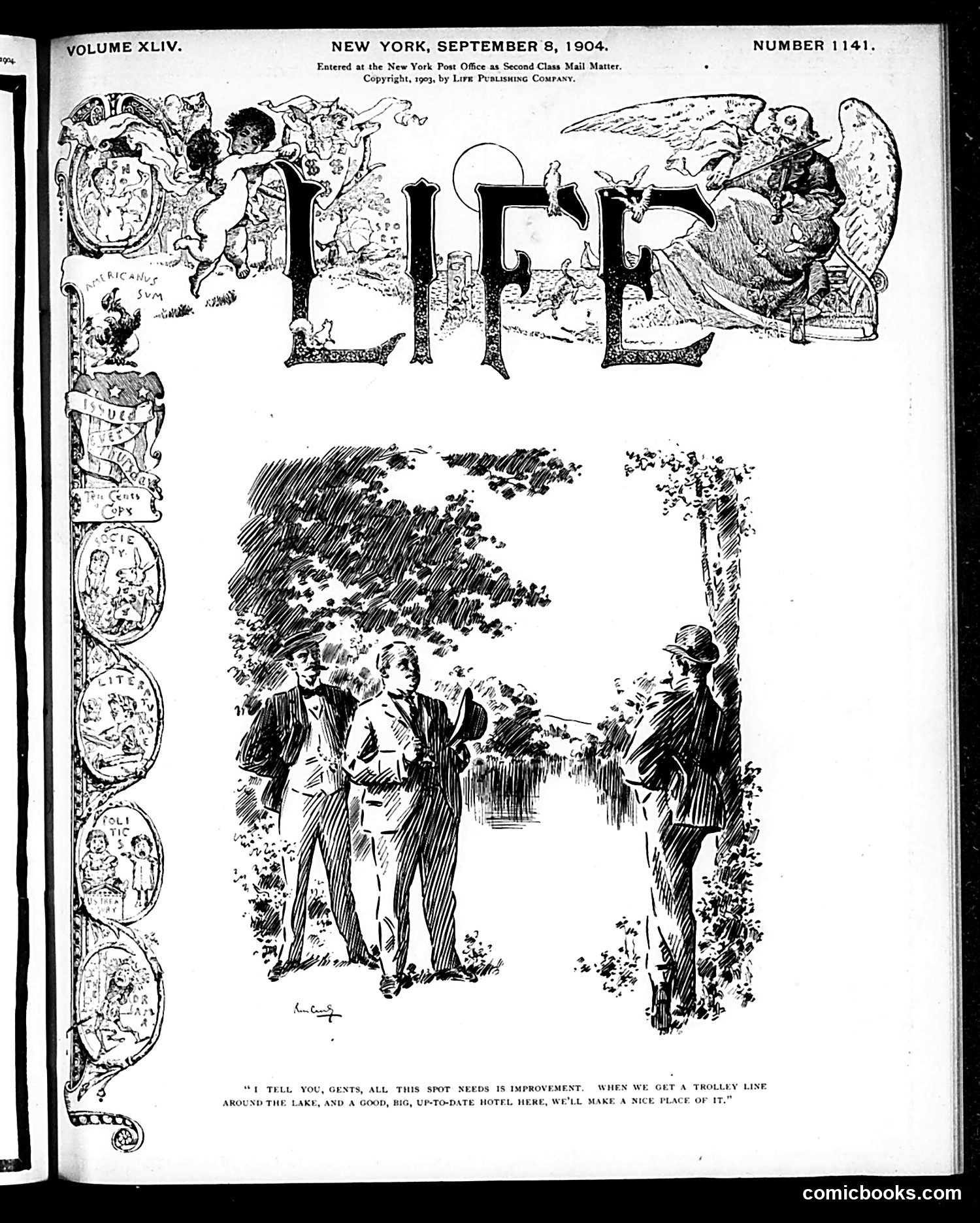
This page features a single cartoon depicting three men in suits standing outdoors near a lake or water feature. Two men on the left converse while a third stands to the right. The caption reads: "I tell you, gents, all this spot needs is improvement. When we get a trolley line around the lake, and a good, big, up-to-date hotel here, we'll make a nice place of it." The satire targets real estate speculation and development schemes common in early 1900s America. The cartoon mocks developers' grandiose visions for transforming natural landscapes into commercial tourist destinations through infrastructure projects like trolley lines and hotels. It critiques the commodification of natural beauty and suggests such "improvements" actually diminish authentic character—a concern about urbanization that resonated with Life's educated readership.
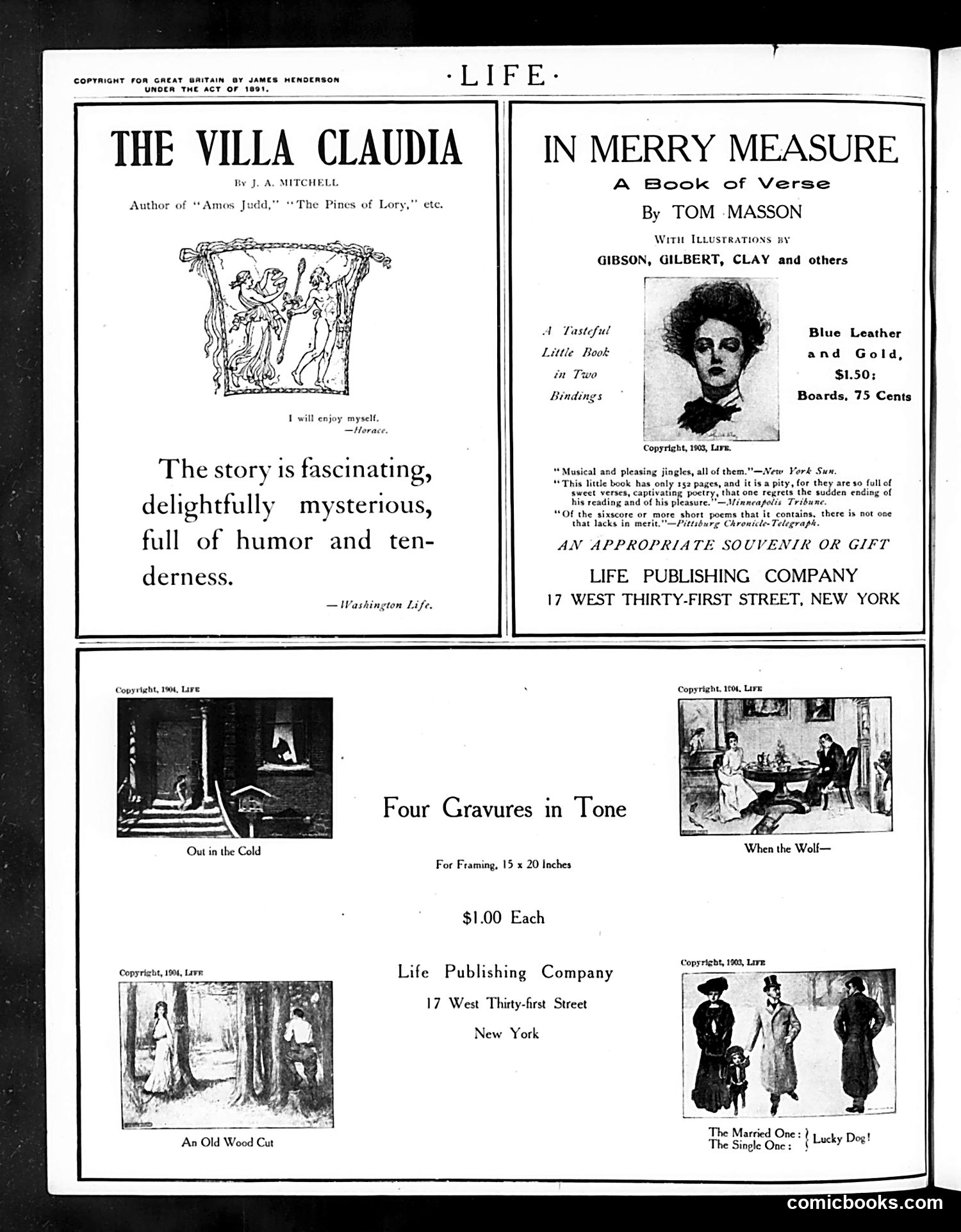
This page is primarily **advertising**, not satire or political commentary. The top half advertises two books: J.A. Mitchell's *The Villa Claudia* (a novel described as "fascinating" and "mysterious") and Tom Masson's *In Merry Measure* (a poetry collection with illustrations). The bottom half showcases **four gravures in tone**—framed artworks priced at $1.00 each—titled "Out in the Cold," "When the Wolf—," "An Old Wood Cut," and "The Married One; The Single One; Lucky Dog!" These appear to be sentimental or genre scenes typical of early 20th-century popular art. The gravures depict domestic or social situations but lack obvious political meaning. The page functions as a catalog of cultural products Life Publishing Company offered readers for purchase.
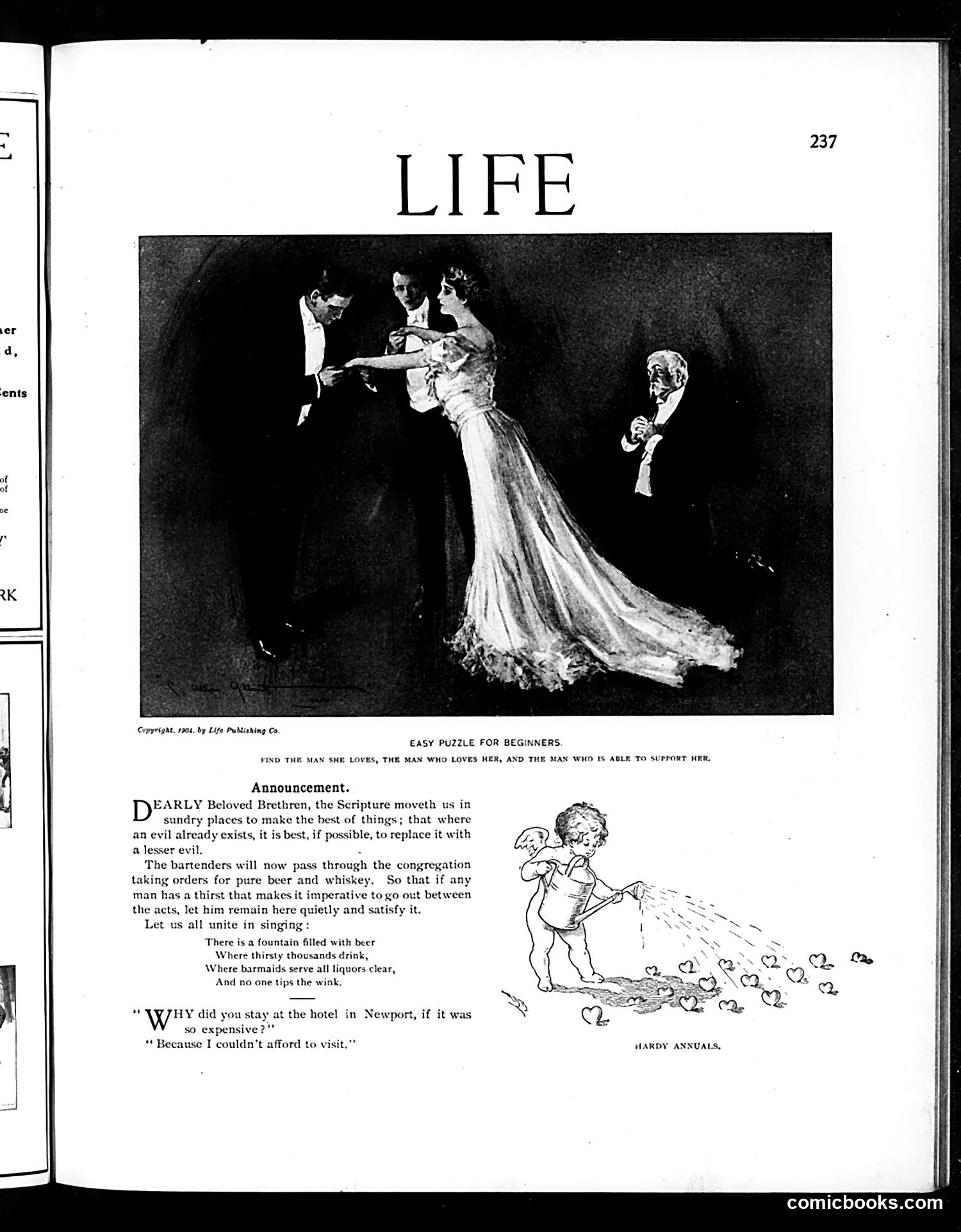
**Top Image**: An "Easy Puzzle for Beginners" depicting a formal social scene with three men in evening dress and a woman in a flowing gown. The puzzle asks readers to identify "the man she loves, the man who loves her, and the man who is able to support her"—a satirical commentary on marriage as a transactional arrangement where financial security matters as much as romantic feeling. This reflects early 20th-century anxieties about matrimony and class. **Bottom Content**: An "Announcement" mocking temperance advocates by sarcastically proposing that bartenders distribute beer/whiskey between theater acts so patrons can satisfy thirst discreetly. This satirizes Prohibition-era debates. A separate joke about expensive Newport hotel rates completes the page's social satire.
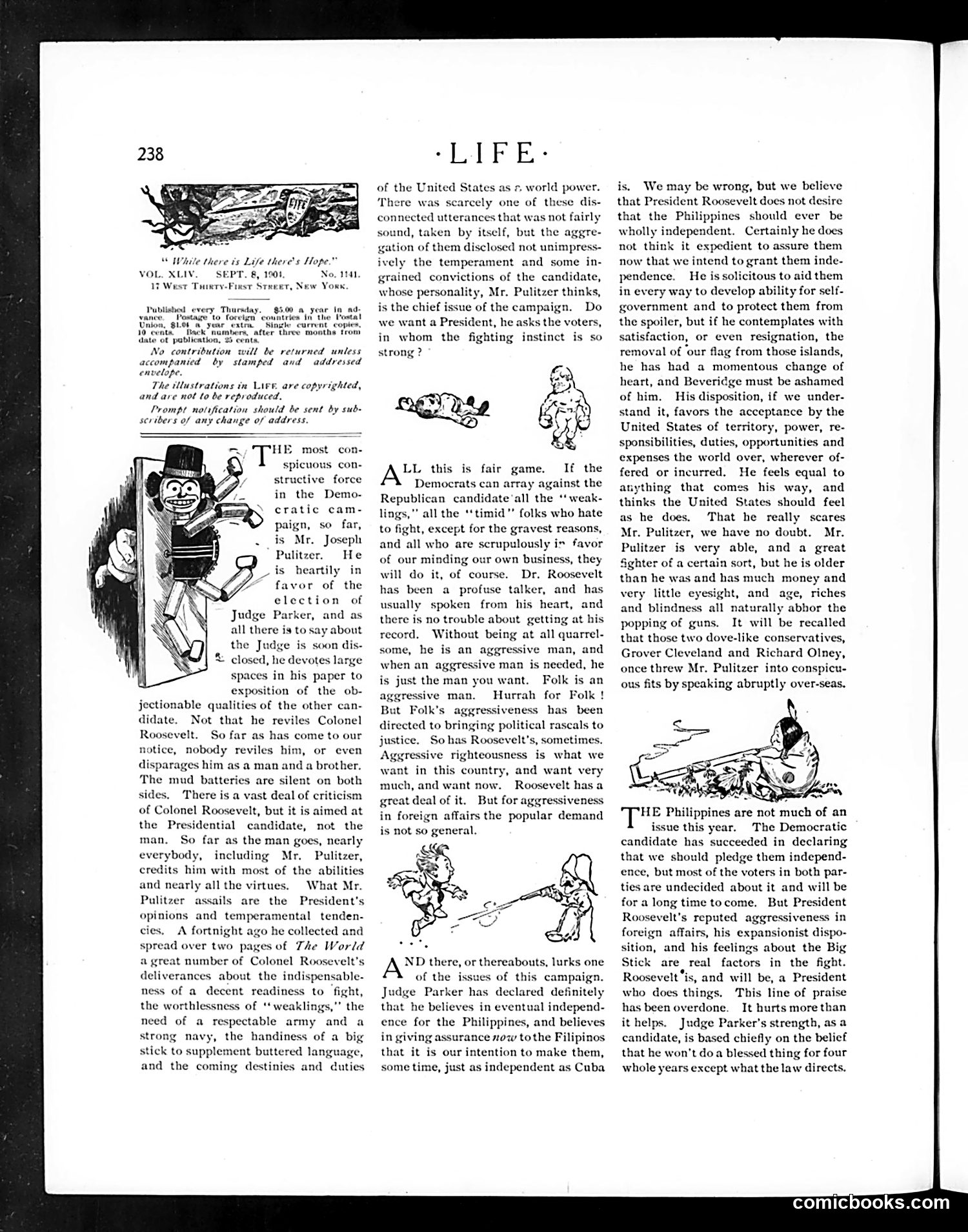
This page from *Life* magazine (September 15, 1904) discusses the Democratic campaign against Republican Theodore Roosevelt. The text defends Roosevelt's temperament and aggressiveness as presidential qualities, praising Judge Alton B. Parker (the Democratic candidate) while arguing Roosevelt possesses superior fighter's instincts. The caricatured figures appear to be political opponents engaged in debate. The cartoons illustrate the era's contentious campaign rhetoric about foreign policy, particularly regarding the Philippines—then a major political issue involving American imperial expansion. The article argues Roosevelt's "aggressive righteousness" in foreign affairs and expansionist disposition represent necessary strength, contrasting with Parker's more cautious approach. The satire implies Democrats underestimate the qualities voters actually want in a wartime president.
This satirical piece critiques the *New York Sun's* editorial support during what appears to be a political crisis. The dialogue shows a President reading newspaper reports about losing crucial backing—the *New York Sun* has withdrawn its support, leaving him dependent on the *New York Sun* alone. The satire mocks the President's desperate reliance on a single newspaper while other major papers have abandoned him. References to "Tweed and Ben Butler" and "Salt River" (a political phrase meaning defeat) suggest this concerns late 19th-century partisan politics. The accompanying prose section addresses Mrs. Maybrick's imprisonment, indicating this is a contemporary issue page mixing political satire with news commentary—typical of Life's format during this era.
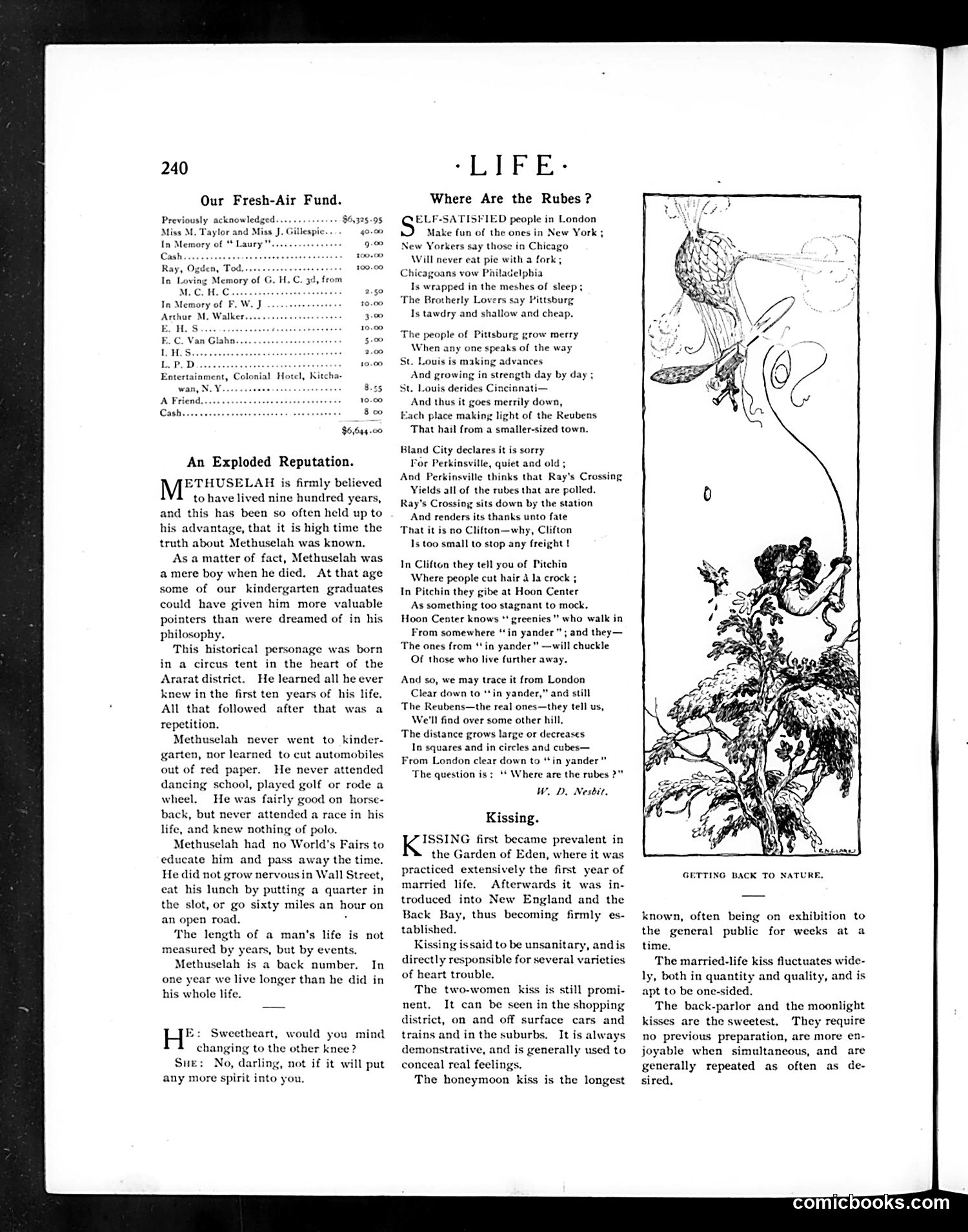
The page contains three distinct pieces: 1. **"Our Fresh-Air Fund"** - A donation list showing contributions (appears to be a charitable fundraising effort). 2. **"An Exploded Reputation"** - An article defending Methuselah's historical legitimacy. The text humorously notes Methuselah was "merely a boy when he died in his whole life," satirizing how his longevity has been mythologized. This appears to be gentle debunking of exaggerated biblical legends. 3. **"Where Are the Rubes?"** - A poem mocking regional stereotypes, specifically mocking various American cities (Pittsburgh, Chicago, Philadelphia, St. Louis, etc.) and their perceived populations. The term "rubes" (country people) suggests urban condescension toward rural Americans. 4. **"Kissing"** - An essay on kissing customs and varieties, treating the subject with satirical earnestness. The right-side illustration labeled "Getting Back to Nature" appears to be whimsical social commentary about returning to simpler living.
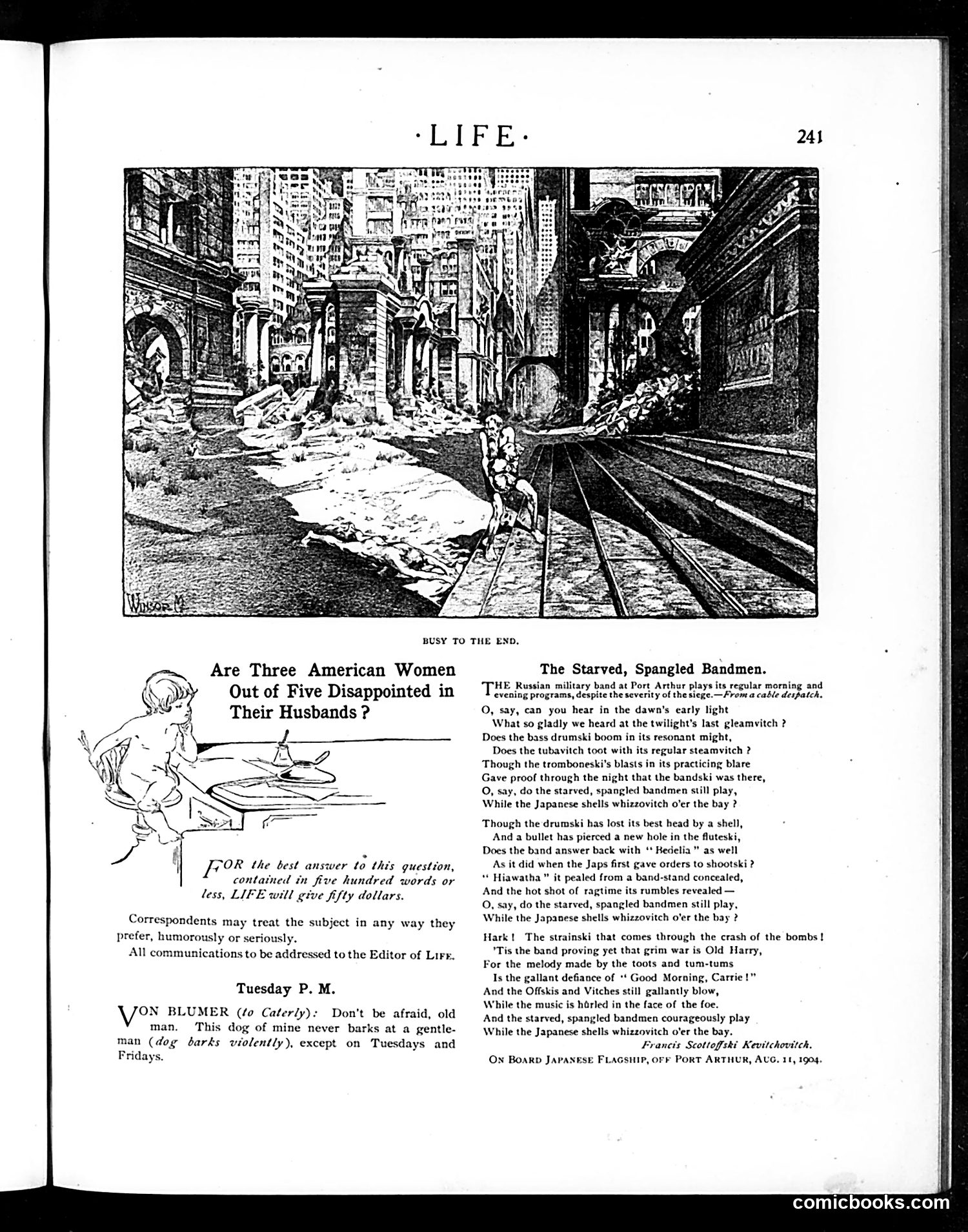
**Main Illustration:** A woodcut-style drawing showing an urban street scene with a train on tracks running through what appears to be a destroyed or war-torn city with tall buildings. The composition suggests chaos and destruction. **Content Below:** The page features a humorous advice column titled "Are Three American Women Out of Five Disappointed in Their Husbands?" with a small cartoon of a woman. Life is offering fifty dollars for the best answer in 100 words or less. **"Tuesday P.M." section:** A joke attributed to "VON BLUMER (to Caterby)" about a dog that only barks violently on Tuesdays and Fridays—a nonsensical humor piece. **Poem:** "The Starved, Spangled Bandmen" by Francis Scottigh Kewitchowitsch appears to be a satirical poem about Russian military musicians during wartime.
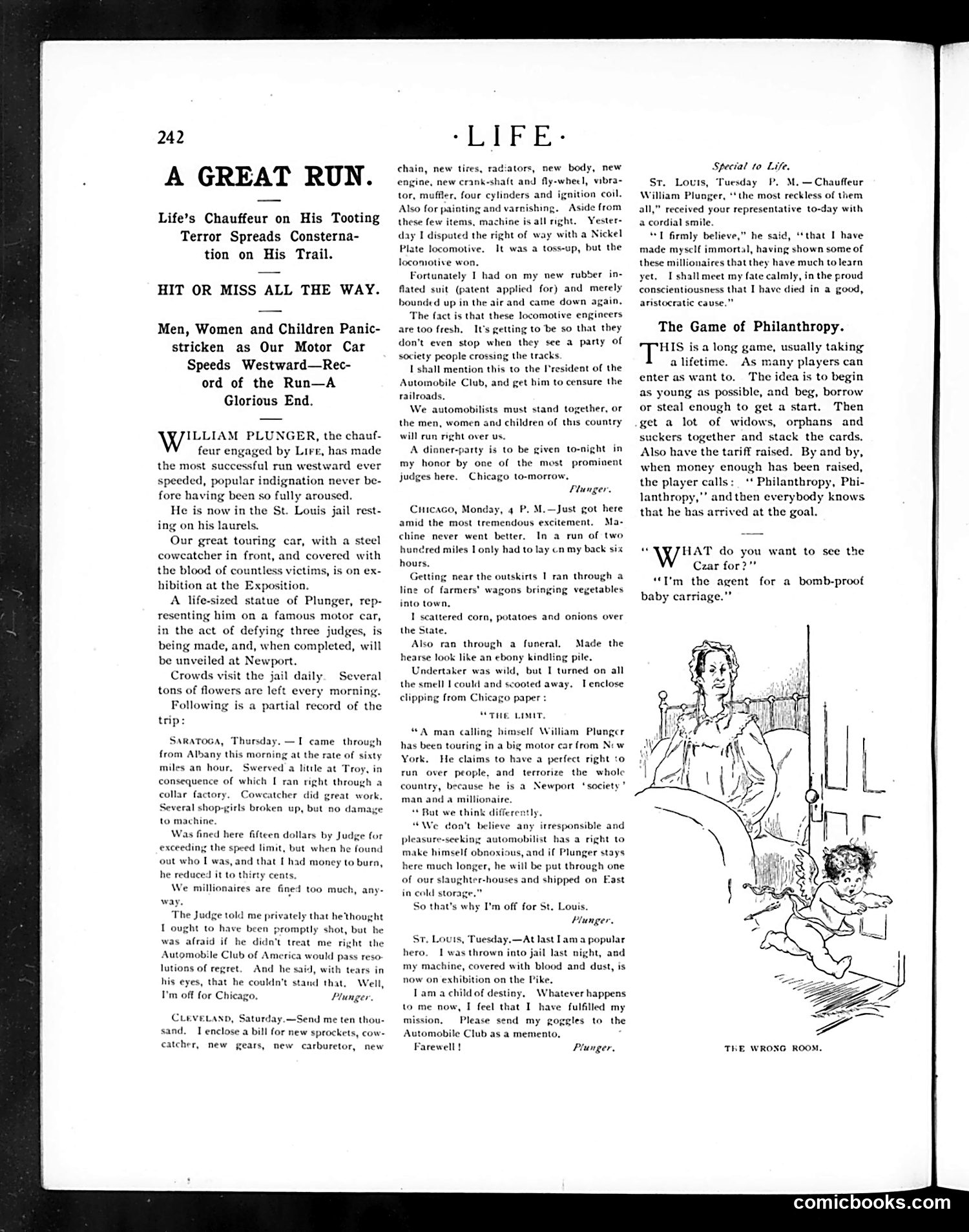
This page satirizes William Plunger, a wealthy chauffeur whose reckless driving has caused panic among the public. The left column details his cross-country motor car journey, with reports from various cities documenting near-misses and collisions—he "hit or miss[es] all the way." The right-side cartoon titled "The Wrong Room" appears unrelated, depicting what seems to be a social comedy scenario about mistaken identity or inappropriate intrusion. The piece mocks both Plunger's dangerous driving and society's tolerance of wealthy men endangering ordinary citizens. The satirical tone—treating his vehicular chaos as a celebrated "record" and "glorious end"—critiques the early automotive age's reckless indulgence and the law's apparent inability to restrain wealthy troublemakers.
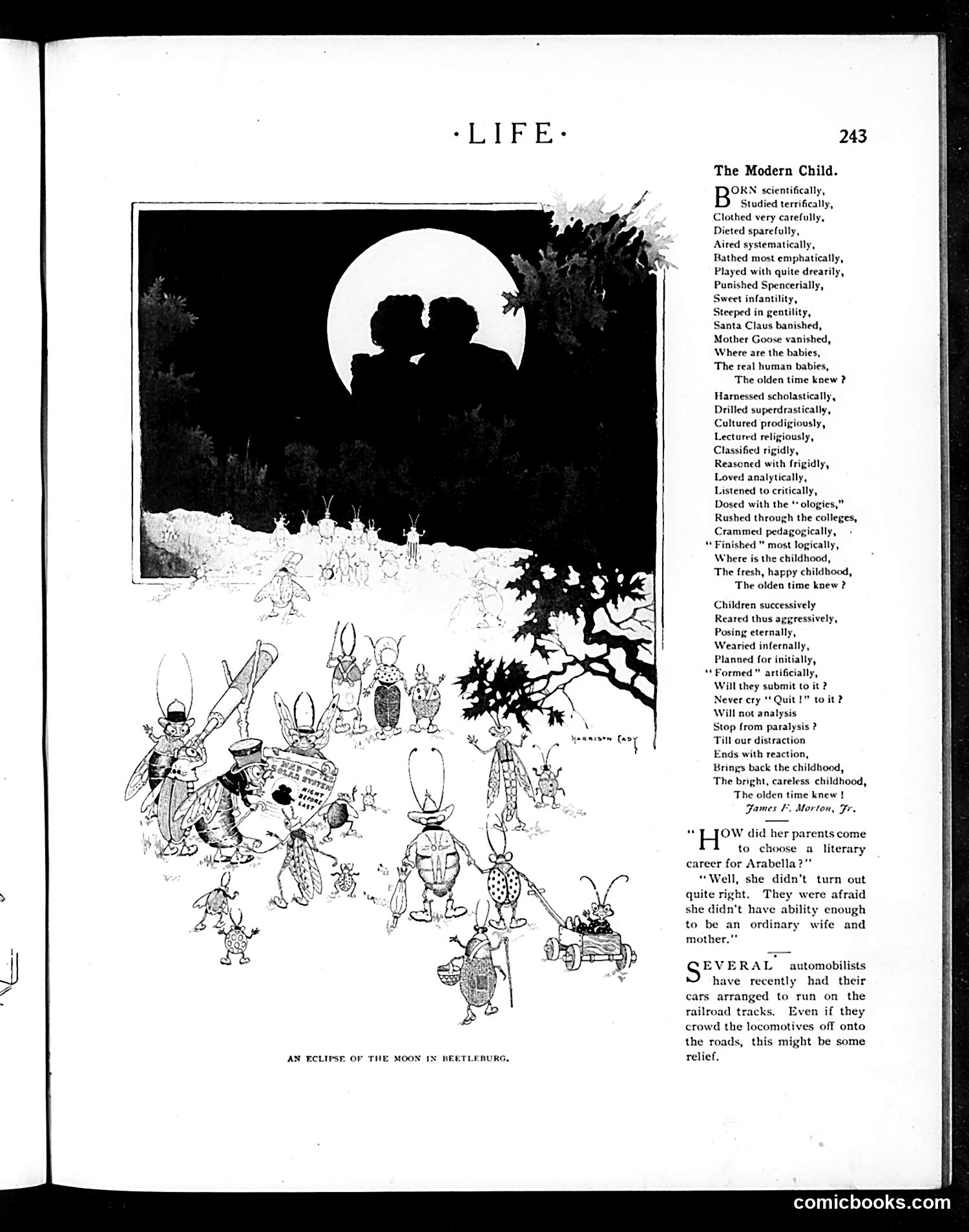
This whimsical illustration satirizes modern child-rearing practices through the eyes of insects. The poem "The Modern Child" (right) laments how contemporary children are over-managed—"studied terrificially," "harness scholastically," "cultured," "lectured religiously," etc.—contrasting with traditional childhood freedoms. The cartoon depicts beetles and insects gazing at a lunar eclipse, suggesting even primitive creatures experience wonder naturally. The satire implies modern parenting has so over-systematized childhood that human children have lost the capacity for simple, authentic experience that comes naturally to lower creatures. The accompanying anecdote about Arabella's literary career reinforces the theme: overly-ambitious parental direction produces disappointing results.
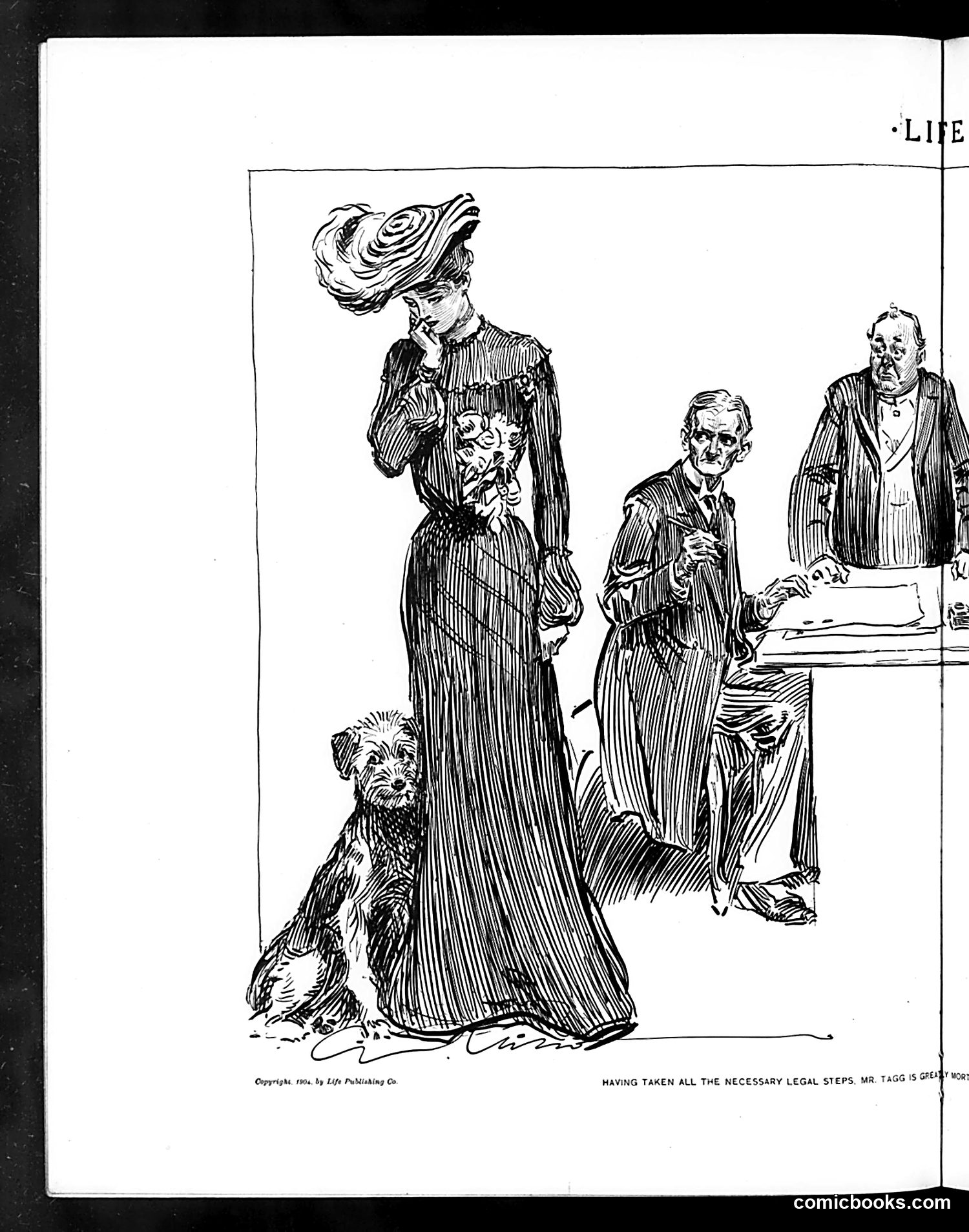
This 1904 Life magazine cartoon satirizes a legal proceeding involving someone named Mr. Tagg. The caption reads: "HAVING TAKEN ALL THE NECESSARY LEGAL STEPS, MR TAGG IS QUITE MORT—" (text cuts off). The image shows a well-dressed woman with an elaborate hat, accompanied by a small dog, presenting documents to two men in formal attire (likely lawyers or officials). The woman appears poised and confident in her legal action. Without the complete caption or additional context, the specific nature of Mr. Tagg's legal troubles remains unclear—whether this concerns divorce, property dispute, or another matter. The cartoon's humor likely derives from the formal legal machinery being set in motion, with the woman's fashionable appearance contrasting with serious legal business. The dog may be a symbolic detail, though its significance is uncertain.
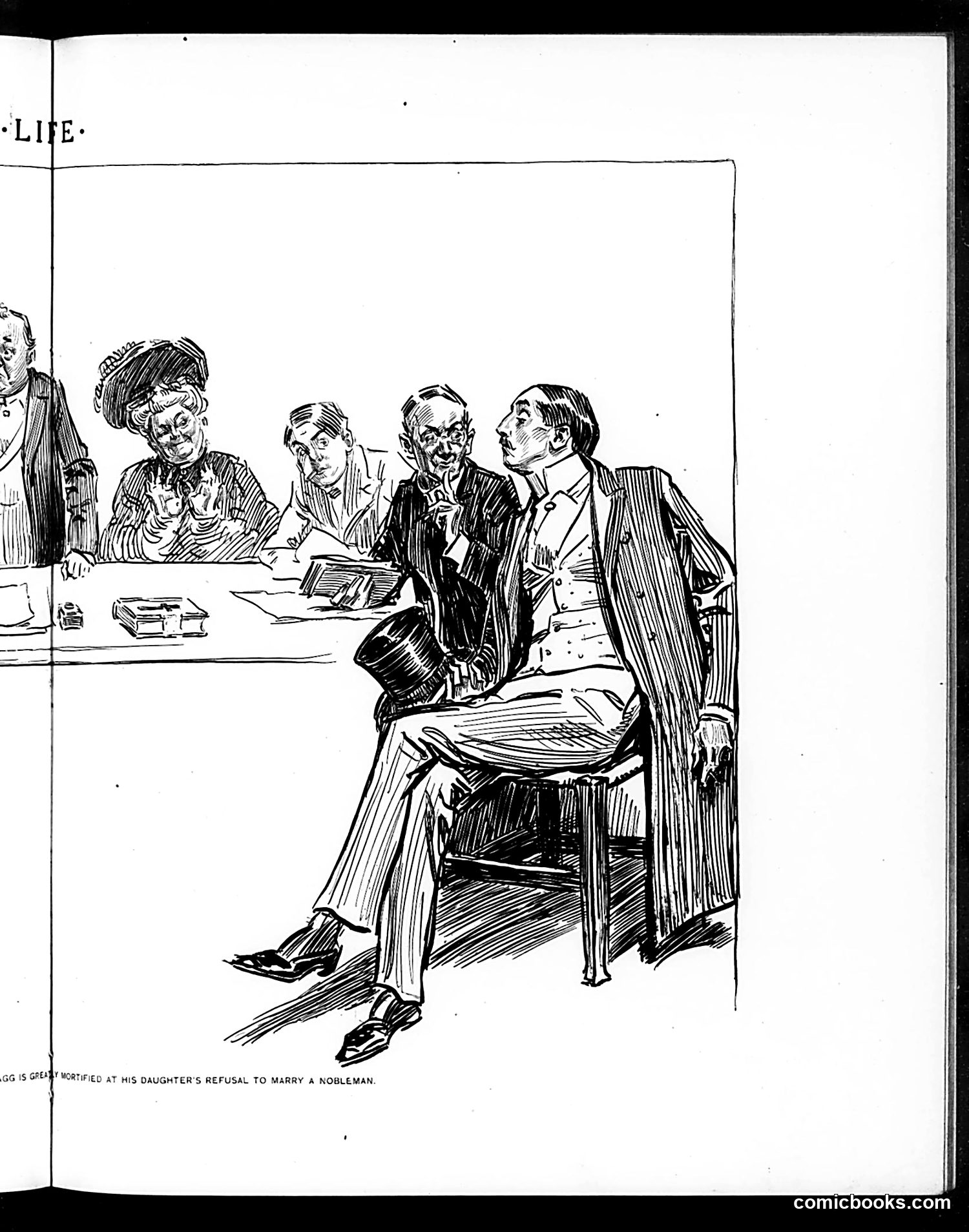
This is a satirical cartoon from *Life* magazine depicting what the caption describes as a father's mortification at his daughter's refusal to marry a nobleman. The scene shows five men at a table—apparently a formal meeting or discussion. The seated figure on the right appears to be the distressed father, while the others (likely family members, advisors, or social peers) react to news of his daughter's rejection of a marriage proposal to someone of noble status. The satire targets upper-class social anxiety about matrimonial arrangements and class status. The exaggerated facial expressions convey the scandal and embarrassment such a refusal would cause in society circles obsessed with advantageous marriages to the nobility. The cartoon mocks the priorities of wealthy families for whom marrying "up" socially was considered essential.
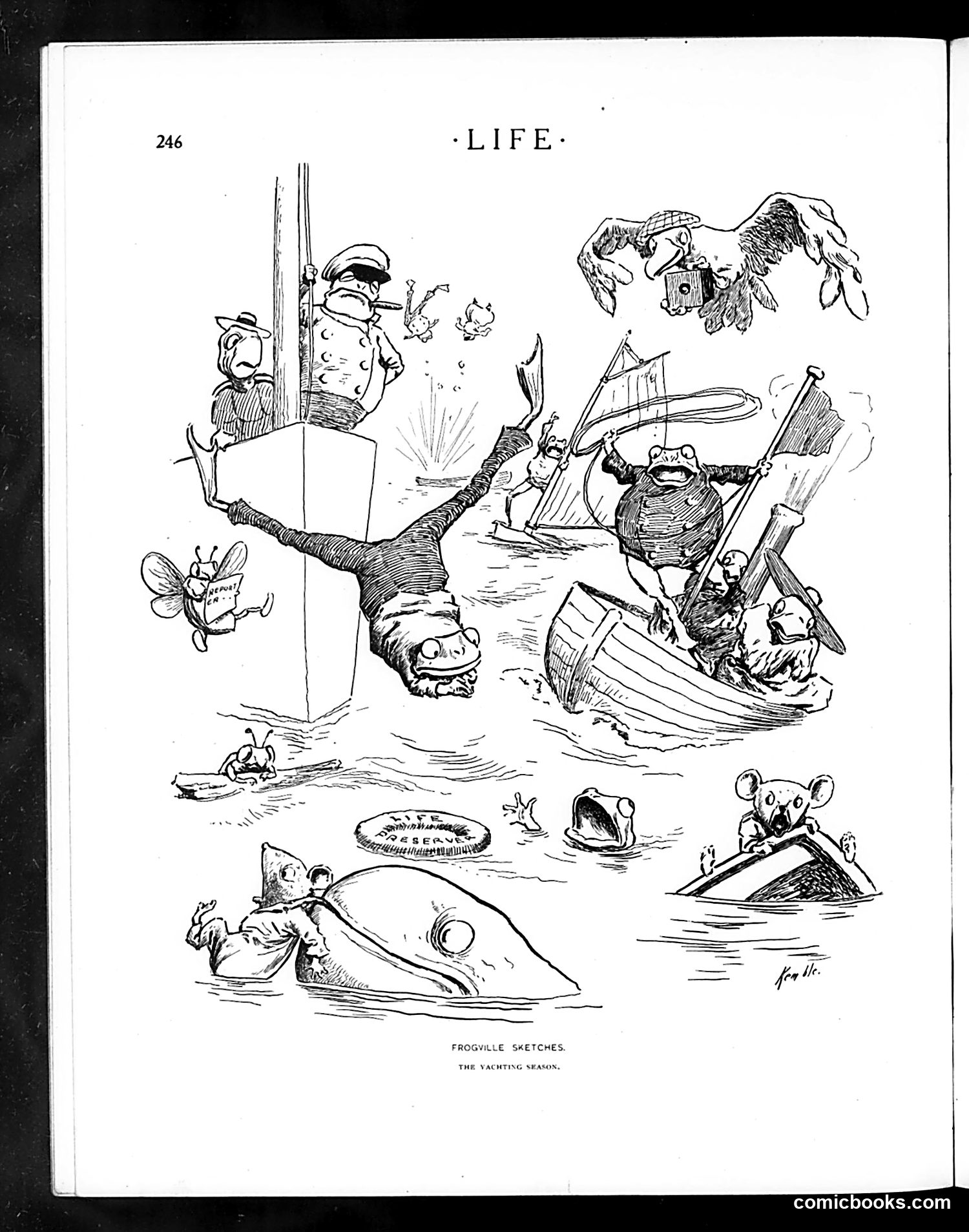
This is a whimsical satirical illustration depicting anthropomorphized frogs engaged in nautical activities. The frogs are shown sailing, swimming, and managing small boats and vessels in various states of comedic chaos—some capsized, some navigating clumsily. The satire appears to target the leisure activities of the wealthy during yachting season, translating human recreational vanity into absurd frog behavior. By depicting dignified sport through ridiculous amphibian characters, the cartoonist mocks the pretensions of yachtsmen and the idle pursuits of the wealthy class. The detailed, energetic linework captures slapstick humor typical of early Life magazine, where social commentary was delivered through animal anthropomorphism and visual comedy rather than explicit political critique.
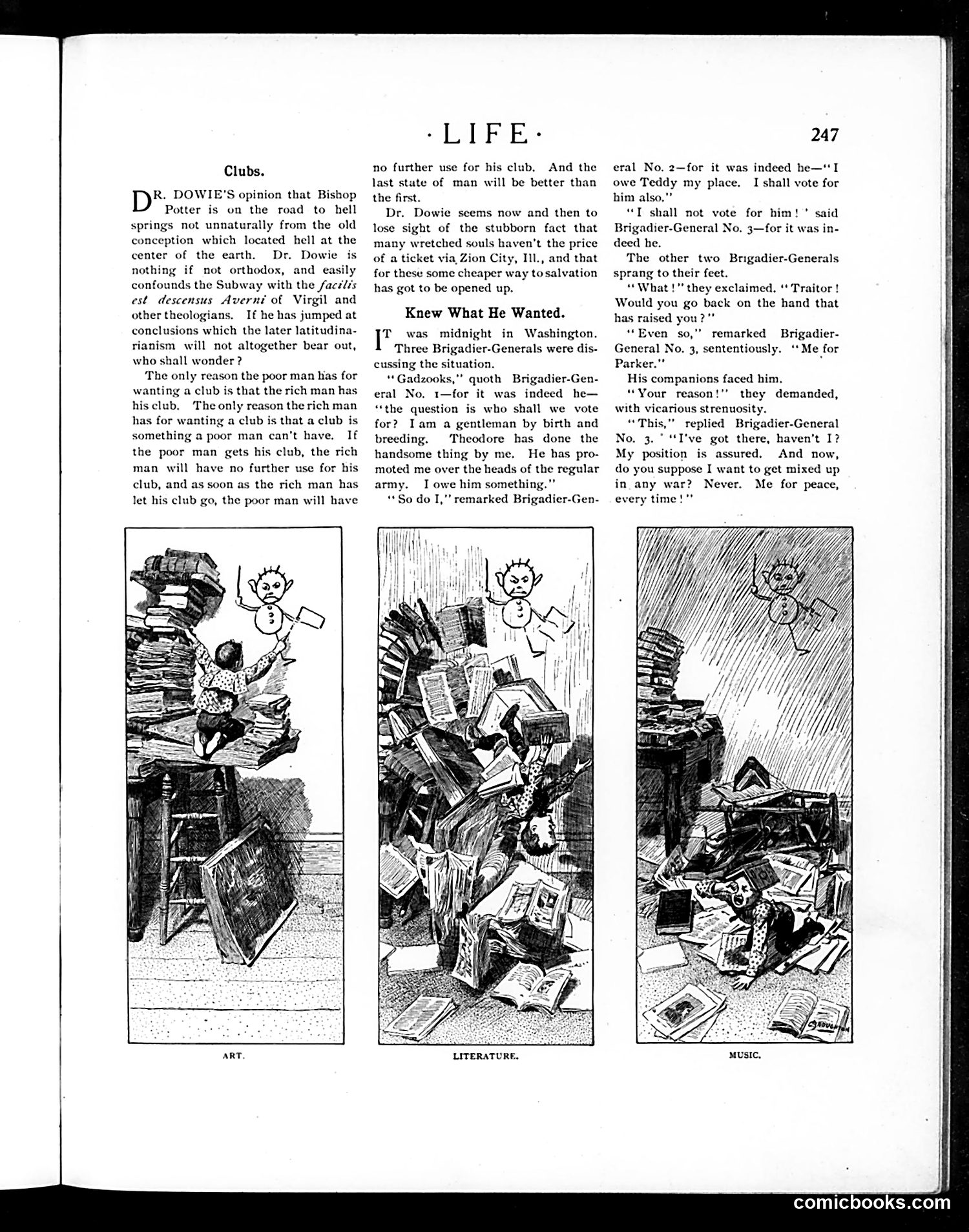
This page contains two satirical pieces about American politics and social hypocrisy, likely from the 1904 presidential election period. **Top section** mocks Dr. John Alexander Dowie (a religious figure) and debates about exclusive clubs, satirizing how the wealthy and poor define social status through club membership—each group wants what the other has, creating circular, pointless rivalry. **Bottom section** features three fictional Brigadier-Generals debating whom to support for president. Two promise loyalty to Theodore Roosevelt because he promoted them; the third declares for Parker (the Democratic candidate) with brutally honest reasoning: he's already secure, so he wants no part of Roosevelt's aggressive foreign policy or wars. He chooses "peace" over loyalty. The satire targets military officers' self-interested careerism and exposes the gap between professed gratitude/loyalty and actual self-preservation instincts—mocking how even those claiming principle simply follow personal advantage.
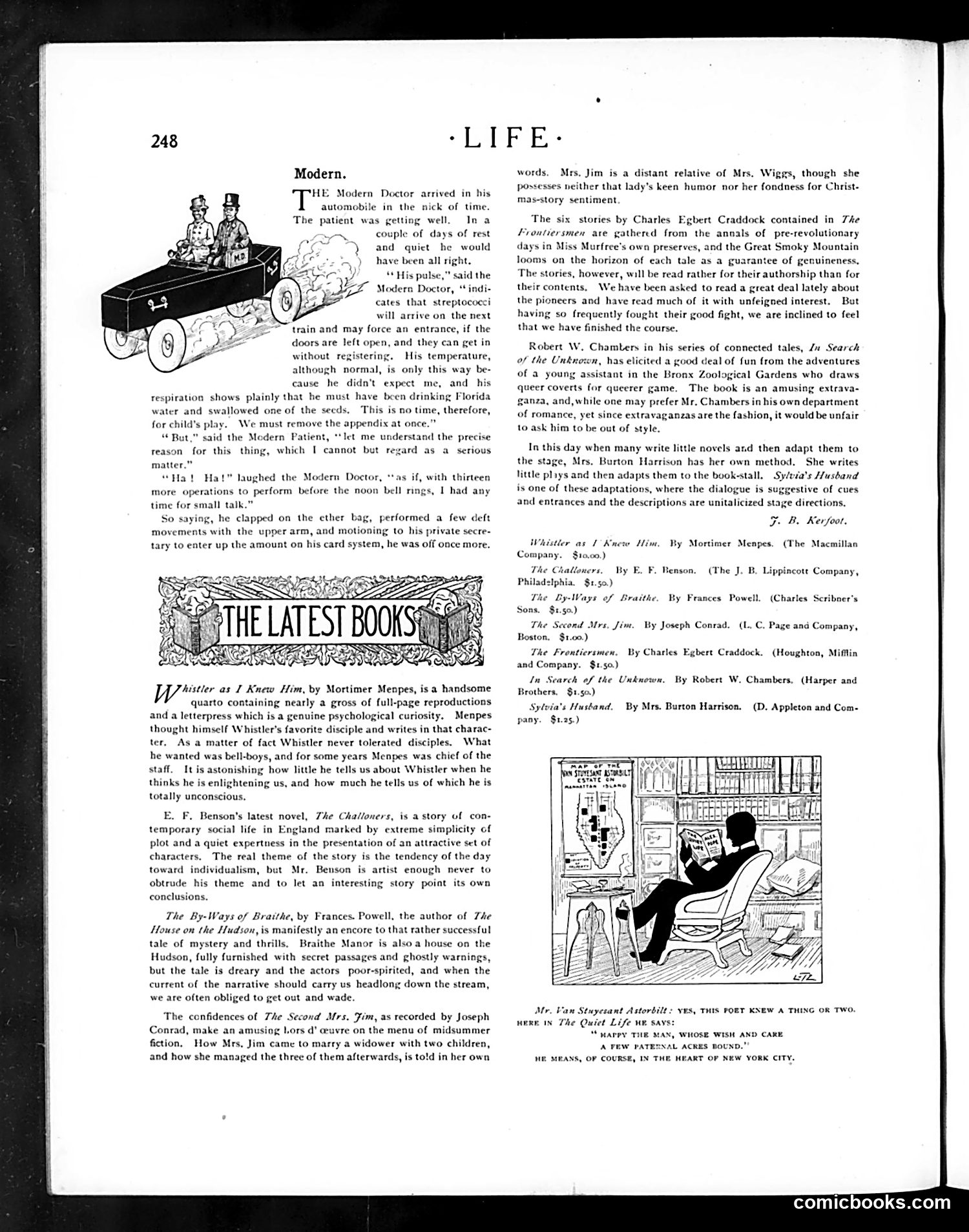
This cartoon mocks the early 20th-century trend of overly medicalized, interventionist medical practice. A doctor arrives by automobile and immediately diagnoses a patient who was recovering naturally with rest. Despite finding nothing objectively wrong (normal temperature, no actual symptoms), he insists on removing the patient's appendix—a common unnecessary surgery of the era. The satire targets the "Modern Doctor's" arrogance and profit-motive: he dismisses the patient's reasonable question about necessity, performs the operation hurriedly via ether anesthesia, and has his secretary record the charge before rushing off to perform thirteen more operations that day. The joke is that this hyperactive intervention contradicts actual medicine—the patient would have recovered without surgery. The cartoon criticizes how doctors weaponized "modern science" to justify profitable, unnecessary procedures on trusting patients.
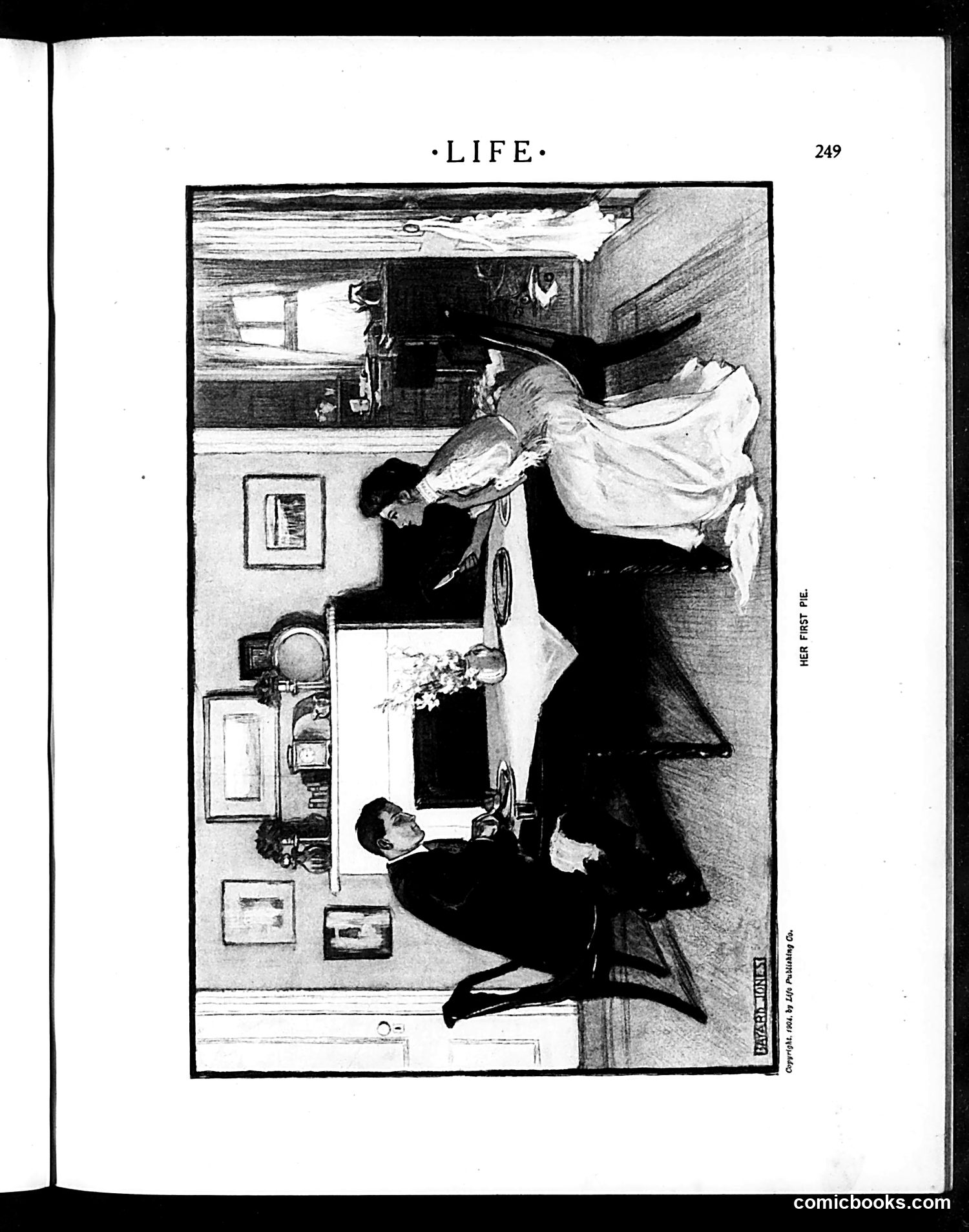
This page from *Life* magazine (page 249) shows a black-and-white photograph rather than a drawn cartoon. The image depicts two men in what appears to be a kitchen or domestic space. One man is crouched or bending down while another stands, both appearing to be in formal attire (suits/dress clothing). The caption reads "HER FIRST PIE," suggesting domestic humor—likely satirizing gender roles or a newlywed scenario where a husband encounters his wife's cooking attempt. The satire appears to target early 20th-century domestic expectations: the implication that a new wife's cooking skills (or lack thereof) would be remarkable or comedic. The photograph's setup—rather than illustration—suggests this may document an actual scene or staged photograph for comedic effect in the magazine.
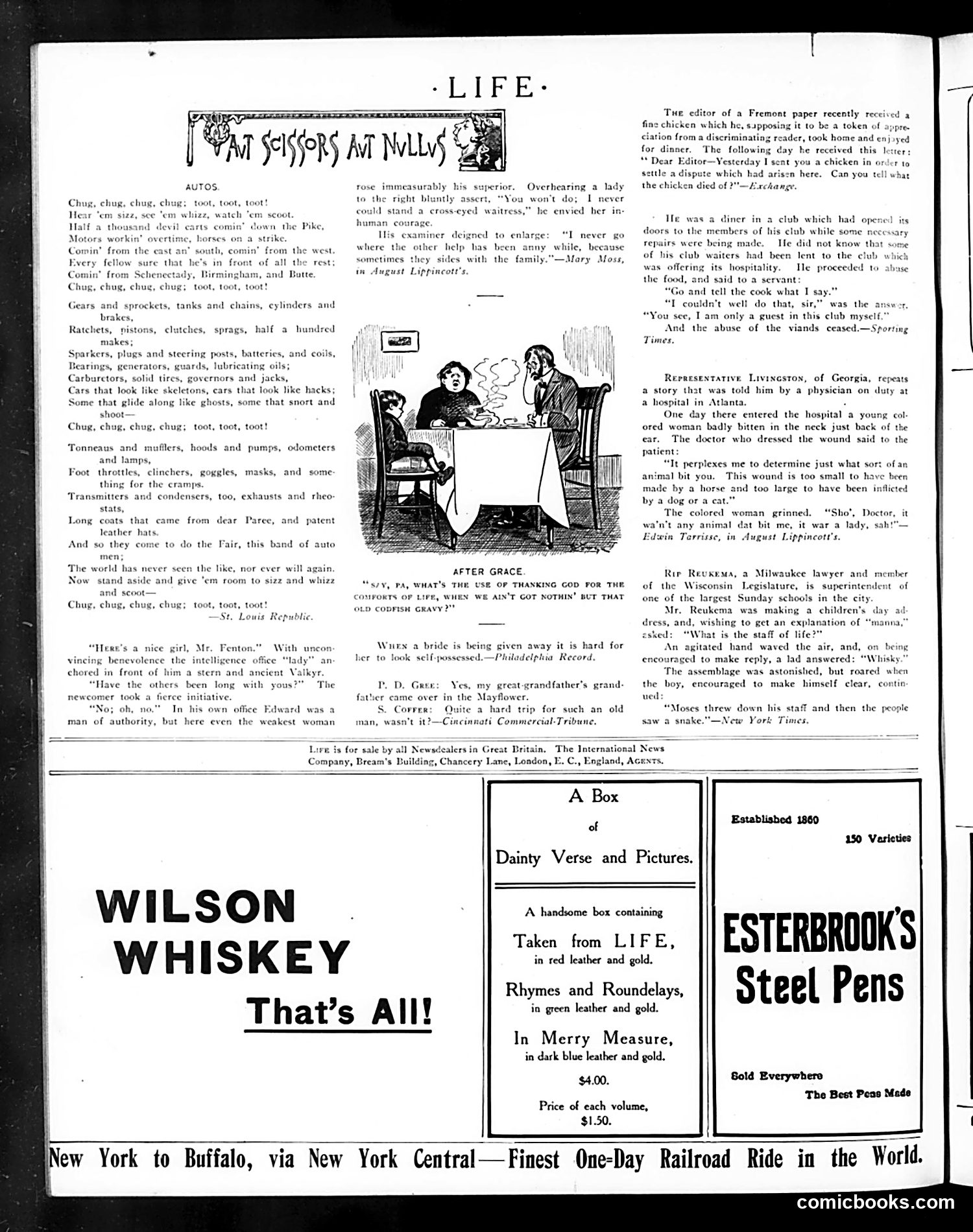
This Life magazine page primarily contains **humorous anecdotes and light social commentary** rather than political cartoons. The main illustrated piece, "After Grace," satirizes **working-class manners and pretension**. The cartoon depicts a dinner scene where a working man, having received a chicken as a gift, attempts to impress by ordering servants around—only to be embarrassed when told the servants are merely borrowed staff, not his own. The joke mocks social climbing and the assumption that material goods or borrowed trappings confer authority. The text anecdotes below ridicule various social situations: a newspaper editor receiving a dead chicken supposedly as appreciation; a club guest abusing borrowed waiters; a woman explaining a bite wound came from "a lady" not an animal. **The satire targets**: pretension among lower and middle classes; the awkwardness of social mobility; assumptions about authority and status. The page also features period advertisements for Wilson Whiskey, Esterbrook Steel Pens, and a box of verse—standard early 20th-century magazine filler reflecting the publication's mixed content model.
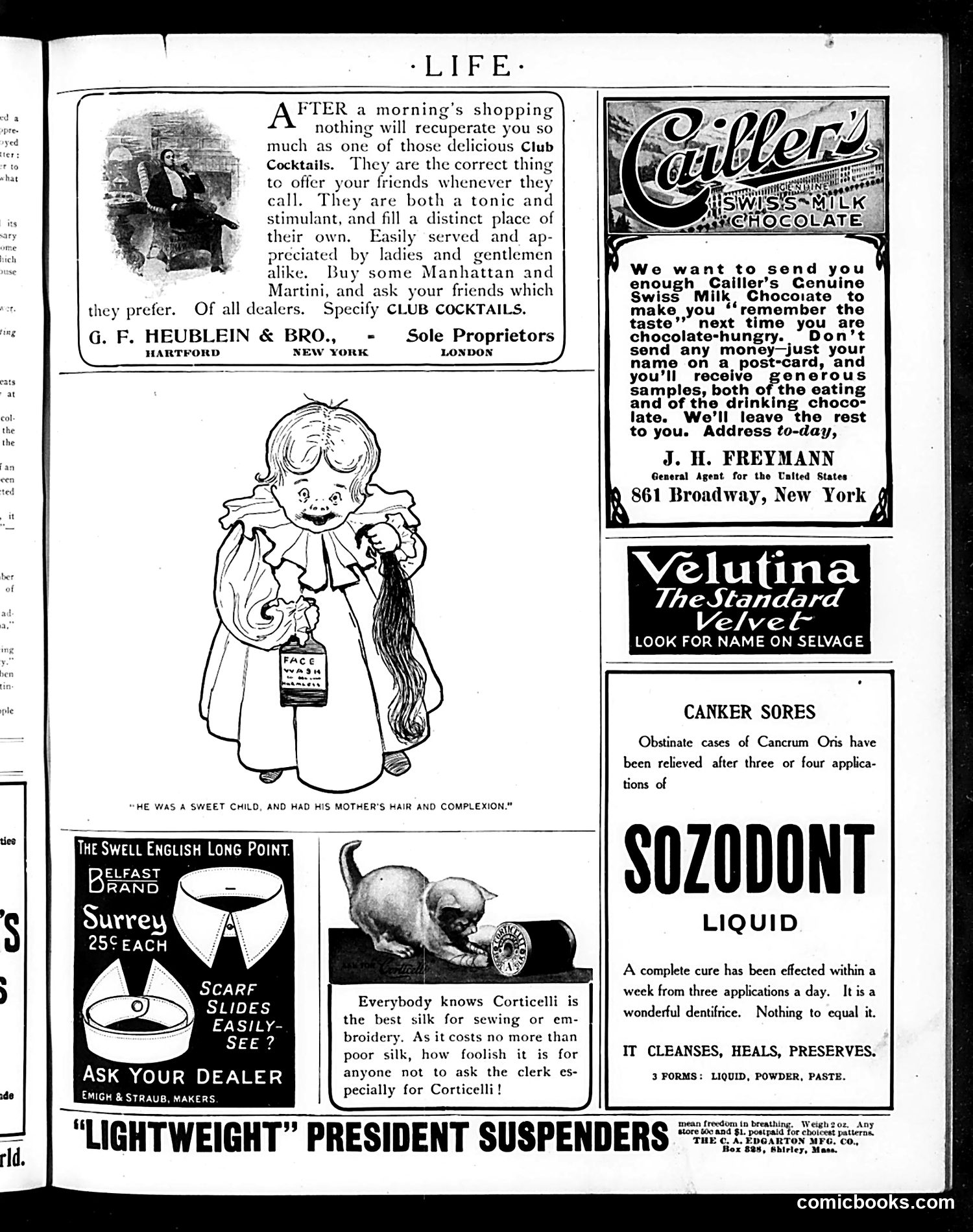
This page is primarily **advertising**, typical of early 20th-century magazines. The only editorial cartoon is the small illustration captioned "He was a sweet child, and had his mother's hair and complexion"—a line drawing of a cherubic baby holding what appears to be a hair product bottle. The joke plays on the common advertising trope of the era: testimonials claiming children inherited parents' desirable traits (good hair, complexion), humorously suggesting the product's effectiveness through inheritance rather than actual use. The rest of the page contains product advertisements for cocktail mixers, Swiss chocolate, collar slides, silk thread, and tooth liquid—representing typical consumer goods marketed to middle and upper-class readers. These ads reflect period shopping culture and available luxuries, with no apparent political content or satire beyond gentle commercial humor.
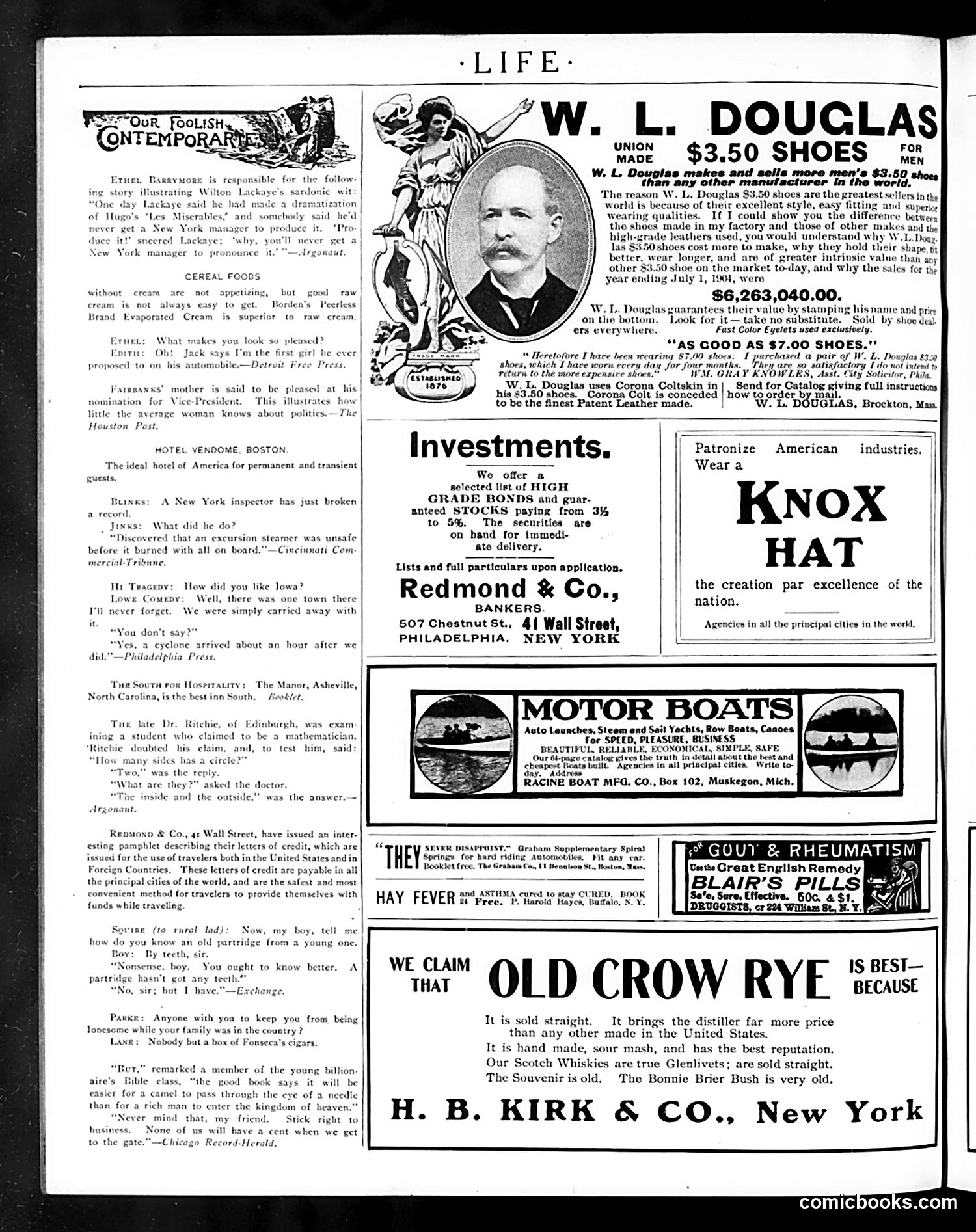
This page is primarily advertisements interspersed with brief humorous anecdotes. The left column contains short, joke-like stories mocking various people—actors with pretentious names, a woman uninterested in politics, mayors of small towns, and an Edinburgh mathematician. These are simple comedic barbs with no deep political significance. The advertisements dominate: W. L. Douglas shoes (with his photograph and endorsement), Knox hats, motor boats, investment firms, hay fever remedies, and Old Crow whiskey. The Douglas shoe ad mentions $6.26 million in sales and includes customer testimonials. These are straightforward commercial pitches typical of early 1900s magazines. Overall, this is a lifestyle/consumer goods page with light humor, not satirical commentary.
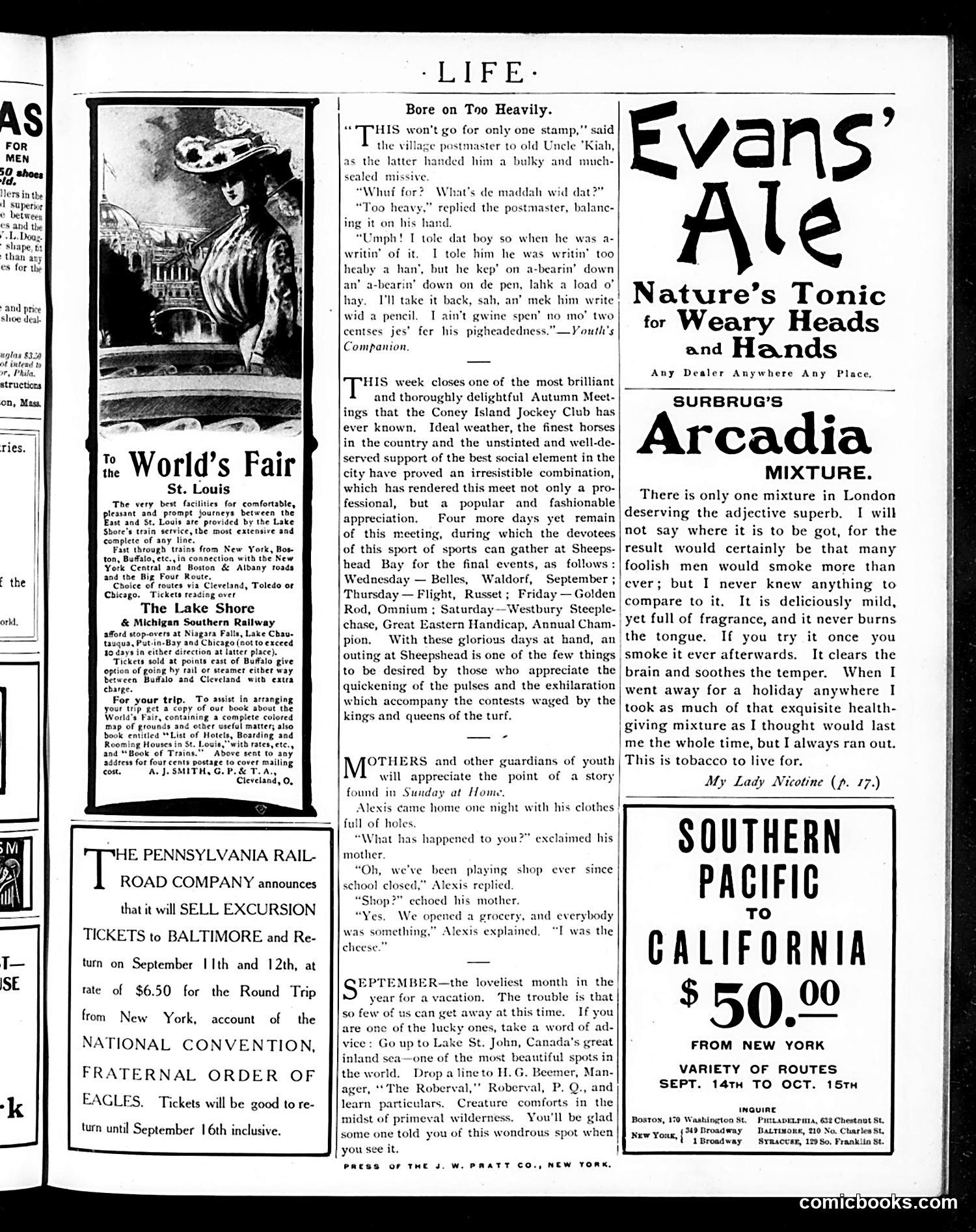
This page contains **no political cartoon**, but rather **humorous anecdotes and advertisements** typical of Life magazine's early 1900s format. The main text features two brief satirical stories: 1. **"Bore on Too Heavily"**: A dialogue between an elderly African American man and a postmaster about an overweight letter. The humor relies on dialect and the man's complaint that his boy pressed too hard with his pen while writing, making the letter too heavy for one stamp. This reflects early-1900s post office practices where mail weight determined postage. 2. **"Mothers and Youth"**: A short anecdote about a boy named Alexis coming home with torn clothes, explaining he and friends opened a pretend grocery store and he was "the cheese"—a mild joke about children's imaginative play. The page is primarily **advertising** (World's Fair travel, railroads, patent medicines like Evans' Ale and Surburg's Arcadia Mixture), reflecting Life's commercial nature. No significant political satire is present.
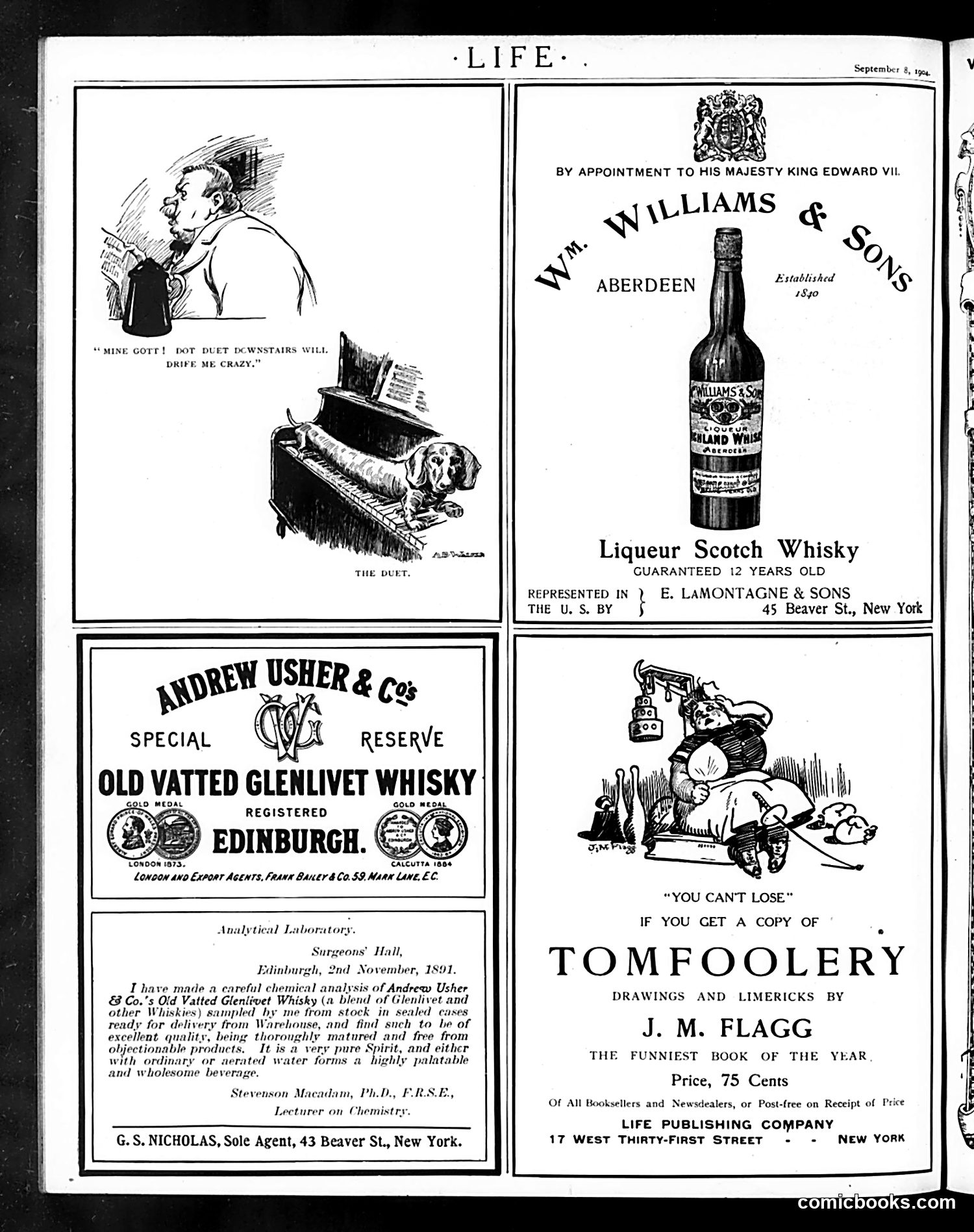
This page is primarily **advertising**, not editorial content. The left cartoon titled "The Duet" depicts a man annoyed by noise from downstairs, exclaiming in German-accented English: "Mine gott! Dot duet downstairs will drive me crazy." The humor relies on the stereotypical **German immigrant character**—identifiable by the dialect and exclamation—a common comedic trope of the era mocking non-English speakers. The page otherwise features **whisky advertisements** (Williams & Sons, Andrew Usher & Co.) and a book ad for "Tomfoolery" by J.M. Flagg, a popular American illustrator. The whisky ads include testimonials and royal warrants typical of early 1900s luxury marketing. The cartoon's satire is mild: it simply plays on immigrant speech patterns and everyday domestic annoyance—popular humor for a period when ethnic caricature was standard in American magazines.