
Life, 1904-09-08 · page 14 of 20
Life — September 8, 1904 — page 14: what you’re looking at
What you’re looking at
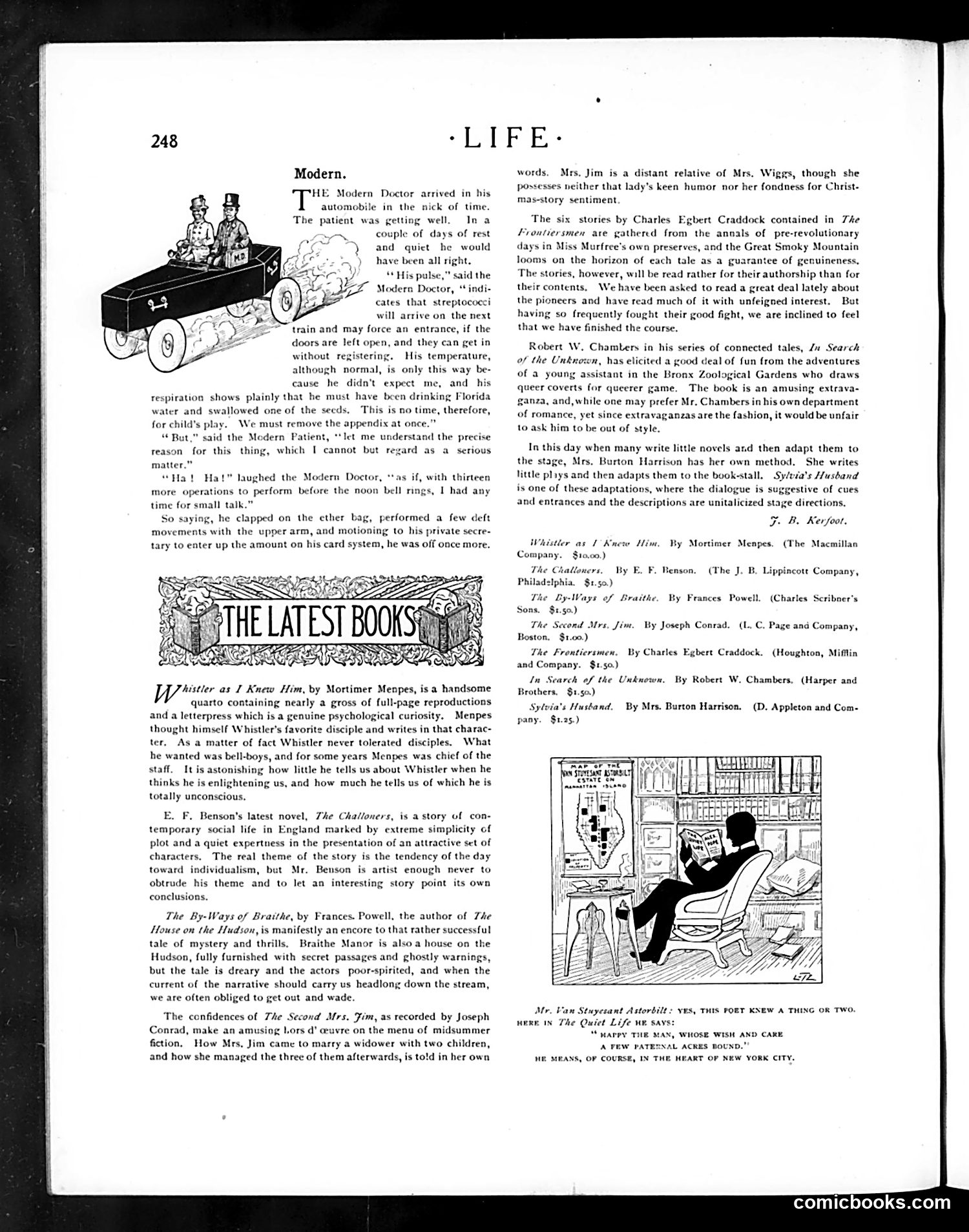
This cartoon mocks the early 20th-century trend of overly medicalized, interventionist medical practice. A doctor arrives by automobile and immediately diagnoses a patient who was recovering naturally with rest. Despite finding nothing objectively wrong (normal temperature, no actual symptoms), he insists on removing the patient's appendix—a common unnecessary surgery of the era. The satire targets the "Modern Doctor's" arrogance and profit-motive: he dismisses the patient's reasonable question about necessity, performs the operation hurriedly via ether anesthesia, and has his secretary record the charge before rushing off to perform thirteen more operations that day. The joke is that this hyperactive intervention contradicts actual medicine—the patient would have recovered without surgery. The cartoon criticizes how doctors weaponized "modern science" to justify profitable, unnecessary procedures on trusting patients.
📄 Transcribed text from this page (OCR, searchable)
Machine-transcribed from the original scan — historical spelling and the odd misread are preserved.
-LIFE- Modern, HE Modern Doctor arrived in his automobile in the nick of time. The patient was getting well. In a SA couple of days of rest and quiet he would have been all right. “ His pulse,” said the Modern Doctor, ‘ indi- cates that streptococci arrive on the next train and may force an entrance, if the doors are left open, and they can get in without registering. His temperature, although normal, is only this way be- cause he didn’t expect me, and his respiration shows plainly that he must have been drinking Florida water and swallowed one of the seeds, This is no time, therefore, for child's play. We must remove the appendix at once, “ But,” said the Modern Patient, ‘let me understand the precise reason for this thing, which I cannot but regard as a serious matter. Ha! Hat” laughed the Moc more operations to perform before the noon bell rings, I had any time for small talk.” So saying, he clapped on the ether bag, performed a few deft movements with the upper arm, and motioning to his private secre- tary to enter up the amount on his card system, he was off once more. 8 Doctor, “as if, with thirteen histler as I Knew Him, by Mortimer Menpes, is a handsome quarto containing nearly a gross of full-page reproductions and a letterpress which is a genuine psychological curiosity. Menpes thought himself Whistler's favorite disciple and writes in that charac- ter, As a matter of fact Whistler never tolerated disciples. What he wanted was bell-boys, and for some years Menpes was chief of the staff. It is astonishing how little he tells us about Whistler when he thinks he is enlightening us, and how much he tells us of which he is totally unconscious, E, F. Benson's latest novel, Zhe Challoners, is a story of con- temporary social life in England marked by extreme simplicity of plot and a quiet expertness in the presentation of an attractive set of characters, The real theme of the story is the tendency of the day toward individualism, but Mr. Benson is artist enough never to obtrude his theme and to let an interesting story point its own conclusions, The By-Ways of Braithe, by Frances. Powell, the author of The House on the Hudson, is manifestly an encore to that rather successful tale of mystery and thrills, Braithe Manor is alsoa house on the Hudson, fully furnished with secret passages and ghostly warnings, but the tale is dreary and the actors poor-spirited, and when the current of the narrative should carry us headlong down the stream, we are often obliged to get out and wade. ‘The confidences of The Second Mrs. Fim, as recorded by Joseph Conrad, make an amusing Lors d’ ceuvre on the menu of midsummer fiction, How Mrs, Jim came to marry a widower with two children, and how she managed the three of them afterwards, is to!d in her own words. Mrs, Jim is a distant relative of Mrs. Wiggs, though she possesses neither that lady’s keen humor nor her fondness for Chri mas-story sentiment The six stories by Charles Egbert Craddock contained in The Frontiersmen are gathered from the annals of pre-revolutionary days in Miss Murfree’s own preserves, and the Great Smoky Mountain looms on the horizon of each tale as a guarantee of genuineness, The stories, however, will be read rather for their authorship than for their contents, We have been asked to read a great deal lately about the pioneers and have read much of it with unfeigned interest. But having so frequently fought their good fight, we are inclined to feel that we have finished the course. Robert W. Chambers in his series of connected tales, Zn Search of the Unknown, has elicited a good deal of fun from the adventures of a young assistant in the Bronx Zoological Gardens who draws queer coverts for queerer game, The book is an amusing extrava- ganza, and, while one may prefer Mr, Chambers in his own department of romance, yet since extravaganzas are the fashion, it would be unfair to ask him to be out of style. In this day when many write little novels and then adapt them to the stage, Mrs, Burton Harrison has her own method, She writes little plays and then adapts them to the book-stall, Sy/via's Husband is one of these adaptations, where the dialogue is suggestive of cues and entrances and the descriptions are unitalicized stage directions. F. B. Kerfoot. Whistler as 1 Kne Him, Company. $10.00.) By Mortimer Menpes. (The Macmillan The Challoners, PhiladsIphia. $1.50.) The Dy-Ways of Braithe Sons. $1.50.) The Sccond Mrs, Jim. By Joseph Conrad. (1 Boston. $1.00.) The Frontiersmen, By Charles Egbert Craddock. (Houghton, Miflin and Company. $1.50.) In Search of the Unknown, By Robert W. Chambers, (Harper and Brothers, $1.50.) ‘a's Husband. By Mrs. Burton Harrison, pany. $1.25.) By E. F. Benson. (The J. B. Lippincott Company, By Frances Powell. (Charles Scribner's Page and Company, (D. Appleton and Com- Mr. Van Stuyesant Astorbilt : YS, THIS FOBT KNEW A THING OR TWO. uern in The Quiet Life we says: “ MAPPY TIE MAN, WHOSE WISH AND CARE A PEW PATERNAL ACRES BOUND." ME MEANS, OF COURSE, IN THE MEART OP NEW YORK CITY. comicbooks.com