
A complete issue · 20 pages · 1904
Life — August 25, 1904
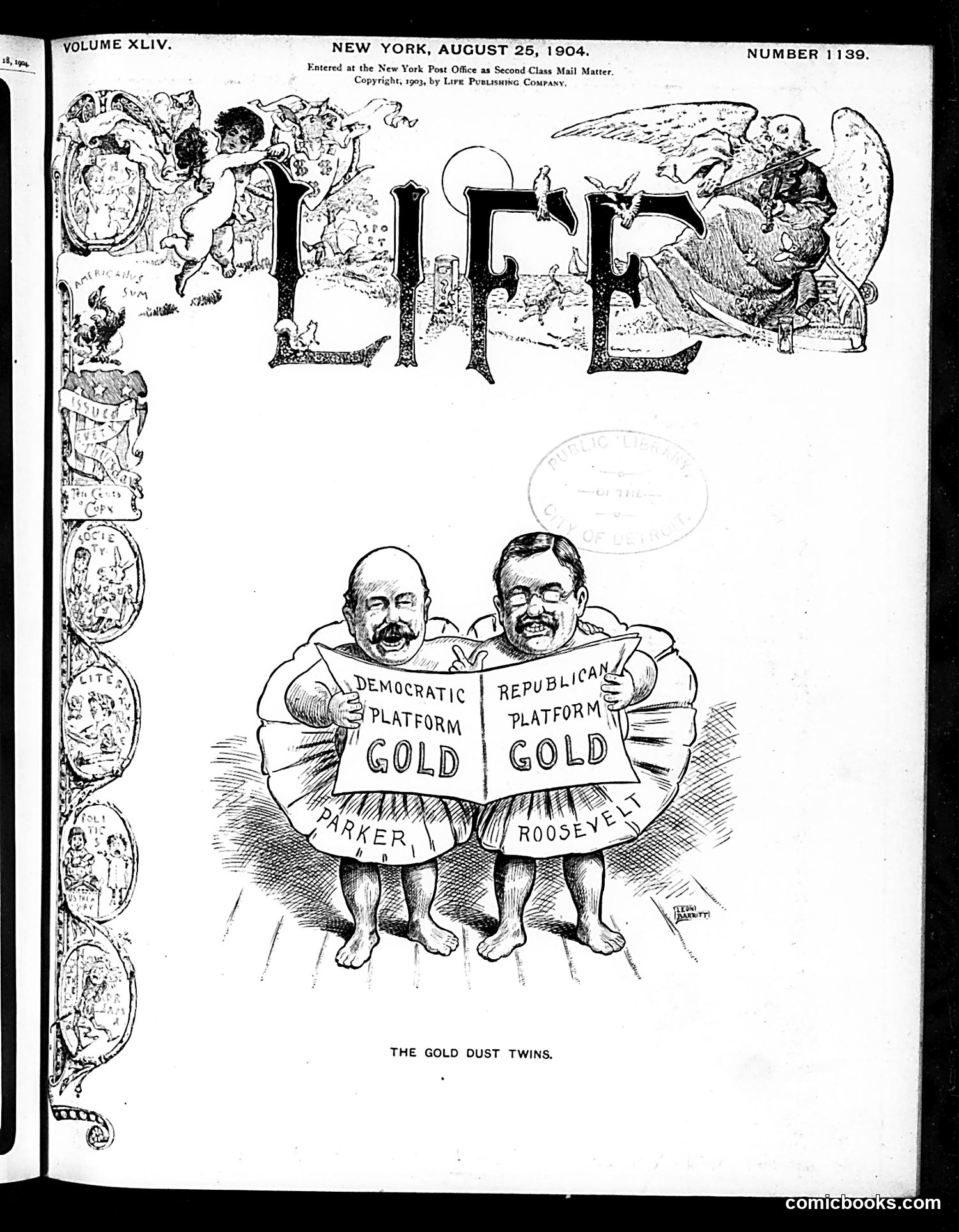
This political cartoon satirizes the 1904 presidential election. Two figures labeled "Parker" and "Roosevelt" are depicted as identical twins holding a shared document reading "Democratic Platform Gold" and "Republican Platform Gold." The satire suggests both major candidates—Alton B. Parker (Democratic nominee) and incumbent Theodore Roosevelt (Republican)—held essentially identical positions on the gold standard, a central economic issue of the era. The "Gold Dust Twins" reference (a popular cleaning product brand) mocks them as interchangeable and indistinguishable on this key policy matter. The cartoon implies voters faced no real choice between the parties, as both supported the gold monetary standard equally.
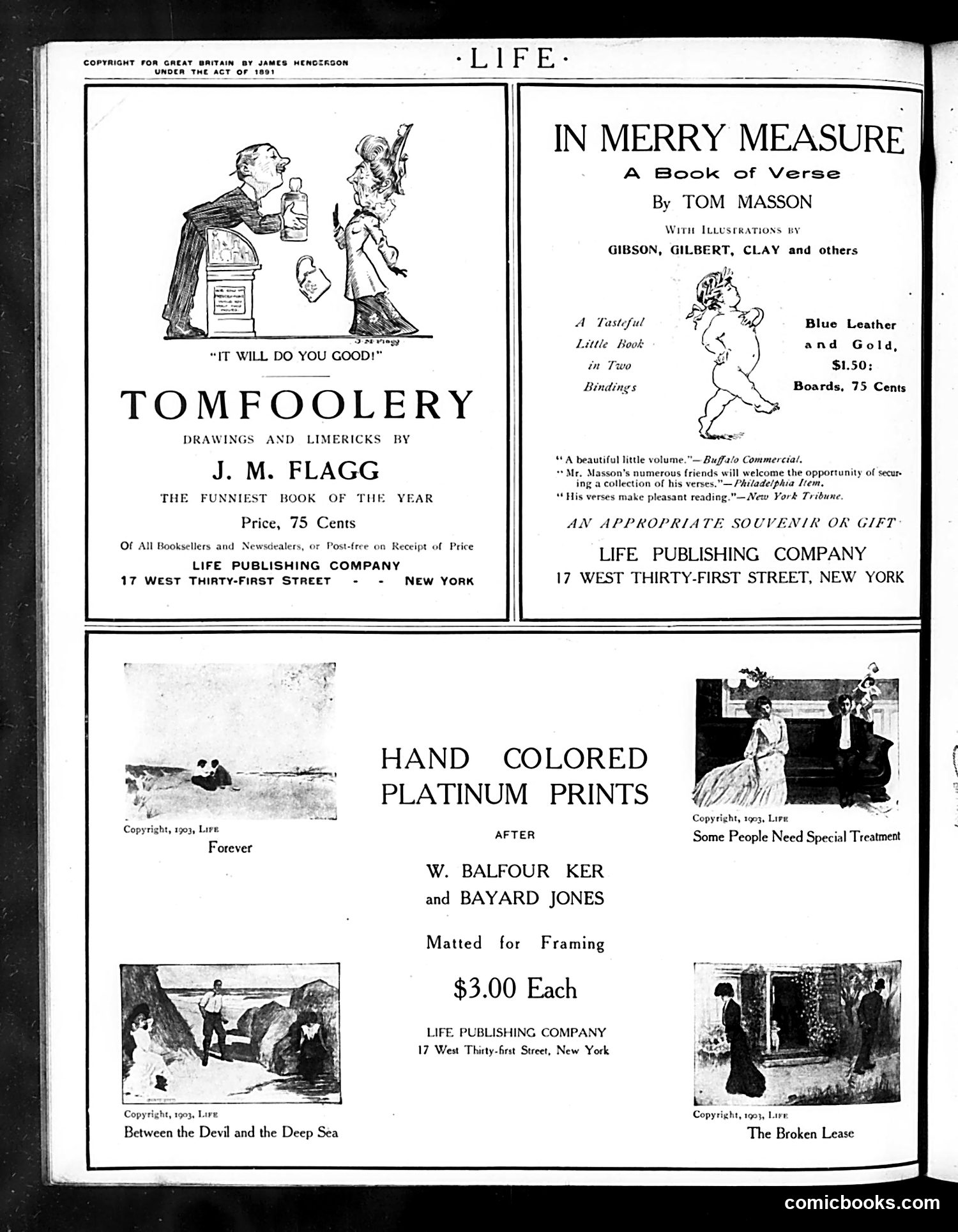
This page is primarily **advertising**, not political commentary. The top half advertises two books: "Tomfoolery" (drawings and limericks by I.M. Flagg, 75 cents) and "In Merry Measure" (verse by Tom Masson, illustrated by Gibson, Gilbert, Clay and others, $1.50). The lower half advertises hand-colored platinum prints by W. Balfour Ker and Bayard Jones, priced at $3 each. Four titled images are shown: "Forever," "Some People Need Special Treatment," "Between the Devil and the Deep Sea," and "The Broken Lease." The small cartoon at top-left (captioned "It will do you good!") appears to be sample humor from Flagg's book, but lacks clear political reference—it simply shows two figures in a comedic exchange.
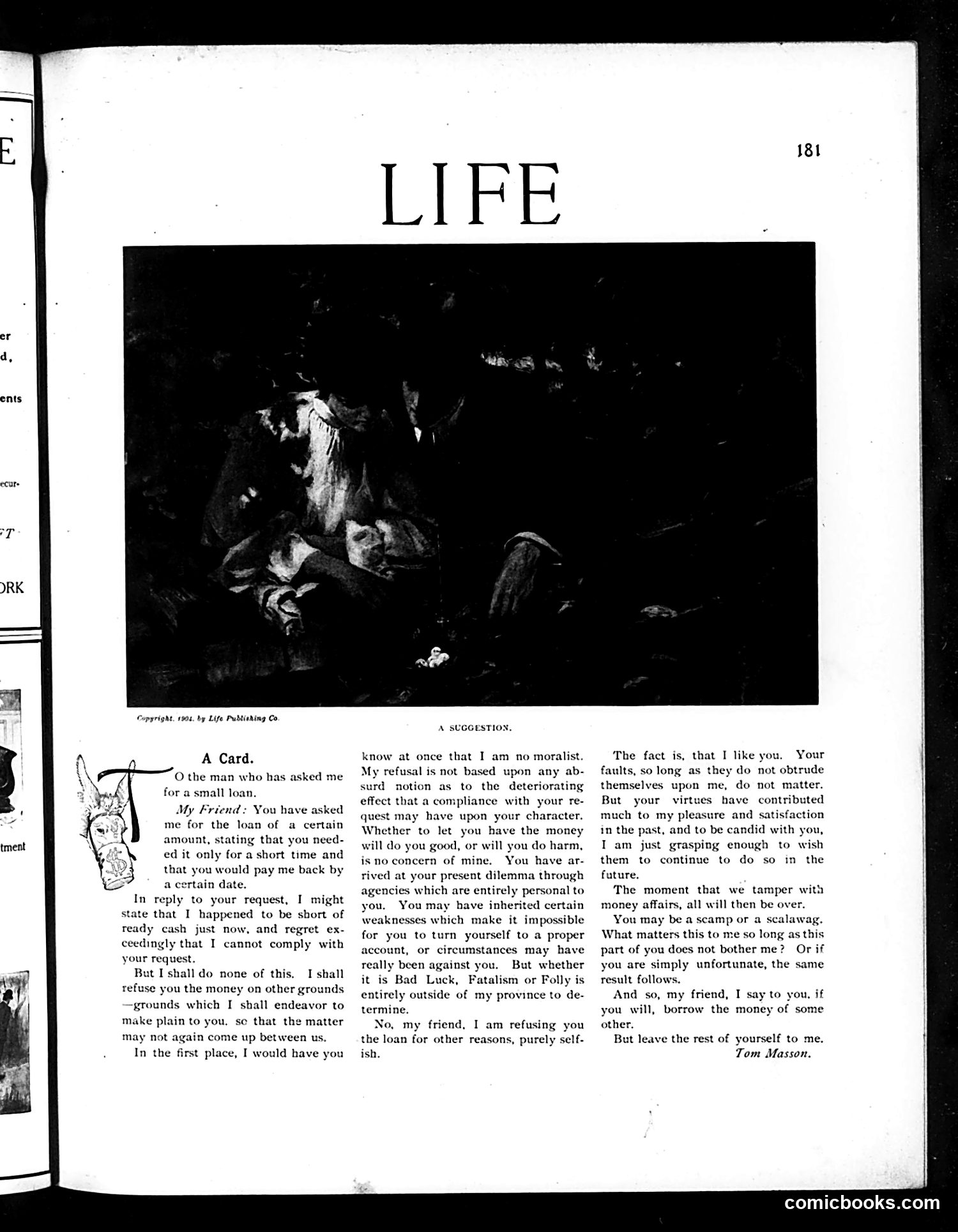
This page contains a satirical piece titled "A Card" addressing a financial dilemma. The accompanying dark illustration appears to show figures in what seems to be a morality tale about debt and character. The text presents a witty refusal of a loan request. The writer argues that lending money would be harmful to both parties—potentially corrupting the borrower's character through false security and creating an awkward power dynamic. Instead, the writer suggests the friend seek a loan elsewhere, concluding that protecting one's integrity and the friendship matters more than financial help. This satire mocks contemporary attitudes about money, obligation, and morality in personal relationships—suggesting that true friendship sometimes means *refusing* to help financially.
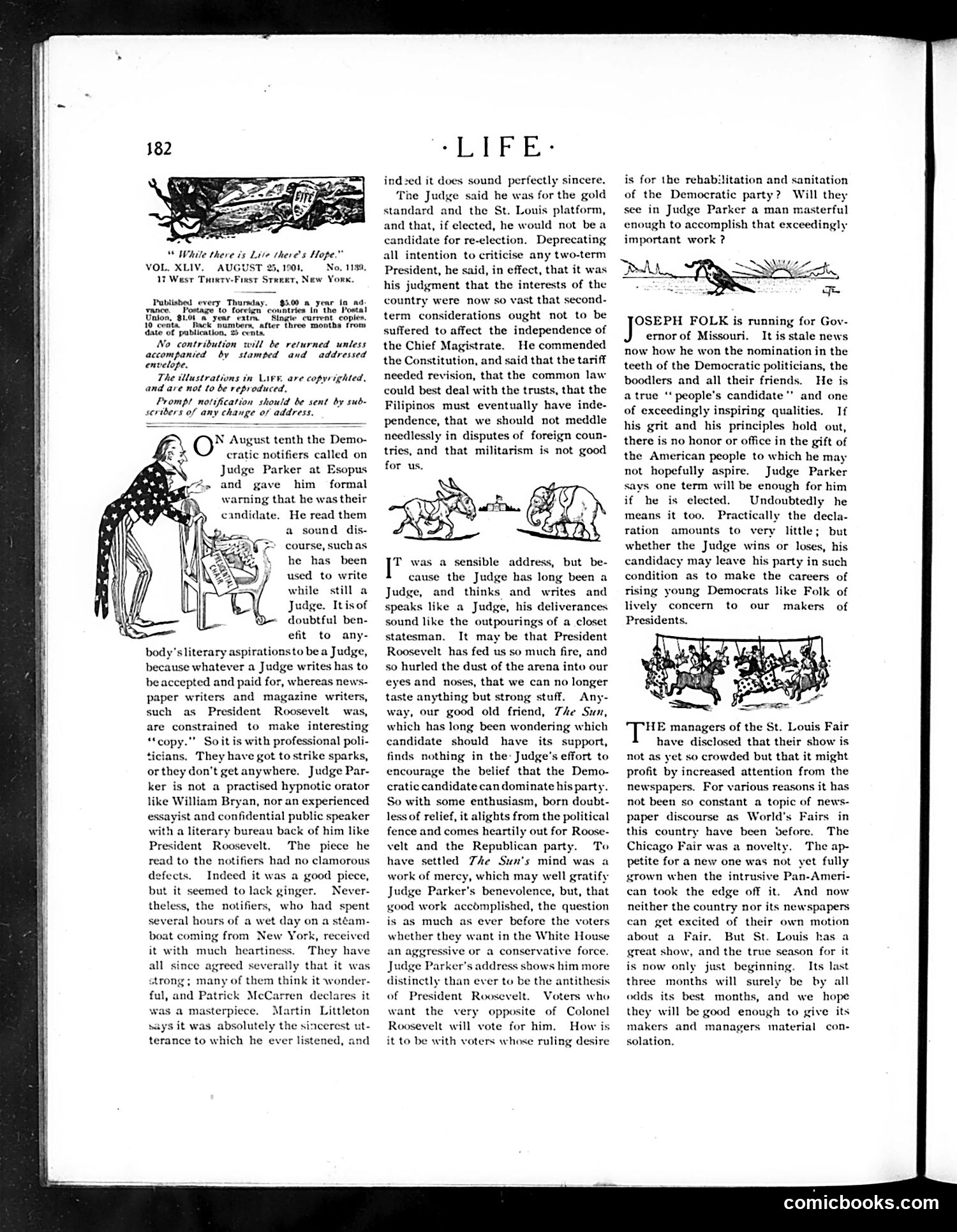
This page critiques Judge Parker's endorsement of Theodore Roosevelt's presidential candidacy. The left cartoon shows a figure (likely Judge Parker) receiving "formal warning" about becoming a two-term presidential candidate—satirizing the hypocrisy of a sitting judge entering politics while claiming to remain impartial. The text mocks Parker's literary pretensions, comparing his political speeches unfavorably to experienced orators like Roosevelt. It argues that Parker's endorsement lacks genuine enthusiasm and appears calculated rather than sincere. The right section discusses Joseph Folk running for Missouri governor as a "people's candidate," contrasting him favorably with Parker's approach. The satire suggests Parker represents establishment politics while Folk embodies genuine Democratic reform—a common Life magazine theme of this era.
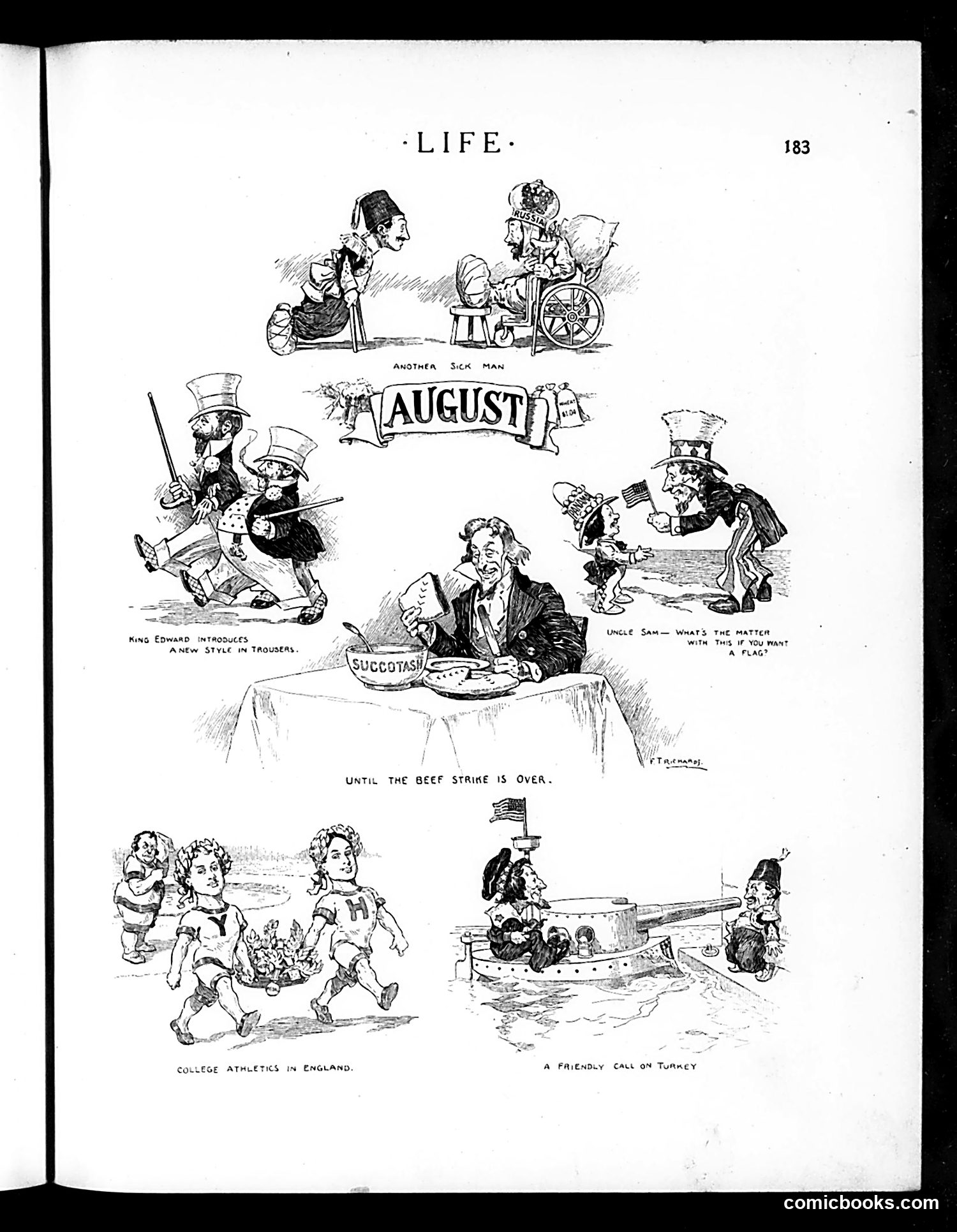
This page of satirical sketches mocks various August 1890s topics: **Top**: "Another Sick Man" depicts someone in a wheelchair—likely referencing the "Sick Man of Europe," a phrase for the declining Ottoman Empire. **Left**: "King Edward Introduces a New Style in Trousers" shows fashionable ridicule, probably Edward VII's fashion influence. **Center**: "Until the Beef Strike is Over" shows someone eating "Succotash"—mocking a labor strike by depicting substitute foods during meat shortages. **Right**: "Uncle Sam—What's the Matter with This if You Want a Place?" depicts American political patronage/spoils system. **Bottom**: "College Athletics in England" and "A Friendly Call on Turkey" continue topical satire about sports and international relations. The cartoons use exaggerated caricatures typical of period satirical humor.
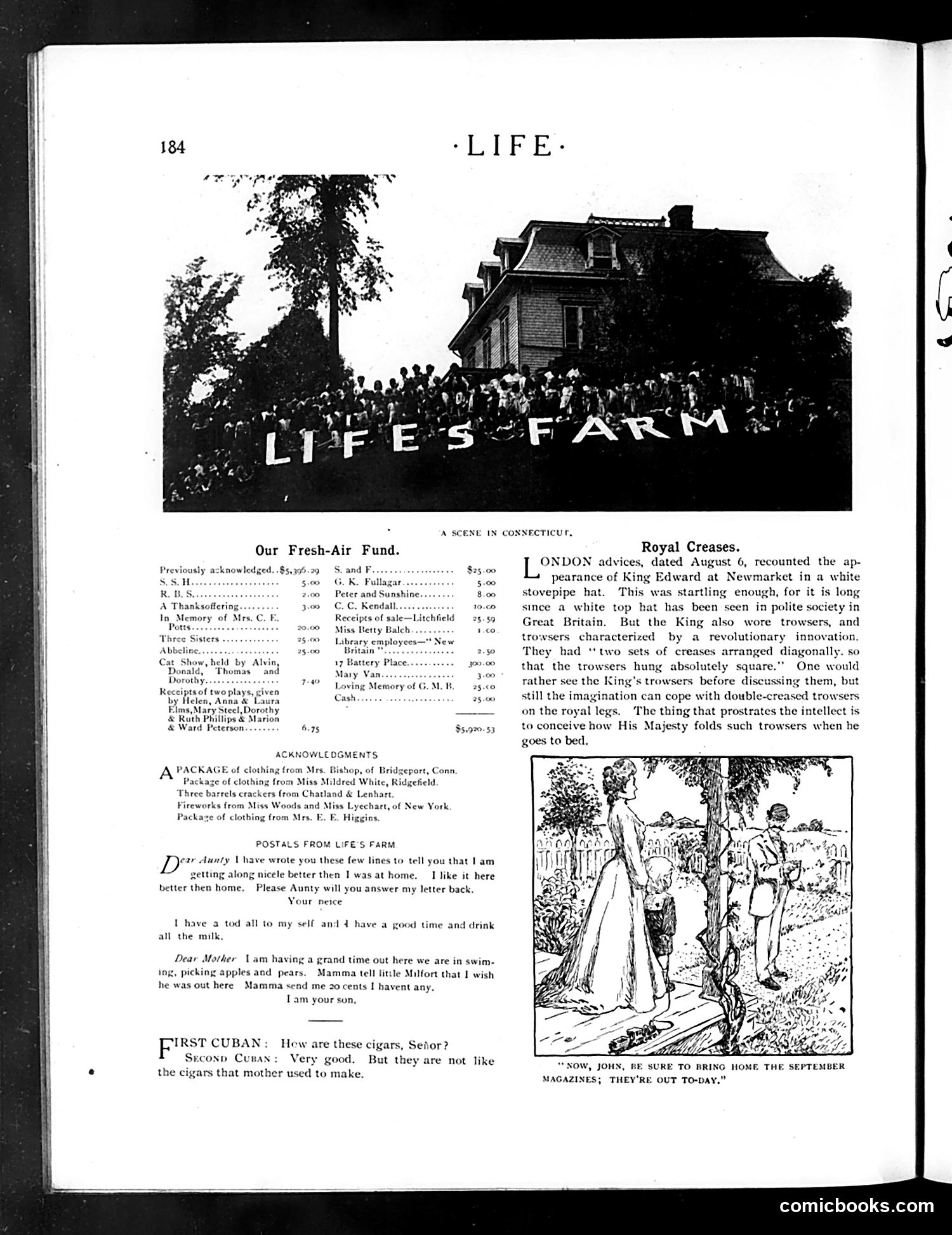
This page contains a satirical section titled "Life's Farm" featuring a humorous photograph of a large crowd gathered outside a Connecticut farmhouse, with the caption "A Scene in Connecticut." Below are light comedic pieces: personal letters from farm visitors (postcards from "Life's Farm"), including complaints about accommodations and requests for supplies, written in a joking tone to suggest the farm's inadequate facilities. The bottom section includes a brief dialogue labeled "First Cuban" between two characters discussing cigars, with one noting these cigars differ from those made by his mother—a gentle ethnic humor common to the era. The right page contains an illustration of a woman and child near a garden, captioned about bringing home September magazines. Overall, this appears to be light domestic and rustic humor rather than sharp political satire.
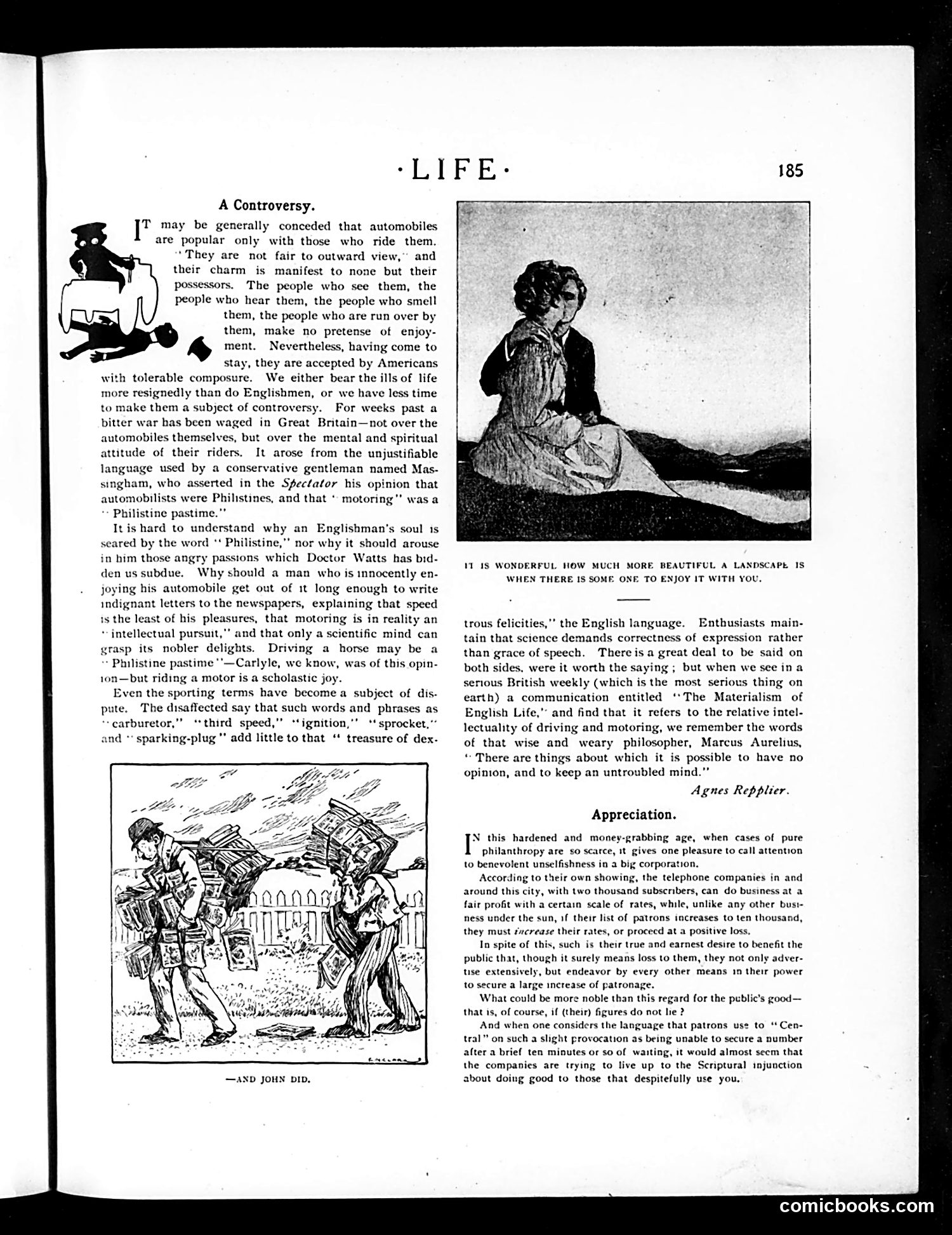
This page discusses the "Philistine" controversy over automobiles in Britain. The text criticizes a conservative gentleman named Massingham (writing in the *Spectator*) for calling automobiles "Philistine" and motoring a "Philistine pastime." The cartoons satirize this debate: **Top cartoon**: Shows a woman enjoying a scenic landscape from an automobile, captioned "It is wonderful how much more beautiful a landscape is when there is some one to enjoy it with you"—suggesting automobiles enhance appreciation of nature. **Bottom cartoon** (captioned "—And John did"): depicts two figures in an automobile, likely mocking the couple from the top image or illustrating the "enjoyment" automobiles provide. The satire targets British snobbery about motorcars as lower-class pursuits, while arguing Americans accept them more pragmatically as transportation and leisure.
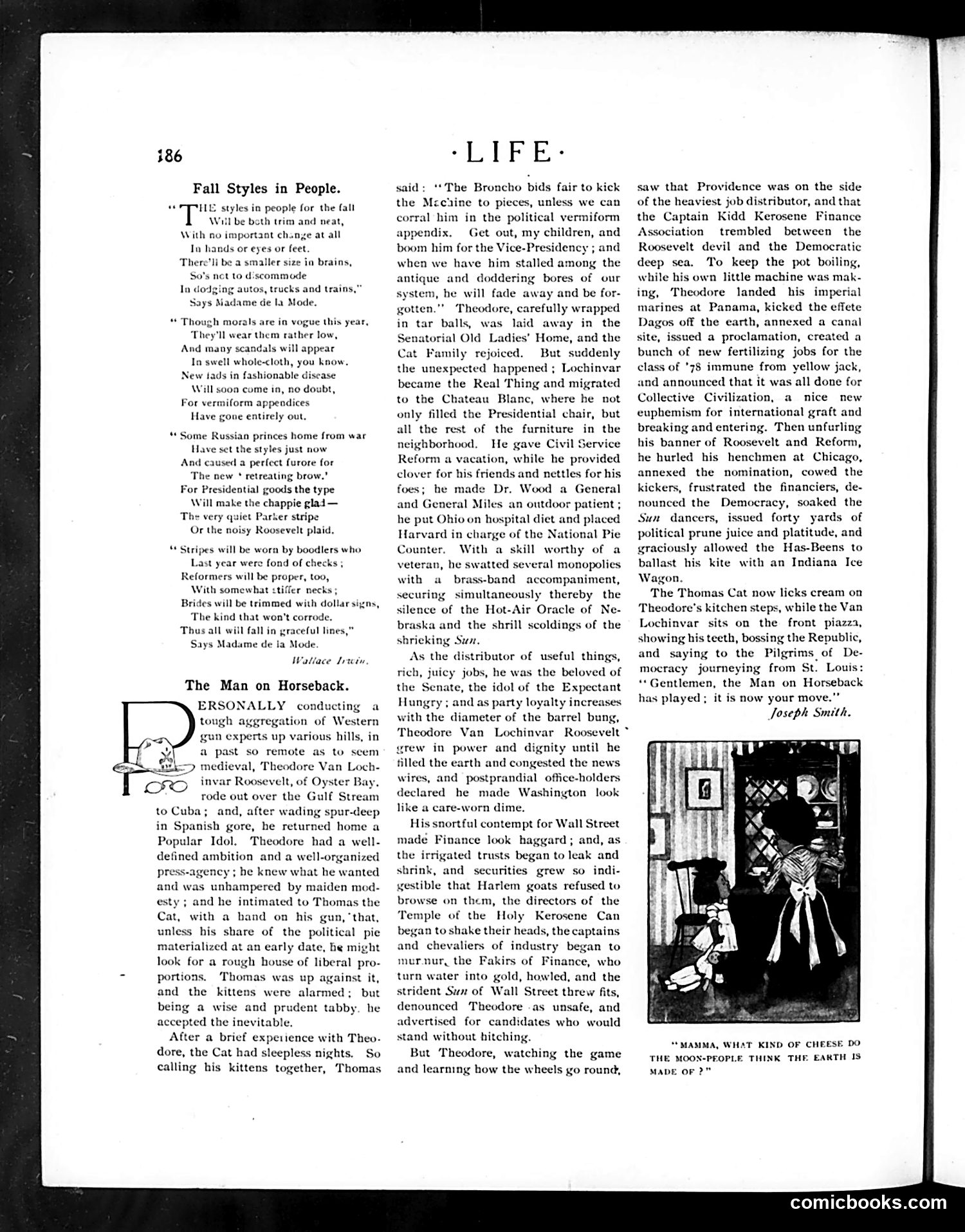
This page satirizes **Theodore Roosevelt's** political influence and ambitions. The text describes Roosevelt conducting "a tough aggregation of Western gun experts" and riding "over the Gulf Stream to Cuba," depicting him as an aggressive, expansionist figure. The accompanying illustration shows a man on horseback—clearly Roosevelt caricatured with his distinctive features—dominating the scene. The satire mocks his: - **Militarism and imperial adventures** (the Cuba reference likely alludes to his Rough Riders) - **Political power-playing** and manipulation of events - **Contempt for Wall Street** and established financial interests - His positioning as an inevitable political force ("your move") The "Man on Horseback" archetype refers to a military strongman wielding political power—a veiled critique of Roosevelt's outsized influence.
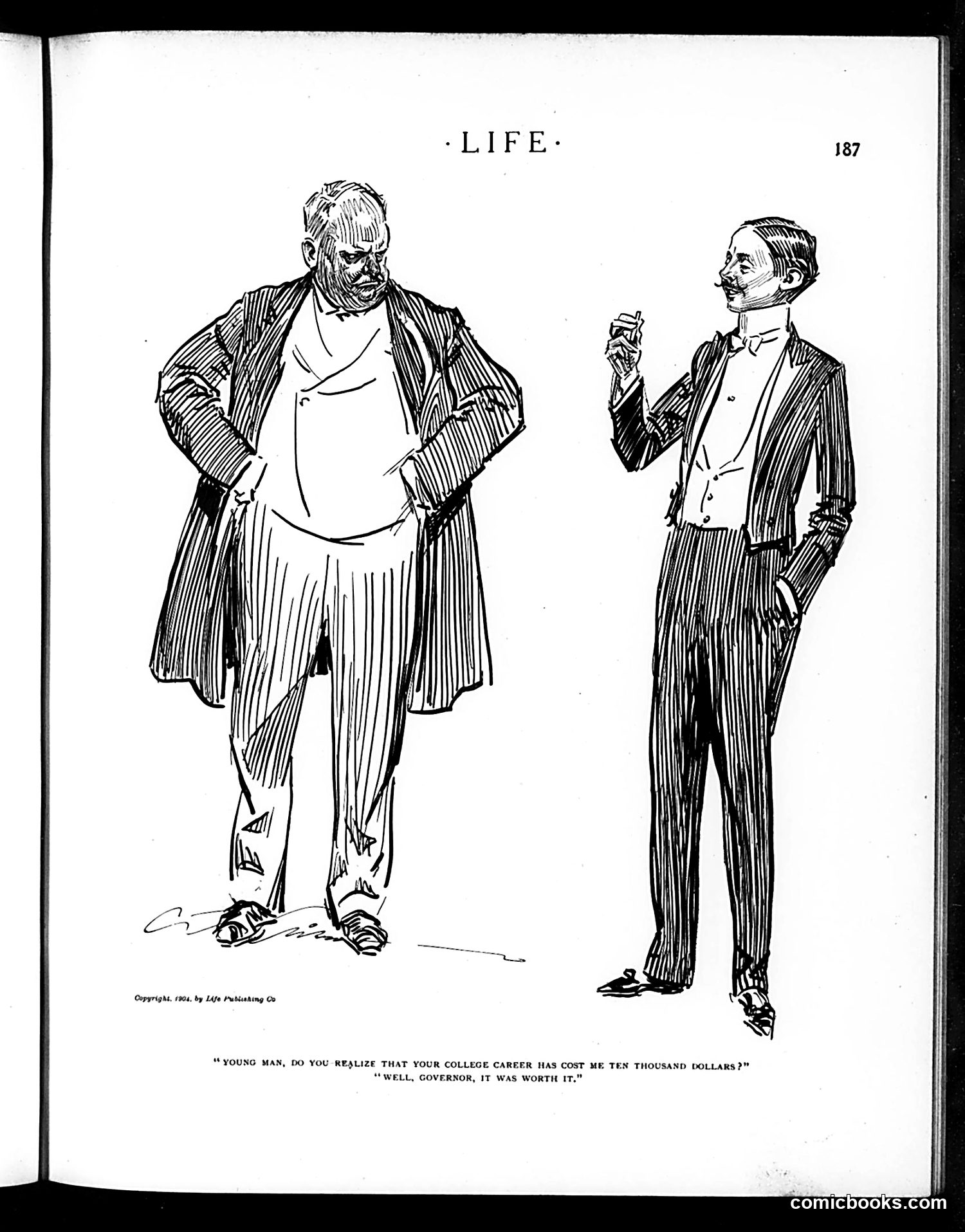
This is a single satirical cartoon from *Life* magazine (page 187). It depicts two men in formal attire: an older, heavyset figure on the left (labeled "Governor") and a younger, slimmer man on the right. The dialogue reads: "Young man, do you realize that your college career has cost me ten thousand dollars?" / "Well, Governor, it was worth it." The satire targets wealthy fathers who finance their sons' expensive college educations, only to watch the young men squander the investment through idleness or poor outcomes. The younger man's confident, dismissive response ("it was worth it") suggests he gained little of value despite the substantial financial burden—likely critiquing both parental indulgence and young men's lack of ambition or gratitude. The cartoon satirizes class privilege and generational attitudes toward education's practical value.
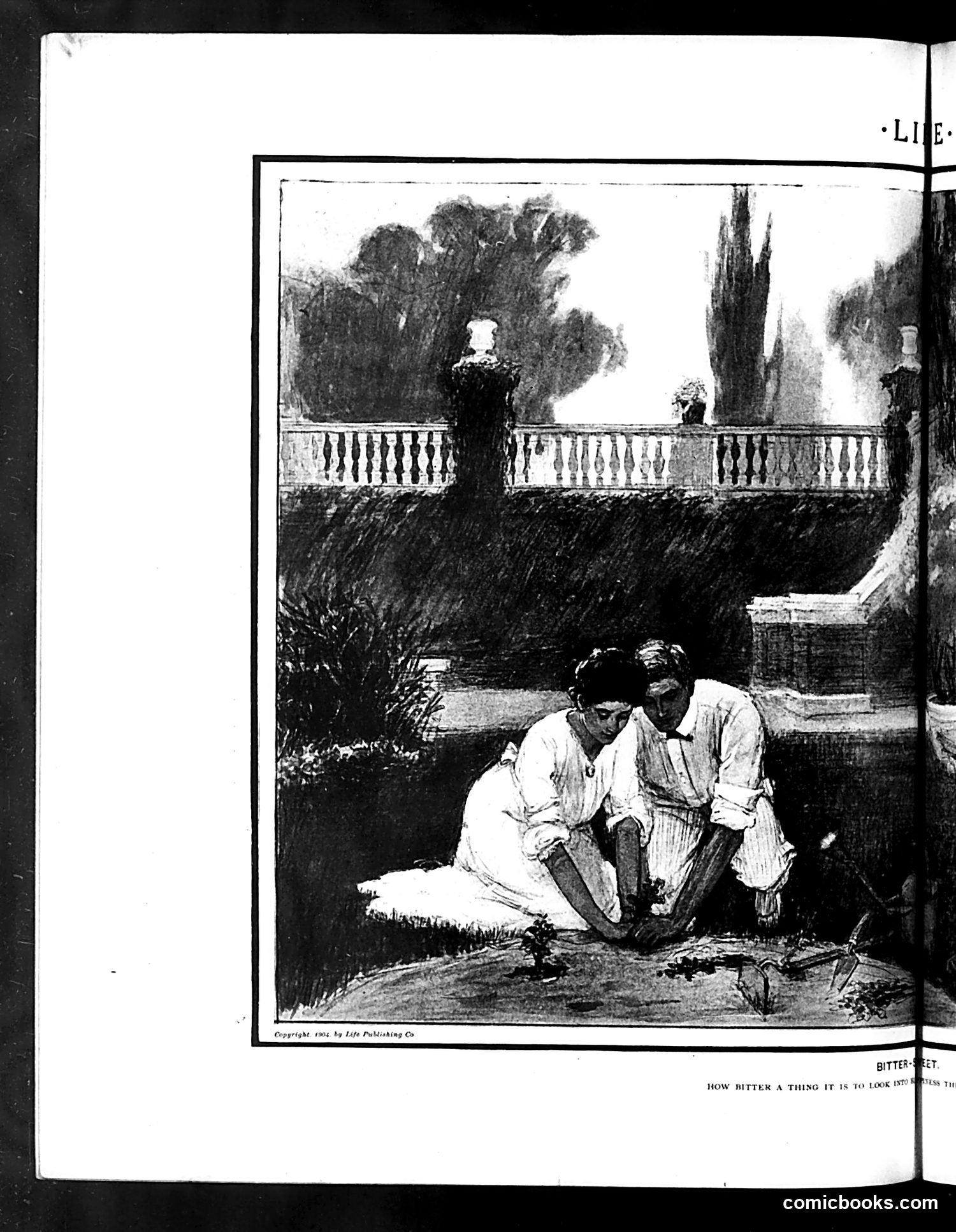
This appears to be a satirical illustration from *Life* magazine showing two figures in working-class dress crouching or bending over in what seems to be a garden or outdoor setting. A well-dressed figure stands elevated on a balcony above them, observing the scene. The caption reads "BITTER SET" and continues "HOW BITTER A THING IT IS TO LOOK UP[ON] TH[E]..." The cartoon likely satirizes class divisions and the perspective of the wealthy observing working-class labor from a distance. The composition emphasizes this hierarchy—the laborers below, the wealthy observer above—suggesting commentary on economic inequality or exploitation. The incomplete caption makes the precise satirical target unclear, but the visual metaphor of looking down upon workers is evident.
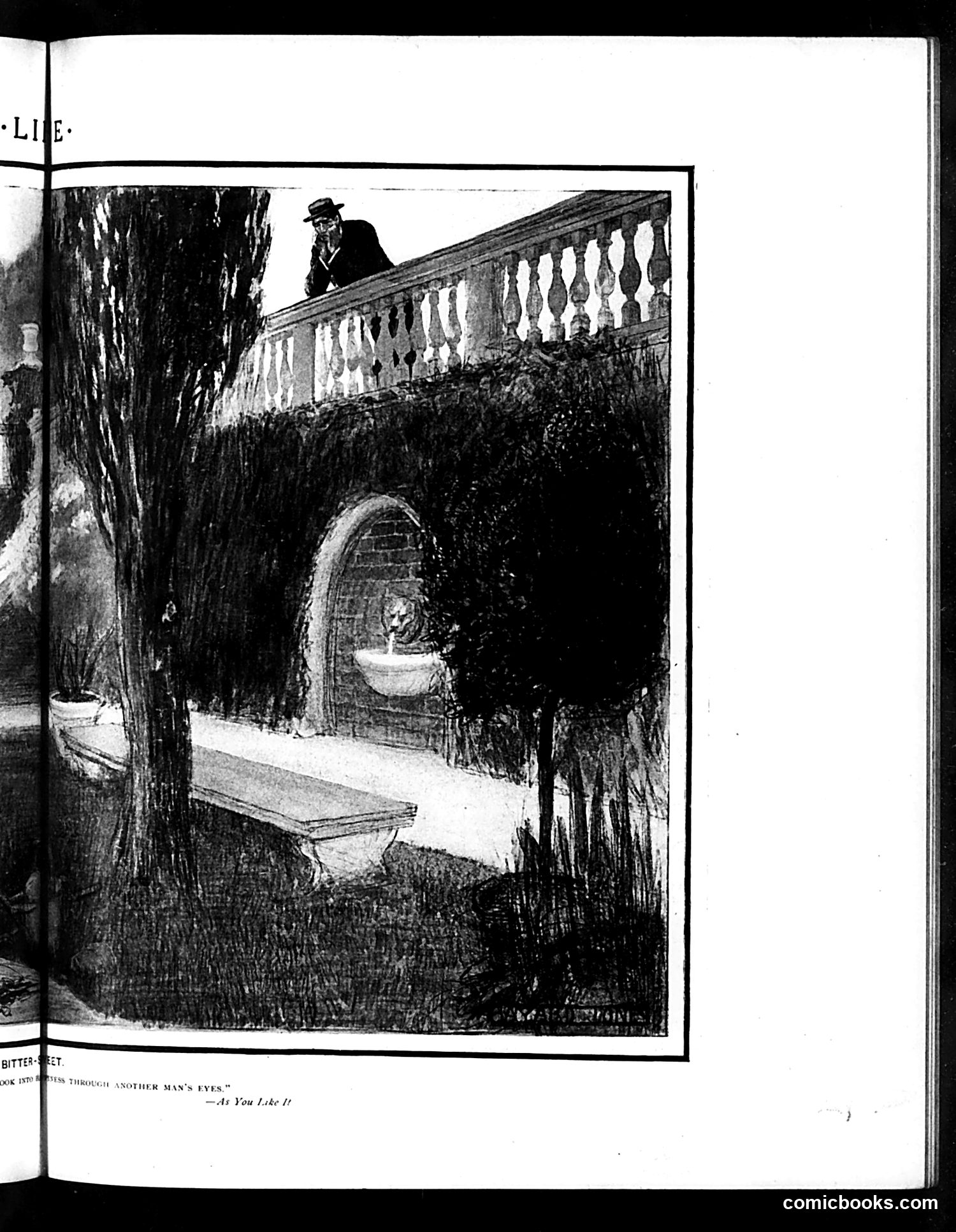
This appears to be a page from *Life* magazine featuring an illustration titled "**Looking Through Another Man's Eyes**" with the subtitle "As You Like It." The image shows a man in a hat standing atop an ornate balustrade, peering down through a stone archway into a garden or courtyard below. The composition uses architectural framing—the arch acts as a viewing window—to literalize the title's concept of "looking through another's eyes" or adopting someone else's perspective. The satirical point appears to be about voyeurism, intrusion into privacy, or the act of judgment from a privileged vantage point. The somewhat sinister tone and dramatic lighting suggest social commentary on observation, surveillance, or perhaps class-based perspective-taking. Without additional context about the publication date or surrounding content, the specific target of satire remains unclear.
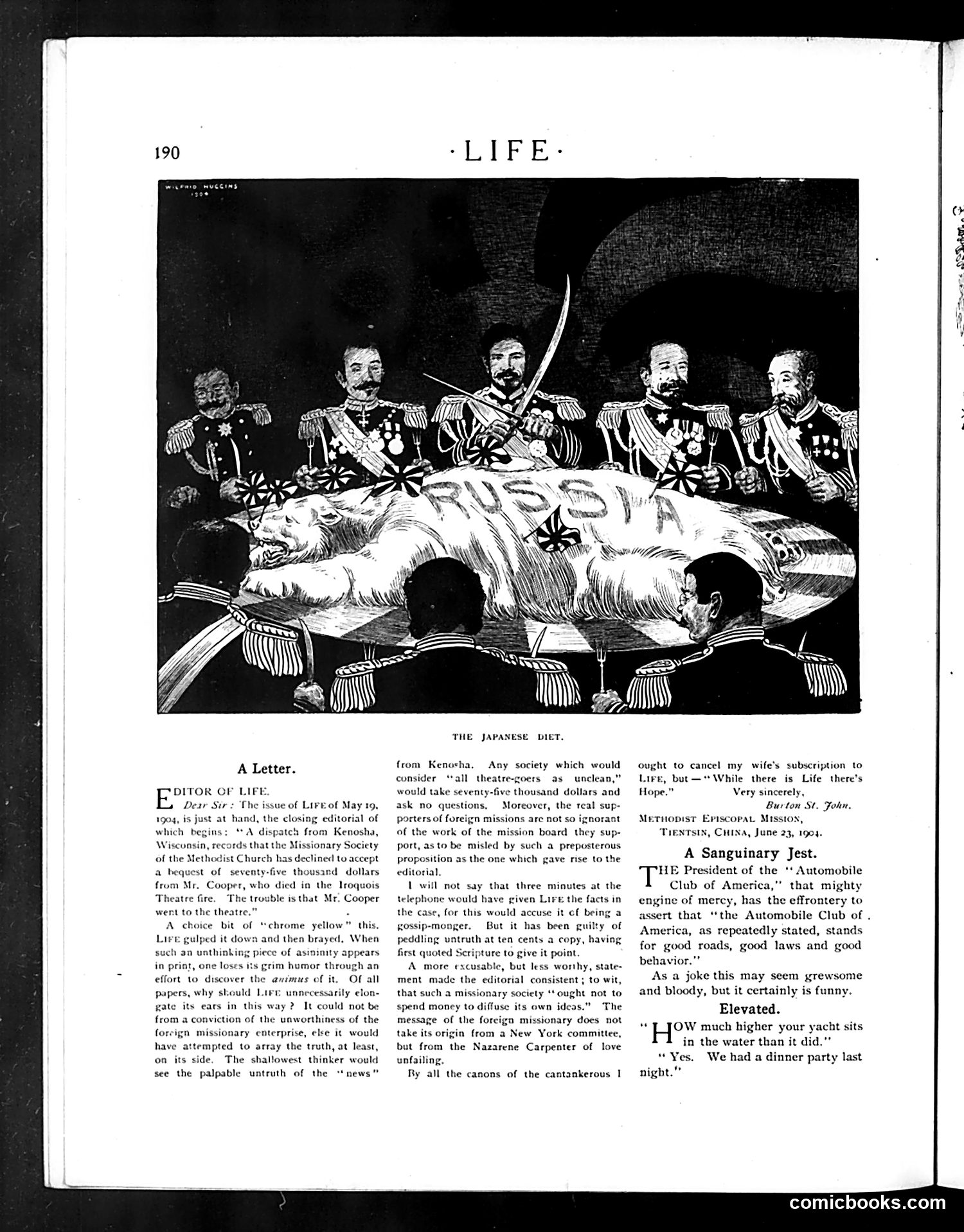
This political cartoon satirizes Japan's military leadership during the early 1920s. The image depicts five high-ranking Japanese military officers in formal dress uniforms seated around a table, appearing to dine on a large fish labeled "RUSSIA." The satire mocks Japan's imperial ambitions and military expansion into Russian territory, particularly following the Russian Revolution. The "diet" metaphor suggests these military leaders are consuming or conquering Russia as their meal—a commentary on Japanese imperial aggression in Eastern territories. The accompanying letter from a Life reader criticizes the magazine's editorial coverage of missionary work, but the cartoon's focus remains Japan's territorial expansion and the dominance of its militaristic government during this period of Japanese imperialism.
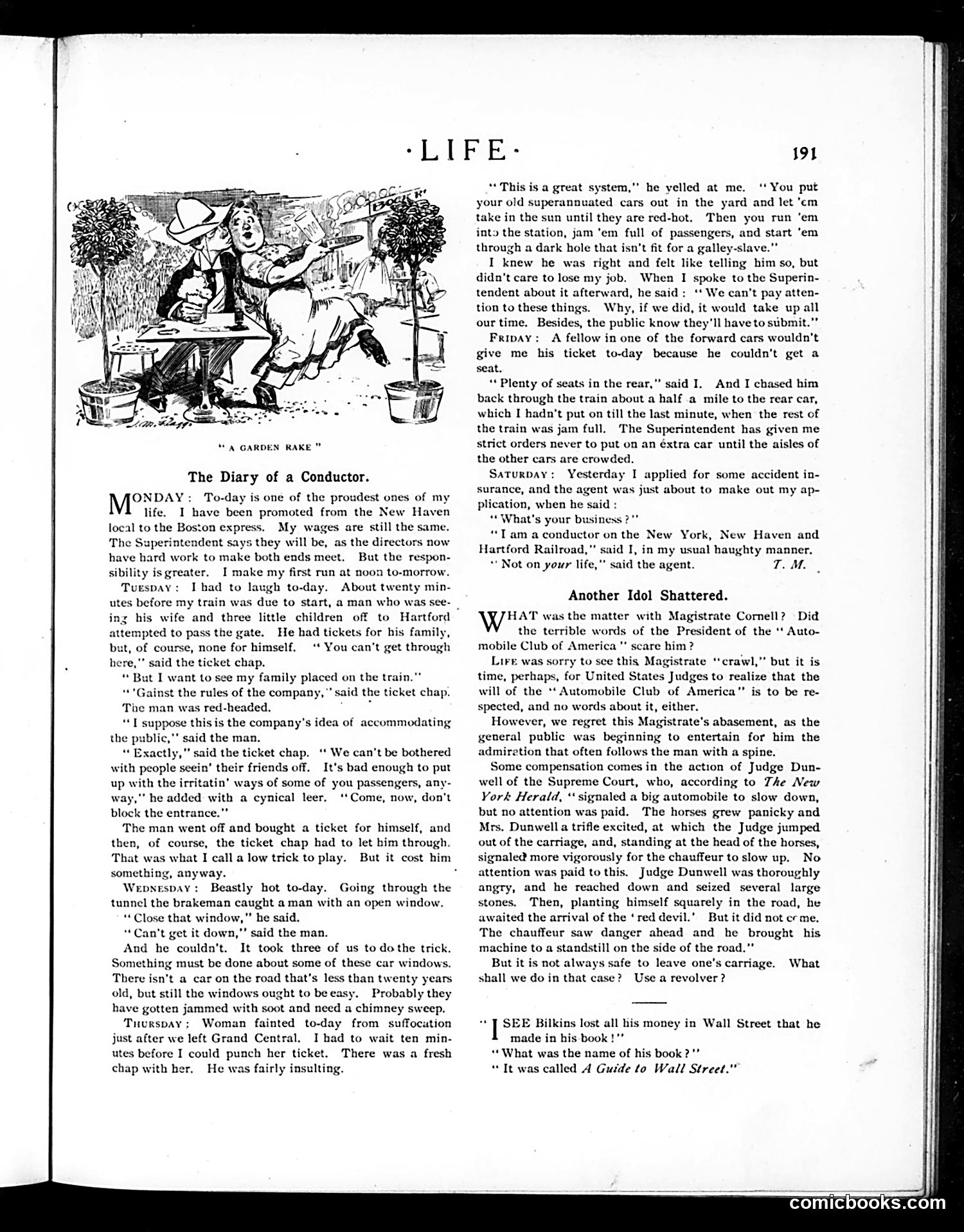
This page from Life magazine satirizes the poor conditions and incompetent management of American railroads (specifically the New York, New Haven and Hartford line) around 1911. **"The Diary of a Conductor"** depicts daily frustrations: outdated, overheated cars; windows jammed shut; overcrowding; and rigid, passenger-hostile policies. The conductor notes his promotion brings no pay increase, and management dismisses complaints about passenger safety and comfort as irrelevant. **The cartoon** ("A Garden Rake") illustrates the absurdity: a frustrated passenger attacking the train with a rake—visual metaphor for passengers' helplessness against corporate indifference. **"Another Idol Shattered"** mocks Magistrate Cornell for supposedly "crawling" before the Automobile Club president—suggesting wealthy motorists wielded enough influence to intimidate judges, while ordinary train passengers had no such power. The satire's point: railroads prioritize profit over service, management ignores legitimate grievances, and political connections matter more than public welfare.
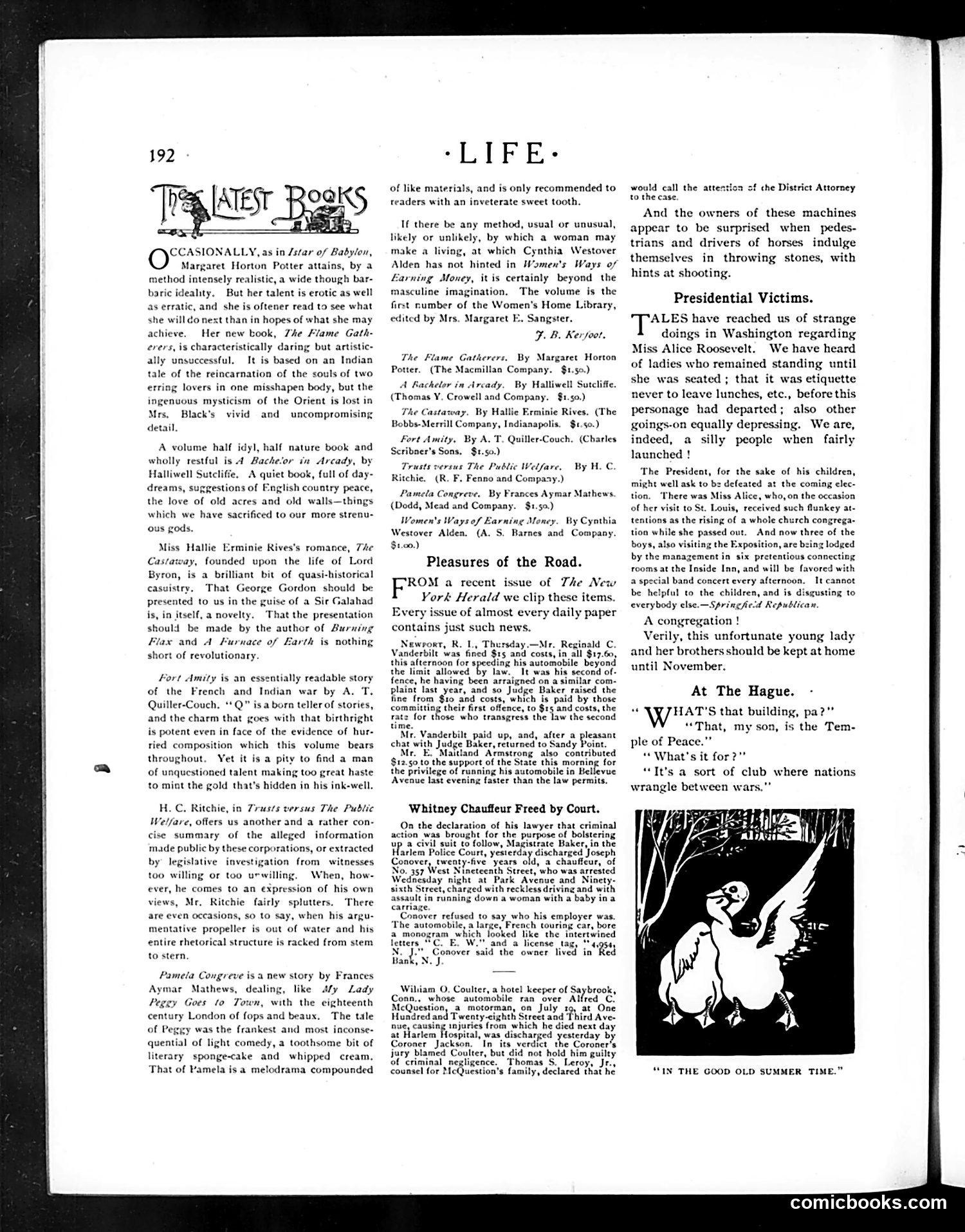
This page is primarily a **book review section** titled "Latest Books," with minimal cartoon content. The only illustration appears at bottom right: a simple sketch labeled "IN THE GOOD OLD SUMMER TIME," showing what appears to be a couple in a romantic pastoral scene—likely a generic nostalgic image accompanying the "Pleasures of the Road" section about leisurely travel. The page reviews contemporary fiction (early 1900s), with pointed criticism of authors like Margaret Horton Potter for "erotic" and "erratic" talent, and praise for quieter works like *Bachelor in Arcady*. There's also a section on "Presidential Victims" discussing ladies who remained standing at White House receptions, presented as social comedy. The book reviews dominate the content; any satirical intent is literary rather than political-cartoon based. This appears to be a standard Arts & Culture page rather than political satire.
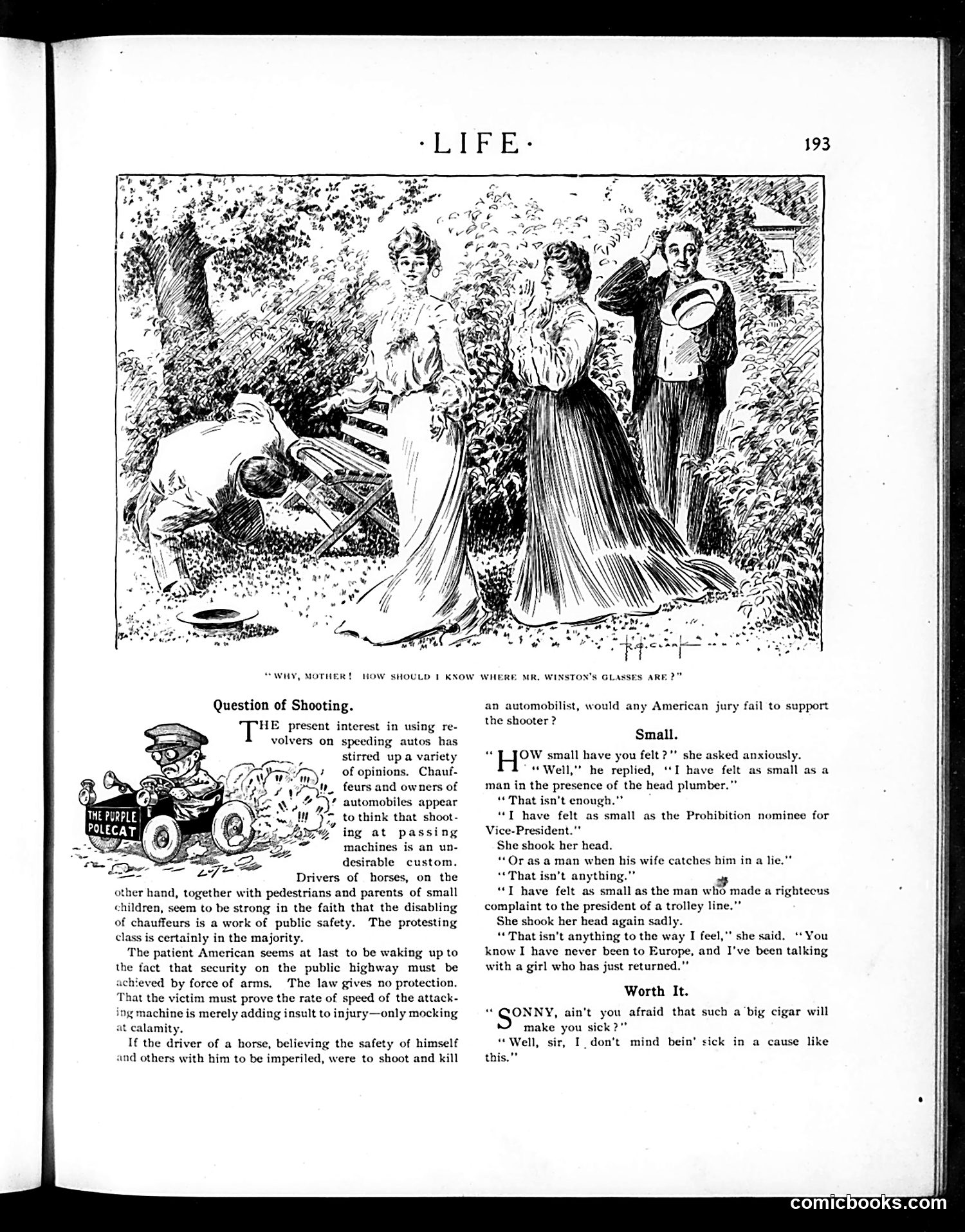
This page contains three satirical pieces reflecting early 20th-century American anxieties: **"Question of Shooting"** addresses automobile safety debates. The piece argues that while chauffeurs and car owners oppose shooting at speeding vehicles, horse drivers and pedestrians—endangered by reckless motorists—support it. The satire criticizes the law's failure to protect victims and suggests a jury would acquit someone defending themselves by shooting an automobilist. This reflects genuine tension between new automobile culture and traditional road users. **"Small"** uses a woman's increasingly exasperated responses to mock various American figures: a plumber (representing tradesmen's inflated self-importance), a "Prohibition nominee for Vice-President" (political commentary on Prohibition era politics), unfaithful husbands, and finally—most bitterly—people boasting about European travel. The joke targets social pretension. **"Worth It"** is a brief gag about a man willing to endure cigar-induced sickness as a patriotic or social duty—the specific cause remains unclear from context.
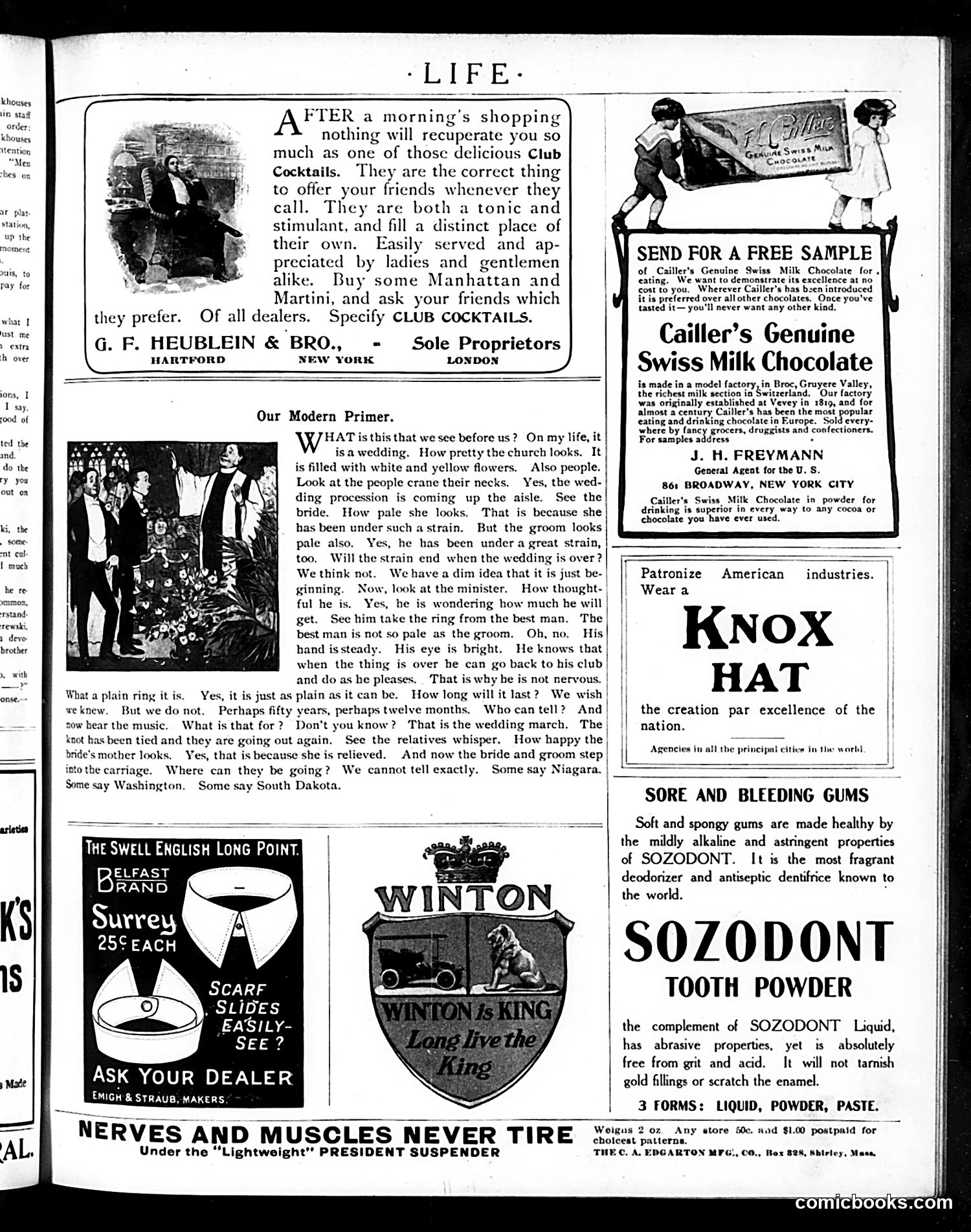
This page is primarily **advertising**, with one notable satirical article. The main editorial content is "Our Modern Primer," a sardonic wedding commentary. It presents a cynical view of marriage through detailed observation: the bride looks pale from "strain," the groom is nervous, and the best man is relaxed because he can "go back to his club and do as he pleases." The minister is calculating his fee. The piece mocks the permanence of marriage ("Perhaps fifty years, perhaps twelve months") and satirizes where newlyweds might honeymoon—suggesting Niagara Falls, Washington, or South Dakota as typical (unglamorous) destinations. This reflects early-20th-century satirical humor about marital obligation and the disconnect between romantic ceremony and mundane reality. The remainder consists of period advertisements: Club Cocktails (promoted as proper hospitality), Cailler's Swiss chocolate, Knox hats (with patriotic "American industries" messaging), and Sozodont tooth powder. These ads are historically interesting but lack satirical content.
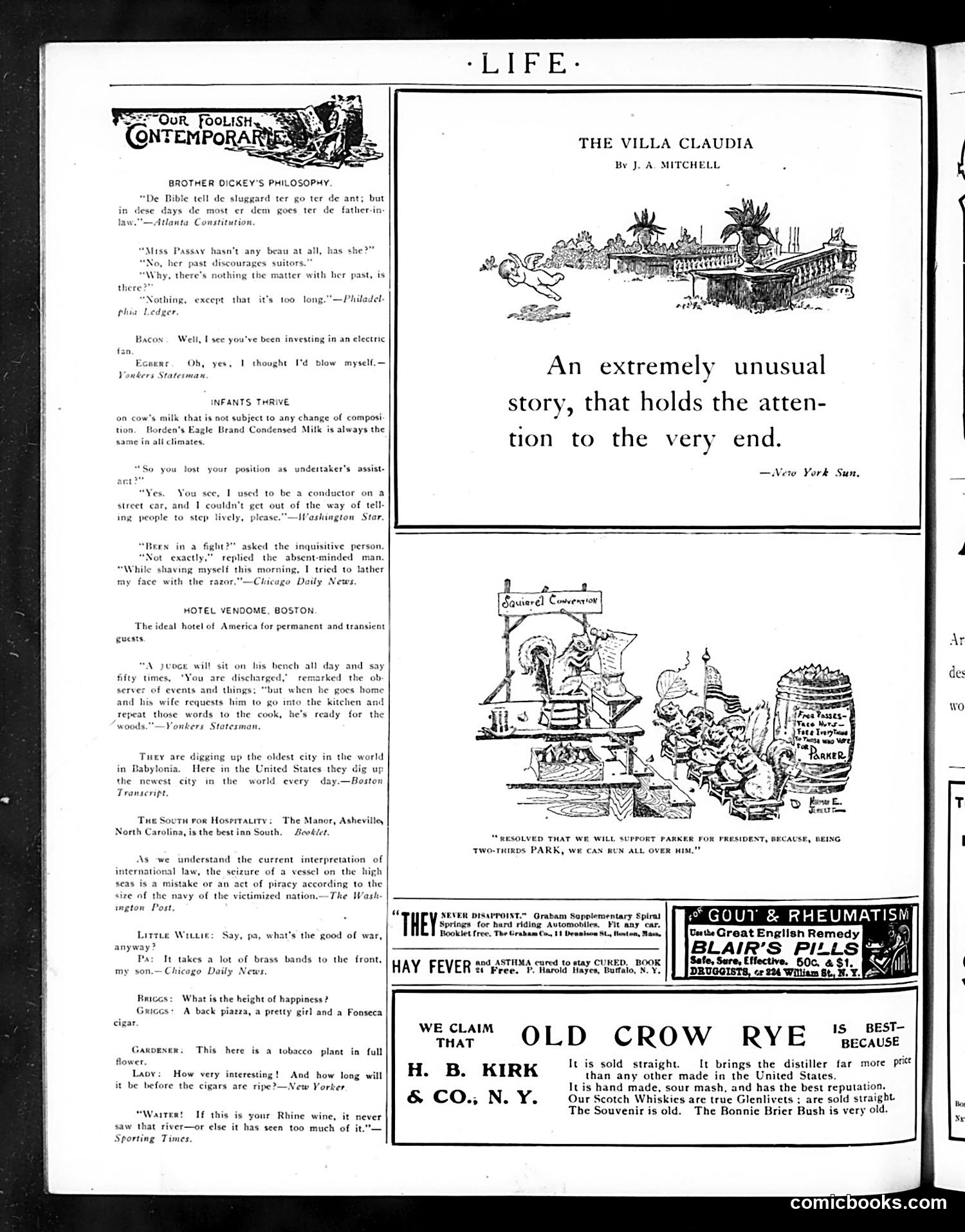
This page from Life magazine (circa early 1900s) is primarily **a collection of short humorous anecdotes and advertisements** rather than political cartoons. The humor relies on **turn-of-the-century social observations**: - "Brother Dickey's Philosophy" mocks lazy excuses - Various quips mock courtship failures, job incompetence, and marital dynamics - A joke about the Spanish-American War ("takes a lot of brass bands to the front") reflects contemporary military concerns - The international law reference appears to address naval seizures, likely post-war diplomatic tensions **The main feature** is an advertisement for "The Villa Claudia," a serialized story by J.A. Mitchell, promoted as sensational fiction. Lower sections include period **patent medicine ads** (hay fever cures, gout remedies) and **whiskey advertisements**, typical of early 1900s magazines before such advertising restrictions existed. The cartoon labeled "Quarrel Convention" appears to be political commentary, though details are unclear in reproduction. Overall, this reflects Life's format as a **satirical humor and lifestyle magazine for educated readers**, mixing social satire with commercial advertising.
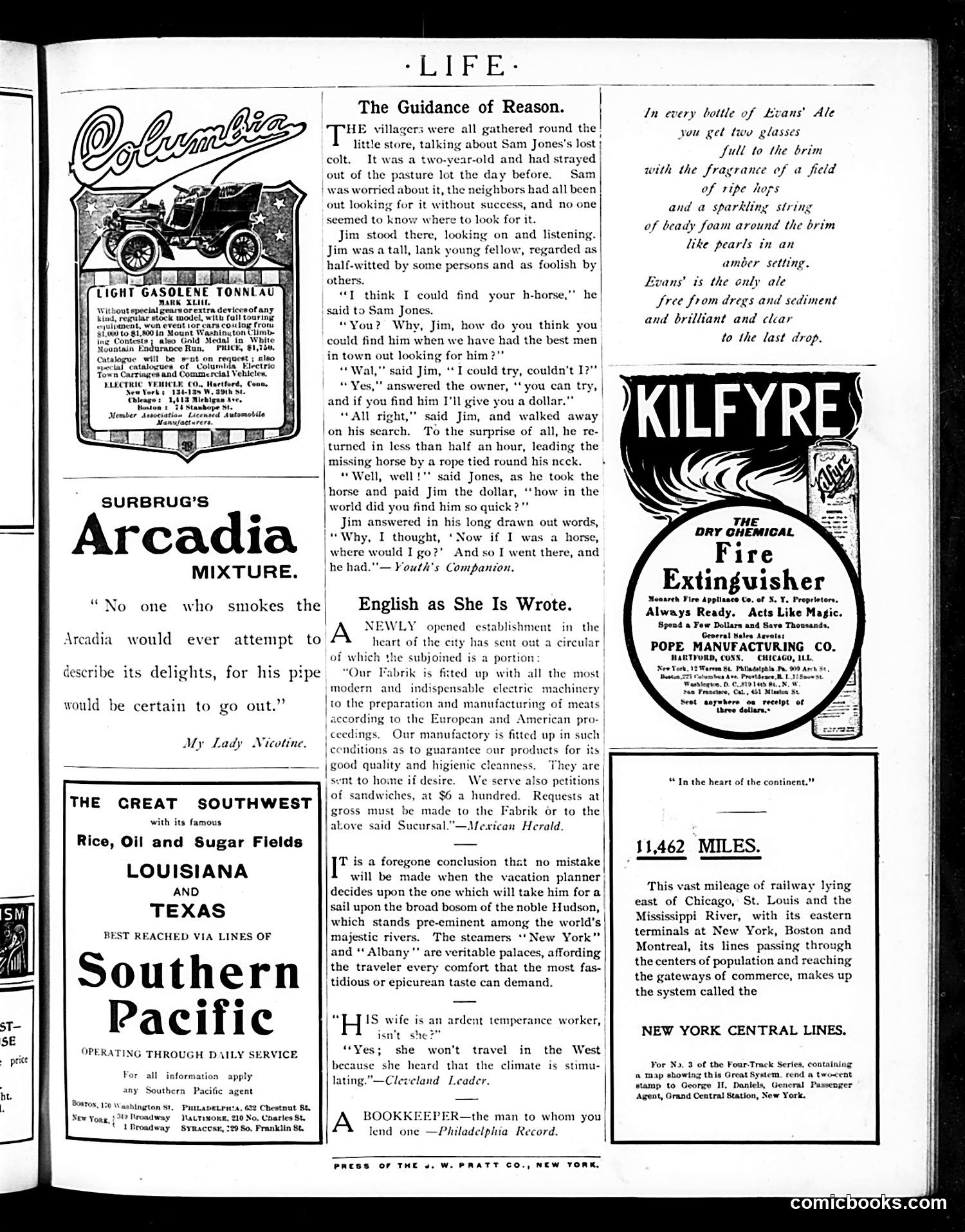
This page from *Life* magazine (a satirical publication) mixes advertisements with humorous anecdotal pieces typical of the era. **Main Content - "The Guidance of Reason":** A folk tale about Jim, a young man regarded locally as foolish or half-witted, who succeeds where educated townspeople fail. When Sam Jones's colt goes missing, Jim finds it by reasoning: "if I was a horse, where would I go?" He retrieves it in under an hour. The satire mocks conventional wisdom—suggesting simple, direct thinking can outperform elaborate effort. This reflects period skepticism toward pretension and education without practical sense. **"English as She Is Wrote":** A satirical notice from a Mexican meat factory advertising its modern facilities but written in comically fractured English ("Fabrik," "higienic cleannes," "petitions of sandwiches"). The humor targets both Mexican business owners attempting English and American condescension toward foreign commercial ventures. **Advertisements:** Primarily tobacco, automobiles, regional travel (Southern Pacific Railroad), and beverages—typical early 1900s consumer goods. The overall tone emphasizes rural common sense versus urban sophistication, a recurring *Life* satirical theme.
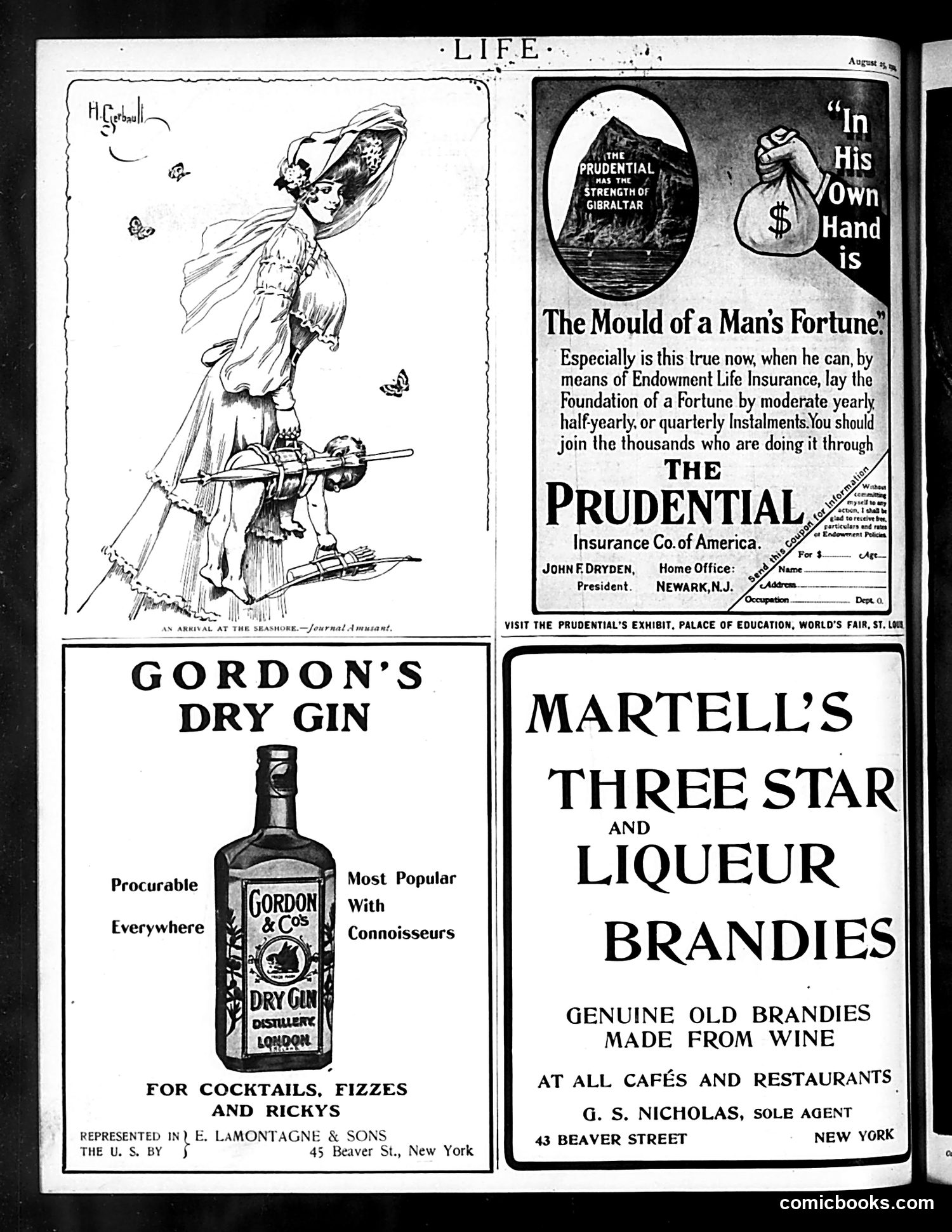
This page is primarily **advertising**, not editorial satire. It contains four commercial advertisements from circa early 1900s. The top-left illustration shows a stylized woman in flowing dress—labeled "An Arrival at the Seashore"—likely a fashion or lifestyle sketch accompanying or separate from the ads. The advertisements promote: 1. **Prudential Insurance**: Emphasizes life insurance as wealth-building through installment payments, referencing their World's Fair exhibit 2. **Gordon's Dry Gin**: British gin marketed as popular with connoisseurs, available for cocktails 3. **Martell's Brandy**: French brandy sold at restaurants No political cartoon or satire is evident here. The page reflects early 20th-century consumer culture: financial products, imported spirits, and leisure pursuits aimed at middle/upper-class readers. The artwork is decorative rather than satirical. This appears to be a typical revenue-generating magazine page mixing illustration with paid advertisements.