
Life, 1904-08-25 · page 4 of 20
Life — August 25, 1904 — page 4: what you’re looking at
What you’re looking at
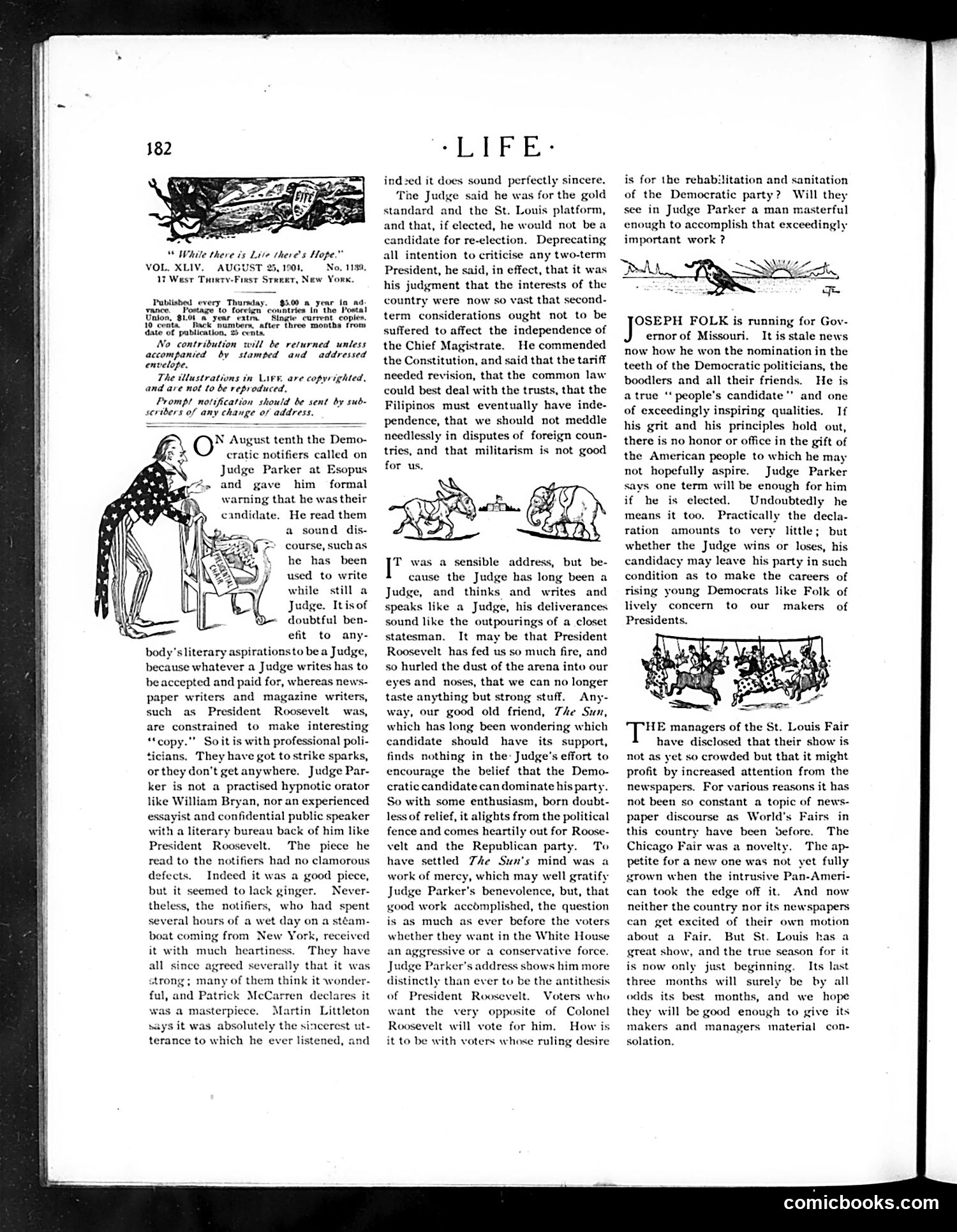
This page critiques Judge Parker's endorsement of Theodore Roosevelt's presidential candidacy. The left cartoon shows a figure (likely Judge Parker) receiving "formal warning" about becoming a two-term presidential candidate—satirizing the hypocrisy of a sitting judge entering politics while claiming to remain impartial. The text mocks Parker's literary pretensions, comparing his political speeches unfavorably to experienced orators like Roosevelt. It argues that Parker's endorsement lacks genuine enthusiasm and appears calculated rather than sincere. The right section discusses Joseph Folk running for Missouri governor as a "people's candidate," contrasting him favorably with Parker's approach. The satire suggests Parker represents establishment politics while Folk embodies genuine Democratic reform—a common Life magazine theme of this era.
📄 Transcribed text from this page (OCR, searchable)
Machine-transcribed from the original scan — historical spelling and the odd misread are preserved.
“ White there is Lite there's Hope.” VOL. XLIV. AU 21901, No, 1189, 17 West Tuiery: TrEET, New Yorn. Thursday. fe Published every $5.00 a year ia nd wance. I to foreign countries In the Postal Union, $1.00 year extm | Singie current copies. 10'centa. "Rack numbers. after three tonths from date of pablication, 25 cents. No contribution will be returned unless accompanied by stambed and addressed envelope. The illustrations in Live, are copyrighted, and are not to be reproduced. Prompt notification should be sent by sub- seribers of any change of address. August tenth the Demo- cratic notifiers called on Judge Parker at Esopus A» and gave him formal \ warning that he was their He read them sound dis- course, such as he has been used to write while still a Judge. Itisof doubtful ben- efit to any- body's literary aspirationsto be a Judge, because whatever a Judge writes has to be accepted and paid for, whereas new paper writers and magazine writers, such as President Roosevelt are constrained to make interesting .”” Soit is with professional poli- ticians, They have got to strike sparks, orthey don't get anywhere. Judge Par- ker is not a practised hypnotic orator like William Bryan, nor an experienced yist and confidential public speaker with a literary bureau back of him like President Roosevelt. The piece he read to the notifiers had no clamorous defects. Indeed it was a good piece, but it seemed to lack ginger. Never- theless, the notifiers, who had spent several hours of a wet day on a st boat coming from New York, received it with much heartiness. They have all since agreed severally that it was strong; many of them think it wonder- ful, and Patrick McCarren declares it was a masterpiece. Martin Littleton it was absolutely the sincerest ut- terance to which he ever listened, and candidate. ‘LIFE indzed it does sound perfectly sincere. ‘The Judge said he was for the gold standard and the St. Louis platform, and that, if elected, he would not be a candidate for re-election. Deprecating all intention to criticise any two-term President, he said, in effect, that it was his judgment that the interests of the country were now so vast that second- term considerations ought not to be suffered to affect the independence of the Chief Magistrate. He commended the Constitution, and said that the tariff needed revision, that the common law could best deal with the trusts, that the Filipinos must eventually have inde- pendence, that we should not meddle needlessly in disputes of foreign coun- tries, and that militarism is not good T was a sensible address, but be- cause the Judge has long been a and thinks and writes and like a Judge, his deliverances sound like the outpourings of a closet statesman. It may be that President Roosevelt has fed us so much fire, and so hurled the dust of the arena into our eyes and noses, that we can no longer taste anything but strong stuff. Any- way, our good old friend, The Sun, which has long been wondering which candidate should have its support, finds nothing in the: Judge's effort to encourage the belief that the Demo- cratic candidate can dominate his party. So with some enthusiasm, born doubt- less of relief, it alights from the political fence and comes heartily out for Roose velt and the Republican party. To have settled The Sun's mind was a work of mercy, which may well gratify Judge Parke benevolence, but, that ood work accomplished, the question is as much as ever before the voters whether they want in the White House an aggre ‘e or a conservative force. Judge Parker's him more distinctly than ever to be the antithesis of President Roosevelt. Voters who want the very opposite of Colonel Roosevelt will vote for him. How it to be with voters whose ruling desire is for the rehabilitation and sanitation of the Democratic party? Will they see in Judge Parker a man masterful enough to accomplish that exceedingly important work ? 7 " qe OSEPH FOLK is running for Gov- ernor of Missouri. It is stale news now how he won the nomination in the teeth of the Democratic politicians, the boodlers and all their friends. He is a true ‘people's candidate" and one of exceedingly inspiring qualities. If his grit and his principles hold out, there is no honor or office in the gift of the American people to which he may not hopefully aspire. Judge Parker says one term will be enough for him if he is elected. Undoubtedly he means it too. Practically the decla- ration amounts to very little; but whether the Judge wins or loses, his candidacy may leave his party in such condition as to make the careers of rising young Democrats like Folk of lively concern to our makers of Presidents. HE managers of the St. Louis Fair have disclosed that their show is not as yet so crowded but that it might profit by increased attention from the newspapers. For various reasons it has not been so constant a topic of news- paper discourse as World's Fairs in this country have been bdefore. The Chicago Fair was a novelty. The ap- petite for a new one was not yet fully grown when the intrusive Pan-Ameri- can took the edge off it. And now neither the country nor its newspapers can get excited of their own motion about a Fair. But St. Louis has a great show, and the true season for it is now only just beginning. Its last three months will surely be by all odds its best months, and we hope they will be good enough to give its makers and managers material con- solation. comicbooks.com