
Life, 1904-08-25 · page 14 of 20
Life — August 25, 1904 — page 14: what you’re looking at
What you’re looking at
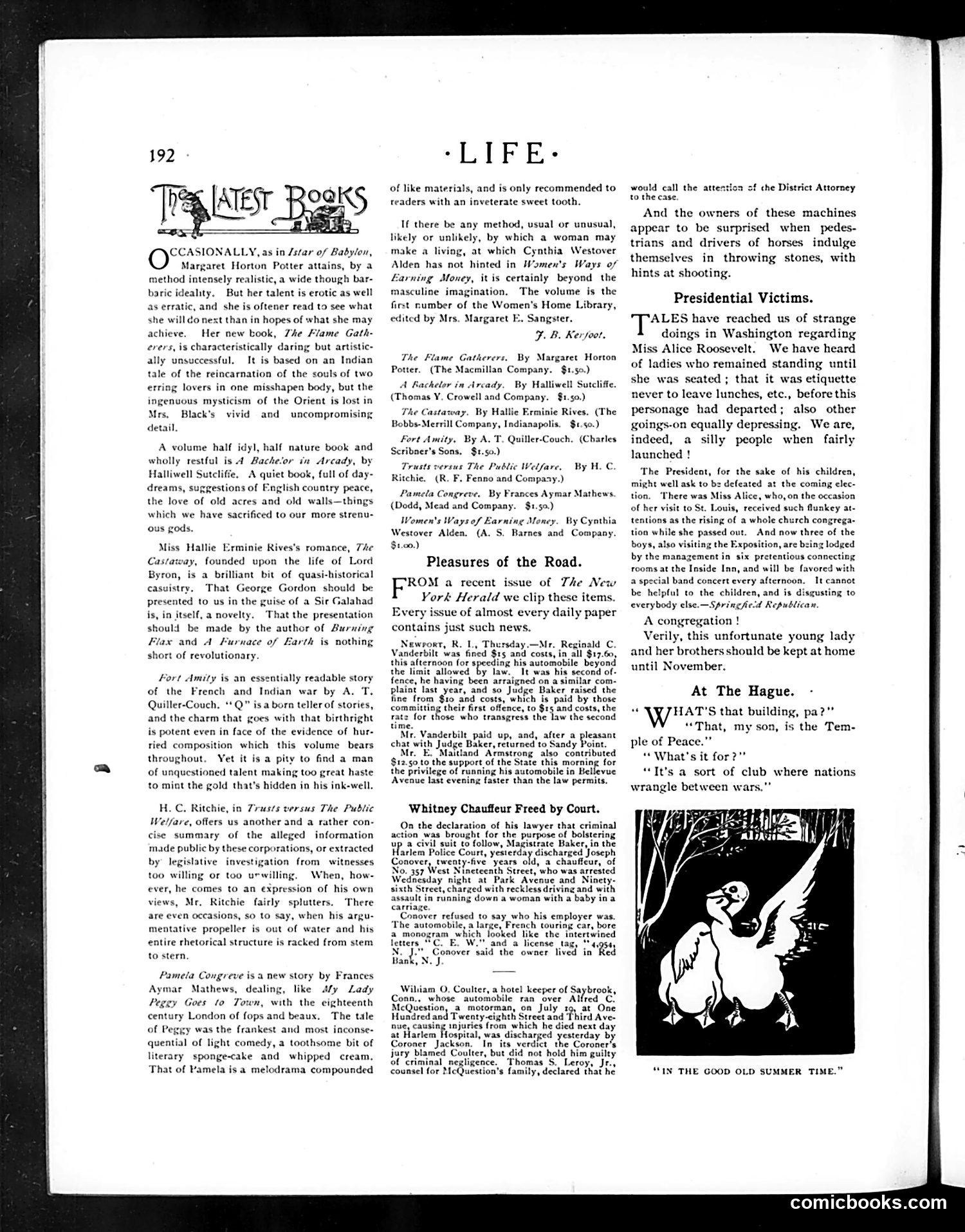
This page is primarily a **book review section** titled "Latest Books," with minimal cartoon content. The only illustration appears at bottom right: a simple sketch labeled "IN THE GOOD OLD SUMMER TIME," showing what appears to be a couple in a romantic pastoral scene—likely a generic nostalgic image accompanying the "Pleasures of the Road" section about leisurely travel. The page reviews contemporary fiction (early 1900s), with pointed criticism of authors like Margaret Horton Potter for "erotic" and "erratic" talent, and praise for quieter works like *Bachelor in Arcady*. There's also a section on "Presidential Victims" discussing ladies who remained standing at White House receptions, presented as social comedy. The book reviews dominate the content; any satirical intent is literary rather than political-cartoon based. This appears to be a standard Arts & Culture page rather than political satire.
📄 Transcribed text from this page (OCR, searchable)
Machine-transcribed from the original scan — historical spelling and the odd misread are preserved.
CASIONALLY, as in /star of Babylon, Margaret Horton Potter attains, by a method intensely realistic, a wide though bar- baric ideality. But her talent is erotic as well as erratic, and she is oftener read to see what she will do next than in hopes of what she may Her new book, The Flame Gath- erers, is characteristically daring but artistic- ally unsuccessful, It is based on an Indian tale of the reincarnation of the souls of two erring lovers in one misshapen body, but the ingenuous mysticism of the Orient is lost in Mrs, Black's vivid and uncompromising detail. achieve. A volume half idyl, half nature book and wholly restful isd Bachelor in Arcady, by Halliwell Sutcliffe, A quiet book, full of day- dreams, suggestions of English country peace, the love of old acres and old walls—things which we have sacrificed to our more strenu- ous gods. Miss Hallie Erminie Rives’s romance, The Castaway, founded vpon the life of Lord Byron, is a brilliant bit of quasi-historical casuistry, That George Gordon should be presented to us in the guise of a Sir Galahad is, in itself, a novelty, That the presentation should be made by the author of Burning Flax and A Furnace of Earth is nothing short of revolutionary. Fort Amity is an essentially readable story of the French and Indian war by A. T. Quiller-Couch, + Q” isa born teller of stories, and the charm that goes with that birthright is potent even in face of the evidence of hur- ried composition which this volume bears throughout, Yet it is a pity to find a man of unquestioned talent making too great haste to mint the gold that’s hidden in his ink-well. H.C. Ritchie, in Zrusts versus The Public Welfare, offers us another and a rather con- cise summary of the alleged information made public by these corporations, or extracted by’ legislative investigation from witnesses too willing or too urwilling, When, how- ever, he comes to an expression of his own views, Mr, Ritchie fairly splutters. There are even occasions, so to say, when his argu- mentative propeller is out of water and his entire rhetorical structure is racked from stem to stern. Pamela Congreve is a new story by Frances Mathews, dealing, like My Lady Peggy Goes to Town, with the eighteenth century London of fops and beaux, The tale of Peggy was the frankest and most inconse- quential of light comedy, a toothsome bit of literary sponge-cake and whipped cream, That of Vamela is a melodrama compounded Aymar *LIF Es of like materials, and is only recommended to readers with an inveterate sweet tooth. If there be any method, usual or unusual, likely or unlikely, by which a woman may ke a living, at which Cynthia Westover Alden has not hinted in Women's Ways of Earning Money, itis certainly beyond the masculine imagination. The volume is the first number of the Women's Home Library, edited by Mrs. Margaret E. Sangster. 7. B. Kersoot. The Flame Gatherers, By Margaret Horton Potter. (The Macmillan Company. $1.50.) A Rachelor in Arcady, By Halliwell Sutcliffe. (Thomas Y. Crowell and Company. $1.50.) The Castaway. By Hallie Erminie Rives. (The Bobbs-Merrill Company, Indianapolis. $4.50.) Fort Amity, By A. T. Quiller-Couch. (Charles Scribner's Sons, $1.50.) Trusts versus The Public Ritchie. Pamela Congreve, By Frances Aymar Mathews. (Dodd, Mead and Company. $1.50.) Women's Ways of Earning Money. By Cynthia Westover Alden. (A. S. Barnes and Company, $1.00.) Yfare, By H.C (R. F. Fenno and Company.) Pleasures of the Road. ROM a recent issue of The New York Herald we clip these items. Every issue of almost every daily paper contains just such news. Newrort, R. 1, Thursday.—Mr. Reginald C. inderbilt was fined $15 and costs, in all $17.60, this afternoon for speeding his automobile beyond the limit allowed by law. It was his second of- fence, he having been arraigned on a similar com- plaint last year, and so Judge Baker raised the fine from $10 and costs, which is paid by those committing their first offence, to $15 and costs, the ratz for those who transgress the law the second time. Mr. Vanderbilt paid up, and, after a pleasant chat with Judge Baker, returned to Sandy Point. Mr. E. Maitland Armstrong also contributed $12.50 to the support of the State this morning for the privilege of running his automobile in Bellevue Avenue last evening faster than the law permits, Whitney Chauffeur Freed by Court. On the declaration of his lawyer that criminal action was brought for the purpose of bolstering up a civil suit to follow, Magistrate Baker, in the Harlem Police Court, yesterday discharged Joseph Conover, twenty-five years old, a chauffeur, of No. 357 West Nineteenth Street, who was arrested Wednesday night at Park Avenue and Ninety sixth Street, charged with reckless driving and with assault in running down a woman with a baby ina carriage Conover refused to say who his employer was. ‘The automobile, a large, French touring car, bore a monogram which locked like the intertwined letters" C. E. W."” and a license tag, "4954 N. J." Gonover said the owner lived in’ ‘Re Bank, N. J Wihiam O, Coulter, a hotel keeper of Saybrook, Coan., whose automobile ran over Alfred C! McQuestion, a motorman, on July 19, at One Hundred and Twenty-cighth Street and Third Ave. nue, causing injuries from which he died next day at Harlem Hospital, was discharged yesterday b; Coroner Jackson. ‘In its verdict the Coroner's jury blamed Coulter, but did not hold him guilty of criminal negligence. Thomas S. Leroy, Jt counsel for McQuestion’s family, declared that he would call the attention of che District Attorney to the case, And the owners of these machines appear to be surprised when pedes- trians and drivers of hors indulge themselves in throwing stones, with hints at shooting. Presidential Victims. ‘ALES have reached us of strange doings in Washington regarding Miss Alice Roosevelt. We have heard of ladies who remained standing until she was seated ; that it was etiquette never to leave lunches, etc., before this personage had departed; also other goings-on equally depressing. We are, indeed, a silly people when fairly launched ! ‘The President, for the sake of his children, might well ask to bz defeated at the coming elec tion. ‘There was Miss Alice, who,on the occasion of her visit to St. Louis, received such flunkey at- tentions as the rising of a whole church congrega- tion while she passed o1 And now three of the boys, also visiting the Exposition, are bsing lodged by the management in six pretentious connecting rooms at the Inside Inn, and will be favored with a special band concert every afternoon. It cannot be helpful to the children, and is disgusting to everybody else.—Springfied Republican. A congregation ! Verily, this unfortunate young lady and her brothers should be kept at home until November. At The Hague. - ot HAT'S that building, pa?” “That, my so: the Tem- ple of Peace. “What's it for?" “It's a sort of club where nations wrangle between wars.” “IN THE GOOD OLD SUMMER TIME. comicbooks.com