
Life, 1904-08-25 · page 7 of 20
Life — August 25, 1904 — page 7: what you’re looking at
What you’re looking at
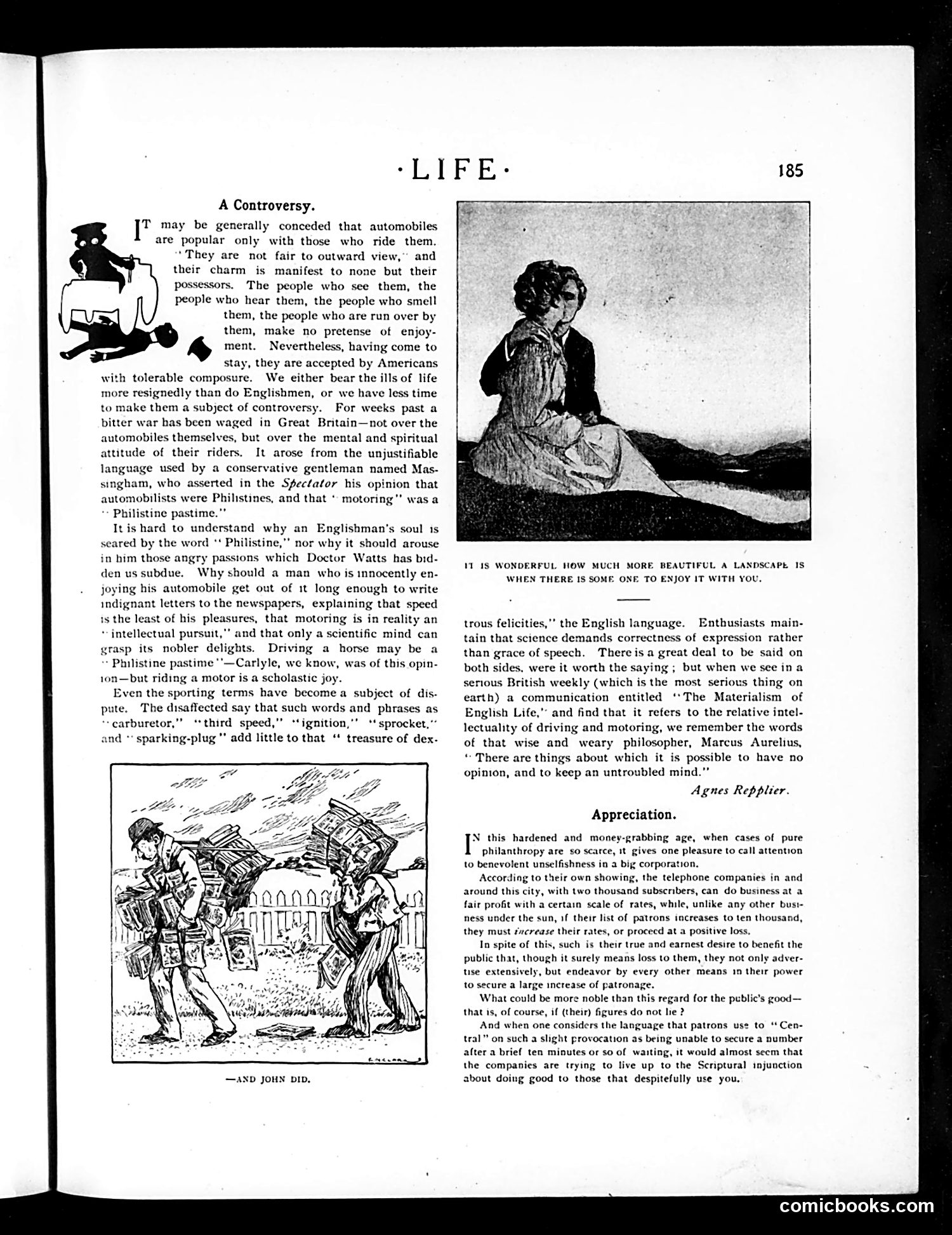
This page discusses the "Philistine" controversy over automobiles in Britain. The text criticizes a conservative gentleman named Massingham (writing in the *Spectator*) for calling automobiles "Philistine" and motoring a "Philistine pastime." The cartoons satirize this debate: **Top cartoon**: Shows a woman enjoying a scenic landscape from an automobile, captioned "It is wonderful how much more beautiful a landscape is when there is some one to enjoy it with you"—suggesting automobiles enhance appreciation of nature. **Bottom cartoon** (captioned "—And John did"): depicts two figures in an automobile, likely mocking the couple from the top image or illustrating the "enjoyment" automobiles provide. The satire targets British snobbery about motorcars as lower-class pursuits, while arguing Americans accept them more pragmatically as transportation and leisure.
📄 Transcribed text from this page (OCR, searchable)
Machine-transcribed from the original scan — historical spelling and the odd misread are preserved.
-LIFE- 185 A Controversy. . may be generally conceded that automobiles are popular only with those who ride them. ‘They are not fair to outward view,” and their charm is manifest to none but their possessors. The people who see them, the people who hear them, the people who smell them, the people who are run over by them, make no pretense of enjoy- ment. Nevertheless, having come to stay, they are accepted by Americans with tolerable composure. We either bear the ills of life more resignedly than do Englishmen, or we have less time to make them a subject of controversy. For weeks past a bitter war bas been waged in Great Britain—not over the automobiles themselves, but over the mental and spiritual attitude of their riders. It arose from the unjustifiable language used by a conservative gentleman named Mas- stngham, who asserted in the Sfectator his opinion that automobilists were Philistines, and that * motoring" was a Philistine pastime.” It is hard to understand why an Englishman's soul 1s seared by the word “‘ Philistine,” nor why it should arouse in him those angry passtons which Doctor Watts has bid- den us subdue, Why should a man who is innocently en- joying his automobile get out of it long enough to write indignant letters to the newspapers, explaining that speed ts the least of his pleasures, that motoring is in reality an * intellectual pursuit,”’ and that only a scientific mind can rasp its nobler delights. Driving a horse may be a - Philistine pastime ‘'—Carlyle, we know, was of this opin- 1on—but riding a motor is a scholastic joy. Even the sporting terms have become a subject of dis- pute. The disaffected say that such words and phrases as *-carburetor,” ‘third speed,"’ *tignition,’’ ‘* sprocket,’ and ** sparking-plug "* add little to that ‘* treasure of dex- AND JOHN DID, 1118 WONDERFUL HOW MUCH MORE BEAUTIFUL A LA: WHEN THERE 1S SOM NE TO ENJOY IT WITH YoU. Enth s main- tain that science demands correctness of expression rather trous felicities,"" the English language. than grace of speech. There is a great deal to be said on both sides, were it worth the saying ; but when we see in a serious British weekly (which is the most serious thing on earth) a communication entitled ‘‘The Materialism of English Life,’’ and find that it refers to the relative intel- lectuality of driving and motoring, we remember the words of that wise and weary philosopher, Marcus Aurelius, « There are things about which it is possible to have no opinion, and to keep an untroubled mind.” Agnes Repplier. Appreciation. this hardened and money-grabbing age, when cases of pure | philanthropy are so scarce, it gives one pleasure to call attention to benevolent unselfishness in a big corporation. According to their own showing, the telephone companies in and around this city, with two thousand subscribers, can do business at a fair profit with a certain scale of rates, while, unlike any other bust- ness under the sun, if their list of patrons increases to ten thousand, they must ¢wcrease their rates, or procecd at a positive loss. In spite of this, such is their true and earnest desire to benefit the public that, though it surely means loss to them, they not only adver- tse extensively, but endeavor by every other means in their power to secure a large increase of patronage. What could be more noble than this regard for the public's good— that is, of course, if (their) figures do not he ? And when one considers the language that patrons use to “Cen- tral” on such a slight provocation as being unable to secure a number after a brief ten minutes or so of waiting, it would almost secm that the companies are trying to live up to the Scriptural injunction about doing good to those that despitefully use you, comicbooks.com