
A complete issue · 22 pages · 1904
Life — June 16, 1904
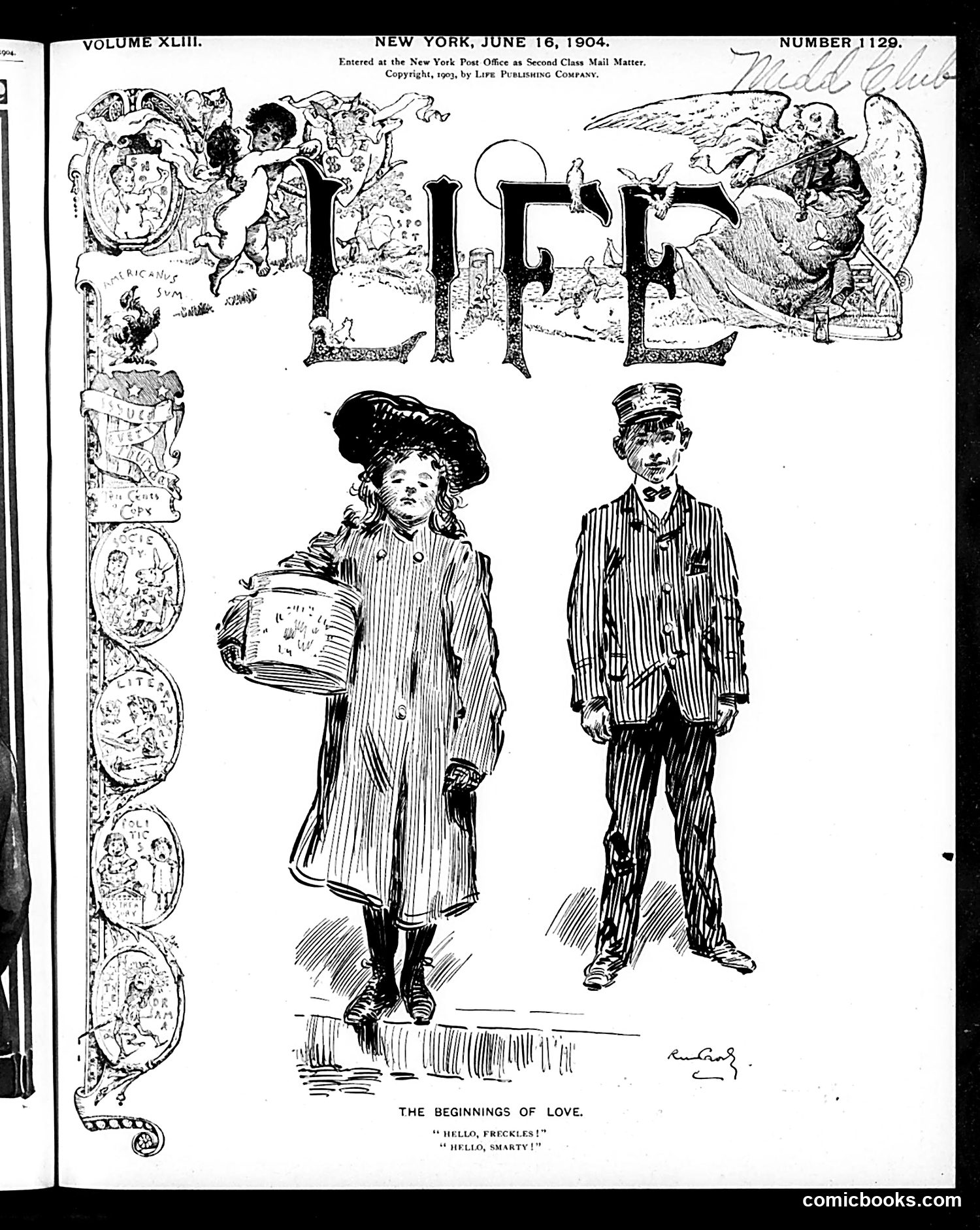
This page features a satirical illustration titled "The Beginnings of Love" with the caption dialogue: "Hello, Freckles!" / "Hello, Smarty!" The cartoon depicts two children—a girl carrying a suitcase wearing a dark hat and coat, and a boy in a striped suit and cap—greeting each other with these cheeky, somewhat sassy remarks. The humor appears to be satirizing courtship rituals by portraying them as childish teasing rather than romantic sentiment. The elaborate decorative border on the left contains classical circular medallions, likely referencing traditional artistic depictions of love and romance, which contrasts with the mundane, sarcastic contemporary interaction shown below—suggesting early 20th-century skepticism toward idealized notions of love.
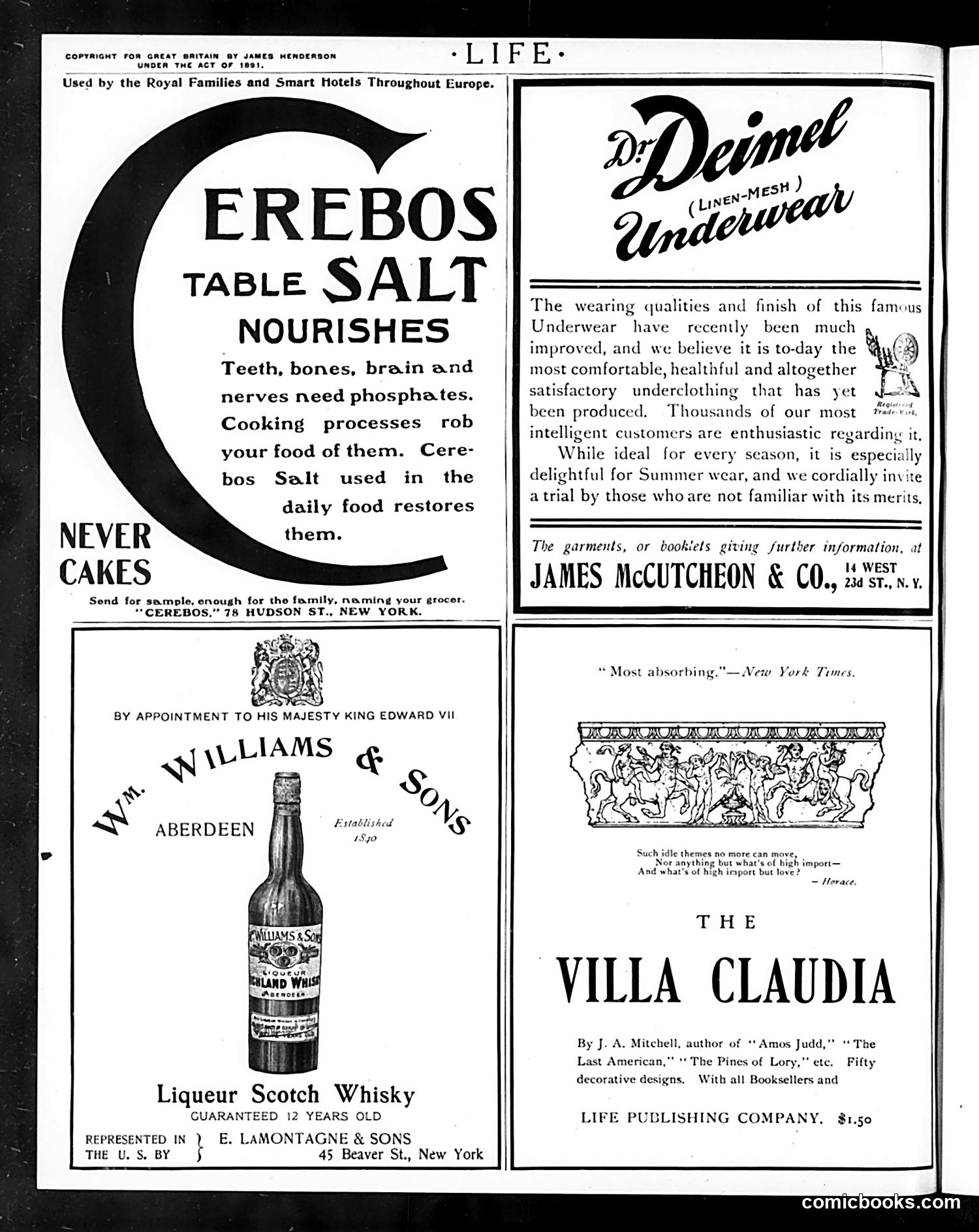
This page is primarily **advertising**, not editorial content or satire. It contains four distinct advertisements: 1. **Cerebos Table Salt** — claims the product restores phosphates lost in cooking, promoting nutritional benefits for "teeth, bones, brain and nerves" 2. **Dr. Deimal Underwear** — promotes linen-mesh undergarments, emphasizing comfort and health benefits 3. **Wm. Williams & Sons Whisky** — Highland Scotch liqueur with royal appointment to King Edward VII 4. **The Villa Claudia** — book advertisement by J.A. Mitchell There is **no political cartoon or satire present**. The page represents typical early 20th-century advertising combining health claims (common for the era) with status markers like royal patronage. The Horace epigraph accompanying the book ad is purely decorative.
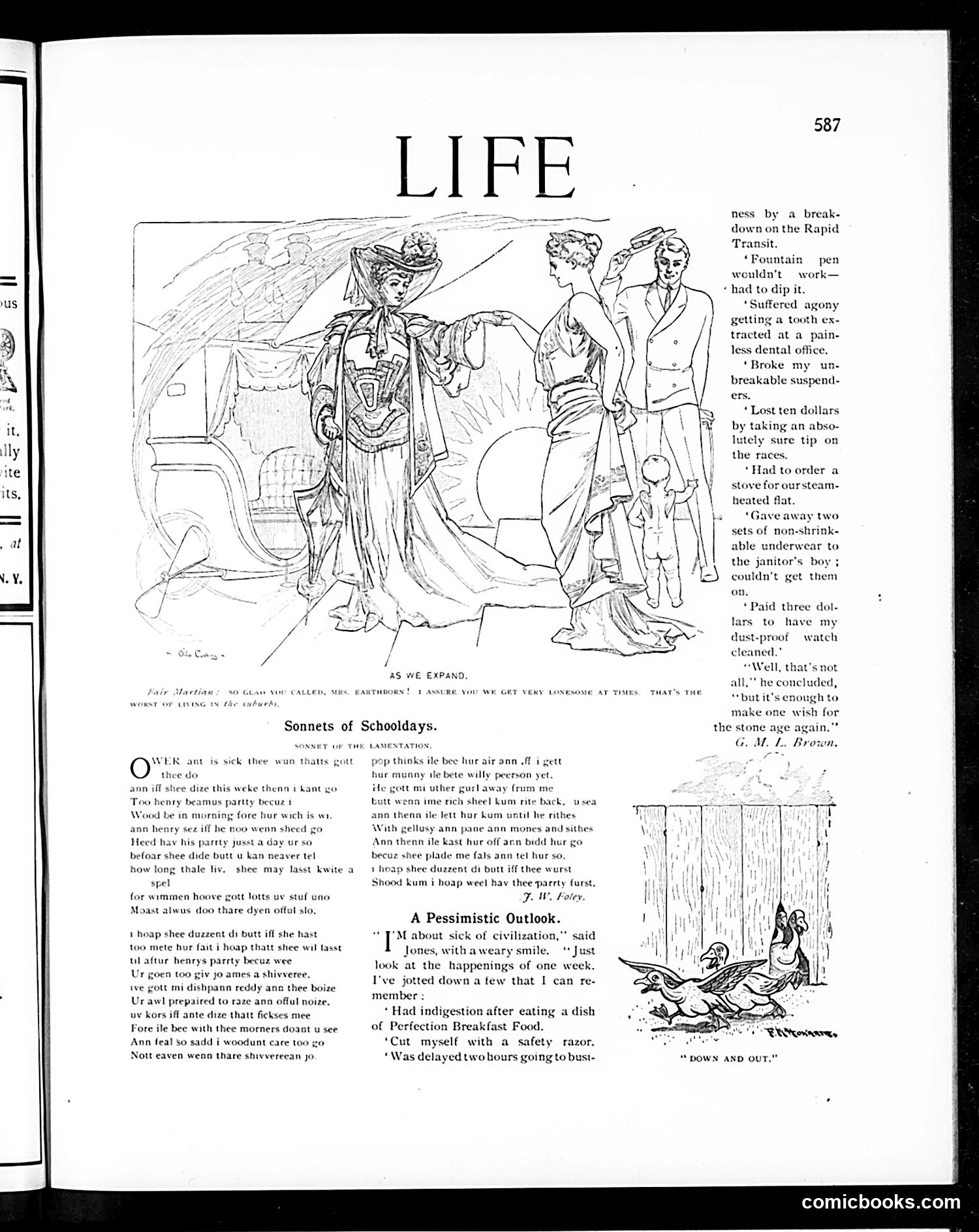
The top illustration, titled "As We Expand," depicts wealthy women in an automobile discussing domestic staff problems. The caption indicates complaint about servants—a common upper-class concern of the early 20th century. The satire mocks privileged women's grievances about household help while society faced larger issues. The "Sonnets of Schooldays" section presents humorous dialect verses about schoolgirl experiences, appearing to be light comic poetry rather than serious satire. "A Pessimistic Outlook" features a character named Jones listing modern annoyances—indigestion from "Perfection Breakfast Food," self-injury from a safety razor, and transportation delays. This satirizes both consumer product failures and the disappointments of modern convenience goods marketed as improvements. The joke: new technology and mass-produced foods often disappointed users despite promotional claims.
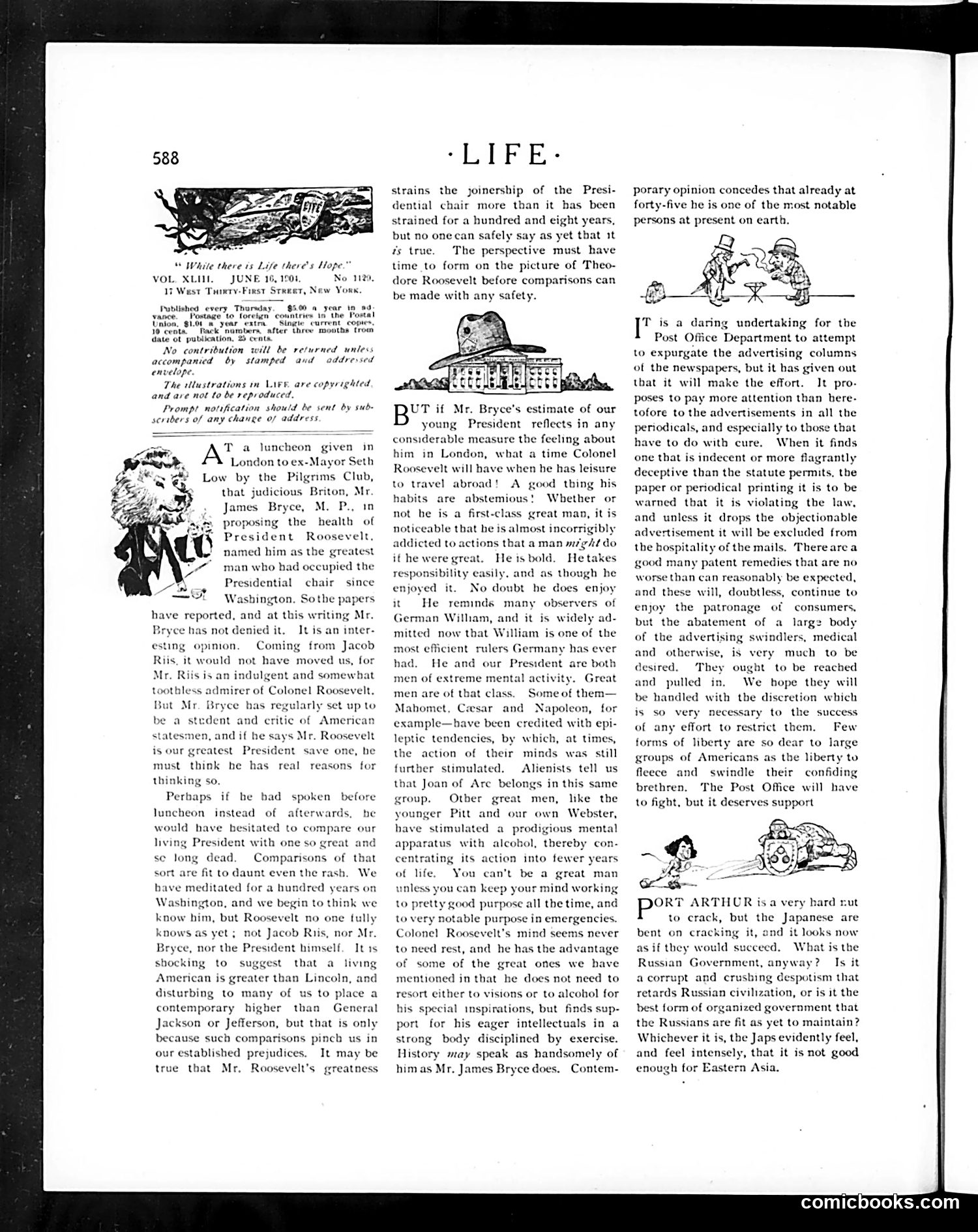
This page contains editorial commentary on President Theodore Roosevelt rather than political cartoons. The text discusses Roosevelt's mental vigor and fitness for office, comparing him favorably to historical figures like Napoleon and Caesar while cautioning against exaggerated claims of his greatness. The decorative illustrations are generic Victorian-style vignettes rather than specific political satire—they appear to be standard magazine ornaments typical of the era. The main article addresses a luncheon where James Bryce (likely the British diplomat) praised Roosevelt's intellect and energy. The piece defends Roosevelt against overstatement while acknowledging his genuine capabilities and promising leadership qualities, establishing him as an active, intellectually engaged executive.
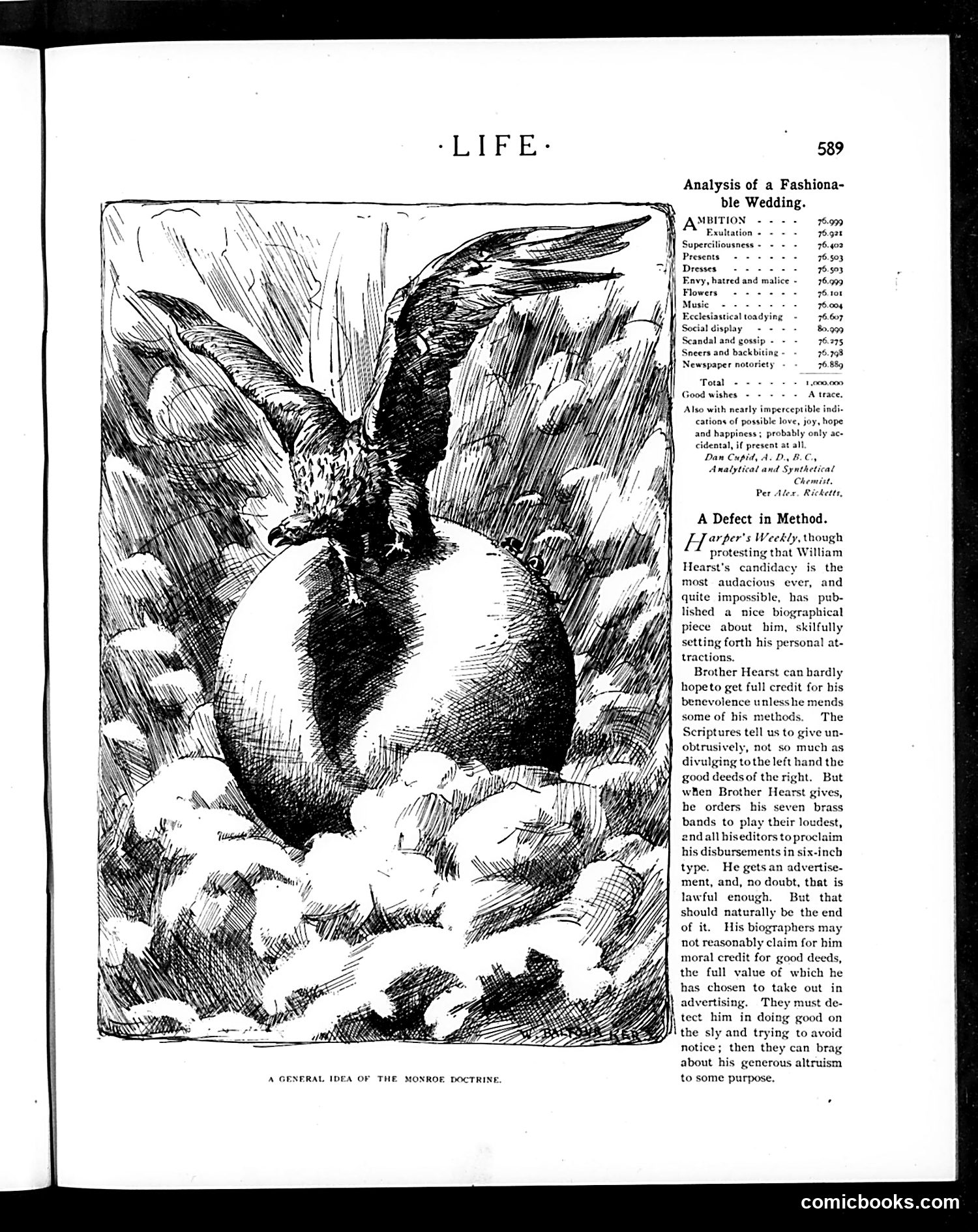
The main illustration depicts a winged creature (appearing demonic or angelic, depending on perspective) emerging from or trapped within rocky terrain. The caption reads "A GENERAL IDEA OF THE MONROE DOCTRINE." This is a satirical commentary on the Monroe Doctrine—the U.S. foreign policy opposing European intervention in the Americas. The ambiguous winged figure likely represents America's assertion of hemispheric dominance. The creature's posture—seemingly constrained or emerging forcefully—suggests satire about the doctrine's aggressive implementation or its contradictions. The accompanying article, "A Defect in Method," criticizes William Hearst's philanthropic approach, arguing his public advertising of charitable deeds undermines genuine benevolence. The juxtaposition suggests critique of both imperialism and performative charity during this era.
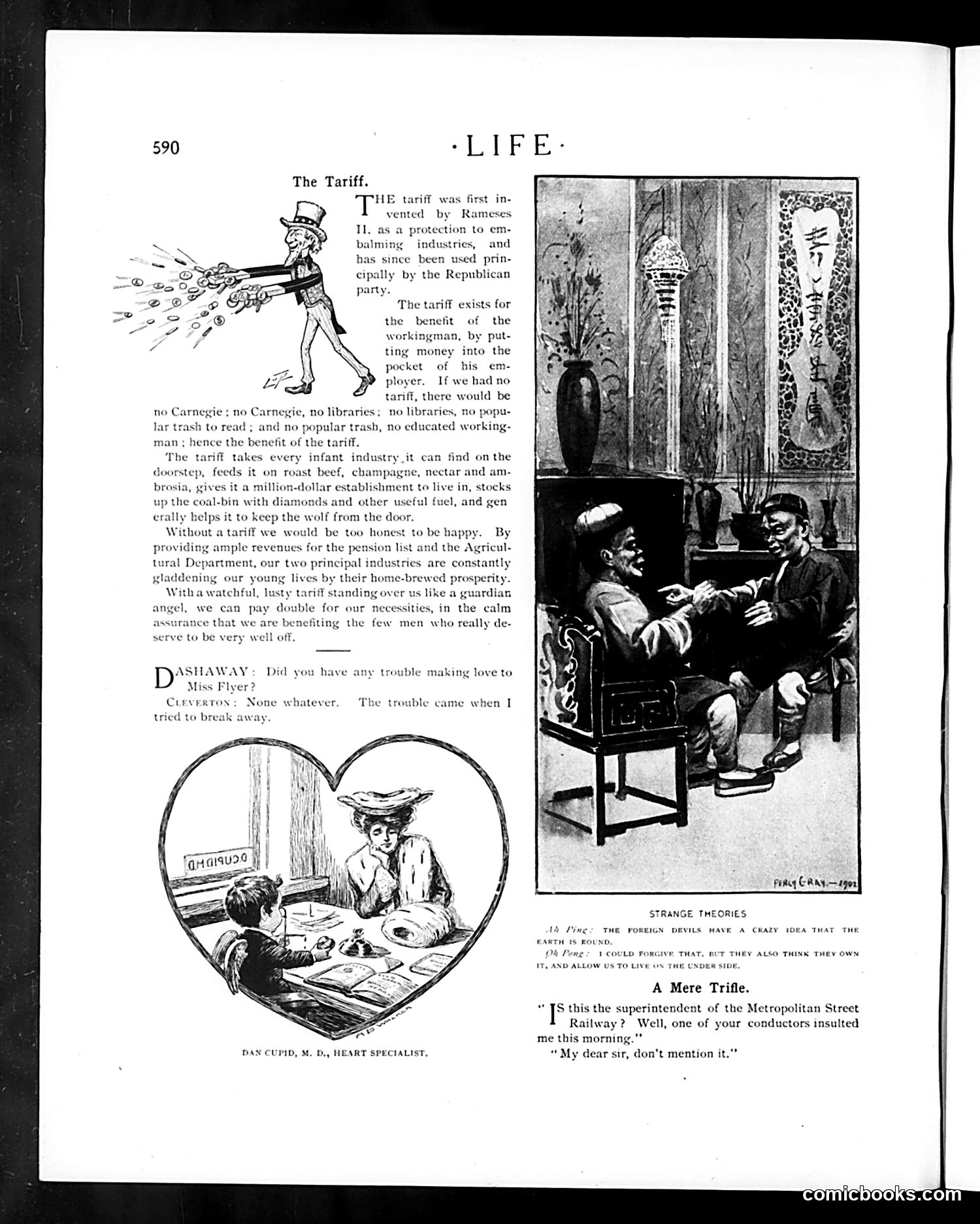
**"The Tariff"** (top left): A caricatured Uncle Sam fires coins from a cannon at foreign competitors. The text argues protective tariffs benefit American workers by enriching employers, who then invest in industry and libraries—a Republican defense of tariff policy. The satire mocks this trickle-down logic: tariffs supposedly help "the working man" by putting money in his employer's pocket. **"Dan Cupid, M.D., Heart Specialist"** (bottom left): A heart-shaped vignette shows a woman feeding a man, illustrating romantic devotion. The caption references a dialogue about making love. **"Strange Theories"** (right): An illustration of what appears to be a foreign interior with two figures, accompanying text about foreigners' misconceptions regarding Earth's shape and gravity—likely mocking pseudoscientific or exotic beliefs.
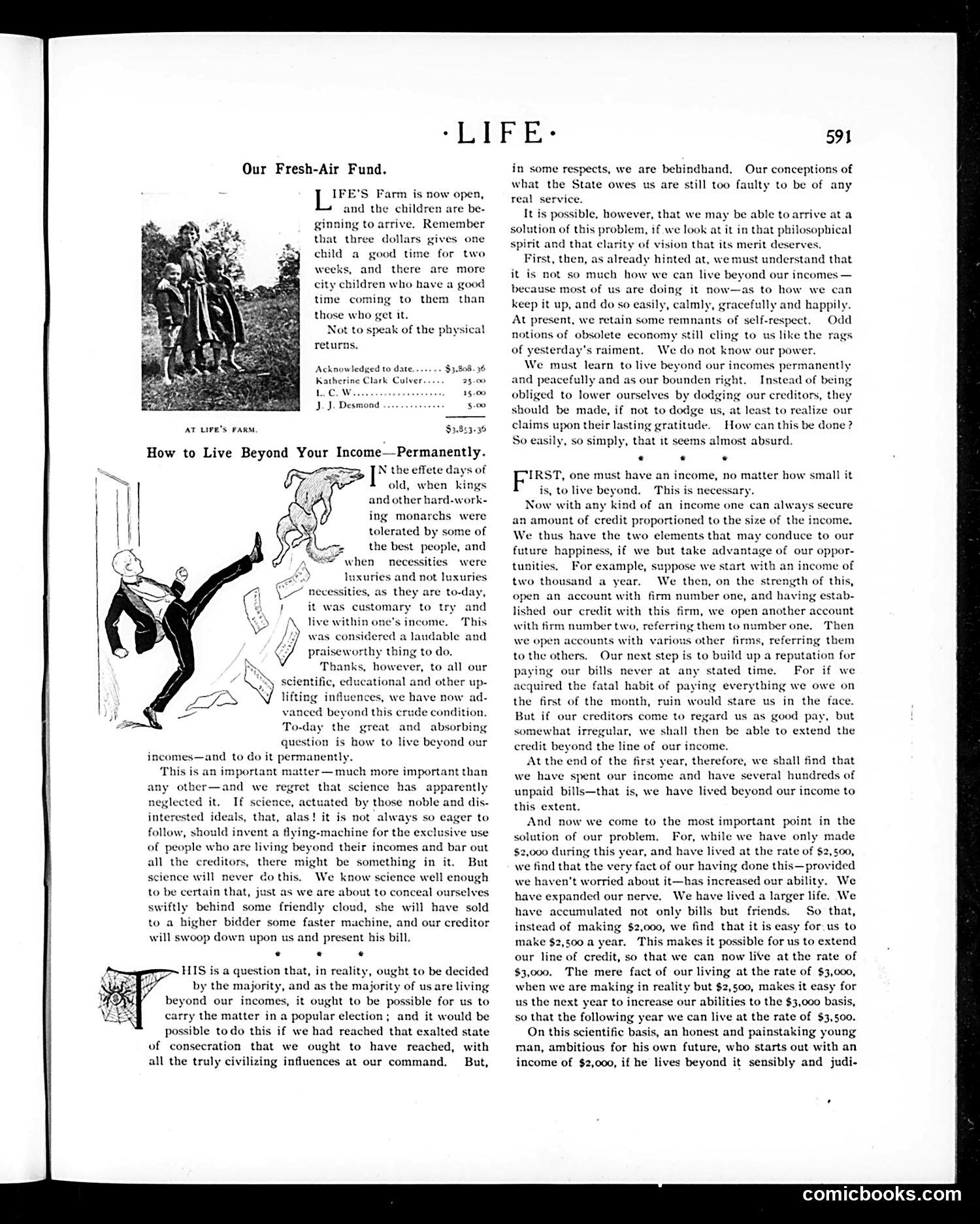
The main cartoon depicts a man in formal dress being kicked backward while money flies around him—illustrating the article's theme "How to Live Beyond Your Income—Permanently." The satire targets the common financial predicament of living beyond one's means. The article argues this was a widespread problem among Americans, even praising it as "laudable and praiseworthy." The text proposes a system using multiple credit accounts with different firms to manage debt strategically, building a reputation for timely payments while gradually extending credit lines. The cartoon's exaggerated violence humorously underscores the absurdity and precariousness of this financial juggling act. It satirizes both the desperation of overextended debtors and the era's emerging consumer credit culture, suggesting that surviving on credit was becoming normal middle-class practice.
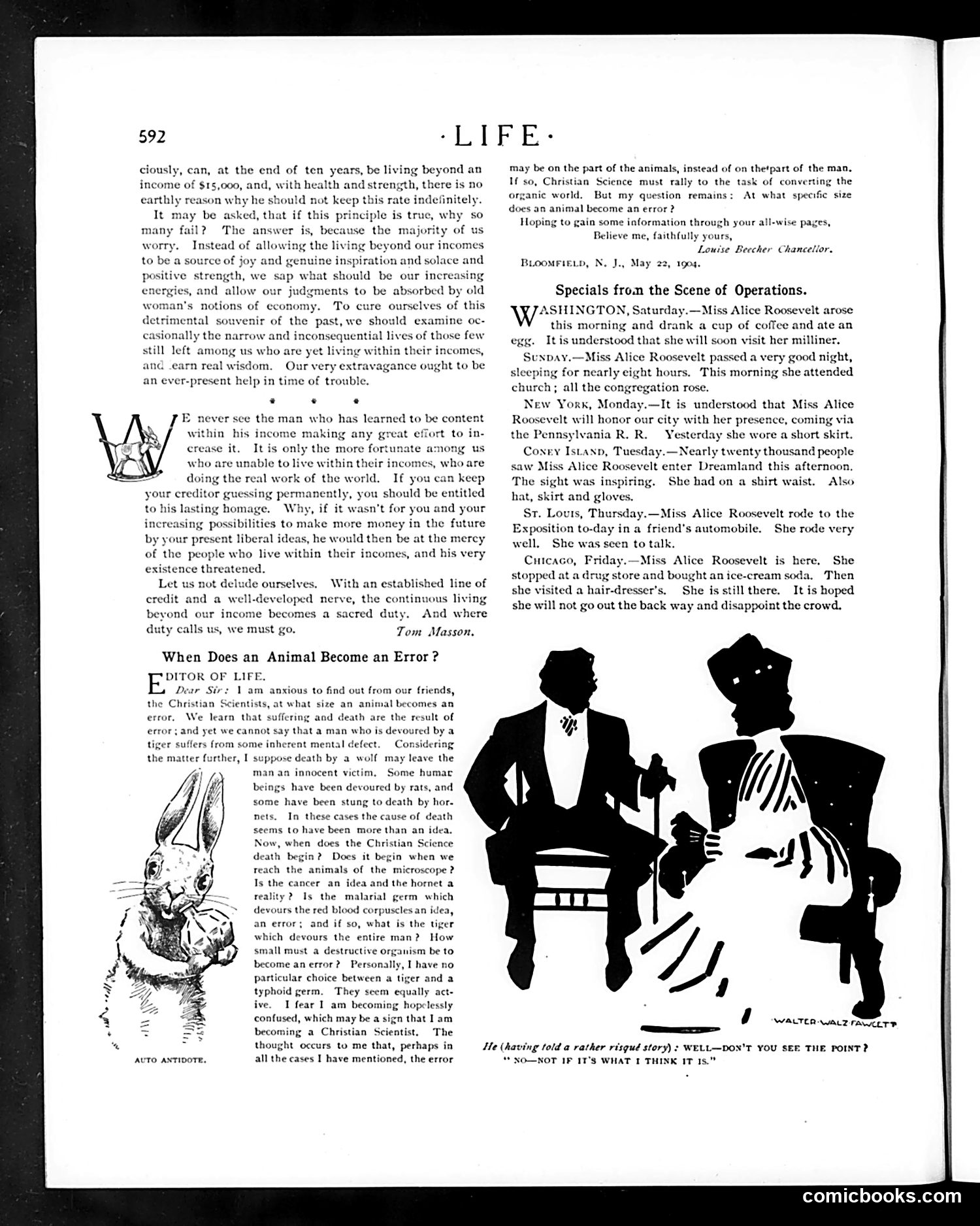
This page contains two distinct elements: **"Specials from the Scene of Operations"** reports on **Alice Roosevelt's travels** across America (Washington, New York, Chicago, St. Louis, etc.). These brief dispatches humorously chronicle her activities—visiting a milliner, riding in automobiles, shopping for ice-cream soda—treating her movements as newsworthy "operations." **The cartoon by Walter Waltz Facelly** depicts a social scene where one figure tells another: "Well—don't you see the point? 'So—not if it's what I think it is.'" The silhouetted figures and cryptic dialogue suggest satirizing a social misunderstanding or breach of etiquette among upper-class characters, though the specific joke's context isn't entirely clear from the image alone. The page overall reflects Life's focus on prominent social figures and contemporary upper-class behavior as subjects for satire.
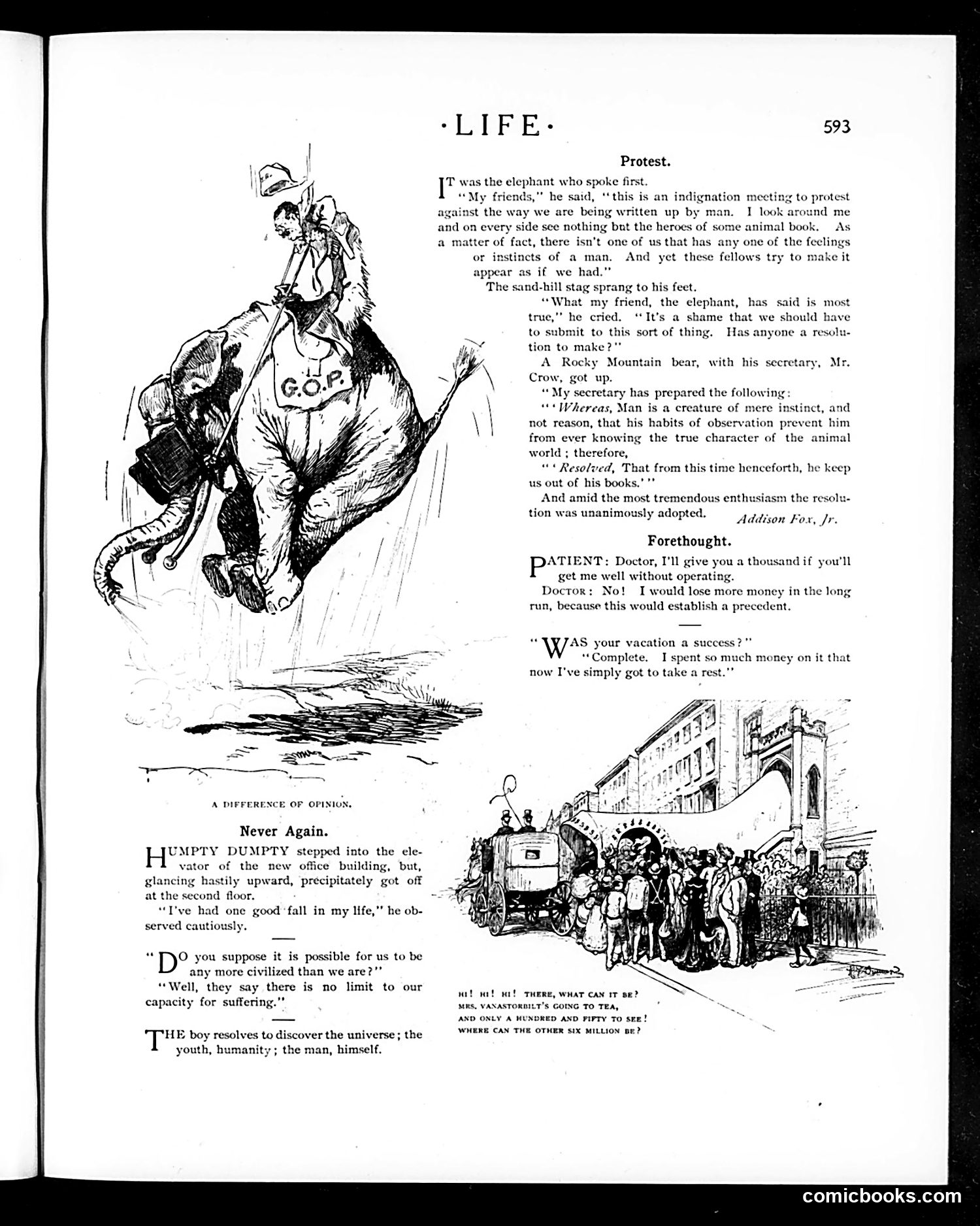
The main cartoon, "A Difference of Opinion," depicts an elephant (Republican Party symbol) wearing "G.O.P." labeled clothing, being bucked off by a donkey (Democratic Party symbol). The accompanying text presents animals at a meeting protesting their depiction in books as lacking human reason and instincts, with a bear's secretary proposing they be excluded from literature henceforth. The satire critiques anthropomorphic animal representations in children's literature and books. Below, shorter pieces mock medical ethics ("Forethought") and vacation spending. The elephant-donkey imagery suggests partisan political conflict, though the animals' "protest" primarily targets literary representation rather than specific policy disputes. The exact historical context remains unclear without a publication date visible on this page.
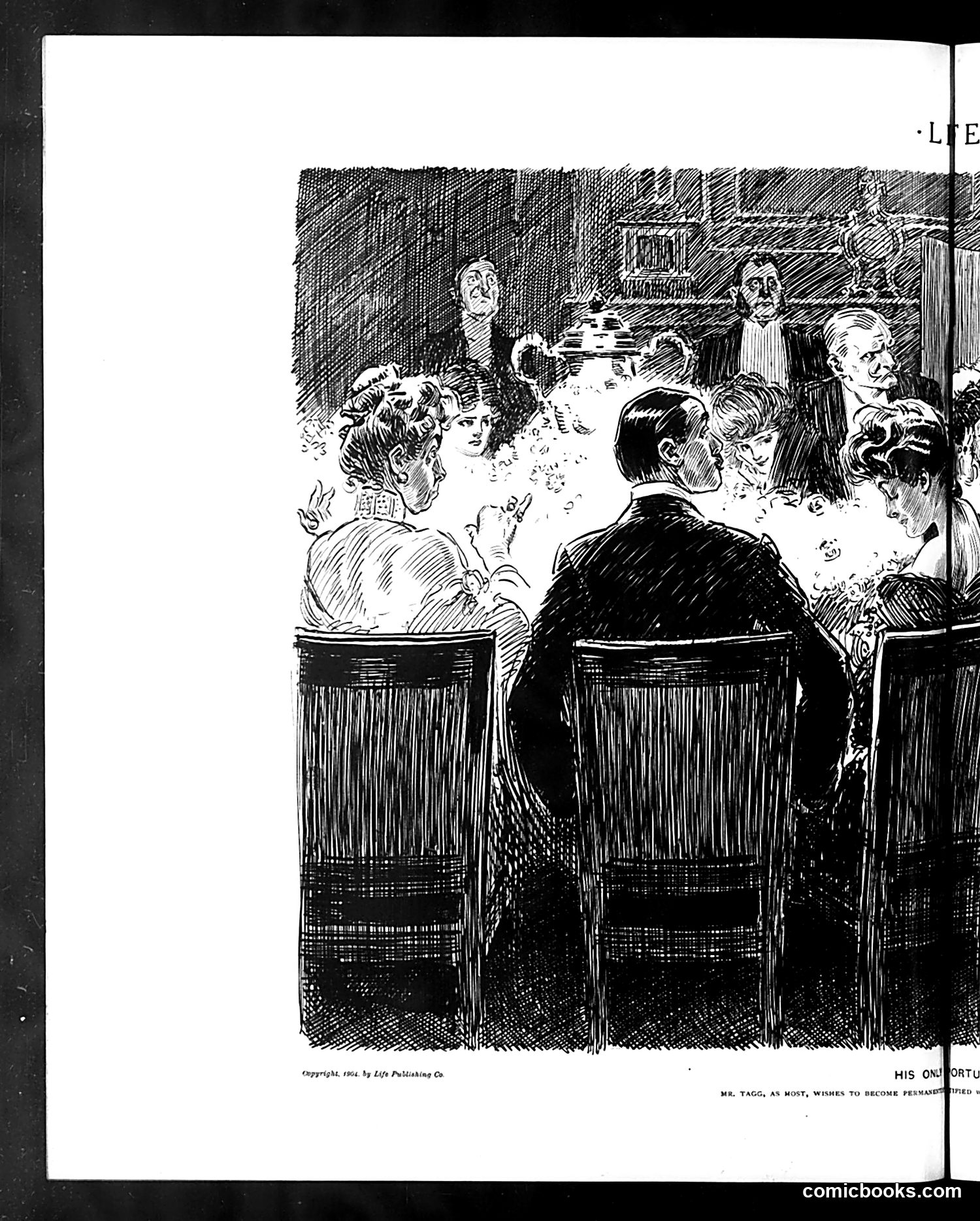
This is a satirical illustration from Life magazine (copyright 1904, per visible text). The caption reads: "MR. TAGG, AS HOST, WISHES TO BECOME PERSONABLE." The cartoon depicts a formal dinner scene where a man identified as "Mr. Tagg" sits with his back to us, facing various well-dressed guests across a dining table. The artist uses exaggerated facial expressions and body language to suggest that Tagg is attempting to appear refined and hospitable as a host, though the satirical framing ("wishes to become personable") implies he's struggling with or failing at this social performance. Without additional context about who Mr. Tagg was, the satire appears to mock someone's awkward attempts at social respectability or pretensions of upper-class civility. The formal dinner setting emphasizes the gap between aspiration and authentic behavior.
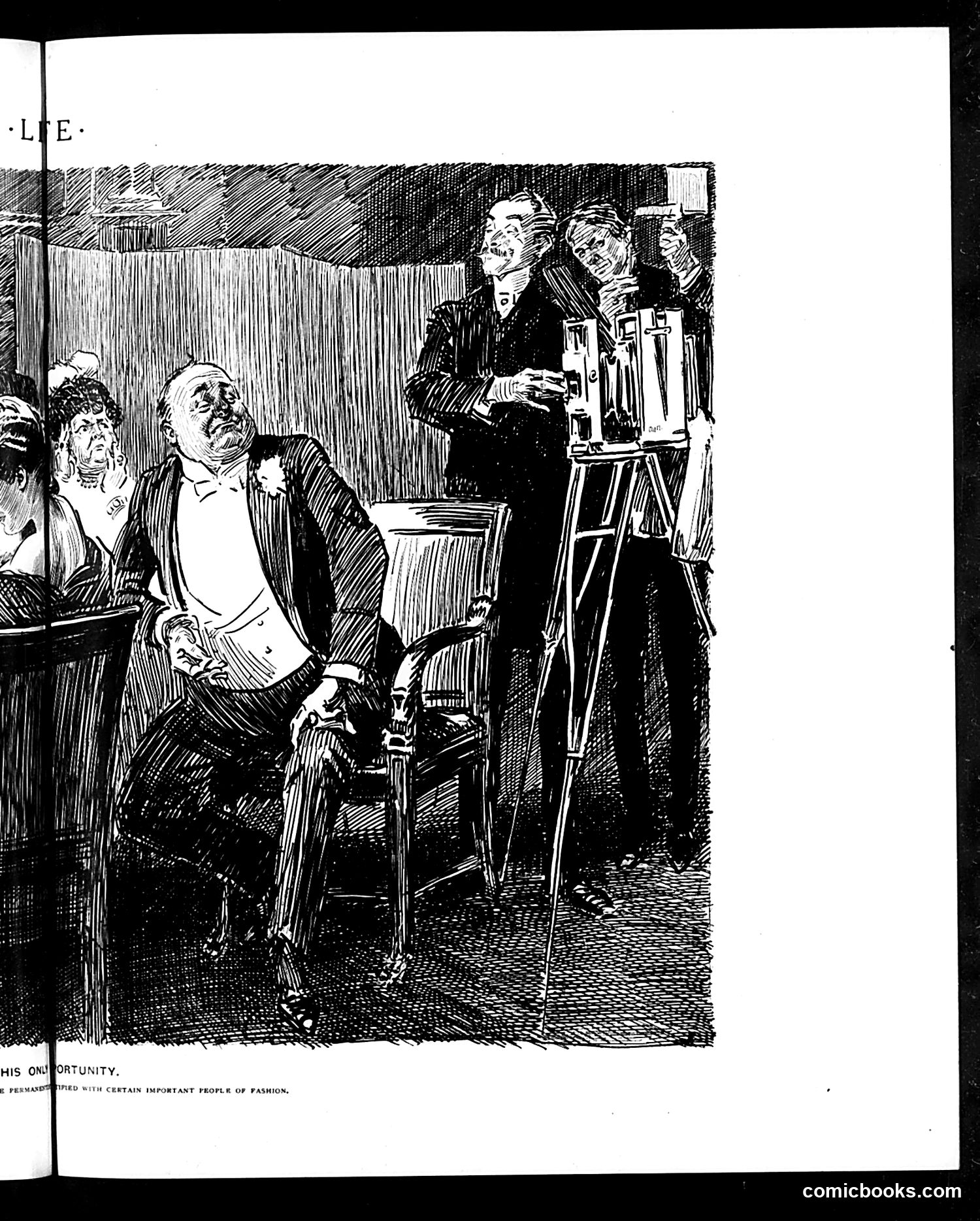
This appears to be a satirical scene depicting what the partially visible caption calls "HIS ONLY OPPORTUNITY"—likely referencing a social climbing or fashion-conscious figure's chance to impress "important people of fashion" (as the OCR partially shows). The cartoon shows a well-dressed seated gentleman observing others, while men in the background hold what appear to be religious crosses or crucifixes. The satire seems to mock either religious hypocrisy or the absurdity of using faith as social currency among the fashionable elite. The exaggerated facial expressions and formal dress suggest this targets either a specific public figure or a broader social type—someone attempting to gain status through conspicuous displays of piety or moral superiority to fashionable society. Without the complete caption, the precise target remains unclear.
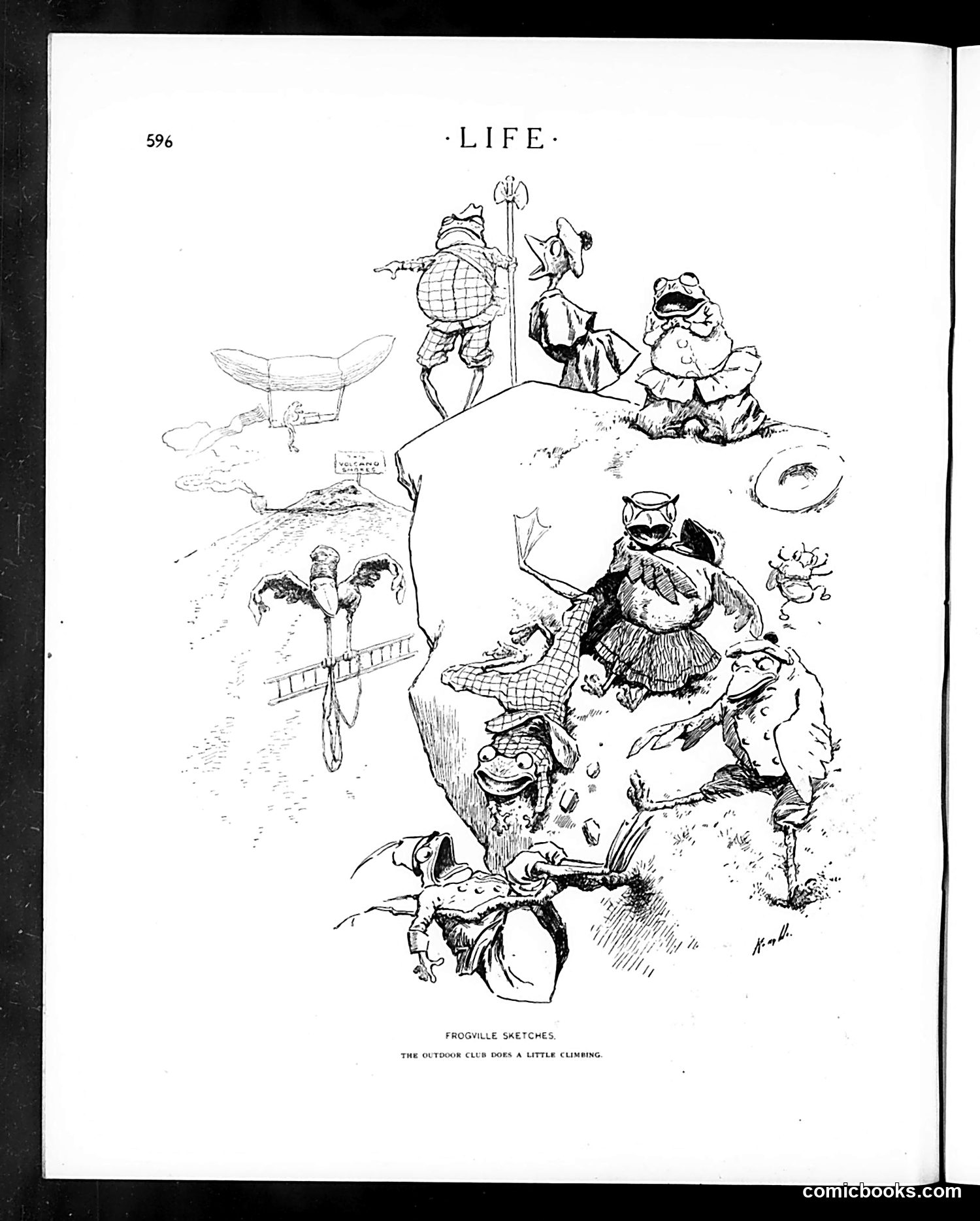
This is a humorous illustrated sketch titled "Frogville Sketches" showing anthropomorphic frogs engaged in outdoor recreation—specifically mountain climbing. The frogs are depicted as members of an "outdoor club," wearing period clothing and attempting various climbing activities with ladders and equipment. The satire appears to target urban leisure activities and the pretensions of organized outdoor clubs, which were fashionable among middle and upper-class Americans. By portraying amphibians awkwardly attempting genteel sports, the cartoonist mocks both the clubs themselves and their members' sometimes comical efforts at athletic pursuits. The exaggerated character designs emphasize the absurdity of the scene.
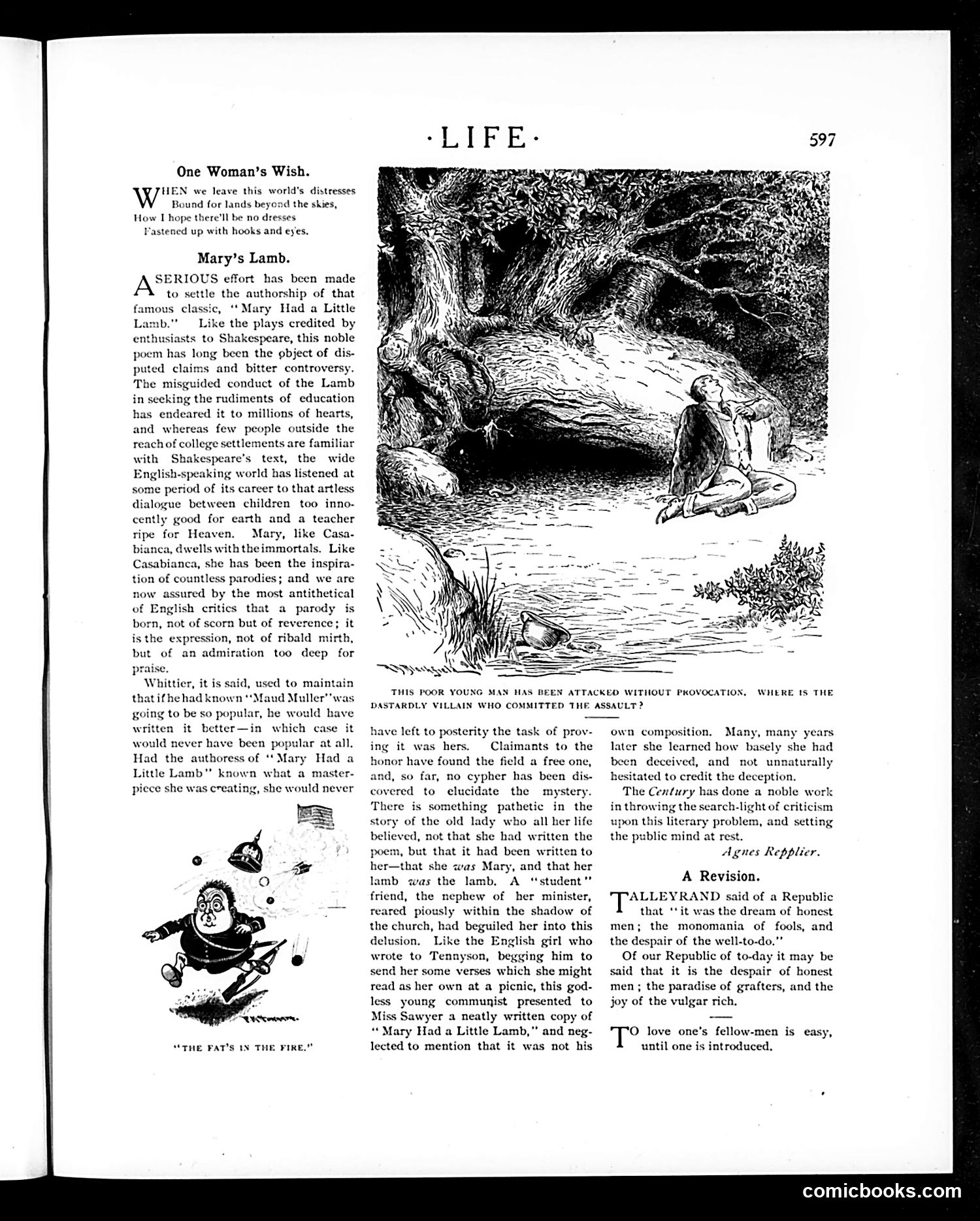
This page contains literary commentary and social satire typical of early 20th-century *Life* magazine. The main article discusses disputed authorship of "Mary Had a Little Lamb," comparing the controversy to Shakespeare attribution debates. The author (Agnes Repplier) satirizes how a poor woman was duped into believing she wrote the poem when a minister's nephew deceived her. The satire targets intellectual pretension and how easily people are manipulated by false authority. The small cartoon captioned "THE PAT'S IN THE FIRE" shows a figure in distress—likely representing someone caught in scandal or trouble—with the ironic caption asking where the "villain" is. This appears to satirize situations where victims are blamed or where culprits escape accountability. "One Woman's Wish" and "A Revision" are brief satirical verses mocking contemporary concerns (women's fashion constraints, political corruption among the wealthy and grafters). The overall tone critiques intellectual dishonesty, gullibility, and social hypocrisy of the era.
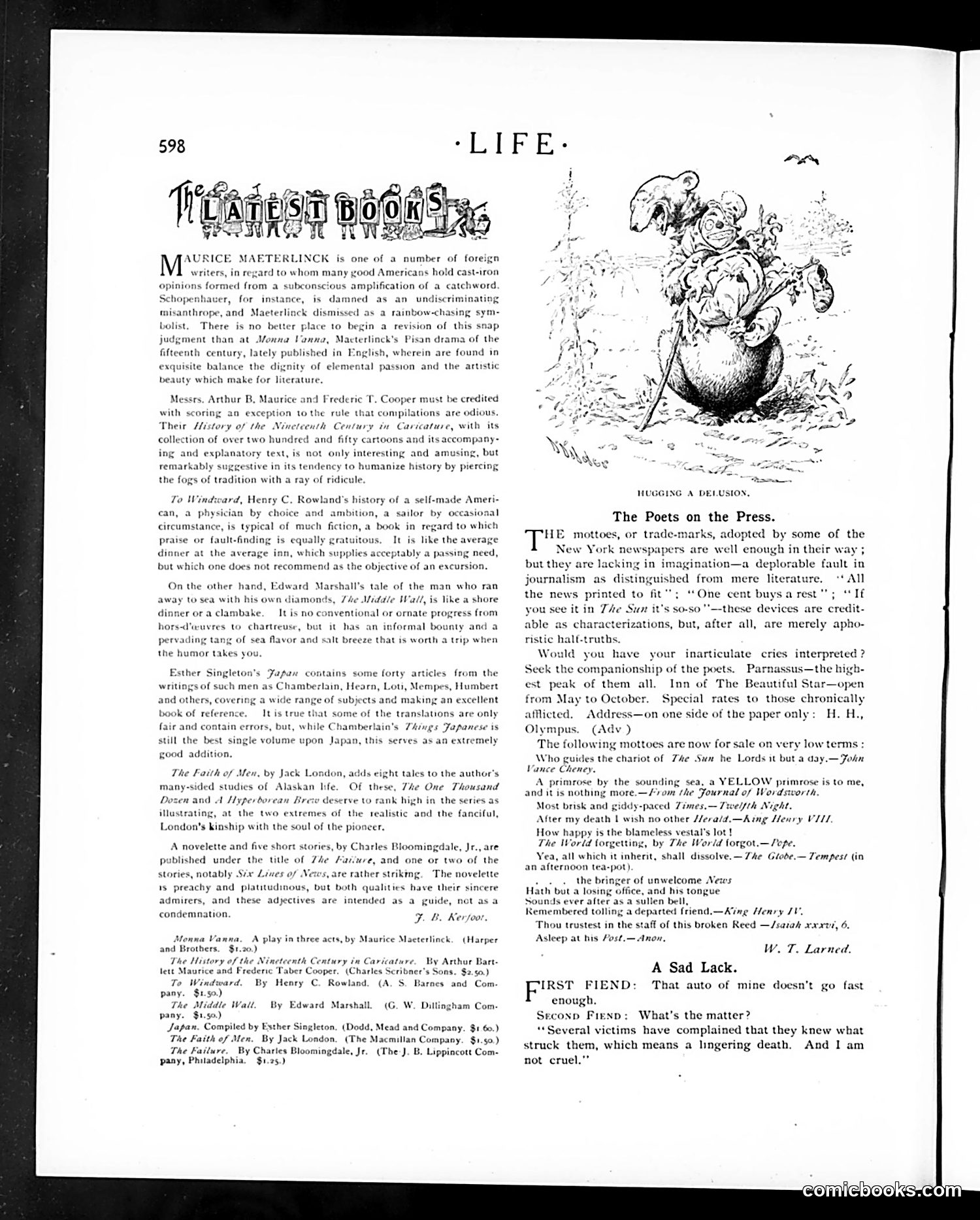
This page is primarily a **book review section** titled "The Latest Books," discussing contemporary literary works by authors like Maurice Maeterlinck, Jack London, and others. The single cartoon titled "HUGGING A DELUSION" shows a figure embracing what appears to be a pig or similar animal—likely a visual pun about self-deception or clinging to false beliefs. The accompanying section "The Poets on the Press" critiques newspaper mottos and journalistic practices. It mocks New York newspapers for adopting trade-marks that sound grand but lack substance, calling them "merely aphoristic half-truths." The text argues that newspapers' grandiose slogans about their own importance ("The Sun is Lords it but a day") ring hollow when their actual reporting is superficial. The page concludes with humorous mock-epitaphs from poets about newspapers and editors, presenting satirical commentary on press pretension and journalistic shortcuts of the era.
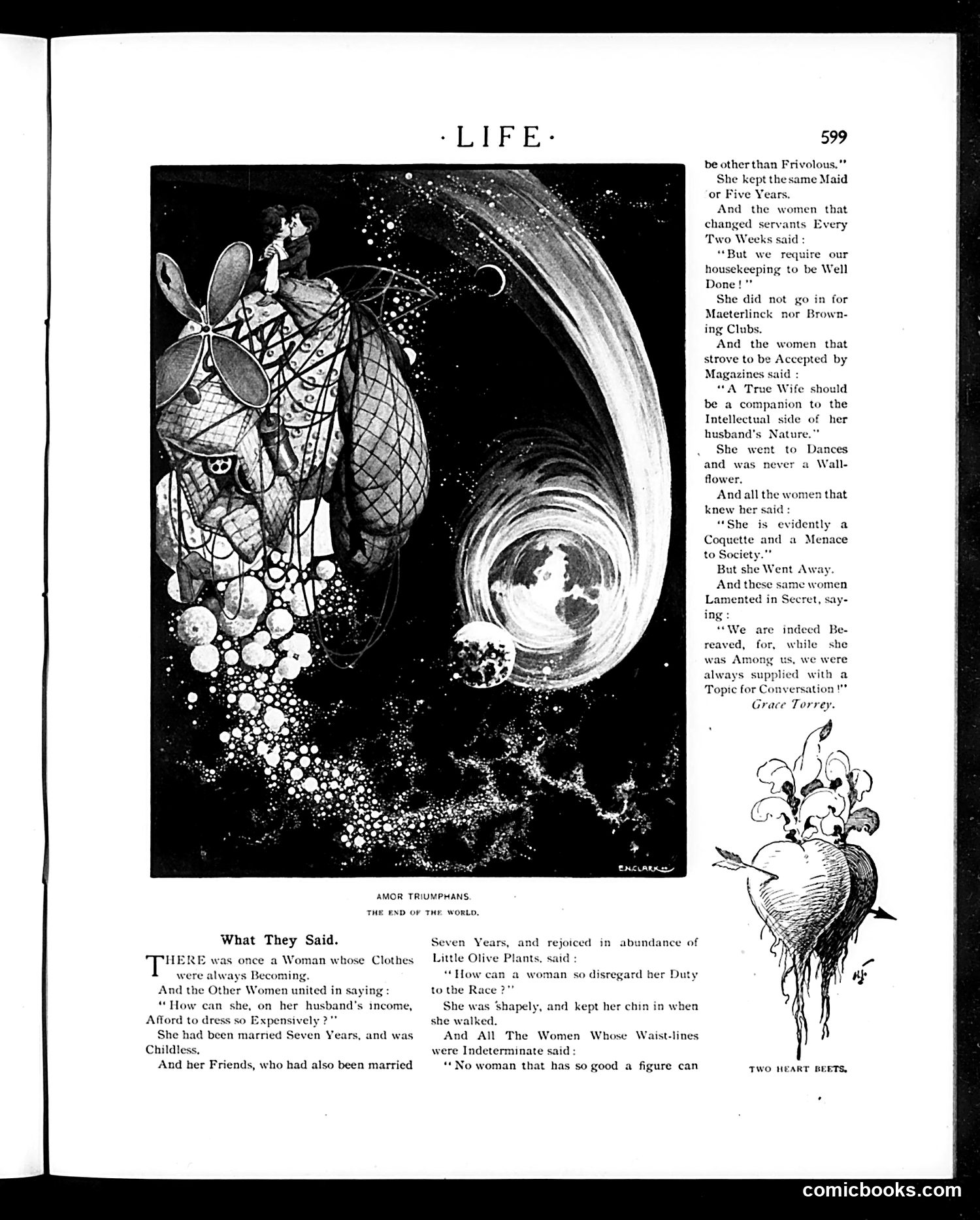
This satirical piece mocks female social judgment and hypocrisy in early 20th-century society. A woman is depicted whose primary "crime" is being well-dressed, attractive, and socially accomplished—yet other women find fault regardless. The satire exposes how women attack her for: - Dressing expensively on her husband's income - Being childless (failing "duty to the race") - Having an attractive figure (proof of frivolousness) - Not attending intellectual clubs - Being too social and never a wallflower The cruel irony: when she leaves, these same women lament losing her because she provided them endless "conversation topics"—implying their entire social bond existed only to criticize her. The title and celestial imagery suggest this petty judgment represents humanity's moral failing. It's a sharp critique of female cattiness and how women, despite shared social constraints, turned on each other rather than supporting one another.
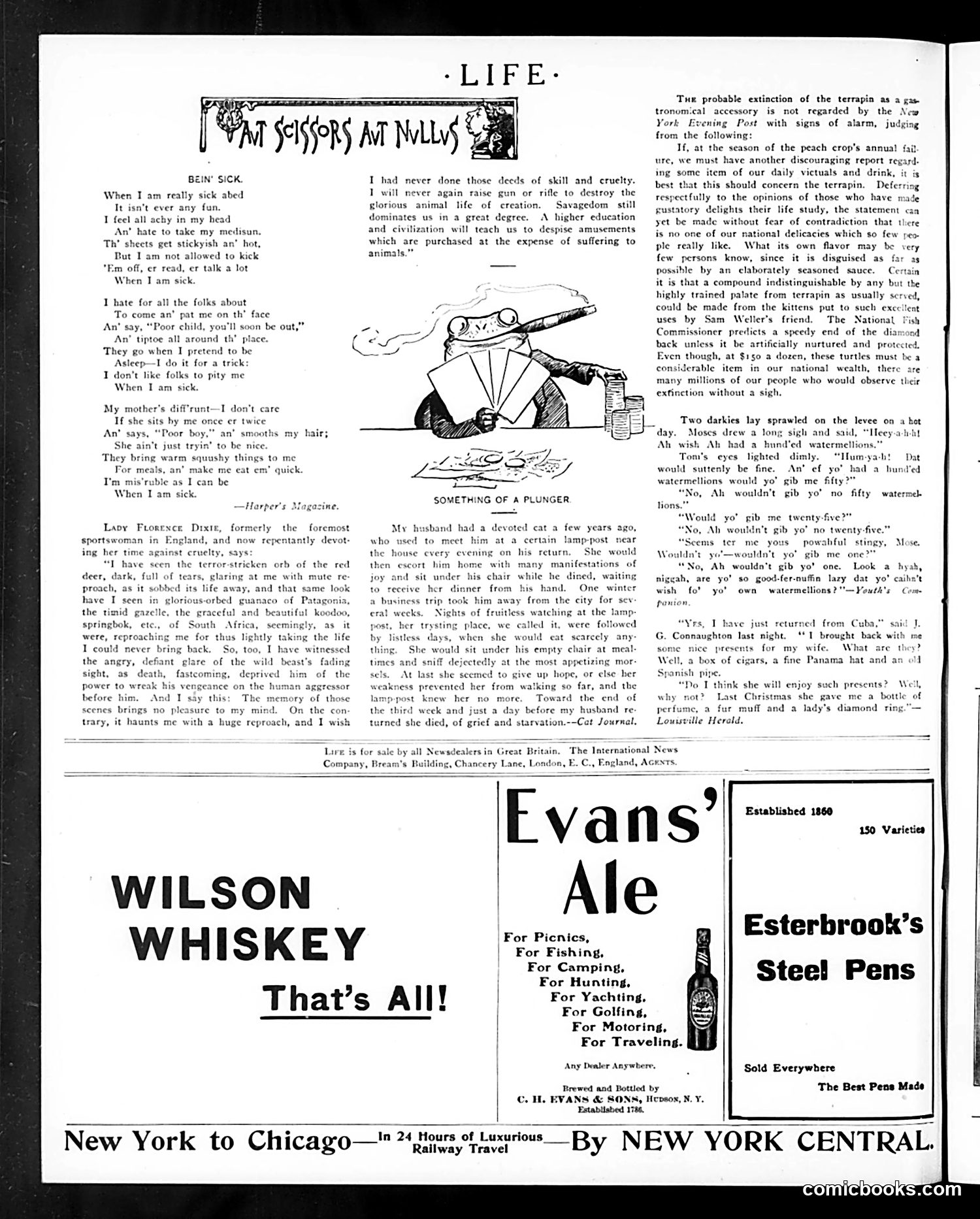
This page contains three distinct pieces: **"I'm Sick" (top):** A humorous children's poem about a boy's complaints during illness—disliking sympathy from visitors, uncomfortable bedding, and forced medicine—except from his mother, whose care he accepts. The satire is gentle, mocking childhood's perspective on sickness. **"Lady Florence Dixie" (middle-left):** A serious piece quoting a sportswoman's moral statement against hunting. She describes witnessing animals' terror and death, pledging never to hunt again. This advocates animal welfare—a progressive social concern of the era. **"Something of a Plunger" (right):** An anecdote about a devoted cat that died of grief and starvation awaiting her owner's return from a business trip. It's sentimental, emphasizing animal loyalty and emotional capacity. **Bottom sections:** Brief commentary on terrapin (turtle) extinction and dining preferences, plus advertisements for Wilson Whiskey, Evans' Ale, and Esterbrook's Steel Pens. The page mixes light humor, animal welfare advocacy, and period advertising typical of early-20th-century Life magazine.
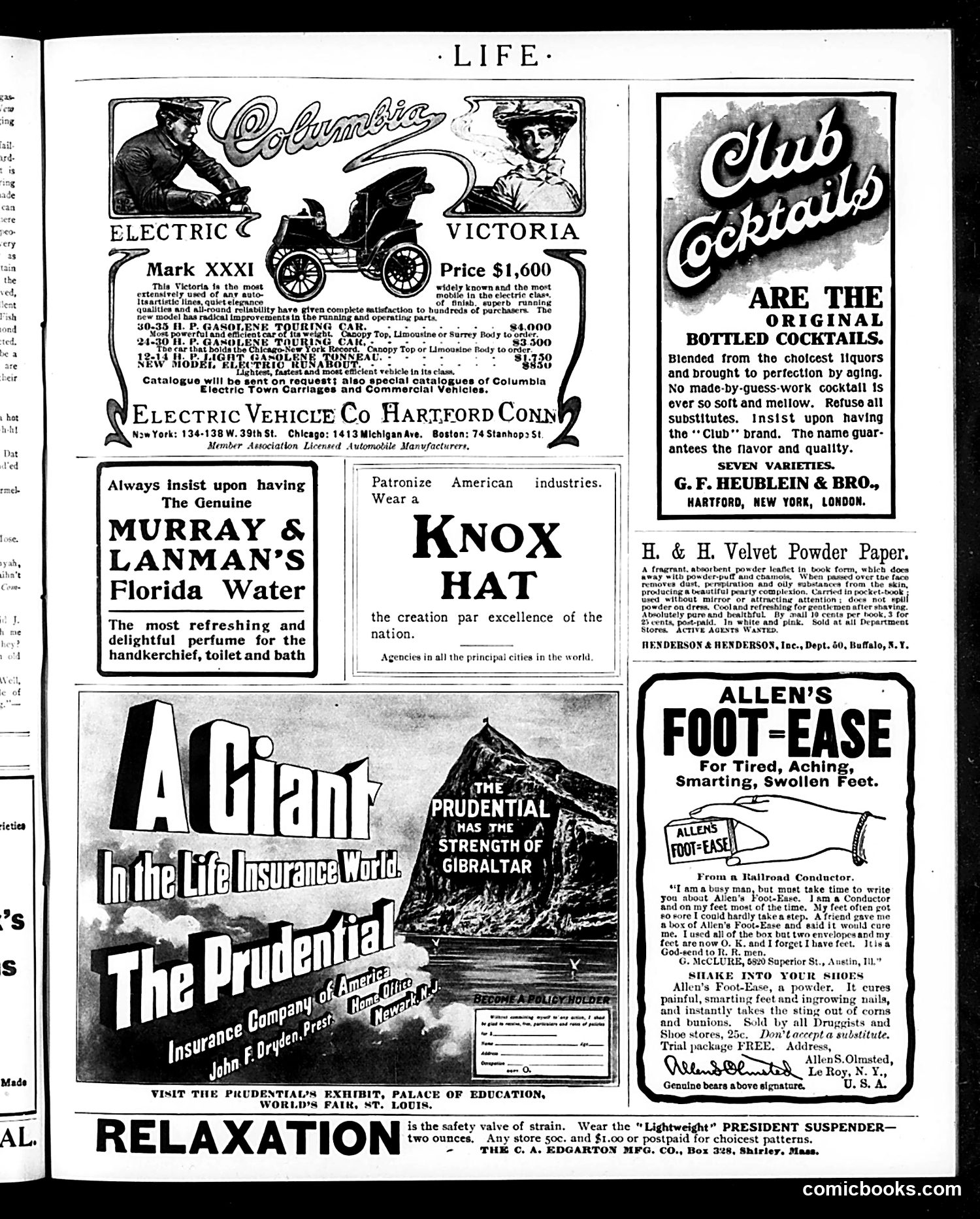
This page is **primarily advertising**, not satire or political commentary. It showcases early 1900s consumer products: **Main Advertisements:** - **Columbia Electric Victoria** automobile ($1,600)—marketed as elegant, quiet, and reliable - **Knox Hat**—appeals to patriotism ("Patronize American industries") - **Club Cocktails**—premium bottled drinks from Hartford - **Murray & Lanman's Florida Water**—perfume/toiletry product - **Prudential Insurance**—large institutional ad emphasizing strength ("Has the Strength of Gibraltar") - **Allen's Foot-Ease**—powder remedy for tired feet, featuring a testimonial from a railroad conductor - **H&H Velvet Powder Paper**—cosmetic product - **President Suspenders**—clothing accessory **Historical Context:** This reflects the consumer culture of the early 1900s, when Life magazine relied heavily on advertising revenue. The ads target middle-to-upper-class readers with new technologies (electric cars) and modern conveniences (prepared cocktails, commercial cosmetics). No political satire is evident on this particular page.
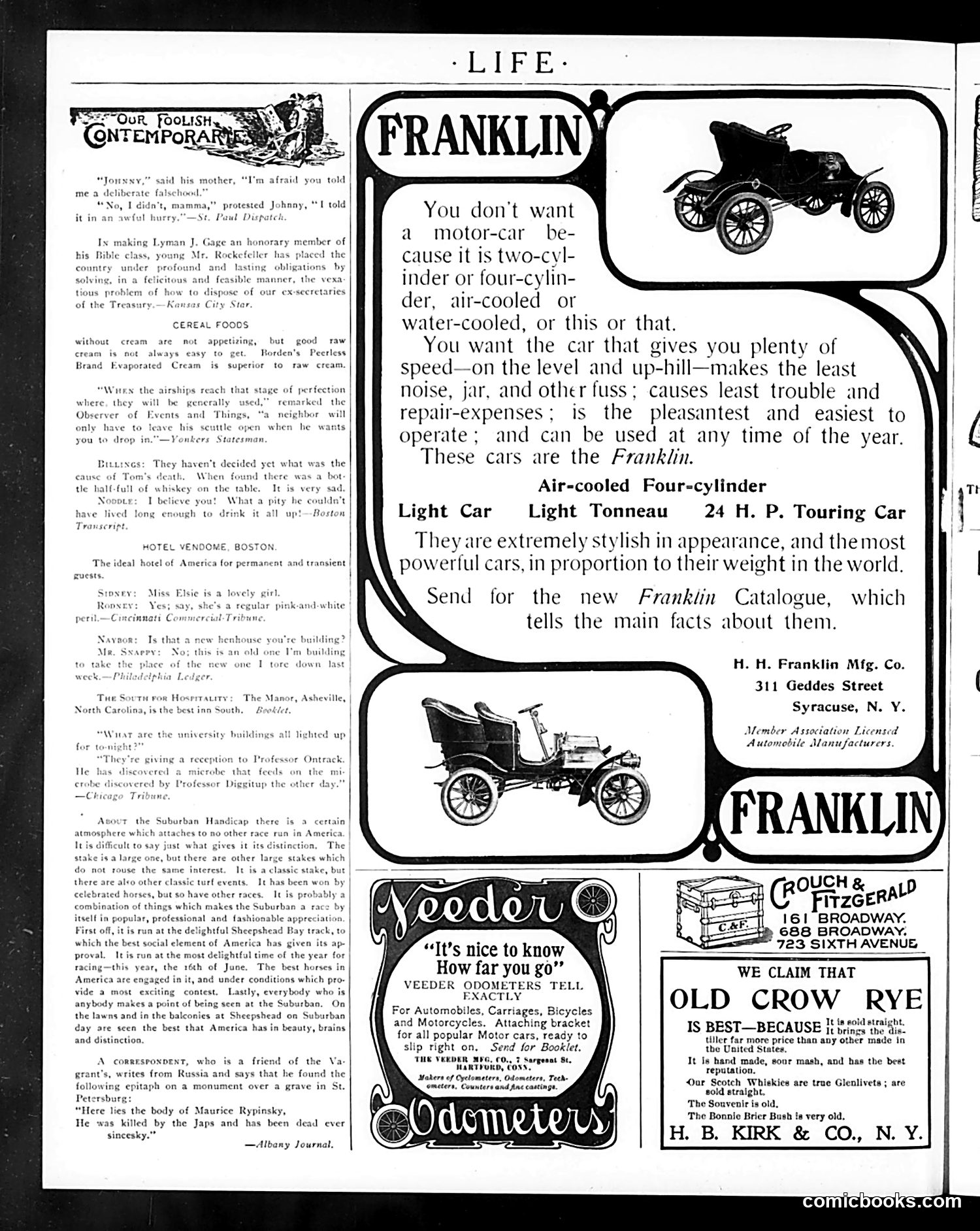
This page is primarily **advertising**, not satire or political commentary. It contains multiple product advertisements typical of early 1900s American magazines. The main content includes: 1. **Franklin Motor Car advertisement** — promotes Franklin automobiles, emphasizing practical features (speed, reliability, low noise, year-round usability) over technical specifications. The car is positioned as stylish and powerful for its weight. 2. **Veeder Odometers ad** — advertises distance-measuring devices for various vehicles, using the slogan "It's nice to know how far you go." 3. **Old Crow Rye whiskey ad** — claims superiority based on price, hand-made production, and sour-mash process. 4. **H.B. Kirk & Co. ad** — sells Scotch whisky brands. The left column contains brief humorous social commentary ("Our Foolish Contemporaries") and gossip items typical of Life's satirical sections, but these are separate from the advertisements and don't relate to the ads' content.
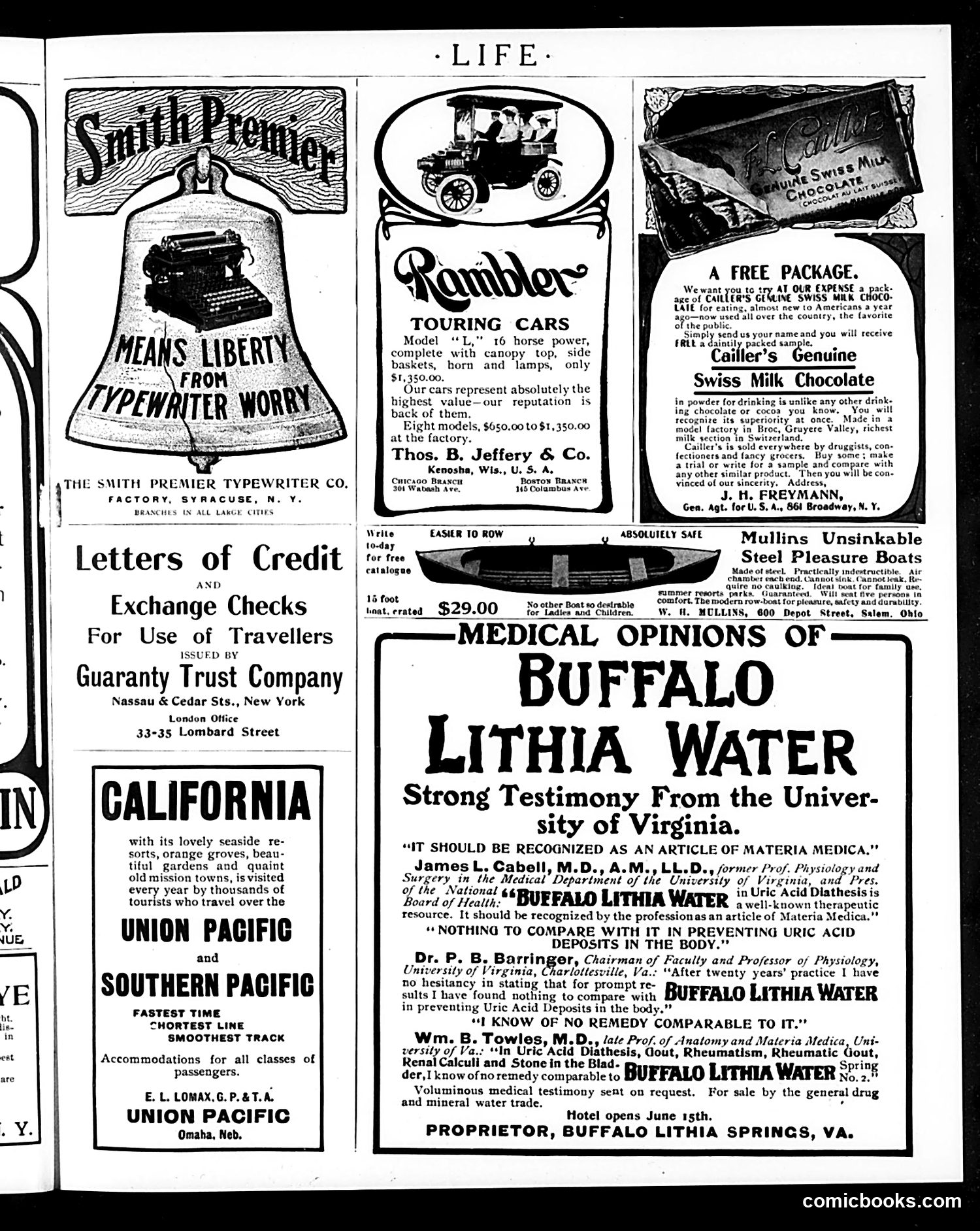
This is primarily an **advertisement page** from *Life* magazine, not a cartoon page, so there's limited satirical content. The page features various commercial ads typical of the early 1900s: typewriters, automobiles (Rambler touring cars), chocolate, pleasure boats, railroad travel, and travelers' checks. The most prominent ad occupies half the page: **Buffalo Lithia Water**, a mineral spring water marketed as medicinal. The water's advertisement relies on **medical endorsements from University of Virginia professors** claiming it treats uric acid deposits, gout, and rheumatism. This reflects a common early-20th-century marketing practice of invoking scientific authority—actual doctors lending credibility to dubious health claims. Modern readers would recognize this as proto-pseudoscience: mineral water promoted as a cure-all remedy based on testimonials rather than rigorous evidence. No political satire is apparent; this is straightforward period advertising reflecting contemporary attitudes toward commerce, health, and scientific legitimacy.
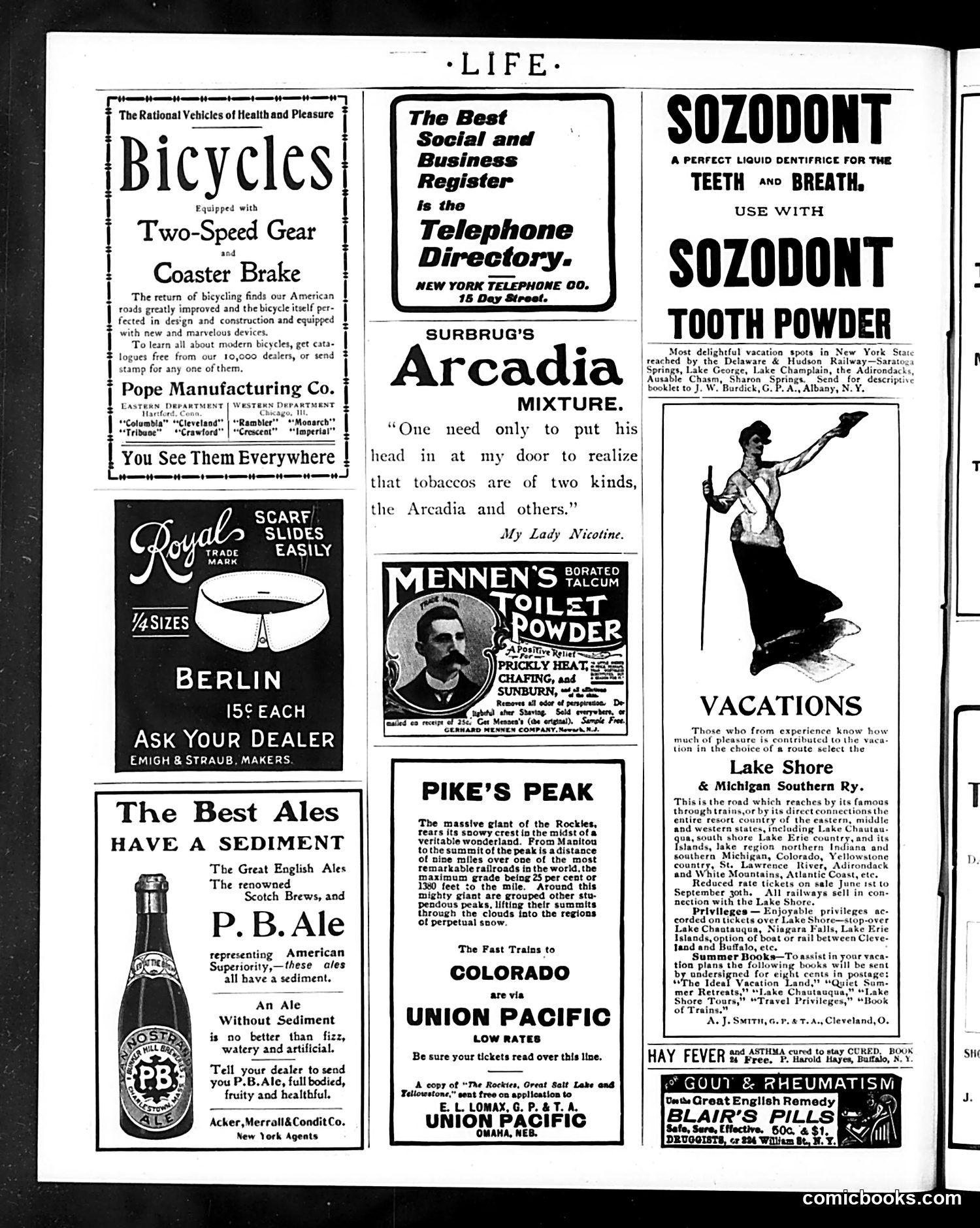
This is primarily an **advertising page** with no political cartoons or satirical content requiring historical context. The page contains period product advertisements (circa early 1900s) including bicycles, dental products (Sozodont), tobacco, scarves, ale, talcum powder, and vacation travel services. The single illustrative element—a woman in classical pose advertising vacations—is decorative rather than satirical. One advertisement quotes "My Lady Nicotine" regarding tobacco types, and another features Mennen's talcum powder with a man's portrait, but these are standard commercial pitches without political commentary. The vacation ads promoting American destinations (Pike's Peak, Lake Shore, Colorado via Union Pacific) reflect period tourism marketing. There is **no identifiable satire, caricature, or social commentary** on this page—it functions as straightforward commercial content typical of early 20th-century magazine layout.
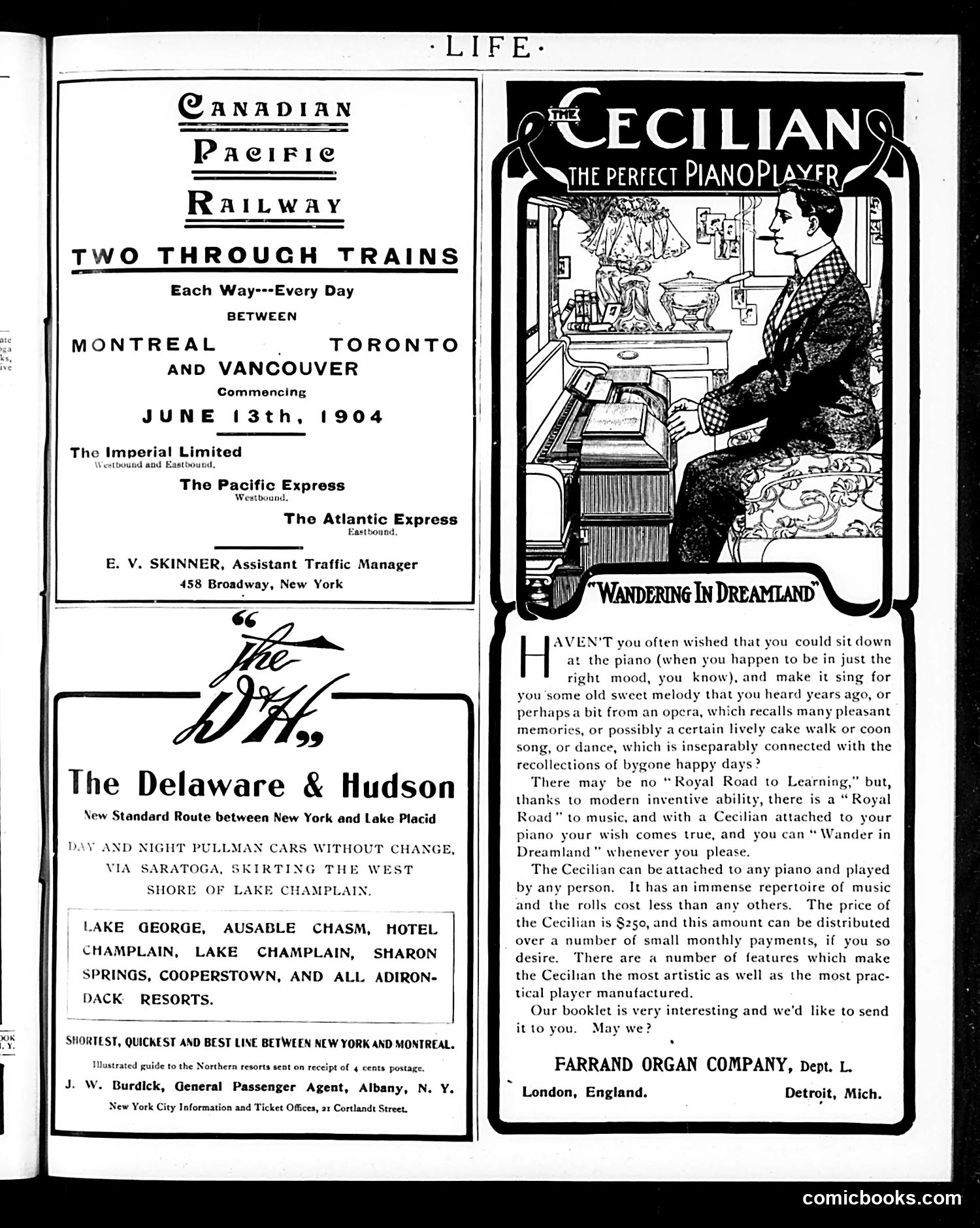
This page contains **three advertisements**, not political cartoons or satire. The **left side** promotes Canadian Pacific Railway's new transcontinental service (June 1904) and the Delaware & Hudson Railway's route to Lake Placid and Adirondack resorts—typical transportation advertising of the era. The **right side** features the Cecilian player piano. The illustration shows a woman at a piano with sheet music, accompanying advertising copy that appeals to nostalgia and leisure. The ad emphasizes how the Cecilian—a mechanical device that plays pre-recorded music rolls—allows anyone to produce music without skill. At $250 (distributed in monthly payments), it promised access to an "immense repertoire." This was cutting-edge consumer technology in 1904, representing the era's fascination with mechanical automation and home entertainment. The "Wandering in Dreamland" tagline captures the romantic appeal: owning a player piano meant affordable access to classical music and popular songs in one's home.
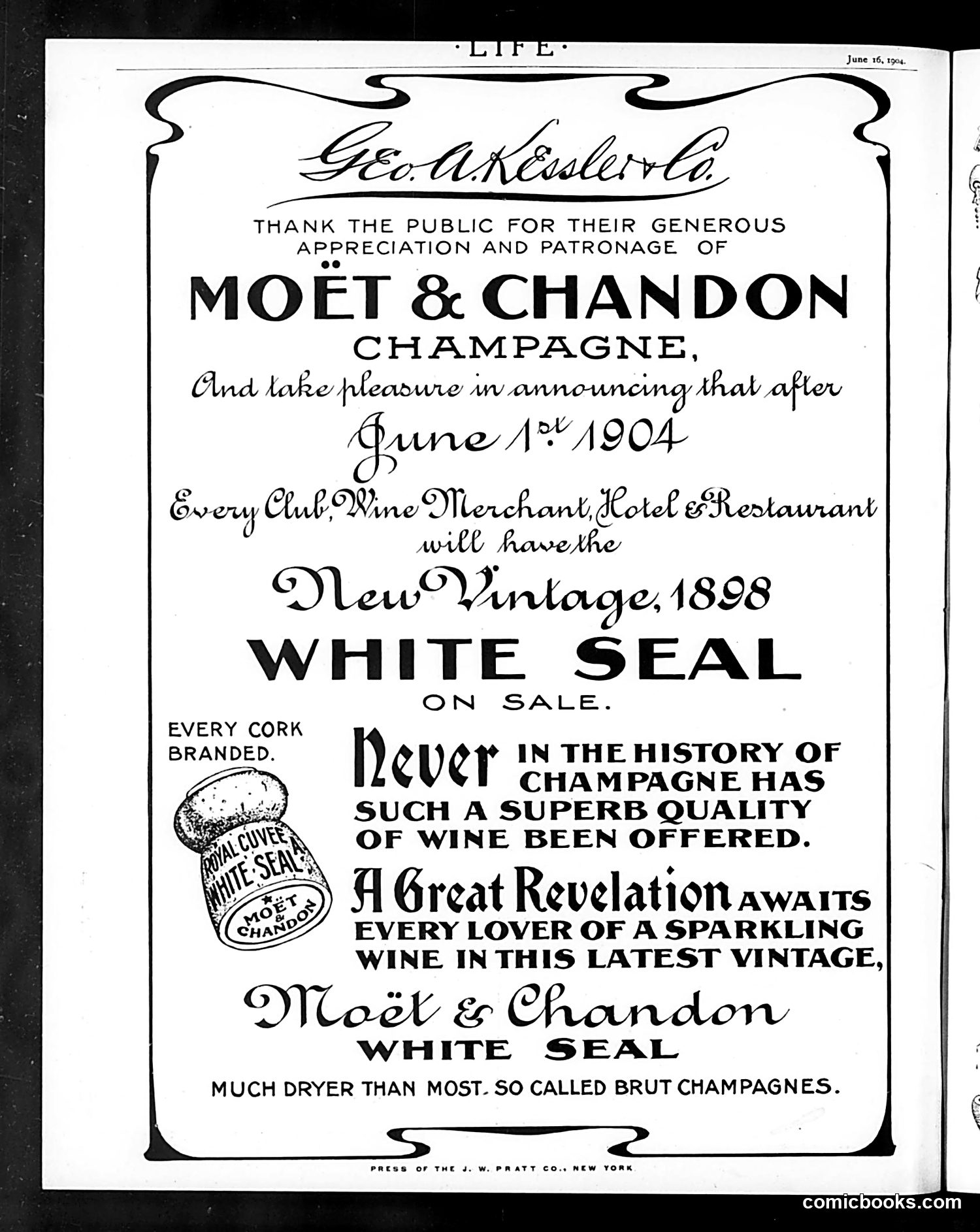
This is a **full-page advertisement**, not a cartoon or satire. It's a 1904 ad for Moet & Chandon champagne's "White Seal" brand, announcing availability of their 1898 vintage. The ad uses hyperbolic marketing language typical of the era—claims of "superb quality," "great revelation," and superiority over competitors' "brut" champagnes. The decorative border and mix of fonts/scripts reflect early 1900s advertising design. An illustration of a branded cork appears on the left. There is no political content or satirical commentary. Life magazine, despite its satirical reputation, regularly published advertisements alongside editorial content. This represents straightforward commercial promotion from a prestigious French champagne house to wealthy American consumers.