
Life, 1904-06-16 · page 14 of 22
Life — June 16, 1904 — page 14: what you’re looking at
What you’re looking at
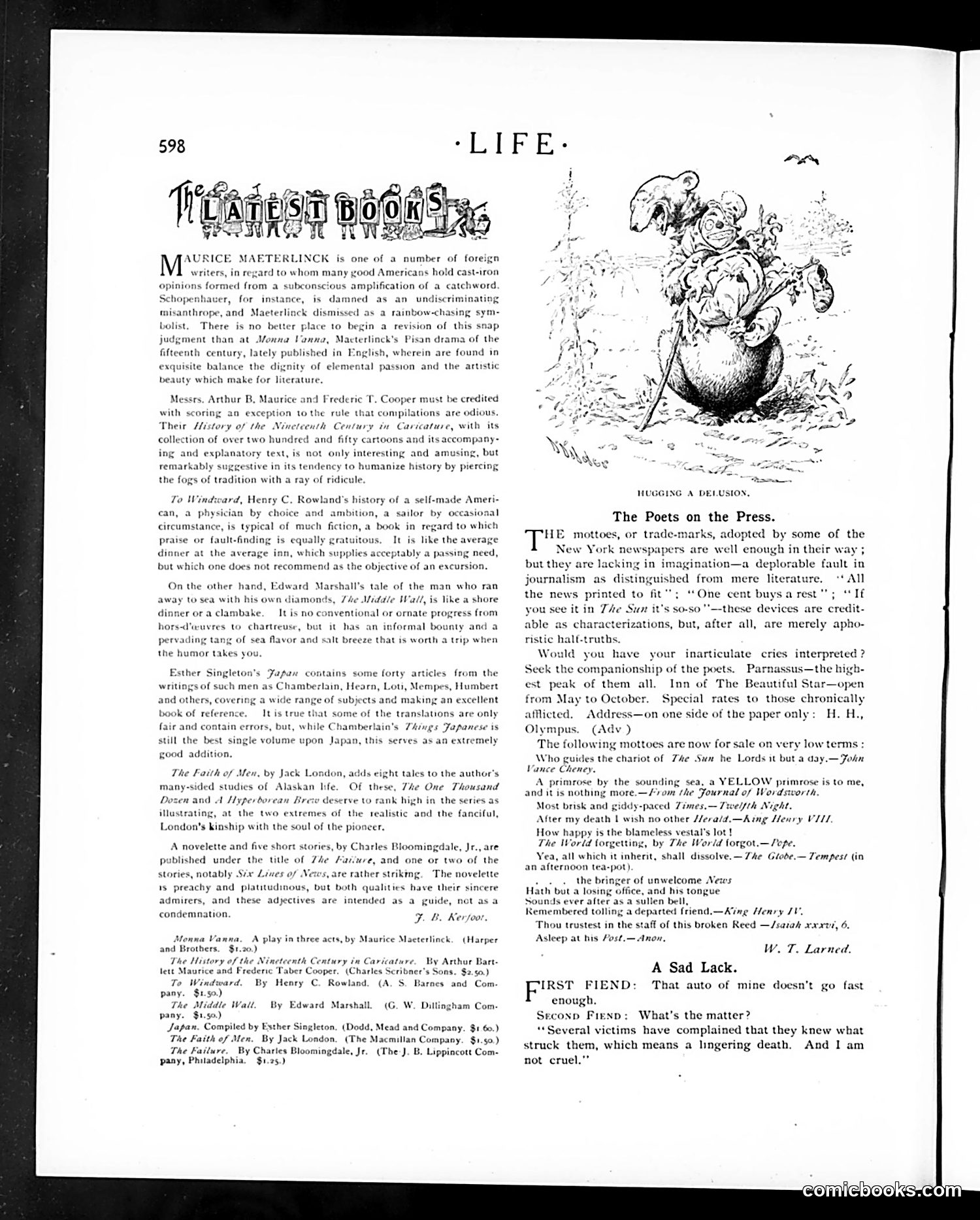
This page is primarily a **book review section** titled "The Latest Books," discussing contemporary literary works by authors like Maurice Maeterlinck, Jack London, and others. The single cartoon titled "HUGGING A DELUSION" shows a figure embracing what appears to be a pig or similar animal—likely a visual pun about self-deception or clinging to false beliefs. The accompanying section "The Poets on the Press" critiques newspaper mottos and journalistic practices. It mocks New York newspapers for adopting trade-marks that sound grand but lack substance, calling them "merely aphoristic half-truths." The text argues that newspapers' grandiose slogans about their own importance ("The Sun is Lords it but a day") ring hollow when their actual reporting is superficial. The page concludes with humorous mock-epitaphs from poets about newspapers and editors, presenting satirical commentary on press pretension and journalistic shortcuts of the era.
📄 Transcribed text from this page (OCR, searchable)
Machine-transcribed from the original scan — historical spelling and the odd misread are preserved.
LARRSo 88 ¥ AURICE MAETERLINCK is one of a number of foreign writers, in regard to whom many good Americans hold cast-iron opinions formed from a subconscious amplification of a catchword. Schopenhauer, for instance, is damned as an undiscriminating misanthrope, and Maeterlinck dismissed as a rainbow-chasing sym- bolist. There is no better place to begin a revision of this snap judgment than at Monna Vanna, Macterlinck’s Pisan drama of the fifteenth century, lately published in English, wherein are found in exquisite balance the dignity of elemental passion and the artistic beauty which make for literatur Messrs, Arthur B, Maurice and Frederic T. Cooper must be credited with scoring an exception tot ¢ that compilations are odious. Their Mistory of the Nineteenth Century in Caricature, with its collection of over two hund ing and explanat 4 and fifty cartoons and its accompany- y text, is not only interesting and amusing, but its tendency to humanize history by piercing remarkably suggestive the fogs of tradition with a ray of ridicule. Windward, Henry C. Rowland’s history of a self-made can, a physician by choice circumstance, is typical of much fiction, a book in regard to whic It is like the average nd ambition, a sailor by occasi praise or fault-finding is equally gratuitous, dinner at the average inn, which supplies acceptably a passing need, but which one does not recommend as the objective of an excursion. On the other hand, Edward Marshall's tale of the man who ran away to sea with his own diamonds, She Middle Wall, is like a shore dinner ora clambake. It is no conventional or ornate progress from hors<l'wuvres to chartreuse, but it has an informal bounty and a pervading tang of sea flavor and salt breeze that is worth a trip when the humor takes you. Esther Singleton’s Japan contains some forty articles from the writings of such men as Chamberlain, Hearn, Loti, Mempes, Humbert and others, covering a wide range of subjects and making an excellent book of reference, It is true that some of the translations are only fair and contain errors, but, while Chamberlain's Things Japanese is still the best single volume upon Japan, this serves as an extremely good addition, The Faith of Men, by Jack Le many-sided studies of Alaskan Ife. jon, adds eight tales to the author's Of these, Tae One Thousand Dozen and A Hyperborean Brew deserve to rank high in the series as iMustrating t the two extremes of the realistic the fanciful, London's kinship with the soul of the pioneer. A novelette and five short stories, by Charles Bloomingdale, Jr., are published under the title of Zhe Masiure, and one or two of the News, are rather striking. The novelette 1s preachy and platitudinous, but both qualities have their sincere stories, notably Six Lives ¢ admirers, and these adjectives are intended as a guide, tasa condemnation. Monna Vanna. 4 play in three acts, by Maurice Macterlinck and Brothers. $1.20.) The History of the Nineteenth Century in Caricature. lett Maurice and Frederic Taber Cooper. (Charles S To Windward. By Henry C. Rowland. pany. $1.50.) The Middle Walt. pany. $1.50.) pan. Compiled by Esther Singleton, (Dodd, Mead and Company. $1 60.) The Faith of Men. By Jack London. (The Macmillan Company. $1.50.) The Failure, By Charles Bloomingdale, Jr. (The-J. B. Lippincott Com- pany, Philadelphia. $1.25.) By Arthor Bart- er’s Sons. $2.50.) (A. S. Barnes and Com. By Edward Marshall. (G. W. Dillingham Com- MUGGING A DELUSION, The Poets on the Press. HE mottoes, or trade-marks, adopted by New York newspapers are well enough in their way ; journalism as distinguished from mere literatur printed to fit’; “One cent buys a rest"; you see itin Te Su it’s so-so'’—these devices are credit- able as characterizations, but, after all, are merely apho- ristic half-truths. Would you have your inarticulate cries interpreted ? Seek the companionship of the poets. Parnassus—the high- est peak of them all. Inn of The Beautiful Star—open from May to October. Special rates to those chronically afflicted. Address—on one side of the paper only: H. H., Olympus. (Adv ) The following mottoes are now for sale on very low terms : Who guides the chariot of The Sun he Lords it but a day,— John Vance Cheney. A primrose by the sounding sea, a YELLOW primrose is to me, and it is nothing more.—F1 0m the Journal of Wordsworth. Most brisk and giddy-paced Zimes.—Tivei/th Night. After my death | wish no other /era/d.—Aing Henry VIII. How happy is the blameless vestal’s lot ! The World forgetting, by The World torgot.— Pepe. Yea, all which it inherit, shall dissolve. — Zhe Grobe.— Tempest (in an afternoon tea-pot). ; the bringer of unwelcome News Hath but a losing office, and his tongue Sounds ever after as a sullen bell, Remembered tolling a departed friend.—Aing Henry IV. Thou trustest in the staff of this broken Reed —/sarah xxxvi, 6. Asleep at his Post.— Anon, the new W, T. Larned. A Sad Lack. IRST FIEND: ‘That auto of mine doesn’t go fast enough, Seconp Fiexp: What's the matter? “Several victims have complained that they knew what struck them, which means a lingering death. And I am not cruel.”’