
Life, 1904-06-16 · page 7 of 22
Life — June 16, 1904 — page 7: what you’re looking at
What you’re looking at
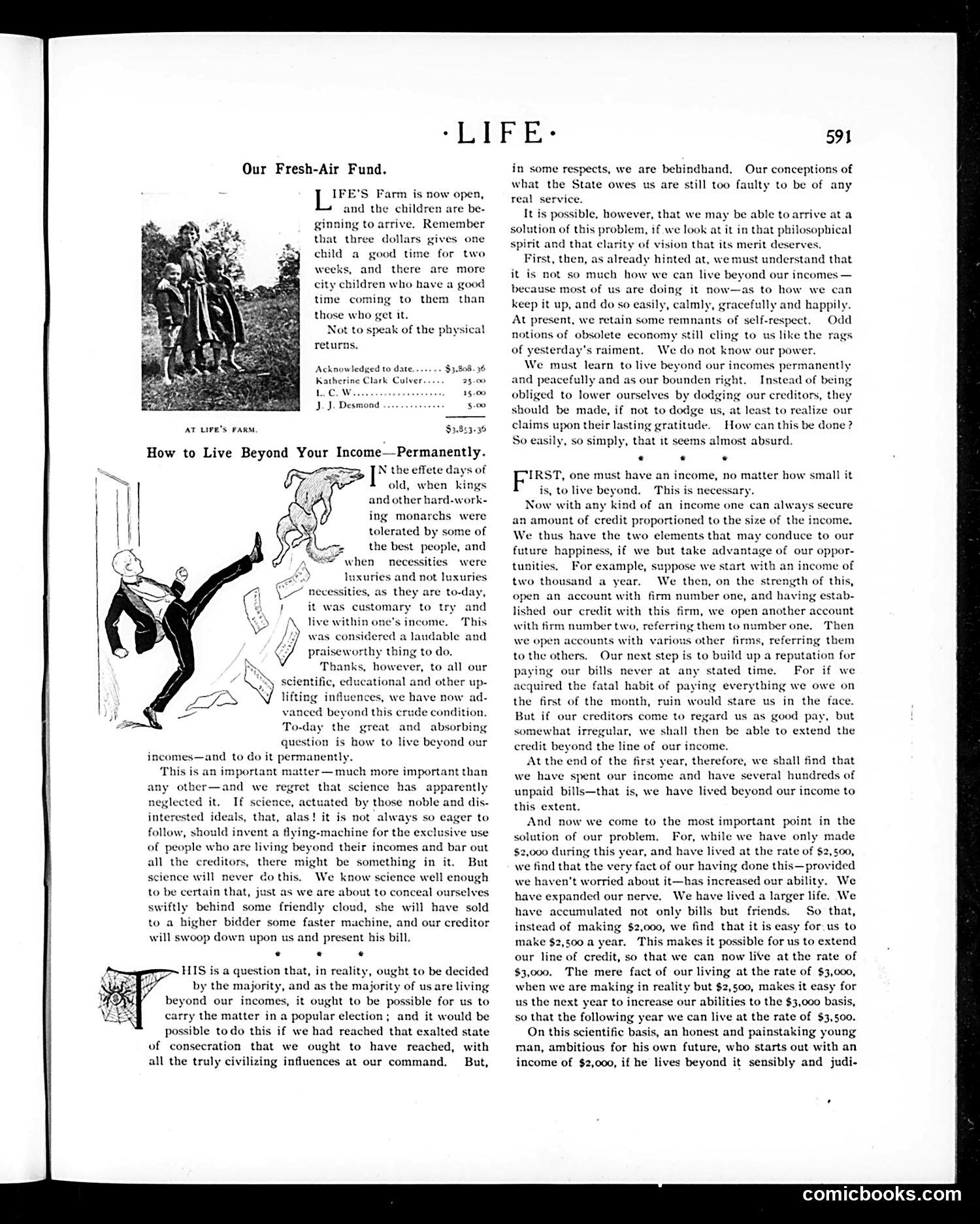
The main cartoon depicts a man in formal dress being kicked backward while money flies around him—illustrating the article's theme "How to Live Beyond Your Income—Permanently." The satire targets the common financial predicament of living beyond one's means. The article argues this was a widespread problem among Americans, even praising it as "laudable and praiseworthy." The text proposes a system using multiple credit accounts with different firms to manage debt strategically, building a reputation for timely payments while gradually extending credit lines. The cartoon's exaggerated violence humorously underscores the absurdity and precariousness of this financial juggling act. It satirizes both the desperation of overextended debtors and the era's emerging consumer credit culture, suggesting that surviving on credit was becoming normal middle-class practice.
📄 Transcribed text from this page (OCR, searchable)
Machine-transcribed from the original scan — historical spelling and the odd misread are preserved.
-LIFE- 591 Our Fresh-Air Fund. L: "S Farm is now open, and the children are be- ginning to arrive. Remember that three dollars gives one child a good time for two weeks, and there are more city children who have a good time coming to them than those who get it. Not to speak of the physical returns, Acknowledged to date.. $3,808.36 25.00 15.00 $00 How to Live Beyond Your Income—Permanently. N the effete days of old, when kings and other hard-work- ing monarchs were tolerated by some of = the best people, and Se" when necessities were eH) luxuries and not luxuries (/ necessities, as they are to-day it was customary to try and live within ¢ ‘This jaudable and eworthy thing to do, Thanks, however, to all our f iN scientific, educationa id other up- Rae NY lifting influences, we have now ad- vanced beyond this crude condition. t and absorbing ion is how to live beyond our —and to do it permanently. This is an important matter—much more important than any other—and we regret that science has apparently neglected it. If science, actuated by those noble and dis- interested ideals, th: !it is not always so eager to follow, should invent a flying-machine for the exclusive use of people who are living beyond their incomes and bar out all the creditors, there might be something in it. But science will never co this. We know science well enough to be certain that, just as we are about to conceal ourselves swiftly behind some friendly cloud, she will have sold to a higher bidder some faster machine, and our creditor will swoop down upon us and present his bill. . . . e's income. considered incom HIS is a question that, in reality, ought to be decided by the majority, and as the majority of us are living beyond our incomes, it ought to be possible for us to arry the matter in a popular election; and it would be possible todo this if we had reached that exalted state of consecration that we ought to have reached, with all the truly civilizing influences at our command. But, in some respects, we are bebindhand, Our conceptions of the State owes us are still too faulty to be of any real service. It is possible, however, that we may be able to arrive at a solution of this problem, if we look at it in that philosophical spirit and that clarity of vision that its merit deserves. ‘st, then, as already hinted at, we must understand that it is not so much how we can live beyond our incomes — because most of us are doing it now—as to how we can keep it up, and do so easily, calmly, gracefully and happily. At present, we retain some remnants of self-respect. Odd notions of obsolete economy still cling to us like the rags of yesterday's raiment. We do not know our power. We must learn to live beyond our incomes permanently and peacefully and as our bounden right. Instead of being obliged to lower ourselves by dodging our creditors, they should be made, if not to dodge us, at least to realize our claims upon their lasting gratitude. How can this be done? So easily, so simply, that it seems almost absurd. * * « IRST, one m have an income, no matter how small it is, to live beyond, This is necessary. Now with any kind of an income one an amount of credit proportioned to the We thus have the two elements that ma future happiness, if we but tal ge of our oppor- tunities. For example, suppose we start with an income of two thousand a year. We then, on the strength of this, open an account with firm number one, and ving estab- lished our credit with this firm, we open another account with firm number two, referring them to number one. Then we open accounts with various other firms, referring them to the others. Our nest step is to build up a reputation for paying our bills never at any stated time. For if we quired the fatal habit of paying everything we owe on the first of the month, ruin would stare us in the face. But if our creditors come to regard us as good pay, but somewhat irregular, we shall then be able to extend the credit beyond the line of our income. At the end of the first year, therefore, we shall find that we have spent our income and have several hundreds of unpaid bills—that is, we have lived beyond our income to this extent. And now we come to the most important point in the solution of our problem. For, while we have only made $2,000 during this year, and have lived at the rate of $2,500, we find that the very fact of our having done this—provided we haven't worried about it—has increased our ability. We have e nded our nerve. We have lived a larger life. We have accumulated not only bills but friends. So that, instead of making $2,000, we find that it i y for.us to make $2,500 a is makes it possible for us to extend our line of credit, so that we can now live at the rate of $3,000. The mere fact of our living at the rate of $3,000, when we are making in reality but $2,500, makes it easy for us the next year to increase our abilities to the $3,000 basis, so that the following year we can live at the rate of $3,500. On this scientific basis, an honest and painstaking young man, ambitious for his own future, who starts out with an income of $2,000, if he lives beyond it sensibly and judi- an always secure come, y conduce to our comicbooks.com