
Life, 1904-06-16 · page 8 of 22
Life — June 16, 1904 — page 8: what you’re looking at
What you’re looking at
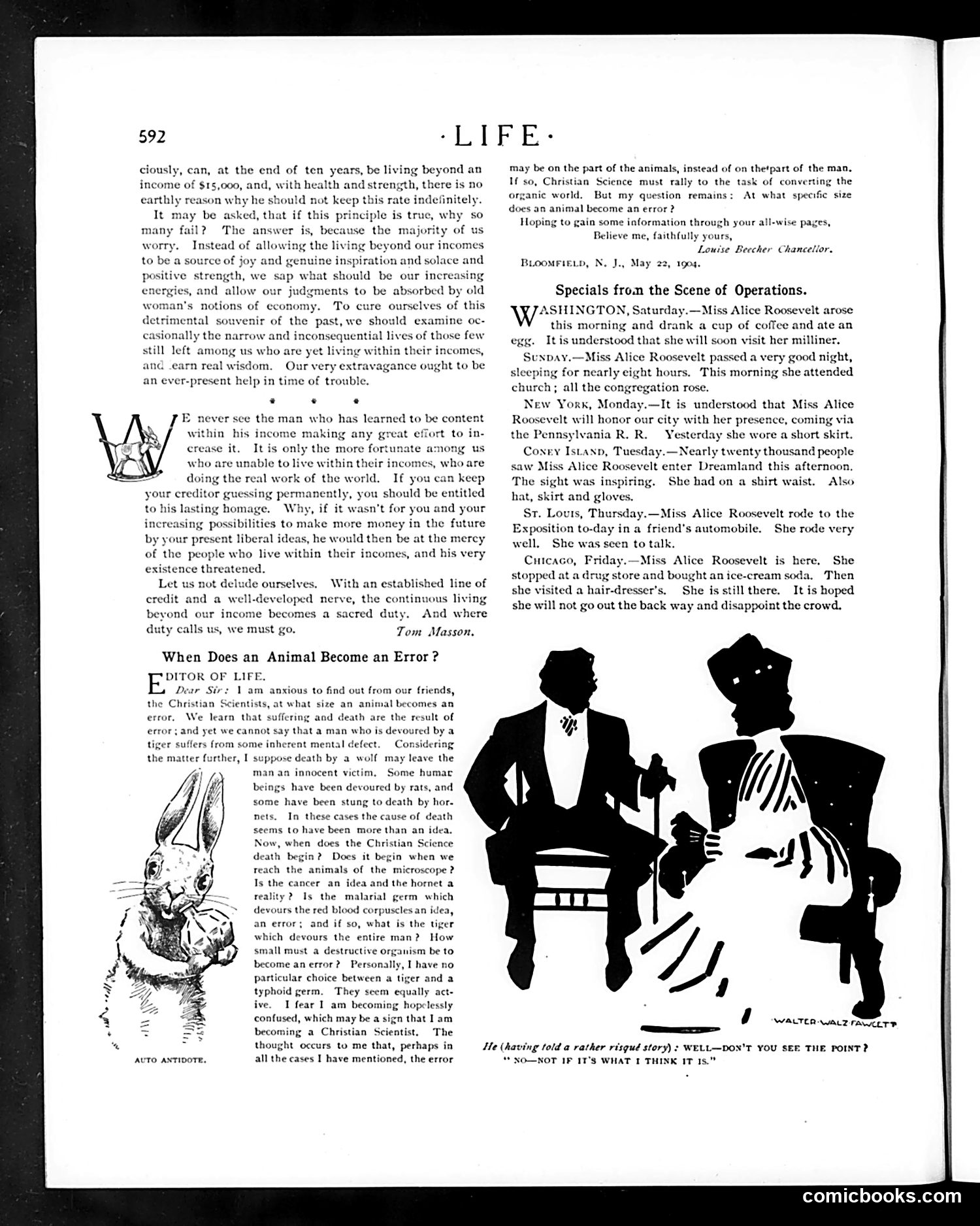
This page contains two distinct elements: **"Specials from the Scene of Operations"** reports on **Alice Roosevelt's travels** across America (Washington, New York, Chicago, St. Louis, etc.). These brief dispatches humorously chronicle her activities—visiting a milliner, riding in automobiles, shopping for ice-cream soda—treating her movements as newsworthy "operations." **The cartoon by Walter Waltz Facelly** depicts a social scene where one figure tells another: "Well—don't you see the point? 'So—not if it's what I think it is.'" The silhouetted figures and cryptic dialogue suggest satirizing a social misunderstanding or breach of etiquette among upper-class characters, though the specific joke's context isn't entirely clear from the image alone. The page overall reflects Life's focus on prominent social figures and contemporary upper-class behavior as subjects for satire.
📄 Transcribed text from this page (OCR, searchable)
Machine-transcribed from the original scan — historical spelling and the odd misread are preserved.
592 ciously, can, at the end of ten years, be living beyond an income of $15,000, and, with health and strength, t earthly reason why he should not keep this rate indefinitely. It may be asked, th many fai worry. to be a source of joy and genuine inspiration and solace and positive strength, we sap w energies, and allow re is no if this principle is true, why so ‘The answer is, because the majority of us Instead of allowing the living beyond our incomes at should be our increasing ar judgments to be absorbed by old woman's notions of economy. To cure ourselves of this detrimental souvenir of the past, we should examine oc- casionally the narrow and inconsequential lives of those few still left among us who are yet living within their incomes, n real wisdom. Our very extravagance ought to be an ever-present help in time of trouble. * * e E never see the man who has learned to be content within his income making any g fiort to in- crease it. It is only the more fortunate among us who are unable to live within their ince doing the real work of the world. If you can keep your creditor guessing permanently, you should be entitled to his lasting homage. Why, if it wasn’t for you and your increasing possibilities to make more money in the future by your present liberal id ould then be at the mercy of the people who live within their incomes, and his very “8, who are existence threatened. Let With an established line of credit and a well-developed nerve, the continuous living beyond our income becomes a sacred duty. And where not delude ourselves. duty calls us, we must go. Tom Masson. When Does an Animal Become an Error? DITOR OF LIFE. Dear Sir: \ am anxious to find out from our friends, the Christian Scientists, at what size an animal becomes an We learn that suffering and death are the result of error; and yet we cannot say that a man who is devoured by a tiger suffers from some inherent mental defect. Considering the matter further, I suppose death by a wolf may leave the error, man an innocent victim, Some humar beings have been devoured by rats, and some have been stung to death by hor- nets. In. these cases the cause of death seems to have been more than an idea, Now, when does the Christian Science death begin? Does it begin when we reach the animals of the microscope ? Is the cancer an idea and the hornet a reality 2 devours the red blood corpusc! Is the malarial germ which san idea, an error; and if so, what is the tiger which devours the entire man? How small must a destructive organism be to become an error? Personally, I have no Particular choice between a tiger and a typhoid germ. They seem equally act- ive. I fear I am becoming hopelessly confused, which may be a sign that Iam becoming a Christian Scientist. The thought occurs to me that, perhaps in all the cases I have mentioned, the error -LIFE- may be on the part of the animals, instead of on thetpart of the man, If so, Christian Science must rally to the task of converting the organic world, But my question remains: At what specific size does an animal become an error? Hoping to gain some information through your all-wise pages, Believe me, faithfully yours, Louise Beecher , May 22, 1904. Chancellor. Bioomrie.p, N. Specials from the Scene of Operations. wes INGTON, Saturday.—Miss Alice Roosevelt arose this morning and drank a cup of coffee and ate an egg. It is understood that she will soon visit her milliner, SuNpay.—Miss Alice Roosevelt passed a very good night, sleeping for nearly eight hours. This morning she attended church; all the congregation rose. New York, Monday.—It is understood that Miss Alice Roosevelt will honor our city with her presence, coming via the Pennsylvania R. R. Coxry Istaxp, Tuesday.—? saw Miss Alice Roosevelt enter Dri The sight was in: hat, skirt and glov Sr. Louts, Thursday.—Miss Alice Roosevelt rode to the Exposition to-day in a friend's automobile. She rode very well, She was scen to talk. Cutcaco, Friday.—Miss Alice Roosevelt is here, stopped at a drug store and bought an ice-cream soda. Then she visited a hair-dresser's, She is still there. It is hoped she will not go out the back way and disappoint the crowd, Yesterday she wore a short skirt. arly twenty thousand people nland this afternoon, piring. She had on a birt waist. Also She 4 === He (having told a rather risgué story) : WELL—DON'T YOU SER THE POINT? * NO—NOT IF IT’S WHAT I THINK IT IS." D wacrea waz eer comicbooks.com