
Life, 1904-06-16 · page 5 of 22
Life — June 16, 1904 — page 5: what you’re looking at
What you’re looking at
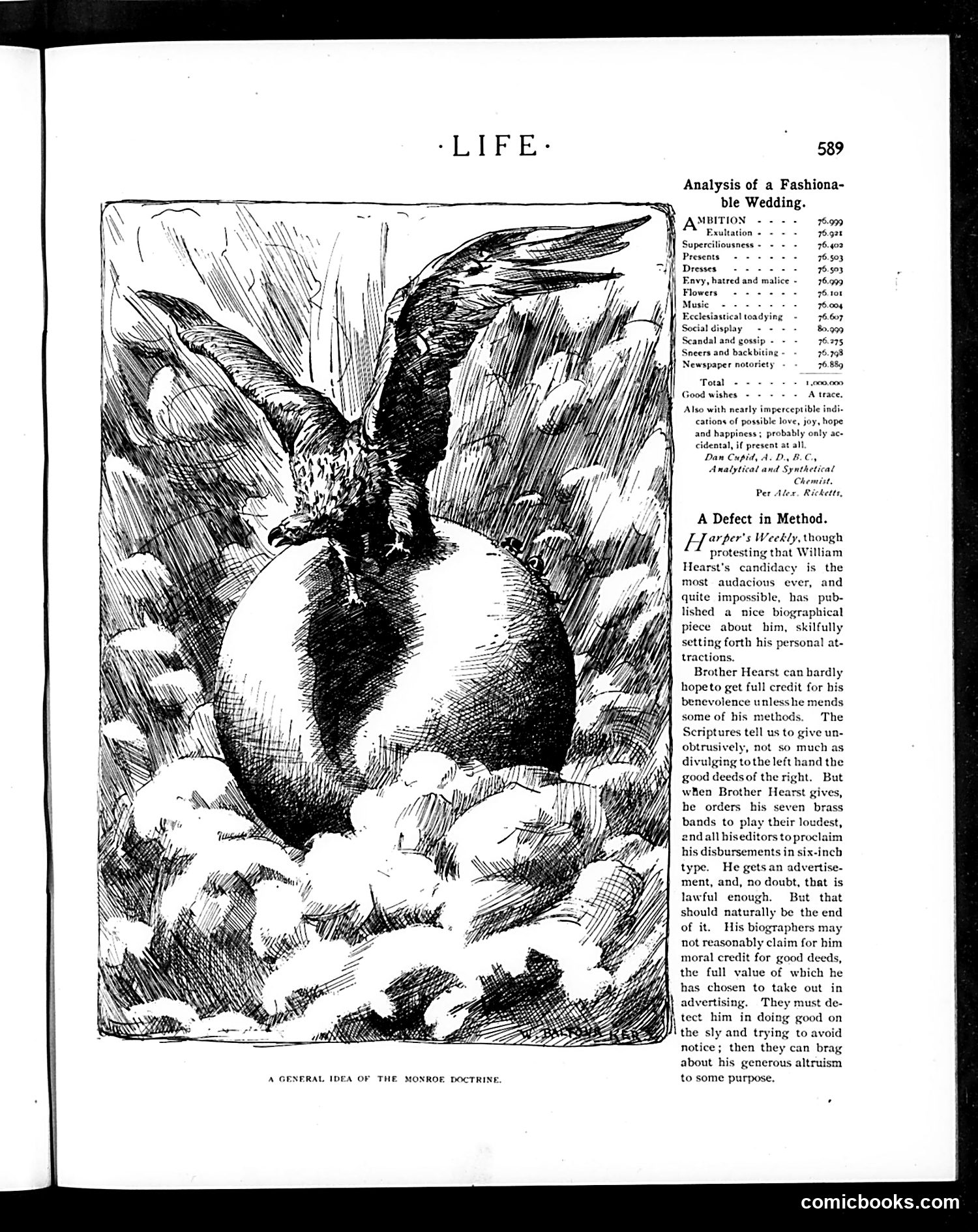
The main illustration depicts a winged creature (appearing demonic or angelic, depending on perspective) emerging from or trapped within rocky terrain. The caption reads "A GENERAL IDEA OF THE MONROE DOCTRINE." This is a satirical commentary on the Monroe Doctrine—the U.S. foreign policy opposing European intervention in the Americas. The ambiguous winged figure likely represents America's assertion of hemispheric dominance. The creature's posture—seemingly constrained or emerging forcefully—suggests satire about the doctrine's aggressive implementation or its contradictions. The accompanying article, "A Defect in Method," criticizes William Hearst's philanthropic approach, arguing his public advertising of charitable deeds undermines genuine benevolence. The juxtaposition suggests critique of both imperialism and performative charity during this era.
📄 Transcribed text from this page (OCR, searchable)
Machine-transcribed from the original scan — historical spelling and the odd misread are preserved.
589 Analysis of a Fashiona- ble Wedding. AMBITION = = + + 16.099 Exultation- - - - 76.g2t Superciliousness- - = - 76.402 Presents 76.503 Dresses = - = = - = 75.503 Envy, hatred - 76.999 Flowers 76.108 Music 76.004 Ecclesiastical toadyi 76.607 Social display - - - = — B.999 Scandal and gossip» - - 76.275 Sneers and backbiting - - 76.798 Newspaper notoriety - - 76.889 A trace. Also with nearly imperceptible indi- '¥, hope probably only ac- cidental, if present at all Dan Cupid, A. Diy BoC Analytical and Synthetical Chemist. Per Alex. Ricketts, A Defect in Method. Hove's Weekly, though protesting that William Hearst's candidacy is the most audacious ever, and quite impossible, has pub- lished a nice biographical piece about him, skilfully setting forth his personal at- tractions. Brother Hearst can hardly hopeto get full credit for bis benevolence unless he mends some of his methods. The Scriptures tell us to give un- obtrusively, not so much as divulging tothe left hand the good deeds of the right. But when Brother Hearst gives, he orders hi: in brass bands to play their loudest, endall hiseditors toproclaim his disbursements in six-inch type. He gets an advertise- ment, and, no doubt, that is lawful enough. But that should naturally be the end of it. His biographers may not reasonably claim for him moral credit for good deeds, the full value of which he has chosen to take out in advertising. They must de- tect him in doing good on the sly and trying to avoid notice; then they can brag about his generous altruism A GENERAL IDEA OF THE MONROE DOCTRINE. to some purpose, comicbooks.com