
Life, 1904-06-16 · page 13 of 22
Life — June 16, 1904 — page 13: what you’re looking at
What you’re looking at
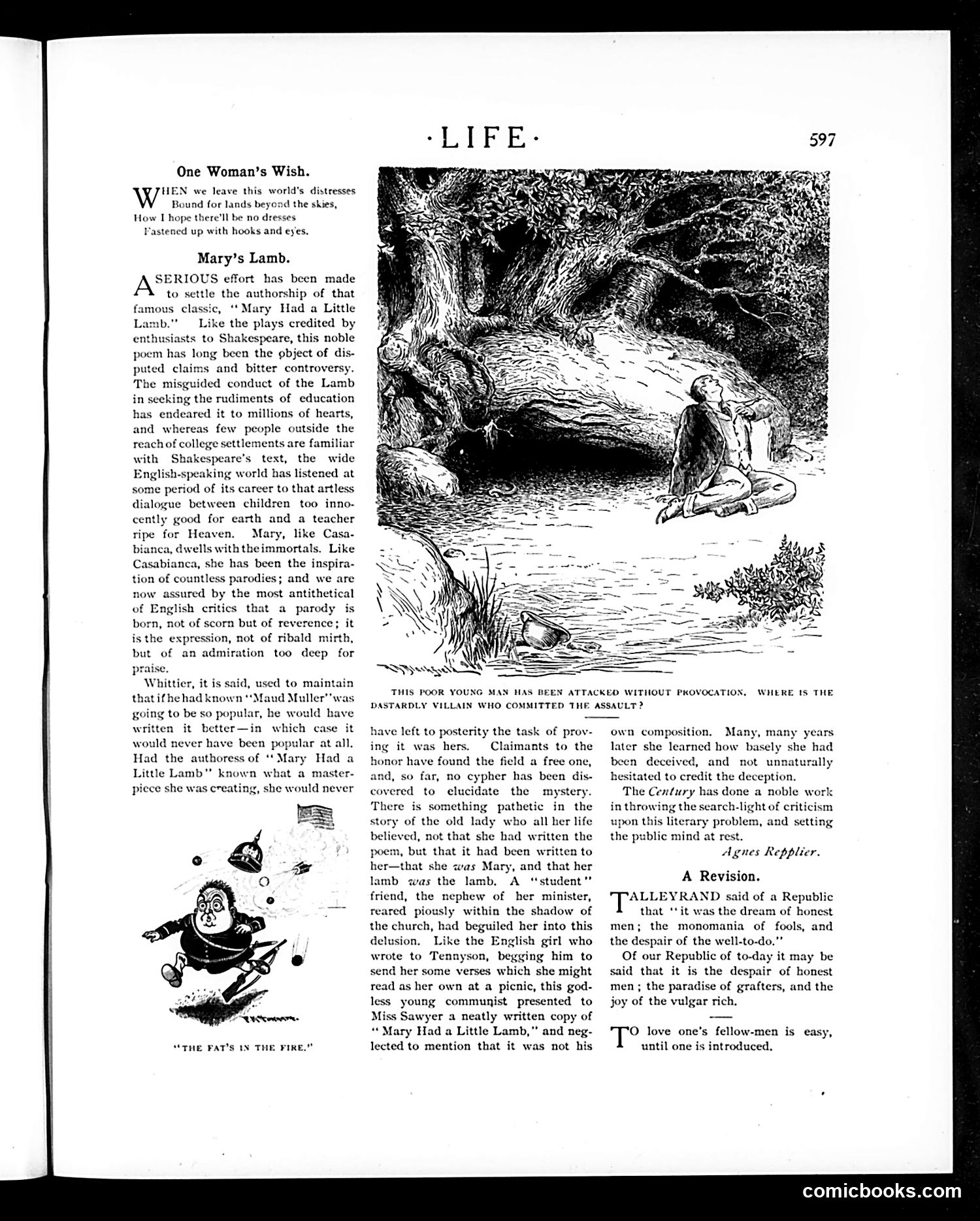
This page contains literary commentary and social satire typical of early 20th-century *Life* magazine. The main article discusses disputed authorship of "Mary Had a Little Lamb," comparing the controversy to Shakespeare attribution debates. The author (Agnes Repplier) satirizes how a poor woman was duped into believing she wrote the poem when a minister's nephew deceived her. The satire targets intellectual pretension and how easily people are manipulated by false authority. The small cartoon captioned "THE PAT'S IN THE FIRE" shows a figure in distress—likely representing someone caught in scandal or trouble—with the ironic caption asking where the "villain" is. This appears to satirize situations where victims are blamed or where culprits escape accountability. "One Woman's Wish" and "A Revision" are brief satirical verses mocking contemporary concerns (women's fashion constraints, political corruption among the wealthy and grafters). The overall tone critiques intellectual dishonesty, gullibility, and social hypocrisy of the era.
📄 Transcribed text from this page (OCR, searchable)
Machine-transcribed from the original scan — historical spelling and the odd misread are preserved.
One Woman’s Wish. HEN we leave this world’s distresses Bound for lands beyond the skies, How I hope there'll be no dresses Fastened up with hooks and eyes, Mary’s Lamb. SERIOUS effort has been made to settle the authorship of that s classic, ‘Mary Had a Little Lamb." Like the plays credited by enthusiasts to Shakespeare, this noble poem has long been the gbject of dis- puted claims and bitter controversy. The misguided conduct of the Lamb in seeking the rudiments of education has endeared it to millions of hearts, and whereas few people outside the reach of college settlements are familiar with Shakespeare's text, the wide English-speaking world has listened at some period of its career to that artle: dialogue between children too inno- cently good for earth and a teacher ripe for Heaven. Mary, like C: bianca, dwells with theimmortals. Like Casabianca, she has been the inspira- tion of countless parodies; and we are now assured by the most antithetical of English critics that a parody is born, not of scorn but of reverence; it isthe expression, not of ribald mirth, but of an admiration too deep for praise, Whittier, it is said, used to maintai that ifhe had known ‘Maud Muller’'w: going to be so popular, he would hav written it better—in which case it would never have been popular at all. Had the authoress of ‘Mary Had a Little Lamb” known what a master- piece she was creating, she would never “THE PATS IN THE FIRE,” THIS POOR YOUNG MAN HAS BEEN ATTACKED WITHOUT PKOVOCATION, WHERE IS THE DASTARDLY VILLAIN WHO COMMITTED THE ASSAULT ? have left to posterity the task of prov- ing it was hers. Claimants to the honor have found the field a free one, and, so far, no cypher has been dis- covered to elucidate the There is something pathetic in the story of the old lady who all her life believed, not that she had written the po but that it had been written to her—that she was Mary, and that her lamb was the lamb, A ‘student’ friend, the nephew of her minister, reared piously within the shadow of the church, had beguiled her into this delusion. Like the English girl who wrote to Tennyson, begging him to send her some verses which she might read as her own at a picnic, this god- less young communist presented to Miss Saw a neatly written copy of “Mary Had a Little Lamb,” and neg- lected to mention that it was not his own composition. Many, many ye later she learned how basely she had been deceived, and not unnaturally hesitated to credit the deception. ‘The Century has done a noble work in throwing the search-light of criticism upon this literary problem, and setting the public mind at rest. Agnes Repplier. A Revision. aces YRAND said of a Republic that ‘tit was the dream of honest men; the monomania of fools, and the despair of the well-to-do. Of our Republic of to-day it may be said that it is the despair of honest men ; the paradise of grafters, and the joy of the vulgar rich. T° love one’s fellow-men is easy, until one is introduced, comicbooks.com