
A complete issue · 22 pages · 1904
Life — May 26, 1904
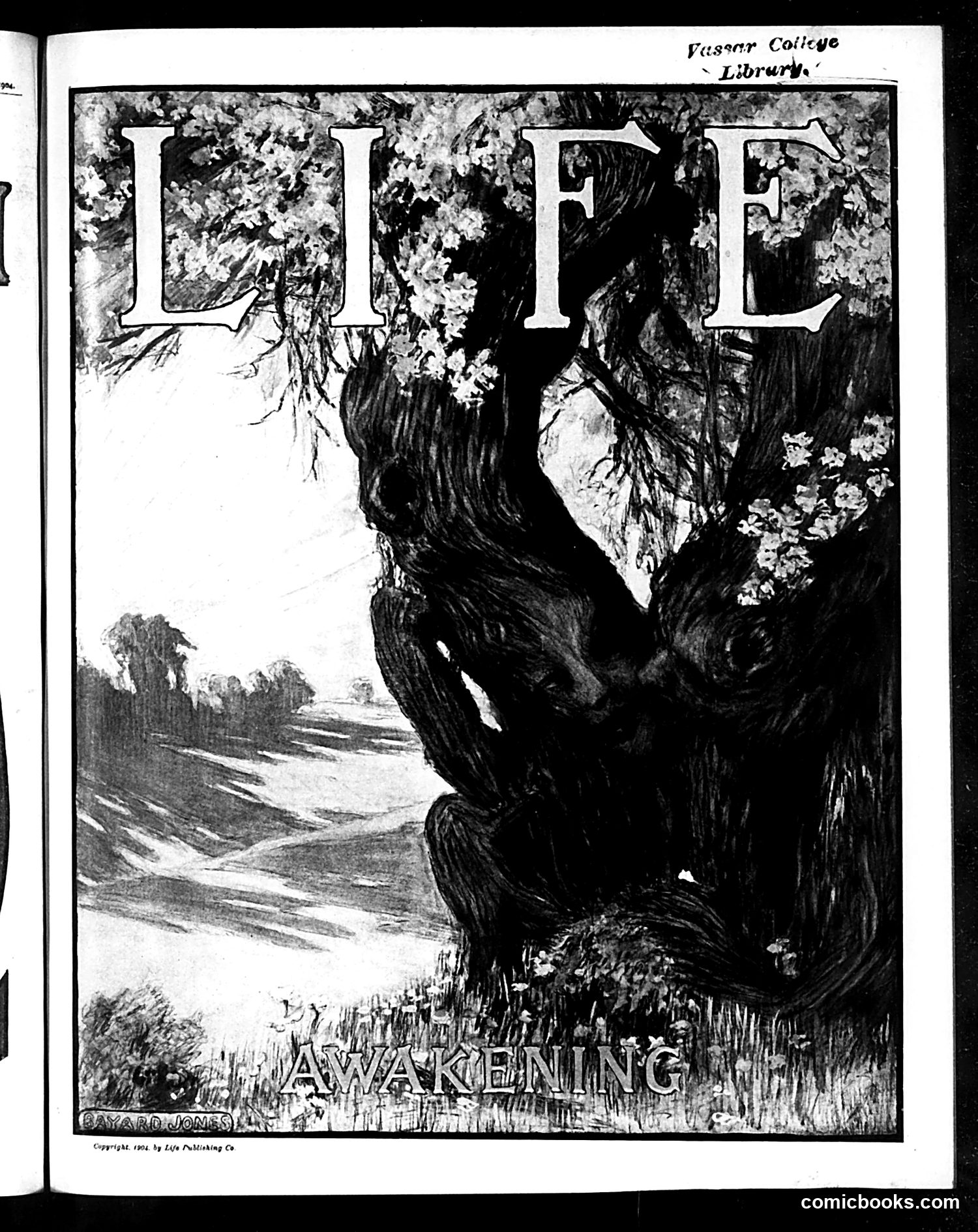
This appears to be a cover illustration for *Life* magazine featuring the word "AWAKENING" at the bottom. The image shows a large, gnarled tree with thick, dark trunk and flowering branches overlooking a pastoral landscape with fields and distant trees. The title suggests an allegorical or metaphorical message about awakening or renewal, though without additional context or text, the specific political or social commentary isn't entirely clear. The artistic style and naturalistic imagery suggest this could relate to themes of spring, growth, national renewal, or social consciousness—common subjects in early 20th-century satirical publications. The artist credit appears to read "Bayard Jones."
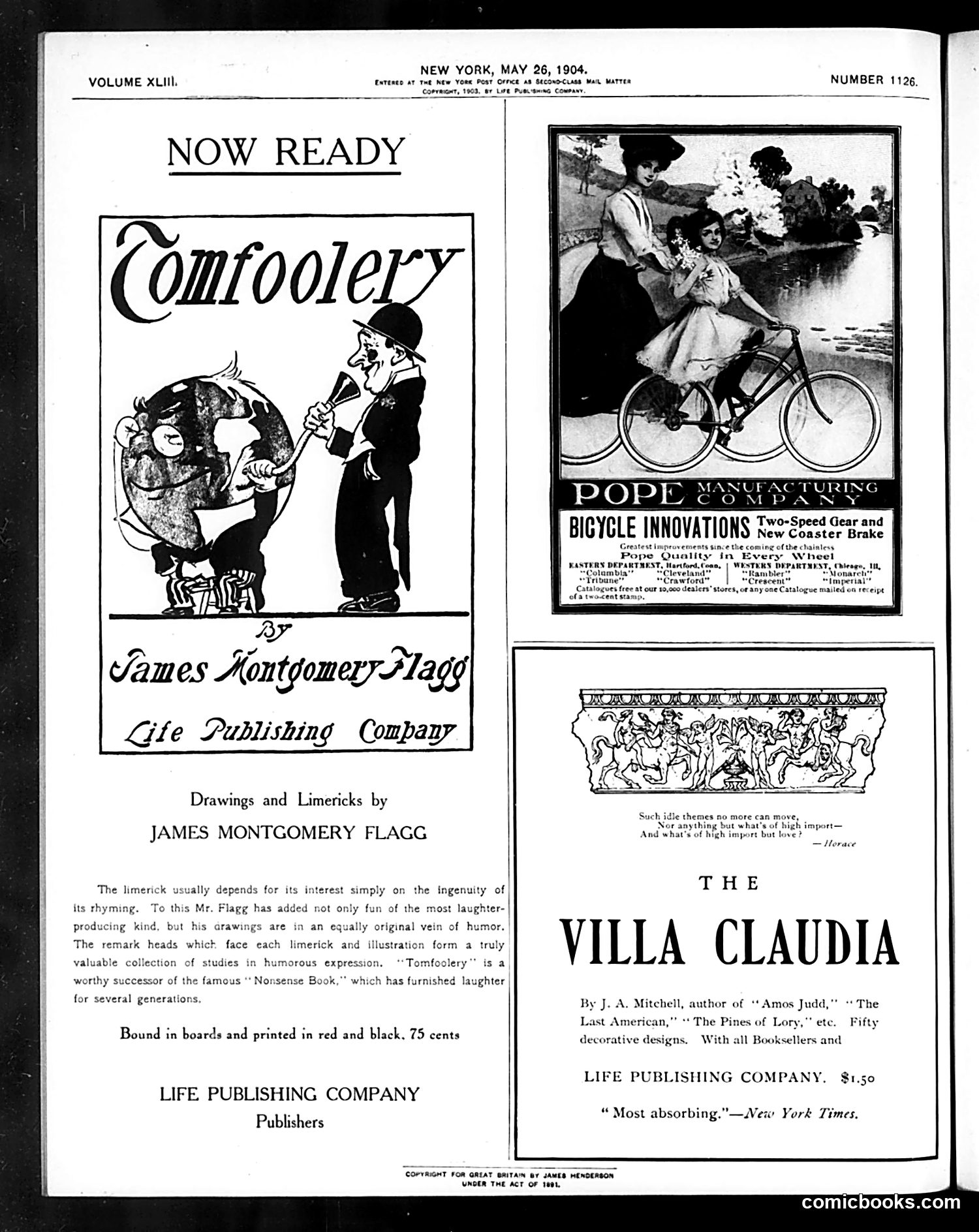
This page is primarily **advertising**, not political satire. The left side advertises "Comfoolery," a new book of drawings and limericks by James Montgomery Flagg, published by Life Publishing Company. The cartoon shows a caricatured figure (appears to be exaggerated for comedic effect) with a man in formal dress—likely representing the author promoting his work. The right side features advertisements for Pope Manufacturing's bicycles and "The Villa Claudia" by I.A. Mitchell. The bicycle ad showcases two women with a bicycle by a riverside—reflecting early 1900s marketing emphasizing bicycles as enabling female leisure and mobility. The page reflects Life's dual role as both satirical magazine and publisher/advertiser of books and consumer goods popular with affluent readers of that era.
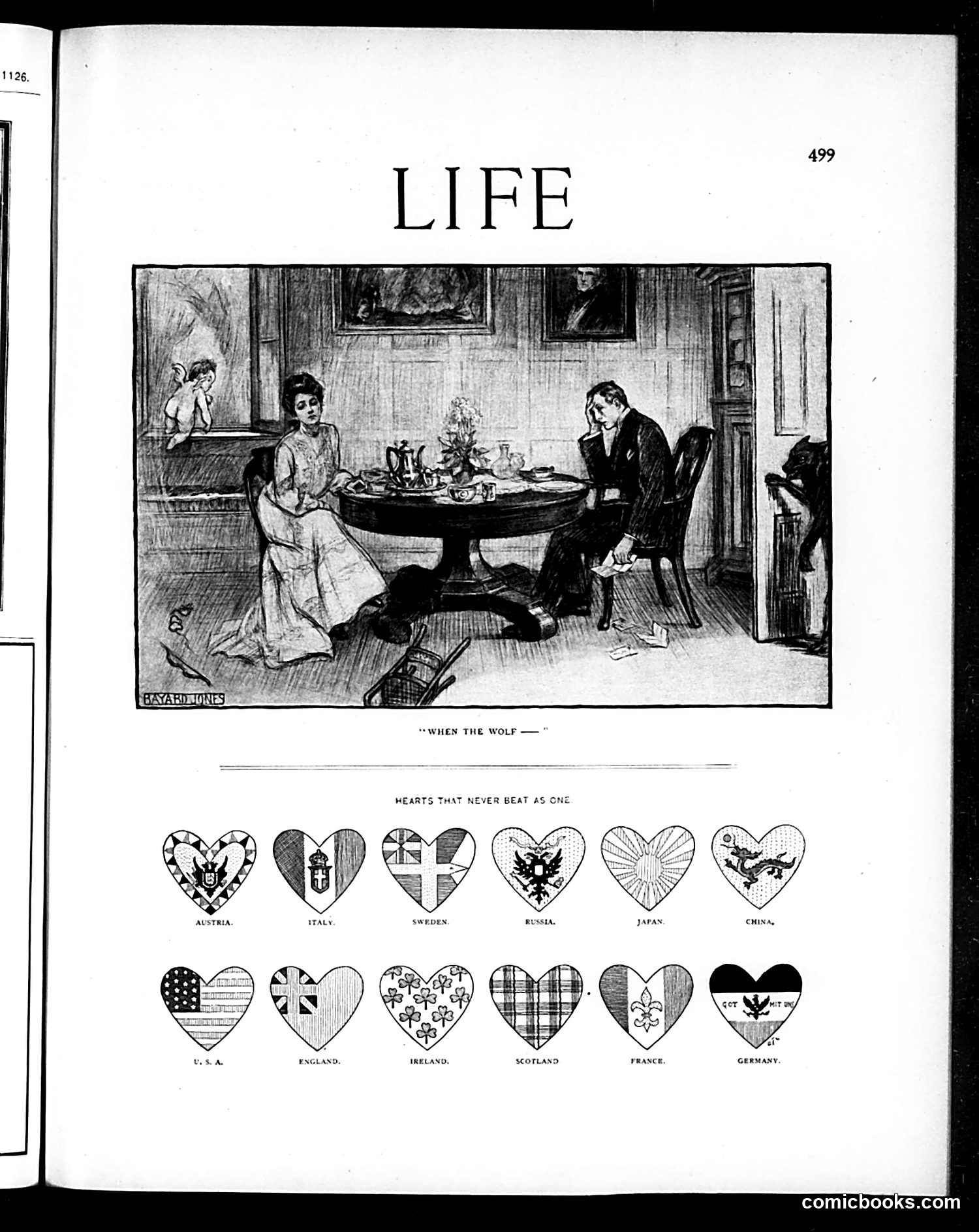
The main cartoon depicts an intimate dinner scene between a man and woman, with a dog lying beneath the table. The title "When the Wolf—" is a colloquial reference to seduction or romantic pursuit ("wolf" being period slang for a male seducer). Below the cartoon, "Hearts That Never Beat as One" displays twelve heart-shaped emblems representing different nations: Austria, Italy, Sweden, Russia, Japan, China, USA, England, Ireland, Scotland, France, and Germany. This appears to be political satire about international relations, likely from the early 20th century. The juxtaposition suggests irony: while the cartoon shows intimate romance, the national "hearts" emphasize that these countries cannot unite emotionally or politically—a commentary on international tensions or failed diplomatic harmony during this era.
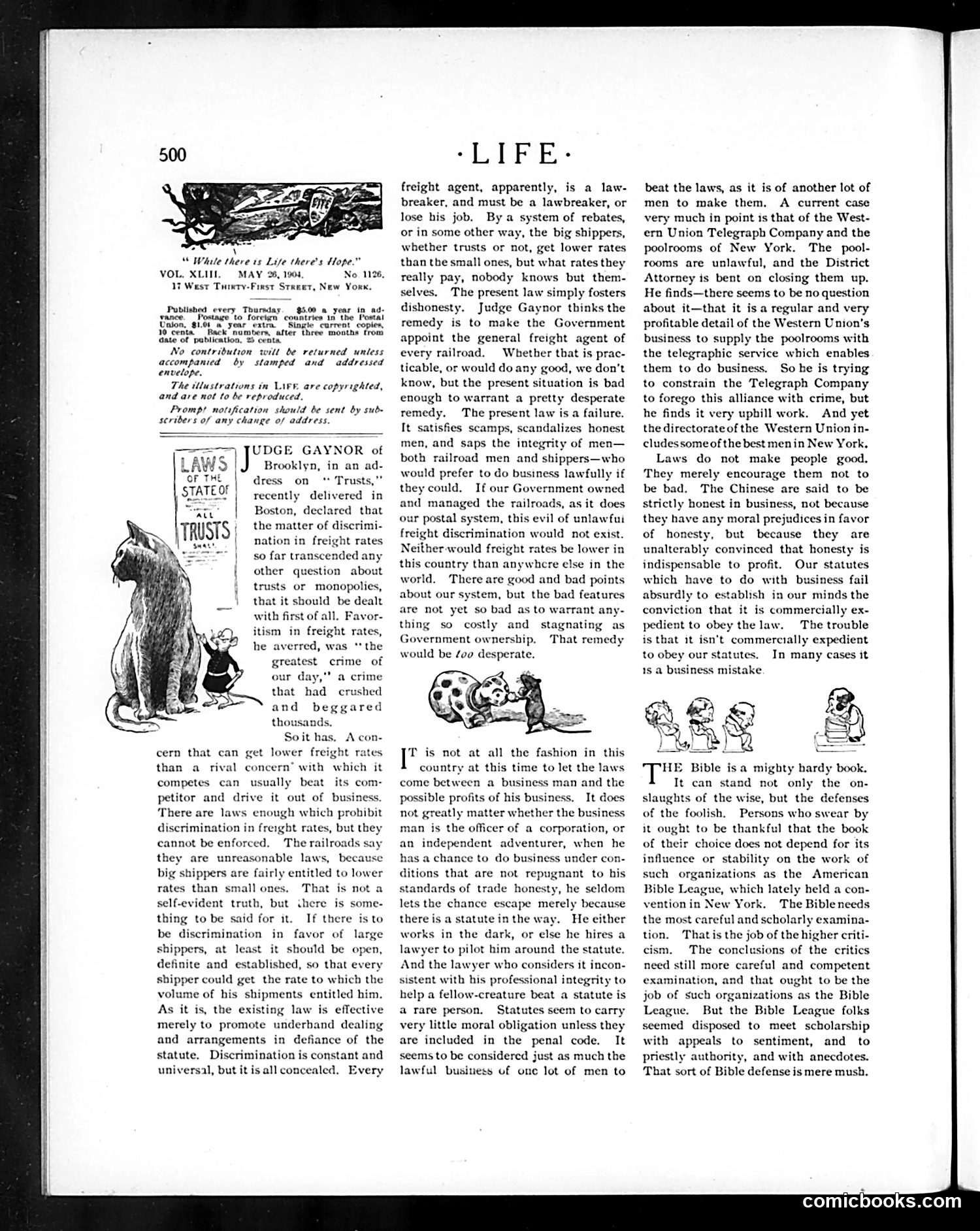
The cartoon depicts a large, menacing figure labeled "TRUSTS" crushing or dominating a much smaller figure representing "the State." This satirizes the perception that corporate trusts had grown so powerful they could evade or override state laws. The accompanying text discusses Judge Gaynor's recent speech in Boston criticizing discriminatory freight rates. The article argues that while government ownership of railroads might solve these problems, the real issue is that large shippers can circumvent laws through legal maneuvering and corruption. The satire suggests that American trusts and monopolies had become more powerful than the legal systems meant to regulate them—a central progressive-era complaint about unchecked corporate power and the inadequacy of existing laws to control business practices.
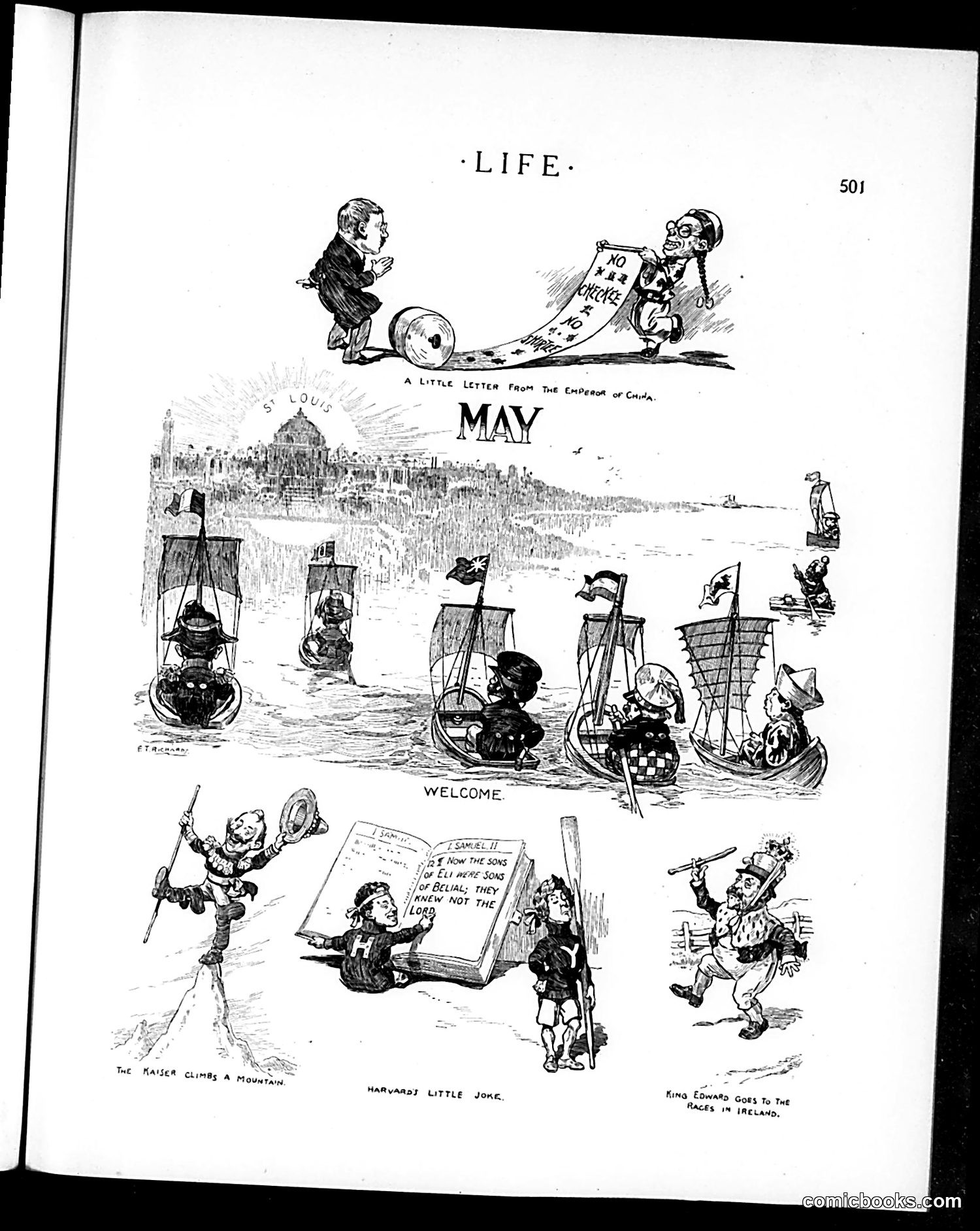
This page lampoons early 20th-century international affairs through several vignettes: **Top cartoon:** "A Little Letter from the Emperor of China" shows two figures with a scroll labeled "No More Privileges" — likely satirizing China's resistance to Western imperial exploitation and extraterritorial rights. **Middle section:** "Welcome" depicts a harbor scene with various vessels flying different flags, possibly representing competing colonial powers or nations arriving in China or another Asian port. **Bottom vignettes:** Include "The Kaiser Climbs a Mountain," "Hark! Hark! Little Joke" (featuring a large book), and "King Edward Goes to the Races in Ireland" — these appear to mock European political figures and their activities. The overall theme critiques imperial competition and international power struggles of the era through caricature and allegory.
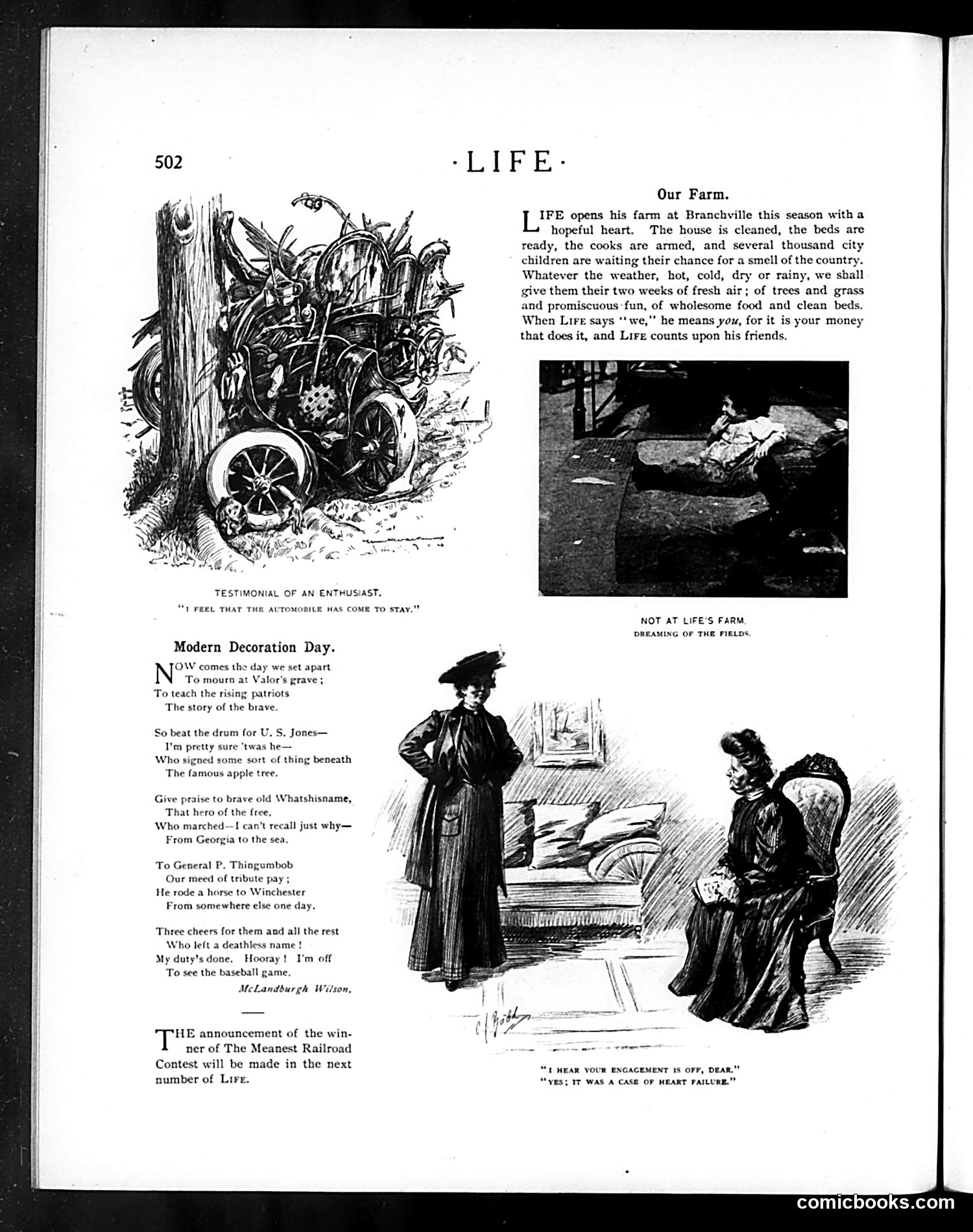
This page contains three distinct pieces: **"Our Farm"** (top right): A promotional article for Life's country retreat, offering city children fresh air and wholesome activities. **"Modern Decoration Day"** (center-left): A patriotic poem by McLandburgh Wilson commemorating what appears to be Decoration Day (now Memorial Day), honoring fallen soldiers with references to specific historical figures like Whatshisname and places like Georgia and Winchester. **Bottom illustration**: A social cartoon depicting two women discussing a broken engagement, with one stating "I hear your engagement is off, dear" and the other responding "Yes; it was a case of heart failure." This is a humorous play on words—suggesting romantic disappointment rather than medical emergency. The page blends patriotic commemoration, promotional content, and lighthearted social satire typical of Life's editorial mix.
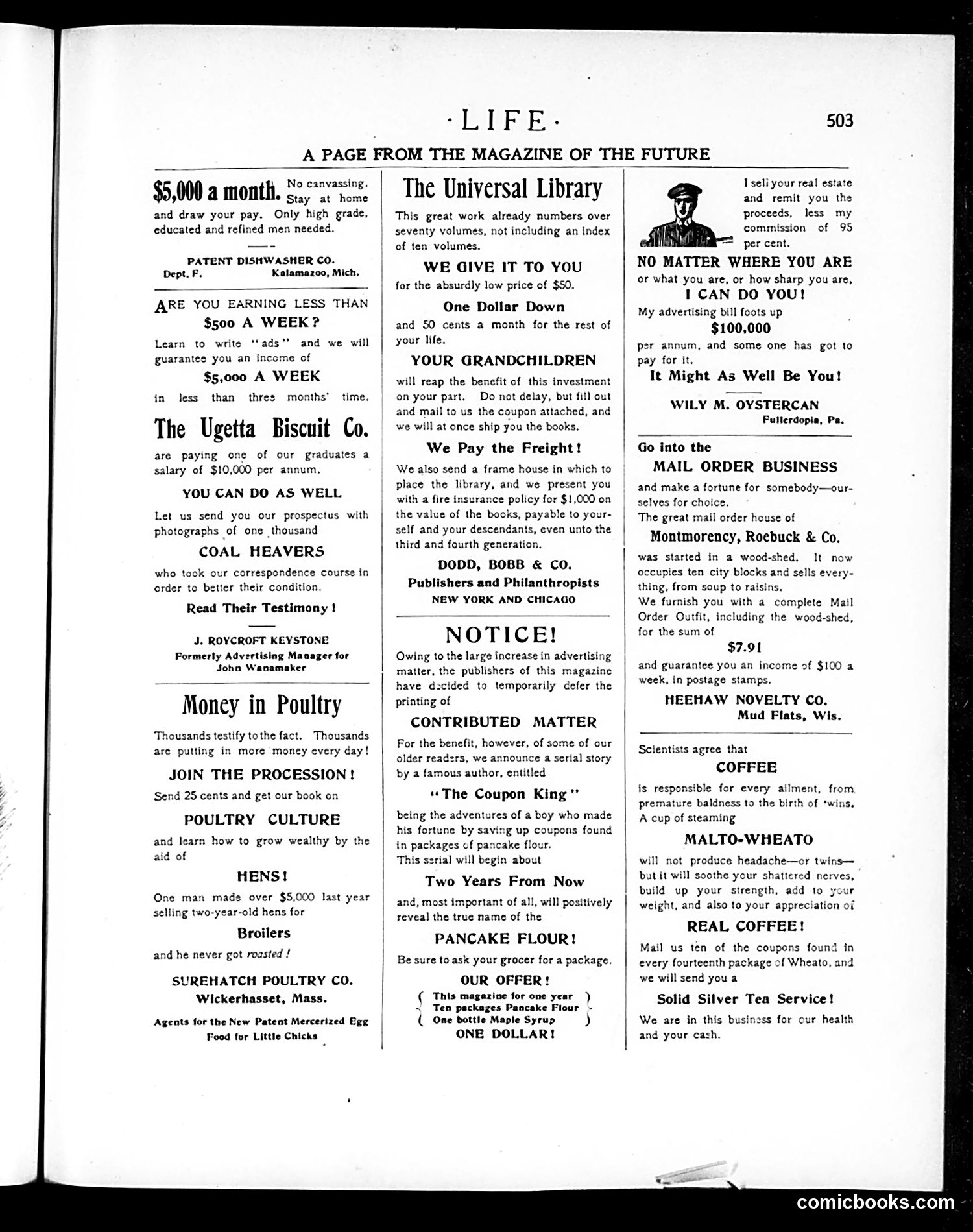
This page is primarily **advertising content**, not satirical cartoons. It's titled "A Page from the Magazine of the Future" and consists entirely of classified ads and business promotions typical of early 20th-century magazines. The ads satirize get-rich-quick schemes common to the era: correspondence courses promising $5,000 monthly income, mail-order businesses guaranteeing $100 weekly earnings, poultry-raising ventures, and pancake flour promotions. The satire lies in the **exaggerated promises** ("You can do as well," "make a fortune for somebody") and implausible claims designed to appeal to desperate readers. A small illustrated figure appears promoting real estate services, but the page functions primarily as a humorous critique of exploitative advertising practices rather than political or social commentary.
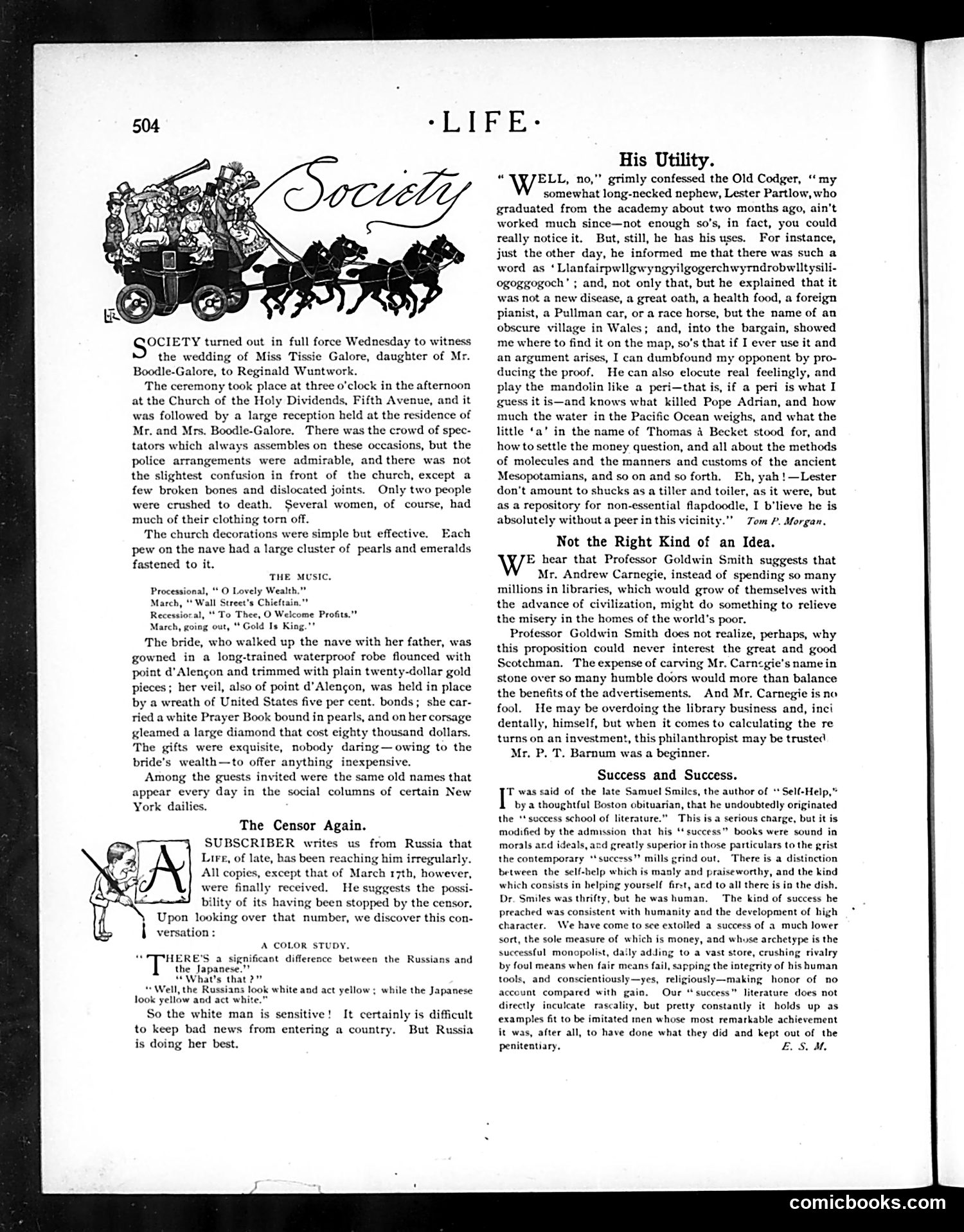
This page contains three satirical pieces from Life magazine's "Society" section. The main article mocks a society wedding of Miss Tissie Dalton and Mr. Boodle-Galore, describing the elaborate church ceremony and gift-giving with gentle irony about upper-class excess. "The Censor Again" presents a joke about Russian censorship: a subscriber notes that the Russian periodical *Lur* reaches him irregularly because copies are suppressed. The satire compares Russian and Japanese book censorship, with Russia depicted as overly sensitive about "bad news." "Not the Right Kind of Idea" criticizes philanthropist Andrew Carnegie's library proposal, suggesting that building libraries for poor communities is less practical than direct financial aid to relieve poverty. The pieces reflect early 20th-century American attitudes toward class, international politics, and philanthropy.
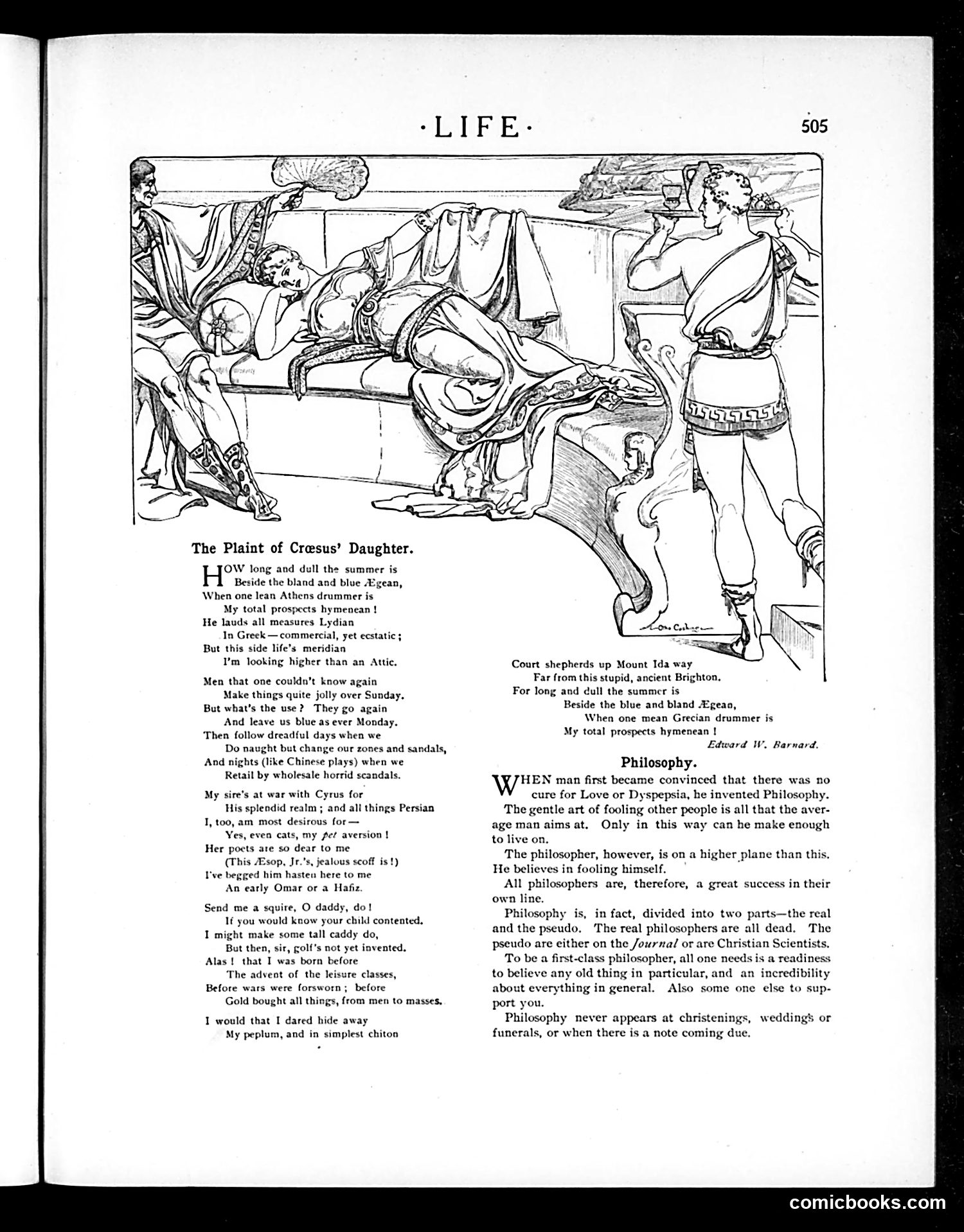
The illustration depicts a classical Greek scene with reclining and seated figures in togas, apparently referencing the wealthy king Croesus from ancient history. The poem "The Plaint of Croesus' Daughter" (by Edward W. Barnard) is a satirical complaint about summer leisure and boredom among the wealthy. It mocks how idle rich people—unable to work or engage meaningfully—simply repeat their weekly routines ("And leave us blue a every Monday"). The speaker wishes to escape her privileged but monotonous existence. Below, the "Philosophy" section sarcastically defines philosophy as "the gentle art of fooling other people" and jokes that philosophers are successful at deceiving themselves. It's social satire mocking both wealth-induced ennui and pretentious intellectual posturing.
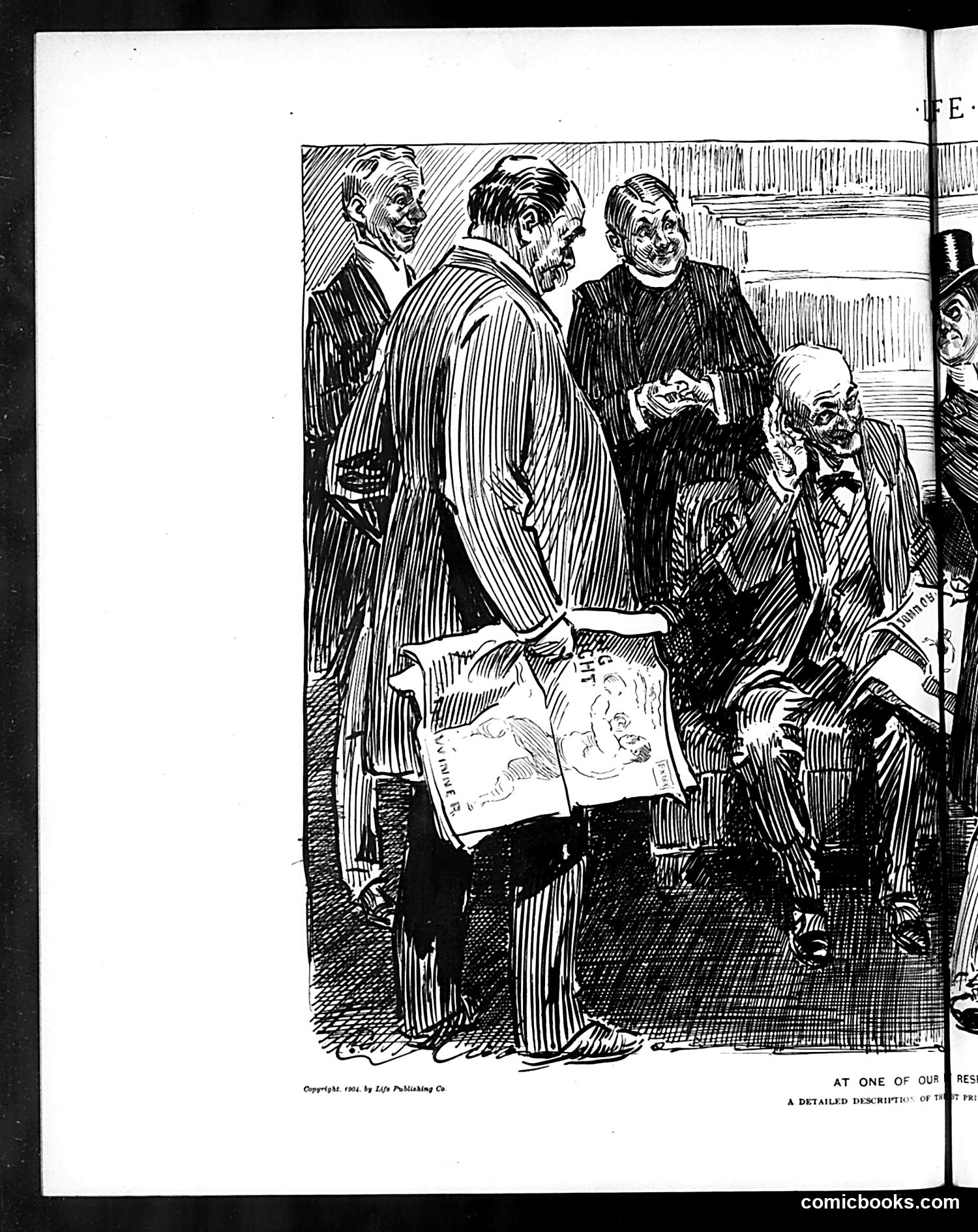
This is a satirical cartoon depicting what appears to be a business or political meeting. Several well-dressed men in suits examine what looks like a detailed map or document together. The exaggerated facial features and caricatured style are typical of early 20th-century Life magazine satire. The caption references "AT ONE OF OUR RESI[DENCES]" and "A DETAILED DESCRIPTION OF TH[E]" (text is cut off), suggesting this depicts wealthy individuals reviewing property or territorial plans. The caricatures emphasize the men's prominent features and expressions, likely mocking their pretensions or business dealings. Without the complete caption, the specific political or social target remains unclear, though the focus on wealthy men examining detailed plans suggests satire about business expansion, real estate schemes, or similar commercial ambitions of the era.
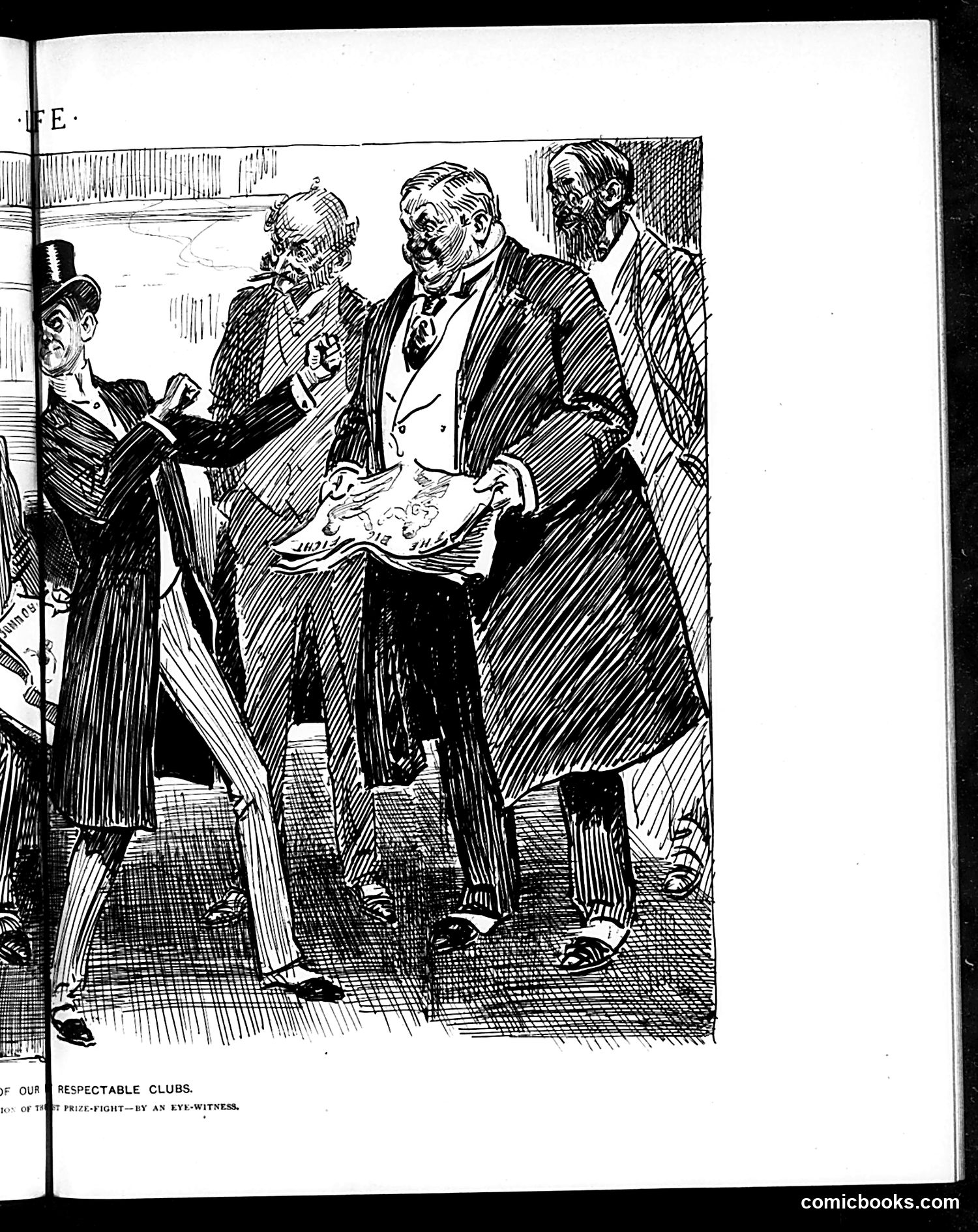
This satirical cartoon depicts wealthy gentlemen in formal attire gathered around what appears to be a bare-knuckle boxing match or prizefight. The central figure holds what looks like betting slips or money, while others observe with interest. The satire targets the hypocrisy of "respectable" high-society clubs that ostensibly maintained genteel standards while secretly hosting illegal prizefights and gambling. The exaggerated facial features and caricatured expressions emphasize the crude behavior beneath the formal dress and social pretense. The joke critiques the double standards of wealthy Victorian-era society—these supposedly respectable gentlemen are actually participating in working-class blood sports, revealing that moral superiority and refined appearance masked base appetites for violence and wagering.
This page contains **drama criticism and theatrical reviews**, not political cartoons. The main content discusses recent Broadway performances, including commentary on a play called *Zaza* and *The Last Gasps of the Season* featuring *Camille*. The decorative header labeled "DRAMA" is ornamental rather than satirical. The text critiques acting performances and theatrical trends, particularly noting that New York's summer amusement venues are becoming increasingly commercialized with "cheap shows and notorious dives." A brief "STAGE BITS" section comments on New York City theater trends during summer months. The page is primarily **theater criticism and gossip** aimed at the magazine's educated, theatergoing audience—not political or social satire.
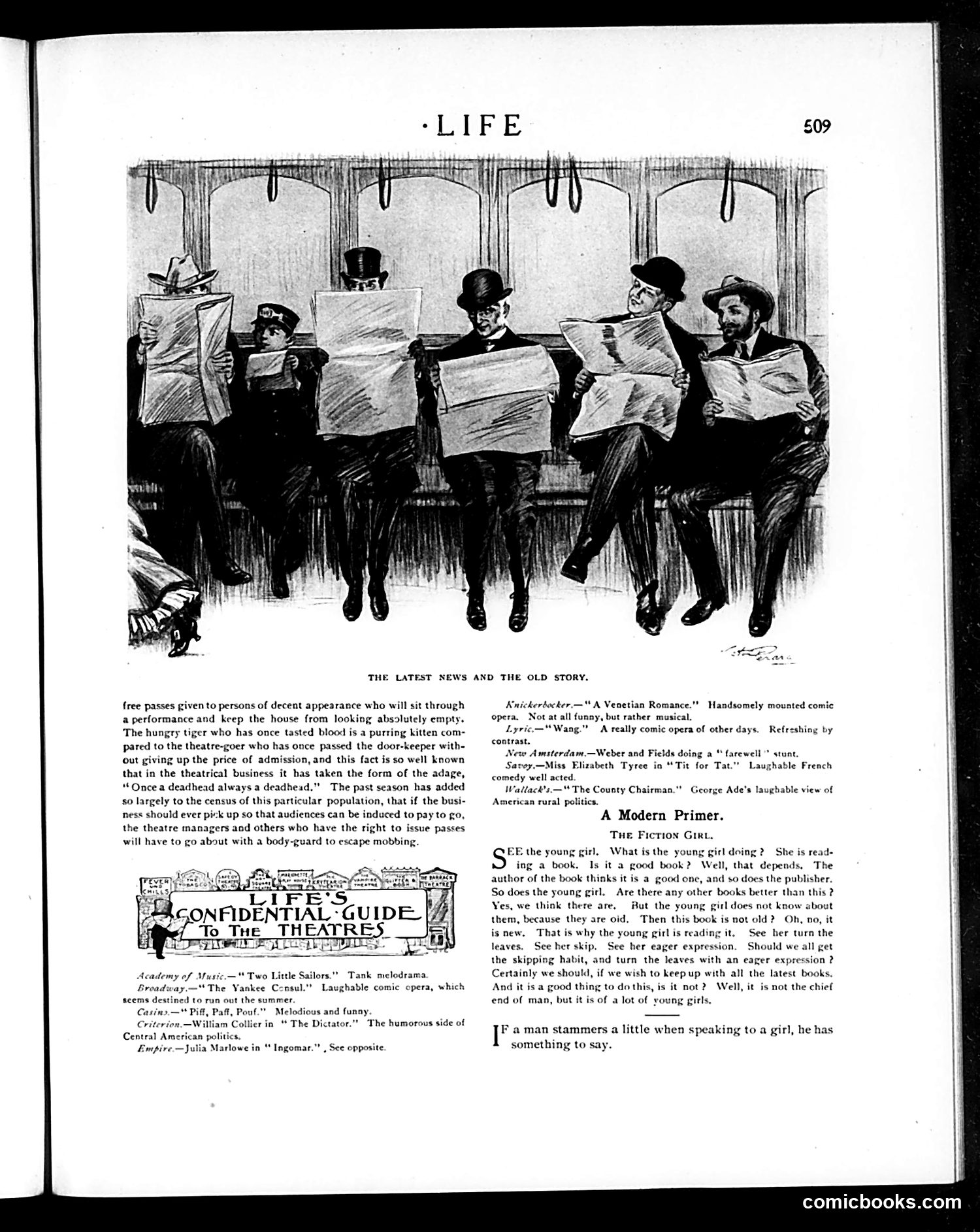
The main cartoon depicts six men in top hats sitting on a bench, all reading newspapers. The satire targets **theatre deadheads**—people given free passes to performances. The accompanying text explains the joke: theatre managers once gave free admission to decent-looking people to fill empty seats. Now that free-pass recipients have developed a taste for theatre, they've become impossible to manage; managers worry they'll face "mobbing" if they try to stop issuing passes. The humor lies in the ironic reversal: a temporary solution to empty houses has created a permanent, ungrateful audience the industry can never shake off. The image of these formally-dressed men obsessively reading "the latest news" (rather than attending theatre) emphasizes how deadheads have become a self-perpetuating social class—forever seeking something free.
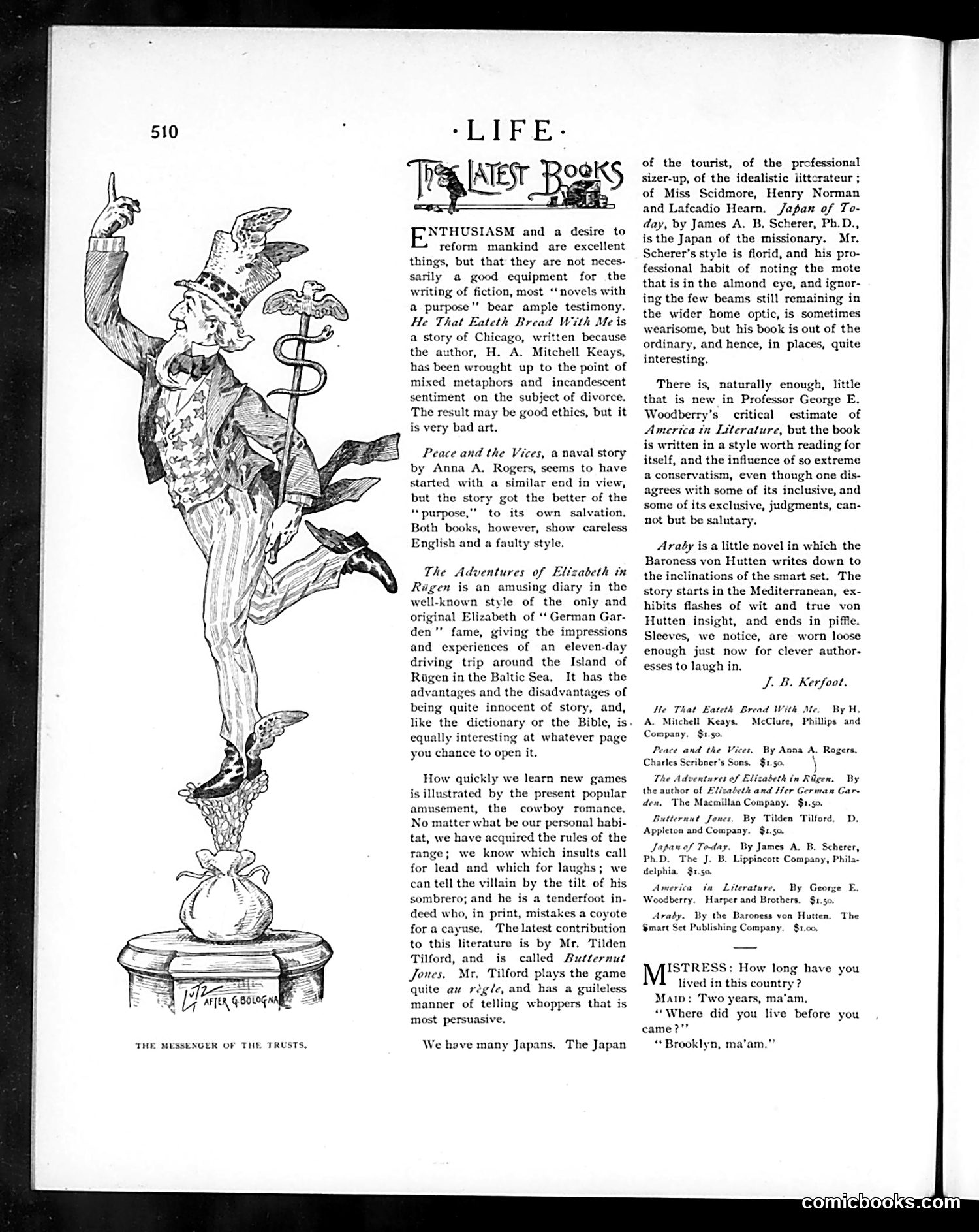
The cartoon depicts a grotesque figure—a caricatured "Trust" personified as a snake-like or octopus creature coiled around a classical column or pedestal, labeled "The Messenger of the Trusts." This is satirizing corporate monopolies and their corrupting influence on American institutions during the Progressive Era. The figure appears to represent how large corporations ("trusts") were seen as spreading through and controlling various aspects of society. The artistic style—exaggerated, monstrous, wrapped around symbols of traditional order—conveys hostile critique of concentrated economic power. The book reviews on the page discuss literature addressing social reform. This juxtaposition suggests the cartoon criticizes how trusts/corporations distort culture and literature, or more broadly, how monied interests corrupt public discourse. The grotesque messenger imagery emphasizes that these economic forces were viewed as fundamentally dangerous to American society.
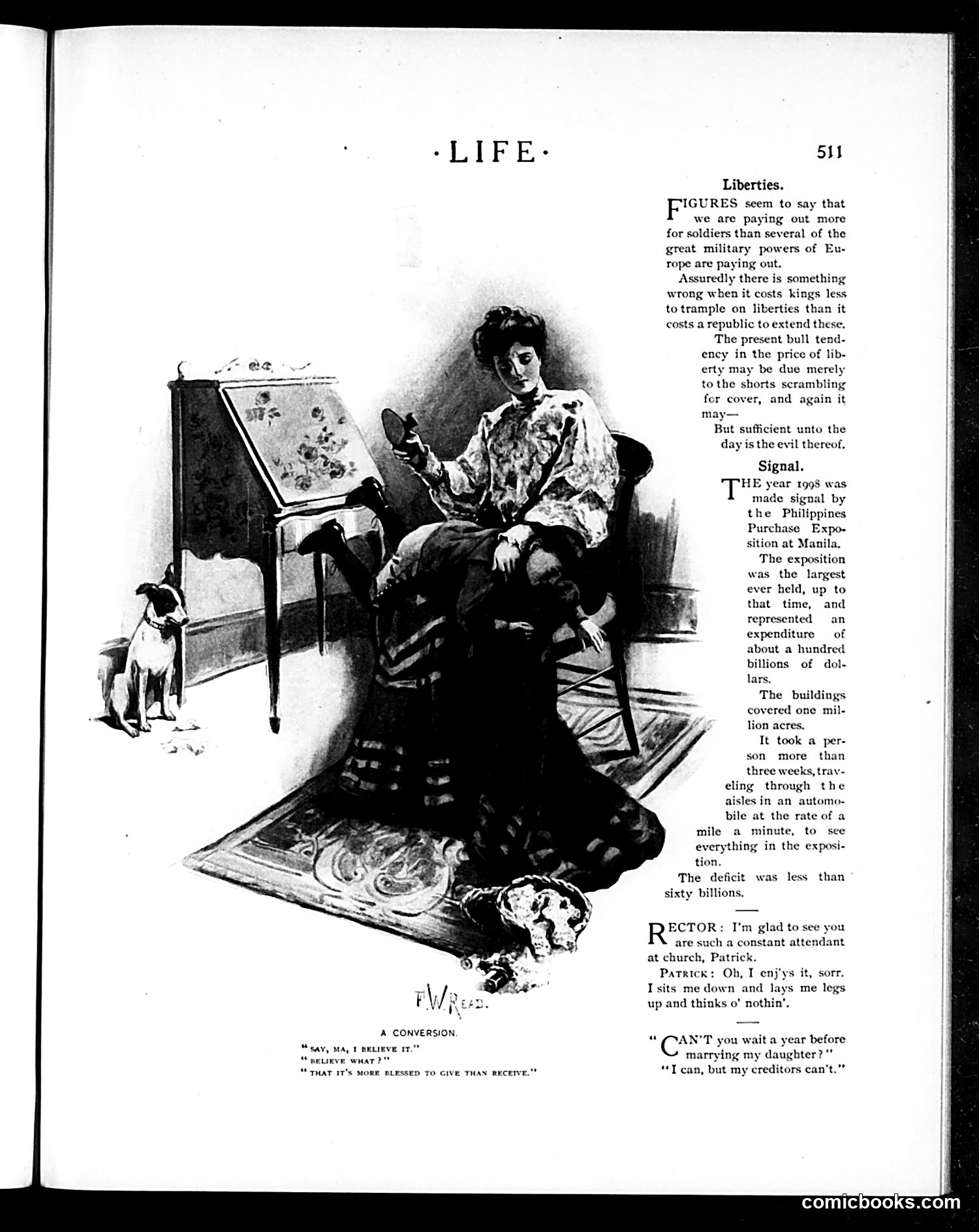
This page contains multiple satirical pieces from early 20th-century Life magazine: **"Liberties" section**: Critiques American military spending, arguing it costs a republic more to maintain liberties than it costs European monarchies to suppress them—a pointed jab at perceived wasteful defense expenditures. **"Signal" section**: Mocks the 1898 Philippines Purchase Exposition in Manila as absurdly lavish. The "hundred billions of dollars" expenditure (clearly hyperbolic satire) and million-acre scale are presented as ridiculous excess, reflecting contemporary debate over American imperialism following the Spanish-American War. **Bottom cartoons**: Two brief jokes—one about a church-attending man who admits he attends merely to rest ("thinks o' nothin'"), and another about a father unable to delay his daughter's wedding because creditors won't wait. Both mock financial desperation and hypocrisy. The overall tone satirizes American spending priorities: military budgets, imperial exhibitions, and personal debt—suggesting misplaced values in the young nation.
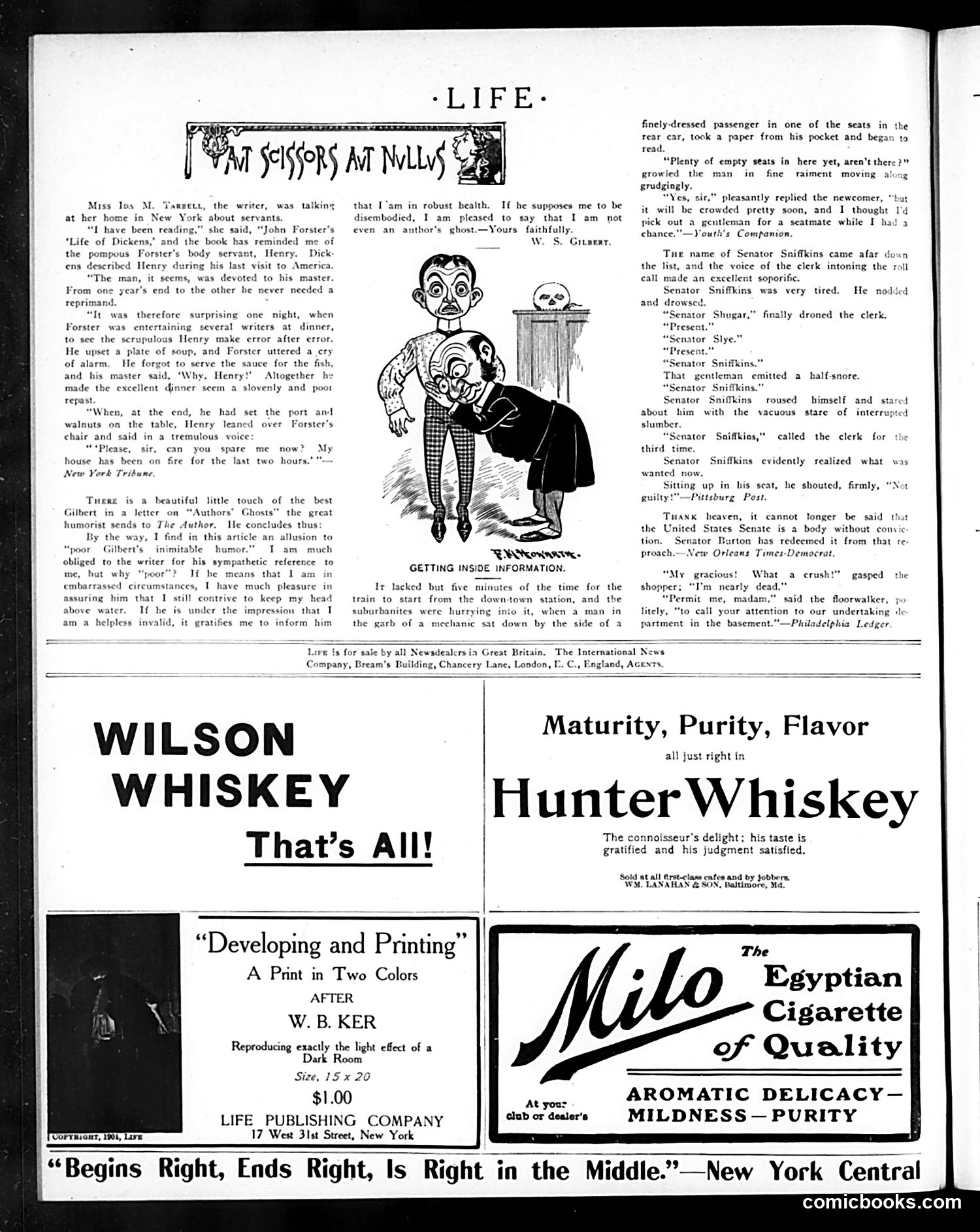
This page contains several humorous anecdotes satirizing social pretension and institutional absurdity: **"Scissors at Nulls"** mocks the unreliability of servants through a story about Henry, the body servant of John Forster (Dickens's friend). The joke: the normally impeccable Henry becomes clumsy at dinner, then desperately asks to leave, revealing he's been "on fire" for two hours—a physical explanation for behavioral collapse that undercuts expectations. **The train seat anecdote** satirizes class assumptions: a well-dressed passenger assumes a newcomer is poor, but the newcomer's polite response ("I thought I'd pick out a gentleman for a seatmate") subtly mocks the passenger's rudeness by implying he's no gentleman. **The Senator Sniffkins pieces** ridicule Congressional incompetence: a senator sleeps through roll call, then shouts "Not guilty!" when finally called upon—absurdly suggesting the Senate is debating criminal charges. The commentary notes this proves the Senate finally has "conviction." All three pieces share a theme: exposing hypocrisy or incompetence beneath surface respectability. The page is primarily content-driven rather than image-driven satire.
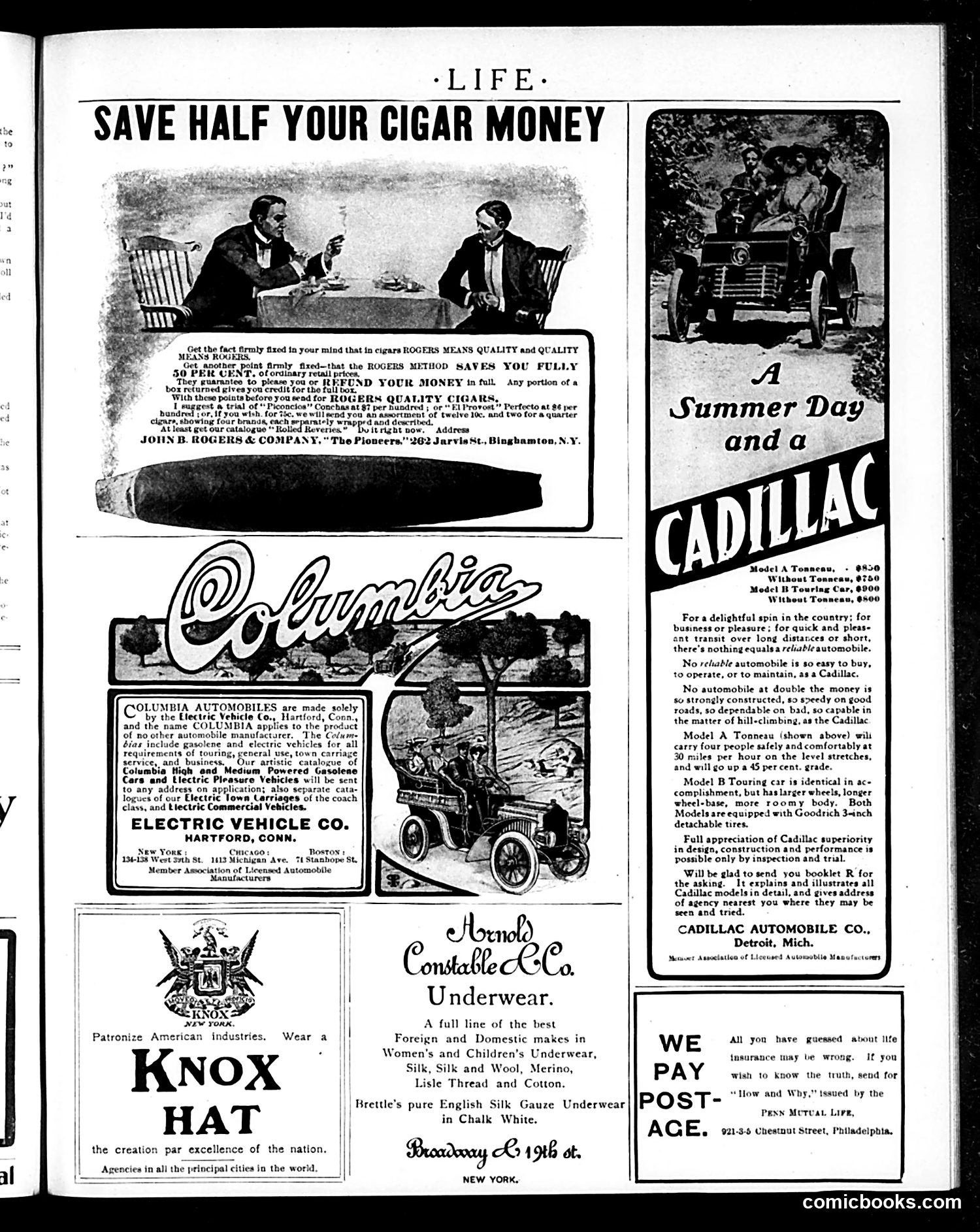
The top cartoon depicts two men in business attire seated at a table, illustrating a sales pitch for Rogers Quality Cigars. The joke plays on a common advertising claim of the era: that buying Rogers cigars—marketed as a quality product—allows customers to "save half your cigar money" by not needing to purchase other, inferior brands. The satire targets the absurdity of this marketing logic. The message suggests that by spending money on *premium* cigars, one actually *saves* money overall—a circular argument typical of early 20th-century advertising hyperbole. The cartoon mocks both the exaggerated sales claims and the gullibility of consumers who believed that premium purchases equaled financial savings. The page is otherwise filled with period automobile and clothing advertisements (Columbia, Cadillac, Knox Hat, Harold Constable Underwear, and Penn Mutual Life Insurance), typical of *Life* magazine's commercial content.
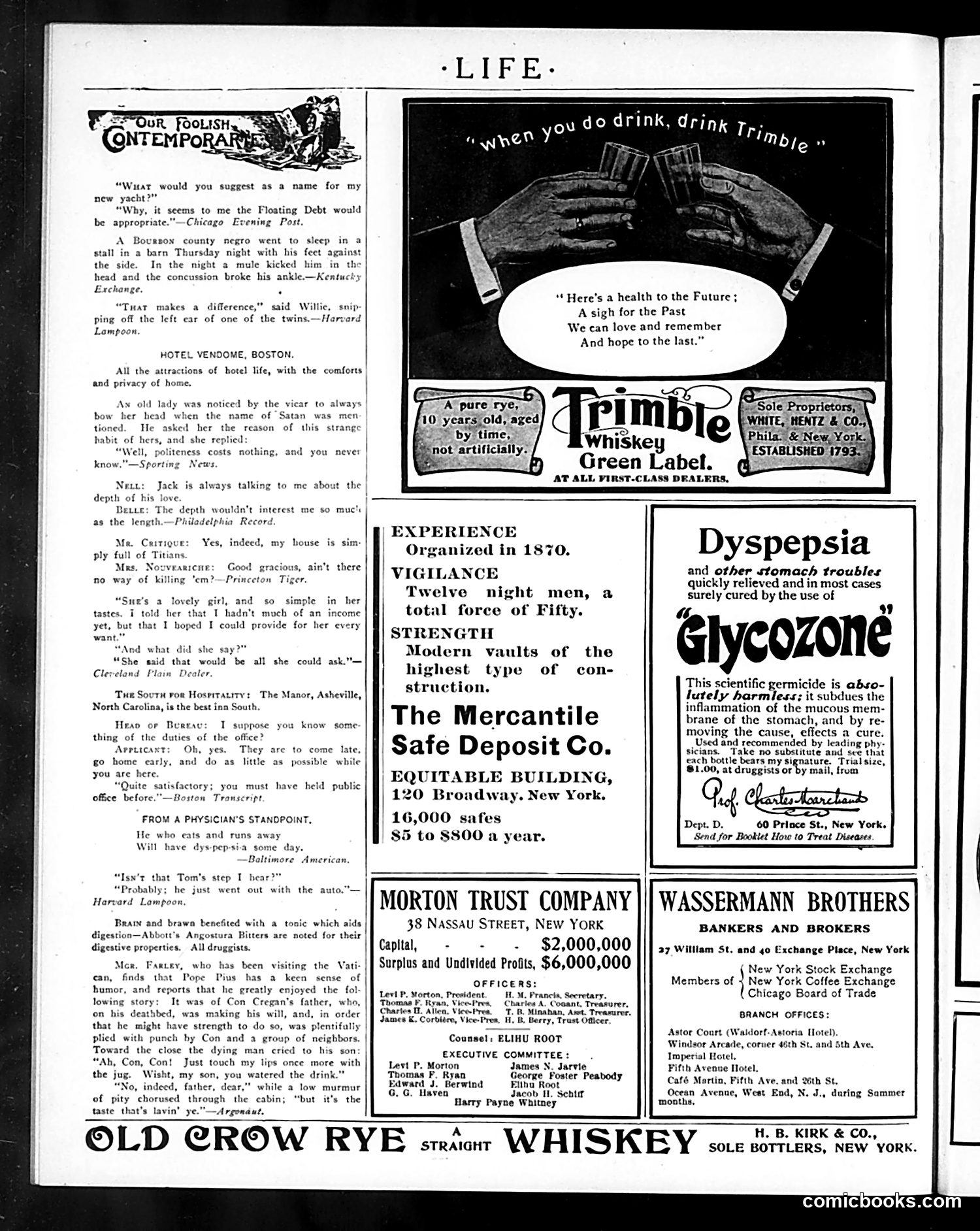
This page is primarily **advertisements and light humor vignettes** typical of Life magazine. The "cartoons" are actually brief jokes—short humorous dialogues rather than visual satire. **The humor:** - A joke about naming a yacht the "Floating Debt" (a reference to government deficit spending) - A quip about a mule kicking a man and breaking his ankle, creating ironic outcomes - Romantic/marriage comedy sketches about courtship and wives - A physician's joke: "He who eats and runs away / Will have dys-pep-sia some day" **The page's main purpose** is advertising: Trimble Whiskey (prominently featured), Glycozone stomach medication, safe deposit companies, and banks. The advertisements are interspersed among the jokes. The content reflects **early 20th-century American humor**: lighthearted domestic situations, wordplay, and gentle satire of courtship and office life. There is no significant political cartoon or sophisticated visual satire—this is essentially a page mixing small comedic anecdotes with period advertising.
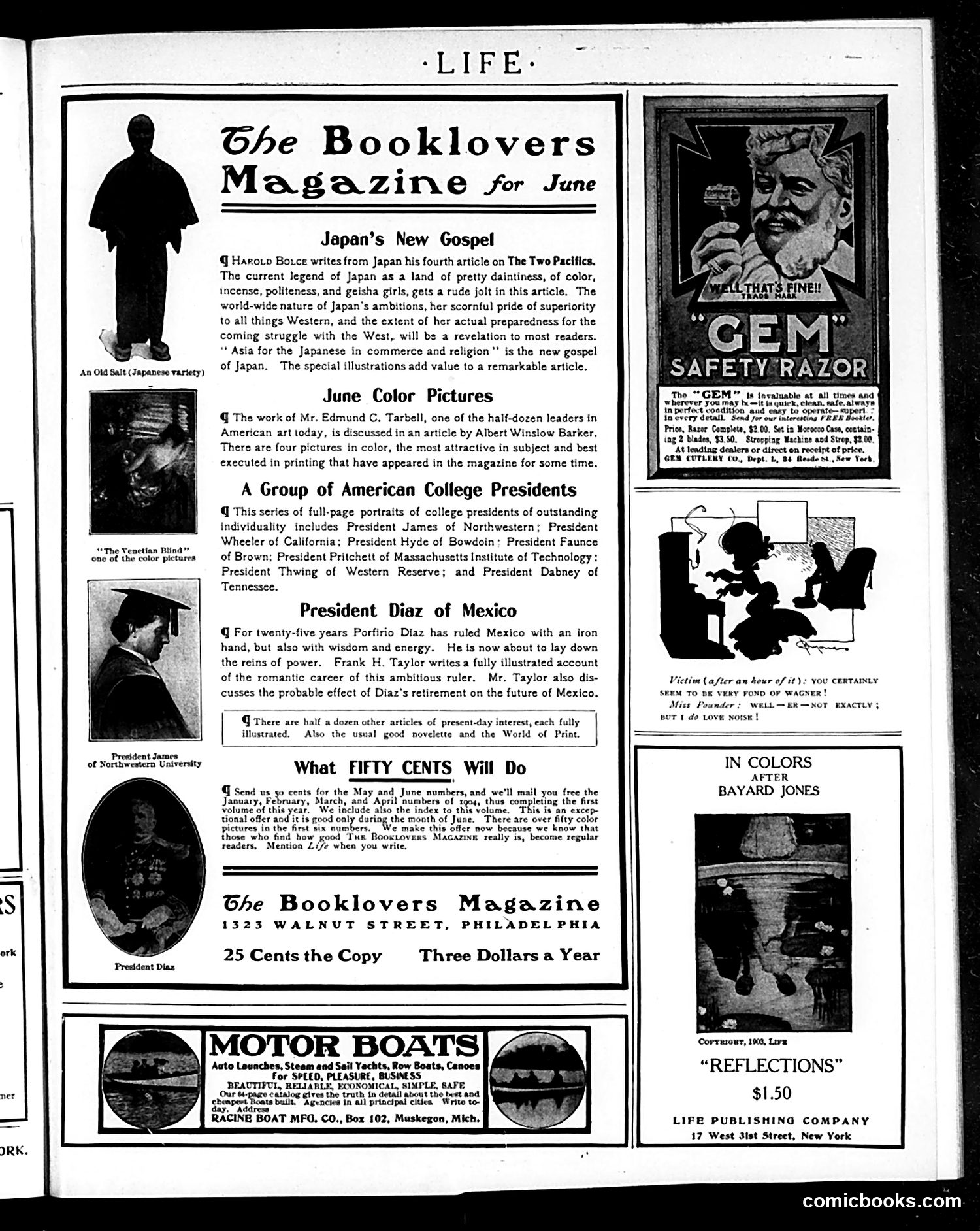
This page is primarily **advertising and magazine promotion** rather than political satire. It announces *The Booklovers Magazine* for June, featuring articles on Japan's imperial ambitions ("Asia for the Japanese in commerce and religion"), Mexican President Porfirio Díaz's upcoming retirement, and American college presidents. The small cartoon in the lower right depicts a couple at a Wagner concert—the woman claims she doesn't love Wagner specifically, but loves "noise," satirizing pretentious classical music appreciation. **Historical context**: Published around 1910, the Japan article reflects Western anxiety about Japanese expansionism in the Pacific. The Díaz piece anticipates Mexico's political upheaval (the Revolution began 1910). The college president profiles celebrate American institutional leadership. The page is dominated by commercial advertising for razors, motor boats, and magazine subscriptions—typical of *Life*'s dual role as satirical publication and commercial vehicle.
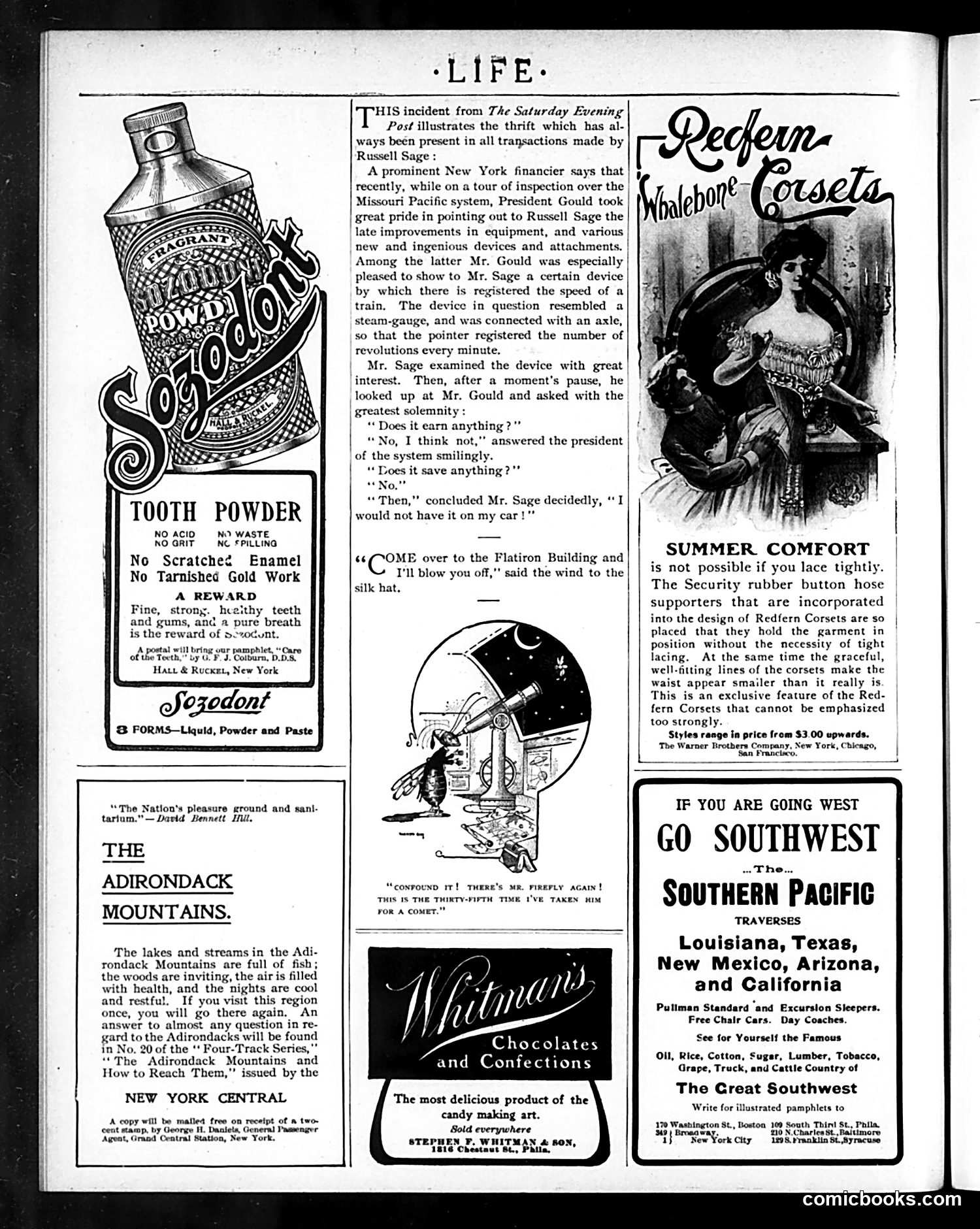
This page features a satirical anecdote about **Russell Sage**, the famously miserly New York financier and railroad magnate. The joke illustrates his reputation for obsessive cost-cutting. The cartoon depicts Sage touring the Missouri Pacific system with President **Jay Gould**. Gould proudly shows Sage a new speed-measuring device (resembling a steam gauge) that tracks train revolutions. When Gould explains the device's purpose, Sage asks the revealing questions: "Does it earn anything?" and "Does it save anything?" Learning it does neither, Sage concludes he wouldn't have it on his car. The satire targets Sage's extreme parsimony—his refusal to invest in anything lacking immediate financial return, even minor improvements. The anecdote portrays him as absurdly penny-pinching, valuing only profit or direct cost savings while dismissing innovation or efficiency for their own sake. This reflects the Gilded Age's public image of railroad barons as ruthless, profit-obsessed industrialists indifferent to anything beyond the bottom line.
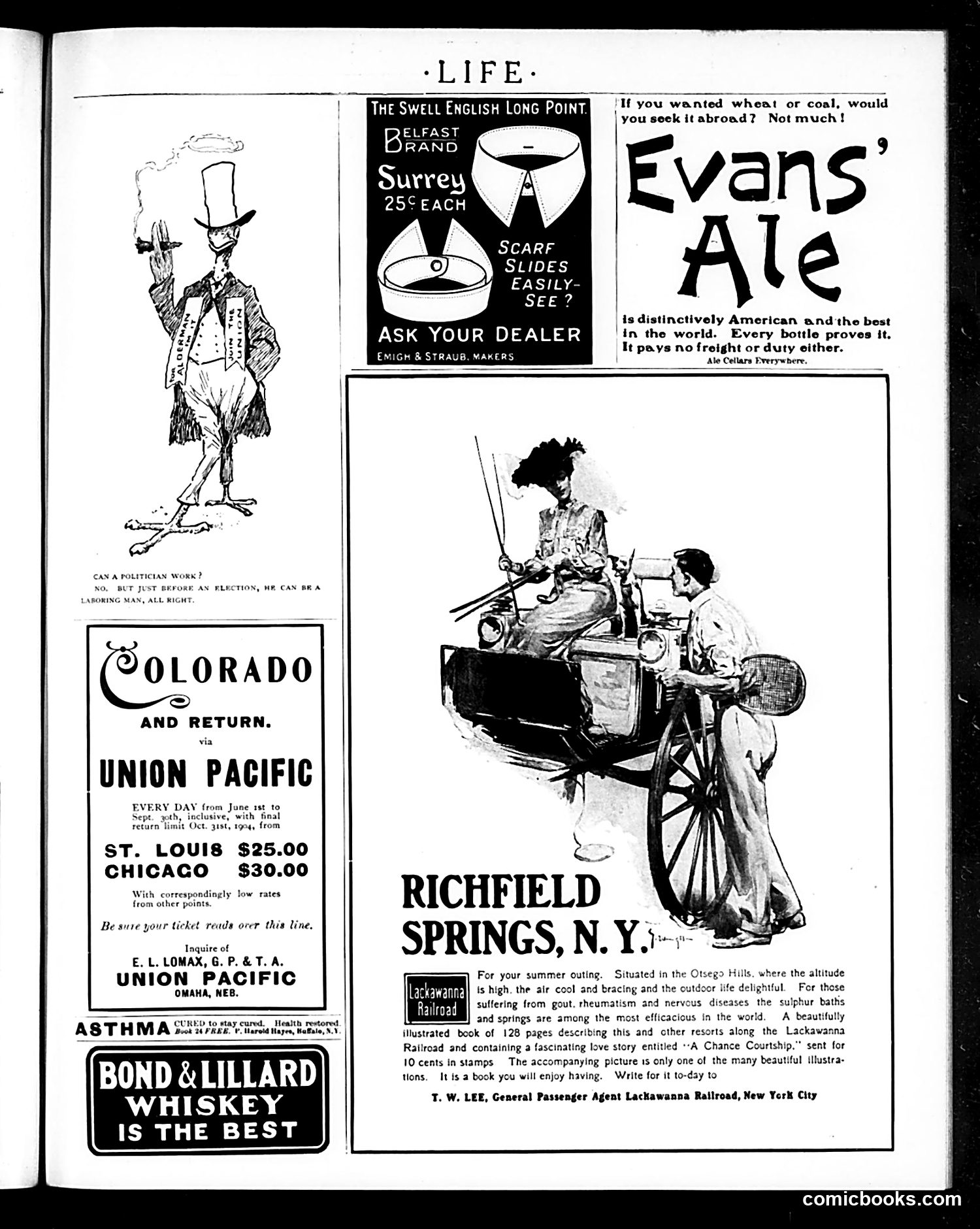
The main cartoon (upper left) depicts a thin, disheveled figure in a top hat labeled as a politician. The caption reads: "CAN A POLITICIAN WORK? NO, BUT JUST BEFORE AN ELECTION, HE CAN BE A LABORING MAN, ALL RIGHT." This is satire on political hypocrisy during election cycles. The joke targets politicians who adopt working-class personas and appearances only when seeking votes, then abandon this pretense once elected. The ragged clothing and exaggerated posture suggest the politician is performing or disguising his true nature. The rest of the page consists of period advertisements for Evans' Ale, travel via Union Pacific Railroad, Bond & Lillard Whiskey, and Lackawanna Railroad's Richfield Springs resort—typical commercial content for Life magazine of this era.
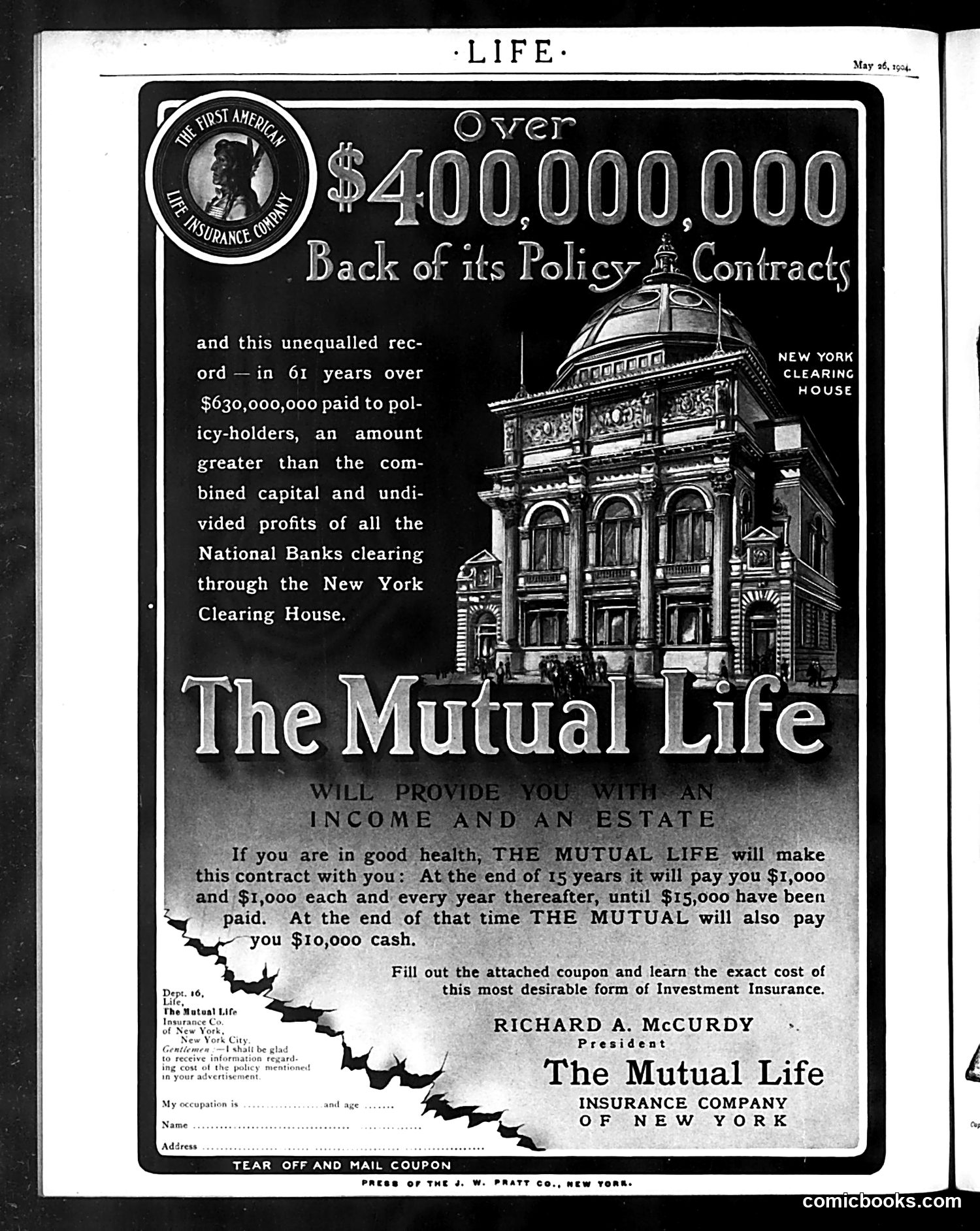
This is primarily a **full-page advertisement**, not a cartoon or satire. It promotes The Mutual Life Insurance Company of New York, founded 1843 ("The First American Life Insurance Company," shown in the circular seal). The ad makes competitive claims: over $400 million backing its policy contracts, and $630 million paid to policyholders in 61 years—allegedly exceeding the combined capital of all National Banks clearing through New York. The centerpiece is an engraving of an impressive classical building (the New York Clearing House), establishing institutional authority and permanence. The contract offer is straightforward: for applicants in good health, after 15 years of payments, Mutual Life will pay $1,000 annually until $15,000 total is reached, plus $10,000 cash. Richard A. McCurdy is identified as President. A tear-off coupon invites readers to request cost information. There is no satire here—this is earnest commercial persuasion leveraging financial credibility and architectural grandeur to sell insurance as "Investment Insurance" during the Progressive Era.