
Life, 1904-05-26 · page 4 of 22
Life — May 26, 1904 — page 4: what you’re looking at
What you’re looking at
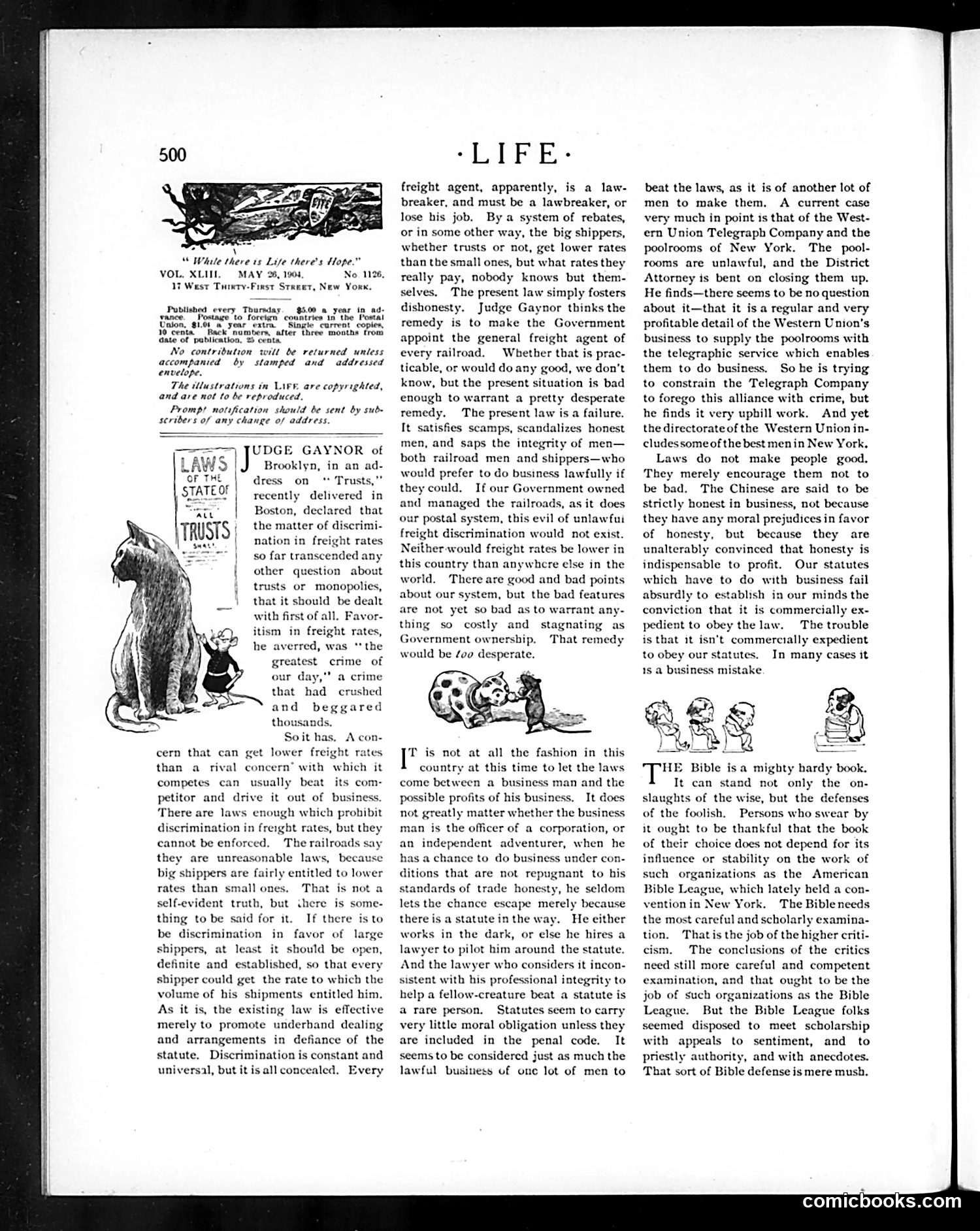
The cartoon depicts a large, menacing figure labeled "TRUSTS" crushing or dominating a much smaller figure representing "the State." This satirizes the perception that corporate trusts had grown so powerful they could evade or override state laws. The accompanying text discusses Judge Gaynor's recent speech in Boston criticizing discriminatory freight rates. The article argues that while government ownership of railroads might solve these problems, the real issue is that large shippers can circumvent laws through legal maneuvering and corruption. The satire suggests that American trusts and monopolies had become more powerful than the legal systems meant to regulate them—a central progressive-era complaint about unchecked corporate power and the inadequacy of existing laws to control business practices.
📄 Transcribed text from this page (OCR, searchable)
Machine-transcribed from the original scan — historical spelling and the odd misread are preserved.
\ “ While there ts Life there's Hope.” VOL. XLII. MAY 28, 1904, No 1126, 17 West Tniwry-Finst Street, New Yorx. Published every Tbarsdas ~ g5.00 @ year in ad- Postage to foreign countries 1m the Postal Year extra, “Singt carrent. copien berm. after thres months trom Gate of pablication, 35 conte No contribution witt be returned unless accompanied by stamped and addressed envelope. The illustrations in LAFF. are copyrighted, and are not to be reproduced. Prompt notification should be sent by sub- scribers of any change of address, LAWS AS UDGE GAYNOR of J Brooklyn, in an ad. dress on “ Trust recently delivered in Boston, declared that the matter of discrimi- nation in freight rates so far transcended any other question about trusts or monopolies, that it should be dealt with first of all, Favor- itism in freight rates, he averred, was ‘the greatest crime of our day," a crime that had crushed and beggared thousands. Soit ha cern that can get lower freight than a rival concern’ with which it competes can usually beat petitor and drive it out of business. There are laws enough which probibit discrimination in freight rates, but they cannot be enforced. The railroads they are unreasonable laws, because ig shippers are fairly entitled to lower rates than small ones. That is not a self-evident truth, but ihere is some- thing to be said for it. If there isto be discrimination in favor of large shippers, at least it should be open, definite and established, so that every shipper could get the rate to which the volume of his shipments entitled him. As it is, the existing law is effective merely to promote underband dealing and arrangements in defiance of the statute. Discrimination is constant and universal, but it is all concealed. Every its com- LIF'E- freight agent, apparently, is a law- breaker, and must be a lawbreaker, or lose his job. By a system of rebates, or in some other way, the big shippers, whether trusts or not, get lower rates than the small ones, but what rates they really pay, nobody knows but them- selves, The present law simply fosters dishonesty. Judge Gaynor thinks the remedy is to make the Government appoint the general freight agent of every railroad. Whether that is prac- ticable, or would do any good, we don’t know, but the present situation is bad enough to warrant a pretty desperate remedy. The present law is a failure. It satisfies scamps, scandalizes honest men, and saps the integrity of men— both railroad men and shippers—who would prefer to do business lawfully if they could. If our Government owned and managed the railroads, as it does our postal system, this evil of unlawfui freight discrimination would not exist. Neither would freight rates be lower in this country than anywhere else in the world. There are good and bad points about our em, but the bad features are not yet so bad as to warrant any- thing so costly and stagnating as Government ownership. That remedy would be 400 desperate. T is not at all the fashion in this country at this time to let the laws come between a business man and the possible profits of his business, It does not greatly matter whether the business man is the officer of a corporation, or an independent adventurer, when he has a chance to do business under con- ditions that are not repugnant to his standards of trade honesty, he seldom lets the chance escape merely because a statute in the w He either works in the dark, or else he hires a lawyer to pilot him around the statute. And the lawyer who considers it incon- sistent with his professional integri help a fellow-creature beat a statute is a rare person, Statutes seem to carry very little moral obligation unless they are included in the penal code. It seems to be considered just as much the lawful business of one lot of men to beat the laws, as it is of another lot of men to make them. A current case very much in point is that of the West- ern Union Telegraph Company and the poolrooms of New York. The pool- rooms are unlawful, and the District Attorney is bent on closing them up. He finds—there seems to be no question about it—that it is a regular and very profitable detail of the Western Union's business to supply the poolrooms with the telegraphic service which enables them to do business. So he is trying to constrain the Telegraph Company to forego this alliance with crime, but he finds it very uphill work. And yet the directorateof the Western Union in- cludessome of the best men in New York, Laws do not make people good. They merely encourage them not to be bad, The Chinese are said to be strictly honest in business, not because they have any moral prejudices in favor of honesty, but because they are unalterably convinced that honesty is indispensable to profit. Our statutes which have to do with business fail absurdly to establish in our minds the conviction that it commercially ex- pedient to obey the law. The trouble is that it isn't commercially expedient our statutes. In many cases it 1s a business mistake HE Bible isa mighty hardy book. It can stand not only the on- slaughts of the wise, but the defenses of the foolish. Persons who swear by it ought to be thankful that the book of their choice does not depend for its influence or stability on the work of such organizations as the American Bible League, which lately held a con- vention in New York. The Bible needs the most careful and scholarly examina- tion. Thatis the job of the higher criti- cism. The conclusions of the critics need still more careful and competent examination, and that ought to be the job of such organizations as the Bible League. But the Bible League folks seemed disposed to meet scholarship with appeals to sentiment, and to priestly authority, and with anecdotes. That sort of Bible defense is mere mush. comicbooks.com