
Life, 1904-05-26 · page 14 of 22
Life — May 26, 1904 — page 14: what you’re looking at
What you’re looking at
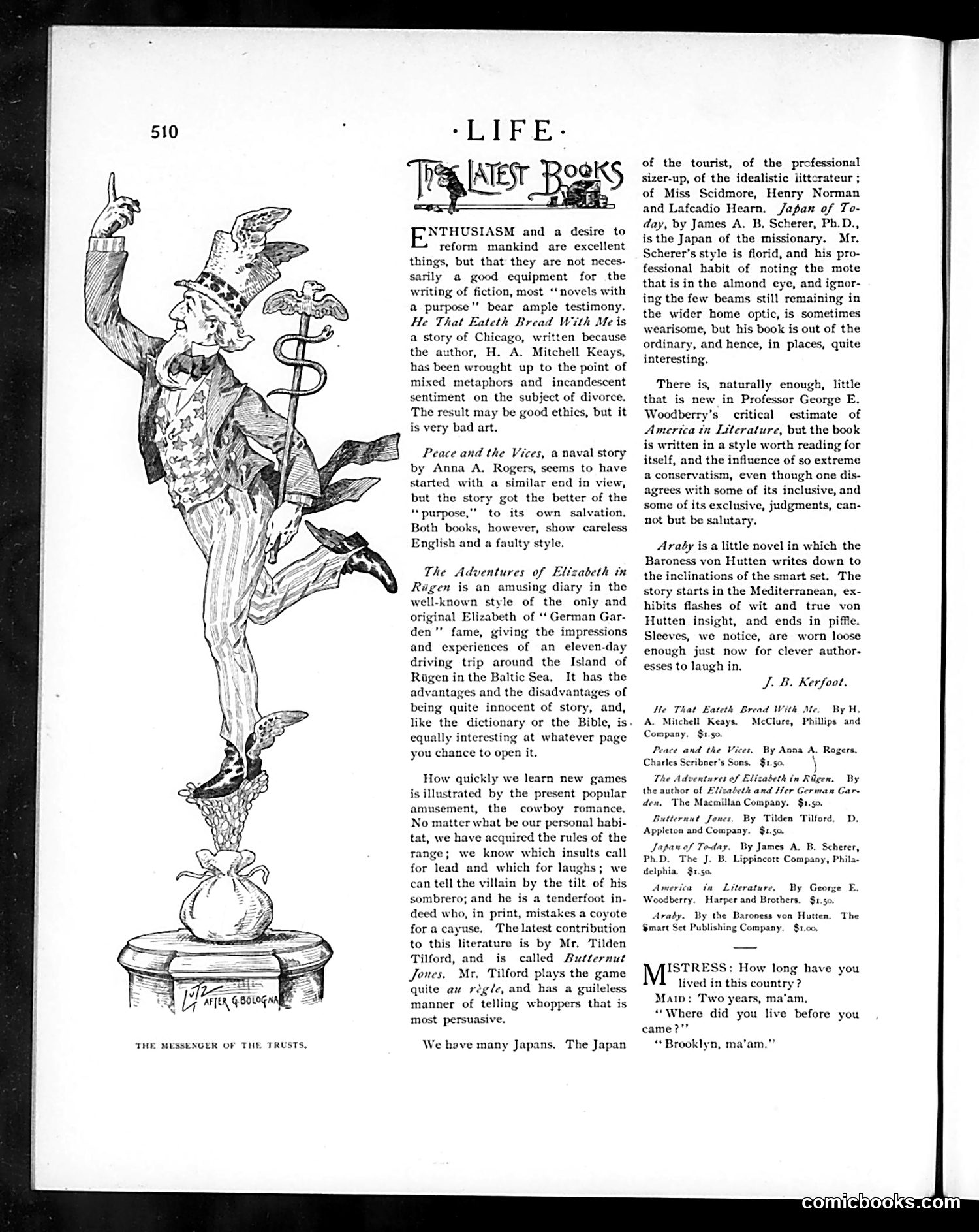
The cartoon depicts a grotesque figure—a caricatured "Trust" personified as a snake-like or octopus creature coiled around a classical column or pedestal, labeled "The Messenger of the Trusts." This is satirizing corporate monopolies and their corrupting influence on American institutions during the Progressive Era. The figure appears to represent how large corporations ("trusts") were seen as spreading through and controlling various aspects of society. The artistic style—exaggerated, monstrous, wrapped around symbols of traditional order—conveys hostile critique of concentrated economic power. The book reviews on the page discuss literature addressing social reform. This juxtaposition suggests the cartoon criticizes how trusts/corporations distort culture and literature, or more broadly, how monied interests corrupt public discourse. The grotesque messenger imagery emphasizes that these economic forces were viewed as fundamentally dangerous to American society.
📄 Transcribed text from this page (OCR, searchable)
Machine-transcribed from the original scan — historical spelling and the odd misread are preserved.
THE MESSENGER OF THE TRUSTS, NTHUSIASM and a desire to reform mankind are excellent things, but that they are not neces- sarily a good equipment for the writing of fiction, most ‘‘novels with a purpose"? bear ample testimony. He That Eateth Bread With Me is a story of Chicago, written because the author, H. A. Mitchell Keays, has been wrought up to the point of mixed metaphors and incandescent sentiment on the subject of divorce. The result may be good ethics, but it is very bad art. Peace and the Vices, a naval story by Anna A. Rogers, seems to have started with a similar end in view, but the story got the better of the “purpose,” to its own salvation. Both books, however, show careless English and a faulty style. The Adventures of Elizabeth in Ragen is an amusing diary in the well-known style of the only and original Elizabeth of ‘‘ German Gar- den” fame, giving the impressions and experiences of an eleven-day driving trip around the Island of Rigen in the Baltic Sea, It has the advantages and the disadvantages of being quite innocent of story, and, like the dictionary or the Bible, is. equally interesting at whatever page you chance to open it. How quickly we learn new games is illustrated by the present popular amusement, the cowboy romance. No matter what be our personal habi- tat, we have acquired the rules of the range; we know which insults call for lead and which for laughs; w can tell the villain by the tilt of his sombrero; and he is a tenderfoot in- deed who, in print, mistakes a coyote for acayuse. The latest contribution to this literature is by Mr. Tilden Tilford, and is called Butternut Jones. Mr. Tilford pt the game quite aw rigle, and has a guileless manner of telling whoppers that is most persuasive. We hove many Japans, The Japan of the tourist, of the professional sizer-up, of the idealistic littcrateur ; of Miss Scidmore, Henry Norman and Lafcadio Hearn. Japan of To- day, by James A. B. Scherer, Ph.D., isthe Japan of the missionary. Mr. Scherer’s style is florid, and his pro- fessional habit of noting the mote that isin the almond eye, and ignor- ing the few beams still remaining in the wider home optic, is sometimes wearisome, but his book is out of the ordinary, and hence, in places, quite interesting. There is, naturally enough, little that is new in Professor George E. Woodberry’s critical estimate of America in Literature, but the book is written in a style worth reading for itself, and the influence of so extreme a conservatism, even though one dis- agrees with some of its inclusive, and some of its exclusive, judgments, can- not but be salutary. Araby is a little novel in which the Baroness von Hutten writes down to the inclinations of the smart set. The story starts in the Mediterranean, ex- hibits flashes of wit and true von Hutten insight, and ends in piffie. Sleeves, we notice, are worn loose enough just now for clever author- esses to laugh in. J. B. Kerfoot. He That Eateth Bread With Me. By WH. A. Mitchell Keays. McClure, Phillips and Company. $1.50. Peace and the Vices, By Anna A. Rogers, Charles Scribner's Sons, $1.50. The Adventures of Elizabeth in Rilgen. By the author of Elisabeth and Her German Gar- den, ‘The Macmillan Company. $1.50. Butternut Jones, By Tilden Tilford, D. Appleton and Company. $1.50. Japan of Today. By James A. B. Scherer, Ph.D, The J. B. Lippincott Company, Phila- delphia. $3.50 America in Literature, By George E. Woodberry. Harper and Brothers. $1.50. Araby. By the Baroness von Hutten. The Smart Sct Publishing Company. $1.00, ISTRE Tow long have you lived in this country ? Matp: Two years, ma'am, “Where did you live before you came?” “Brooklyn, ma'am.”