
Life, 1904-05-26 · page 8 of 22
Life — May 26, 1904 — page 8: what you’re looking at
What you’re looking at
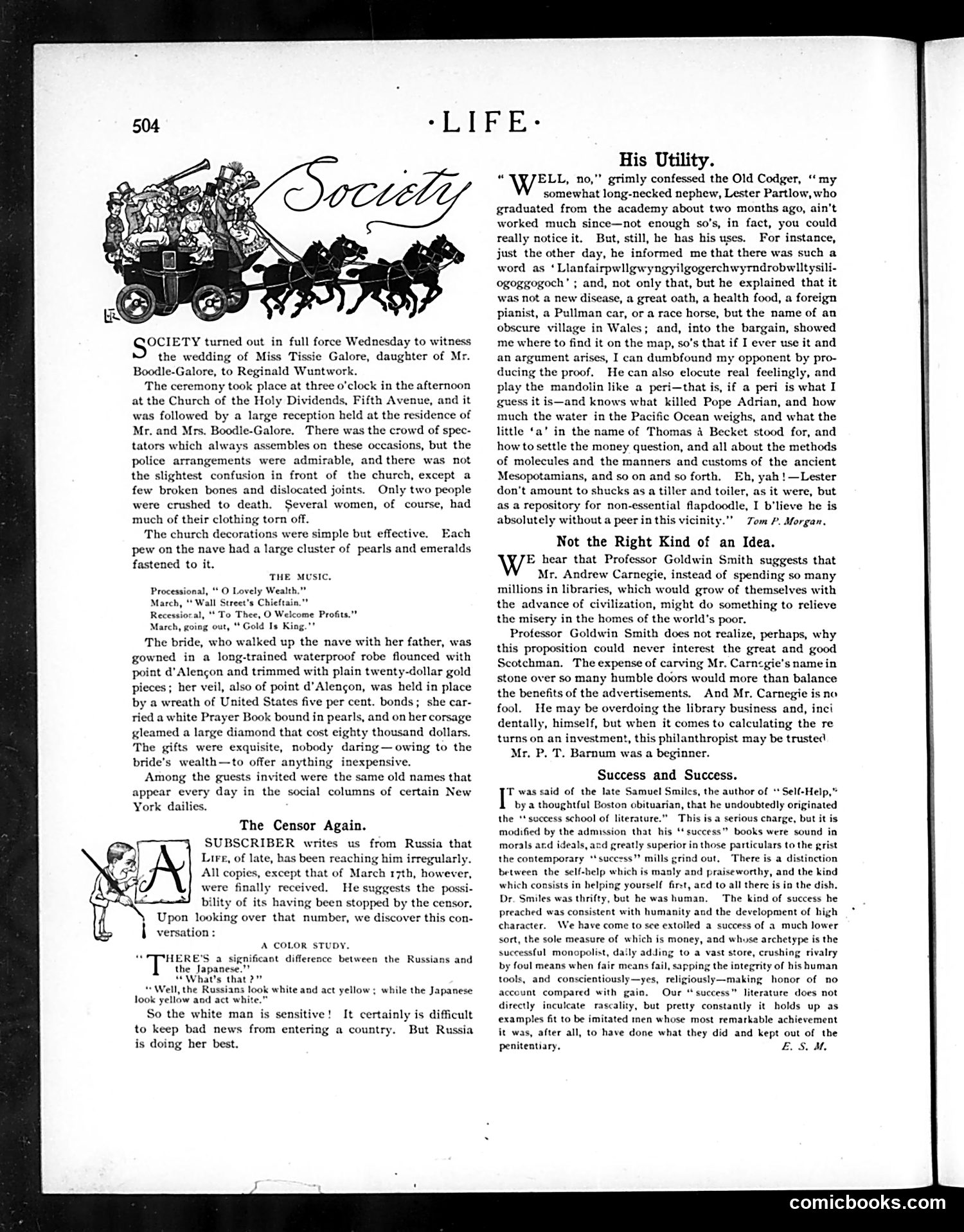
This page contains three satirical pieces from Life magazine's "Society" section. The main article mocks a society wedding of Miss Tissie Dalton and Mr. Boodle-Galore, describing the elaborate church ceremony and gift-giving with gentle irony about upper-class excess. "The Censor Again" presents a joke about Russian censorship: a subscriber notes that the Russian periodical *Lur* reaches him irregularly because copies are suppressed. The satire compares Russian and Japanese book censorship, with Russia depicted as overly sensitive about "bad news." "Not the Right Kind of Idea" criticizes philanthropist Andrew Carnegie's library proposal, suggesting that building libraries for poor communities is less practical than direct financial aid to relieve poverty. The pieces reflect early 20th-century American attitudes toward class, international politics, and philanthropy.
📄 Transcribed text from this page (OCR, searchable)
Machine-transcribed from the original scan — historical spelling and the odd misread are preserved.
eevleGelee OCIETY turned out in full force Wednesday to witness the wedding of Miss Tissie Galore, daughter of Mr. Boodle-Galore, to Reginald Wuntwork. The ceremony took place at three o'clock in the afternoon at the Church of the Holy Dividends, Fifth Avenue, and it was followed by a large reception held at the residence of Mr. and Mrs. Boodle-Galore. There was the crowd of spec- tators which always assembles on these occasions, but the police arrangements were admirable, and there was not the slightest confusion in front of the church, except a few broken bones and dislocated joints. Only two people were crushed to death. Several women, of course, had much of their clothing torn off. The church decorations were simple but effective. Each pew on the nave had a large cluster of pearls and emeralds fastened to it. THE MUSIC. Processional, ‘* Lovely Wealth,”* March, “ Wall Street's Chieftain." Recessioral, "* To Thee, O Welcome Profits.”” March, going out, Gold Is King."? The bride, who walked up the nave with her father, was gowned in a long-trained waterproof robe flounced with point d’Alengon and trimmed with plain twenty-dollar gold pieces; her veil, also of point d’Alengon, was held in place by a wreath of United States five per cent. bonds; she car- ried a white Prayer Book bound in pearls, and on her corsage gleamed a large diamond that cost eighty thousand dollars. The gifts were exquisite, nobody daring— owing to the bride's wealth—to offer anything inexpensive. Among the guests invited were the same old names that appear every day in the social columns of certain New York dailies. The Censor Again. SUBSCRIBER writes us from Russia that Lire, of late, has been reaching him irregularly. All copies, except that of March 17th, however, were finally received. He suggests the possi- bility of its having been stopped by the censor, Upon looking over that number, we discover this con- versation : A COLOR STUDY. “THERE'S a significant difference between the Russians and the Japanese. “What's tha “Well, the Russians look white and act yellow ; look yellow and act white. So the white man is sensitive! It certainly is difficult to keep bad news from entering a country, But Russia is doing her best. while the Japanese His Utility. “ ELL, no,” grimly confessed the Old Codger, somewhat long-necked nephew, Lester Partlow, who graduated from the academy about two months ago, ain't worked much since—not enough so’s, in fact, you could really notice it. But, still, he has his uses. For instance, just the other day, he informed me that there was such a word as ‘Llanfairpwllgwyngyilgogerchwyrndrobwlltysili- ogoggogoch’ ; and, not only that, but he explained that it was not a new disease, a great oath, a health food, a foreign , @ Pullman car, or a race horse, but the name of an ure village in Wales; and, into the bargain, showed me where to find it on the map, so’s that if I ever use it and an argument arises, I can dumbfound my opponent by pro- ducing the proof. He can also elocute real feelingly, and play the mandolin like a peri—that is, if a peri is what I guess it is—and knows what killed Pope Adrian, and how much the water in the Pacific Ocean weighs, and what the little ‘a’ in the name of Thomas 4 Becket stood for, and how to settle the money question, and all about the methods of molecules and the manners and customs of the ancient Mesopotamians, and so on and so forth. Eb, yah !—Lester don’t amount to shucks as a tiller and toiler, as it were, but as a repository for non-essential flapdoodle, I b'lieve he is absolutely without a peer in this vicinity."” 7om P. Morgan. Not the Right Kind of an Idea. E hear that Professor Goldwin Smith suggests that Mr. Andrew Carnegie, instead of spending so many millions in libraries, which would grow of themselves with the advance of civilization, might do something to relieve the misery in the homes of the world’s poor. Professor Goldwin Smith does not realize, perhaps, why this proposition could never interest the great and good Scotchman. The expense of carving Mr. Carncgie’s name in stone over so many humble doors would more than balance the benefits of the advertisements. And Mr. Carnegie is no fool. He may be overdoing the library business and, inci dentally, himself, but when it comes to calculating the re turns on an investment, this philanthropist may be trusted Mr. P, T. Barnum was a beginner. Success and Success. 'T was said of the late Samuel Smiles, the author of ** Self-Help,” bya thoughtful Boston obituarian, that he undoubtedly originated the ‘success school of literature.” This is a serious charge, but it is modified by the admission that his “success” books were sound in morals ard ideals, and greatly superior in those particulars to the grist the contemporary *success”” mills grind out, ‘There is a distinction between the self-help which is manly and praiseworthy, and the kind which consists in helping yourself first, acd to all there is in the dish. Dr. Smiles was thrifty, but he was human. The kind of success he preached was consistent with humanity and the development of high character. We have come to sce extolled a success of a much lower sort, the sole measure of which is money, and whuse archetype is the successful monopolist, daily adding to a vast store, crushing rivalry by foul means when fair means fail, sapping the integrity of bis human tools, and conscientiously—yes, religiously—making honor of no account compared with gain, Our “success” literature does not directly inculcate rascality, but pretty constantly it holds up as examples fit to be imitated inen whose most remarkable achievement it was, after all, to have done what they did and kept out of the penitentiary. E. SM. comicbooks.com