
Life, 1904-05-26 · page 9 of 22
Life — May 26, 1904 — page 9: what you’re looking at
What you’re looking at
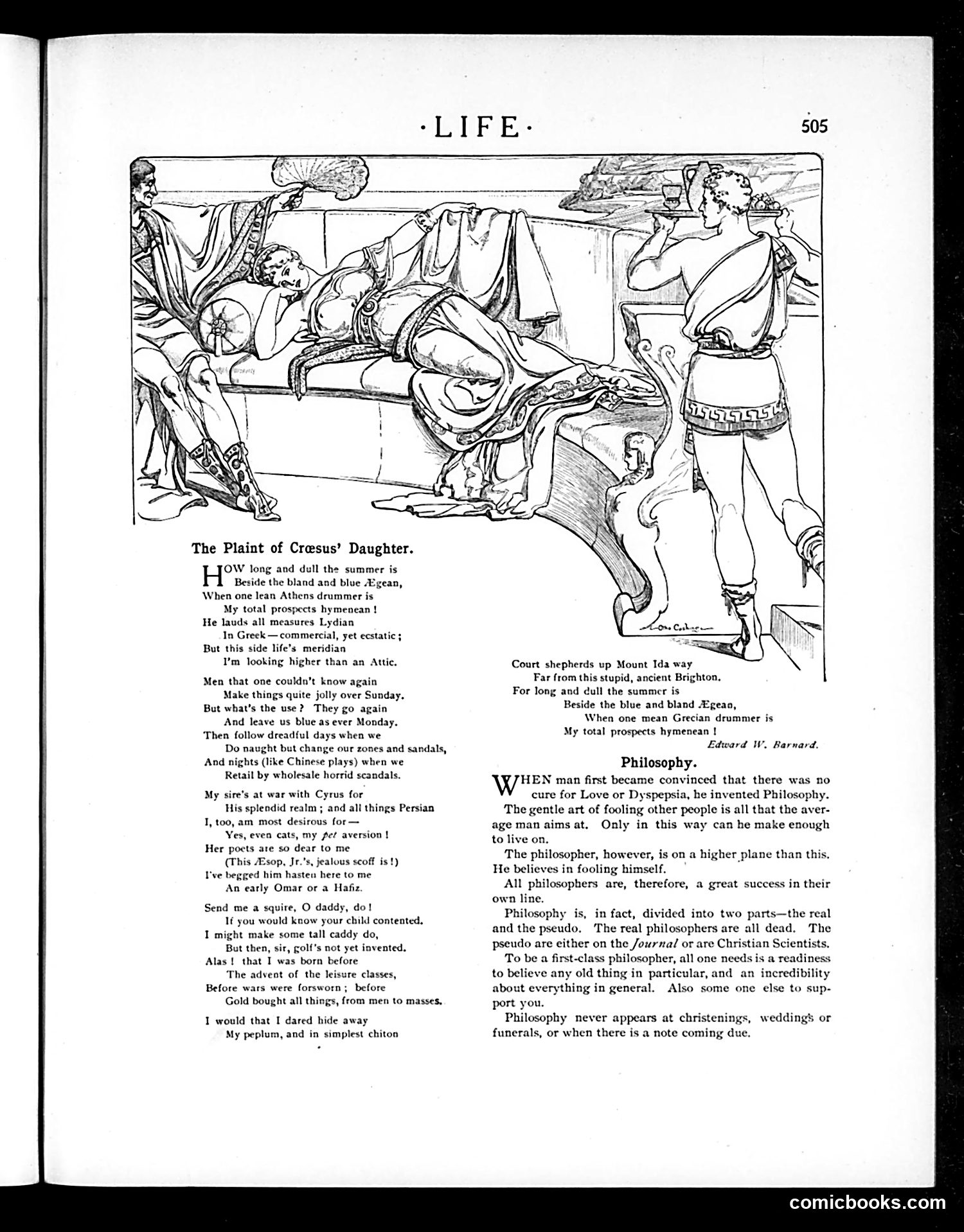
The illustration depicts a classical Greek scene with reclining and seated figures in togas, apparently referencing the wealthy king Croesus from ancient history. The poem "The Plaint of Croesus' Daughter" (by Edward W. Barnard) is a satirical complaint about summer leisure and boredom among the wealthy. It mocks how idle rich people—unable to work or engage meaningfully—simply repeat their weekly routines ("And leave us blue a every Monday"). The speaker wishes to escape her privileged but monotonous existence. Below, the "Philosophy" section sarcastically defines philosophy as "the gentle art of fooling other people" and jokes that philosophers are successful at deceiving themselves. It's social satire mocking both wealth-induced ennui and pretentious intellectual posturing.
📄 Transcribed text from this page (OCR, searchable)
Machine-transcribed from the original scan — historical spelling and the odd misread are preserved.
The Plaint of Cresus’ Daughter. OW long and dull the summer is Beside the bland and blue gean, When one lean Athens drummer is My total prospects hymenean ! He lauds all measures Lydian In Greek — commercial, yet ecstatic ; But this side life’s meridian I’m looking higher than an Attic. Men that one couldn’t know again Make things quite jolly over Sunday, But what's the use? They go again And leave us blue as ever Monday. ‘Then follow dreadful days when we Do naught but change our zones and sandals, And nights (like Chinese plays) when we Retail by wholesale horrid scandals. My sire’s at war with Cyrus for His splendid realm ; and all things Persian I, too, am most desirous for — Yes, even cats, my fet aversion | Her pocts ate so dear to me (This sop, Jr.’s, jealous scoff is !) I've begged him hasten here to me An early Omar or a Hafiz Send me a squire, O daddy, do! If you would know your child contented, I might make some tall caddy do, But then, sir, golf's not yet invented, Alas! that I was born before The advent of the leisure classes, Before wars were forsworn ; before Gold bought all things, from men to masses, I would that I dared hide away My peplum, and in simplest chiton Court shepherds up Mount Ida way Far from this stupid, ancient Brighton, For long and dull the summer is Beside the blue and bland geao, When one mean Grecian drummer is My total prospects hymenean ! Edward W. Barnard. Philosophy. HEN man first became convinced that there was no cure for Love or Dyspepsia, he invented Philosophy. The gentle art of fooling other people is all that the aver- age man aims at. Only in this way can he make enough to live on, ‘The philosopher, however, is on a higher plane than this, He believes in fooling himself, All philosophers are, therefore, a great success in their own line. Philosophy is, in fact, divided into two parts—the real and the pseudo, The real philosophers are all dead. The pseudo are either on the Journal or are Christian Scientists, To be a first-class philosopher, all one needs is a readiness to believe any old thing in particular, and an incredibility about everything in general. Also some one else to sup- port you. Philosophy never appears at christenings, wedding’ or funerals, or when there is a note coming due. comicbooks.com