
Life, 1904-05-26 · page 12 of 22
Life — May 26, 1904 — page 12: what you’re looking at
What you’re looking at
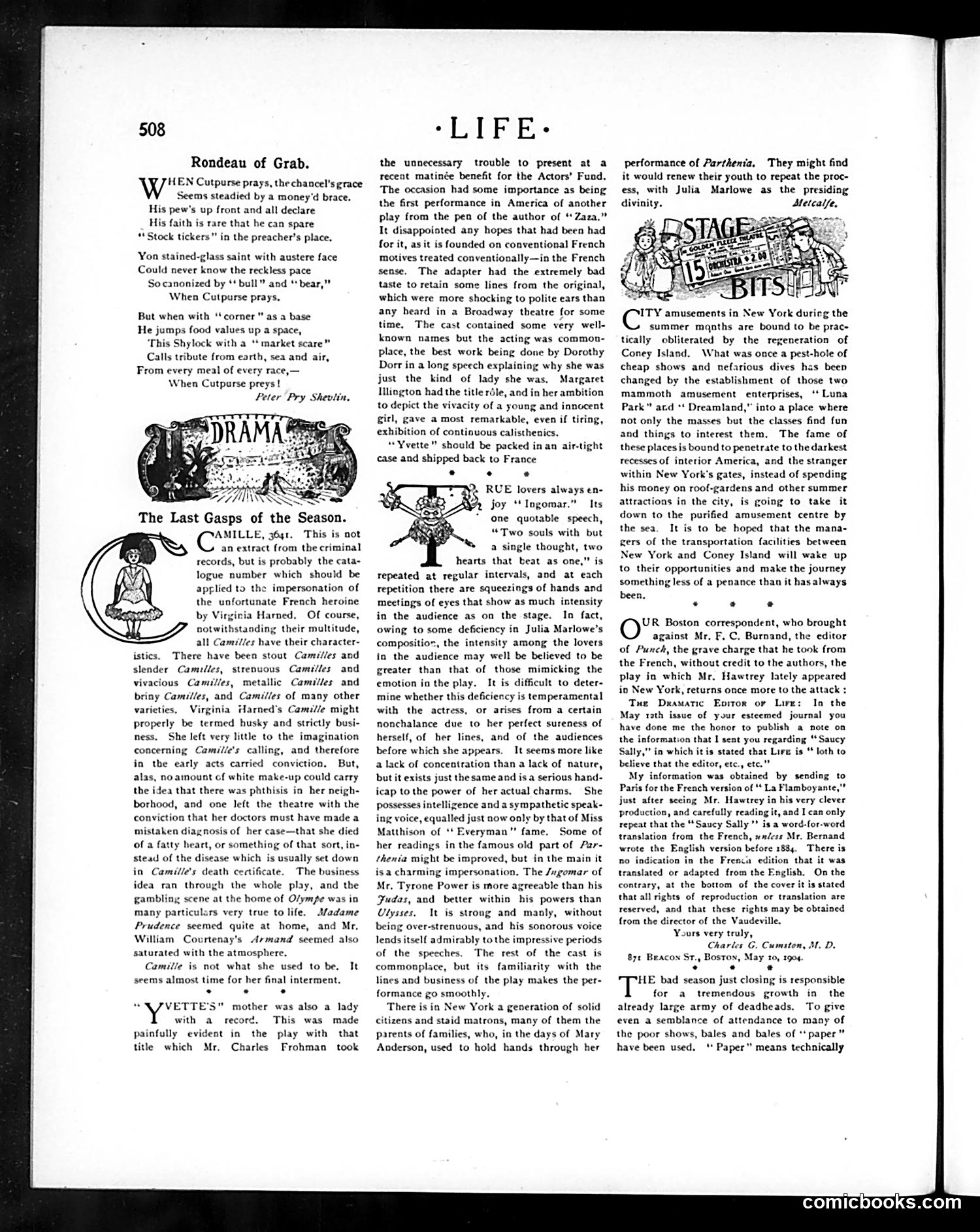
This page contains **drama criticism and theatrical reviews**, not political cartoons. The main content discusses recent Broadway performances, including commentary on a play called *Zaza* and *The Last Gasps of the Season* featuring *Camille*. The decorative header labeled "DRAMA" is ornamental rather than satirical. The text critiques acting performances and theatrical trends, particularly noting that New York's summer amusement venues are becoming increasingly commercialized with "cheap shows and notorious dives." A brief "STAGE BITS" section comments on New York City theater trends during summer months. The page is primarily **theater criticism and gossip** aimed at the magazine's educated, theatergoing audience—not political or social satire.
📄 Transcribed text from this page (OCR, searchable)
Machine-transcribed from the original scan — historical spelling and the odd misread are preserved.
508 Rondeau of Grab. Wwe \ Cutpurse prays, thechancel's grace Seems steadied by a money'd brace. His pew's up front and all declare His faith is rare that he can spare “Stock tickers" in the preacher's place. Yon stained-glass saint with austere face Could never know the reckless pace So canonized by ** bull” and bear,” When Cutpurse prays. But when with ‘corner as a base He jumps food values up a space, ‘This Shylock with a market scare” Calls tribute from earth, sea and air, From every meal of every race,— When Cutpurse preys! Peter Pry Shevlin, The Last Gasps of the Season. ‘AMILLE, 3641. This is not an extract from the criminal records, but is probably the cata~ logue number which should be applied to the impersonation of the unfortunate French heroine by Virginia Harned. Of course, notwithstanding their multitude, all Camitles have their character- istics, There have been stout Camilies and slender Camulles, strenuous Camilles and vivacious Camilies, metallic Camilles and briny Camiiles, and Camilies of many other varieties, Virginia Harned’s Cami//e might properly be termed husky and strictly busi- ness. She left very little to the imagination concerning Camille's calling, and therefore in the early acts carried conviction, But, alas, noamount of white make-up could carry the idea that there was phthisis in her neigh- borhood, and one left the theatre with the conviction that her doctors must have made a mistaken diagnosis of her case—that she died of a fatty heart, or something of that sort, in- stead of the disease which is usually set down in Camitle’s death cectificate. The business idea ran through the whole play, and the gambling scene at the home of O/ymfe was in many particulars very true to life. Madame Prudence seemed quite at home, and Mr. William Courtenay'’s Armand seemed also saturated with the atmosphere. Camitie is not what she used to be, It seems almost time for her final interment. . . . VETT! mother was also a lady with a record, This was made painfully evident in the play with that title which Mr. Charles Frohman took *LIFE- the unnecessary trouble to present at a recent matinée benefit for the Actors’ Fund. The occasion had some importance as being the first performance in America of another play from the pen of the author of “Zaza.” It disappointed any hopes that had been had for it, as it is founded on conventional French motives treated conventionally—in the French sense. The adapter had the extremely bad taste to retain some lines from the original, which were more shocking to polite ears than any beard in a Broadway theatre for some time, The cast contained some very well- known names but the acting was common- place, the best work being done by Dorothy Dorr in a long speech explaining why she was just the kind of lady she was, Margaret Illington had the title rdle, and in her ambition to depict the vivacity of a young and innocent girl, gave a most remarkable, even if tiring, exhibition of continuous calisthenics. “Yvette” should be packed in an air. case and shipped back to France . . ight 2. RUE lovers always en- joy ‘ Ingomar.” Its one quotable speech, “Two souls with but a single thought, two hearts that beat as one,” is repeated at regular intervals, and at each ion there are squeezings of hands and meetings of eyes that show as much intensity in the audience as on the stage. In fact, owing to some deficiency in Julia Marlowe's composition, the intensity among the lovers ia the audience may well be believed to be greater than that of those mimicking the emotion in the play. It is difficult to deter- mine whether this deficiency is temperamental with the actress, or arises from a certain nonchalance due to her perfect sureness of herself, of her lines, and of the audiences before which she appears. It seems more like a lack of concentration than a lack of nature, but it exists just the same and is a serious hand- icap to the power of her actual charms, She possesses intelligence and a sympathetic speak- ing voice, equalled just now only by that of Miss Mathison of ** Everyman” fame, Some of her readings in the famous old part of Par- thenia might be improved, but in the main it isa charming impersonation, The /ugomar of Mr. Tyrone Power is more agreeable than his Judas, and better within his powers than Ulysses. It is strong and manly, without being over-strenuous, and his sonorous voice lends itself admirably to the impressive periods of the speeches. The rest of the cast is commonplace, but its familiarity with the lines and business of the play makes the per- formance go smoothly, There is in New York a generation of solid citizens and staid matrons, many of them the parents of families, who, in the days of Mary Anderson, used to hold hands through her performance of Parthenia, They might find it would renew their youth to repeat the proc- ess, with Julia Marlowe as the presiding divinity. tetcalfe, ITY amusements in New York durieg the summer manths are bound to be prac- tically obliterated by the regeneration of Coney Island. What was once a pest-hole of cheap shows and nefarious dives has been changed by the establishment of those two mammoth amusement enterprises, “ Luna Park” atd *‘ Dreamland,” into a place where not only the masses but the classes find fun and things to interest them. The fame of these places is bound to penetrate to the darkest recesses of interior America, and the stranger within New York's gates, instead of spending his money on roof-gardens and other summer attractions in the city, is going to take it down to the purified amusement centre by It is to be hoped that the mana- gers of the transportation facilities between New York and Coney Island will wake up to their opportunities and make the journey something less of a penance than it hasalways been, the sea. . e * UR Boston correspondent, who brought against Mr. F.C. Burnand, the editor of Punch, the grave charge that he took from the French, without credit to the authors, the play in which Mr, Hawtrey lately appeared in New York, returns once more to the attack : Tue Deawaric Eorror or Lire: In the May 12th issue of your esteemed journal you have done me the honor to publish a note on the information that I sent you regarding “Saucy Sally," in which it is stated that Lire is “loth to believe that the editor, etc., ete.” My information was obtained by sending t Paris for the Freach version of * La Flamboyant just after seeing Mr. Hawtrey in his very clever production, and carefully reading it, and I can only repeat that the "Saucy Sally ’” is a word-for-word translation from the French, wn/ezs Mr. Bernand wrote the English version before 188. There is no indication in the Frenca edition that it was translated or adapted from the English. On the contrary, at the bottom of the cover it is stated that all rights of reproduction or translation are reserved, and that these rights may be obtained from the director of the Vaudeville, Yours very truly, Charles G. Cumston, M.D. 871 Beacox St., Bostox, May 10, 1904. . ° * HE bad season just closing is responsible for a tremendous growth in the already large army of deadheads. To give even a semblance of attendance to many of the poor shows, bales and bales of ** paper” have been used. ‘ Paper” means technically comicbooks.com