
A complete issue · 28 pages · 1904
Life — May 19, 1904
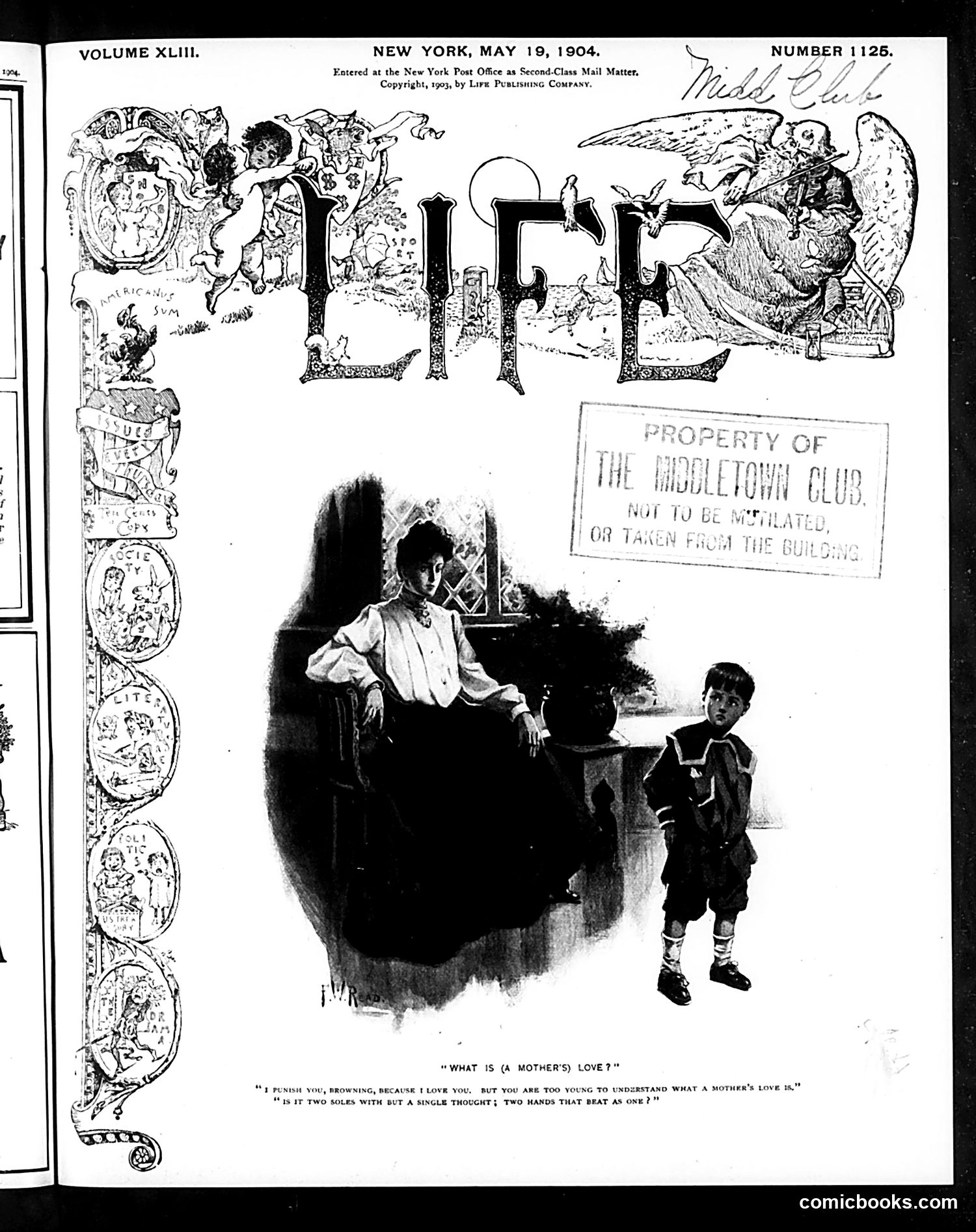
This page features a sentimental domestic illustration rather than political satire. The main image shows a woman at a piano with a young boy standing beside her. The caption reads "WHAT IS (A MOTHER'S) LOVE?" followed by a quote: "I know you, browsing, because I love you. But you are too young and understand what a mother's love is. Is it two soles with but a single thought; two hands that beat as one?" The illustration appears to be commentary on maternal devotion and the bond between mother and child—a typical sentimental theme for early 1900s American magazines. The ornamental left border with classical motifs and cherubs reinforces the genteel, idealized nature of the subject. This represents *Life* magazine's lighter, lifestyle-focused content rather than its satirical political work.
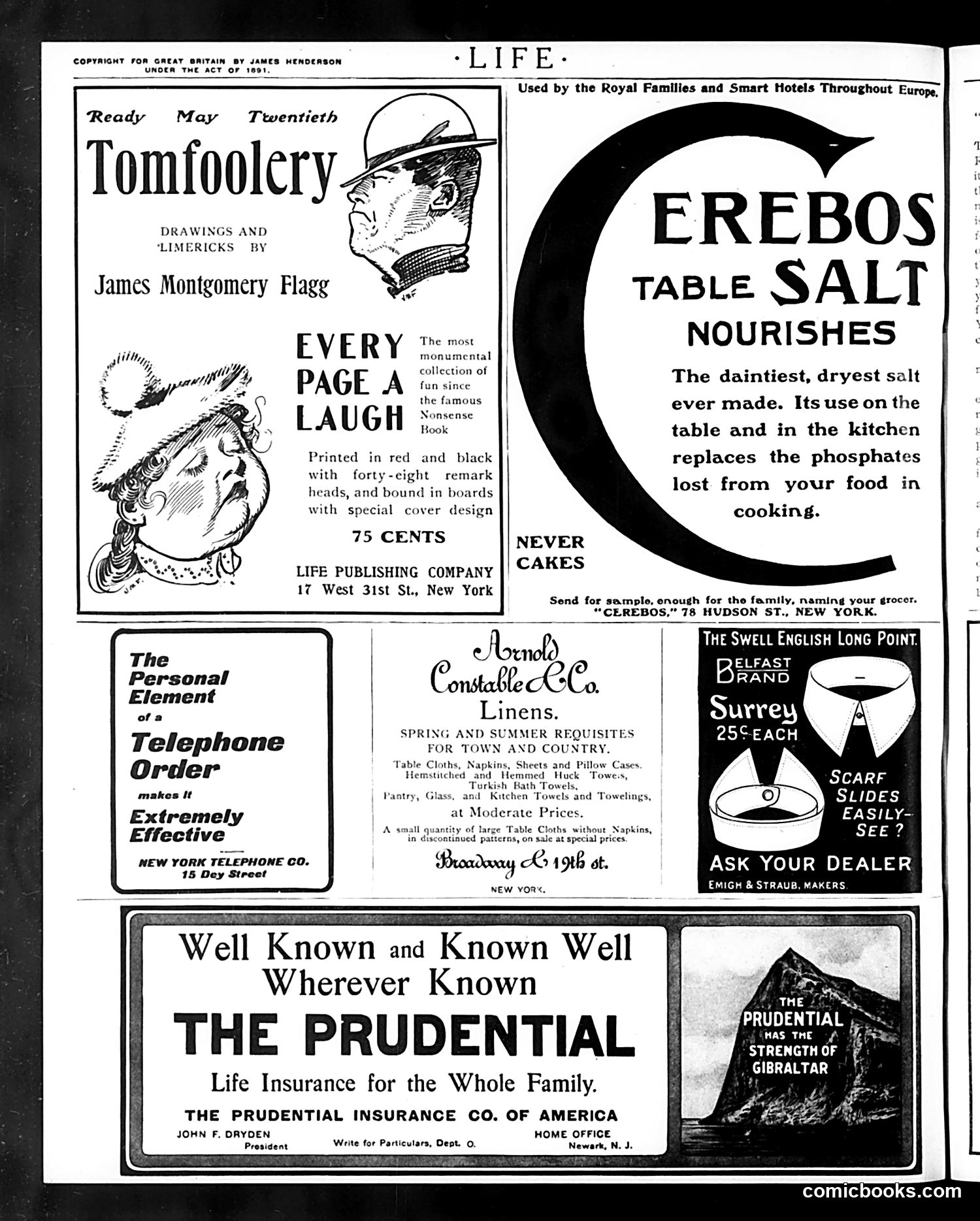
This page is primarily **advertising**, not satirical content. The main featured item is "Tomfoolery," a 1920 humor book with drawings and limericks by James Montgomery Flagg, priced at 75 cents. The illustration shows a caricatured male head in profile—likely representing comedic subject matter rather than a specific political figure. The remaining advertisements promote practical goods: Erebos table salt, Arnold Constable linens, a New York Telephone Company service, English scarf slides, and Prudential life insurance. There is no discernible political satire or commentary on this page. It represents early 20th-century magazine advertising and a humor book promotion typical of *Life* magazine's commercial content during this period.
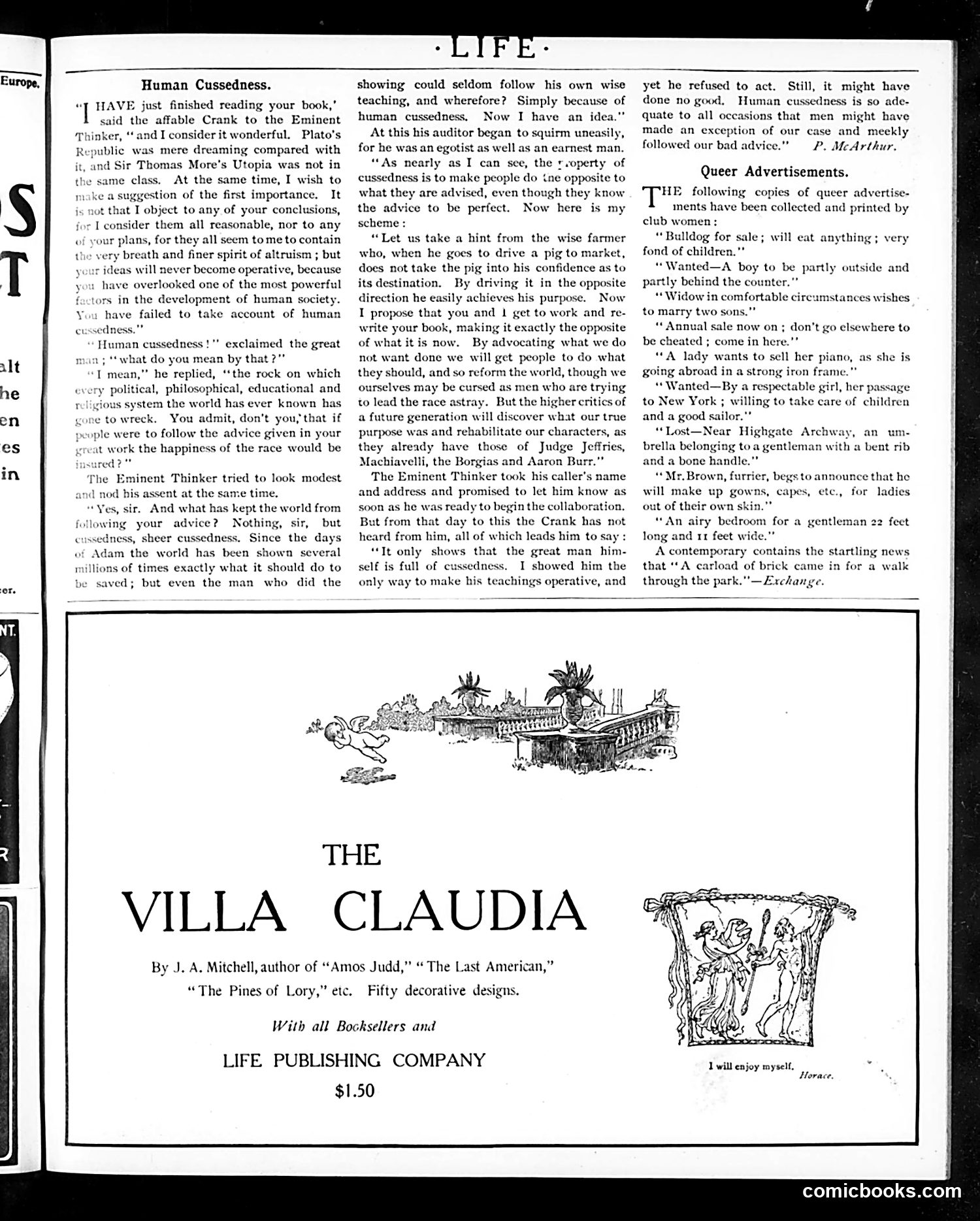
This page is primarily **advertising and editorial content** rather than political satire. The upper portion contains an article titled "Human Cussedness" discussing the concept of human stubbornness and contrarian behavior—using examples like a farmer intentionally driving a pig the wrong direction to make a point. Below that is a "Queer Advertisements" section featuring humorous classified ads, a recurring Life magazine feature poking fun at absurd or poorly-worded real advertisements. The main content is a **book advertisement** for *The Villa Claudia* by J.A. Mitchell, with decorative classical illustrations. The page reflects early 20th-century Life magazine's blend of light satire, humor columns, and commercial promotion rather than hard-hitting political commentary.
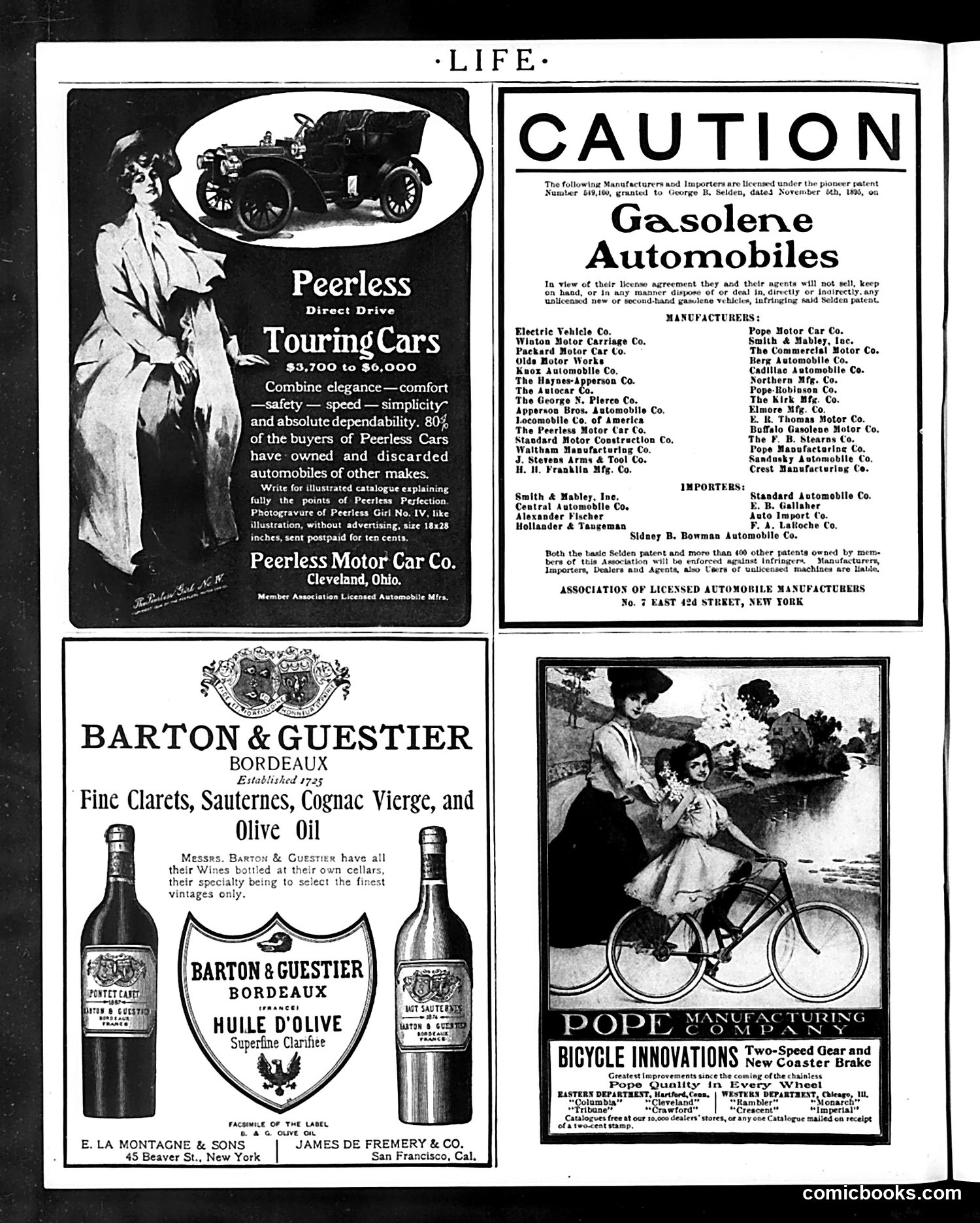
This page is primarily **advertising, not satire or political commentary**. It contains four advertisements from the early 1900s: 1. **Peerless automobiles** (top left): Features a woman in period dress promoting touring cars priced $3,700-$6,000, emphasizing comfort and reliability. 2. **Caution notice** (top right): A legal disclaimer from the Association of Licensed Automobile Manufacturers listing manufacturers and importers of gasoline automobiles, warning against patent infringement. 3. **Barton & Guestier** (bottom left): Advertisement for French wines and olive oil, emphasizing cellar-bottled quality. 4. **Pope bicycle innovations** (bottom right): Shows women on bicycles, advertising two-speed gear and coaster brake technology. These reflect early 1900s consumer goods and emerging automobile industry disputes.
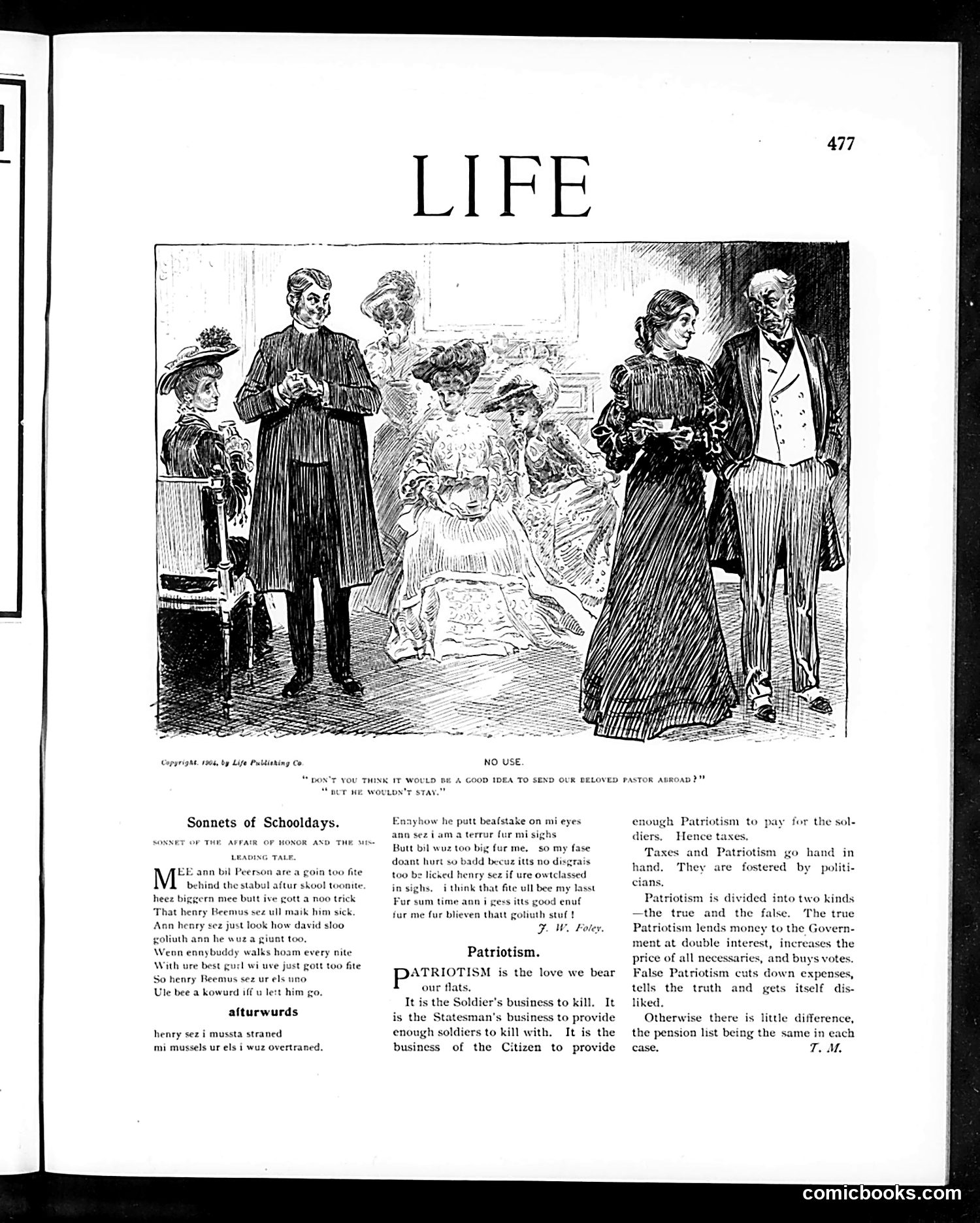
The cartoon titled "NO USE" satirizes sending pastors abroad during wartime. A clergyman (center) is being encouraged to relocate overseas, with the caption suggesting it would be "a good idea to send our beloved pastor abroad" — but "he wouldn't stay," implying reluctance to leave comfortable domestic life. The accompanying text discusses patriotism, distinguishing between "false" and "true" patriotism. False patriotism lends money to government at interest and manipulates prices; true patriotism supports soldiers and provides necessities affordably. The "Sonnets of Schooldays" section offers satirical verse about youthful indiscretions and regrets. The page appears to critique both clerical resistance to wartime sacrifice and hypocritical patriotism that profits from conflict rather than genuinely serving the nation's needs.
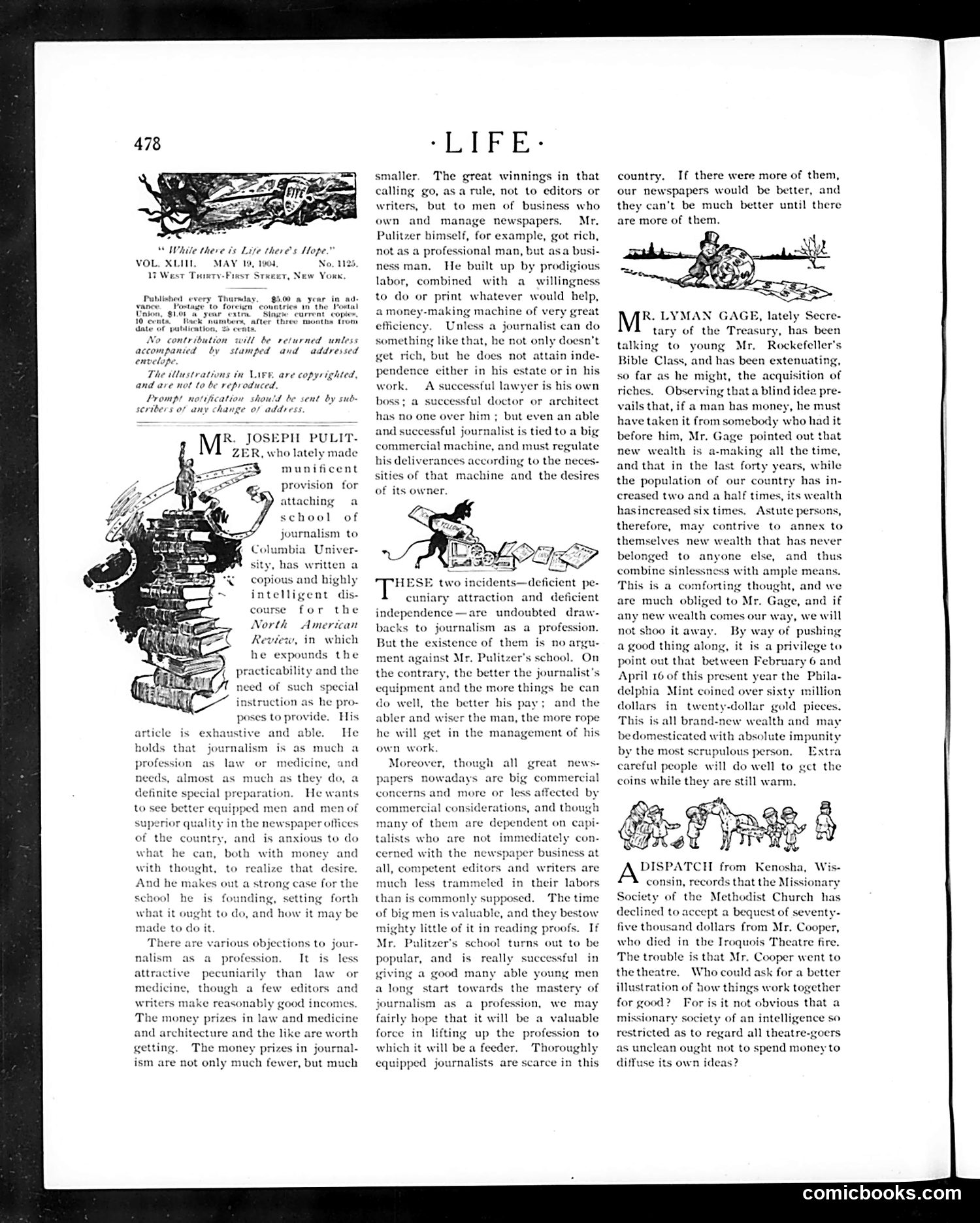
This page discusses journalism education, specifically praising Joseph Pulitzer's new school of journalism at Columbia University. The text argues journalism deserves professional training like law or medicine, noting that successful newspapers require skilled editors and writers—not just businessmen. The left illustration shows a printing press stacked with books, symbolizing how journalism education combines practical and theoretical knowledge. The satirical point appears subtle: while endorsing Pulitzer's initiative, the author acknowledges journalism has historically attracted fewer talented people than other professions, and that newspapers are often run by commercial interests rather than editorial expertise. The right section discusses wealth accumulation, using Mr. Lyman Gage as an example of how new fortunes are being made in America.
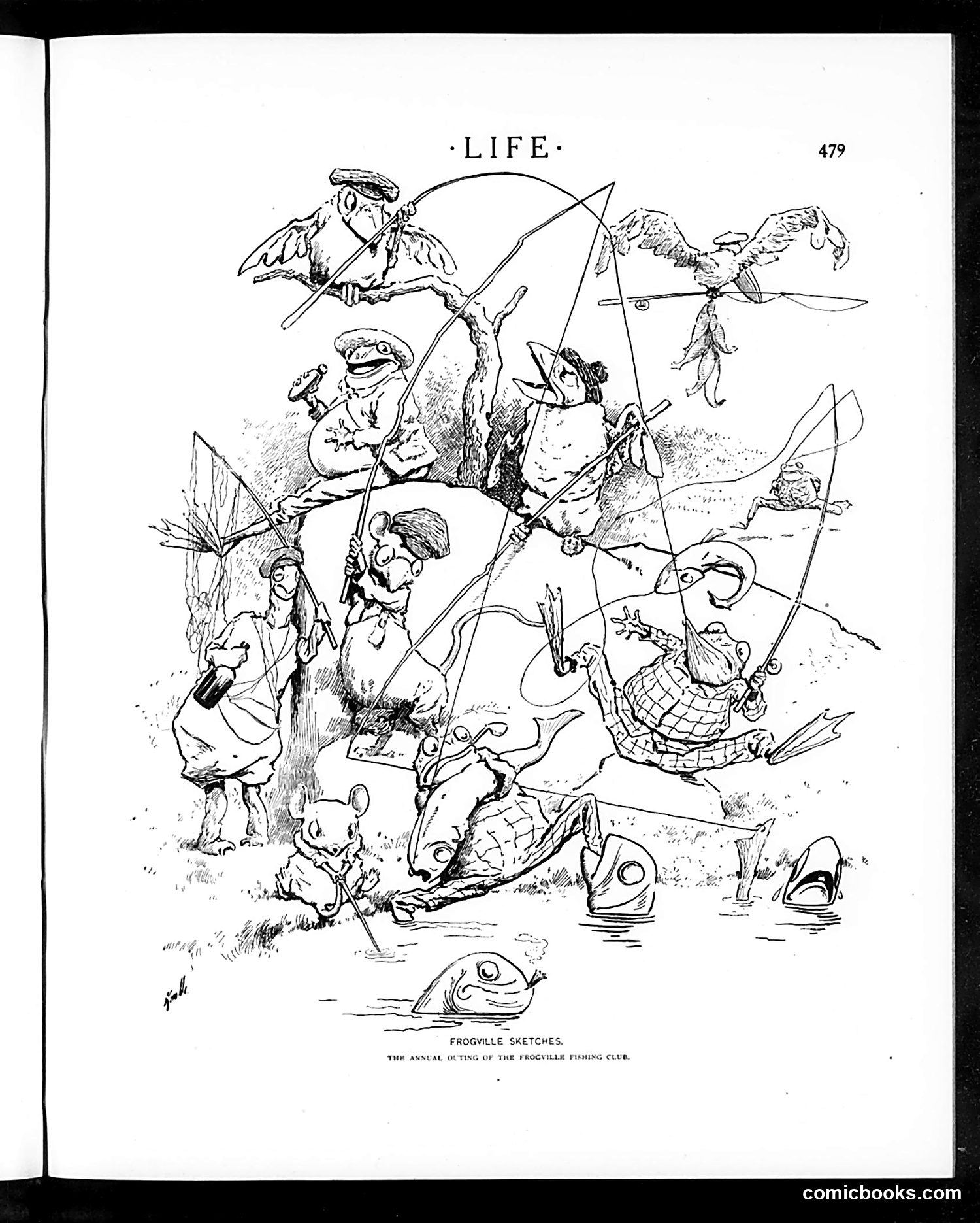
This is a whimsical satirical illustration depicting anthropomorphized frogs engaged in a fishing outing. The frogs are shown as caricatured humans—some wearing clothes, holding fishing rods, and managing a picnic setup near water and a tree. The satire appears to mock human leisure activities and social clubs by presenting them through animal characters. The frogs' exaggerated poses and expressions suggest comedy derived from the contrast between animal nature and human pretension. Some figures appear to be fishing while others manage tents, baskets, and supplies—parodying the organized chaos of recreational outings. The title suggests this depicts a regular "annual" club event, likely satirizing the pretensions of exclusive gentleman's fishing clubs that were popular in this era.
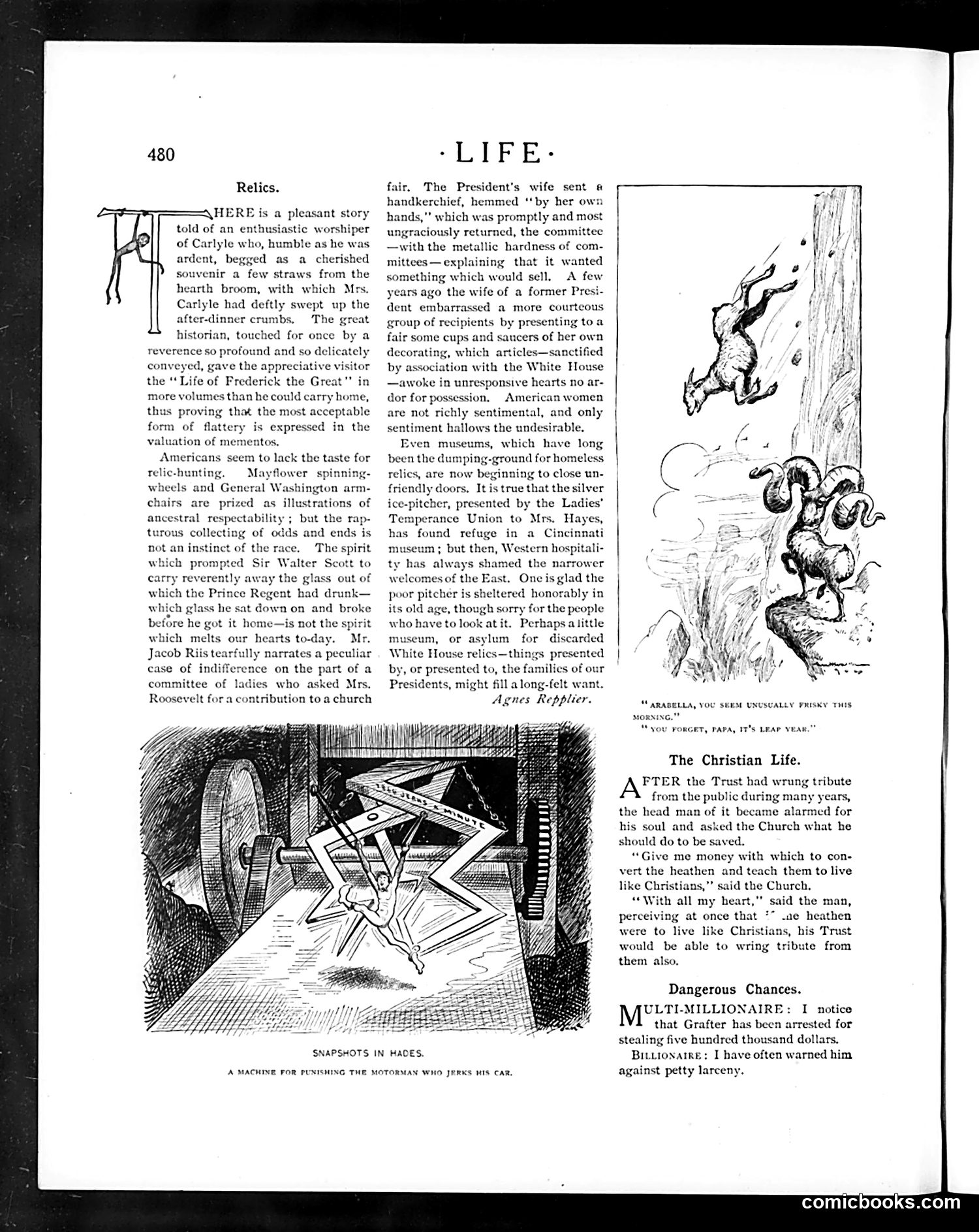
This page contains three distinct satirical pieces: 1. **"Relics"** (top left): Mocks American sentimentality around presidential memorabilia. The text criticizes how Americans collect trivial White House items—like General Washington's chairs or a glass the Prince Regent drank from—as sacred relics. The satire targets the "Life of Frederick the Great" comparison, suggesting Americans lack refined taste compared to Europeans. 2. **"Snapshots in Races"** (bottom left): A cartoon showing a mechanical contraption designed to punish motorists who jerk their cars. It's social commentary on dangerous driving habits of the era. 3. **"The Christian Life"** (right): A parable about converting wealthy heathens through financial incentive rather than genuine faith—satirizing the church's pragmatism regarding wealthy donors. The page satirizes American materialism, reckless modernity, and institutional hypocrisy.
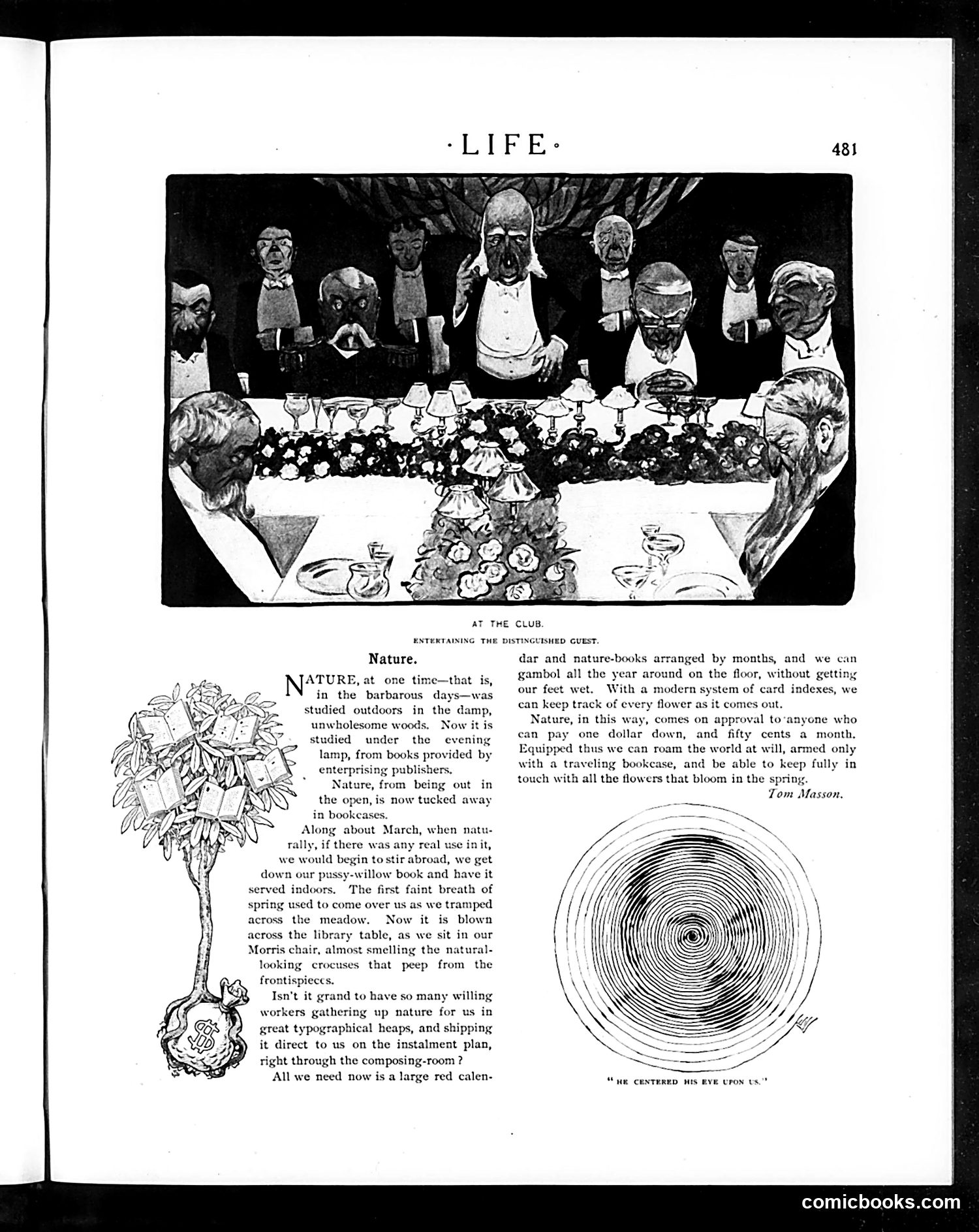
This page contains a satirical illustration titled "At the Club: Entertaining the Distinguished Guest" showing what appears to be a formal dinner scene with exaggerated caricatured faces of men in formal wear seated at a table. Below is an essay by Tom Masson titled "Nature," discussing how urban people study nature indoors through books rather than experiencing it outdoors. The piece humorously advocates for accessible nature study—mentioning a "pussy-willow book" kept indoors and a system where people can "gambol all the year around" by paying installments to track flowers. The right side features botanical illustrations (a flowering plant and circular tree-ring diagram labeled "He centered his eye upon it"). **The satirical point:** The contrast between the formal, artificial dinner scene above and the essay below critiques how modern urban society has become disconnected from authentic nature, replacing it with mediated, commercialized substitutes.
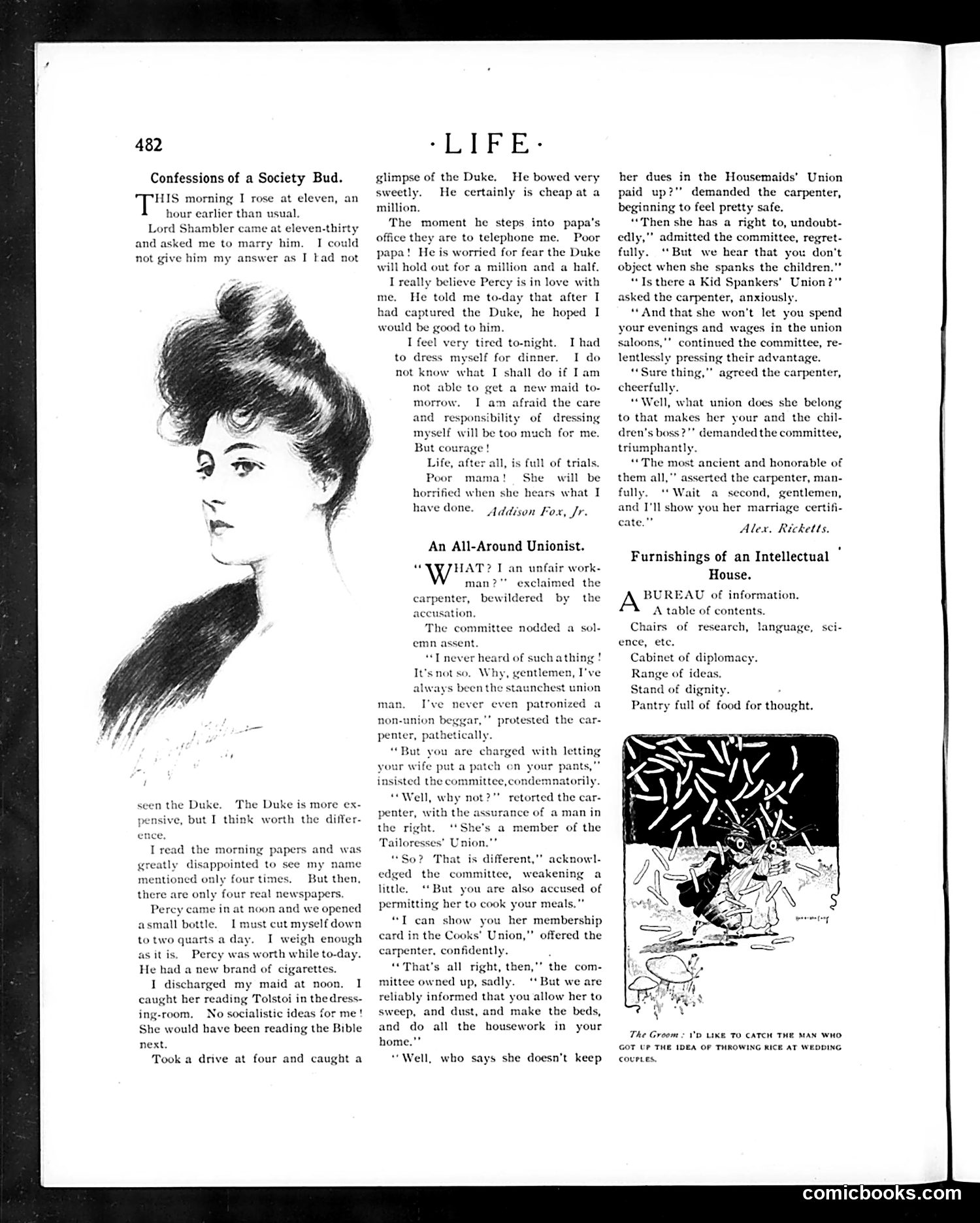
This page satirizes early 20th-century labor organizing and women's roles. A society woman confesses her maid has joined the "Housemaids' Union," demanding better wages and conditions. The "All-Around Unionist" section mocks a carpenter accused of being an unfair workman because his wife does domestic labor. He defends himself through various union memberships—asserting unions represent ALL workers, even those doing traditional "women's work." The bottom cartoon depicts someone reluctant to adopt the "idea of throwing rice at wedding couples," suggesting resistance to emerging labor protections or new social practices. The satire targets unions as absurdly expanding into every aspect of life, while also mocking bourgeois anxiety about workers' organizing and women's economic independence.
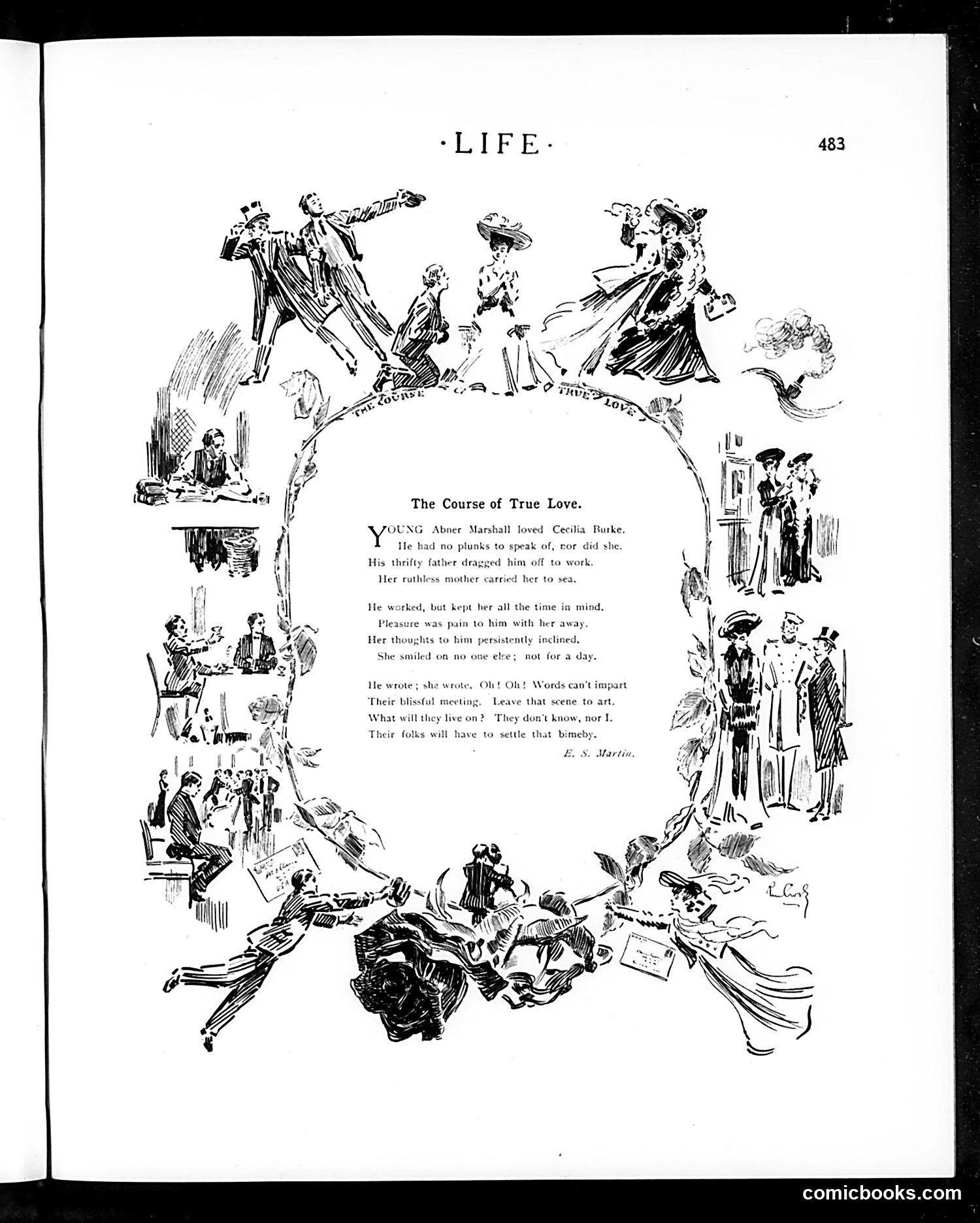
This page presents a satirical poem by E.S. Martin about young Abner Marshall's courtship of Cecilia Burke. The narrative follows their romance through various life stages, depicted in the border illustrations. The satire mocks romantic idealism: despite Abner's deep feelings and devoted letter-writing, the poem cynically concludes that their families—not the couple themselves—will ultimately decide whether they marry ("Their folks will have to settle that timely"). The surrounding vignettes illustrate scenes of courtship, family involvement, and social convention. The joke targets Victorian-era romance narratives that emphasize passionate love while ignoring practical realities: parental authority, economic considerations, and social expectations actually determined marriage outcomes, not genuine affection.
This appears to be a title page or section divider from *Life* magazine, showing only the word "LIFE" printed vertically on the left side of the page. The right side contains a dark, heavily shadowed photograph that is difficult to discern clearly—it shows what appears to be an interior scene with some mechanical or industrial elements visible, and possibly a human figure, but the image quality and contrast make specific identification impossible. Without legible text accompanying this image or clearer visual details, I cannot reliably identify what cartoon, satire, or social commentary this page was intended to convey. The context needed to explain its meaning to modern readers is not sufficiently visible here.
I cannot provide a meaningful analysis of this page. The image itself is almost entirely black or illegible—the main content area shows no discernible cartoon, illustration, or readable text. Only the page margins and what appear to be binding elements are visible. The OCR text provided is garbled characters that don't form readable words, suggesting the scanning or OCR process failed. To properly identify the figures, political references, and satirical intent as you've requested, I would need a legible image where the actual cartoon content and caption text are clearly visible. I cannot responsibly invent or guess at details not actually present in the source material.
This page contains theater criticism and a letter to the editor debating British vs. American wit. **Main Content:** The page critiques "A Venetian Romance," a new comic opera with music by Frederic Coit Wright. The reviewer praises its staging and costumes but faults its weak plot, unfunny dialogue, and undistinguished orchestration—arguing the composer, like others, lacks originality. The critic notes that spending money on improving the libretto (script) would have helped considerably. **The Letter:** A correspondent challenges Life's recent suggestion that English authors can be funny. He defends British theatrical talent, citing current New York hits like "A Country Girl," "A Chinese Honeymoon," and "The Night of the Party"—all English productions running successfully. He argues American audiences unfairly dismiss British wit while eagerly consuming British entertainment. **Context for Modern Readers:** This reflects early 1900s theatrical rivalries between American and British playwrights, plus American ambivalence about British culture—simultaneously dismissing and embracing it.
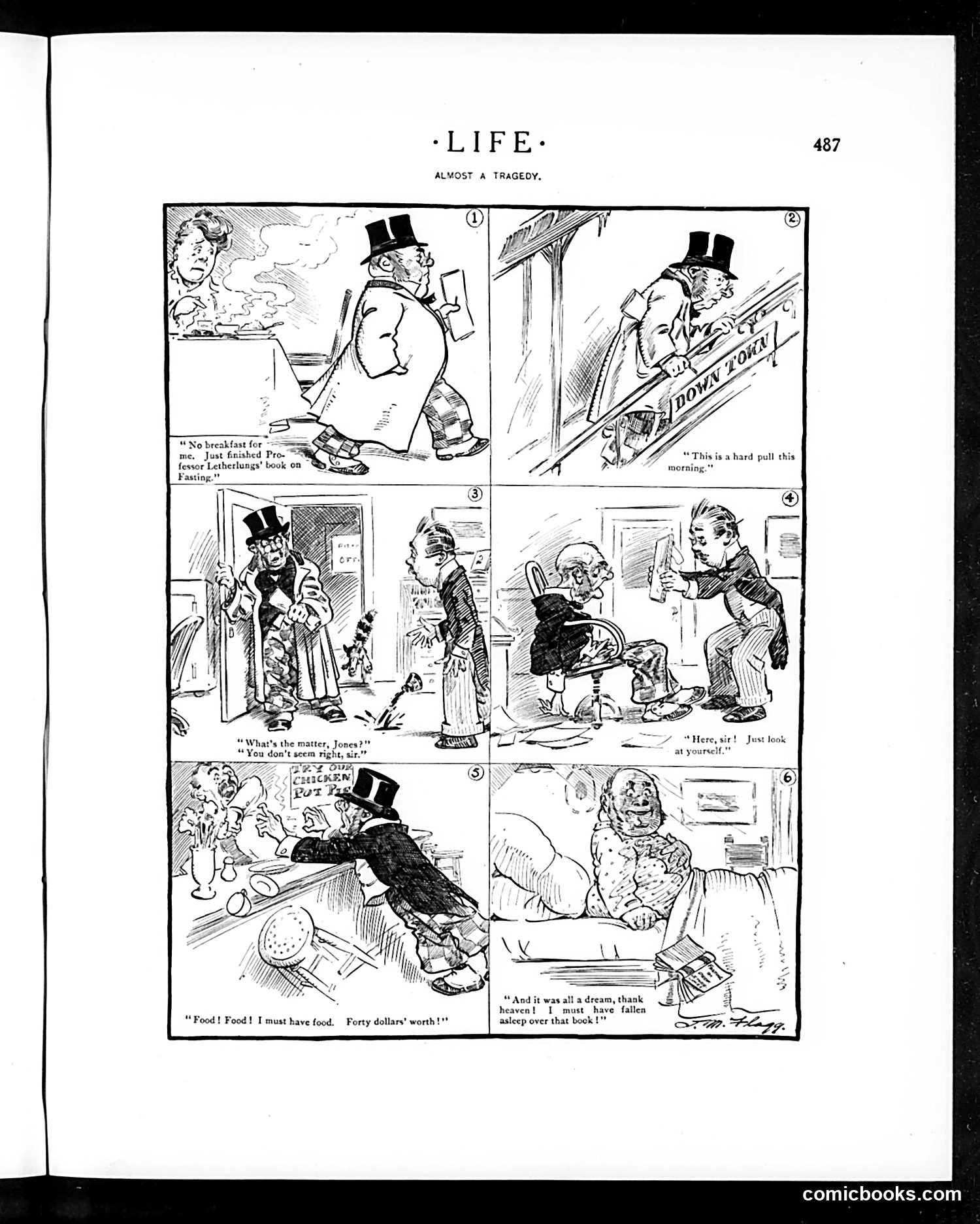
This six-panel comic depicts a gentleman's misfortune as social satire. The well-dressed man in a top hat experiences a series of humiliations: skipping breakfast, struggling on public transit, losing his composure indoors, and desperately seeking food while apparently broke or destitute. The final panel reveals it was all a dream—he falls asleep over a book, suggesting this cautionary tale warns of potential financial ruin. The satire appears to target class anxiety: even a formally-dressed, educated man can face rapid descent into poverty and desperation. The exaggerated dialogue ("Forty dollars' worth!") emphasizes both hunger and financial despair, likely resonating with early 20th-century readers concerned about economic instability and social standing.
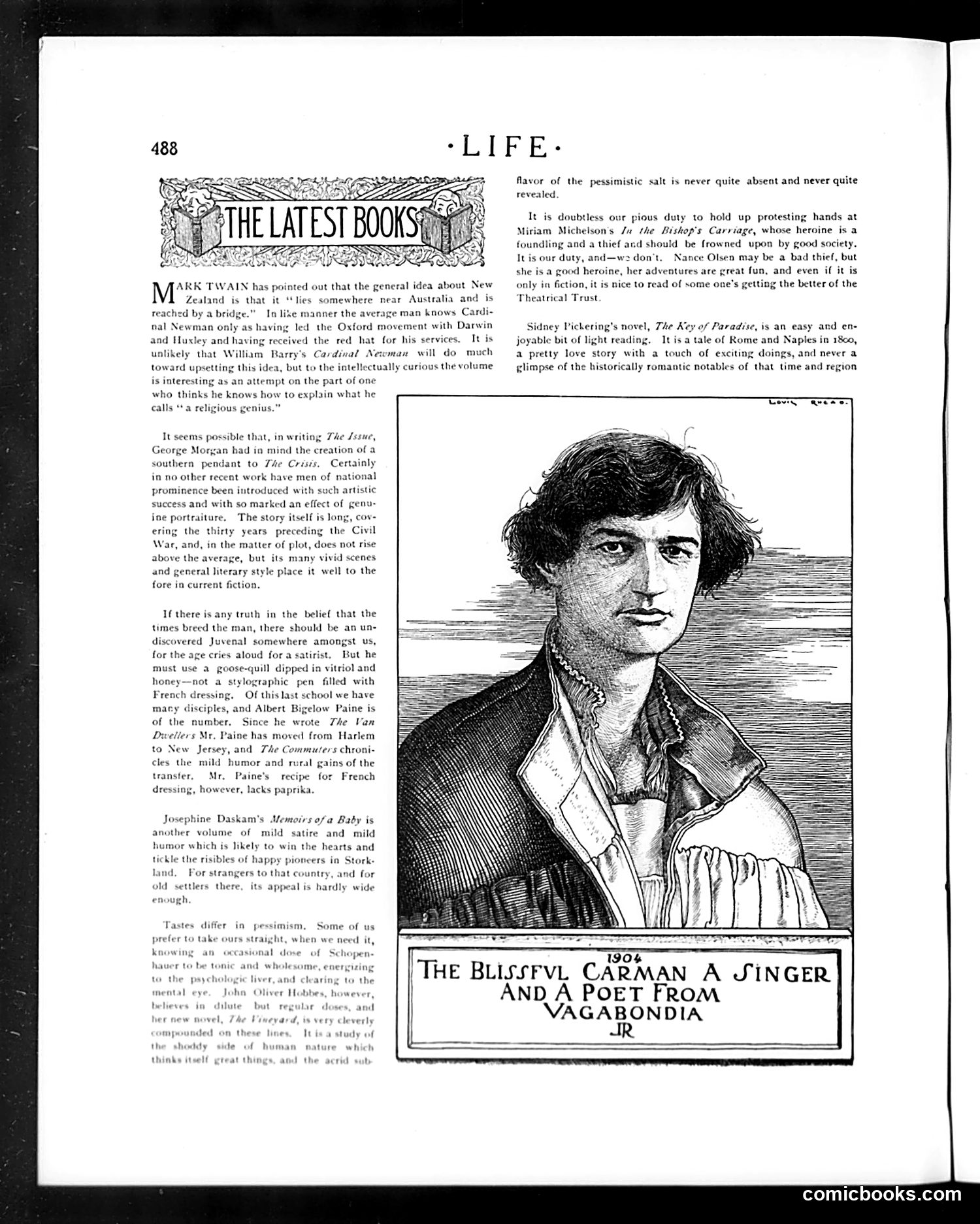
This page is a book review section from *Life* magazine. The illustration and caption refer to **Bliss Carman**, a Canadian poet and writer popular in the early 1900s. The portrait shows a young man in period dress. The caption's romantic language—"blissful," "singer," "poet from Vagabondia"—appears to gently satirize Carman's literary reputation and bohemian associations. "Vagabondia" was a real poetry collection by Carman and Richard Hovey (1894) celebrating wandering, nature, and artistic freedom. The surrounding text discusses contemporary novels with mild, satirical tones. The page criticizes overly sentimental or simplistic satire, preferring wit with substance—suggesting *Life*'s reviewers valued sharp social commentary over superficial mockery. Without seeing the full review of Carman's work, the exact satirical point remains unclear, but the romantic framing likely mocks either Carman's poetic pretensions or the era's idealization of the bohemian artist.
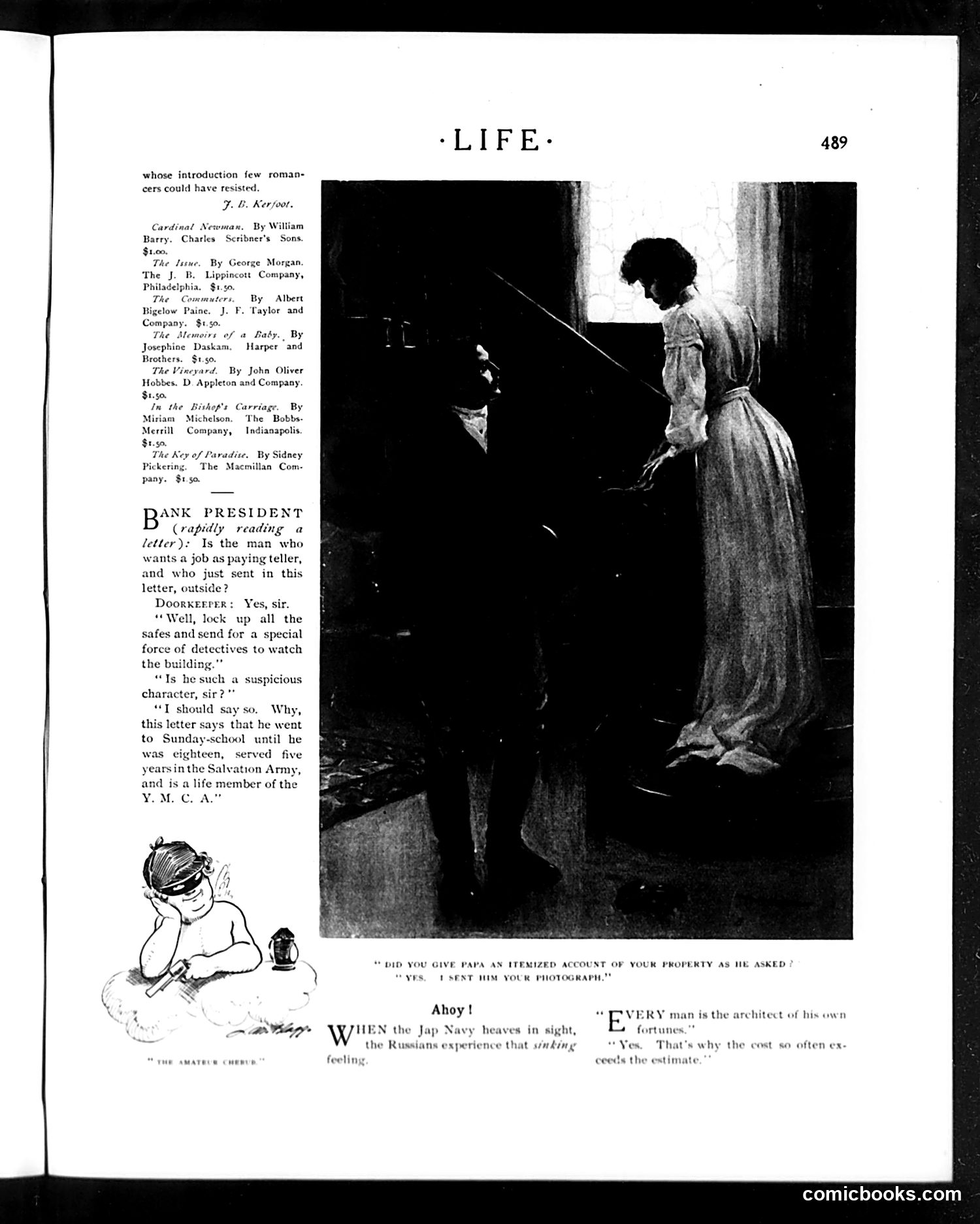
This page contains two separate satirical pieces from *Life* magazine: **"Bank President" comic**: A bank president reads a job application from someone seeking a teller position. The applicant's letter mentions attending Sunday school until age eighteen and serving five years in the Salvation Army—credentials suggesting moral character and trustworthiness. The absurd humor: the president responds by locking all safes and calling detectives, treating these *virtuous* qualifications as deeply suspicious. The satire mocks cynical business culture that distrusts morality, suggesting banks assume anyone too good-hearted must be hiding something criminal. **"Ahoy!" and "Every Man" aphorisms**: Brief witty observations—one about the Japanese Navy causing Russians to feel a "sinking feeling" (a pun), another about how people architect their own fortunes, explaining why estimates get exceeded. These appear to be standalone humor/wisdom snippets typical of *Life's* format. The photograph caption shows a domestic scene, likely illustrating another comedic vignette about property and marriage.
This page contains theater criticism and reader correspondence about American musical theater circa 1904. **The cartoons:** Two small illustrated decorative headers accompany articles—one labeled "DRAMA" showing theatrical imagery, another for "With the Flavor of Venice" featuring a Venetian mask, both typical period ornaments. **The content's satire:** The main criticism targets "A Venetian Romance," a musical comedy. The reviewer mocks its lavish but empty production—expensive costumes and sets cannot compensate for a weak plot and unfunny script. This satirizes the era's tendency to prioritize spectacle over substance. **The letters section** defends English theatrical talent against American prejudice. A correspondent challenges *Life*'s suggestion that English wit is inherently contradictory, citing successful British productions currently running in New York. This reflects period cultural tension between American and British entertainment industries. **For modern readers:** This captures turn-of-century Broadway's familiar problem—expensive productions failing due to poor writing.
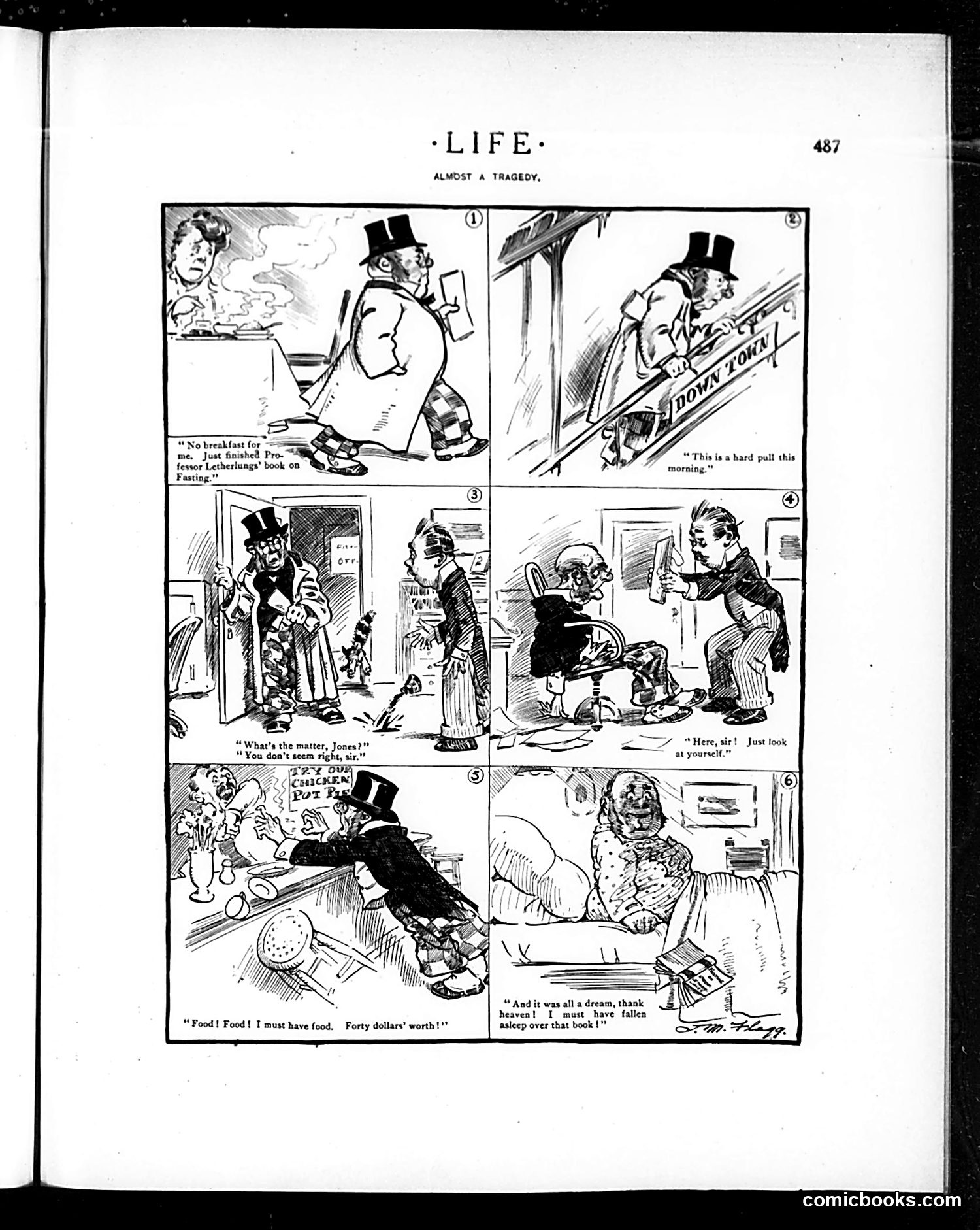
This six-panel comic strip depicts a gentleman's morning struggle. Panel 1 shows him reading a book on "Fasting." He announces he's finished a "Professor Lethering" text on fasting. By panel 2, climbing stairs, he's already weakening ("hard pull this morning"). Panels 3-5 show his deteriorating condition—he asks if he's "right," appears disheveled, and desperately declares "Food! Food! I must have food. Forty dollars' worth!" Panel 6 reveals the punchline: he's fallen asleep over the fasting book and dreamed the entire ordeal. **The satire**: This mocks health fad literature and self-help books popular in the early 20th century. The joke is that merely *reading about* fasting causes immediate psychological collapse—the gentleman cannot even intellectually commit to the idea without his body rebelling. It satirizes both trendy wellness movements and human weakness regarding dietary discipline.
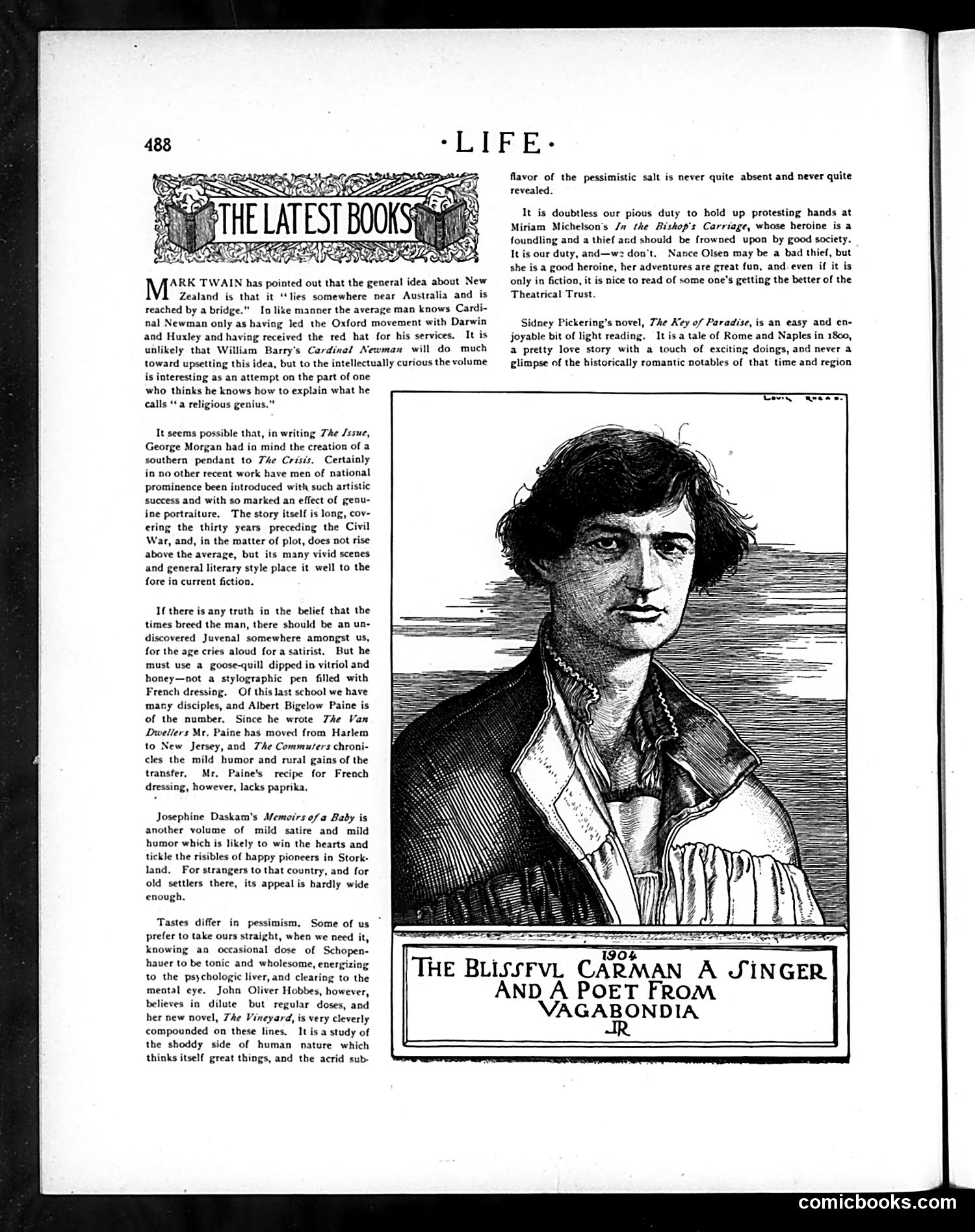
This is a **book review section**, not a political cartoon. The page features reviews of contemporary novels by authors like Mark Twain, George Morgan, and others, discussing their literary merit and social themes. The **portrait illustration** shows a man identified in the caption below as "a singer and a poet from Vagabondia"—likely **Bliss Carman**, a Canadian poet popular in the early 1900s. The portrait style is typical of Life's artistic illustrations of literary figures. The reviews themselves are **satirical commentary** on American literary taste: the critic mocks popular misconceptions (comparing ignorance of New Zealand to ignorance of Cardinal Newman), calls for sharper satire in literature ("goose-quill dipped in vitriol and honey"), and offers wry observations on contemporary authors' work. The page exemplifies Life's role as a **cultural arbiter**, mixing literary criticism with gentle mockery of both authors and readers' preferences.
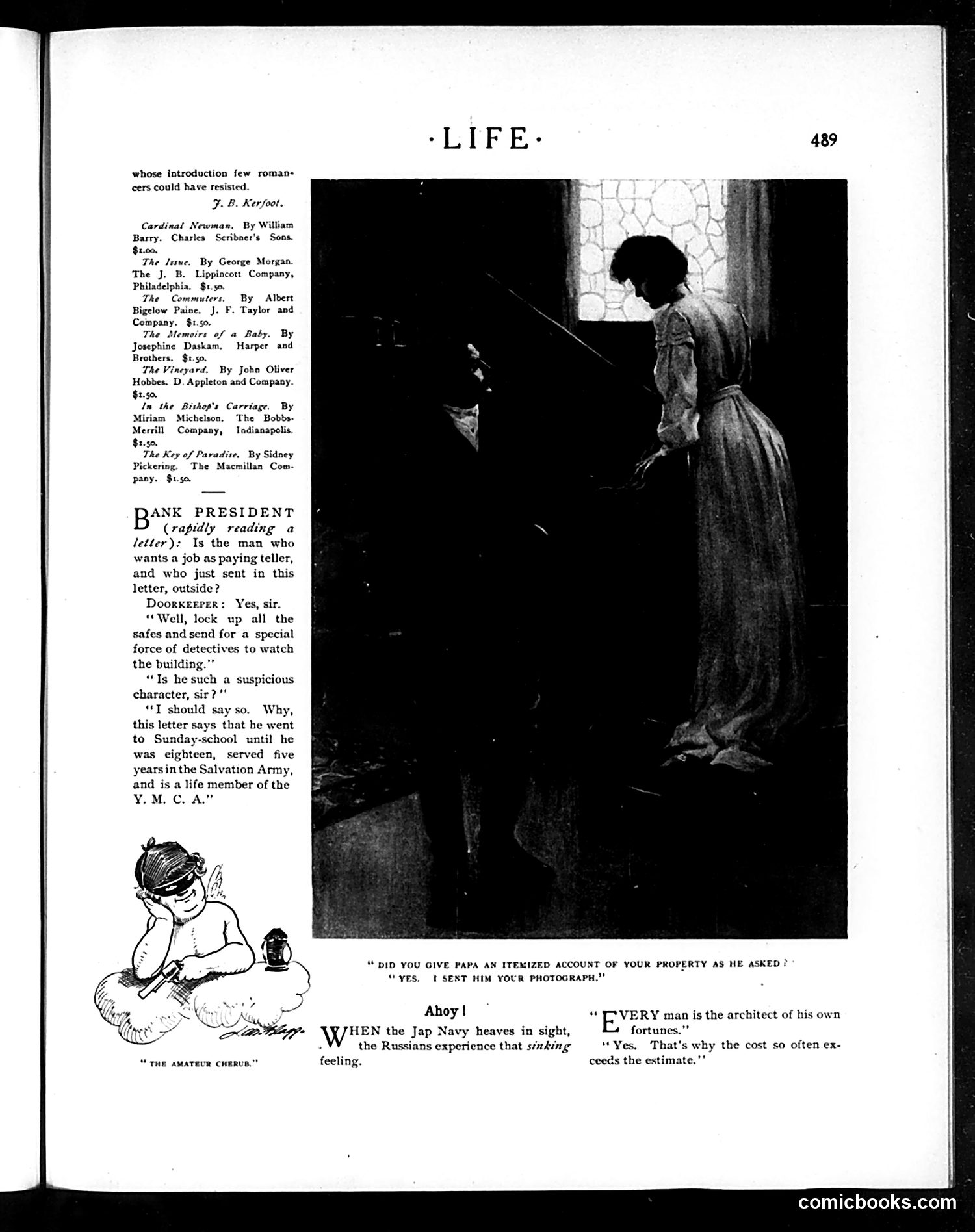
This page contains book advertisements and two satirical jokes typical of early 1900s Life magazine humor. The main cartoon shows a **bank president** suspicious of a job applicant whose credentials—Sunday school attendance, five years in the Salvation Army, Y.M.C.A. membership—are *too virtuous*. The satire mocks how exaggerated moral respectability can seem suspicious, inverting expectations: excessive piety becomes a red flag rather than reassurance. It's commentary on hypocrisy and distrust of the overly "good." Below is a smaller dialogue cartoon about a woman who, when asked for an itemized property account by her father, sends him her photograph instead—implying she considers herself her father's most valuable asset (or sardonically, that a woman's worth reduces to appearance). A third caption references the "Jap Navy" and Russian naval conflict, likely alluding to the **Russo-Japanese War (1904-1905)**, with "that sinking feeling" as grim wordplay about naval warfare. The page is primarily book reviews with these interspersed satirical vignettes.
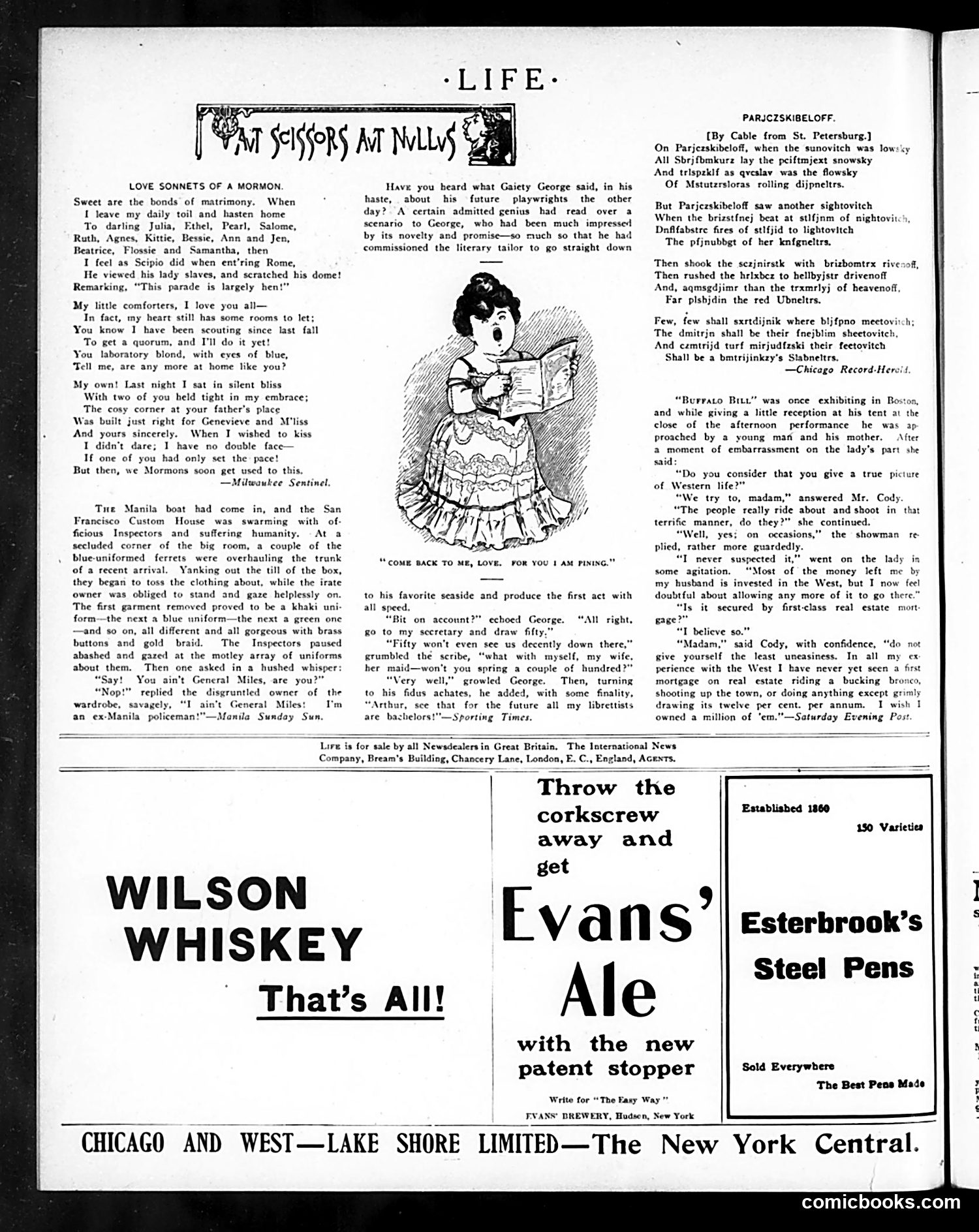
This page contains three satirical pieces: **"Love Sonnets of a Mormon"** mocks Mormon polygamy, presenting a man listing his many wives (Julia, Ethel, Pearl, Salome, Ruth, Agnes, etc.) in deliberately comic fashion. The joke relies on 1890s-era anti-Mormon sentiment, portraying polygamy as absurd. The poem's romantic language clashes humorously with its subject matter. **"The Manila Policeman"** satirizes American imperial overreach in the Philippines (recently acquired after the Spanish-American War). An inspector mistakes a trunk full of colorful military uniforms for evidence that the owner is General Miles, humorously suggesting that American officials in the Philippines accumulated ridiculously excessive official regalia. **"Parjczskibeloff"** is nonsense verse parodying Russian literature's exotic-sounding names and allegedly impenetrable style. It's gibberish designed to mock American literary pretension about Russian works. The advertisements are period products (whiskey, ale, steel pens). The page represents *Life* magazine's typical mix of satirical commentary on contemporary politics and social issues alongside humor and advertising.
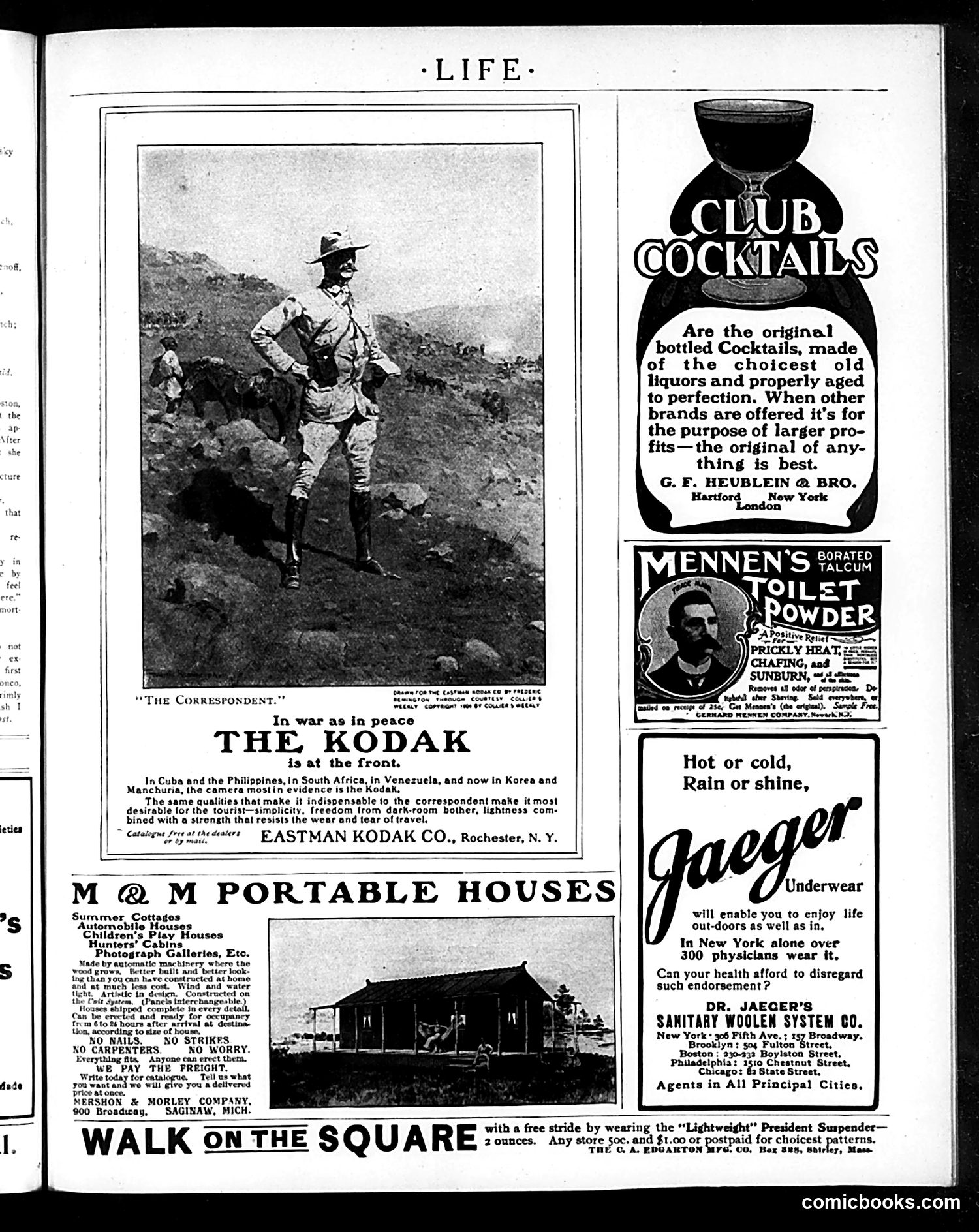
This is primarily an **advertising page** from an early 1900s Life magazine, not a satirical cartoon. The page features a photograph labeled "The Correspondent" showing a war correspondent in field dress, used to advertise Kodak cameras. The central message: **Kodak cameras are reliable tools for journalists covering wars** (Cuba, Philippines, South Africa, Venezuela, Korea, Manchuria are mentioned). The advertisement argues that the camera's simplicity, durability, and portability make it essential for correspondents—and therefore desirable for tourists. The page is surrounded by period product advertisements: Club Cocktails, Mennen's Talcum Powder, Jaeger Underwear, portable houses, and suspenders. These represent typical early 1900s consumer goods marketed to middle/upper-class readers. **Historical context**: This reflects the era when photography was becoming militarized and commercialized, with Kodak positioning cameras as instruments of modern warfare and documentation.
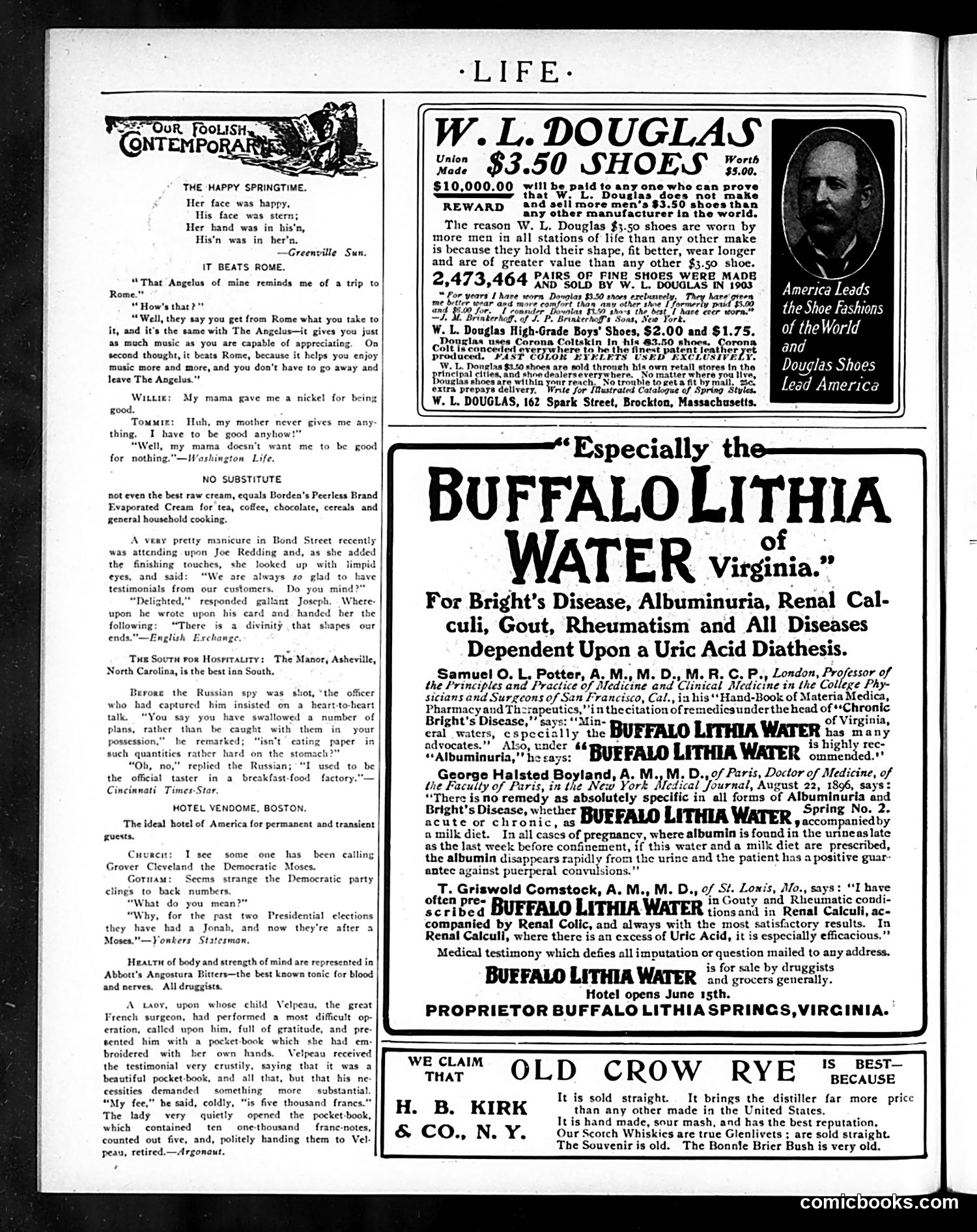
This page contains primarily **short humorous anecdotes and advertisements** rather than political cartoons. The text pieces are brief satirical jokes typical of early 1900s Life magazine: - **"The Happy Springtime"** and **"It Beats Rome"** are gentle romantic/cultural humor - **Dialogue snippets** mock pretension (a manicurist fishing for compliments; Democrats compared to "Jonah" and "Moses") - **Anecdotes** include a Russian spy story and a French surgeon demanding proper payment The dominant content is **advertising**: W.L. Douglas shoes (claiming 2,473,464 pairs sold in 1903), Buffalo Lithia Water (marketed for kidney/gout ailments—common patent medicine claims of the era), and Old Crow Rye whiskey. The Buffalo Lithia ad features medical testimonials, a period marketing practice now recognized as dubious. The whiskey ad emphasizes Scottish authenticity and age. **Context for modern readers**: This reflects pre-FDA era when medicinal water and whiskey were advertised with unproven health claims.
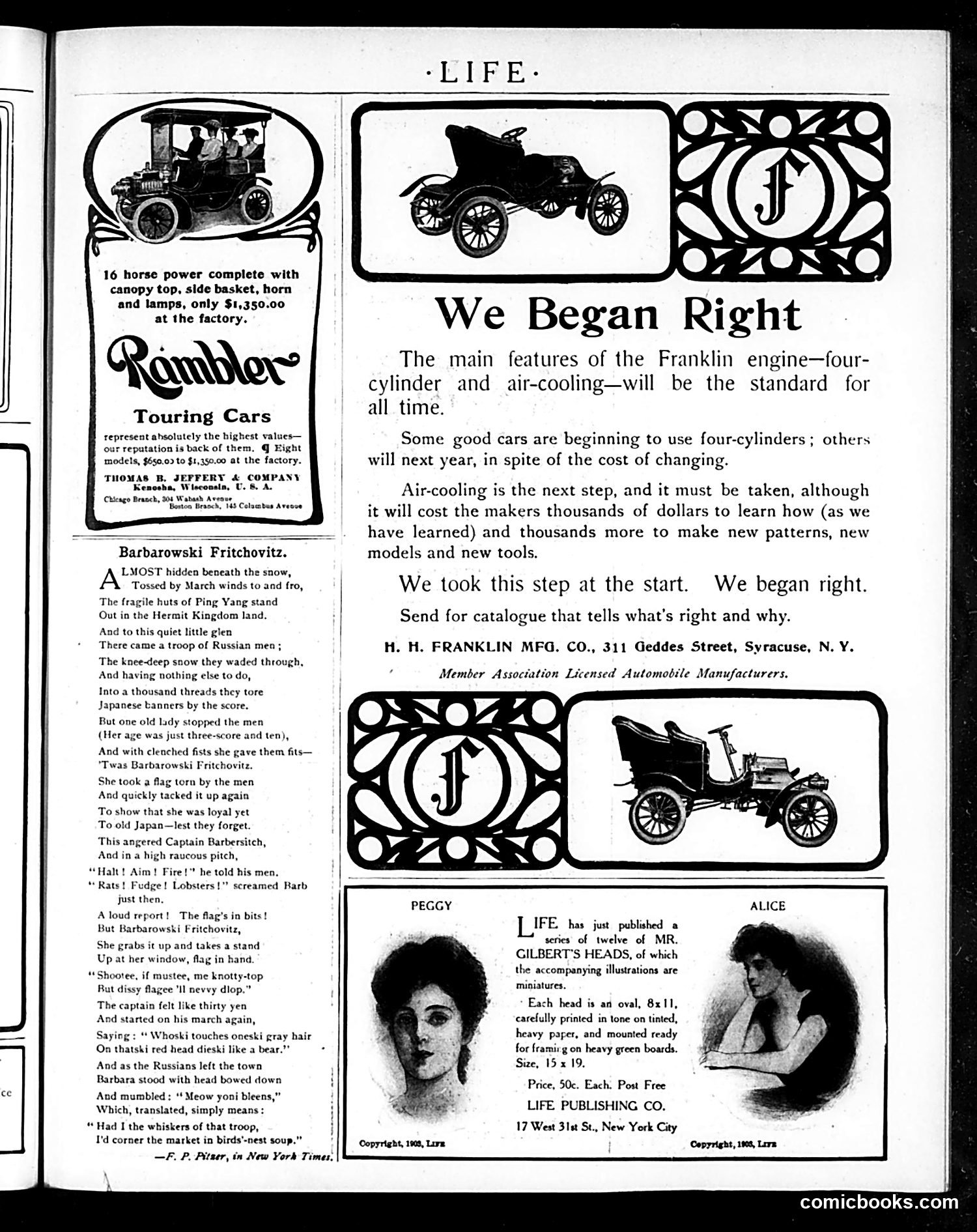
This page is primarily **advertising** (Rambler and Franklin automobiles), but includes a lengthy comic poem mocking **Russo-Japanese tensions and ethnic stereotypes**. The poem satirizes Russian soldiers in Manchuria (during the Russo-Japanese War era) through the figure of an elderly Chinese woman, "Barbarowski Fritchovitz," who defends a Japanese flag. The satire works through **exaggerated mock-Russian gibberish** ("Shootee," "dieski," "oneski") and absurdist humor—a Russian captain becomes so embarrassed by an old woman's defiance that he compares his shame to losing Japanese currency. The joke relies on period **ethnic caricature and malapropism**, portraying Russians as comically inept and dramatic, while the woman's final musing about cornering the "birds'-nest soup" market is nonsensical wordplay typical of early 1900s humor. The poem's appeal lay in mocking foreign conflict through exaggerated dialect and absurdity—humor that would perplex modern readers unfamiliar with early-20th-century attitudes toward both the Russo-Japanese conflict and theatrical ethnic stereotyping.
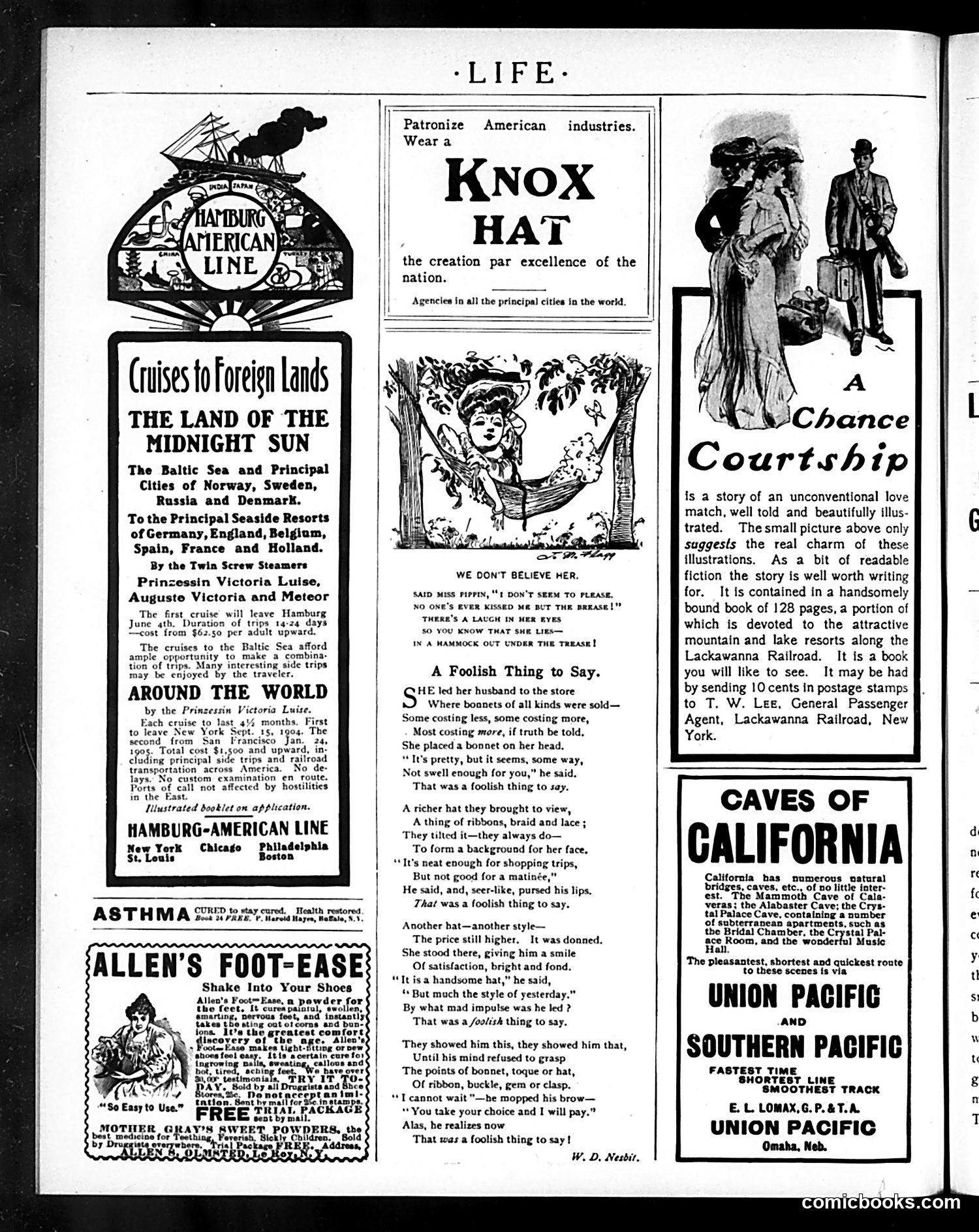
This page is primarily **advertisements and light humor**, typical of early 1900s Life magazine. The main satirical content is "A Foolish Thing to Say"—a poem mocking a husband's misguided attempts to dissuade his wife from buying an expensive hat. The joke: his repeated criticisms ("Not swell enough," "not good for a matinee") paradoxically encourage her spending. The final line suggests his compliment backfires when she demands an even more expensive version. The satire targets male cluelessness in marriage and women's shopping power. The accompanying illustration captioned "WE DON'T BELIEVE HER" shows Miss Pippin claiming no one has kissed her except "the breeze"—a humorous denial of her romantic history, illustrated by her laughing eyes that "betray" the lie. The remaining content consists of period travel ads (Hamburg-American Line cruises, Lackawanna Railroad), product advertisements (Knox Hats, Allen's Foot-Ease powder, asthma cure), and a book promotion for "*A Chance Courtship*." No political satire or caricature is present on this page.
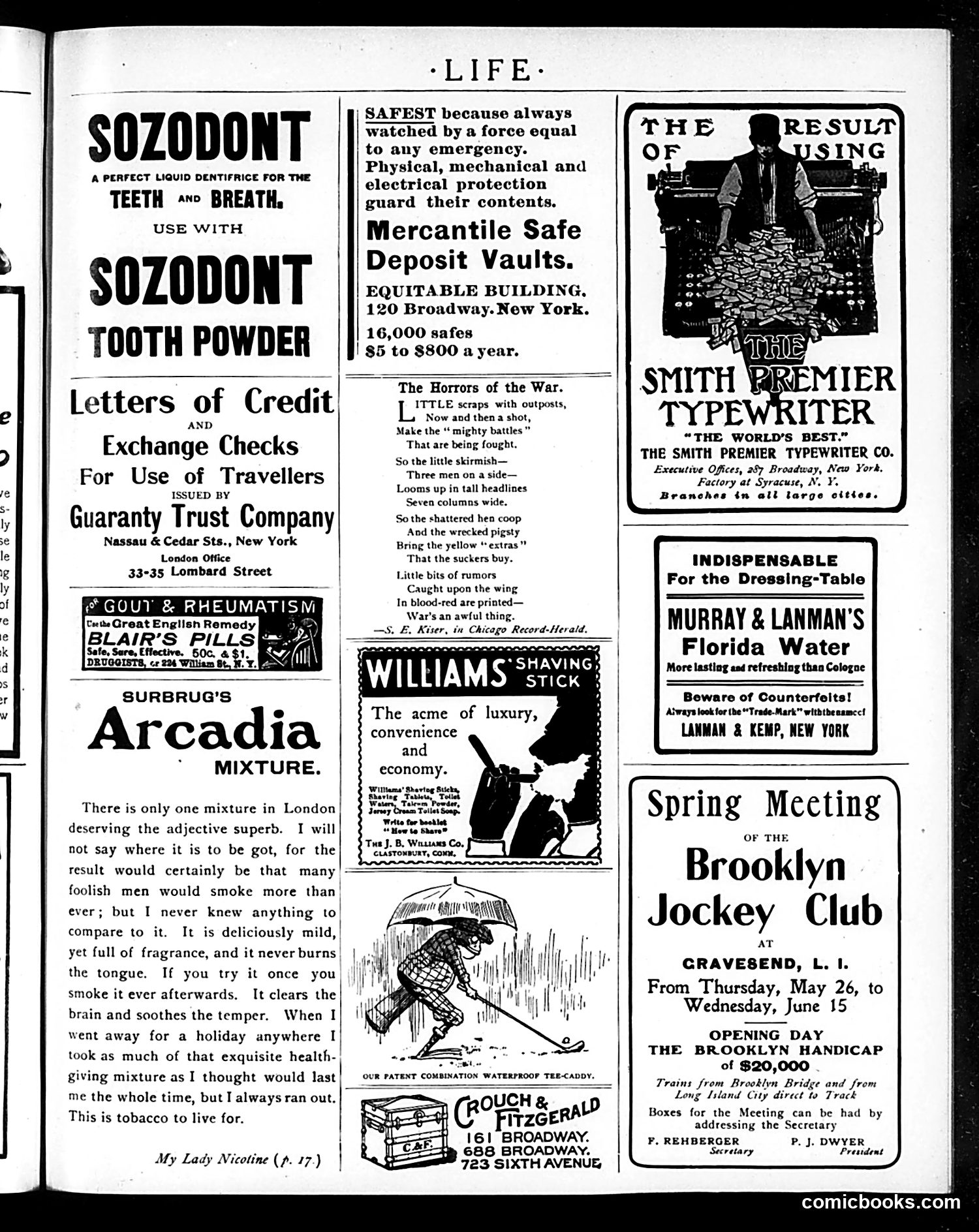
This page is primarily **advertising** with one notable poem. The main content of interest is "The Horrors of the War" by S. E. Kiser, a satirical poem mocking sensationalist war reporting during what appears to be the **early 1900s** (likely the Boer War or similar conflict). **The Satire:** Kiser ridicules how newspapers exaggerate minor military skirmishes into dramatic headlines. Small engagements between "three men on a side" are blown up to fill "seven columns wide" in bold yellow "extras" designed to sell papers to gullible readers ("suckers"). Trivial incidents—a damaged hen coop, a destroyed pigsty, vague rumors—are presented as major war news printed in sensational red ink. **The Point:** The poem critiques both media manipulation and public appetite for war sensationalism, suggesting newspapers profit by manufacturing drama from mundane military reality. The rest of the page consists of period advertisements (Sozodont toothpaste, typewriters, Florida Water, etc.) and an announcement for the Brooklyn Jockey Club spring racing meet.
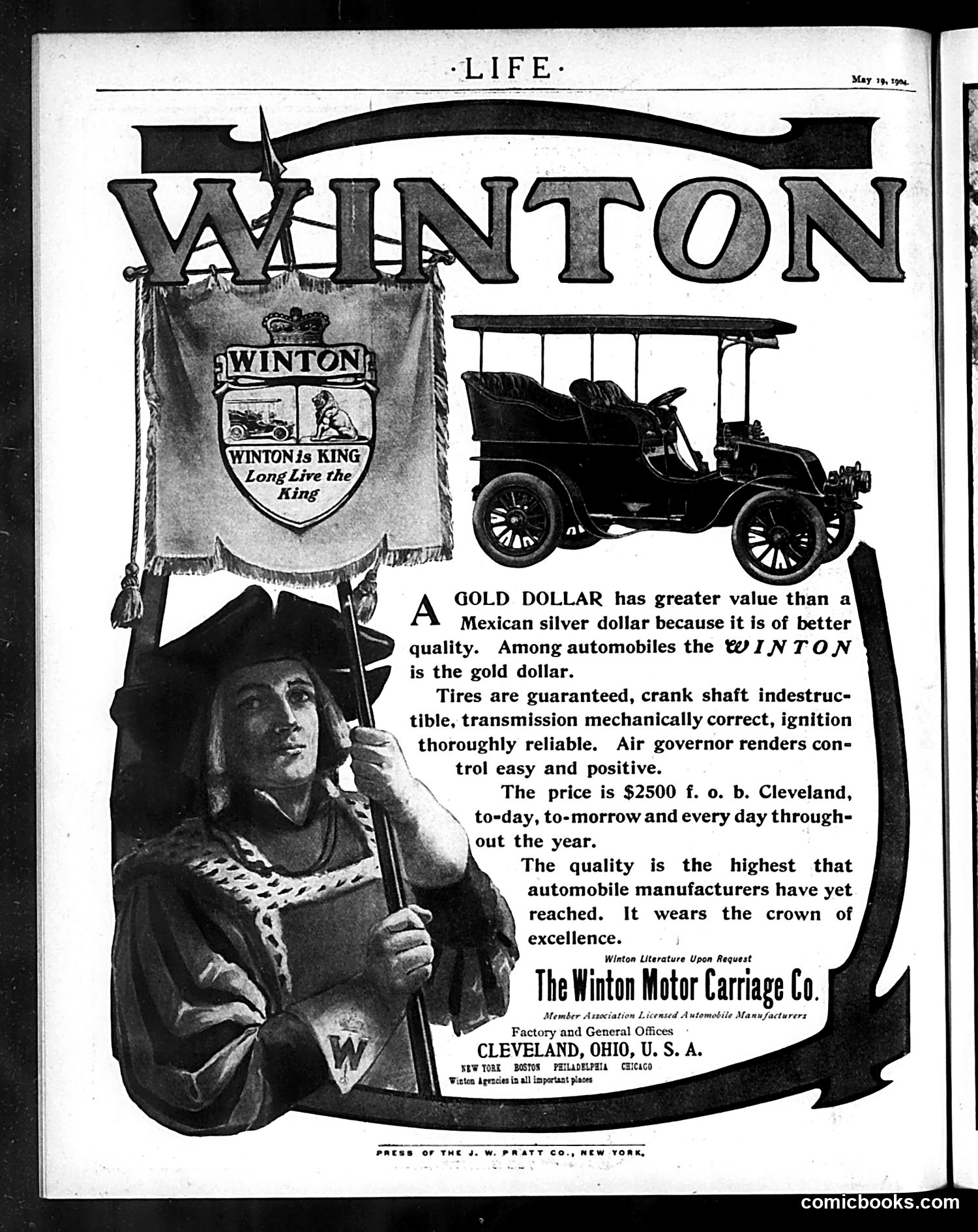
This is primarily an advertisement for the Winton Motor Carriage Company, not political satire. The page uses a patriotic "king" figure holding a banner to market the automobile as America's superior product—comparing it metaphorically to a "gold dollar" versus inferior "Mexican silver dollar," emphasizing quality and reliability. The imagery invokes American nationalism and economic superiority through the crowned figure and royal banner bearing "WINTON is KING." The ad promises consistent pricing ($2500), reliability features (guaranteed tires, mechanical correctness), and claims the highest manufacturing quality available. This reflects early 1900s advertising strategy: positioning American industrial products as inherently superior to foreign competition. For modern readers, the explicit Mexican comparison—treated as obviously inferior—reveals period attitudes about American exceptionalism and reflects the economic anxieties of industrial competition at that time.