
Life, 1904-05-19 · page 16 of 28
Life — May 19, 1904 — page 16: what you’re looking at
What you’re looking at
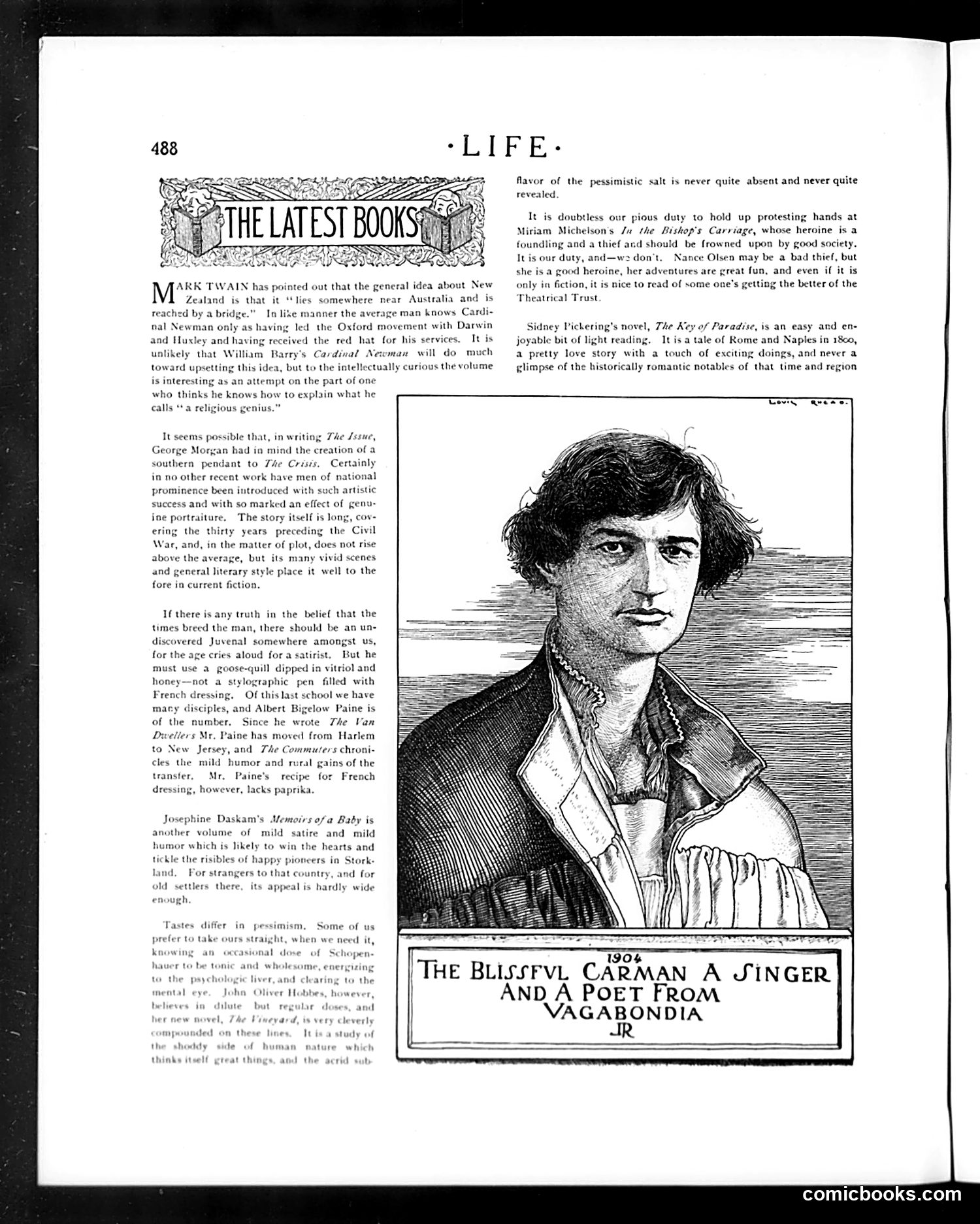
This page is a book review section from *Life* magazine. The illustration and caption refer to **Bliss Carman**, a Canadian poet and writer popular in the early 1900s. The portrait shows a young man in period dress. The caption's romantic language—"blissful," "singer," "poet from Vagabondia"—appears to gently satirize Carman's literary reputation and bohemian associations. "Vagabondia" was a real poetry collection by Carman and Richard Hovey (1894) celebrating wandering, nature, and artistic freedom. The surrounding text discusses contemporary novels with mild, satirical tones. The page criticizes overly sentimental or simplistic satire, preferring wit with substance—suggesting *Life*'s reviewers valued sharp social commentary over superficial mockery. Without seeing the full review of Carman's work, the exact satirical point remains unclear, but the romantic framing likely mocks either Carman's poetic pretensions or the era's idealization of the bohemian artist.
📄 Transcribed text from this page (OCR, searchable)
Machine-transcribed from the original scan — historical spelling and the odd misread are preserved.
*LIFE: flavor of the pessimistic salt is never quite absent and never quite revealed It is doubtless our pious duty to hold up protesting hands at Miriam Michelson’s /u the Bishop's Carriage, whose heroine is a foundling and a thief and should be frowned upon by good society. It is our duty, and—we2 don't. Nance Olsen may be a bad thief, but she is a good heroine, her adventures are great fun, and even if it i ARK TAVAIN has poi ene: New only in fiction, it is nice to read of some one’s getting the better of the Zealand is that it “lies somewhere near Australia and is Theatrical Trust reached by a bridge.” In like manner the average man knows Cardi~ nal Newman only as having led the Oxford movement with Darwin Sidney Vickering’s novel, The Key of Paradise, is an easy and en- and Huxley and having received the red hat for his services. It is joyable bit of light reading. It is a tale of Rome and Naples in 1800, unlikely that William Barry's Cardinal Newman will do much — q pretty love story with a touch of exciting doings, and never a toward upsetting this idea, but to the cetually curious the volume glimpse of the historically romantic notables of that time and region is interesting as an attempt on the part of o1 who thinks he knows how to explain what he calls “+a religious genius.” It seems possible that, in writing The Jssue, George Morgan had in mind the creation of a southern pendant to The Crisis. Certainly in no other recent work have men of national prominence been introduced with such artistic success and with so marked an effect of gen ine portraiture. The story itself is long, cov ering the thirty years preceding the Civil War, and, in the matter of plot, does not rise above the average, but its many vivid scenes and general literary style place it well to the fore in current fiction. If there is any truth in the belief that the times breed the man, there should be an un- discovered Juvenal somewhere amongst us, for the age cries aloud fora satirist. But he must use a goose-quill dipped in vitriol and honey—not a stylographic pen filled with French dressing. Of this last school we have macy disciples, and Albert Bigelow Paine is of the number. Since he wrote Zhe Van Dwellers Mr. Paine has moved from Harlem to New Jersey, and The Commuters chroni- cles the mild humor and rural gains of the transfer. Mr. Paine’s recipe for French however, lacks paprika. Josephine Daskam’s Memoirs ofa Baby is another volume of mild satire and mild humor which is likely to win the hearts and tickle the risibles of happy pioneers in Stork- land, For strangers to that country, for old settlers. there, ypeal is hardly wide oowldg’ aa, goclocal docs of Sehoren’ —- — tovertote voc ona vioinoneererins | |THE BLISSFVL CARMAN A SINGER anental « AND A POET FROM mut ‘regular doses, and} | VAGABONDIA 1 AR Oliver Hobbes, however, vard, is very cleverly tudy of comicbooks.com