
Life, 1904-05-19 · page 6 of 28
Life — May 19, 1904 — page 6: what you’re looking at
What you’re looking at
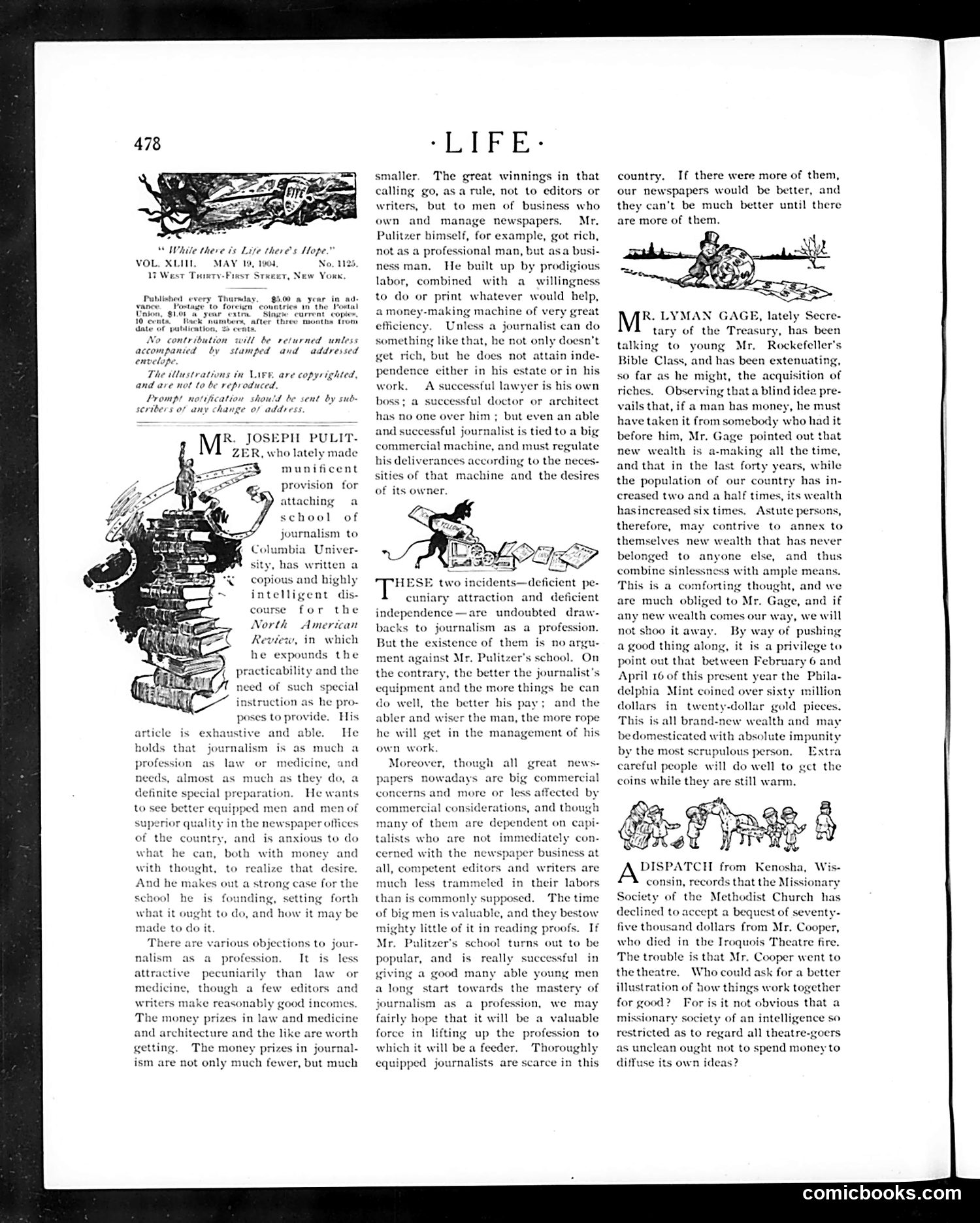
This page discusses journalism education, specifically praising Joseph Pulitzer's new school of journalism at Columbia University. The text argues journalism deserves professional training like law or medicine, noting that successful newspapers require skilled editors and writers—not just businessmen. The left illustration shows a printing press stacked with books, symbolizing how journalism education combines practical and theoretical knowledge. The satirical point appears subtle: while endorsing Pulitzer's initiative, the author acknowledges journalism has historically attracted fewer talented people than other professions, and that newspapers are often run by commercial interests rather than editorial expertise. The right section discusses wealth accumulation, using Mr. Lyman Gage as an example of how new fortunes are being made in America.
📄 Transcribed text from this page (OCR, searchable)
Machine-transcribed from the original scan — historical spelling and the odd misread are preserved.
“ While there is L VOL. XLII, MAY 9 17 West Triety-Fiest fe there's Hope.” No. 1125, New York. Thurslay. to foreign will be returned unte: amped and addressed No contribution accompanied by envelope. The illustrations in LAPk, are copyrighted, and are not to be reproduced. Prompt notification shoutd be sent by sub- scribers of any change of address R. JOSEPH PULIT- ZER, who lately made munificent provision for attaching school of journalism to Columbia Unive: written a copious and highly intelligent dis- course for the North American Review, in which he expounds the practicability and the need of such special struction as he pro- poses to provide, His rticle is exh and able. He holds that profession as law or tive journalism is as much a medicine, and needs, almost as much as they do, a definite special preparation. He wants to see bet! superior qu er equ lity in the newspaper offices sped men and men of of the country, and is anxious to do what he ca both with money and h thought, to realize that desire. And he makes out a strong case f school he is founding, setting what it ong nd how it may be made to do it. There are various objections to jour- ht to do, ism as a less. attractive profession. It is pecuniarily than medicine, though writers make reasonably good incomes. The money prizes in law and medicine and architecture and the like are worth getting. The money prizes in journal- ism are not only much fewer, but much law or few editors and ~LIFE- smaller. The great winnings in that calling go, asa rule, not to editors or but to men of business who manage newspapers. Mr. Pulitzer himself, for example, got rich, a professional man, but asa bu: ness man. He built up by prodigious labor, combined with a to do or print whatever would help, -making machine of very great iency. Unless a journalist can do something like that, he not only doesn’t writers, own and nota willingness amon get rich, but he does not attain inde- pendence cither in his estate or in his work. A successful lawyer is his own architect has no one over him ; but even an able and successful journalist is tied to a big commercial machine, and must regulate boss; a successful doctor or his deliverances according to the ne sities of that machine and the desires of its owner, two incidents—deficient pe- attraction and deficient independence —are undoubted draw- backs to journalism as a_ profession, But the existence of them is no argu- ment against Mr. Pulitzer’s school, On the contrary, the better the journalist's equipment and the more things he can Jo well, the better his pay; and the abler and wiser the man, the more rope he will get in the management of his own work, Moreover, though all great news: papers nowadays are big commercial concerns and more or less affected by commercial considerations, and thou; many of them are dependent on capi- talists who are not cerned with the newspaper business at all, competent editors and writers are much less trammeled in their labors than is commonly supposed. The time nd they bestow mighty little of it in reading proofs. If Mr. Pulitzer's school turns out to be popular, and is really successful: in immediately con- of big men is valuable, giving a good many able young men a long start towards the mastery of journalism as a profession, we 1 airly hope that it will be a valuable force in lifting up the profession to which it will be a feeder, Thoroughly equipped journalists are scarce in this country. If there were more of them, our newspapers would be better, and they can’t be much better until there are more of them. R. LYMAN GAGE, lately Secre- tary of the Treasury, has been talking to young Mr. Rockefeller's Bible Class, and has been extenuating, so far as he might, the acquisition of riches. Observing thata blind idea pre- vails that, if a man has money, he must have taken it from somebody who had it before him, Mr. Gage pointed out that new wealth is a-making all the time, and that in the last forty years, while the population of our country has in- creased two and a half times, its wealth hasincreased sis therefore, may contrive to annex to themselves new wealth that has never belonged to anyone and thus combine sinlessness with ample means. This is a comforting thought, and we nd if any new wealth comes our way, we will By way of pushing a good thing along, it is a privilege t point out that between February 6 and April 16 of t times, Astute persons, else, are much obliged to Mr. Gage, not shoo it away. present year the Ph delphia Mint coined over sisty million dollars. in ar gold piec This is all brand-new wealth and may ute impunity by the most scrupulous person, Ex careful people will do well to get the coins while they are still warm. twenty-dol be domesticated with abso DISPATCH from Kenosha, Wis- consin, records that the Missionary Society the Methodist Church has declined to accept a bequest of seventy- five thousand dollars from Mr. Cooper, who died in the Iroquois Theatre fire. The trouble is that Mr. Cooper went to the theatre. Who could ask for a better illustration of how things work together for good? For is it no! that a missionary society of an intelligence so restricted as to regard all theatre-goers obvious as unclean ought not to spend money to diffuse its own ideas? comicbooks.com