
Life, 1904-05-19 · page 18 of 28
Life — May 19, 1904 — page 18: what you’re looking at
What you’re looking at
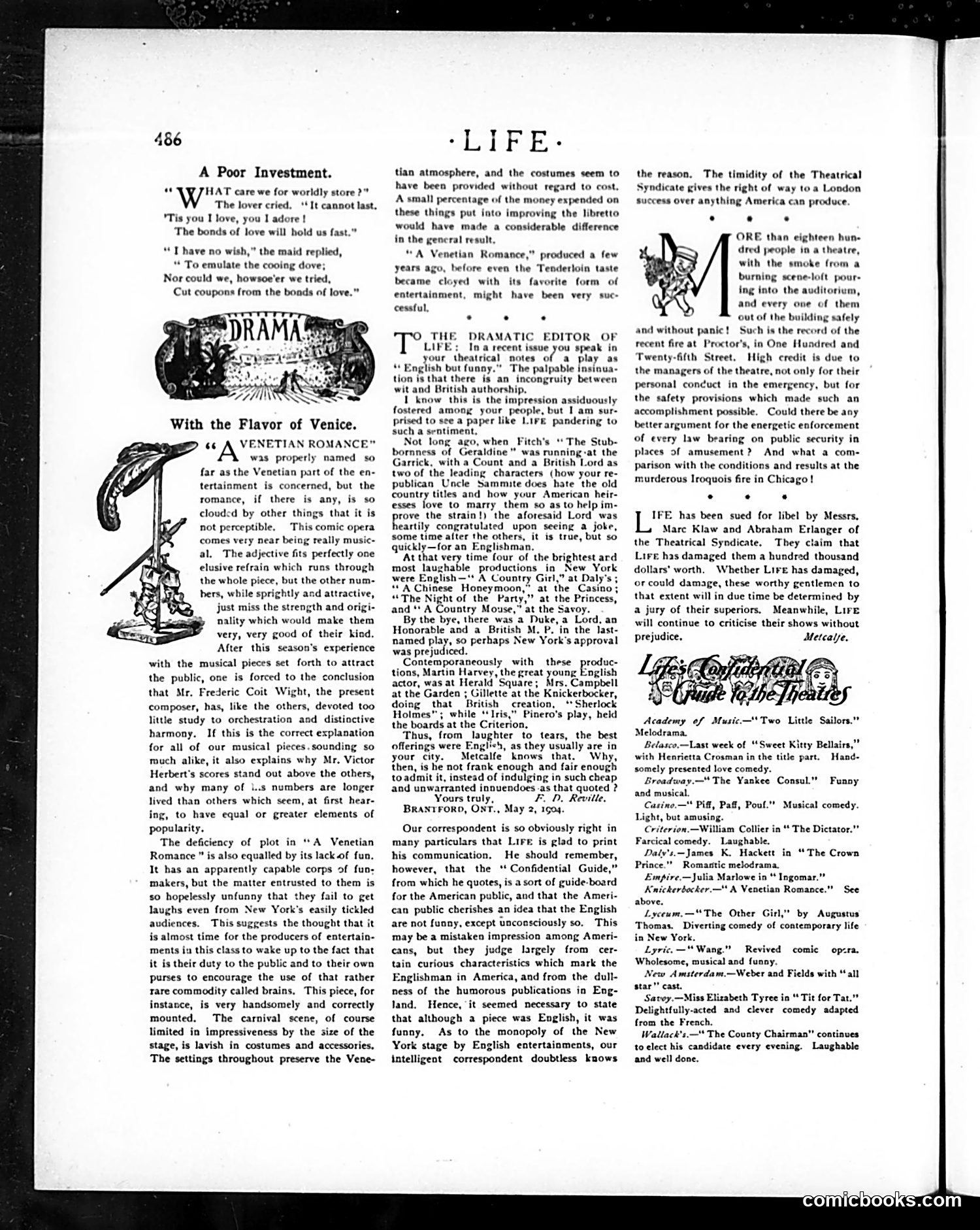
This page contains theater criticism and reader correspondence about American musical theater circa 1904. **The cartoons:** Two small illustrated decorative headers accompany articles—one labeled "DRAMA" showing theatrical imagery, another for "With the Flavor of Venice" featuring a Venetian mask, both typical period ornaments. **The content's satire:** The main criticism targets "A Venetian Romance," a musical comedy. The reviewer mocks its lavish but empty production—expensive costumes and sets cannot compensate for a weak plot and unfunny script. This satirizes the era's tendency to prioritize spectacle over substance. **The letters section** defends English theatrical talent against American prejudice. A correspondent challenges *Life*'s suggestion that English wit is inherently contradictory, citing successful British productions currently running in New York. This reflects period cultural tension between American and British entertainment industries. **For modern readers:** This captures turn-of-century Broadway's familiar problem—expensive productions failing due to poor writing.
📄 Transcribed text from this page (OCR, searchable)
Machine-transcribed from the original scan — historical spelling and the odd misread are preserved.
A Poor Investment. HAT care we for worldly store? The lover cried. ‘It cannot last, 'Tis you I love, you I adore! ‘The bonds of love will hold us fast.” “ Thave no wish,” the maid replied, “ To emulate the cooing dove; Nor could we, howsoe'er we tried, Cut coupons from the bonds of love.” With the Flavor of Venice. -_ SCA YENETIAN ROMANCE” was properly named so far as the Venetian part of the en- tertainment is concerned, but the romance, if there is any, is so clouded by other things that it is not perceptible, This comic opera comes very near being really music- al, The adjective fits perfectly one elusive refrain which runs through the whole piece, but the other num- bers, while sprightly and attractive, just miss the strength and origi- nality which would make them very, very good of their kind. After this season's experience with the musical pieces set forth to attract the public, one is forced to the conclusion that Mr, Frederic Coit Wight, the present composer, has, like the others, devoted too little study to orchestration and distinctive harmony. If this is the correct explanation for all of our musical pieces.sounding so much alike, it also explains why Mr. Victor Herbert's scores stand out above the others, and why many of |..s numbers are longer lived than others which seem, at first hear- ing, to have equal or greater elements of popularity, The deficiency of plot in A Venetian Romance " is also equalled by its lack of fun. It has an apparently capable corps of fun; makers, but the matter entrusted to them is so hopelessly unfunny that they fail to get laughs even from New York's easily tickled audiences. This suggests the thought that it is almost time for the producers of entertain- ments iu this class to wake up to the fact that it is their duty to the public and to their own purses to encourage the use of that rather rare commodity called brains. This piece, for instance, is very handsomely and correctly mounted. The carnival scene, of course limited in impressiveness by the size of the stage, is lavish in costumes and accessories, The settings throughout preserve the Vene- -LDRE- tian atmosphere, and the costumes seem to have been provided without regard to cost, A small percentage of the money expended on these things put into improving the libretto would have made a considerable difference in the general result, A Venetian Romance,” produced a few years ago, before even the Tenderloin taste became cloyed with its favorite form of entertainment, might have been very suc- cessful, . . . THE DRAMATIC ITOR OF IFE: Ina recent issue you speak in our: thealtical motes of a pay es English but funny.” The palpable insinua- tion is that there is an incongruity between wit and British authorship, 1 know this is the impression assiduously fostered among your people, but I am sur- prised to see a paper like LIFE pandering to such a sentiment, Not long ago, when Fitch's The Stub- bornness of Geraldine * was running-at the Garrick, with a Count and a British Lord as two of the leading characters (how your re- publican Uncle Sammuite does hate the old country titles and how your American heir- esses love to marry them so as to help im- rove the strain!) the aforesaid Lord was Reartily congratulated upon seeing a joke, some time alter the others, it is true, but so quickly—for an Englishman, At that very time four of the brightest ard most laughable productions in New York were English—** A Country Girl,” at Daly's; ** A Chinese Honeymoon,” at the Casino} “The Night of the Party,” at the Princess, and‘ A Country Mouse,” at the Savoy. By the bye, there was'a Duke, a Lord, an Honorable and a British M. P. in the last- named play, so perhaps New York's approval was prejudi Contemporaneously with tions, Martin Harvey, the great young actor, was at He: at the Garden ; doing that British creation, Sherlock Holmes”; while ‘Iris,” Pinero’s play, held the boards at the Criterion, Thus, from laughter to tears, the best offerings were Engleh, as they usually are in your city. Metcalfe. knows that. Why, then, is he not frank enough and fair enough toadmit it, instead of indulging in such cheap and unwarranted innuendoes as that quoted ? Yours truly, F. D. Reville, BRANTFORD, ONT., May 2, 1904. these produc: Snglish Id Square; Mrs, Campbell ilette at the Knickerbocker, Our correspondent is so obviously right in many particulars that Lire is glad to print his communication. He should remember, however, that the ‘ Confidential Guide,” from which he quotes, is a sort of guide-board for the American public, and that the Ameri- can public cherishes an idea that the English are not funny, except unconsciously so. This may be a mistaken impression among Ameri- cans, but they judge largely from cer- tain curious characteristics which mark the Englishman in America, and from the dull- ness of the humorous publications in Eng- land. Hence, it seemed necessary to state that although a piece was English, it was funny. As to the monopoly of the New York stage by English entertainments, our intelligent correspondent doubtless knows the reason, The timidity of the Theatrical Syndicate gives the right of way toa London success over anything America can produce. ORE than eighteen hun- dred people in a theatre, with the smoke from a burning scene-lo(t_ pour- ing into the auditorium, and every one of them out of the building safely and without panic! Such is the recc the recent fire at Proctor's, in One Hundred and Twenty-fifth Street. High credit is due to the managers of the theatre, not only for their personal conduct in the emergency, but for the safety provisions which made such an accomplishment possible. Could there be any better argument for the energetic enforcement of every law bearing on public security in places of amusement ? And what a com- parison with the conditions and results at the murderous Iroquois fire in Chicago! . . . IFE. has been sued for libel by Messrs, Marc Klaw and Abraham Erlanger of the Theatrical Syndicate. They claim that Lire has damaged them a hundred thousand dollars’ worth. Whether Lire has damaged, or could damage, these worthy gentlemen to that extent will in due time be dete a jury of their superiors. Meanwhile, Lire will continue to criticise their shows without prejudice. Metcalye. Academy of Music.—*Two Little Sailors.” Melodrama. Belasco.—Last week of “Sweet Kitty Bellairs,”” with Henrietta Crosman in the title part. Hand- somely presented love comedy. Broadway.—" The Yankee Consul.” and musical. Casino.— Piff, Paff, Pout." Musical comedy. Light, but amu Criterion.—William Collier in“ The Dictator."” Farcical comedy. Laughable. Daly's.—James K. Hackett in “The Crown Prince.” Romasitic melodrama. Empire.—Julia Marlowe in“ Ingoma: Knickerbocker. — A Venetian Romance.” See above, Lyceum. —"The Other Girl,” by Augustus ‘Thomas, Diverting comedy of contemporary life in New York, Lyric, —" Wang.” Revived Wholesome, musical and funny. New Amsterdam.—Weber and Fields with “all Funny comic opzra. Satoy.—Miss Elizabeth Tyree in “Tit for Tat.” Delightfully-acted and clever comedy adapted from the French. Wallack's.—" The County Chairman" continues toclect his candidate every evening. Laughable and well done.