
A complete issue · 24 pages · 1904
Life — March 17, 1904
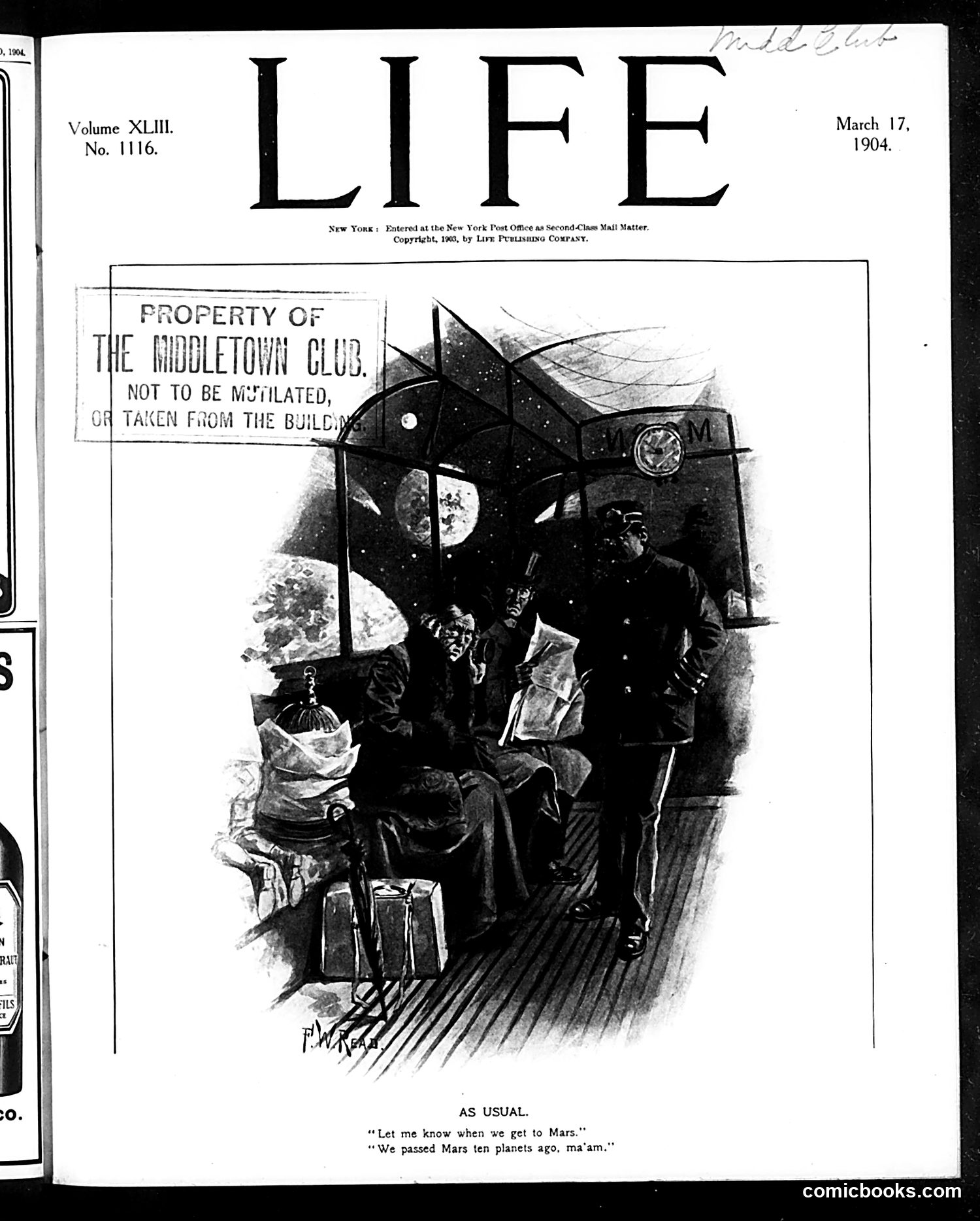
This is the cover of *Life* magazine from March 17, 1904. The illustration depicts a crowded ship's cabin with passengers of various nationalities and classes, some appearing seasick or distressed. A sign reads "Property of the Middletown Club. Not to be mutilated, or taken from the building." The caption reads: "As usual. 'Let me know when we get to Mars.' 'We passed Mars ten planets ago, ma'am.'" The satire appears to mock pretentious club members or tourists so absorbed in their own conversation or concerns that they're oblivious to their actual location—they've apparently traveled so far they've passed Mars itself. The humor suggests absurd detachment from reality, likely commenting on the self-absorption of wealthy or elite social groups during this period.
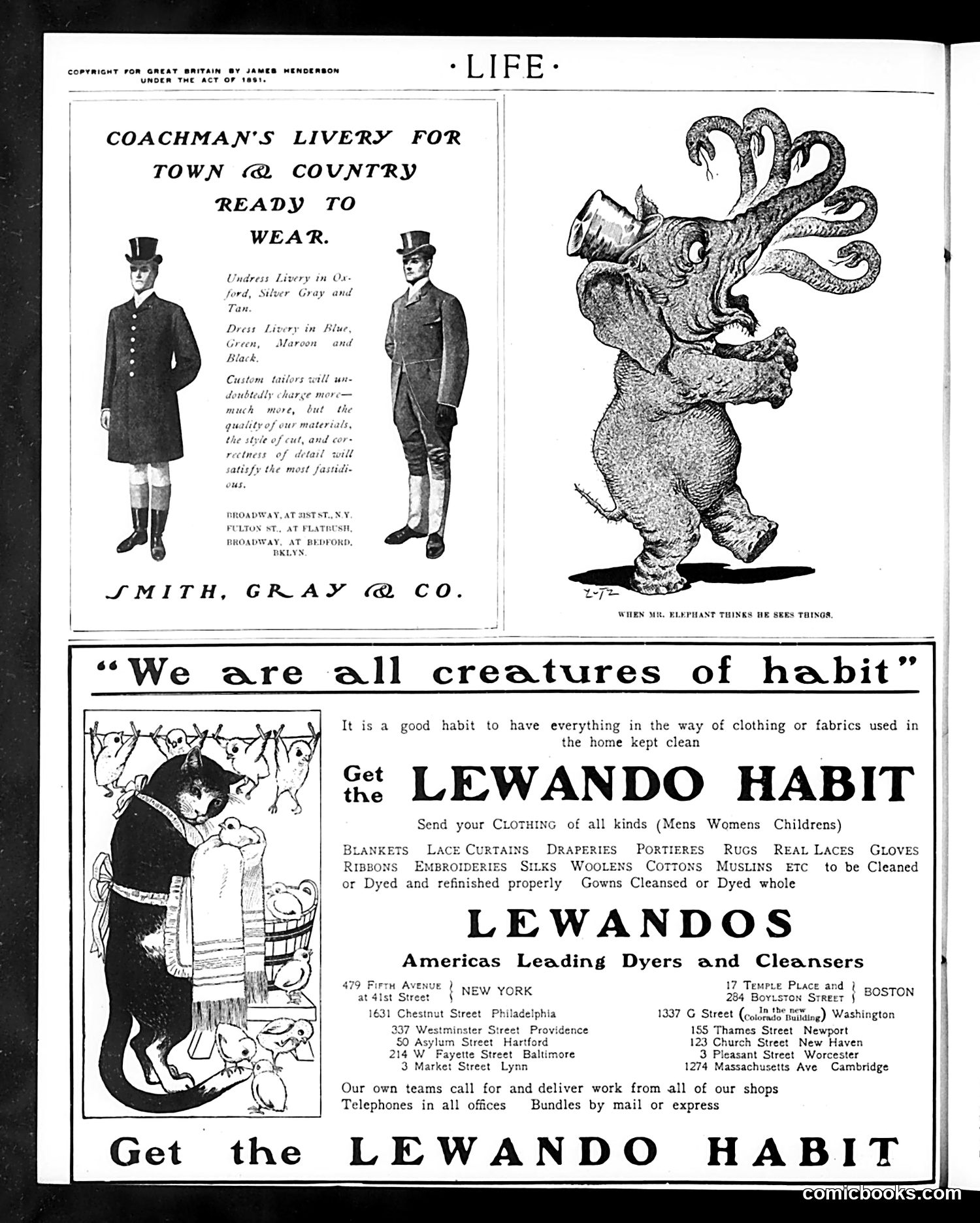
This page contains primarily **advertisements** rather than political satire. The top left advertises **Smith, Gray & Co.'s coachman's livery** (formal servant uniforms) for town and country wear, showing two men in buttoned coats and riding attire—typical late 19th/early 20th-century gentleman's servant dress. The top right features a whimsical illustration of an **elephant thinking**, with the caption "When Mr. Elephant thinks he sees things"—likely a humorous visual gag unrelated to current events. The dominant lower section promotes **Lewando's cleaning service**, a major American dry-cleaning business. The cartoon shows a woman and cat surrounded by laundry, illustrating their message about developing good cleaning habits. This is straightforward advertising, not satire. No identifiable political figures or social commentary appears present.
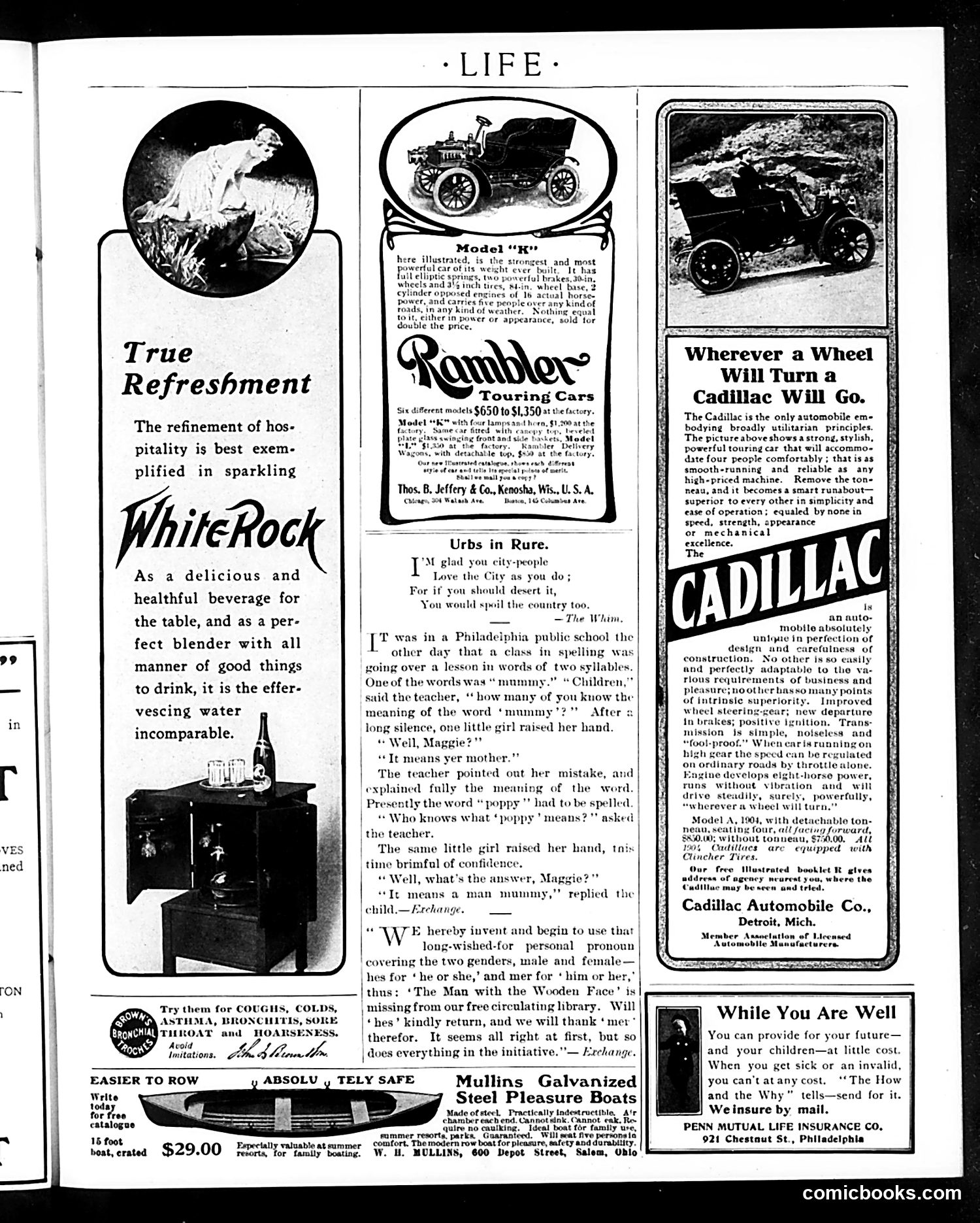
This page is primarily **advertising** rather than political satire or comics. It contains four product advertisements: 1. **White Rock** (beverages) - promotes sparkling water as "refreshment" and a table beverage 2. **Rambler Touring Cars** - highlights the Model "K" automobile with technical specifications 3. **Cadillac** - emphasizes reliability and comfort for four passengers 4. **Mullins Galvanized Steel Pleasure Boats** - advertises affordable family boats at $29.00 5. **Penn Mutual Life Insurance** - offers future financial security The center section includes "Urbs in Rure" (Latin: "City in the Country"), a humorous **editorial piece** about a schoolteacher explaining the word "mummy" to children, ultimately teaching them new slang terms. No political cartoons or social satire appear on this page. It represents typical early 20th-century magazine content mixing advertisements with light humor.
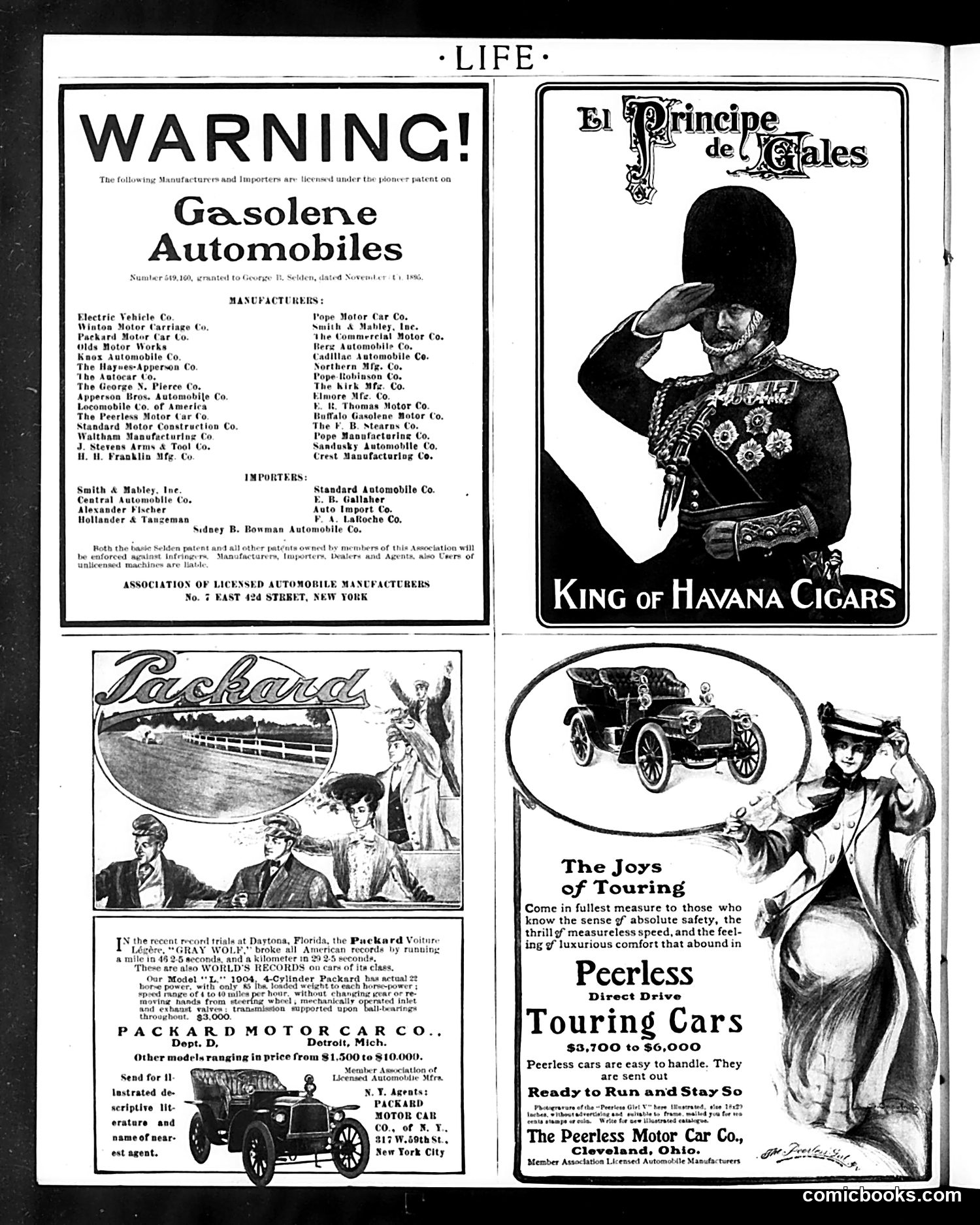
This page is primarily **advertising rather than satire or political commentary**. The top left contains a patent warning about gasoline automobiles, listing licensed manufacturers and importers—essentially a legal notice protecting intellectual property. The remaining space features four commercial advertisements: 1. **El Príncipe de Gales** cigars (top right)—depicts a figure in military dress, likely referencing the Prince of Wales 2. **Packard automobiles** (middle left)—highlights speed records from Daytona races 3. **Peerless touring cars** (bottom right)—emphasizes luxury and reliability, priced $3,700-$6,000 The imagery reflects early 1900s advertising conventions: elegant figures, automobiles as status symbols, and appeals to sophistication and performance. There is no apparent political cartoon or satirical commentary on this page—it's a straightforward commercial layout typical of *Life* magazine's revenue model during this era.
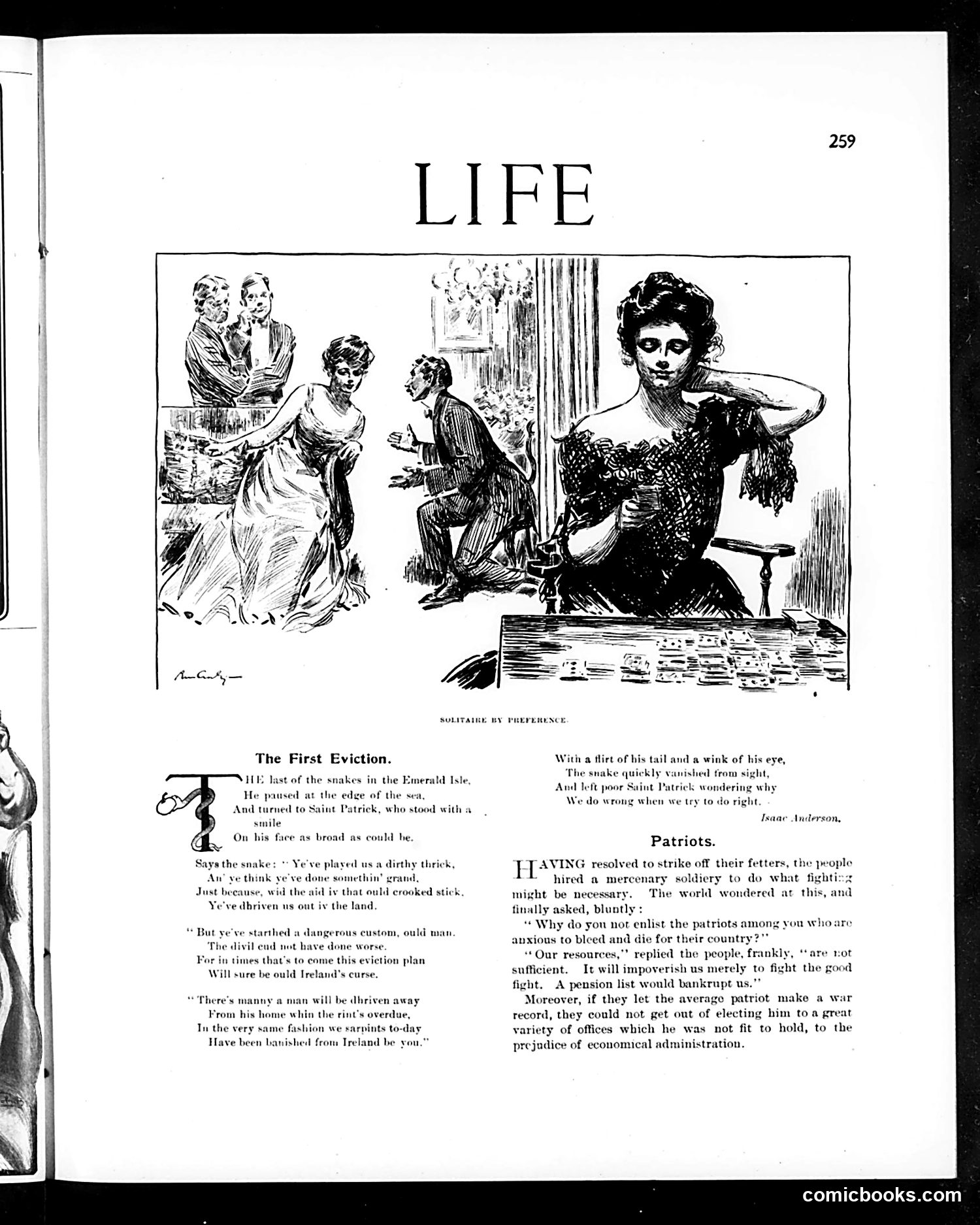
The top cartoon depicts a woman playing solitaire alone while three men observe from behind—the title suggests she deliberately prefers solitude to male company, a commentary on changing gender dynamics and women's independence. "The First Eviction" references Ireland's historical eviction crisis. The poem and accompanying illustration depict Saint Patrick being evicted from the Emerald Isle, using religious/mythological imagery to protest actual Irish tenant evictions. The accompanying article "Patriots" critiques Ireland's proposal to hire mercenary soldiers rather than rely on citizens' patriotic duty to fight for their country—satirizing the economic and military shortsightedness of this approach. Both pieces address Irish political crises of the period.
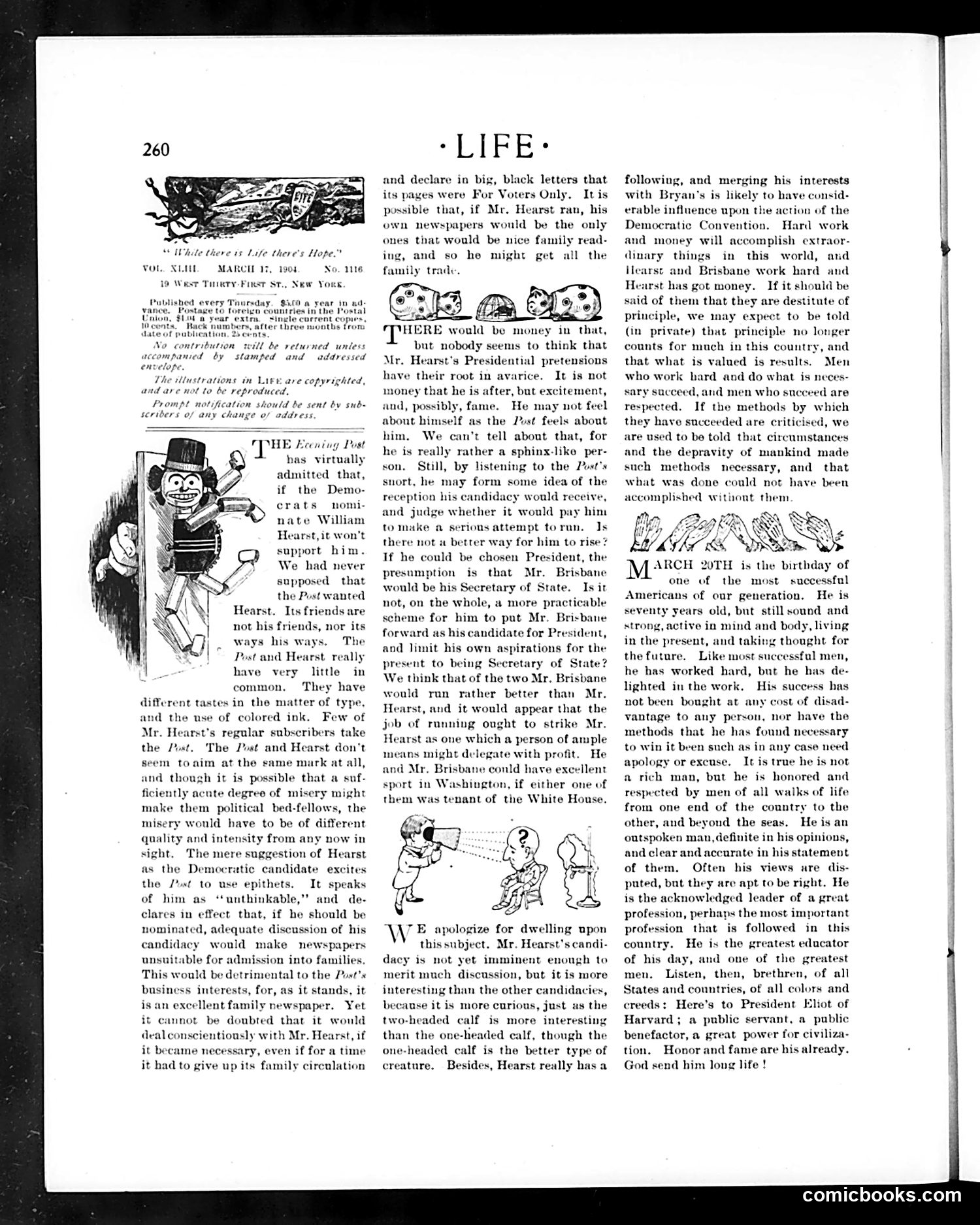
This page contains political commentary about William Randolph Hearst's presidential ambitions. The text discusses whether Hearst should run for President or accept a position as Secretary of State under a Democratic administration led by William Jennings Bryan. The editorial argues Hearst is unsuitable for either role—too ambitious and unprincipled for high office. It characterizes him as driven by "excitement, rank possibility, fame" rather than genuine public service. The accompanying cartoons (though difficult to parse clearly) appear to mock Hearst's political pretensions and his newspaper's influence-seeking. The piece concludes by praising Bryan as an honest public servant, implicitly contrasting him with Hearst's perceived opportunism. The satire targets wealthy industrialists using newspapers for political power.
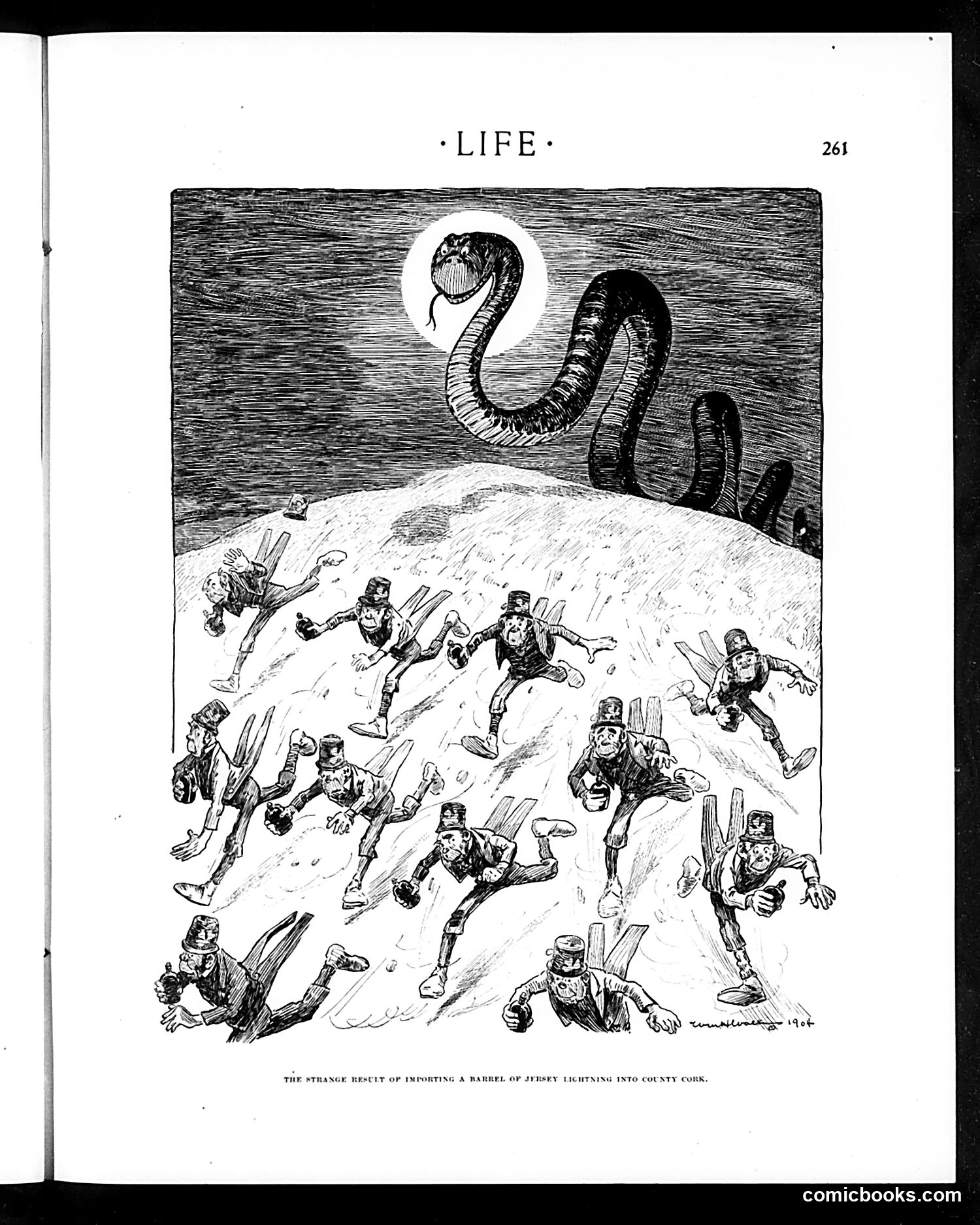
This satirical cartoon from *Life* magazine depicts a giant sea serpent or tentacled creature looming over a group of men in Victorian dress fleeing down a slope. The caption reads: "THE STRANGE RESULT OF IMPORTING A BARREL OF JERSEY LIGHTNING INTO COUNTY CORK." The joke concerns "Jersey Lightning"—a colloquial term for illegally distilled whiskey from New Jersey. The cartoon satirizes the consequences of smuggling this potent alcohol into County Cork, Ireland. The absurdist humor suggests that importing such powerful liquor causes chaos and panic among the local population, depicted as scrambling figures. The monstrous creature metaphorically represents the disruptive effects of bootleg alcohol on the community. This reflects broader anxieties about alcohol trade, prohibition-era smuggling, and cross-border commerce during this period.
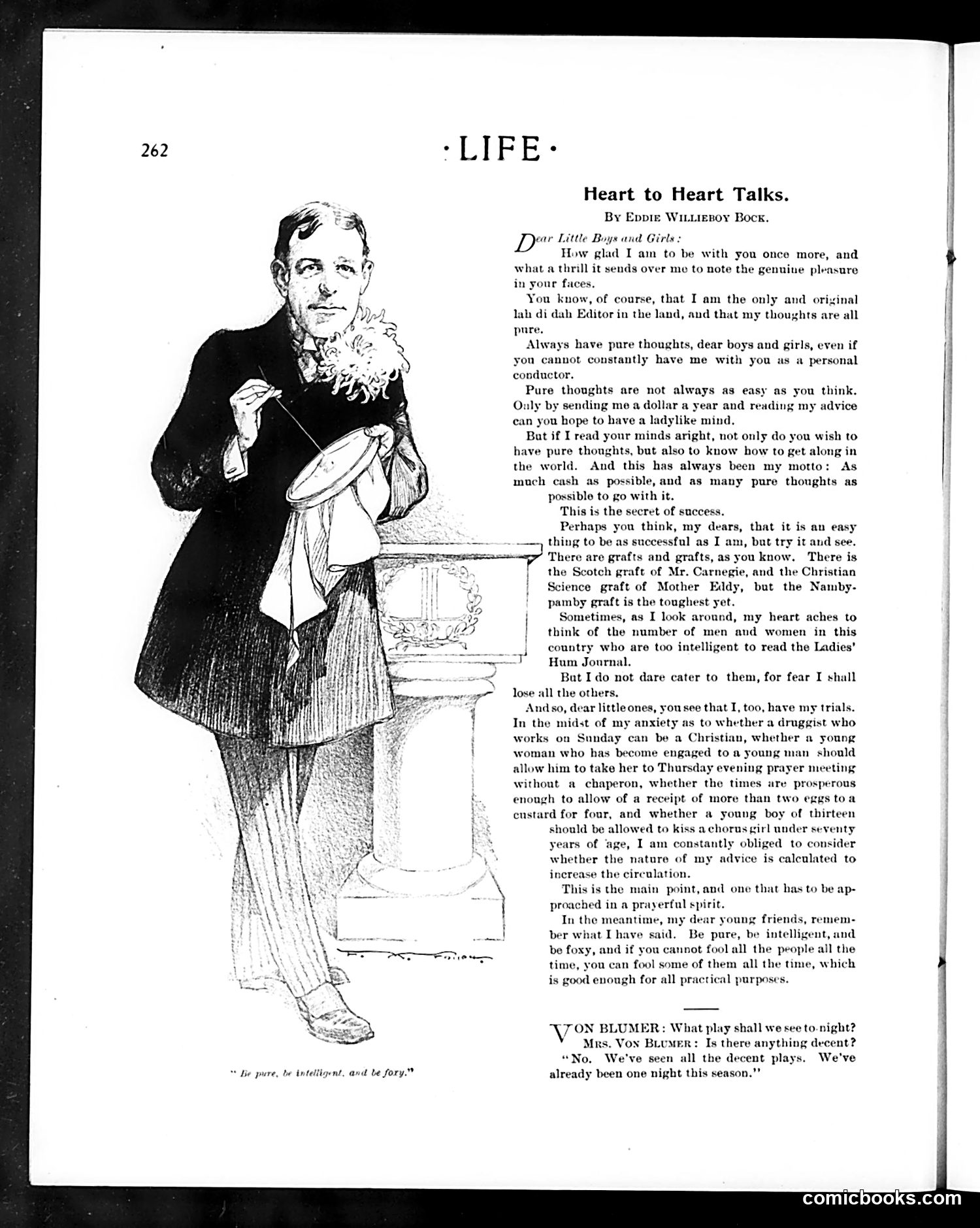
This page from *Life* magazine presents "Heart to Heart Talks" by Eddie Willeymoy Bock, addressed to children. The illustration shows a man in formal dress holding a small child, with the caption "Be pure, be intelligent, and be foxy." The piece is satirical advice-giving that mocks sentimental morality columns. Bock ironically claims to be "the only and original lad di dah Editor in the land" with "pure thoughts," then undermines this by explaining how to succeed through calculated self-interest—acquiring money while maintaining appearance of virtue. The final exchange between Von Blumer and his wife about attending "decent plays" (having already seen all indecent ones) reinforces the satire: the column targets hypocrisy among the wealthy, who publicly perform propriety while privately pursuing pleasure.
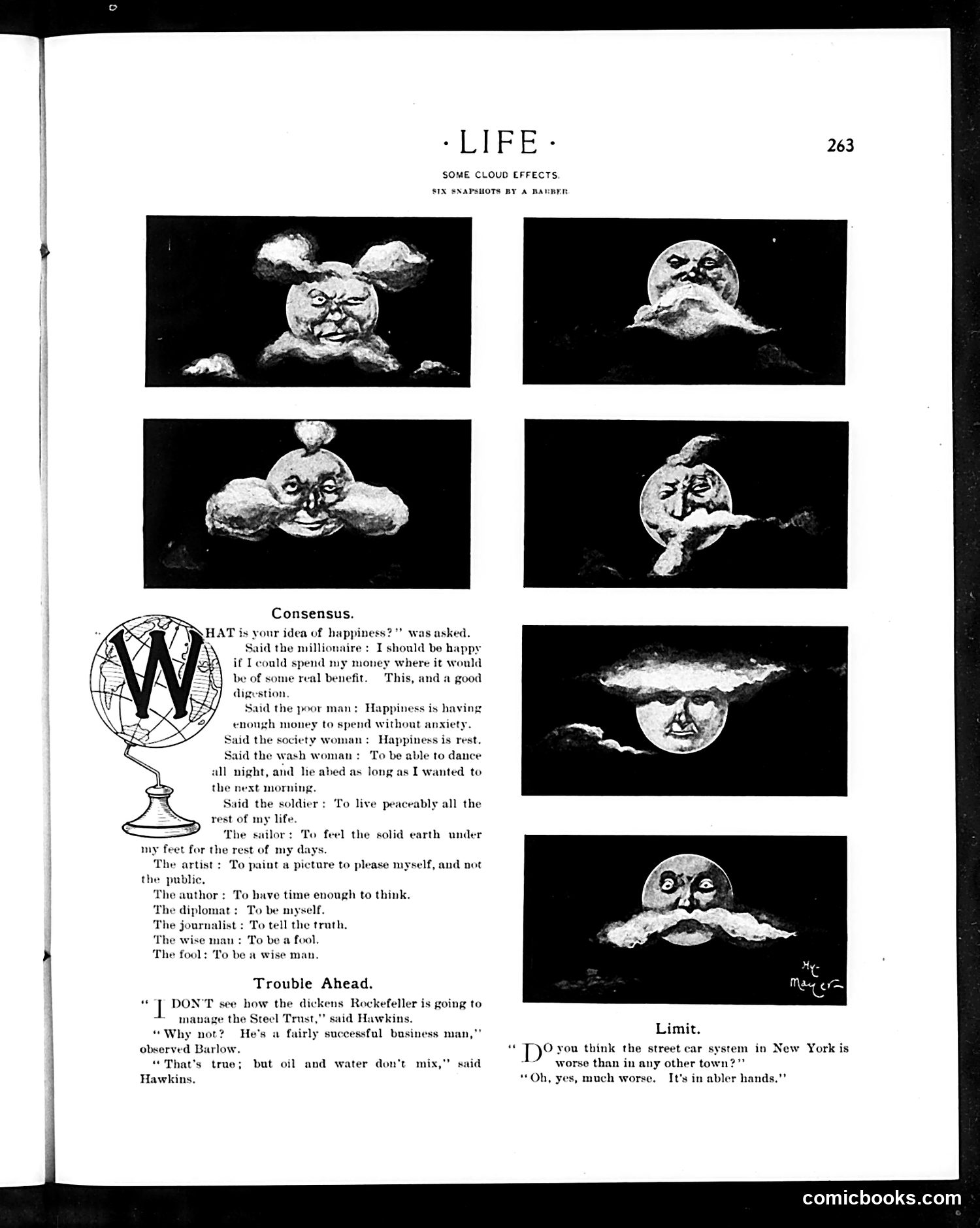
**Top Section: "Some Cloud Effects"** Six sketches by a cartoonist show anthropomorphic cloud faces with human expressions—angry, bemused, contemplative, playing instruments, scowling. This appears to be a whimsical artistic exercise rather than political satire. **"Consensus"** section presents satirical definitions of happiness from different social classes: a millionaire wants to spend money beneficially; a poor man wants financial security; a society woman wants rest; a washerwoman wants to dance all night. The joke critiques how happiness differs by class and circumstance. **"Trouble Ahead"** and **"Limit"** are brief dialogue jokes about business (oil and water not mixing) and New York City's street car system being poorly managed. These are typical early-20th-century magazine humor pieces combining visual gags with social commentary.
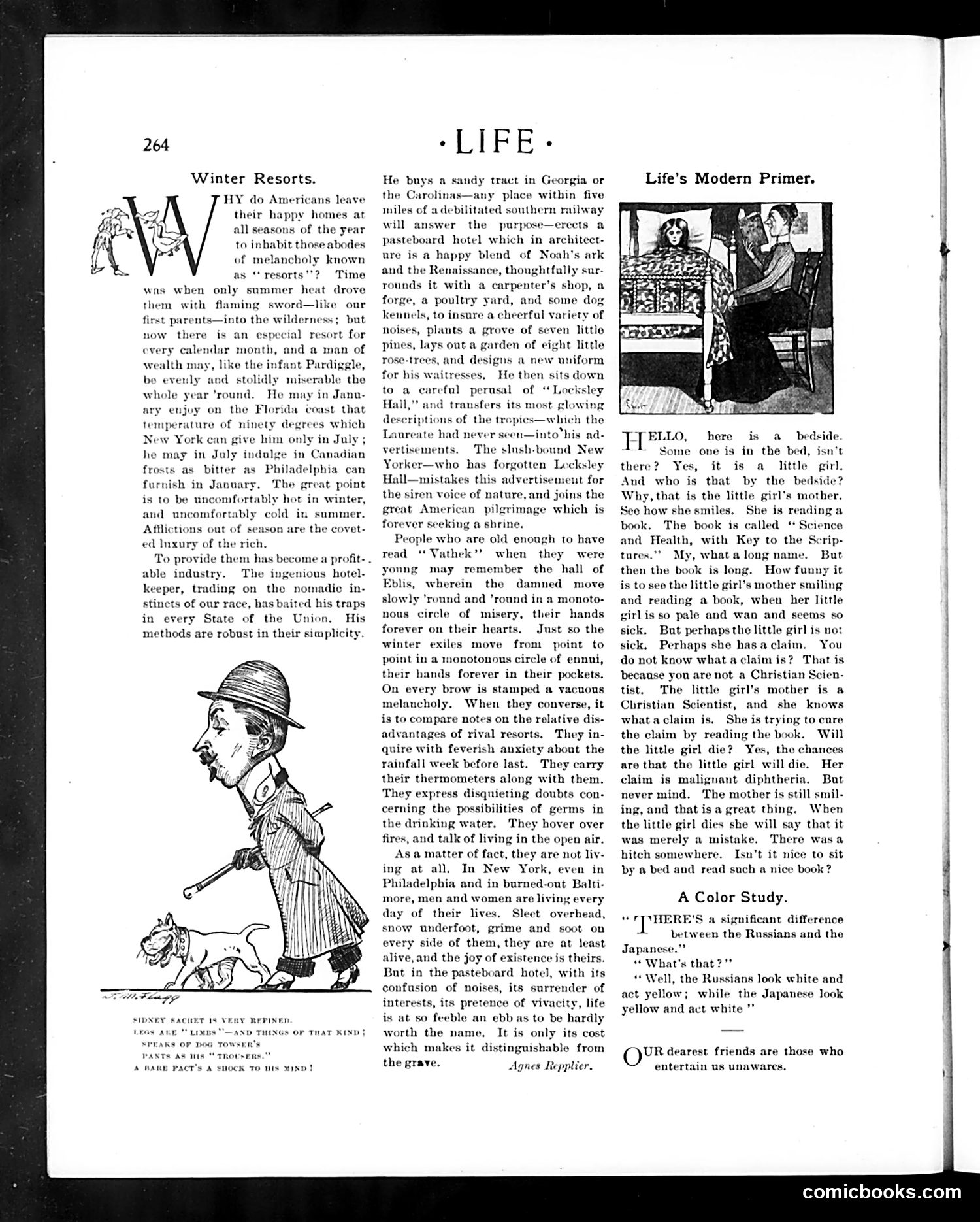
This satirical piece mocks wealthy Americans' obsession with winter resorts. The cartoon depicts a fashionable gentleman traveling south to escape harsh winters, accompanied by the caption critiquing how the rich escape to places like Georgia and the Carolinas. The accompanying illustration shows a caricatured figure in a top hat and overcoat with a small dog—representing the type of wealthy traveler seeking comfort. The satire targets the contradiction between these privileged winter escapes and the harsh realities faced by ordinary people in northern cities enduring cold and hardship. The text references "Locksley Hall" and discusses how wealthy resorts function as havens for the affluent while ordinary citizens struggle with winter poverty—a pointed social critique of class disparity.
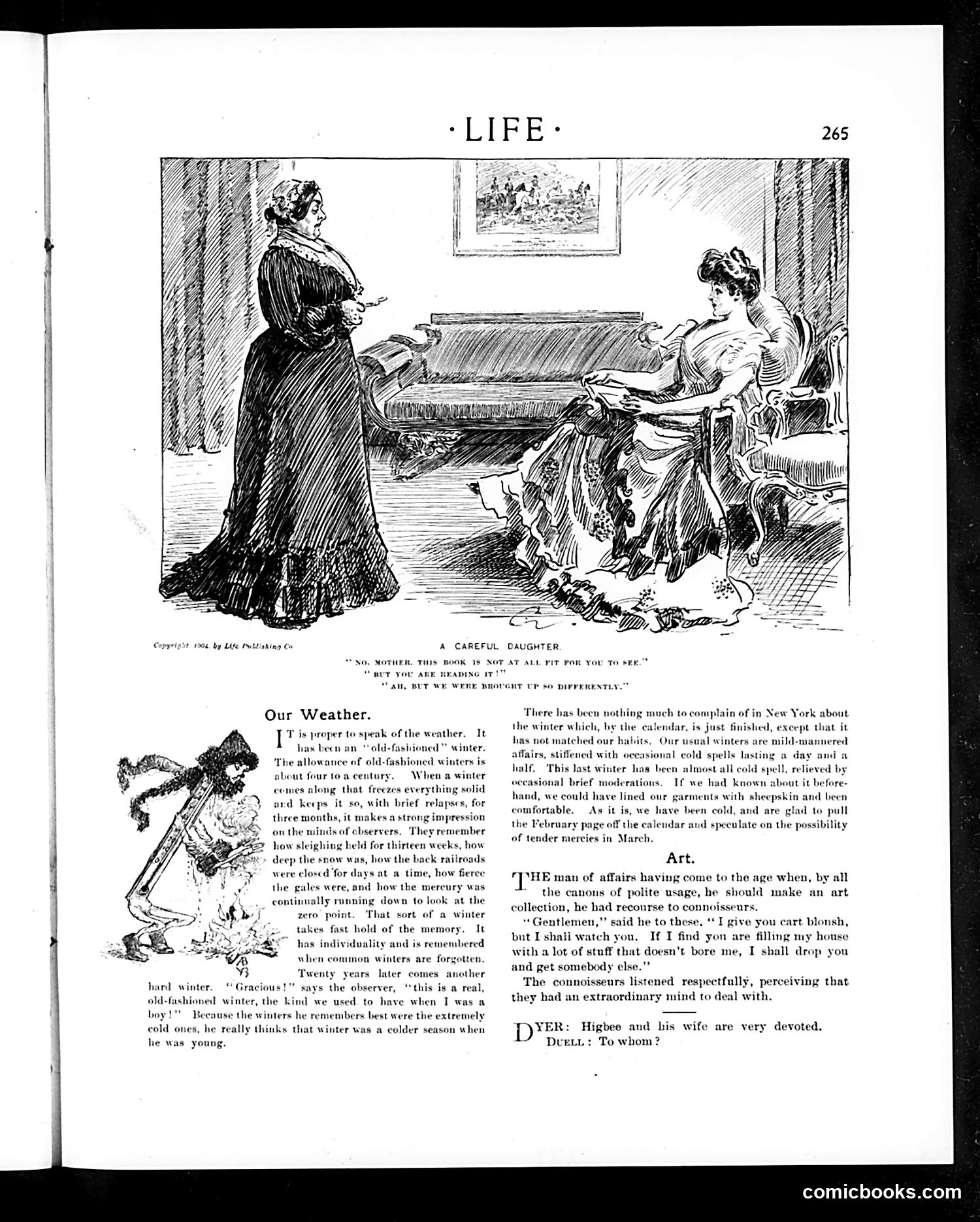
**Top Cartoon ("A Careful Daughter"):** Shows a young woman reading to an older woman (likely her mother), with the caption indicating the mother disapproves of the book's content. The joke satirizes Victorian-era parental anxiety about young women's literature—the mother finds even the reading material "not fit" for her daughter to see, reflecting period concerns about protecting young women from "improper" influences. **"Our Weather" Section:** A humorous complaint about New York winters, contrasting nostalgic memories of harsher winters from the writer's youth with current milder conditions. The illustration shows a freezing figure, emphasizing the exaggerated recollections of extreme cold that older generations claim to remember. **"Art" Section:** Brief dialogue mocking art connoisseurs who use pretentious language ("extraordinary mind") when discussing artists.
This appears to be a still from a theatrical or film production rather than a political cartoon. The black and white image shows figures in what looks like a classical or dramatic scene set among tall columns or trees. Two figures are visible in the lower portion of the frame, positioned within an architectural or natural setting with strong vertical elements creating dramatic shadows. The copyright notice reads "Copyright 1924 by Life Publishing Co" and partial text at bottom appears to reference "OUT IN COL" (possibly "OUT IN COLORADO" or similar). Without clearer visibility of details or accompanying article text, I cannot definitively identify the specific theatrical production, characters depicted, or the satirical point Life magazine intended. The image quality and framing make precise interpretation difficult.
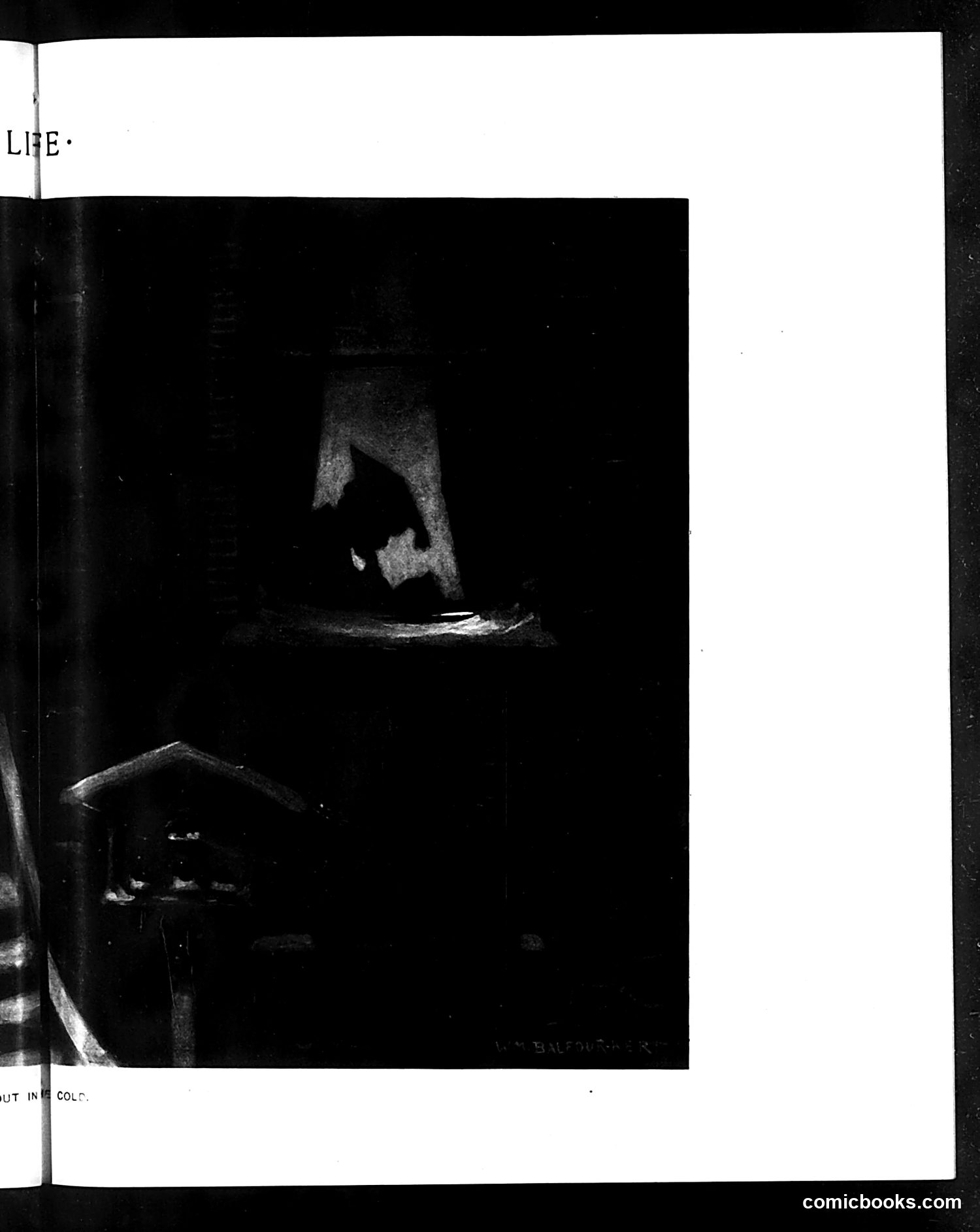
This page is largely illegible due to poor contrast and image quality. The visible elements include: - A header reading "LIFE" in the top left - A predominantly black rectangular image/photograph in the center with minimal visible detail - Text at the bottom that appears to read "OUT IN COL." (possibly "OUT IN COLOR") The image quality makes it impossible to identify specific figures, caricatures, or satirical content with confidence. Without clearer visibility of the illustration or accompanying text, I cannot reliably explain what political or social commentary this page conveyed to contemporary readers. The page may contain a political cartoon or satirical illustration, but the details are not discernible enough to provide accurate analysis.
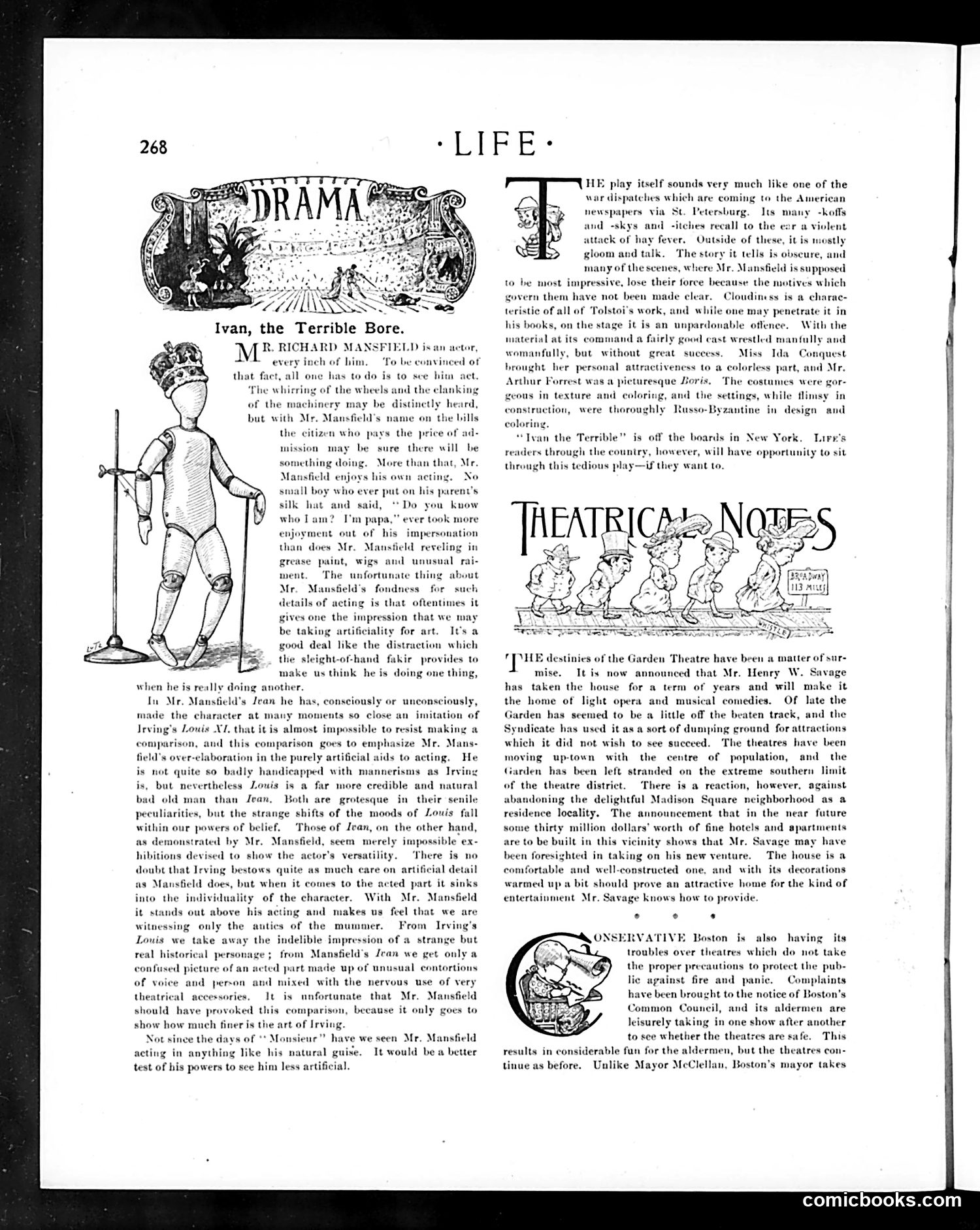
This is a theater review of actor Richard Mansfield's production of a play about Ivan the Terrible (adapted from Tolstoy). The title itself is the satire—a pun suggesting the play is both about Ivan and is itself tedious ("bore"). The accompanying caricature depicts Mansfield as a mechanical, wooden figure, illustrating the review's central criticism: that Mansfield relies excessively on artificial theatrical tricks—"grease paint, wigs and unusual raiment"—rather than natural character development. The reviewer compares him unfavorably to Henry Irving, whose portrayal of similar material achieves genuine emotional impact because the artifice serves the character rather than dominating it. The review critiques both Mansfield's overwrought acting style and the play itself (obscure Russian source material, unclear motivations). The cartoon visualizes the wooden, mechanical nature of his performance—literally making him a puppet or automaton—to emphasize the reviewer's point about artificiality overwhelming artistry.
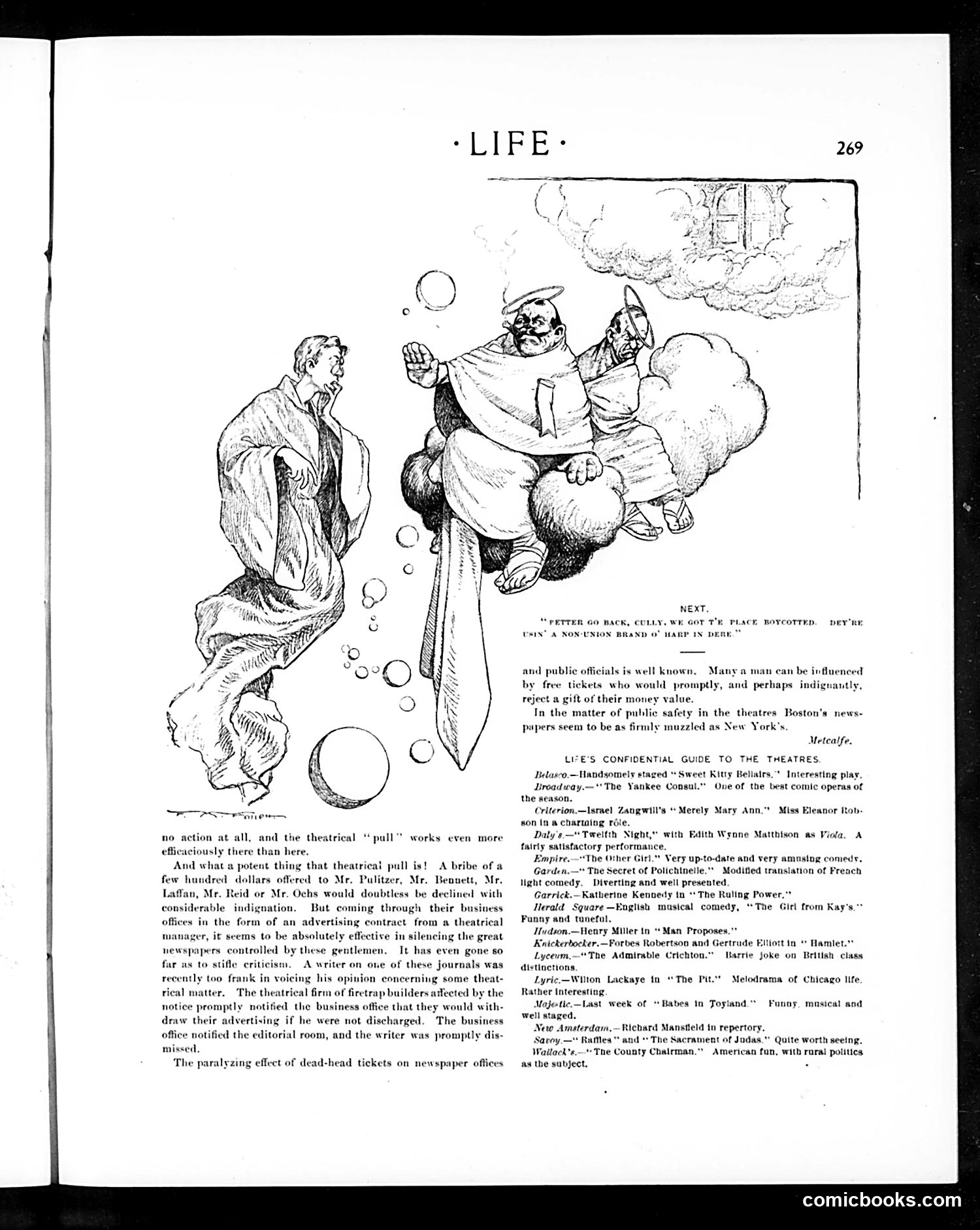
This page critiques corruption in newspaper journalism through two related elements: **The Main Cartoon** depicts a figure on the left (representing an honest journalist or reformer) being ejected by theatrical producers and newspaper executives floating above. The caption references a "non-union brand" boycott threat. **The Satirical Text** (by Metcalfe) exposes how theatre owners silence critical newspaper coverage through economic pressure: offering free tickets and advertising contracts to newspapers and editors who would reject direct bribes. The article describes a specific incident where a theatre company forced a journalist's dismissal after criticizing unsafe "firetraps" (theatres with poor safety conditions). **The Point**: Major newspapers (Pulitzer, Bennett, Reid, Ochs) maintain editorial independence from direct corruption but remain vulnerable to indirect economic coercion through advertising and complimentary tickets—what the author calls "dead-head tickets." This allows powerful interests to suppress legitimate public safety concerns without overtly purchasing silence. The accompanying theatre reviews mock this compromised coverage.
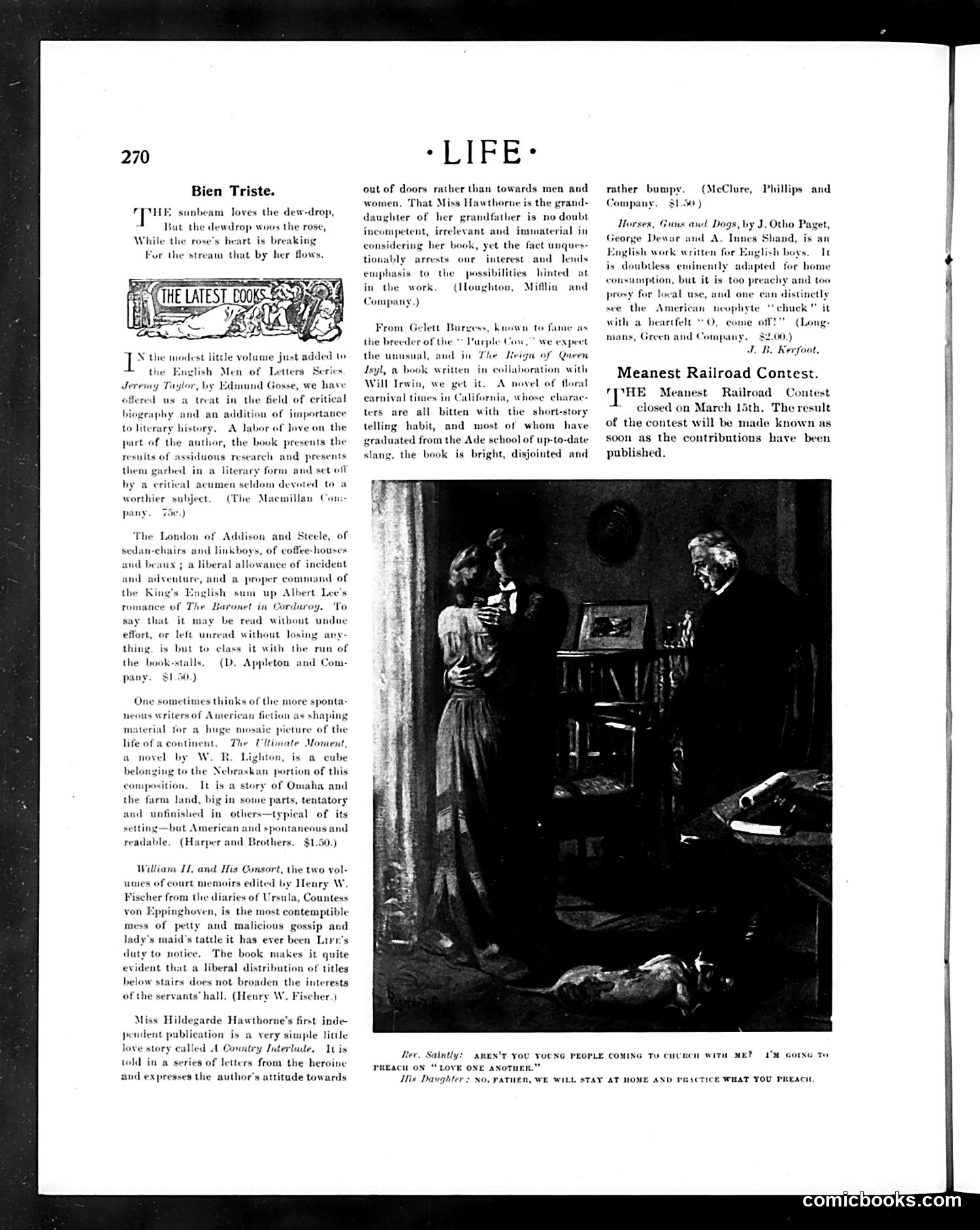
This page is primarily a **book review section** with one small cartoon at the bottom. The cartoon shows a **domestic scene with a father and daughter**. The father invites the daughter to church, saying "Aren't you young people coming to church with me?" The daughter replies: "No, father, we will stay at home and practice what you preach." **The satire**: This is a classic hypocrisy joke—a common theme in early 20th-century American humor. The daughter suggests her father's *actual behavior* contradicts his religious teachings, so she'll practice what he truly demonstrates rather than what he preaches. It's a mild rebuke of parental/clerical inconsistency between stated moral values and lived conduct. The page otherwise contains book reviews discussing contemporary literature—novels about American life, court memoirs, and children's books—typical of Life's cultural criticism section. No major political figures or events appear to be referenced.
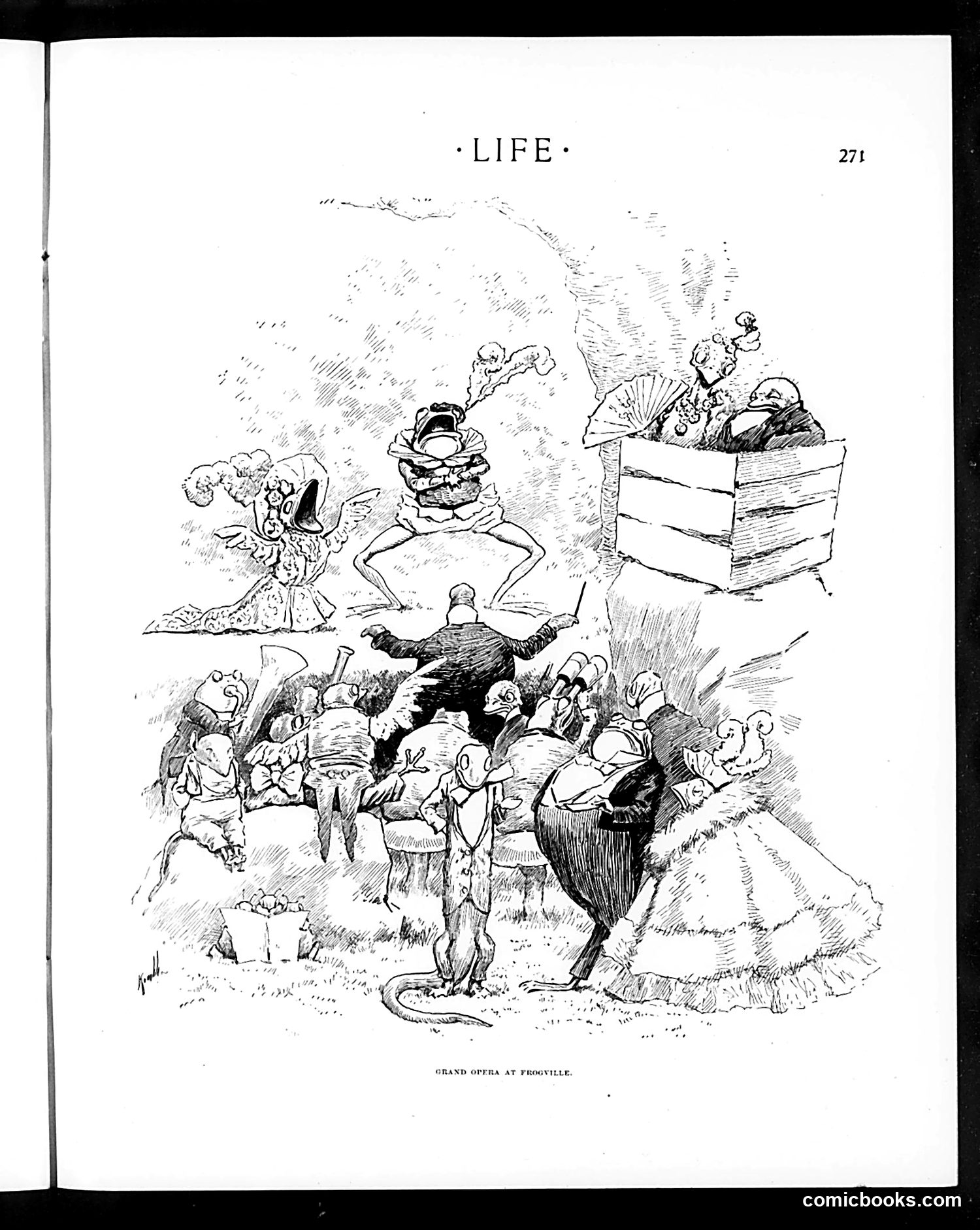
This is a satirical cartoon depicting frogs performing an opera. A frog conductor stands center-stage with arms raised, leading an ensemble of frog performers. Above, frogs sit in a box seat (upper right), and various costumed frogs engage in theatrical poses. The setting appears to be a pond or natural amphitheater. The satire likely mocks pretentious opera culture by transplanting it to animals. By setting "grand opera" in "Frogville" among frogs, the cartoon ridicules opera's self-importance and artificiality. The juxtaposition of dignified, formal opera performance with the undignified nature of frogs creates comedic incongruity—suggesting that opera's elaborate conventions are absurdly overwrought, even laughable.
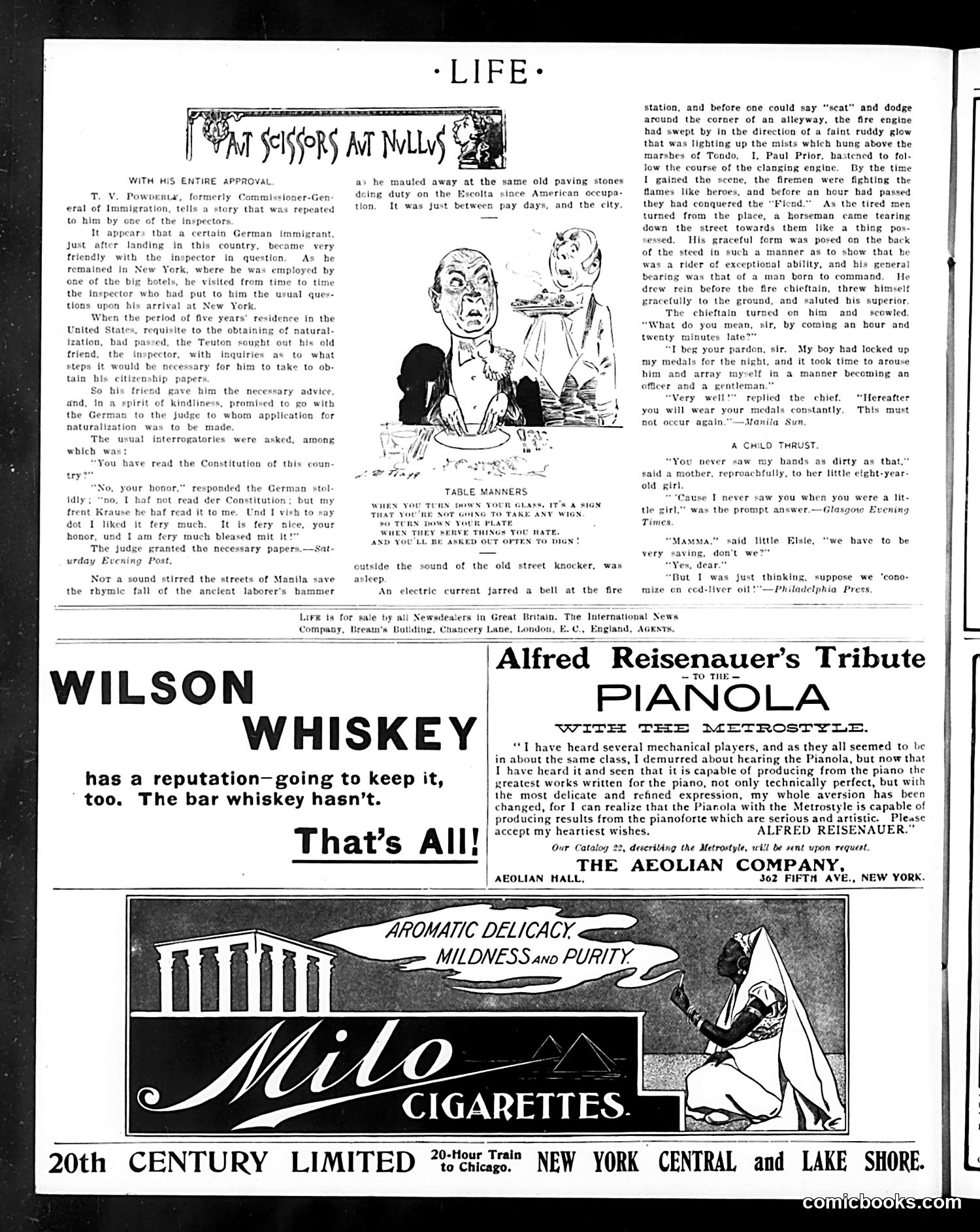
This Life magazine page contains three main elements: **"Scissors at Nullus" cartoon**: A satirical story about a German immigrant seeking U.S. citizenship. The humor relies on the immigrant's broken English and his misunderstanding of constitutional principles. When asked if he's read the Constitution, he responds he hasn't but approves of it anyway—a jab at naturalization procedures and immigrants' cursory engagement with American civic documents. The inspector's willingness to vouch for him suggests lax oversight. **"Table Manners" section**: Brief etiquette humor about proper dining behavior, including a story about a military officer's excuse for tardiness involving locked-up medals. **"A Child Thrust" anecdotes**: Short jokes about children's innocent observations, including one about a child noting her mother's hands were dirty as a girl. The page is primarily **advertising**: Wilson Whiskey, Milo Cigarettes, Pianola, and 20th Century Limited train service occupy significant space. The satirical content addresses early-1900s immigration and assimilation concerns while maintaining the lighthearted tone typical of Life's humor magazine format.
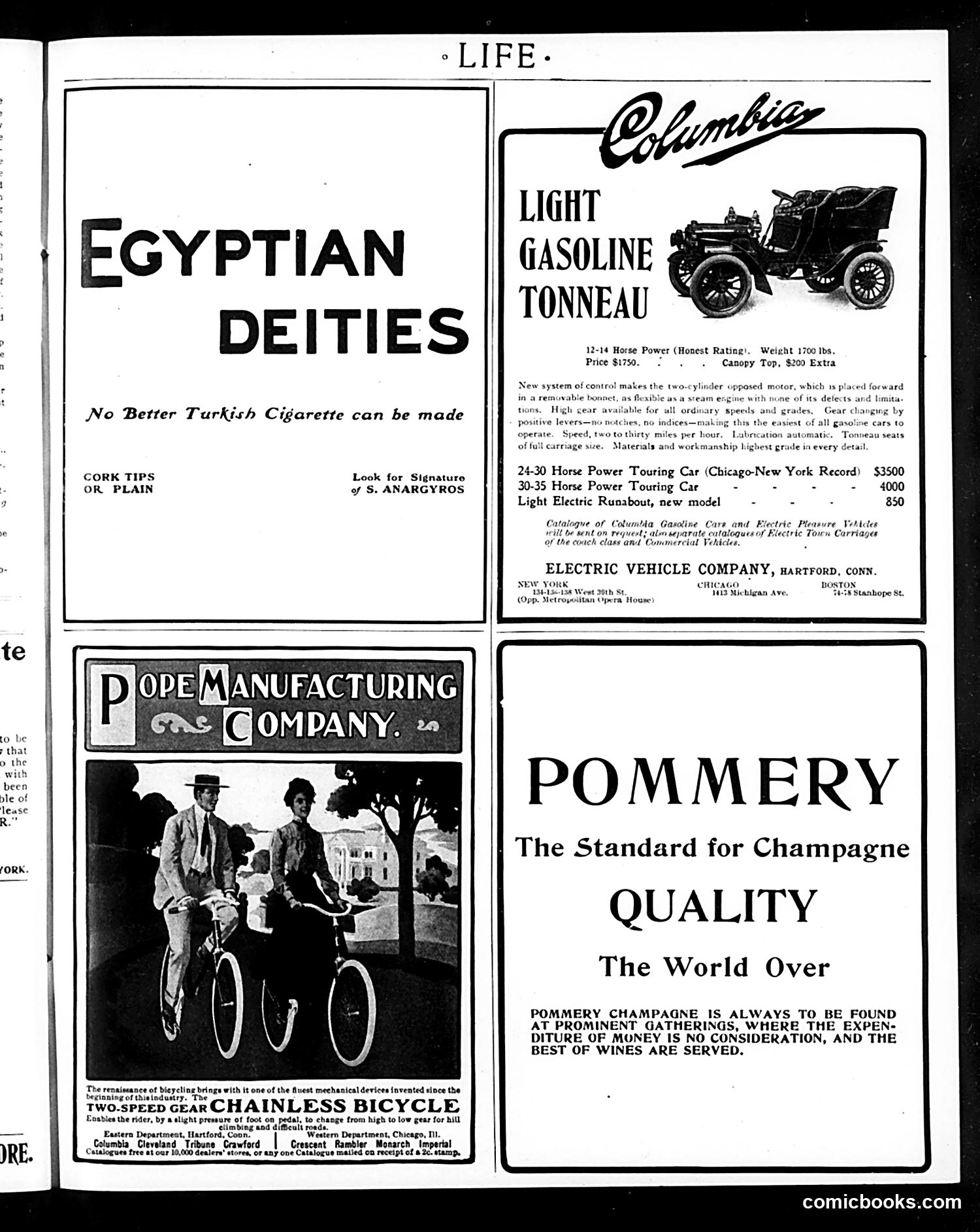
This is primarily an **advertising page**, not a satirical cartoon. It contains four distinct advertisements: 1. **Egyptian Deities cigarettes** — a Turkish cigarette brand emphasizing quality ("No Better Turkish Cigarette can be made"), with cork or plain tips. 2. **Columbia Light Gasoline Tonneau** — an early automobile advertisement highlighting a 12-14 horsepower vehicle priced at $1,750, marketed as reliable and easy to operate. 3. **Pope Manufacturing Company's Chainless Bicycle** — featuring a photo of well-dressed men on bicycles, promoting a two-speed gear system as a mechanical innovation. 4. **Pommery Champagne** — positioning the brand as the standard for quality champagne served at elite gatherings. The page reflects early 1900s consumer culture, showcasing luxury goods (automobiles, imported champagne) and emerging technology (bicycles with mechanical innovations). There is **no satirical cartoon content** visible—this is straightforward period advertising.
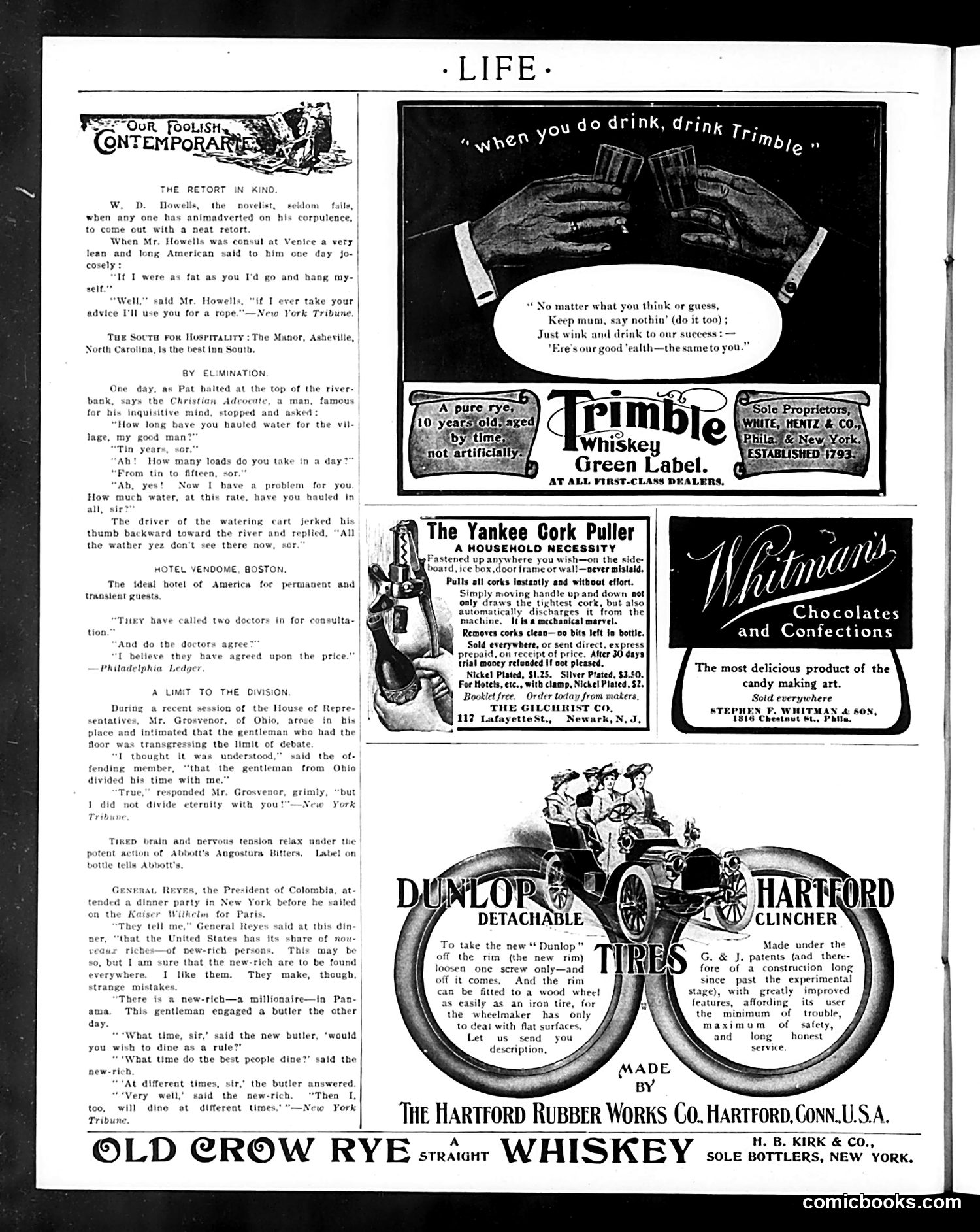
This page from *Life* magazine contains humorous anecdotes and period advertisements. The text pieces are satirical jabs at American social pretension and political figures: **"The Retort in Kind"** mocks novelist W.D. Howells' wit—he's being teased about his weight and responds cleverly, turning an insult back on the speaker. **"By Elimination"** is a joke about an Irish laborer outwitting a nosy questioner asking how much water he's hauled in ten years—the laborer simply points to the river, implying the answer is immeasurable. **"A Limit to the Division"** shows Congressman Grosvenor of Ohio making a dark joke about time—refusing to share debate time eternally with a colleague, sarcastically implying death. **The Colombia President anecdote** satirizes American "new-rich" (nouveau riche) pretentiousness—a wealthy businessman absurdly mimics high society by dining at random times, thinking that's what the wealthy do. The advertisements (Trimble Whiskey, cork puller, Dunlop tires, Whitman's chocolates) are period products typical of early 20th-century *Life*.
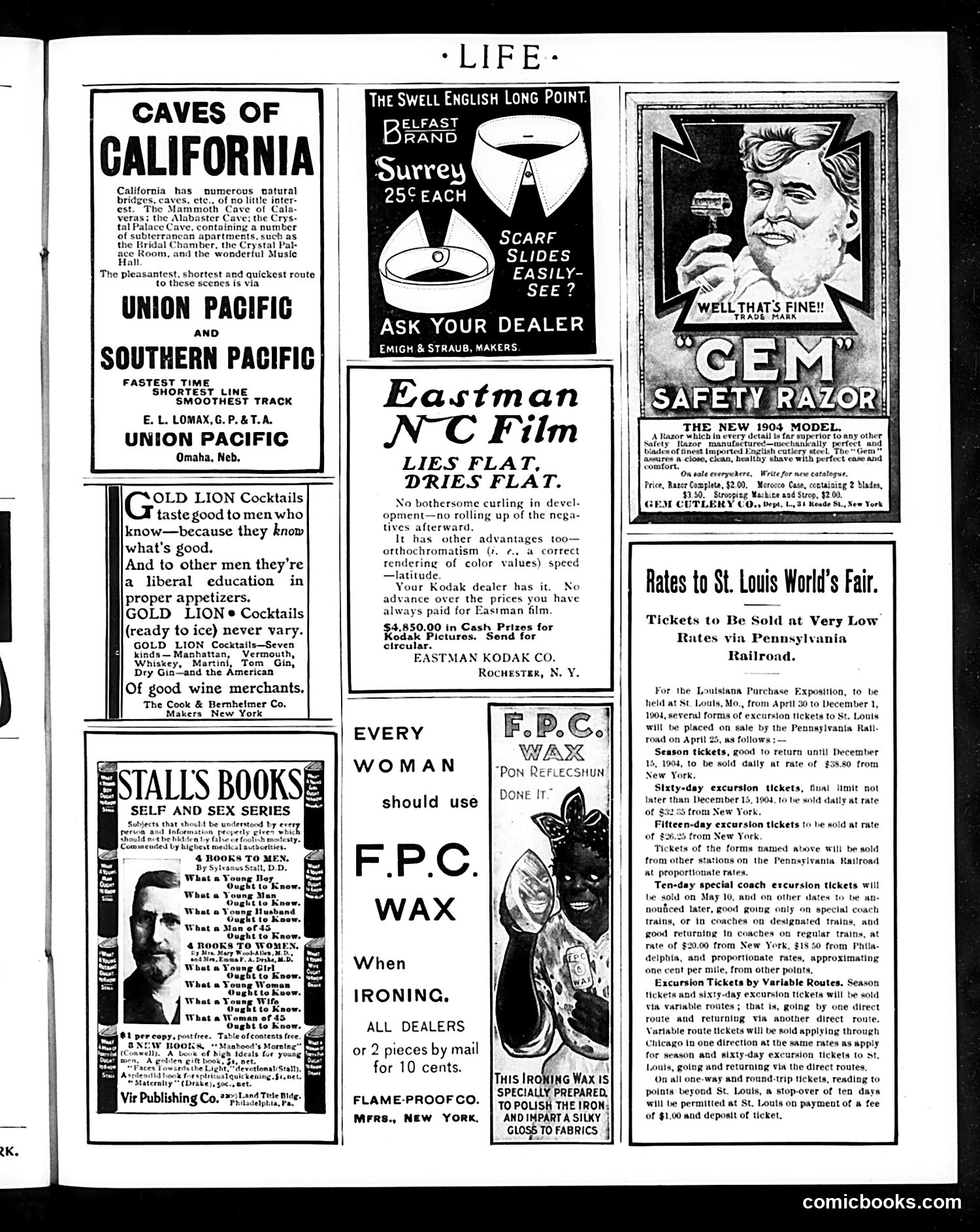
This page is primarily **advertising**, not satirical content. It's from Life magazine circa 1904, showcasing commercial products and services typical of the Edwardian era. Notable advertisements include: - **Caves of California** (railroad travel promotion via Union Pacific/Southern Pacific) - **Gold Lion Cocktails** (pre-Prohibition spirits) - **Eastman NC Film** (early cinema technology) - **Gem Safety Razor** (the "New 1904 Model") - **F.P.C. Wax** (ironing product) - **Stall's Books** (self-help/educational volumes) - **St. Louis World's Fair excursion rates** (the 1904 Louisiana Purchase Exposition) The single illustrated element is the **Gem Safety Razor advertisement** featuring a man's face saying "Well that's fine!!" — a straightforward endorsement, not satire. This page reflects early-20th-century consumer culture, product innovation, and the railroad era's role in American commerce and tourism.
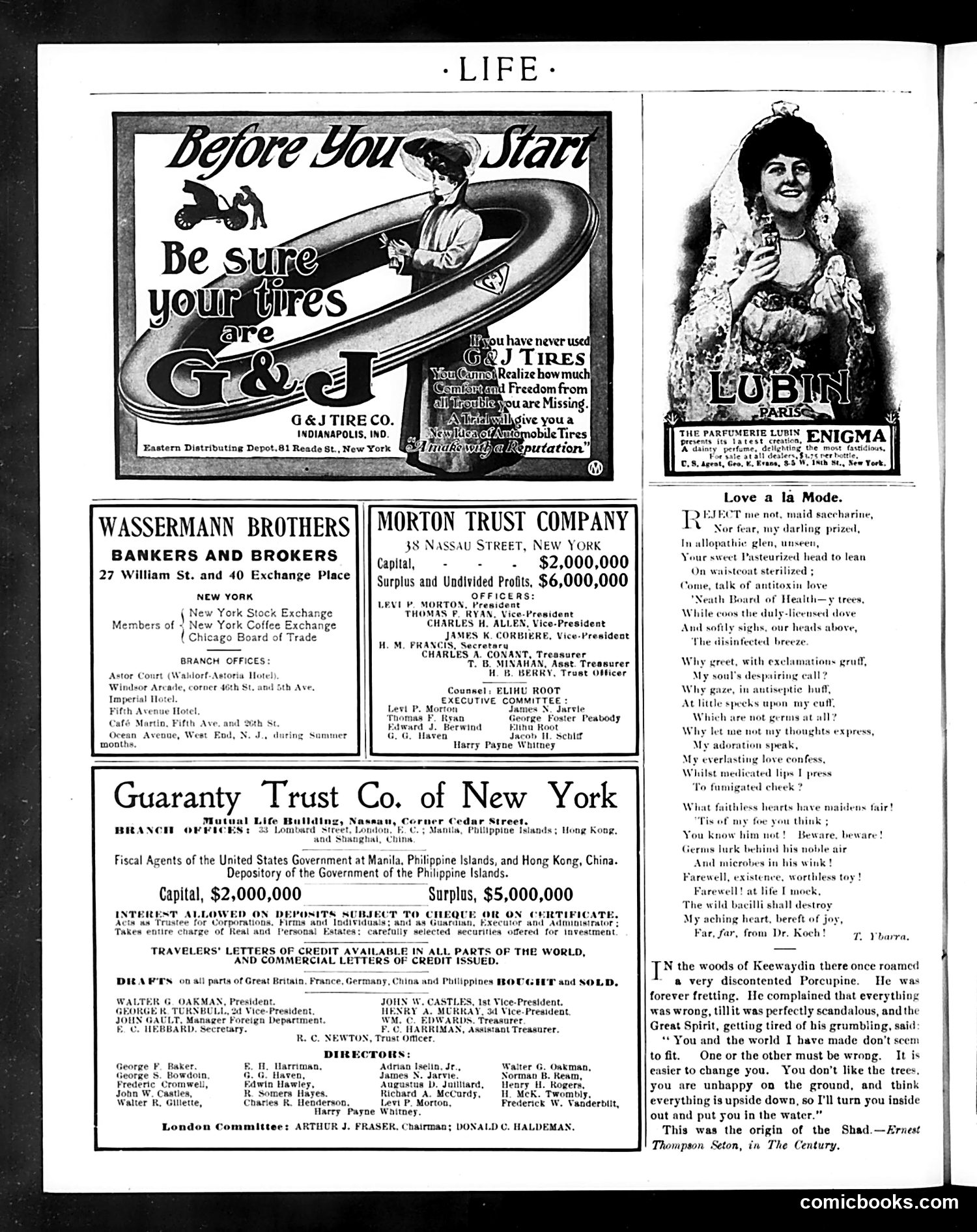
This page is primarily **financial advertising** for New York financial institutions (Morton Trust Company, Guaranty Trust Co., Wassermann Brothers), interspersed with literary content. The notable satirical element is the **G&J Tire advertisement** (upper left), which features a driver in an early automobile with the headline "Before You Start—Be sure your tires are G&J." This is straightforward product advertising playing on automobile safety concerns of the era. The **"Love à la Mode" poem** and accompanying illustration appear to satirize modern romance during the germ-theory era—mocking overly cautious, "antiseptic" courtship where fear of infection inhibits romantic expression. The reference to "Dr. Koch" alludes to Robert Koch's germ theory work, suggesting contemporary anxiety about microscopic pathogens was affecting even intimate relationships. The **Ernest Thompson Seton fable about the Porcupine** is a whimsical moral tale unrelated to satire—pure storytelling. Overall, this is a mixed-content page typical of *Life* magazine's format: advertising revenue alongside light satirical verse and fiction.
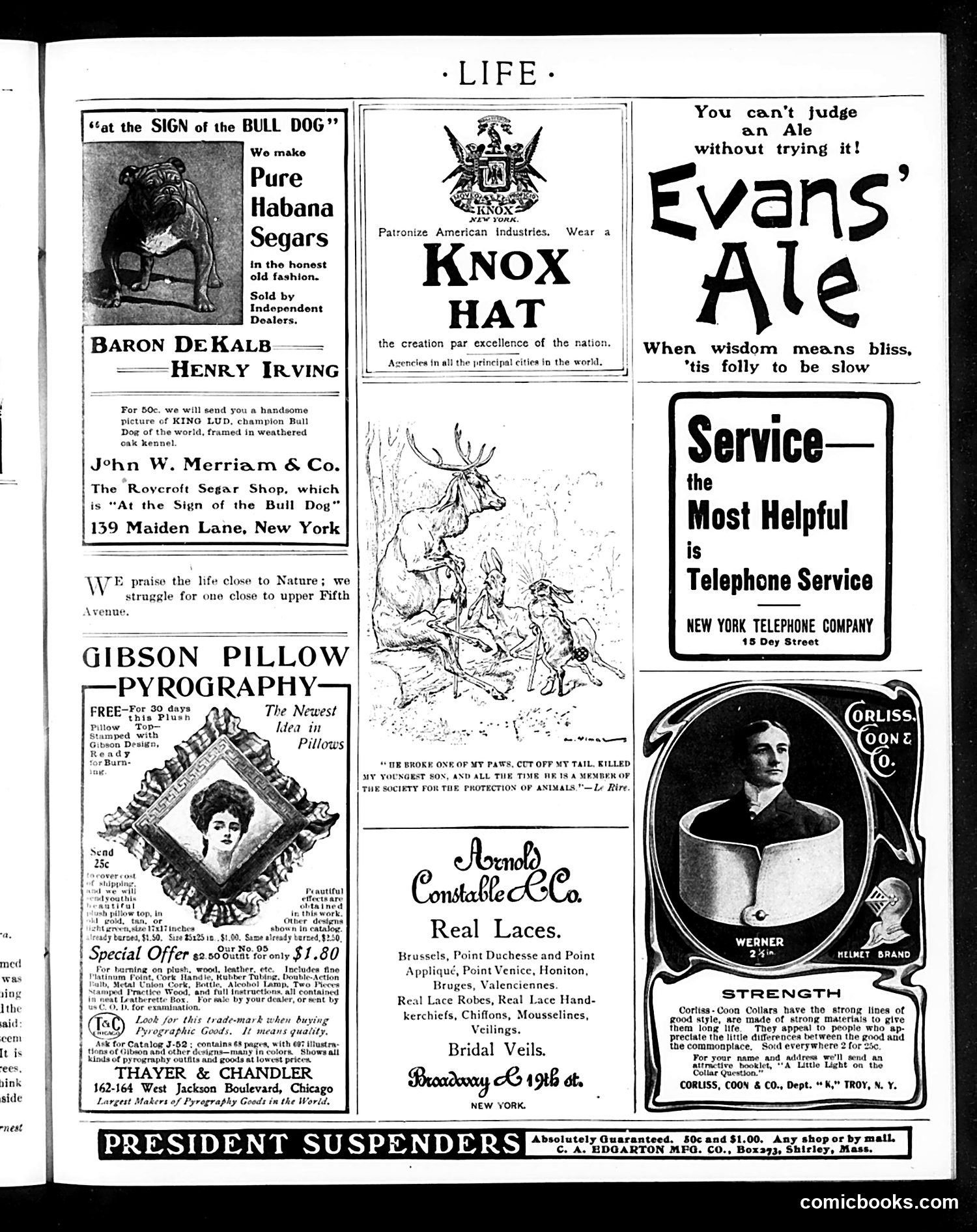
This is primarily an **advertisement page** with minimal satirical content. The page features various commercial ads from early 20th-century America, including cigars, hats, ale, pillows, lace, and telephone service. The one cartoon element is a **French satirical illustration** (credited to *Le Rire*, a French humor magazine) depicting a mistreated dog that ironically belongs to a member of the "Society for the Protection of Animals." The joke exposes hypocrisy: the dog's owner beats it, yet belongs to an animal welfare organization—mocking people who advocate for causes while behaving contrary to their stated principles. The ads themselves reflect period concerns: Knox Hats promote "American Industries," Evans' Ale uses the tagline "wisdom means bliss," and Corlis-Coon Collars emphasize durability. These are standard commercial pitches rather than satire, though Life's placement of such ads among humor content created an ironic contrast typical of the magazine's format.
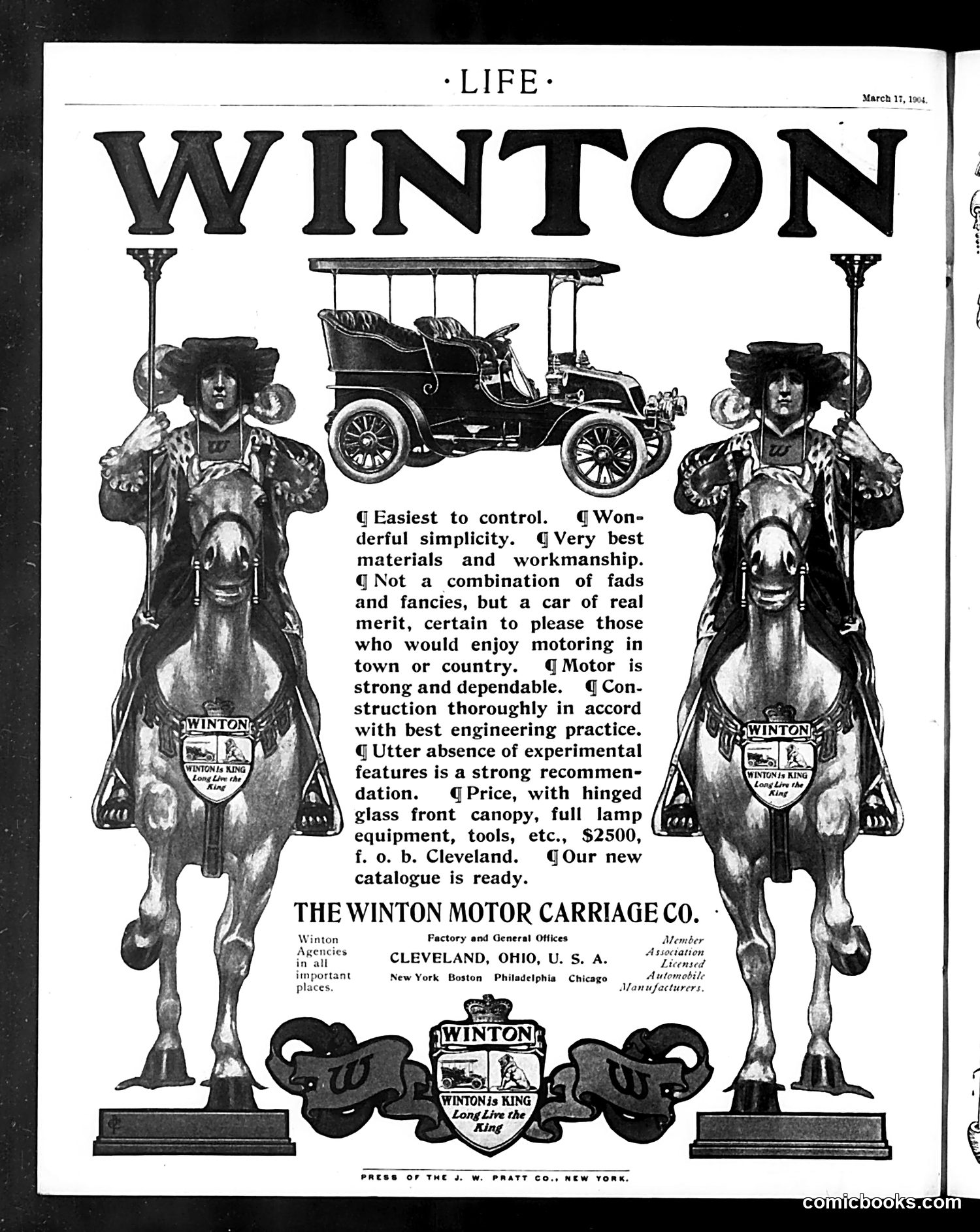
This is an advertisement for the Winton Motor Carriage Company, not a political cartoon. Published in *Life* magazine on March 17, 1904, it promotes an early automobile priced at $2,500. The visual design uses two large lion statues flanking a Winton carriage to suggest strength, stability, and regal status. The lions carry shields labeled "Winton" with the company slogan "Winton is King—Long Live the King," presenting the automobile as dominant and superior. The sales copy emphasizes practical virtues—simplicity, reliability, good engineering—rather than luxury or novelty. This approach reflects early automotive marketing, when manufacturers needed to convince skeptical buyers that cars were serious, dependable investments rather than experimental fads. The address in Cleveland, Ohio, reflects Winton's actual headquarters as one of America's early car manufacturers.