
A complete issue · 36 pages · 1904
Life — February 4, 1904
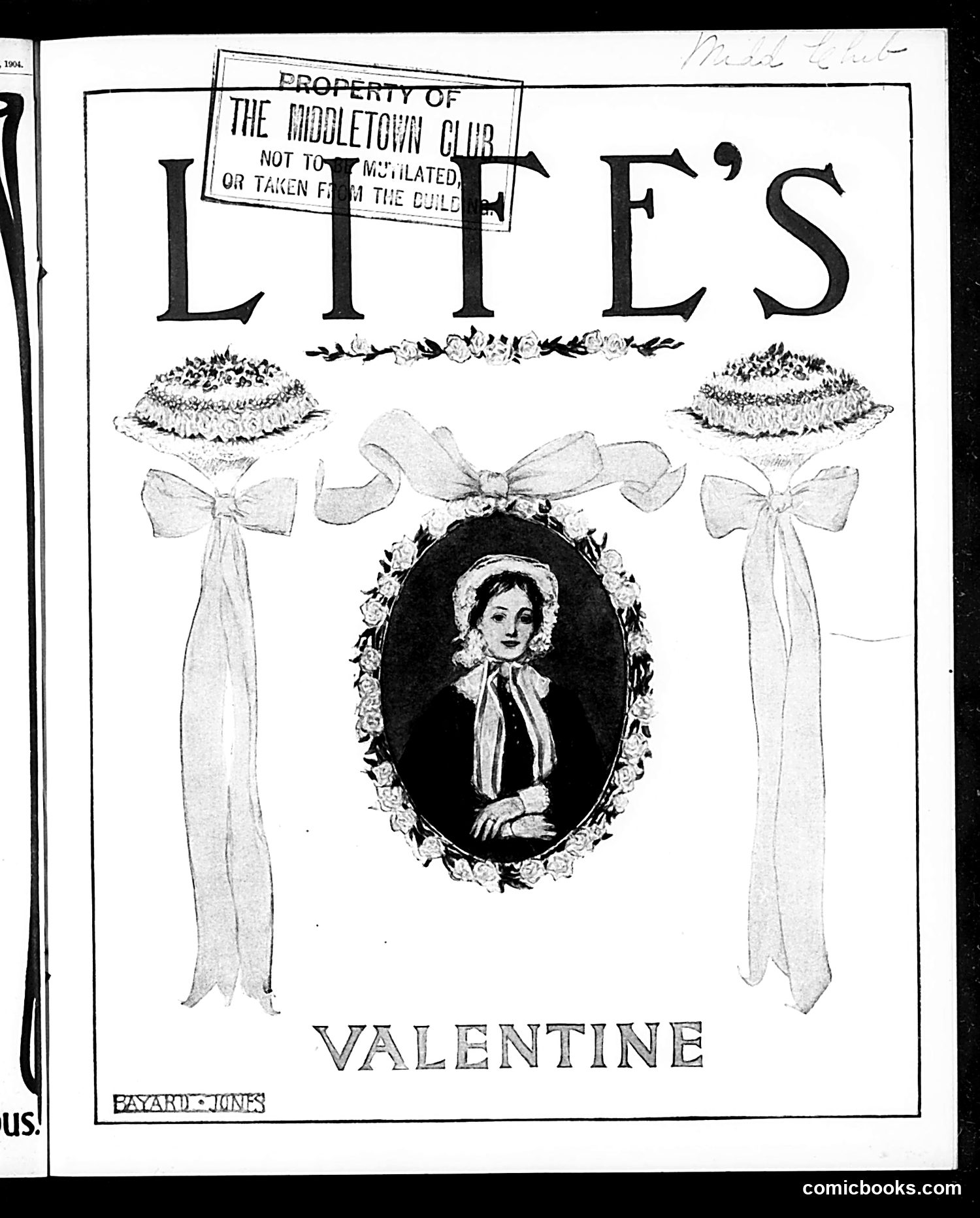
This is a Valentine's Day greeting card from *Life* magazine, a prominent American humor publication. The design features decorative elements typical of early 1900s Valentine imagery—ribbons, bows, and floral wreaths surrounding a portrait of a young woman wearing a bonnet. The text "LIFE'S VALENTINE" appears at the bottom, with artist credit to "Bayard Jones." The woman's portrait is framed in an ornamental oval wreath, and the page includes a property stamp indicating it belonged to the Middletown Club library. This appears to be straightforward sentimental illustration rather than political satire—a romantic greeting suitable for the magazine's Valentine's issue, celebrating feminine beauty and courtship conventions of the Edwardian era.
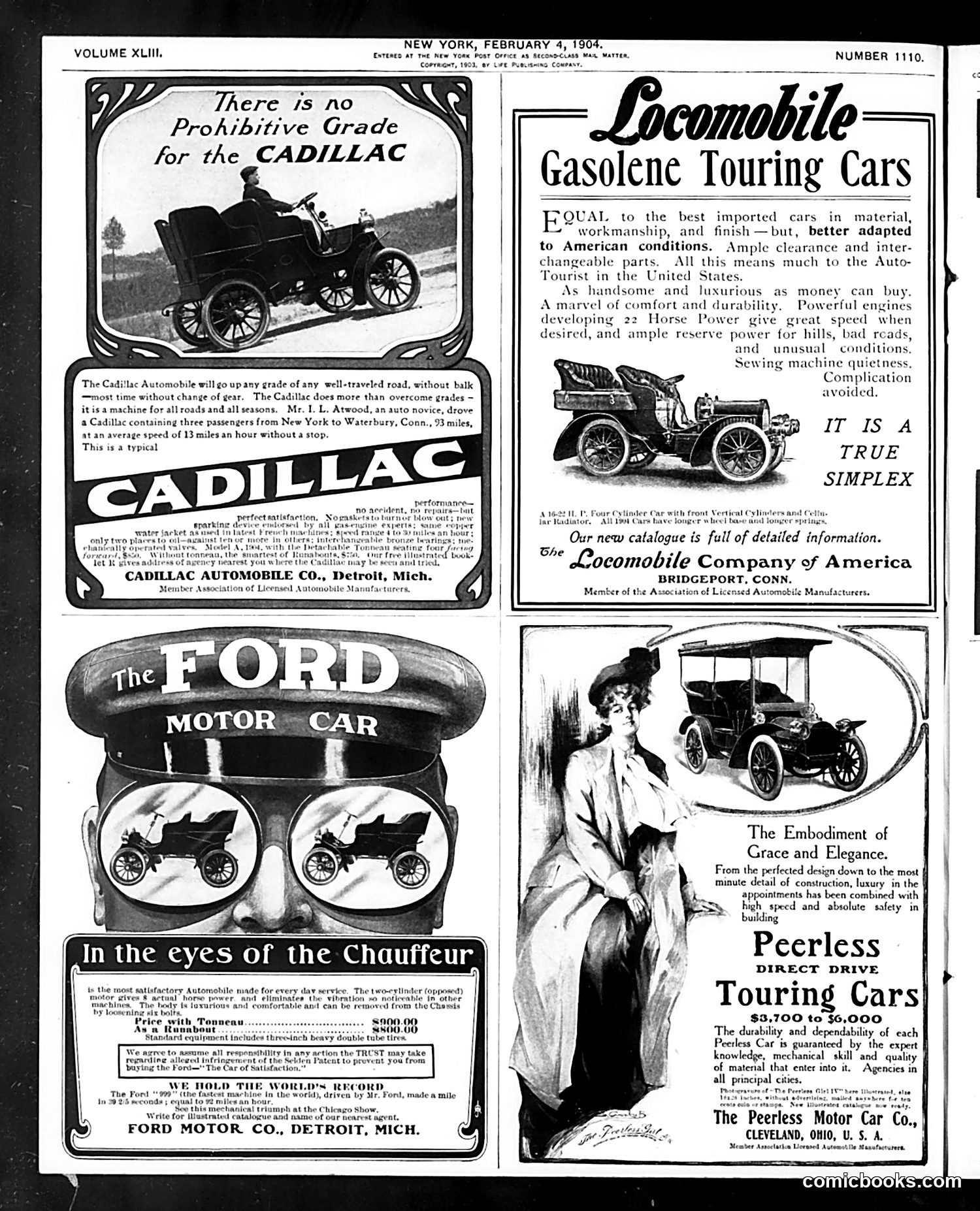
This page is **primarily automobile advertisements** from 1904, not political satire. It contains four car ads: Cadillac, Locomotive, Ford, and Peerless. The Cadillac ad emphasizes the car's ability to climb any grade without mechanical difficulty—a significant selling point when roads were primitive. The Ford ad notably claims the Model "T" (implied) holds "the world's record" for a two-cylinder motor, referencing a 1901 Chicago Show achievement. The Locomotive and Peerless ads stress luxury and reliability for affluent buyers. These ads reflect early automotive marketing focused on *reliability and capability* rather than speed or style, since reliable cars were still novel in 1904. No political cartoons or satire appear on this page.
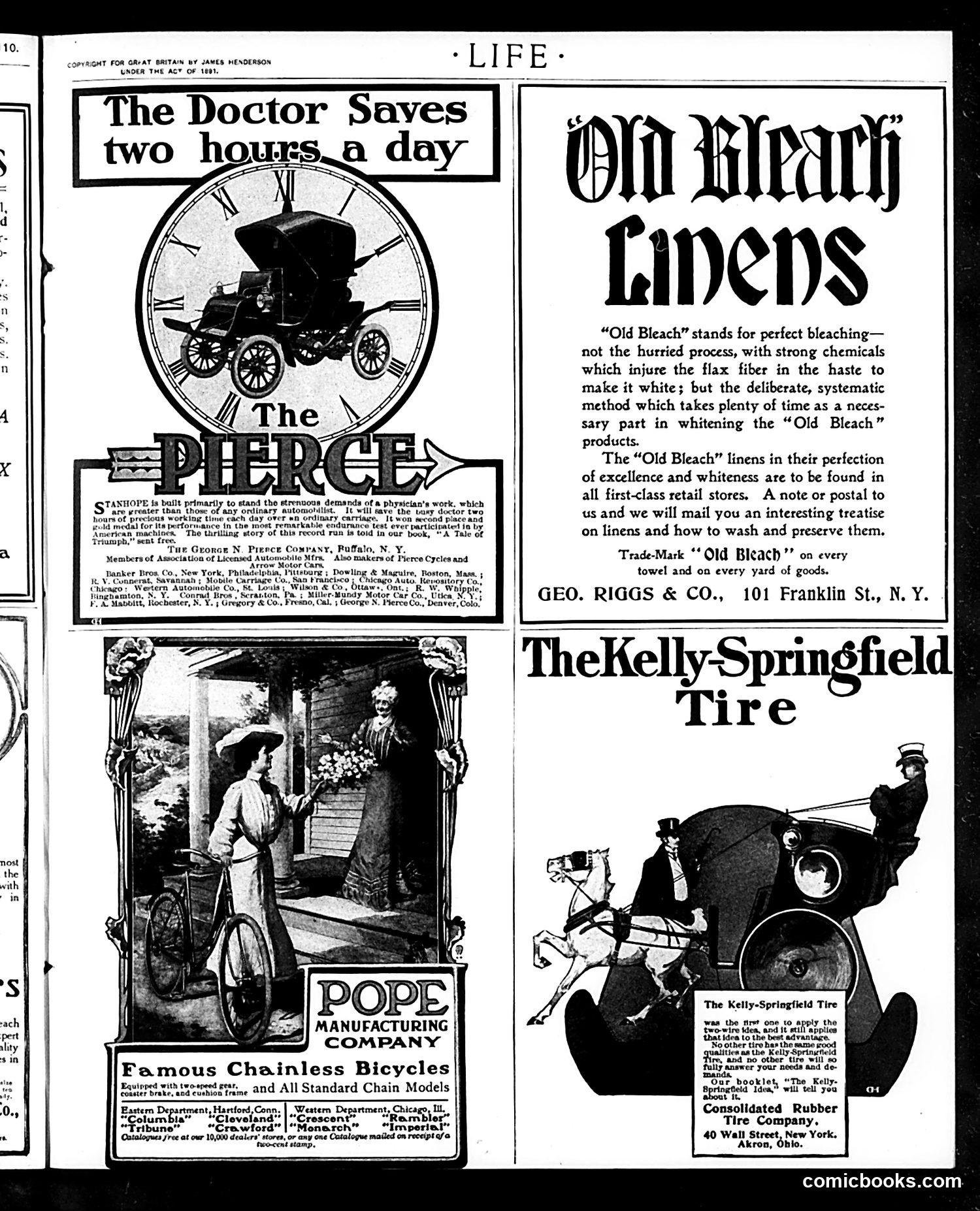
This page consists primarily of **period advertisements** rather than political satire or editorial cartoons. The four ads showcase early 1900s consumer products: 1. **The Pierce automobile** - advertises a doctor's time-saving vehicle 2. **Old Bleach linens** - promotes a whitening product with detailed manufacturing claims 3. **Pope Manufacturing bicycles** - features a romantic scene of someone arriving by bicycle 4. **Kelly-Springfield Tire** - displays an automobile with passengers The Pierce ad's headline "The Doctor Saves two hours a day" is the closest to humor—suggesting automobiles freed professionals from time-consuming travel. Otherwise, these are straightforward product endorsements typical of *Life* magazine's advertising revenue model, emphasizing newly available consumer goods and modern conveniences for affluent readers.
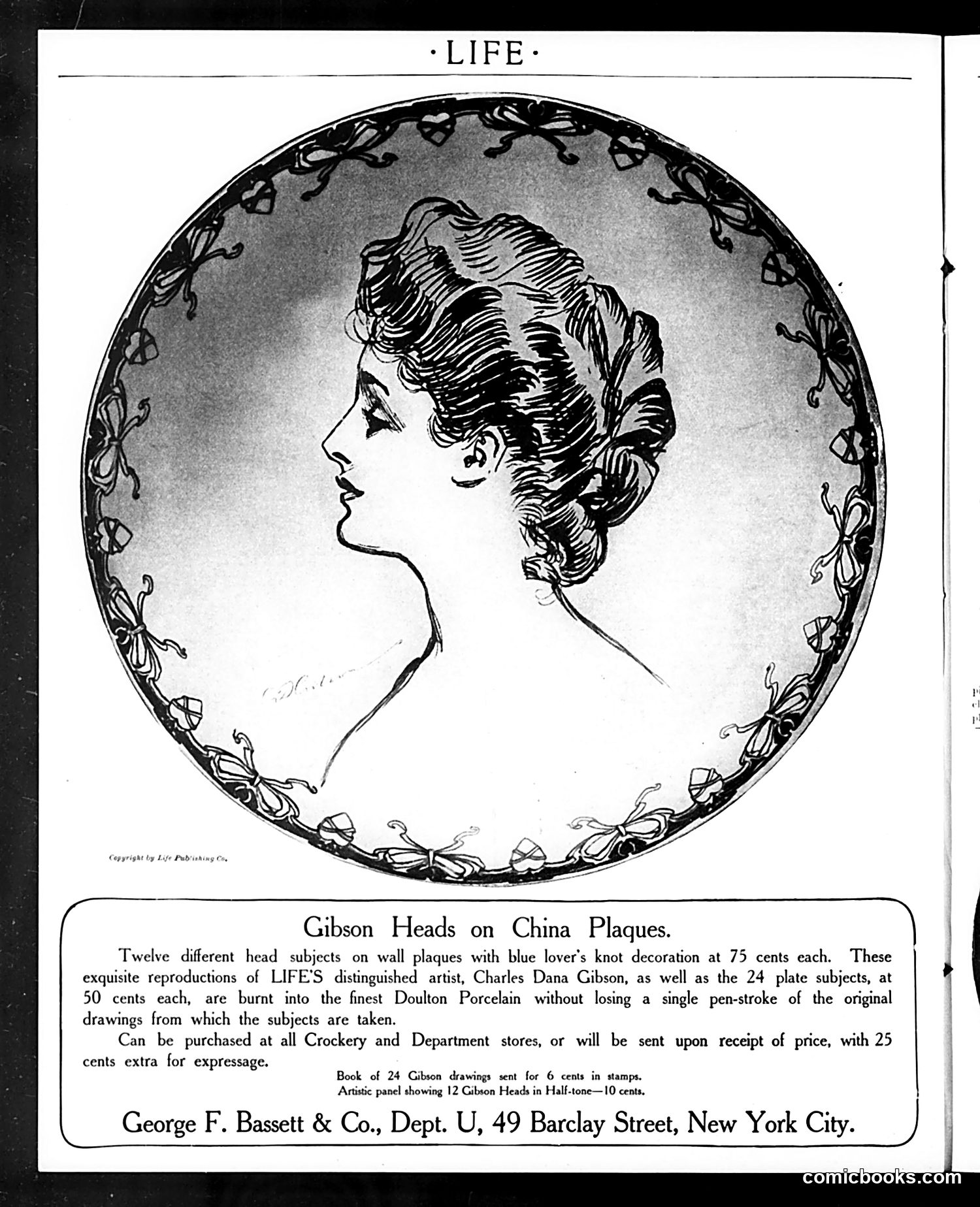
This page is primarily **advertising**, not political satire. It promotes decorative china plaques featuring portrait heads by Charles Dana Gibson, the famous illustrator known for creating "Gibson Girl" images of idealized women. The advertisement describes twelve different head designs available as wall plaques with blue lover's-knot decoration, priced at 75 cents each. The products were manufactured by Doulton Porcelain and sold through Crockery and Department stores, or by mail order from George F. Bassett & Co. in New York City. This represents early 20th-century consumer culture—transforming a popular artist's work into affordable home décor products for middle-class consumers. The decorative border and elegant profile shown exemplify the refined aesthetic Gibson's name signified.
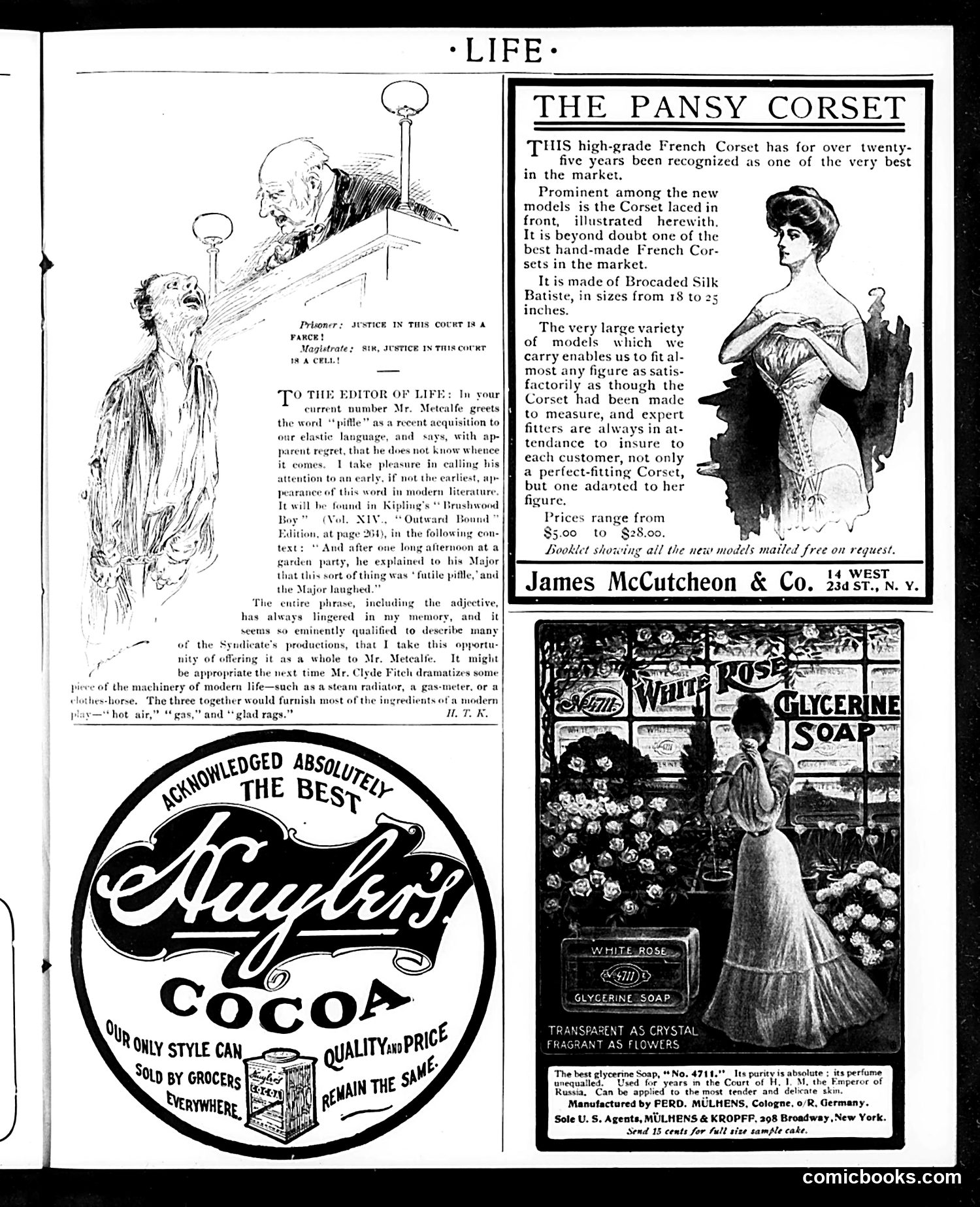
The main cartoon depicts two figures labeled "Justice in this court is a farce" and "Sir, justice in this court is a cell." This appears to be political satire about courtroom justice, though the specific legal case or scandal referenced is unclear from this excerpt alone. The bulk of the page consists of period advertisements: Auyler's Cocoa emphasizes quality and availability, while James McCutcheon & Co. advertises "The Pansy Corset" as a high-grade French import. White Rose Glycerine Soap claims superiority and purity. These advertisements reflect early-1900s consumer culture and marketing claims typical of Life's revenue model. The page is primarily commercial rather than satirical content.
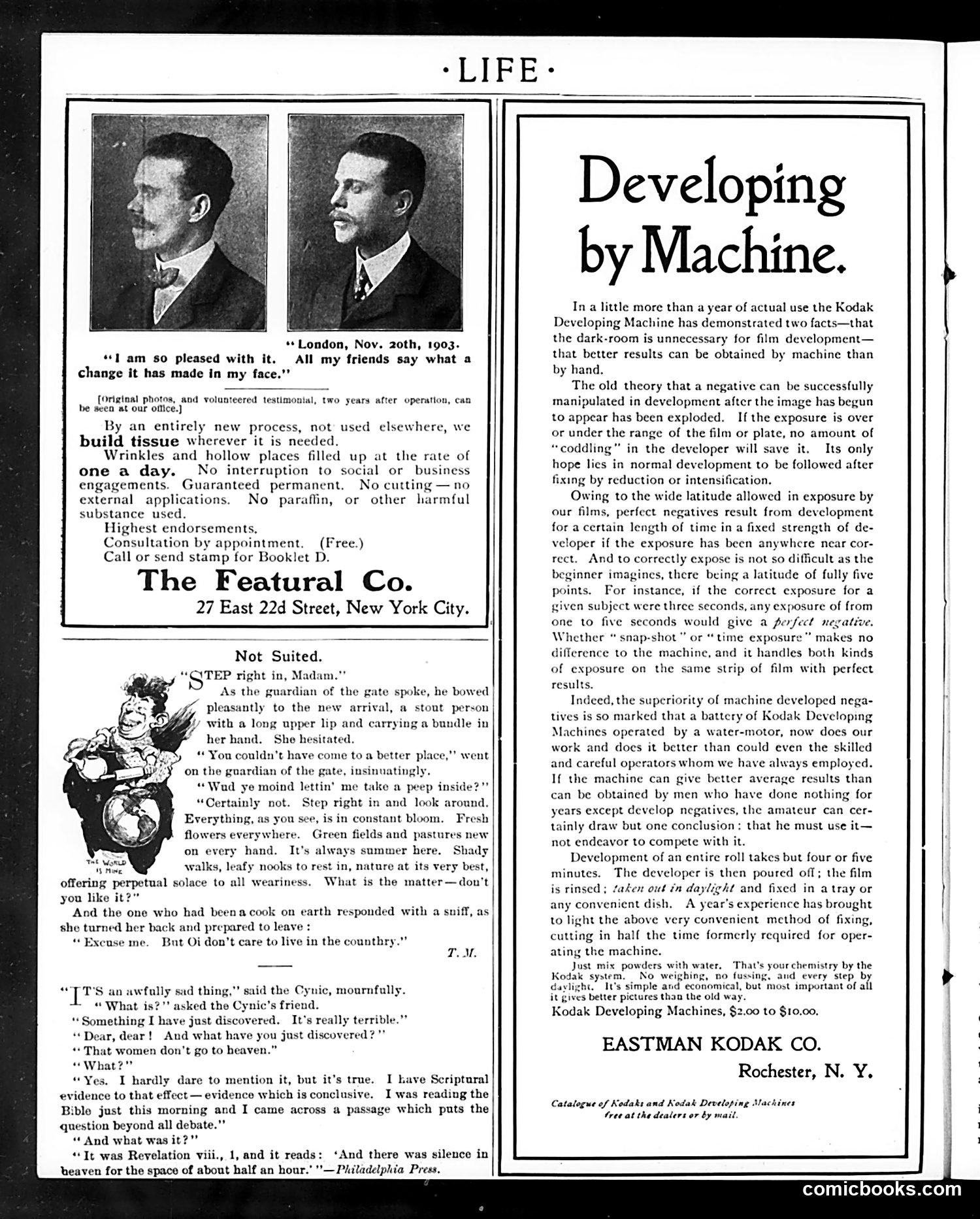
This page contains two distinct sections: **Left side:** An advertisement for "The Natural Co." featuring before-and-after photographs of a man's face, claiming their process eliminates wrinkles through tissue-building. The testimonial claims results within a year. **Center-left:** A short humorous story titled "Not Suited," illustrated with a cartoon of a stout woman at a garden gate. The joke involves wordplay about a cook seeking employment—the gatekeeper misunderstands her request to "let in" as permission to look inside, leading to the cook's indignant response about not wanting country life. **Right side:** A Kodak advertisement promoting their developing machines, emphasizing that amateur photographers can achieve professional results through mechanical development rather than hand-processing. The page mixes commercial advertising with light humor—typical Life magazine content from the early 1900s.
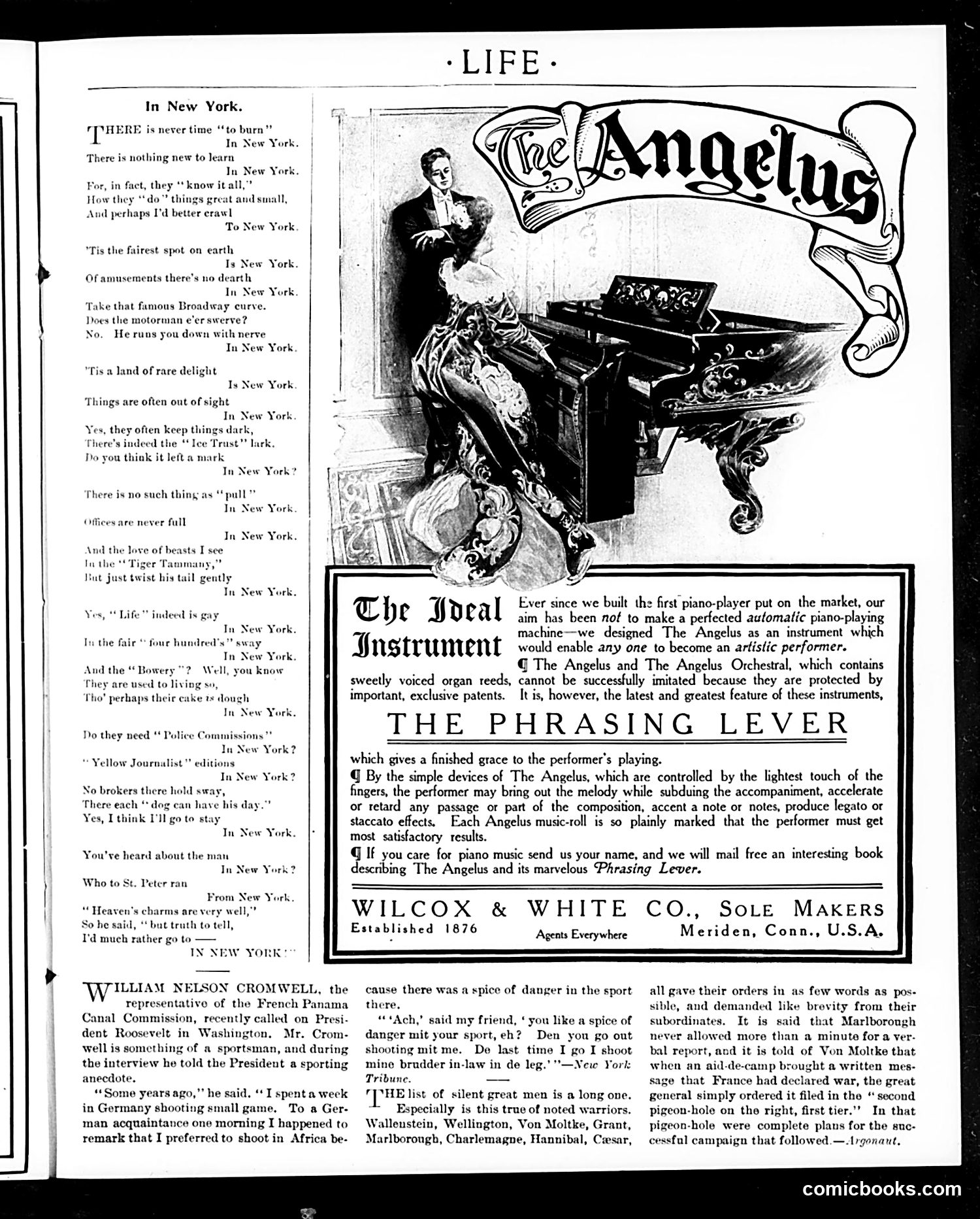
This page is primarily **advertising** for The Angelus, a player piano made by Wilcox & White Co. of Meriden, Connecticut (established 1876). The left side contains humorous poetry titled "In New York," which satirizes New York life through repeated observations about things being "never" done or known there—a lighthearted jab at New York's reputation for constant novelty and chaos. The main illustration shows an elegantly dressed woman at an ornate piano, promoting The Angelus's "Phrasing Lever," which allegedly allows anyone to become an "artistic performer." The advertisement emphasizes the device's sophisticated mechanical controls, positioning the player piano as accessible luxury for the aspirational middle class during this early 20th-century period.
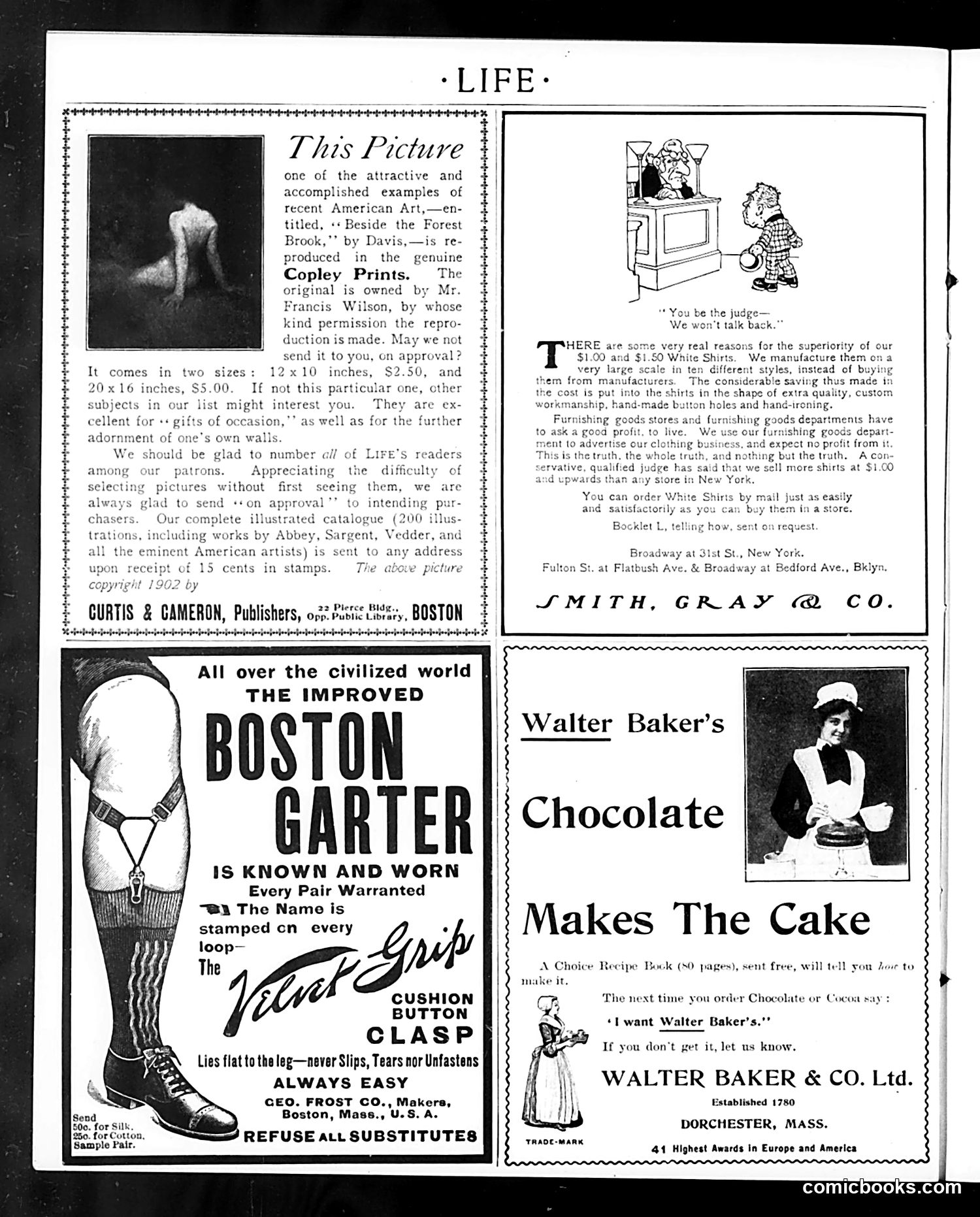
This is primarily an **advertising page** from Life magazine, not a political cartoon. The page contains four advertisements: 1. **Top left**: An art print advertisement for Curtis & Cameron Publishers (Boston), featuring a nature photograph titled "Beside the Forest Brook" by Davis, available in two sizes. 2. **Top right**: Smith, Gray & Co. advertisement for White Shirts, emphasizing quality and custom workmanship as superior to cheaper mass-produced alternatives. 3. **Bottom left**: The Improved Boston Garter advertisement, featuring an illustration of a woman's leg, promoting a garter clasp that "never slips, tears nor unfastens." 4. **Bottom right**: Walter Baker's Chocolate advertisement, promoting their baking chocolate and offering a free recipe book. The page reflects early 20th-century consumer culture and advertising aesthetics rather than satire or political commentary.
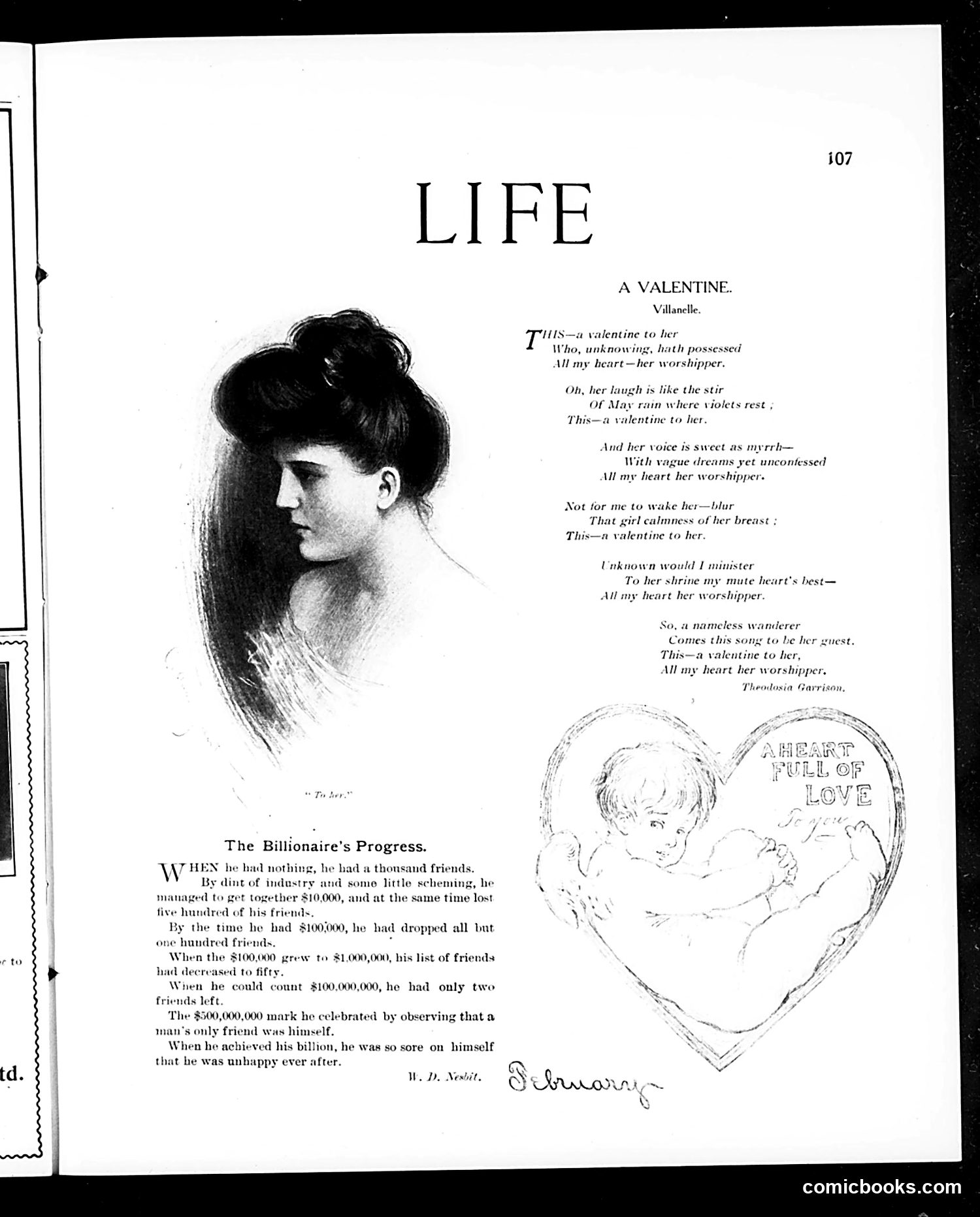
This page contains two distinct pieces: **"A Valentine" (poem by Villanelle):** A romantic poem dedicated to an unnamed woman, illustrated with a sketch of a woman's profile. The verse expresses devotion, comparing her qualities to natural imagery (May rain, myrrh). It's a conventional Valentine's tribute with no apparent satire. **"The Billionaire's Progress" (by W.D. Nesbit):** A satirical verse using ironic logic to critique wealth accumulation. As a man grows richer—from $1,000 to $1 billion—his friendships proportionally disappear, until at the peak of wealth he has only two friends left and is utterly unhappy. The final couplet: a man's only true friend is himself. This mocks the isolating effects of extreme wealth and the transactional nature of friendships among the wealthy. The accompanying heart illustration labeled "A Heart Full of Love" provides romantic counterpoint.
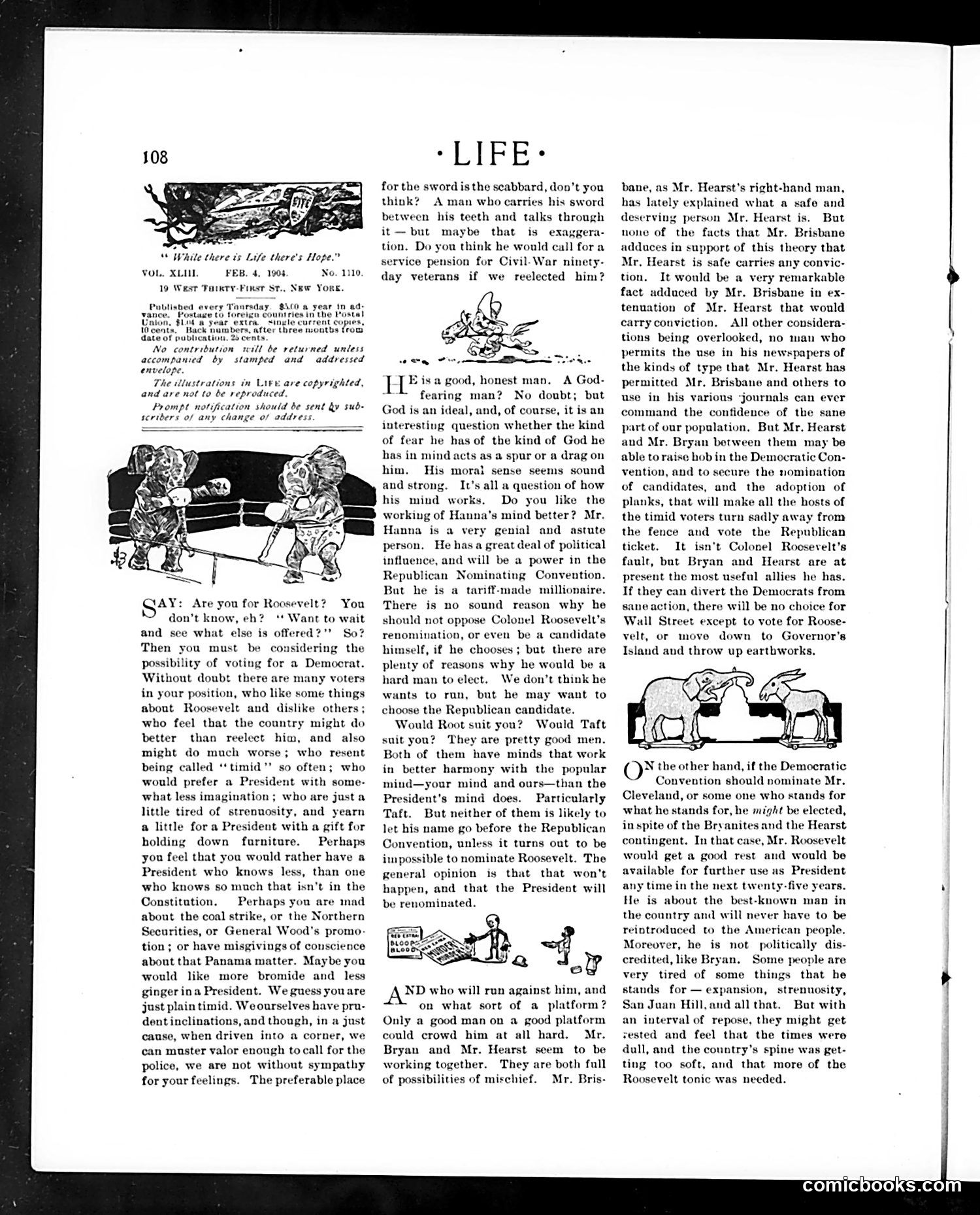
This *Life* magazine page discusses the upcoming presidential race, debating whether voters should support Roosevelt, Taft, or Bryan. The text dismisses the idea that Roosevelt would run a third-party campaign, arguing he lacks sufficient political appeal compared to established candidates. The cartoon showing two donkeys (Democratic and Republican symbols) illustrates the competing parties' strategic positions. The commentary suggests Bryan might be the Democratic nominee, while questioning whether Taft or Roosevelt better represents Republican interests. The page's overall argument emphasizes that both major parties contain capable leaders, but neither Roosevelt nor Bryan represents the type of decisive leadership the country currently needs—a critique of the candidates' ability to energize voters.
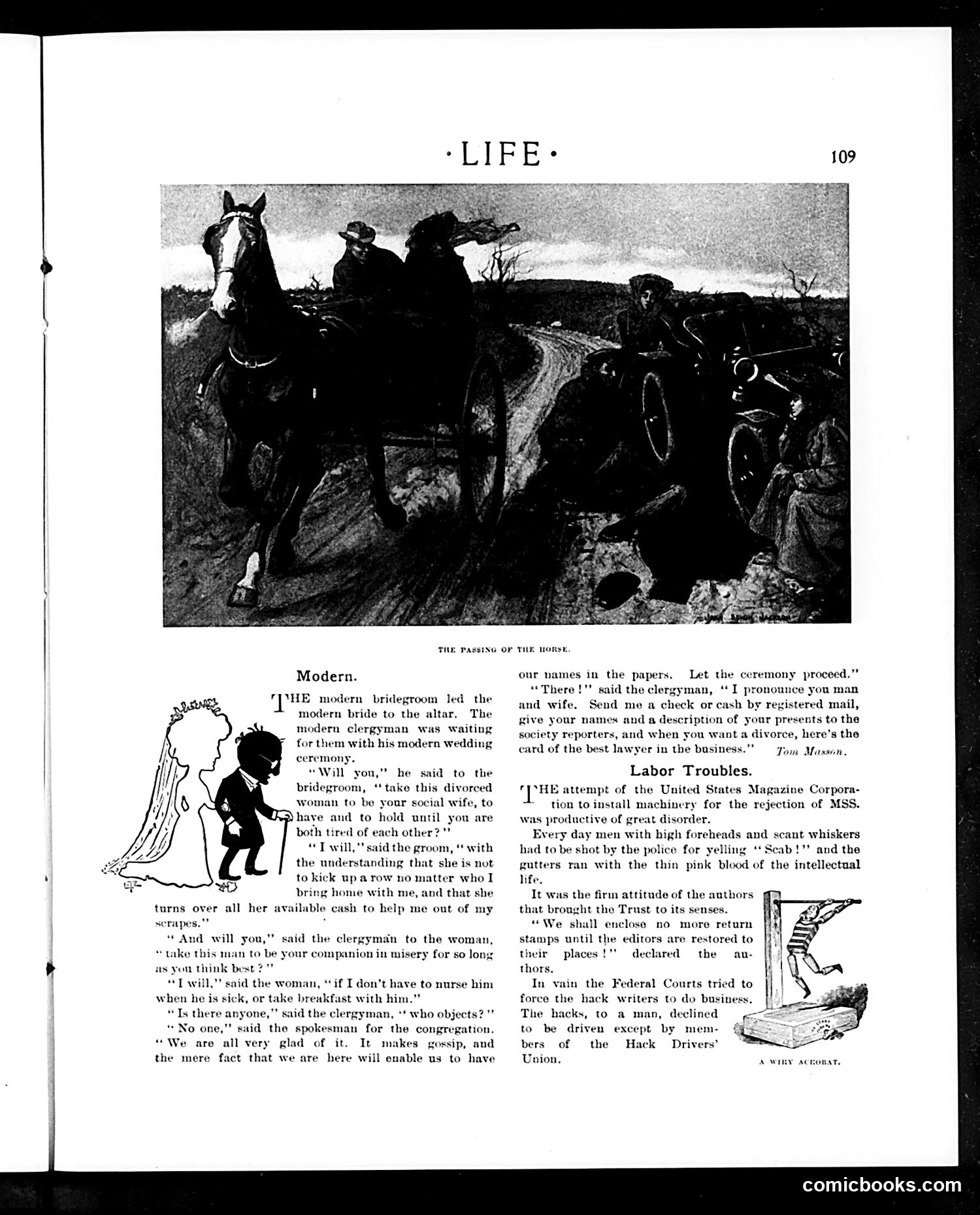
This page contains two satirical pieces about early 20th-century social issues. **"Modern" (top cartoon):** A humorous dialogue mocking modern marriage. A bridegroom negotiates terms with his bride like a business contract, discussing her "available cash" and her obligation to "hold until you are both tired of each other." The clergyman facilitates this transactional view of marriage, reducing matrimony to financial arrangement and mutual self-interest rather than romantic commitment. **"Labor Troubles" (bottom section):** Satirizes labor unrest at *United States Magazine Corporation*. The text describes writers and "hack drivers" (freelance journalists) refusing to work, demanding editors restore their positions. The satire mocks both the authors' dramatic stance ("We shall enclose no more return stamps") and the absurdity of literary workers organizing like industrial laborers. The small cartoon shows a dejected writer, emphasizing the piece's mockery of struggling writers' pretensions.
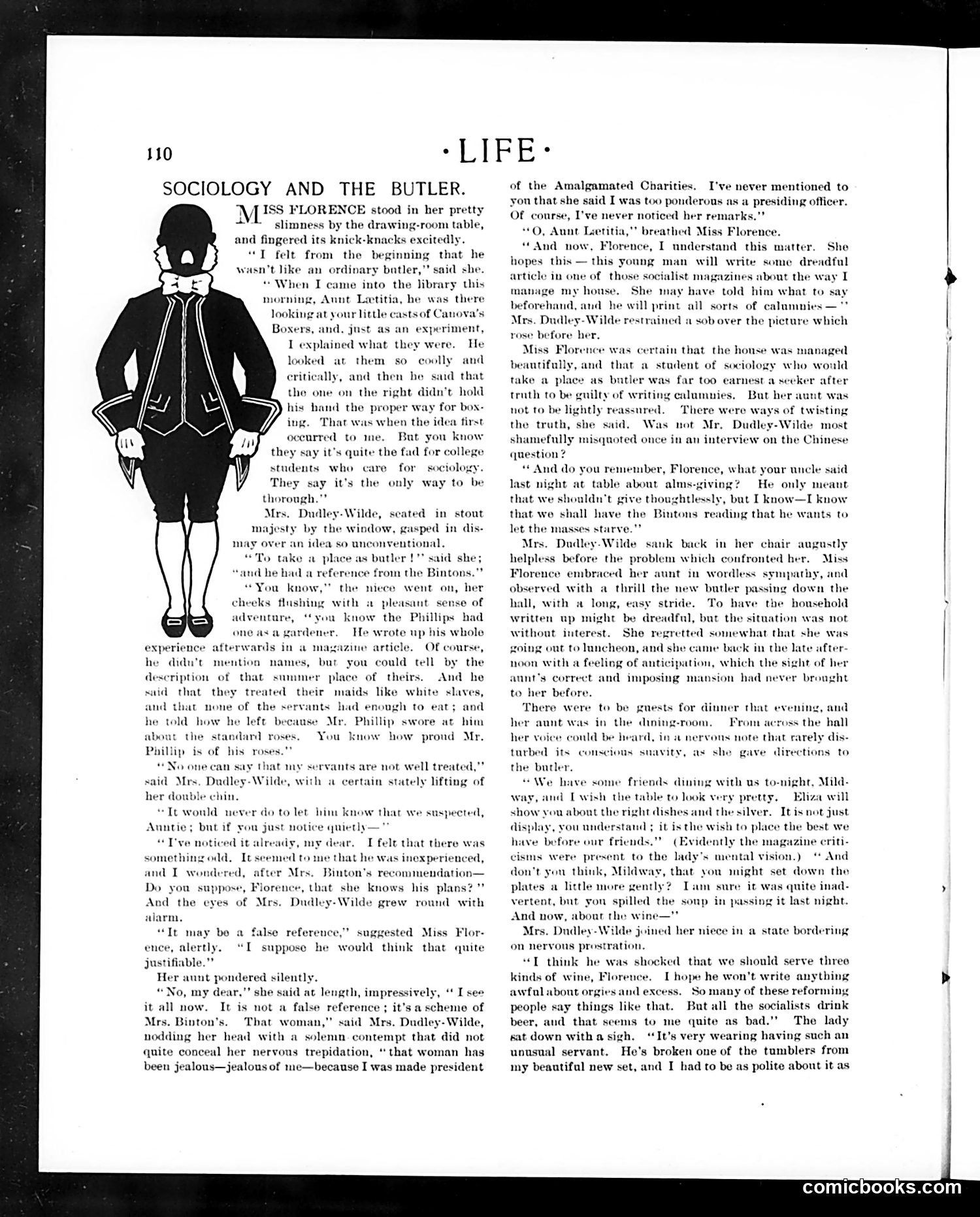
This satirical piece mocks early 20th-century "sociology" as a fashionable intellectual pursuit among wealthy women. The illustration shows a butler in formal livery—the figure being analyzed. The narrative involves Miss Florence and her aunt Mrs. Dudley-Wilde discussing whether a young sociology student should write about their household management. The humor centers on social pretension: Mrs. Dudley-Wilde worries the student will expose unflattering truths about their servants and household operations (including servant mistreatment), while simultaneously insisting their servants are "well treated." The satire targets how affluent people used "sociology" as a trendy intellectual interest while resisting actual scrutiny of their social practices—a critique of performative concern for social reform disconnected from genuine ethical behavior.
This page contains a serialized short story rather than political cartoons. The narrative concerns a dinner party at the home of Mr. and Mrs. Dudley-Wilde, where their awkward houseguest Mildway—whom Florence suspects may be a socialist agitator—observes the family's servants and class dynamics with a "scornful smile." The satire targets upper-class anxiety about revolutionary sentiment. Mrs. Dudley-Wilde carefully steers dinner conversation away from labor disputes and workers' rights, terrified that Mildway (who listens intently to servants' grievances) will judge her household as oppressive. The climax reveals Mildway committing burglary—he's not a dangerous intellectual but a common criminal. The joke appears to be mocking both bourgeois paranoia about radicalism *and* the servant class itself: the real threat isn't ideology but theft. The wealthy obsess over appearances while their employees steal their silver.
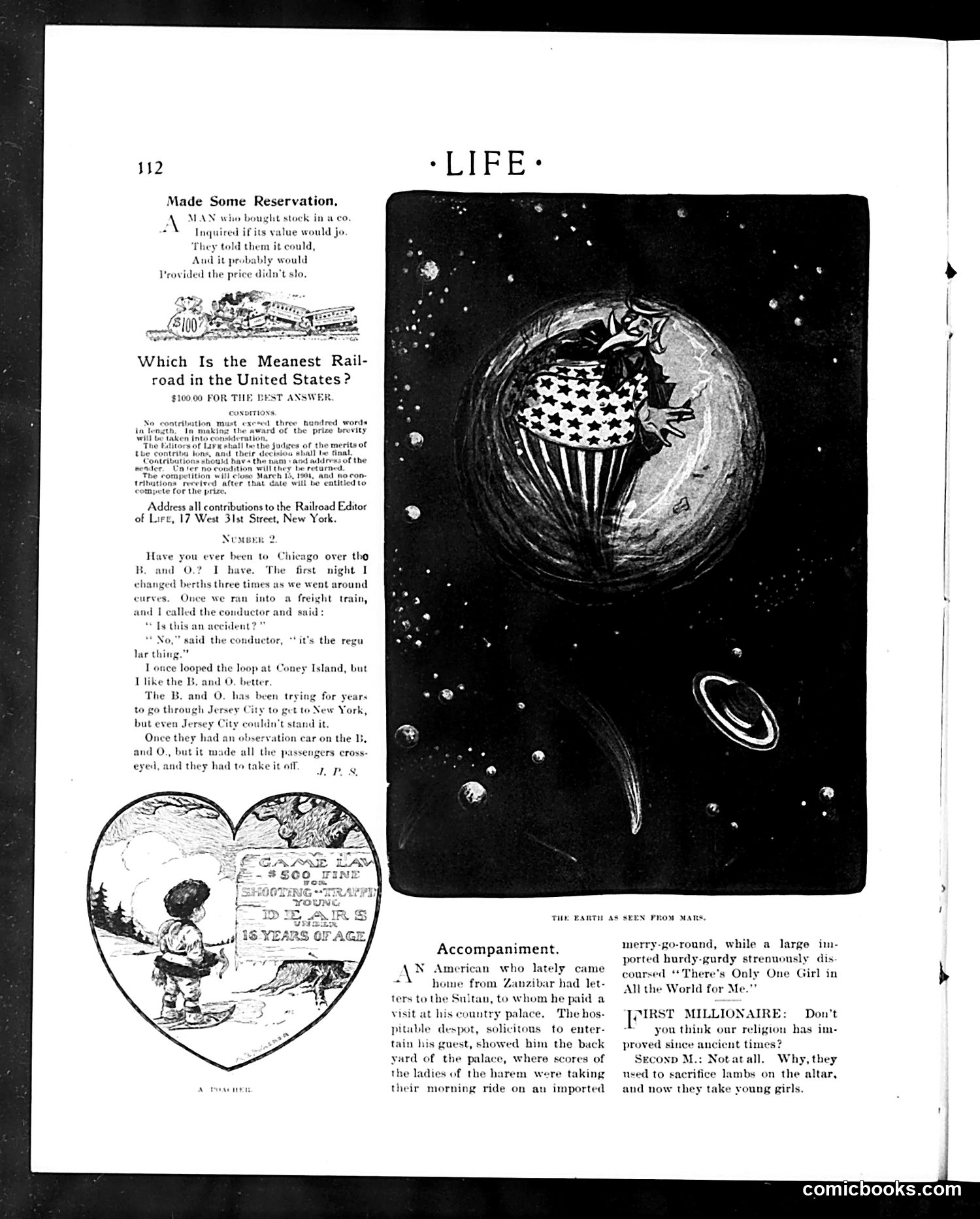
This page contains several satirical pieces typical of early 20th-century American humor: **"Made Some Reservation"** is a brief joke about a stock investor asking about a company's value—the humor lies in the circular logic of financial speculation. **"Which Is the Meanest Railroad?"** is a $100 contest soliciting reader submissions. The accompanying anecdote (labeled "Number 2") mocks the B&O (Baltimore & Ohio) and another railroad for poor service—specifically their bumpy rides and difficulty transporting passengers through New Jersey to New York without making them "cross-eyed." **"The Earth as Seen from Mars"** is an illustration captioned with an anecdote about an American visiting a Sultan in Zanzibar. The humor is in the contrast: the Sultan entertains his guest by showing off his harem women riding a merry-go-round while a hurdy-gurdy plays "There's Only One Girl in the World for Me"—satirizing both exotic orientalism and American sentimentality. **The final joke** mocks wealthy hypocrisy: a millionaire claims religion has improved, but a second character points out that ancient animal sacrifices have merely been replaced by modern exploitation of young women.
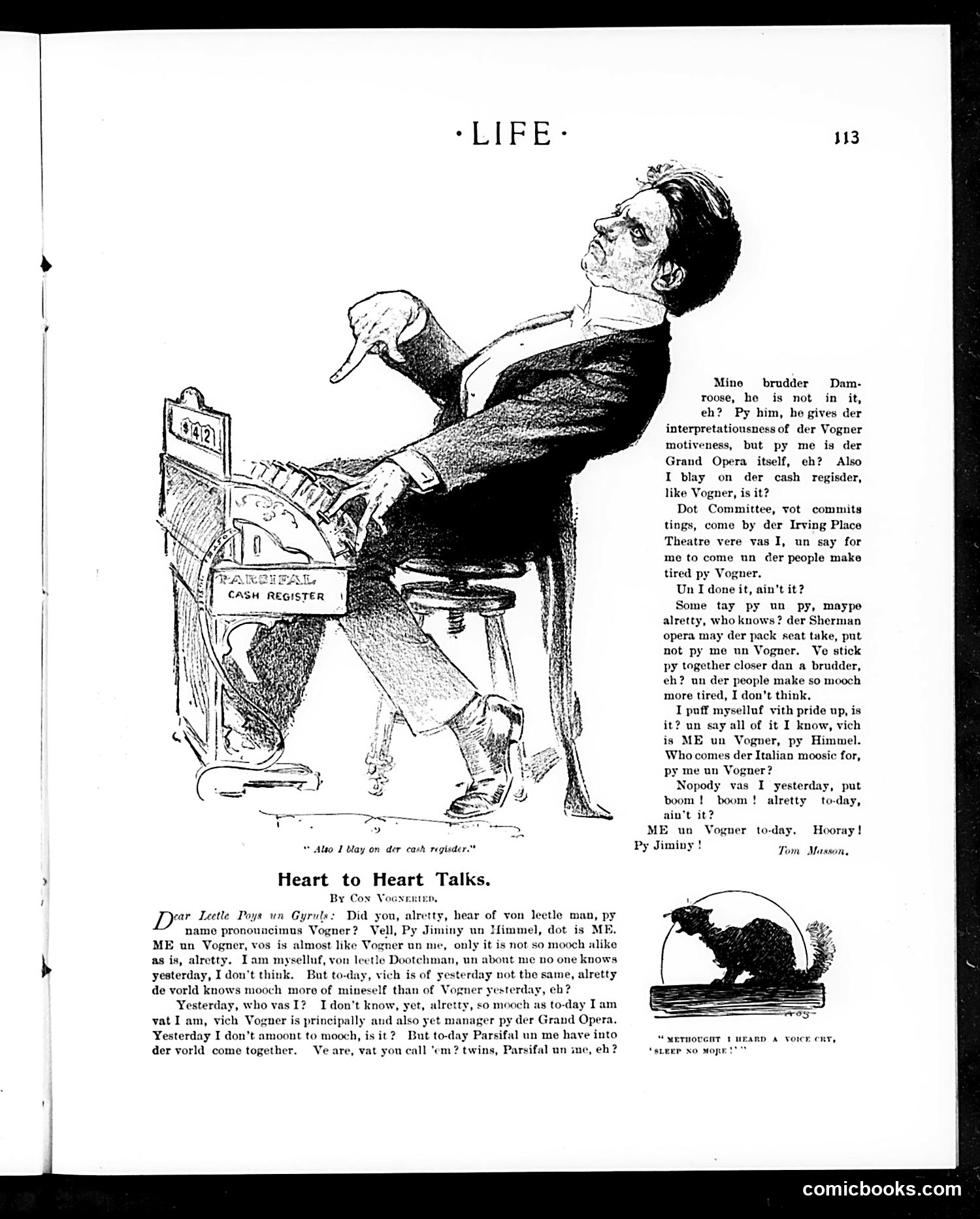
This page satirizes a German-accented immigrant's obsession with Richard Wagner and operatic success. The main cartoon shows a man at a cash register labeled "National Cash Register," striking a proud pose while holding a duck—a visual pun on "laying on der cash register" (playing the cash register). The accompanying "Heart to Heart Talks" dialogue presents a comic character claiming newfound importance through association with Wagner's opera *Parsifal* at the Irving Place Theatre. The humor relies on: 1. **Heavy German dialect** ("Py Jiminy," "Dootchman") mocking immigrant speech patterns 2. **Self-aggrandizement through Wagner**—the speaker inflates his importance by connecting himself to the famous composer 3. **Social climbing**—yesterday he was nobody; today he's "twins" with *Parsifal* itself The satire targets both pretentious operatic culture and immigrant aspirations for social status in early 20th-century America, presenting the character as comically delusional about his newfound relevance.
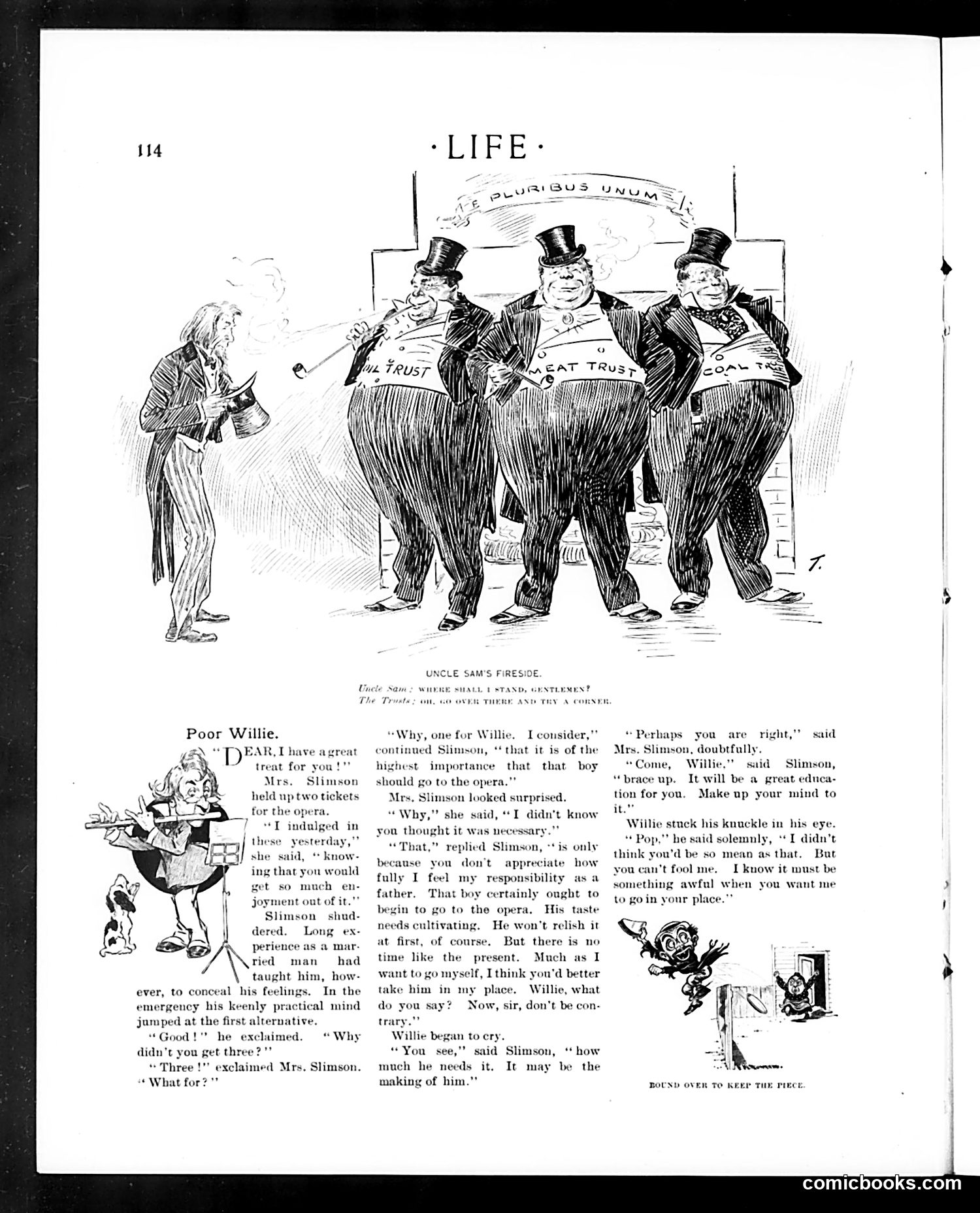
**Top Cartoon:** Depicts Uncle Sam (thin, elderly figure on left) confronting three bloated, top-hatted monopolists labeled "Oil Trust," "Meat Trust," and "Coal Trust." They stand before a building marked "E Pluribus Unum" (the national motto). This satirizes the major industrial trusts—massive corporations controlling entire industries—that dominated American business in the Progressive Era. Sam appears powerless against these giants, reflecting public anxiety about corporate monopolies controlling the economy and potentially the government. **"Poor Willie" Story:** A humorous domestic tale where Mr. Simson manipulates his wife into attending the opera by claiming their son Willie needs cultural refinement—while actually securing free tickets for himself. Willie sees through the ruse, knowing his father wouldn't sacrifice his own pleasure unless something was truly awful. The satire mocks masculine deception and self-serving rationalization disguised as paternal concern.
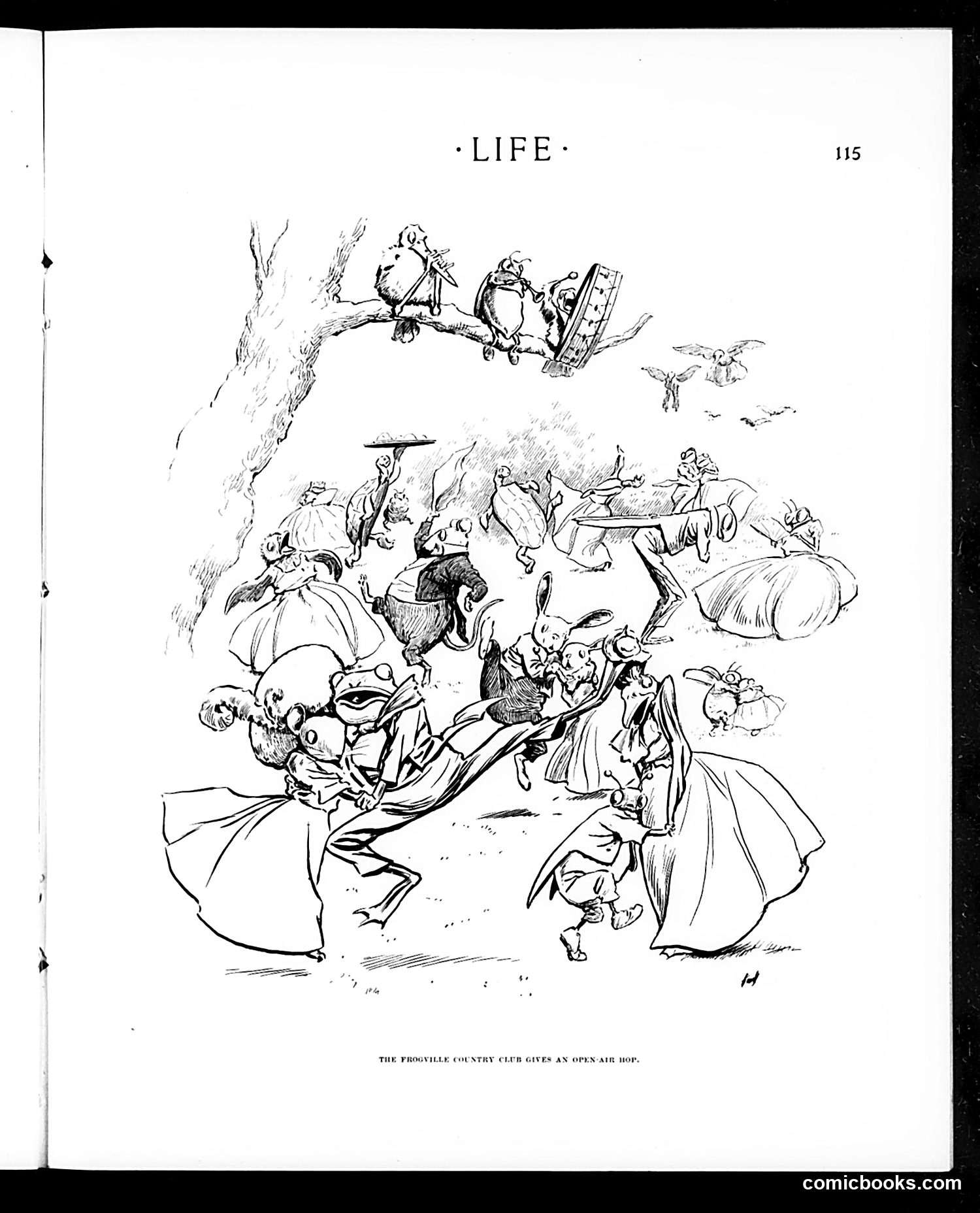
This is a whimsical anthropomorphic cartoon depicting frogs hosting a dance or social gathering ("hop"—a pun on frogs' movement). The illustration shows various dressed-up frogs in human clothing engaged in recreational activities: dancing, socializing, and enjoying themselves outdoors. The humor derives from the animal characters adopting human social conventions and leisure activities typical of early 20th-century country club culture. The "Frogville Country Club" setting is a playful reference to exclusive social clubs of the era. The cartoon appears to be light satirical commentary on human social pretension, using animal characters to gently mock the formality and self-importance of such exclusive establishments, a common strategy in Life magazine's humor.
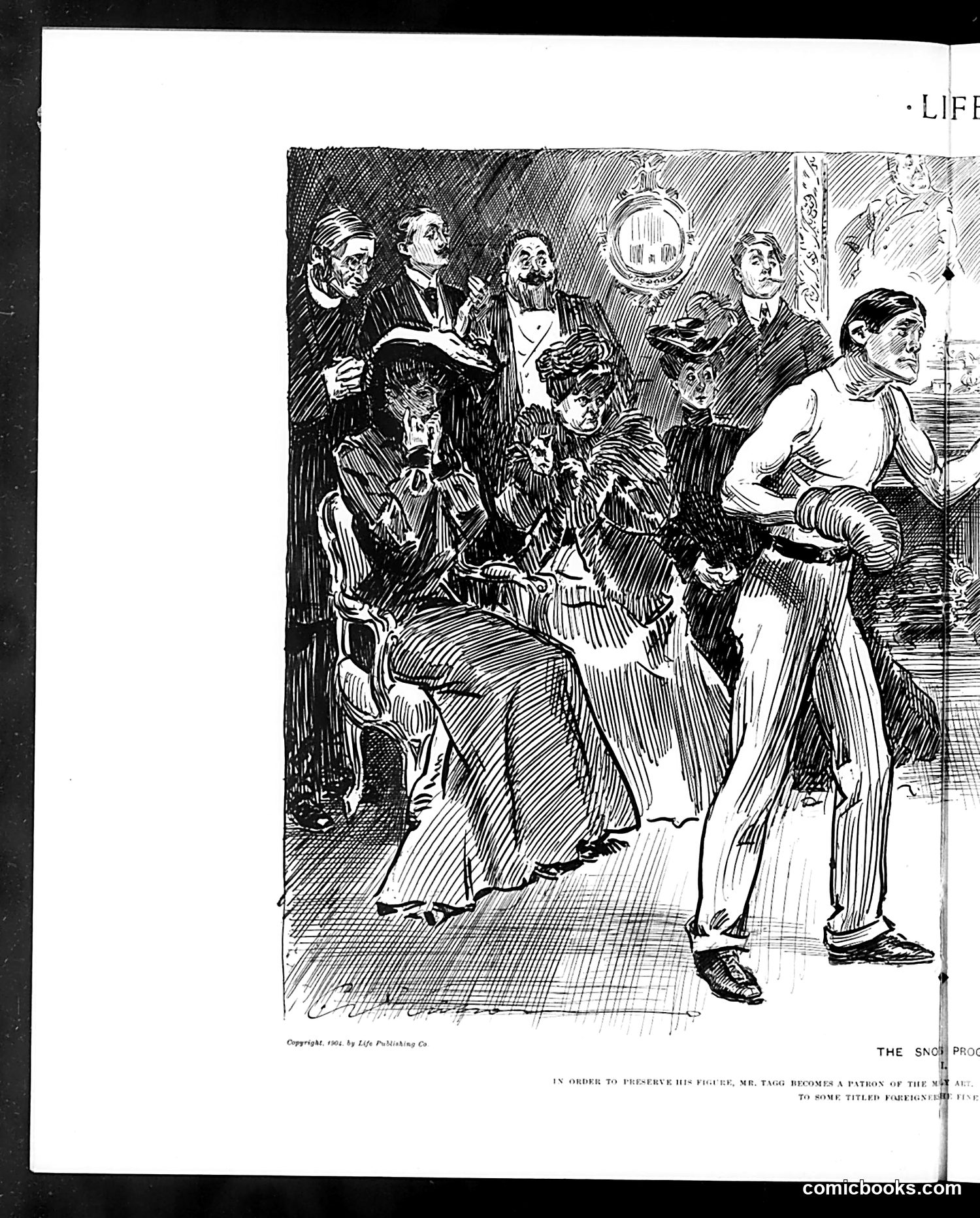
This satirical illustration depicts a scene of social pretension. The caption indicates the central theme: a man named Tagg becomes a patron of the arts to preserve his social status and claim titles associated with foreign nobility. The cartoon shows Tagg (seated, center-left) surrounded by what appear to be society figures and artists in formal dress. On the right stands a working-class man in humble clothing, creating a stark visual contrast—the satire's point. The joke targets wealthy Americans who adopted European cultural patronage not from genuine appreciation but to appear refined and elite. By contrasting Tagg's artificial social climbing with the ordinary man's authenticity, Life mocks the pretentiousness of the nouveau riche seeking legitimacy through art collecting and aristocratic associations.
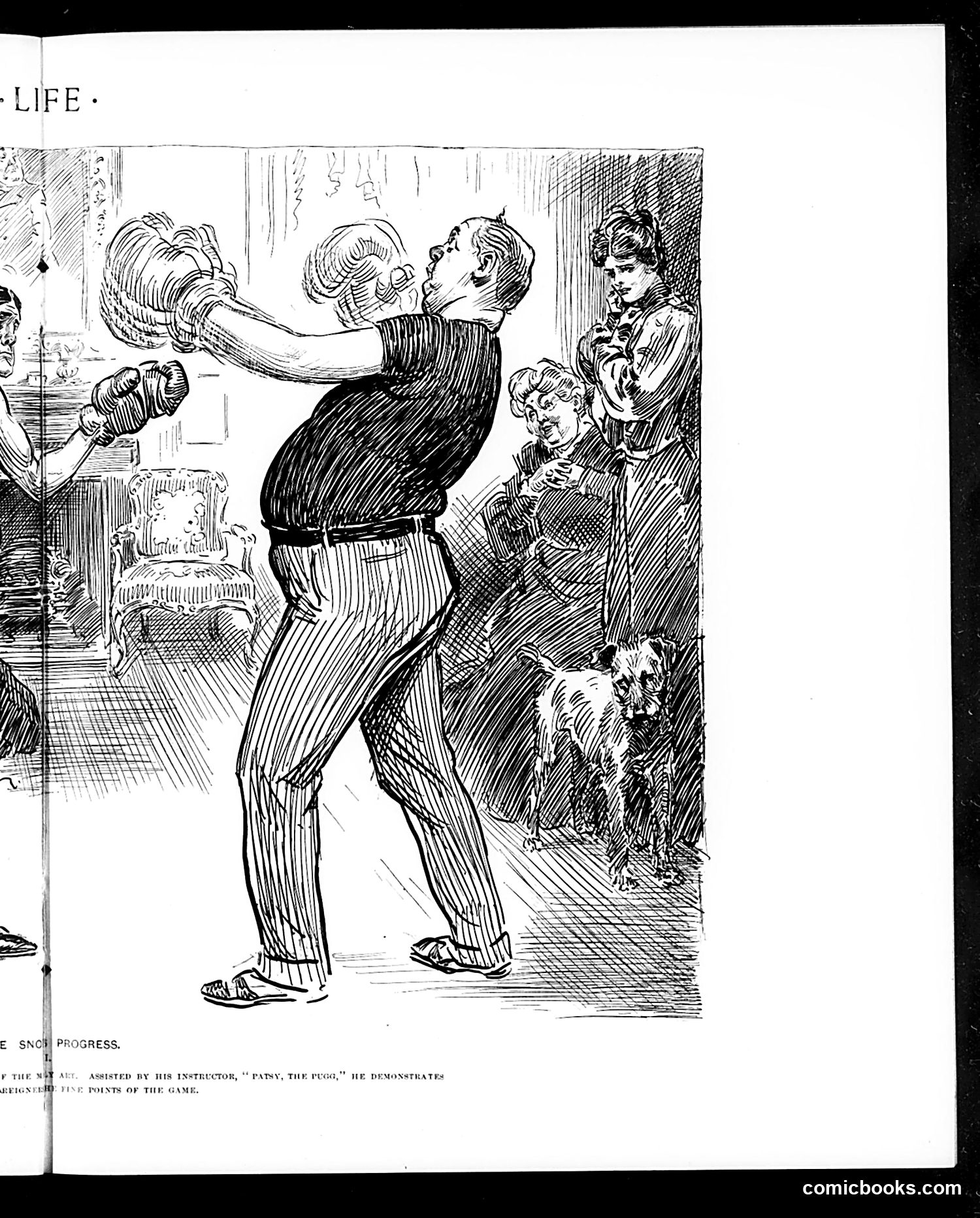
This satirical cartoon depicts a man in striped pants enthusiastically demonstrating boxing technique to an audience that includes women and a small dog. The caption indicates he's being "assisted by his instructor, 'Patsy, the Pug,'" a play on words using the dog's name. The satire appears to target the absurdity of boxing instruction or self-improvement schemes of the era—specifically mocking the notion that a man would receive legitimate athletic guidance from a small dog, while displaying exaggerated, clumsy form to onlookers. The title "Snowball Progress" suggests ironic commentary on supposed advancement or improvement that is actually ridiculous or going nowhere. This reflects *Life* magazine's typical satirical humor about American masculine pretensions and popular fads of the period.
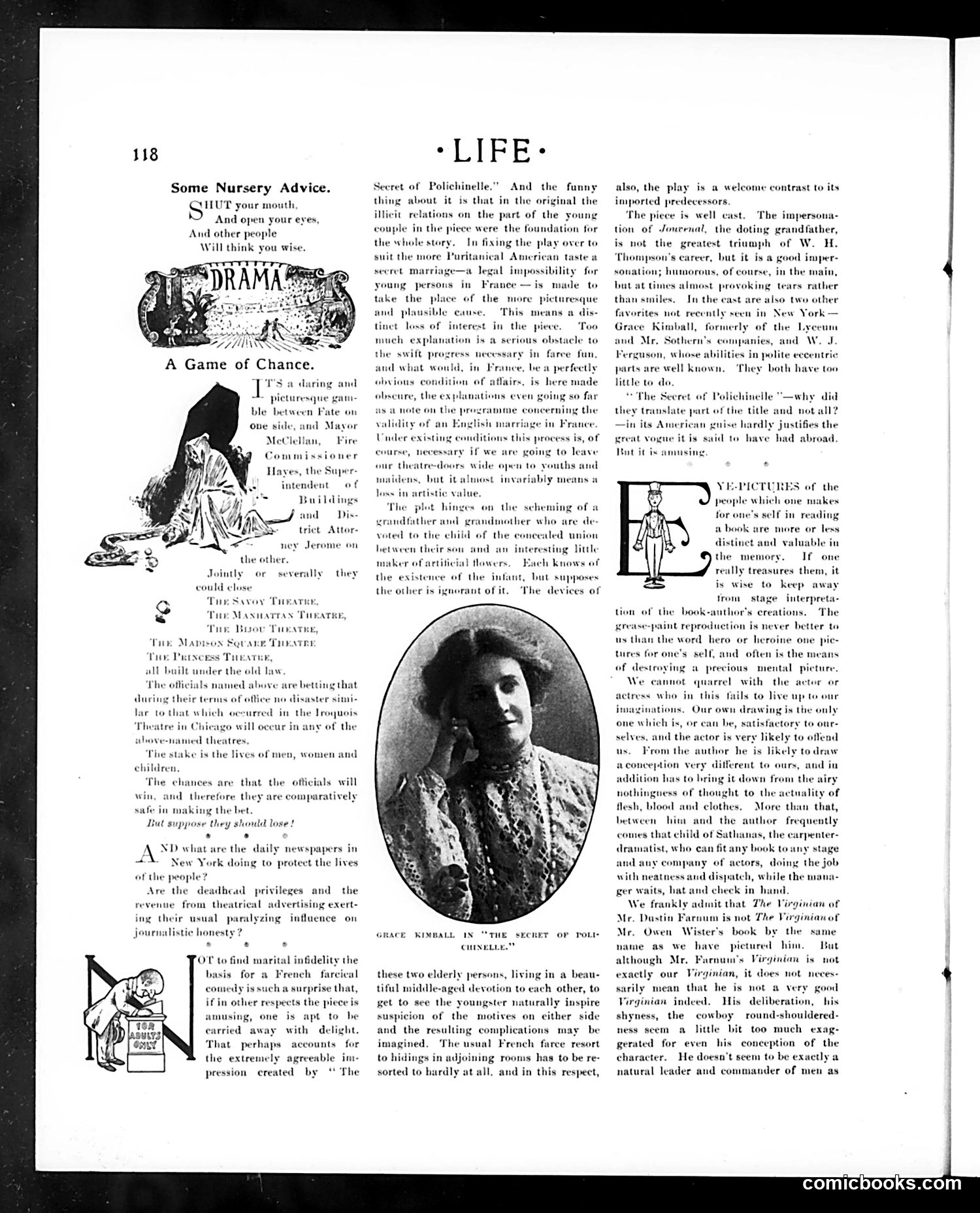
This *Life* magazine page contains theatrical commentary and social satire typical of early 20th-century journalism. **"A Game of Chance"** satirizes New York city officials (Commissioner Hayes, the Superintendent of Buildings, and a District Attorney) who are "betting" that no theater disaster will occur during their terms—with the stakes being public lives. This references the **1903 Iroquois Theatre fire in Chicago**, which killed over 600 people. The cartoon mocks officials for prioritizing theatrical advertising revenue and "deadhead privileges" (free tickets) over genuine safety enforcement, asking whether journalistic honesty is compromised by theater industry influence. **The theater reviews** discuss French farce adaptations, including "The Secret of Polichinelle" starring Grace Kimball. The satire critiques how American producers "Americanize" European plays by removing scandalous content (marital infidelity) to suit "Puritanical" American taste, thereby undermining artistic value. **"Ye-Pictures"** debates book illustrations versus theatrical stage adaptations—arguing readers' personal mental images are superior to actors' interpretations, since "greuse-paint reproduction" can never match imagination.
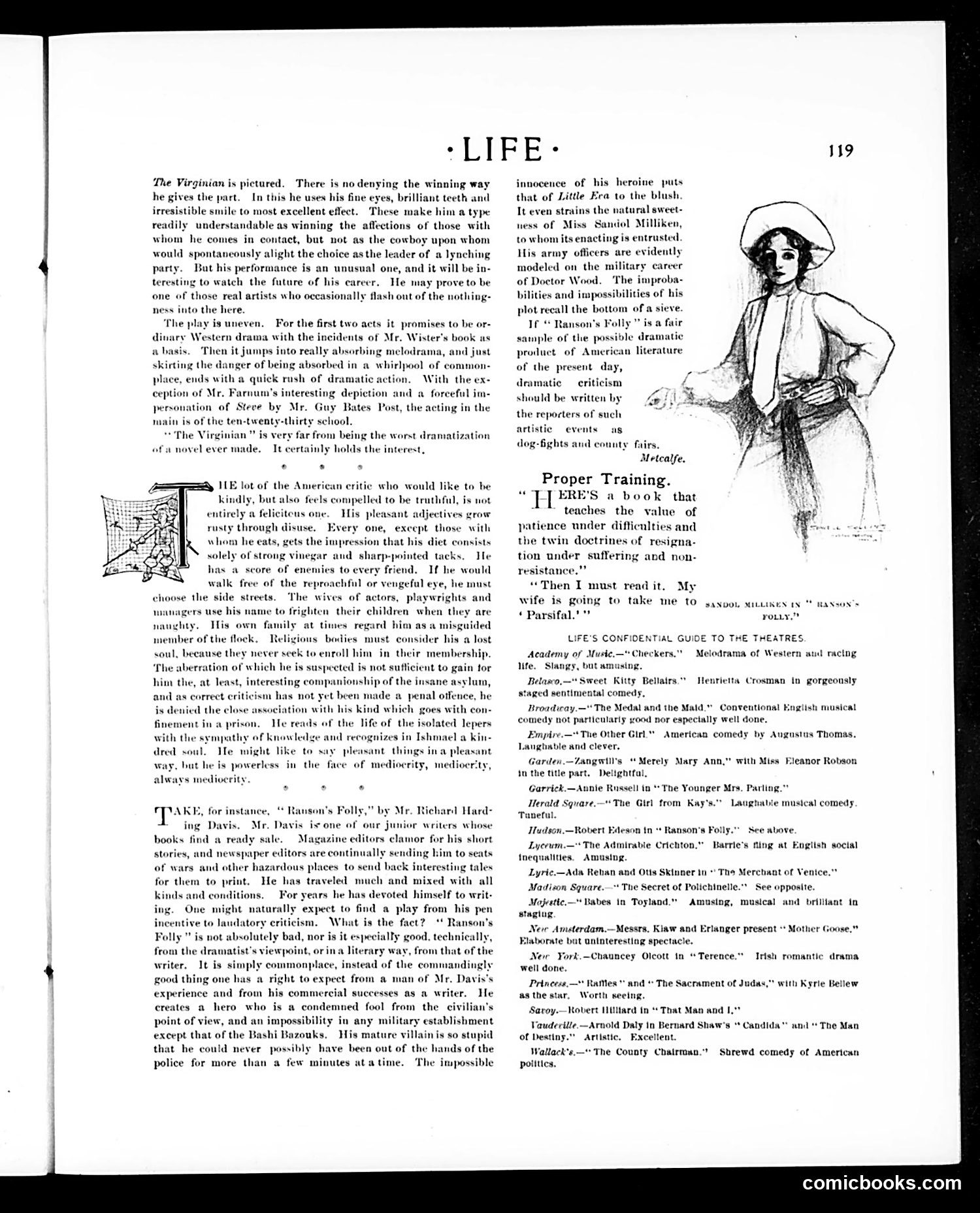
This page reviews two Broadway plays. The upper section critiques "The Virginian," praising the lead actor's charm and physical appeal while criticizing the overall production as uneven melodrama—competent but not exceptional. The illustration shows a woman in period costume, likely from the play. The lower section attacks a play called "Ranson's Folly" by junior writer Richard Harding Davis. The critic argues that despite Davis's literary success and magazine popularity, his dramatic work is merely "commonplace" rather than the "commandingly good" output one would expect from someone of his experience. The satire targets the disconnect between a writer's commercial success in other media and their actual dramatic talent—suggesting that fame in magazines doesn't guarantee stage competence. The page also includes brief reviews of other theatrical productions.
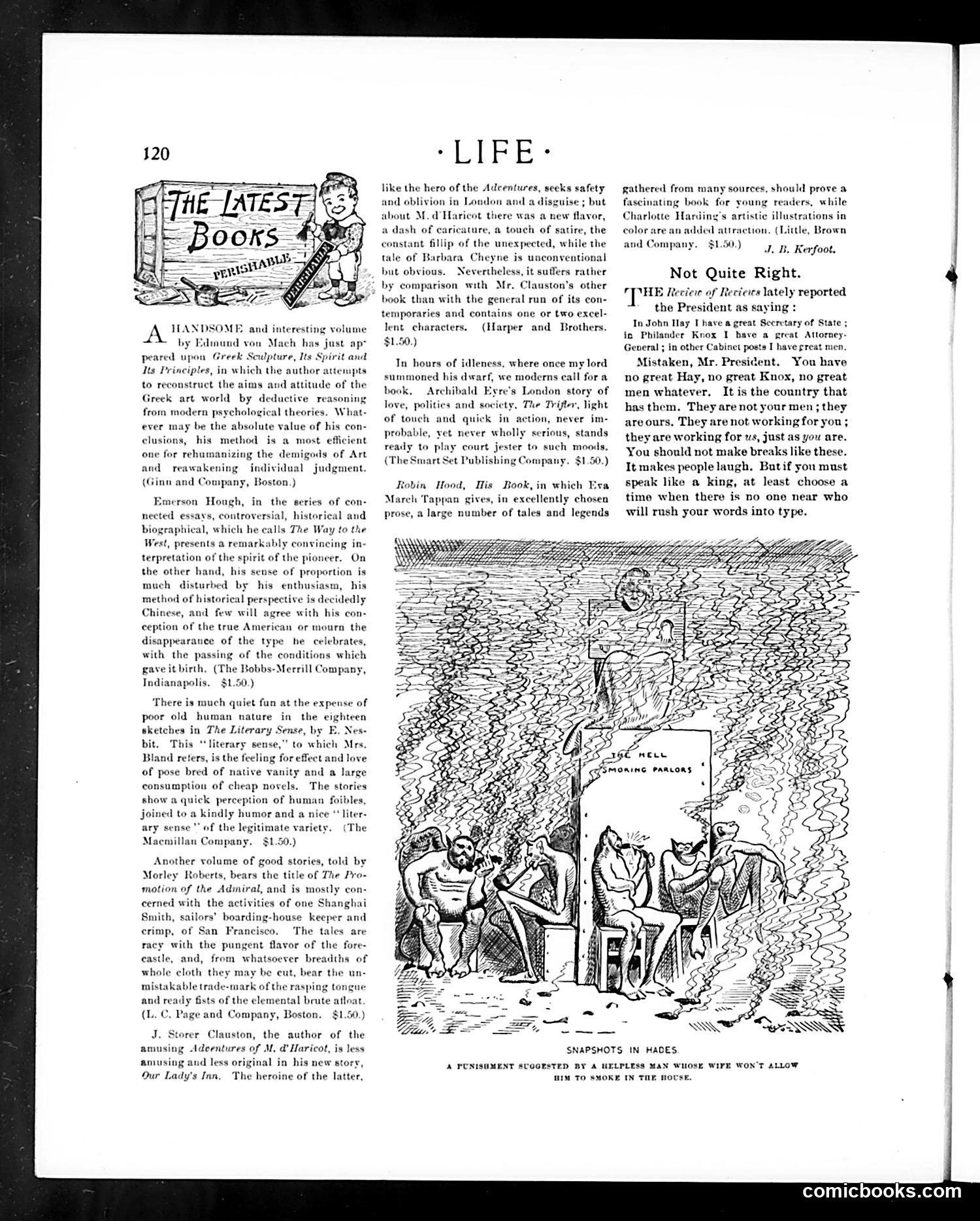
This page primarily reviews new books, but includes one notable political cartoon titled "Snapshots in Hades." The cartoon depicts two men in what appears to be hell or a smoking parlor, with the caption: "A punishment suggested by a helpless man whose wife won't allow him to smoke in the house." The accompanying text section, "Not Quite Right," quotes President Theodore Roosevelt praising his Cabinet members (John Hay as Secretary of State and Philander Knox), then sarcastically corrects him, arguing these men belong to the country, not the President—they work for the nation's interests, not his personal agenda. This appears to be satirizing Roosevelt's tendency to take credit for his administration's accomplishments while the text reasserts that talented officials serve the public, not individual leaders.
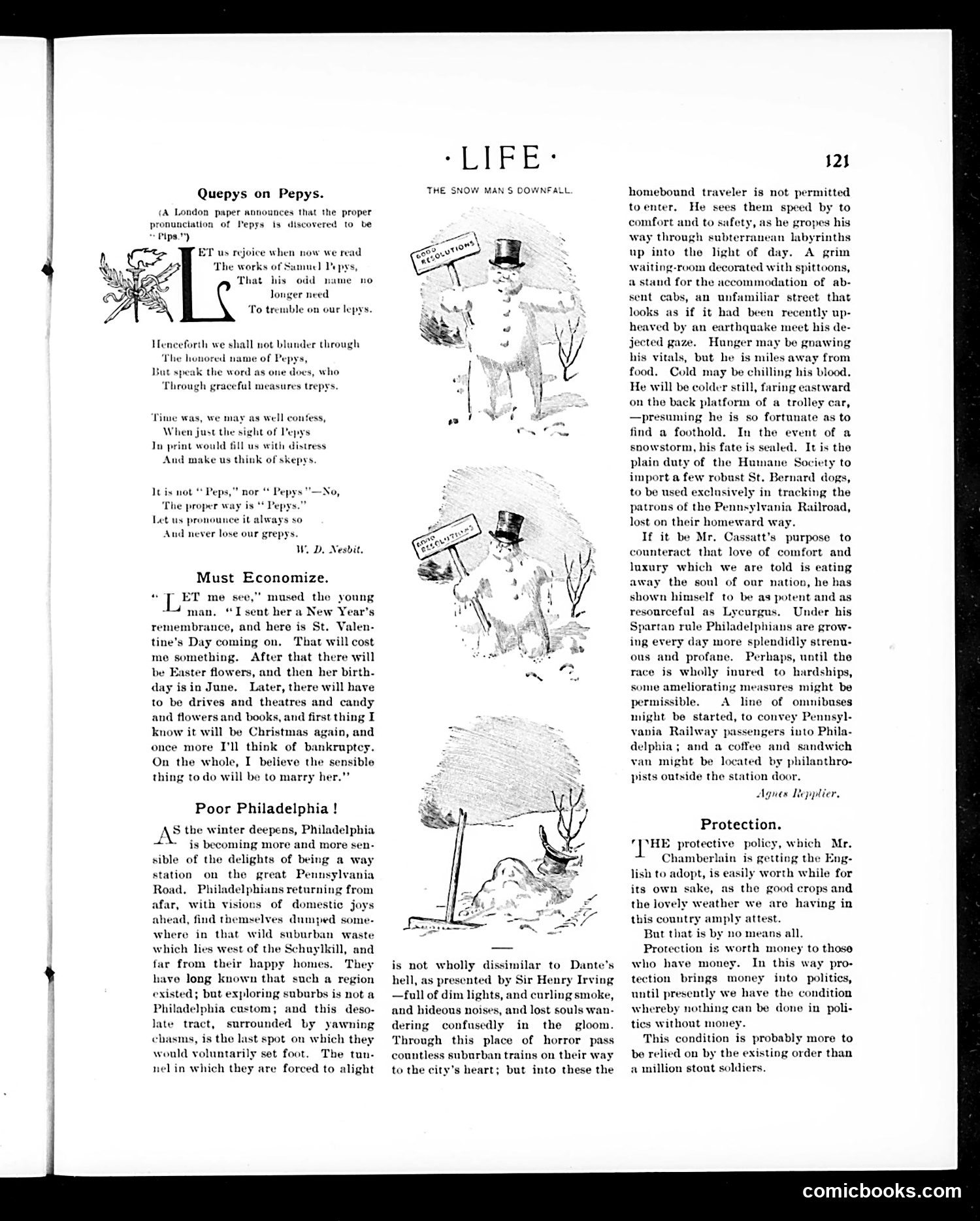
This page contains three satirical pieces typical of early Life magazine's social commentary: **"Quepys on Pepys"** mocks a London newspaper's announcement of the "correct" pronunciation of the diarist Samuel Pepys's name as "Pips" rather than "Pepys." The verse humorously defends maintaining the traditional pronunciation, suggesting pedantic language corrections are unnecessary. **"Must Economize"** satirizes a young man calculating the mounting expenses of courting (Valentine's Day flowers, Easter gifts, birthday presents, entertainment), concluding marriage is the economical solution to avoid bankruptcy—poking fun at both courtship customs and male financial anxieties. **"Poor Philadelphia!"** by Agnes Repplier criticizes the Pennsylvania Railroad's underground terminal station in Philadelphia. The piece sarcastically compares the dingy, disorienting subterranean waiting area to Dante's hell, mocking both the infrastructure and apparently Mr. Cassatt (likely railroad president Alexander Cassatt) for subjecting travelers to such unpleasant conditions while passing trains carry more fortunate passengers directly into the city.
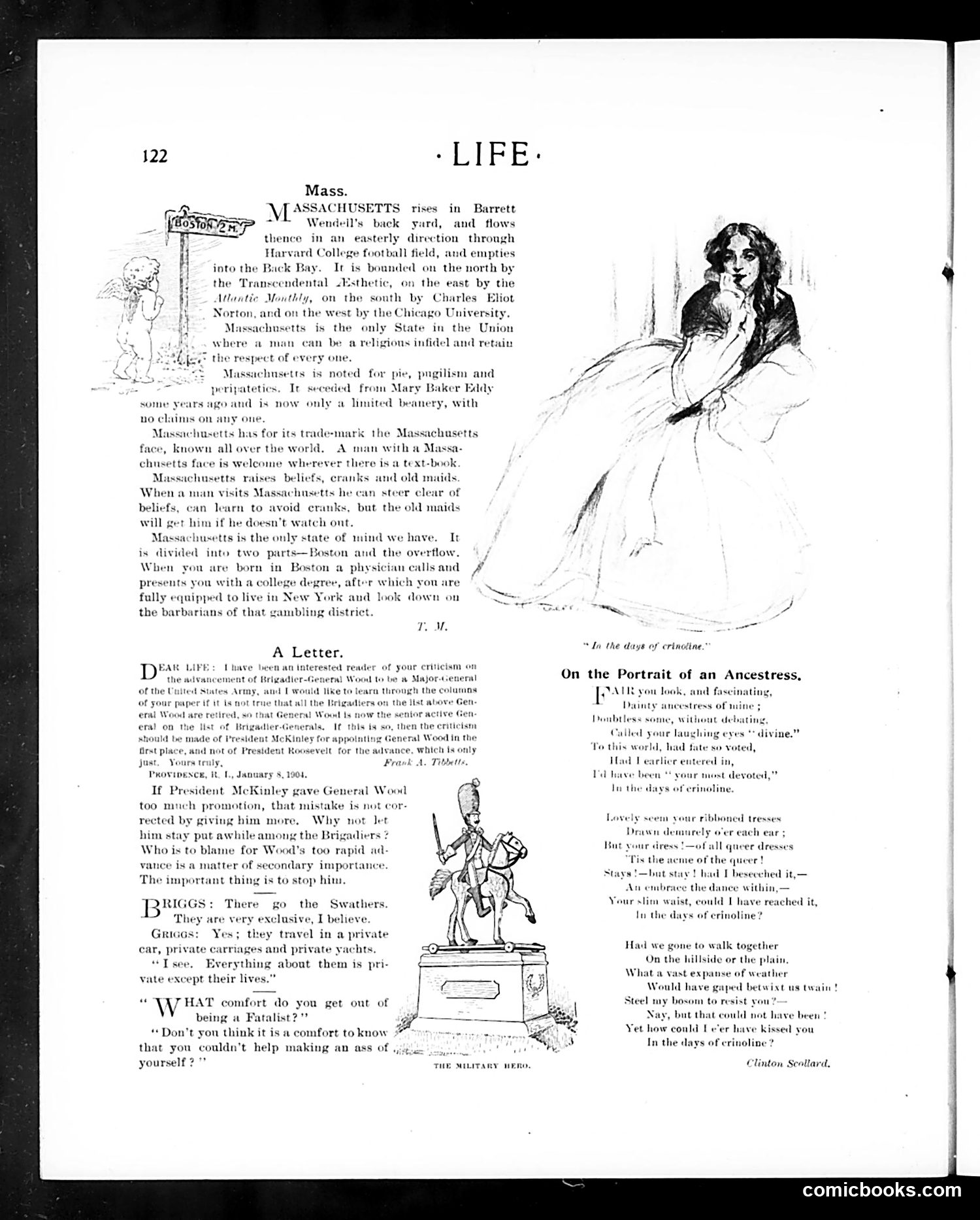
This page contains **satirical commentary on Massachusetts and a political cartoon about General Leonard Wood**. ## The Massachusetts Section A humorous essay mocking Massachusetts stereotypes: its intellectual pretension (Harvard, transcendentalism), religious eccentricity ("only state where a man can be a religious infidel"), pugilism, pie-eating, and notably its "old maids" who will "get him if he doesn't watch out." The satire suggests Boston Brahmins look down on other Americans as "barbarians." ## "The Military Hero" Cartoon This critiques **General Leonard Wood's rapid military promotion**. The letter from Frank Tibbetts complains that President McKinley promoted Wood too quickly to Major-General. The cartoon depicts Wood as a statue on a pedestal—inflated and monumental—mocking his elevated status. The accompanying dialogue questions whether giving him further promotion corrects the original mistake, arguing the real problem is stopping his advancement altogether. The page also includes poetry about an ancestress and a brief social commentary on wealthy "Swathers" who keep everything private.
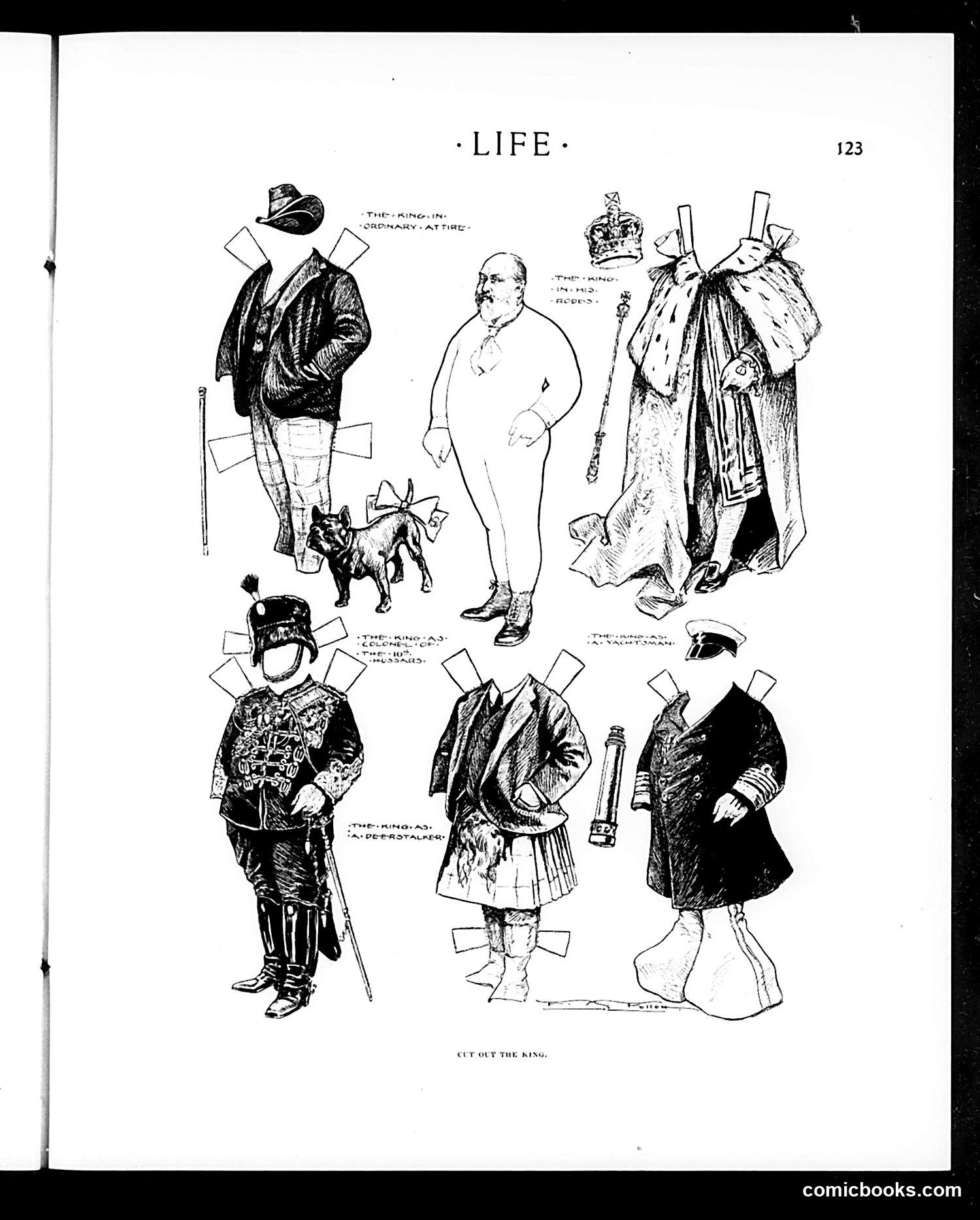
This satirical page from *Life* magazine presents paper-doll style cutouts of various British royal and aristocratic figures in their formal regalia. The title "Cut Out the King" suggests commentary on British monarchy and nobility. The figures display exaggerated formal dress—ornate military uniforms, robes, crowns, and ceremonial regalia—typical of Edwardian-era British high society. The "ordinary attire" label appears ironic, as the clothing is anything but ordinary. The satire likely mocks the excessive formality and pretense of British aristocracy, or possibly criticizes the institution of monarchy itself. By presenting them as disposable paper dolls, the cartoonist reduces these supposedly important figures to trivial, cuttable objects—a biting commentary on their actual relevance or utility. The exact historical moment is unclear without the date, but the style suggests early 20th century.
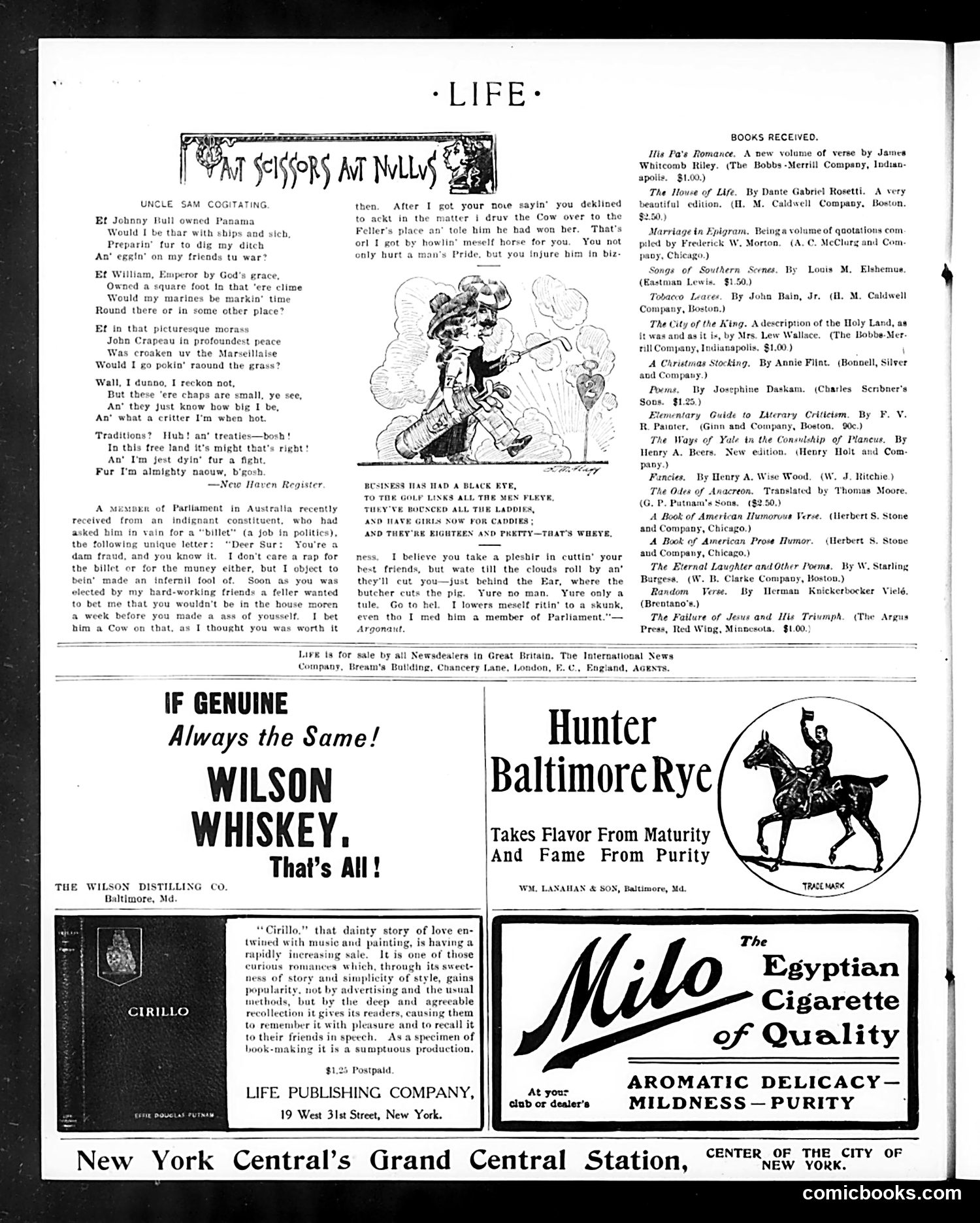
This cartoon satirizes American imperialism and interventionism in the early 1900s. **The Figure:** Uncle Sam (personification of the U.S. government) appears as a rural, aggressive character using dialect ("b'gosh," "Ef"). **The Point:** Uncle Sam boasts that he intervenes in other nations' affairs—Panama (Johnny Bull/Britain), Germany (Wilhelm), France (Crapeau)—not for principled reasons but simply because he's powerful enough to do so. He explicitly rejects treaties and tradition, claiming "might makes right." **The Satire:** The cartoon mocks American foreign policy by having Uncle Sam admit openly what diplomats denied: that the U.S. acts from raw self-interest and military strength, not moral conviction. His casual disregard for international law ("Traditions? Hub! an' treaties—bosh!") and his boastful aggression expose the hypocrisy of imperial powers claiming noble motives. This likely references real contemporary interventions, particularly American involvement in Panama and potential conflicts with European powers.
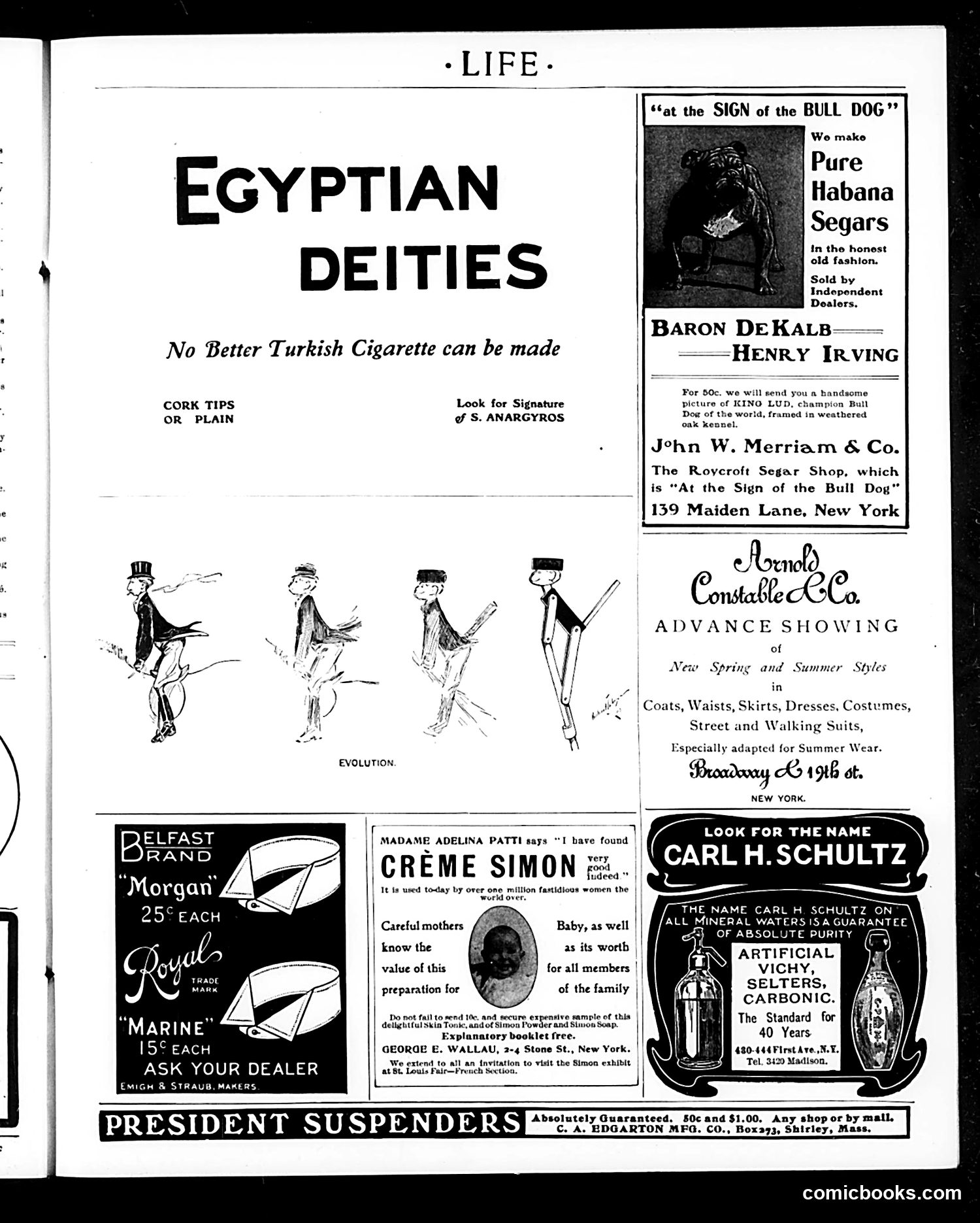
This page is primarily **advertisements** with one satirical cartoon at the top. The cartoon titled "EVOLUTION" depicts four figures in progressively more upright, refined poses, labeled to suggest the evolutionary development from primitive to civilized man. This is a **visual satire on the theory of evolution**, likely poking fun at debates about Darwinism that were contemporaneous with Life's publication. The joke appears to be mocking the notion that human "progress" is linear and inevitable. The rest of the page consists entirely of period advertisements—for Egyptian Deities cigarettes (with signature of S. Anargyros), Belfast linen products, Crème Simon cosmetics, Carl H. Schultz mineral waters, Arnold Constable & Co. clothing, and President Suspenders. These ads reflect early 20th-century consumer culture and luxury goods marketed to middle and upper-class readers.
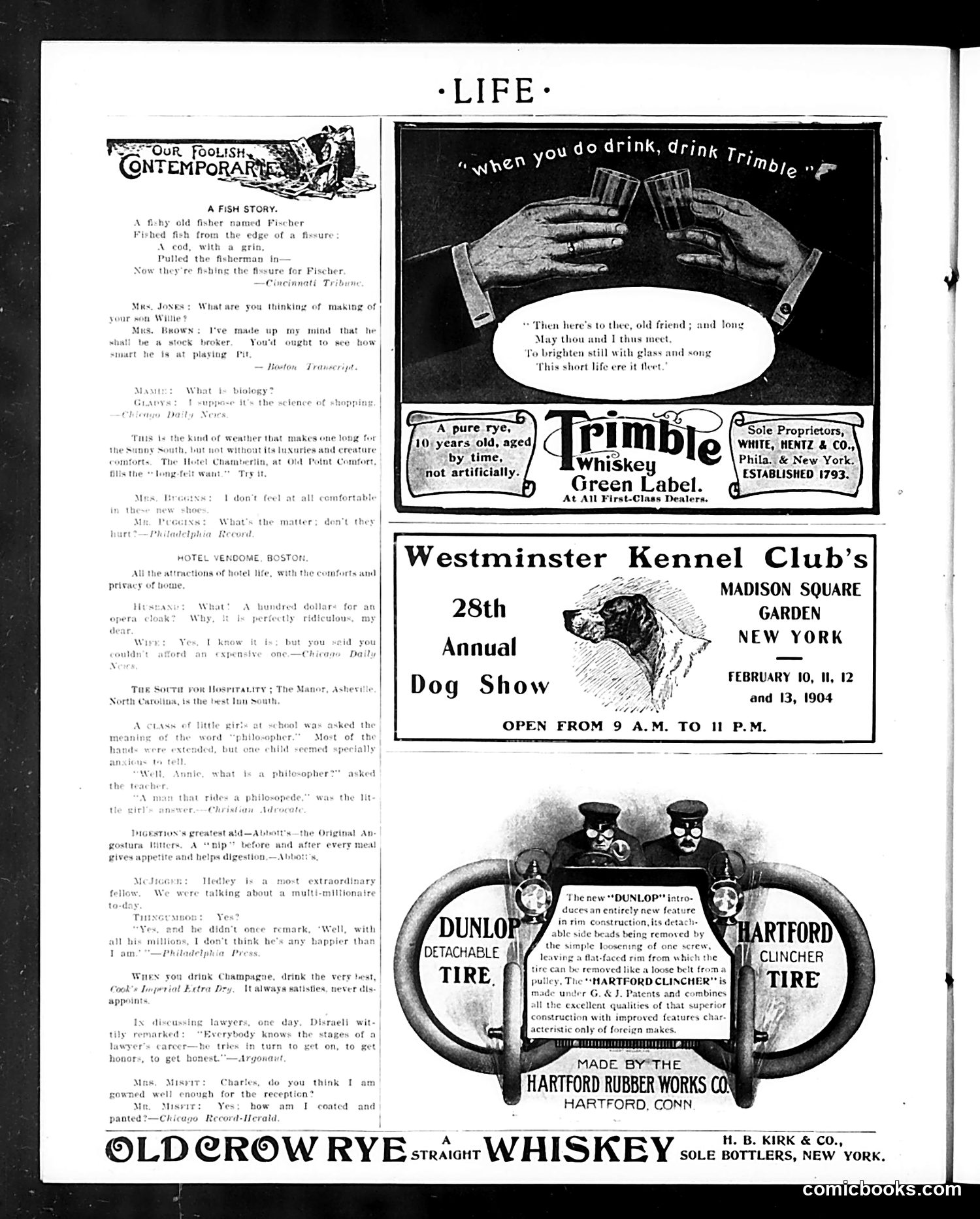
This page is primarily **advertising**, dominated by liquor and consumer product ads from circa 1904. The main content includes: **Left column**: "Our Foolish Contemporary" — a section of satirical jokes and witticisms mocking contemporary society, including commentary on opera cloaks, philosophers, and legal disputes. These are brief, topical quips rather than sustained political cartoon commentary. **Right column advertisements**: - **Trimble Whiskey** (Green Label): Features two hands toasting with text about friendship and "this short life ere it fleet" - **Westminster Kennel Club's 28th Annual Dog Show** at Madison Square Garden (Feb. 10-13, 1904) - **Hartford Clincher Tire** and **Dunlop Detachable Tire**: Competing tire advertisements with technical descriptions - **Old Crow Rye** whiskey The page reflects early-1900s American consumer culture and advertising practices rather than political satire. There are no identifiable political figures or sustained editorial cartoons—only commercial messaging mixed with light contemporary humor.
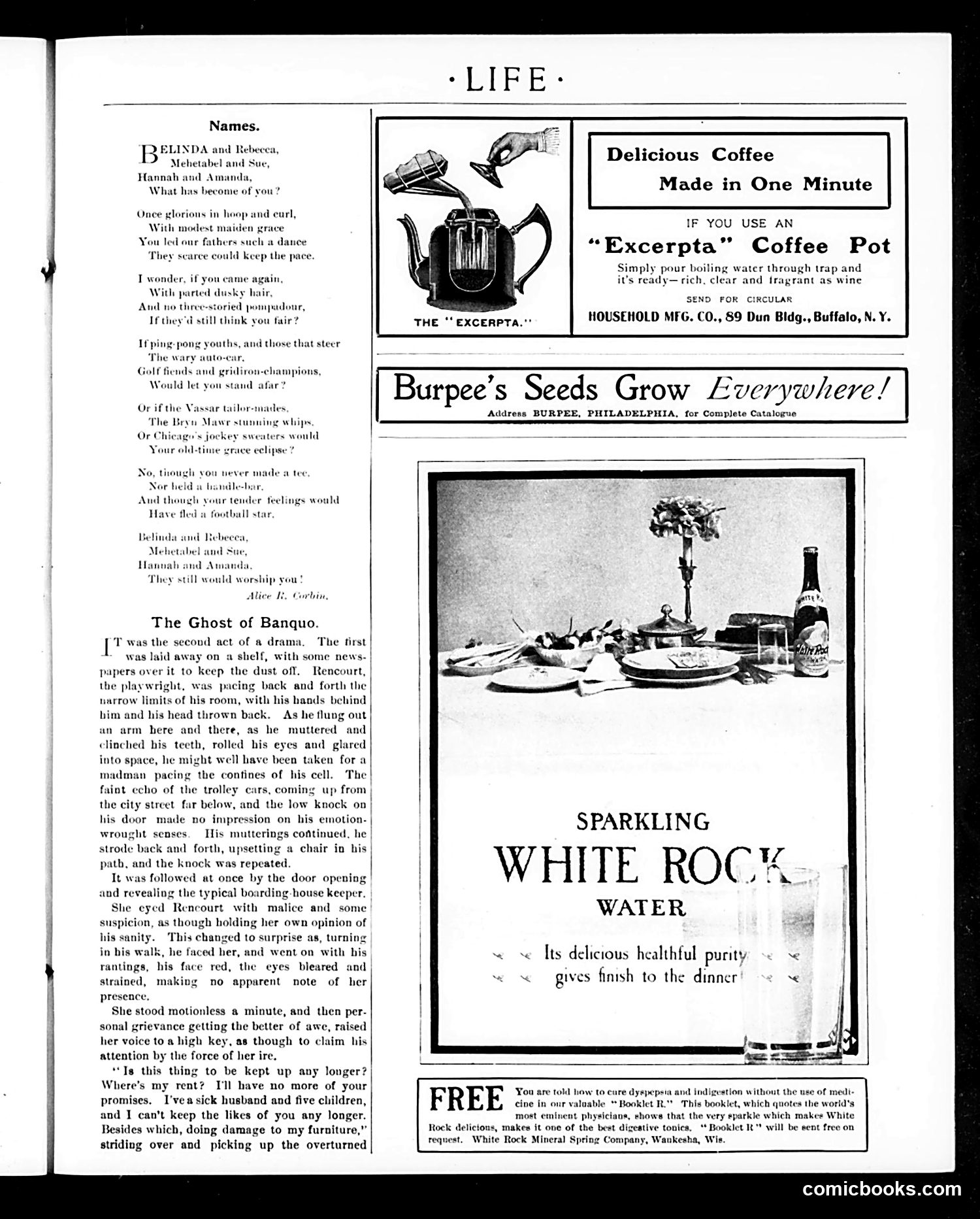
This page is primarily **advertising** with minimal comic content. The left column contains a poem titled "Names" by Alice B. Corbin, lamenting changes in young women—once gracious "maiden[s]" who would "worship" their suitors, now pursuing modern interests (auto-racing, golf, Vassar education, football). It's social satire about the "New Woman" of the early 1900s, critiquing female independence and changing gender roles. Below that, "The Ghost of Banquo" begins a dramatic short story about a playwright's creative crisis and a boarding-house keeper demanding rent—unrelated satirical fiction. The remainder is **commercial advertising**: the "Excerpta" coffee pot, Burpee seeds, and White Rock mineral water. These ads are typical of Life's revenue model, not editorial content meant to satirize contemporary politics or figures.
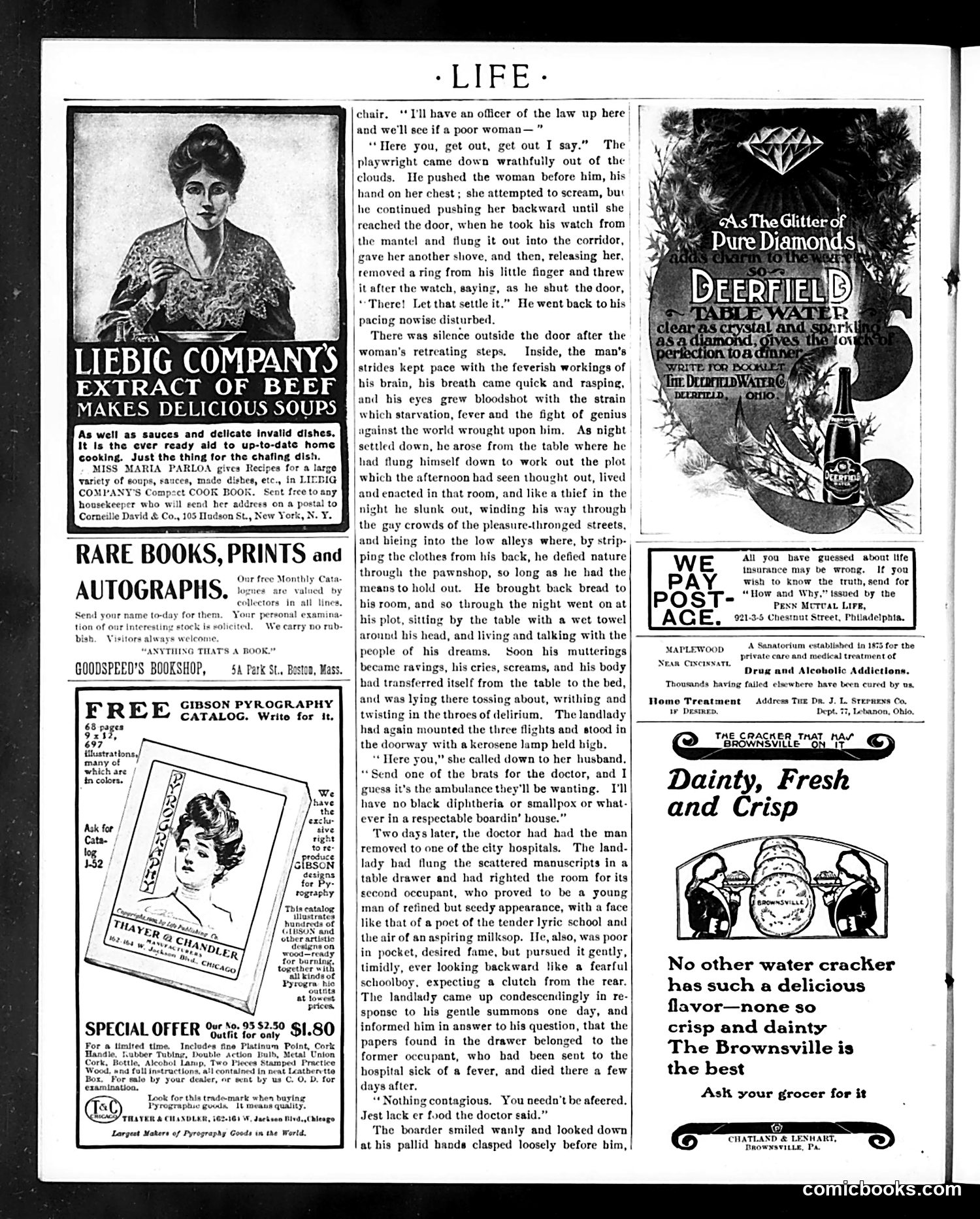
This page presents a serialized short story (not a political cartoon) about a struggling playwright's descent into poverty and madness. The narrative describes a volatile artist who violently ejects a poor woman from his room, then pawns his possessions to survive while obsessively working on his play. He eventually collapses into delirium and dies in a hospital. The story illustrates early 20th-century themes about the Romantic ideal of the starving artist—the notion that genius requires suffering and sacrifice. However, the text suggests this is presented ironically or critically: the protagonist's behavior is portrayed as brutal (he physically assaults the woman), and his "genius" leads only to death and poverty. The surrounding advertisements (soup, books, water crackers) form the typical magazine layout of the era. The story reflects period anxieties about poverty, urban life, and whether artistic aspiration justified actual human suffering or simply enabled self-destructive behavior.
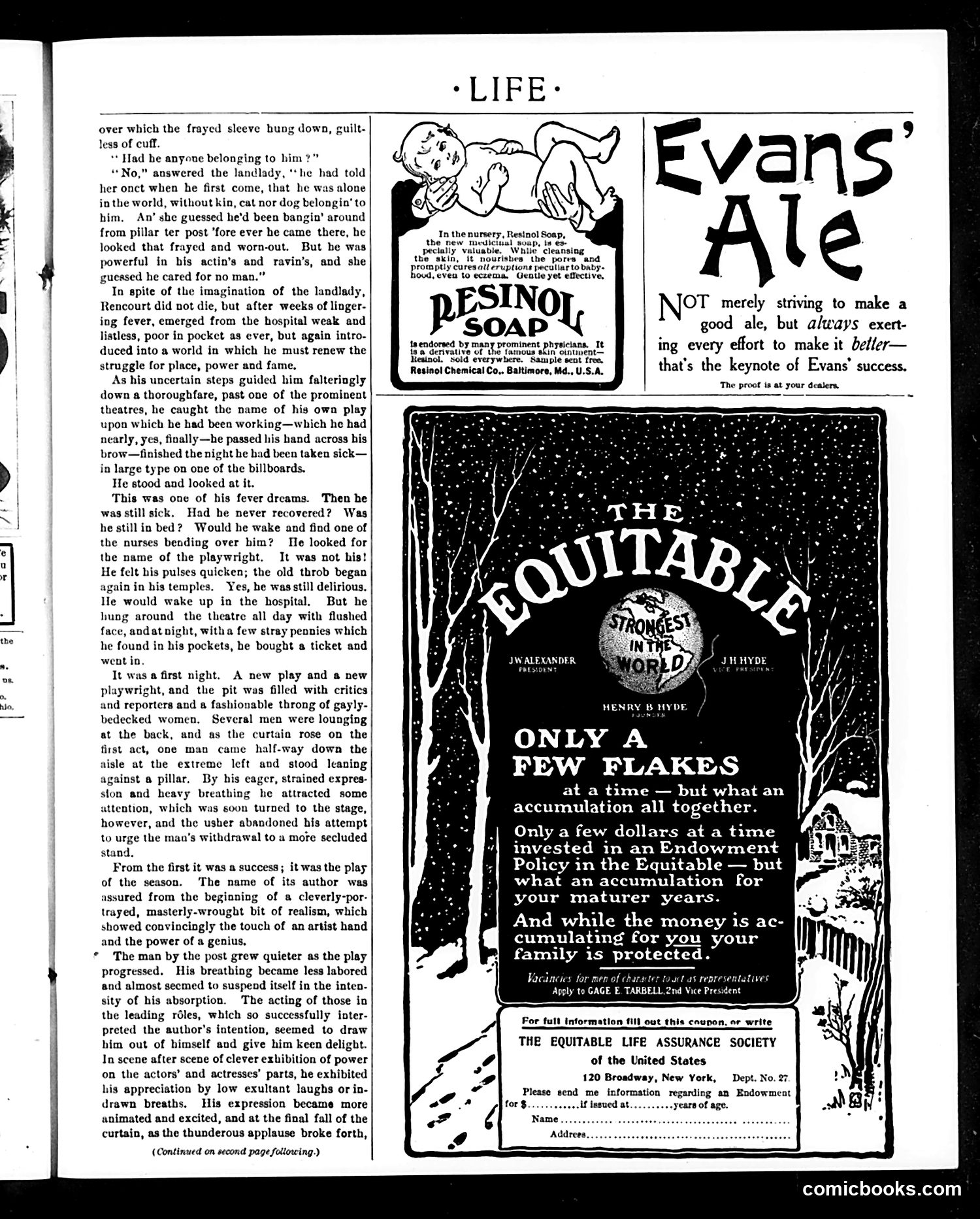
This page contains two advertisements and a serialized fiction story ("Life"), not political satire. The narrative follows a struggling playwright named Rencourt who, while ill with fever, sees his own play's name on a theater billboard—but then discovers it's actually another playwright's work, causing confusion about whether he's delirious or recovered. He attends the premiere of this mysteriously identically-titled play and becomes emotionally absorbed in its performance. The two ads are: 1. **Resinol Soap** - a medicinal soap marketed for nursery use and skin conditions 2. **Evans' Ale** - emphasizing quality and effort in brewing 3. **Equitable Life Assurance Society** - promoting endowment insurance policies The story explores themes of artistic struggle, mental illness (fever-induced delirium), and the theatrical world, rather than offering political commentary or social satire typical of Life magazine's reputation.
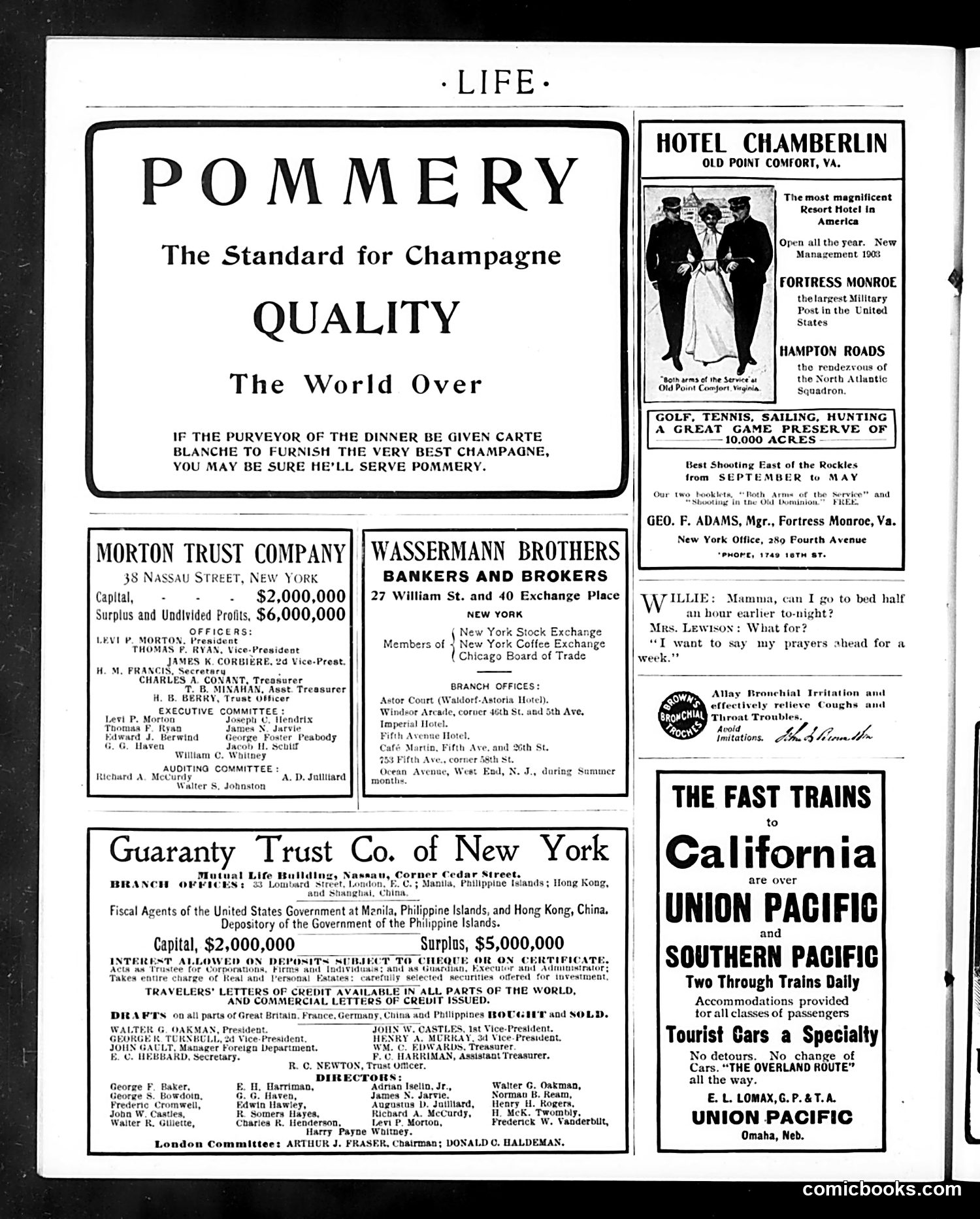
This page is primarily **advertising and financial listings**, not political satire or cartoons. The main content consists of advertisements for major financial institutions (Morton Trust Company, Wassermann Brothers bankers, Guaranty Trust Co.) and luxury destinations (Hotel Chamberlin resort in Virginia, Pommery champagne, and railroad services to California). The only **comic dialogue** appears in a small section labeled "WILLIE," showing a humorous conversation between a mother and son where Willie requests an earlier bedtime to pray for the week—a mild joke on childhood priorities and religious observance. The remainder is standard early-1900s institutional and travel advertising typical of *Life* magazine's revenue model. No political figures or satire are present on this particular page.
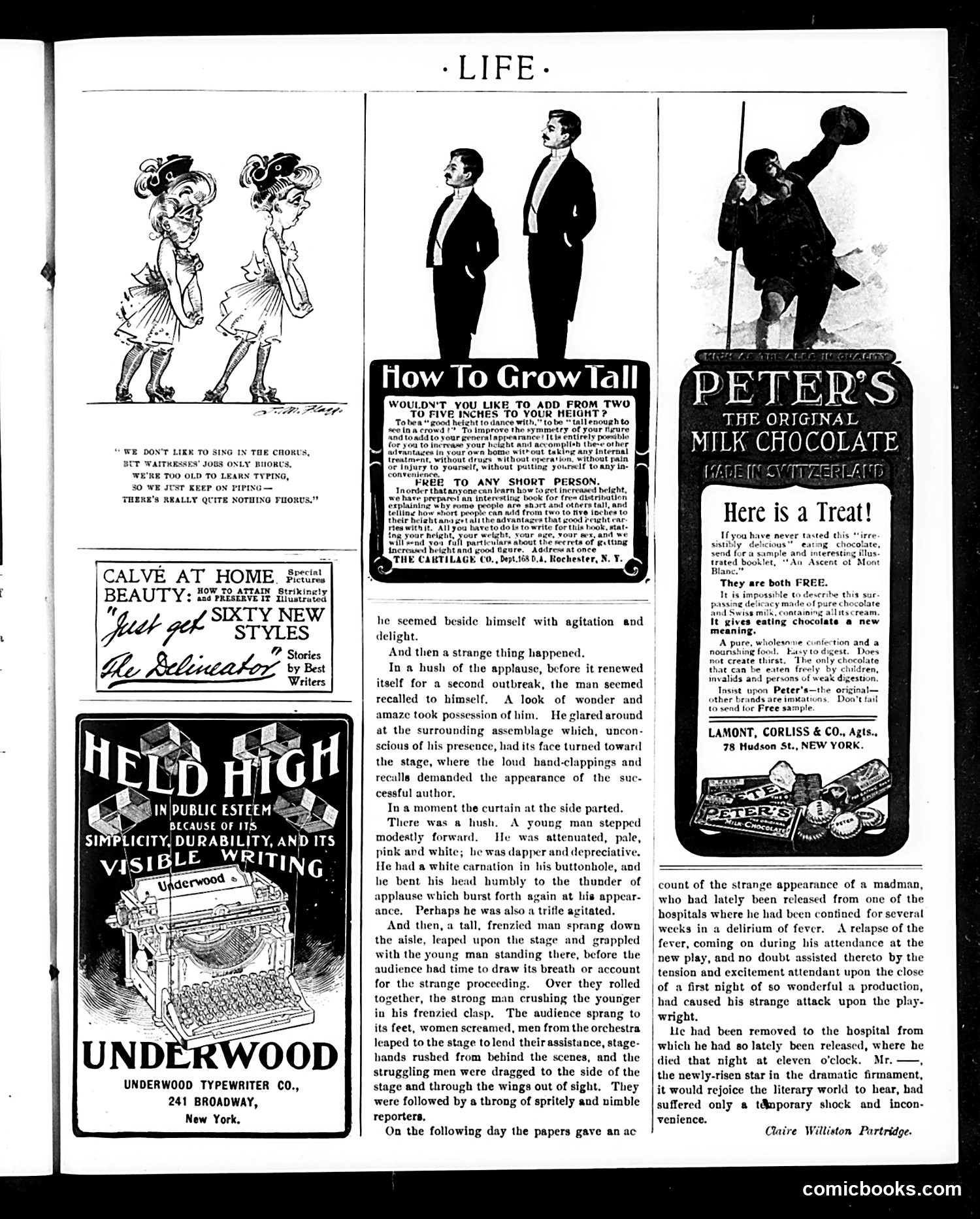
This page contains mostly **advertisements and serialized fiction**, not political cartoons. The top cartoons are light social humor: two identical women in chorus costumes joking about their low-paying jobs, and a sketch about adding height (a recurring early-20th-century pseudo-medical pitch). The substantial text is a serialized short story by "Chrice Willison Burbridge" depicting a theatrical melodrama: at a play's opening night, a recently-released mental patient in the audience becomes agitated watching the young playwright onstage. The madman suddenly attacks the writer onstage before being subdued. The patient is hospitalized again and dies that night. The story plays on fin-de-siècle anxieties about **urban insanity, theatrical excess, and sensational newspaper coverage**—treating the incident as darkly comic material. It's serialized entertainment for *Life* readers, alongside ads for typewriters, chocolate, and hair-growth schemes.
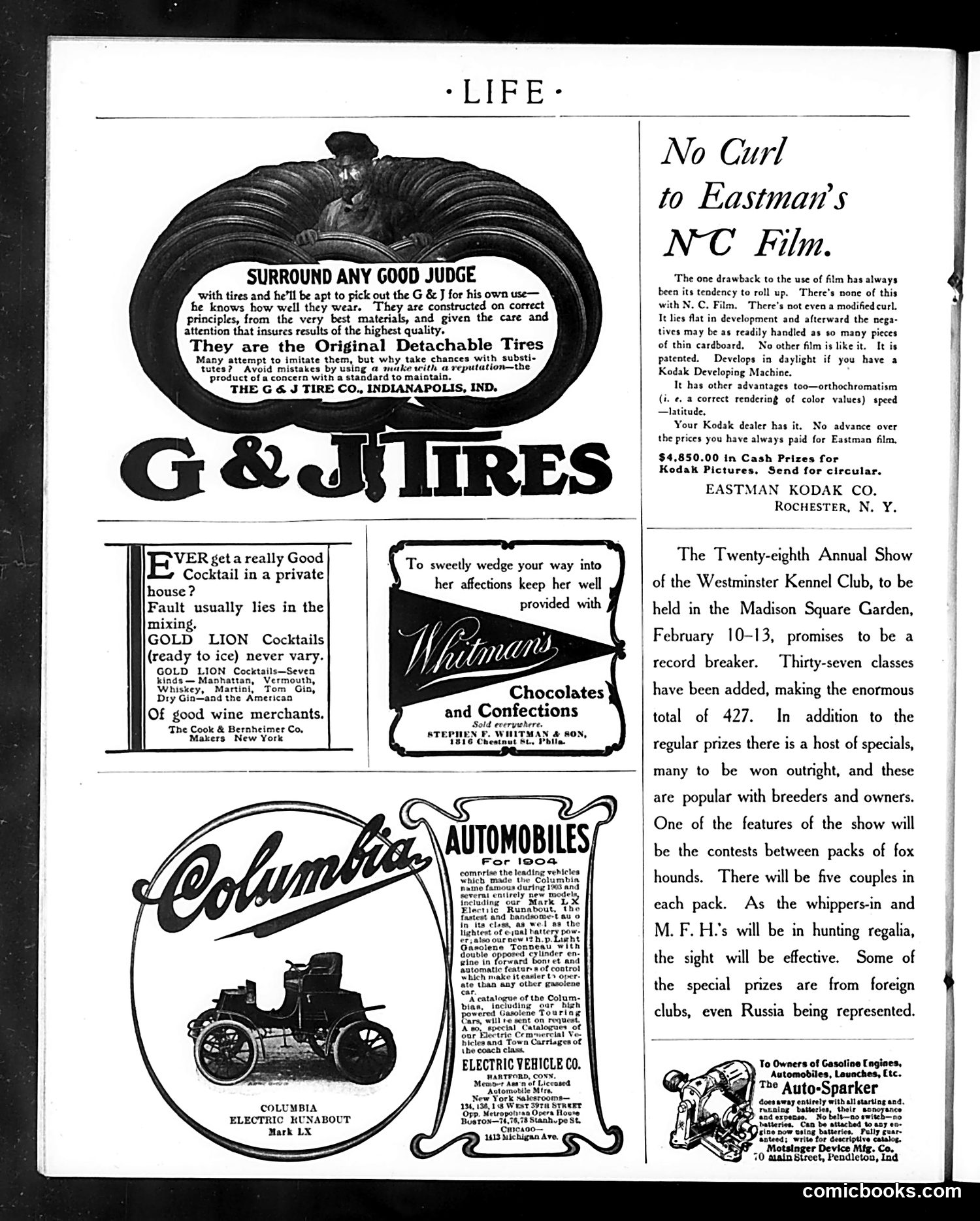
This is primarily an **advertising page** from Life magazine, likely from early 1904 (based on the Westminster Kennel Club show date of February 10-13 and automobile references). The page contains no political cartoons or satire. Instead, it features six commercial advertisements: 1. **G&J Tires** — appeals to judges' authority to endorse quality tires 2. **Gold Lion Cocktails** — jokes that home bartenders fail at mixing drinks; ready-made cocktails solve this 3. **Whitman's Chocolates** — uses romantic innuendo ("wedge your way into her affections") 4. **Kodak film** — technical specifications about non-curling film for photography 5. **Columbia Automobiles** — showcasing 1903-1904 gasoline and electric vehicles 6. **Auto-Sparker** — an automotive ignition device The page also includes a news brief about the Westminster Kennel Club's twenty-eighth annual dog show, noting expanded entries and special international prizes. The advertisements reflect early 1900s consumer goods and emerging technologies (automobiles, photography, gasoline engines).
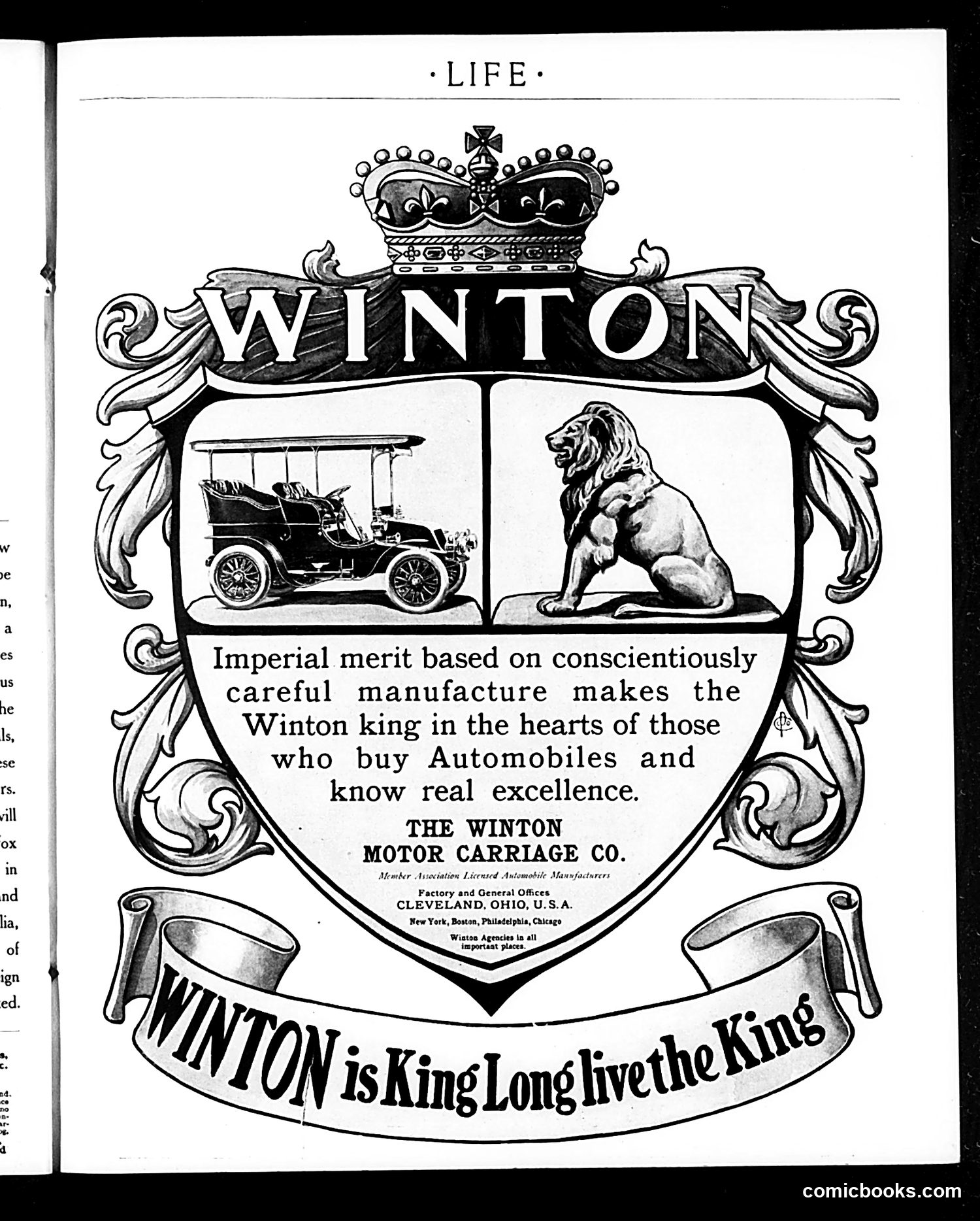
This is an advertisement for Winton Motor Carriage Company, a Cleveland-based automobile manufacturer. The heraldic design mimics royal coat-of-arms imagery, positioning Winton as the "king" of automobiles through careful manufacturing. The left panel shows an early motorcar; the right shows a lion—a traditional symbol of royalty and strength. The tagline "WINTON is King Long live the King" reinforces this positioning. Rather than satire, this represents early 1900s automotive advertising strategy: establishing brand prestige and quality through imperial/monarchical symbolism. The "Life" magazine context suggests this appeals to affluent readers who equate luxury cars with aristocratic status. The lion's prominence underscores strength and dominance in the emerging automobile market.
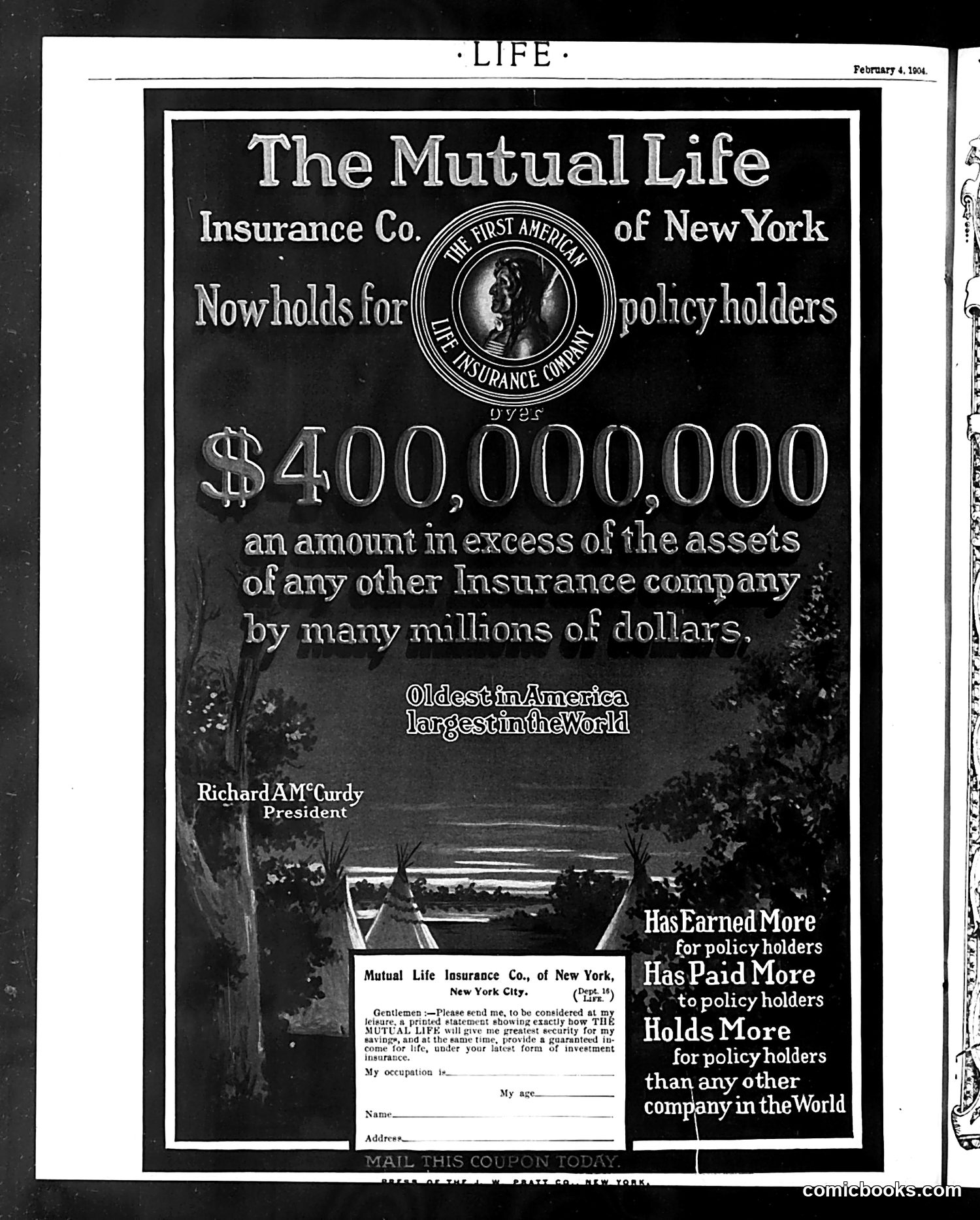
This is a full-page **advertisement**, not a satirical cartoon. The Mutual Life Insurance Company of New York is promoting itself in *Life* magazine (February 4, 1904). The ad makes competitive claims: $400 million in assets, "oldest in America" and "largest in the World." It emphasizes that the company has "earned more," "paid more," and "holds more" for policyholders than competitors. The circular seal shows "The First American Life Insurance Company" with a profile portrait (likely a company founder, though unclear who). There's a mail-in coupon below requesting personal details (age, occupation, address) for interested readers. This represents early 20th-century corporate advertising's emphasis on size, stability, and superiority claims—typical of the era's insurance industry competition.