
Life, 1904-02-04 · page 6 of 36
Life — February 4, 1904 — page 6: what you’re looking at
What you’re looking at
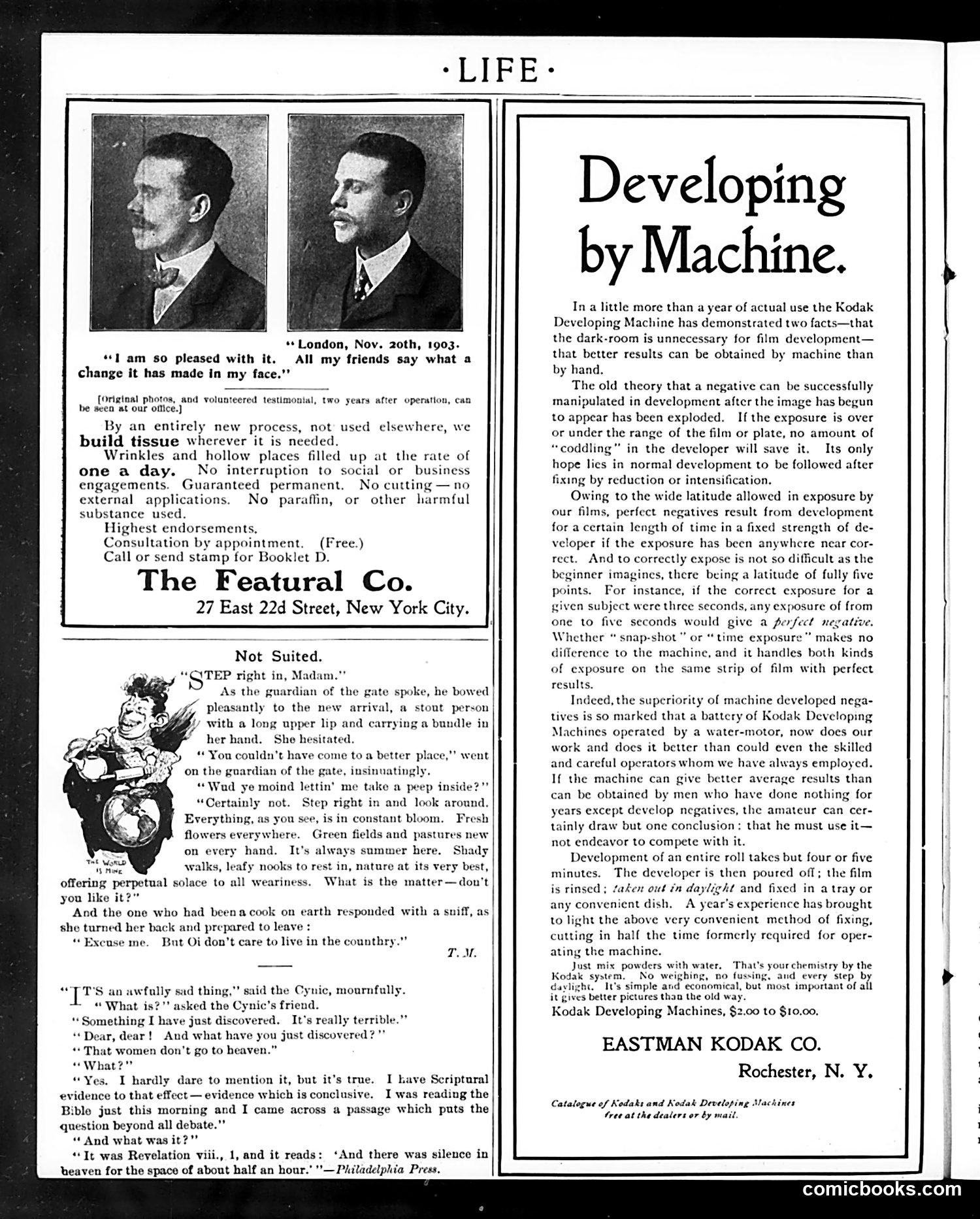
This page contains two distinct sections: **Left side:** An advertisement for "The Natural Co." featuring before-and-after photographs of a man's face, claiming their process eliminates wrinkles through tissue-building. The testimonial claims results within a year. **Center-left:** A short humorous story titled "Not Suited," illustrated with a cartoon of a stout woman at a garden gate. The joke involves wordplay about a cook seeking employment—the gatekeeper misunderstands her request to "let in" as permission to look inside, leading to the cook's indignant response about not wanting country life. **Right side:** A Kodak advertisement promoting their developing machines, emphasizing that amateur photographers can achieve professional results through mechanical development rather than hand-processing. The page mixes commercial advertising with light humor—typical Life magazine content from the early 1900s.
📄 Transcribed text from this page (OCR, searchable)
Machine-transcribed from the original scan — historical spelling and the odd misread are preserved.
**London, Nov. 2oth, 1903. “(lam so pleased with it. All my friends say what a change it has made in my face.” [Original photos, and volunteered testimonial, two years after operation, can be seen at our office.) By an entirely new process, not used elsewhere, we build tissue wherever it is needed. Wrinkles and hollow places filled up at the rate of one a day. No interruption to social or business engagements. Guaranteed permanent. No cutting — no external applications. No paraflin, or other harmful substance used. Highest endorsements, Consultation by appointment. (Free.) Call or send stamp for Booklet D. The Featural Co. 27 East 22d Street, New York City. Not Suited. TEP right in, Madam.” As the guardian of the gate spoke, he bowed “ pleasantly to the new arrival, a stout person 4y with a long upper lip and carrying a bundle in her hand. She hesitated. “© Yon couldn't have come to a better place,"’ went on the guardian of the gate, insinuatingly. “Wud ye moind lettin’ me take a peep inside?” “Certainly not. Step right in and look around. Everything, as you see, is in constant bloom. Fresh flowers everywhere. Green fields and pastures new on every hand. It’s always summer here. Shady walks, leafy nooks to rest in, nature at its very best, offering perpetual solace to all weariness. What is the matter—dou't you like it?” And the one who had beenacook on earth responded with a sniff, as she turned her back and prepared to leay “Excuse me. But Oi don’t care to live in the counthry.”” “T? an awfully sad thing,” said the Cynic, mournfally. “Ww is?’ asked the Cynic’s friend. Something I have just discovered. It’s really terrible.” “Dear, dear! And what have you just discovered?" ** That women don’t go to heaven.” “What?” “Yes. I hardly dare to mention it, but it's true. I have Scriptural evidence to that effect — evidence which is conclusive. I was reading the Bible just this morning and I came across a passage which puts the question beyond all debate.” “And what was it?” «It was Revelation viii., 1, and it reads: ‘And there was silence in teaven for the space of about half an hour.’ "—Philadelphia Press. Developing by Machine In a little more than a year of actual use the Kodak Developing Machine has demonstrated two facts—that the dark-room is unnecessary for film development— that better results can be obtained by machine than by hand, The old theory that a negative can be successfully manipulated in development after the i ¢ has begun to appear has been exploded. If the exposure is over or under the range of the film or plate, no amount of “coddling” in the developer will save it. Its only hope lics in normal development to be followed after fixing by reduction or intensification, Owing to the wide latitude allowed in exposure by our films, perfect negatives result from development for a certain length of time in a fixed strength of de- veloper if the exposure has been anywhere near cor- rect. And to correctly expose is not so difficult as the beginner imagines, there being a latitude of fully five points. For instance, if the correct exposure for a given subject were three seconds, any exposure of from one to five seconds would give a perfect negative. Whether “ snap-shot” or “time exposure” makes no difference to the machine, and it handles both kinds of exposure on the same strip of film with perfect results. Indeed, the superiority of machine developed nega- tives is so marked that a battery of Kodak Developing Machines operated by a water-motor, now does our work and does it better than could even the skilled and careful operators whom we have always employed. If the machine can give better average results than can be obtained by men who have done nothing for years except develop negatives, the amateur can cer- tainly draw but one conclusion: that he must use it— not endeavor to compete with it. Development of an entire roll takes but four or five minutes. The developer is then poured off; the film is rinsed; taken out in daylight and fixed in a tray or any convenient dish, A year's experience has brought to light the above very convenient method of fixing, cutting in half the time formerly required for oper- ating the machine. Just mix powders with water, That's your chemistry by the Kodak system. No weighing, no fussing, aud every step by daylight, It’s simple and economical, but most important of all it gives better pictures than the old way. Kodak Developing Machines, $2.00 to $10.00, EASTMAN KODAK CO. Rochester, N. Y. Catalogue of Kodaks and Kodak Developing Machines free at the dealers or by mail. comicbooks.com