
Life, 1904-02-04 · page 11 of 36
Life — February 4, 1904 — page 11: what you’re looking at
What you’re looking at
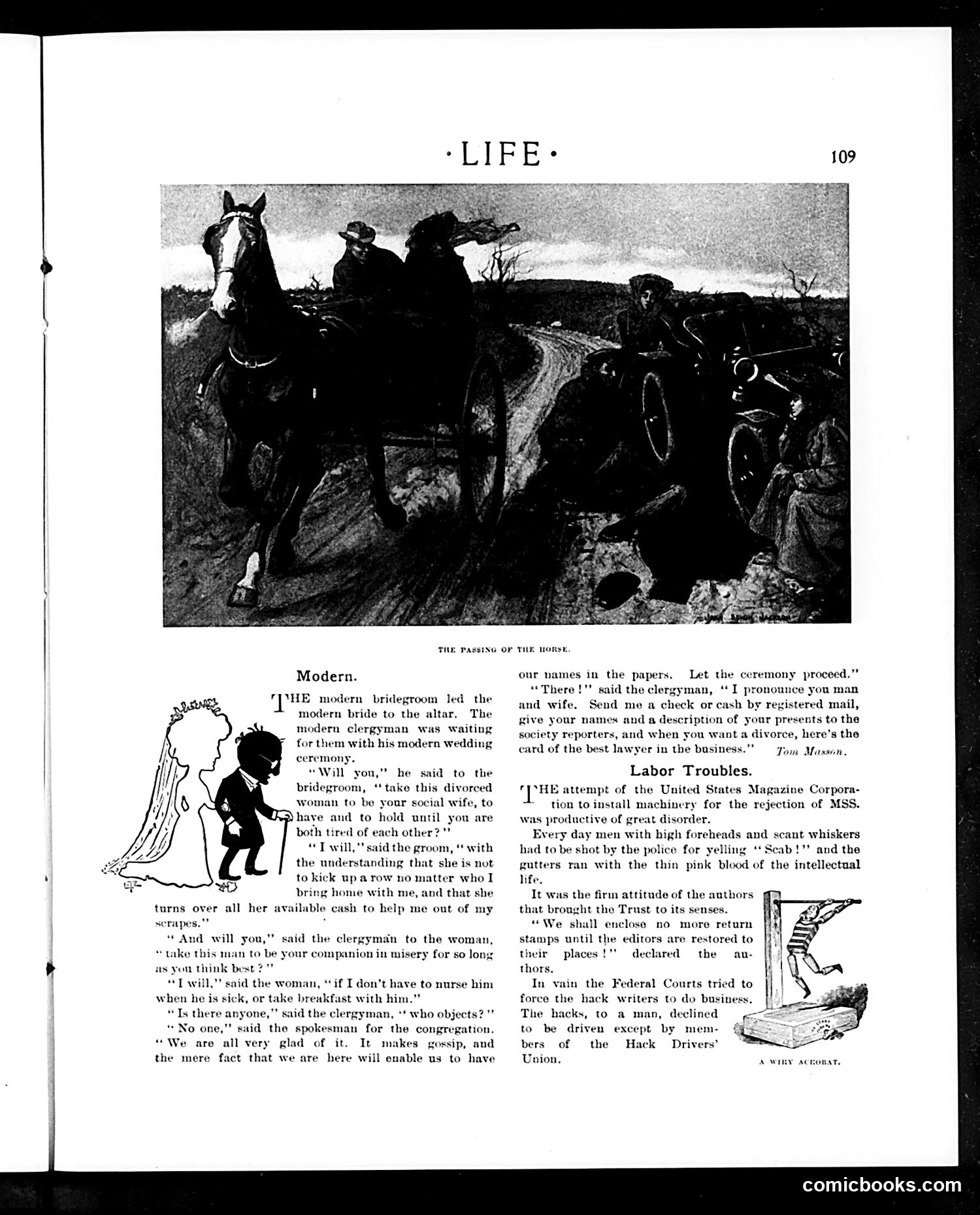
This page contains two satirical pieces about early 20th-century social issues. **"Modern" (top cartoon):** A humorous dialogue mocking modern marriage. A bridegroom negotiates terms with his bride like a business contract, discussing her "available cash" and her obligation to "hold until you are both tired of each other." The clergyman facilitates this transactional view of marriage, reducing matrimony to financial arrangement and mutual self-interest rather than romantic commitment. **"Labor Troubles" (bottom section):** Satirizes labor unrest at *United States Magazine Corporation*. The text describes writers and "hack drivers" (freelance journalists) refusing to work, demanding editors restore their positions. The satire mocks both the authors' dramatic stance ("We shall enclose no more return stamps") and the absurdity of literary workers organizing like industrial laborers. The small cartoon shows a dejected writer, emphasizing the piece's mockery of struggling writers' pretensions.
📄 Transcribed text from this page (OCR, searchable)
Machine-transcribed from the original scan — historical spelling and the odd misread are preserved.
THE PAssiNe oF Modern. YHE modern bridegroom led the modern bride to the altar. The modern clergyman was waiting for them with his modern wedding ceremony. “Will you,” he said to the bridegroom, “take this divorced Woman to be your social wife, to US have and to hold until you are both tired of each other?" “T will," said the groom, “ with the understanding that she is not to kick up a row no matter who I bring home with me, and that she turns over all her available cash to help me out of my And will you,” said the clergyman to the woman, “take this man to be your companion in misery for so long as you think best 2” “«T will,”’ said the woman, “if I don’t have to nurse him when he is sick, or take breakfast with him.” “Is there anyone,” said the clergyman, ** who objects “No one,” said the spokesman for the congregation. “We are all very glad of it. It makes gossip, and the mere fact that we are here will enable us to have TE uC our names in the papers. Let the ceremony proceed.” “There !"" said the clergyman, ‘I pronounce you man and wife. Send me a check or cash by registered mail, give your names and a description of your presents to the society reporters, and when you want a divorce, here’s the card of the best lawyer in the business.” Tom Masson, Labor Troubles. (pHE attempt of the United States Magazine Corpora- tion to install machinery for the rejection of MSS. was productive of great disorder. Every day men with high foreheads and nt whiskers had to be shot by the police for yelling ‘Scab !’? and the gutters ran with the thin pink blood of the intellectual life. It was the firm attitude of the authors that brought the Trust to its senses. “We shall enclose no more return stamps until the editors are restored to their places !"’ declared the — an- thors, In vain the Federal Courts tried to force the hack writers to do busine! The hacks, to a man, declined to be driven except by mem- bers of — the ck Drivers’ Union. A winy acKOMAT. comicbooks.com