
A complete issue · 22 pages · 1903
Life — December 17, 1903
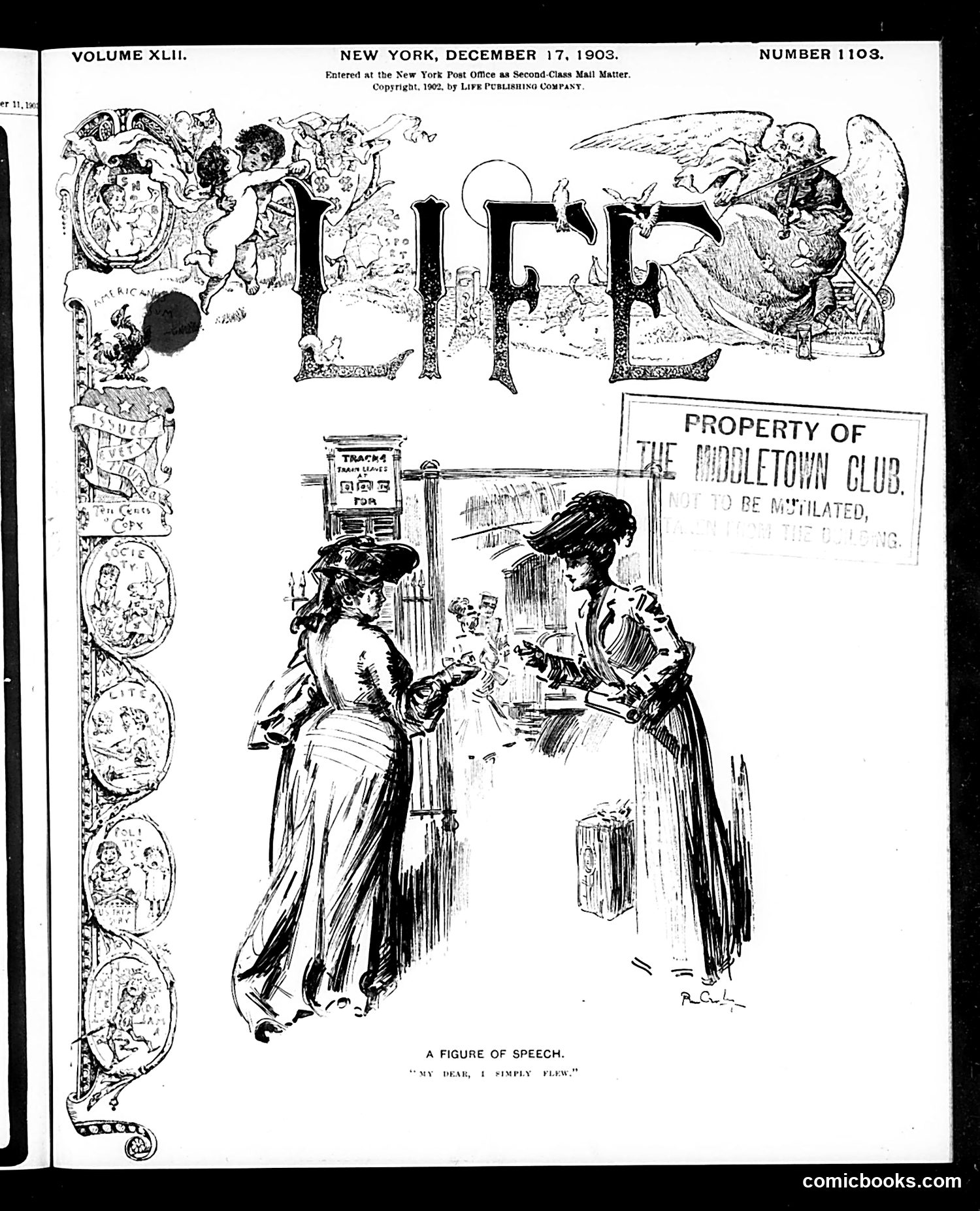
This illustration depicts two women at what appears to be a train station, with one saying "My dear, I simply flew." The cartoon satirizes the contemporary figure of speech—using "flew" to mean "hurried quickly"—by playing on the literal meaning. The ornate left border contains classical medallions, typical of Life's decorative style. The masthead features cherubs and whimsical figures. The humor relies on the gap between colloquial expression and literal interpretation, mocking how fashionable society women employed dramatic language. The railway setting emphasizes speed and modern travel, suggesting why "flew" became popular slang among the upper classes for rapid movement. This reflects turn-of-the-century social commentary on women's speech patterns and affectation.
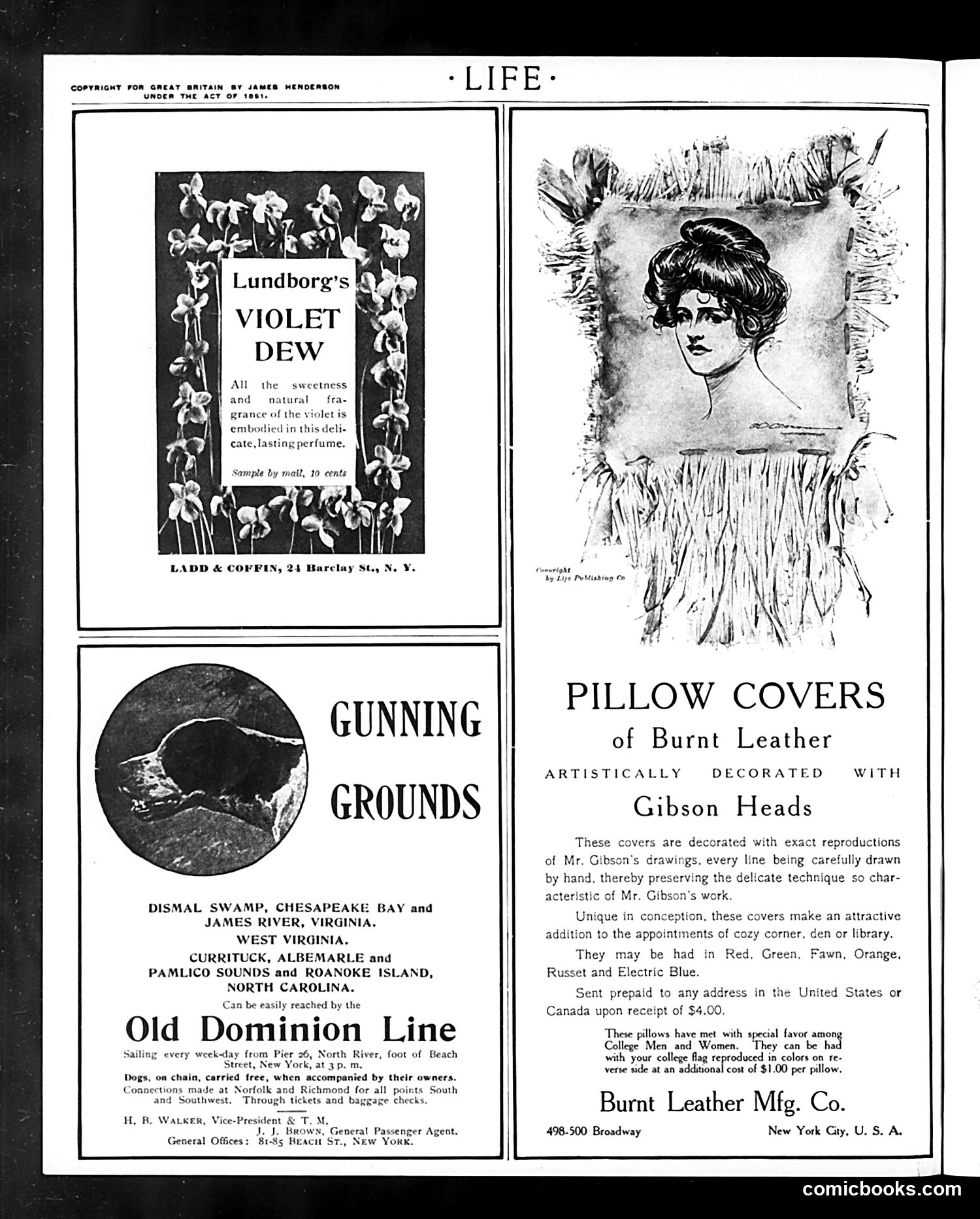
This page is **primarily advertising**, not satire or political commentary. It contains four period advertisements from what appears to be an early 20th-century Life magazine: 1. **Lundborg's Violet Dew** perfume (top left) 2. **Gibson Head pillow covers** (right) — featuring an illustration of an idealized woman's portrait, referencing Charles Dana Gibson's famous "Gibson Girl" aesthetic that defined beauty standards of the era 3. **Old Dominion Line** steamship service (bottom left) — advertising passenger travel between New York and Virginia ports 4. **Burnt Leather Mfg. Co.** (bottom right) — decorative pillow covers The Gibson Girl reference is the only potential cultural touchstone; Gibson's illustrations were influential markers of feminine beauty and upper-class taste during this period. Otherwise, these are straightforward commercial notices with no satirical intent.
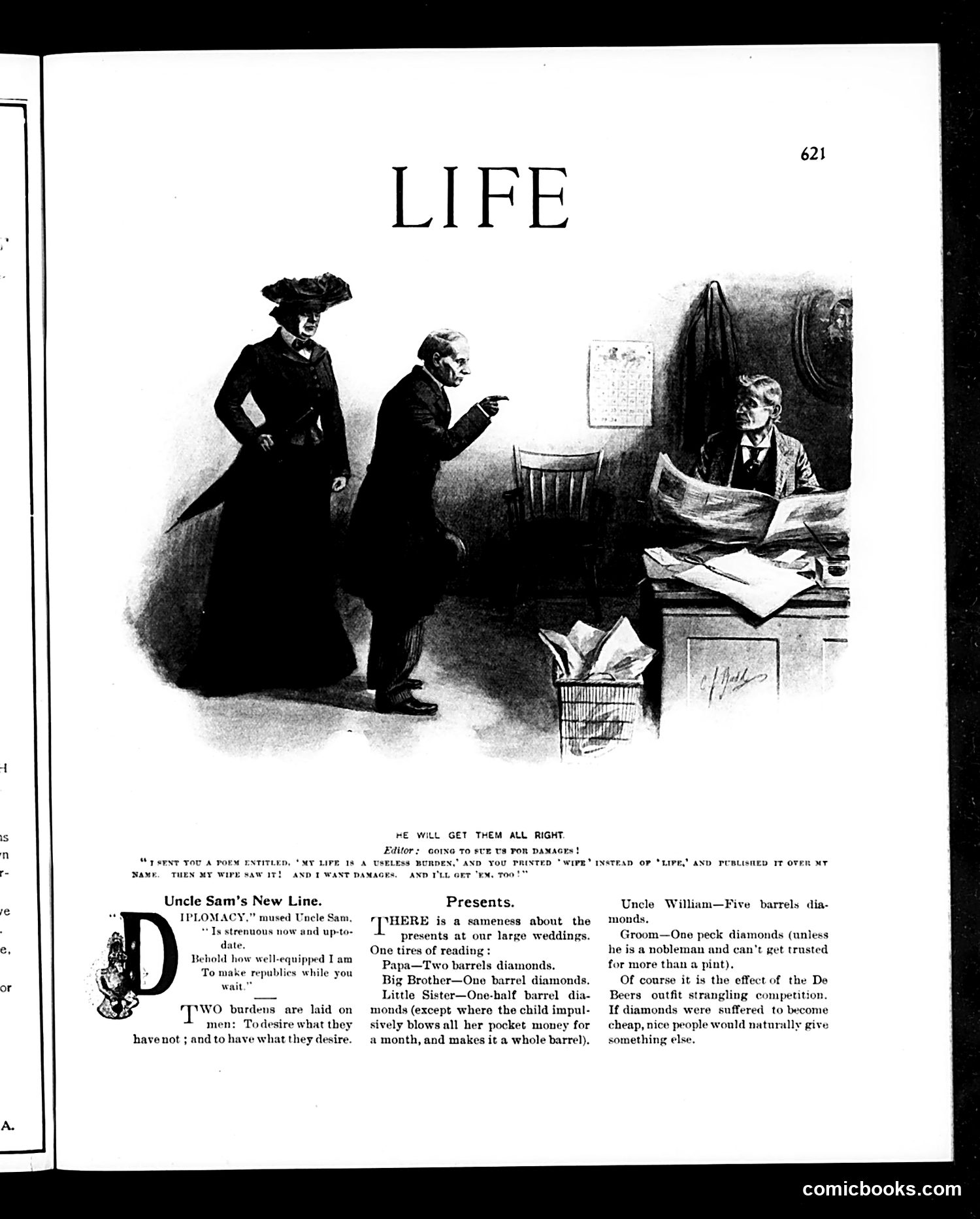
This page satirizes the commercialization of marriage and gift-giving. The cartoon shows a couple presenting an editor with a poem titled "My Life is a Useless Burden," which he rejects, suggesting he publish "Wife" instead and promising damages. **The satire:** The accompanying text, "Uncle Sam's New Line," mocks extravagant wedding gift expectations. It presents absurd diamond quantities as engagement gifts—ranging from "two barrels" (Papa) to "half-barrel diamonds" (Little Sister)—treating precious gems as casual commodities. **The joke:** The piece ridicules both commercialized marriages where gifts become burdensome obligations and the American consumer culture that encourages excessive spending on weddings. The contrast between serious poetry and frivolous diamond gifting emphasizes the satirical point about materialistic values displacing genuine sentiment.
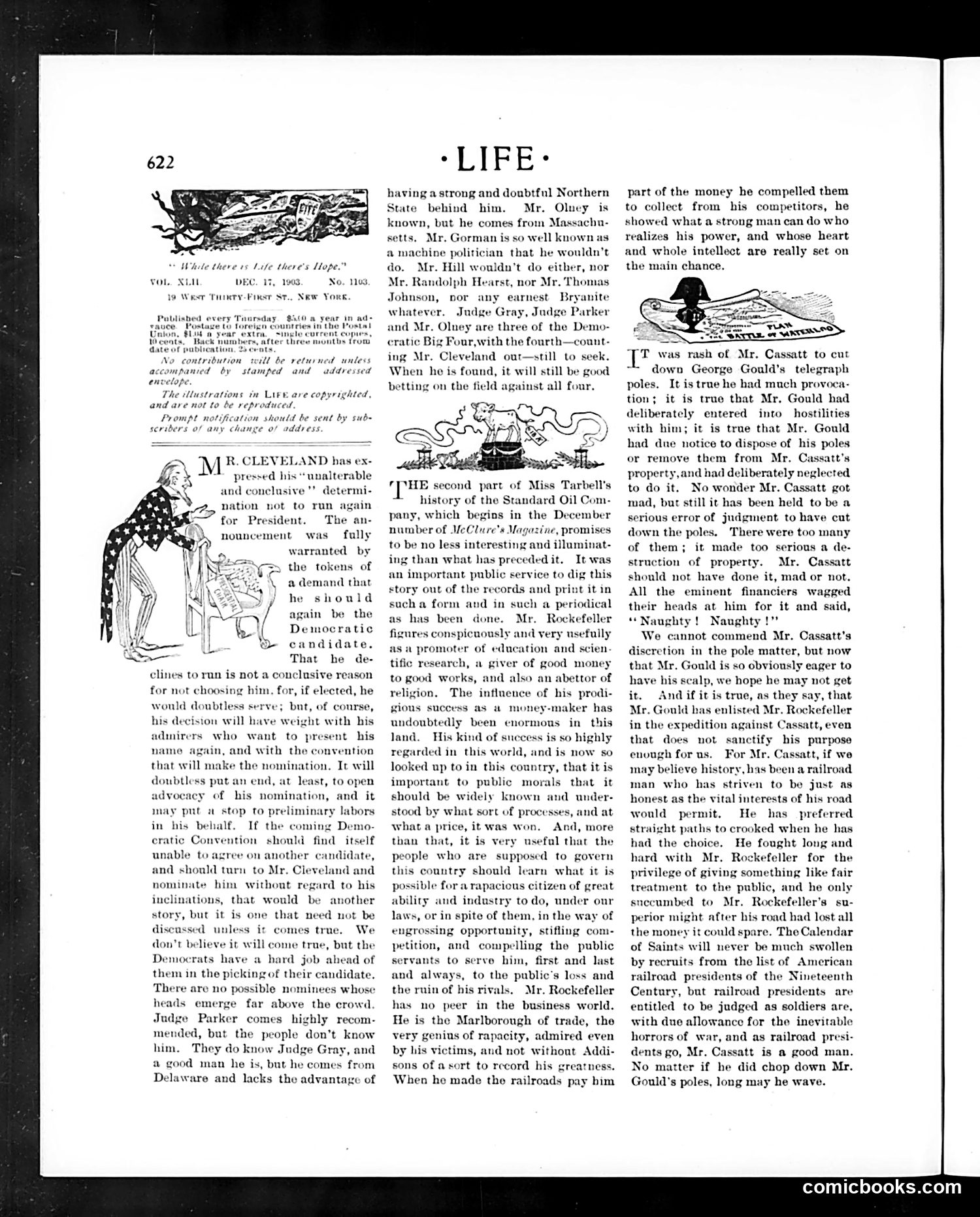
This page contains political commentary about the 1892 Democratic presidential nomination. The text discusses Mr. Cleveland's potential re-nomination, critiquing various Democratic candidates including Judge Gray, Judge Parker, and Mr. Olney as alternatives. The left illustration depicts an elderly, somewhat frail figure (likely representing Cleveland) being supported or examined, suggesting concerns about his fitness for office. The right cartoon shows a man cutting telegraph poles, apparently referencing George Gould's telegraph infrastructure and a controversy involving Mr. Cassatt's handling of railroad property disputes. The satire criticizes hasty judgments about this matter and suggests Mr. Rockefeller might intervene. The overall tone mocks internal Democratic Party divisions and questions about leadership competency during this election cycle.
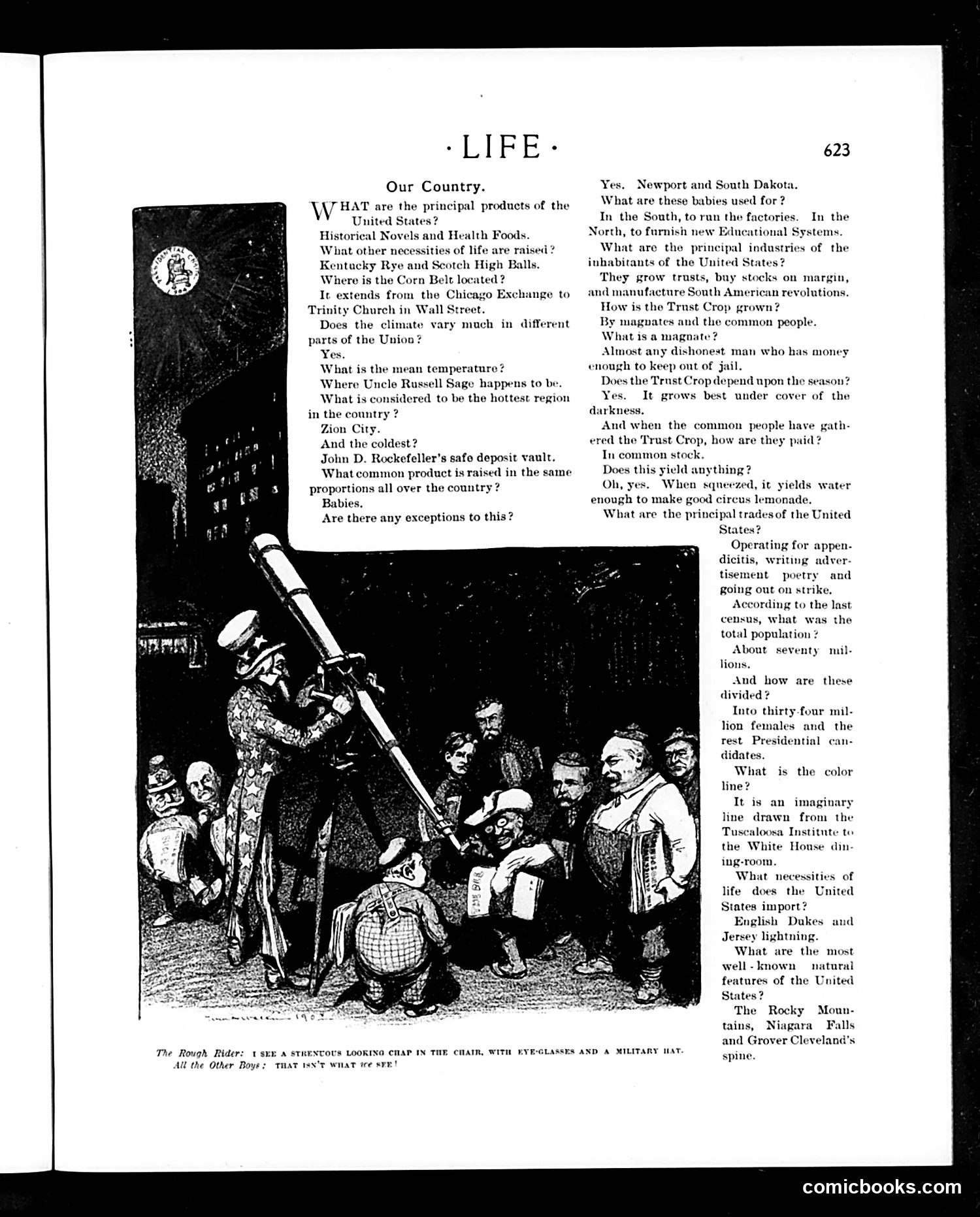
This page contains a satirical Q&A section titled "Our Country" alongside a cartoon illustration. The main cartoon depicts "The Road's Elder" — an older man with an eyeglass and military hat examining something through a telescope — addressing "other boys" about what he sees. The Q&A section parodies educational civics quizzes, but answers mock American institutions and social problems: babies used in factories, the "Trust Crop" as a metaphor for monopolistic control, and cynical observations about wealth and corruption. The cartoon likely satirizes older authority figures who claim superior wisdom while the nation faces serious industrial and economic abuses. The satire targets both generational pretension and actual systemic failures during the Progressive Era.
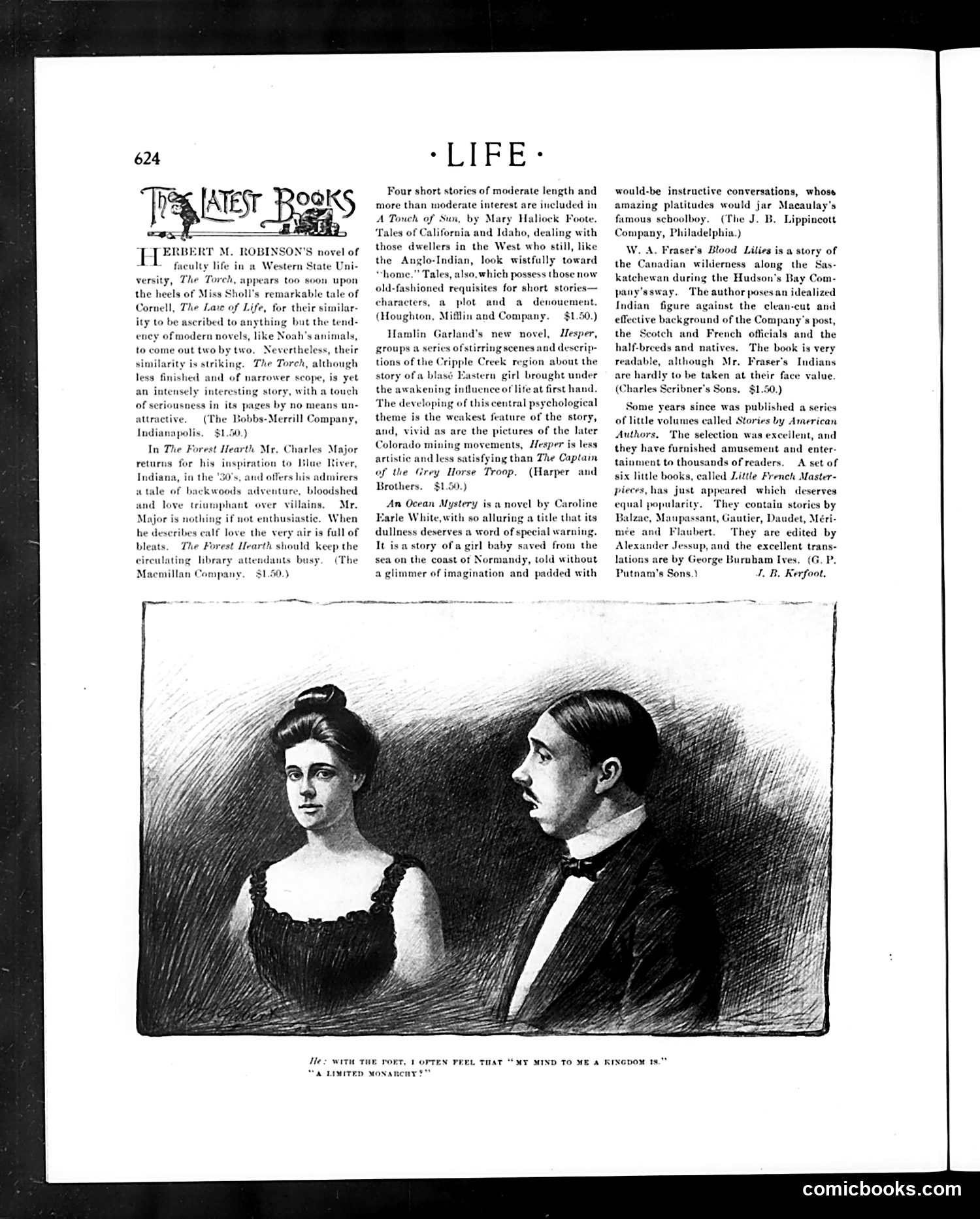
This page is primarily a **book review column** titled "Latest Books," not political satire. It discusses several novels including works set in the American West and stories about California and Idaho. The illustration shows **a man and woman in formal dress** having what appears to be an intimate conversation. The caption quotes: "He: with the face I often feel that 'my mind to me a kingdom is.' A limited monarchy?" This appears to be **satirical commentary on romance or marriage**, likely mocking the sentiment that one's mind offers refuge from domestic life—here suggesting the "kingdom" is limited by a spouse's presence. The cartoon illustrates a literary or social observation about relationships rather than political commentary. The specific novel being referenced is unclear from the visible text.
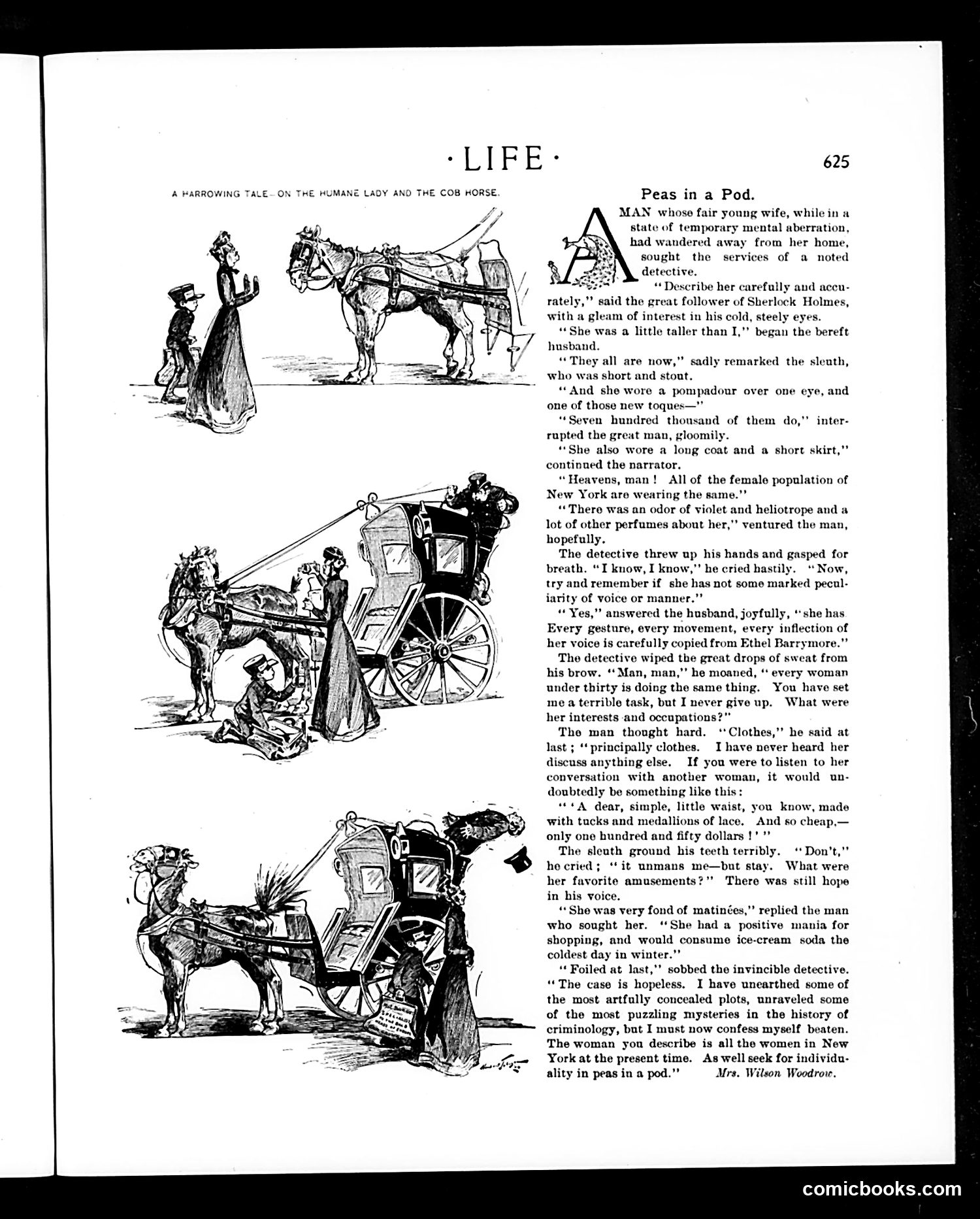
This page satirizes the uniformity of fashionable women in New York. The three illustrations show identical horse-drawn carriages with women dressed in nearly identical outfits—long coats, short skirts, pompadors, and perfume. The story mocks a detective hired to locate a missing wife. He discovers she's indistinguishable from every other fashionable woman in the city, all wearing identical clothes and accessories. The satire targets: - **Fashion conformity**: Women blindly copying Ethel Barrymore's style - **Consumer culture**: Their obsession with shopping and appearances - **Lack of individuality**: The impossibility of identifying anyone by clothing alone The joke's punchline: finding one specific woman among identical-looking others is impossible—"individuality in peas in a pod." This reflects turn-of-century anxieties about mass production homogenizing society.
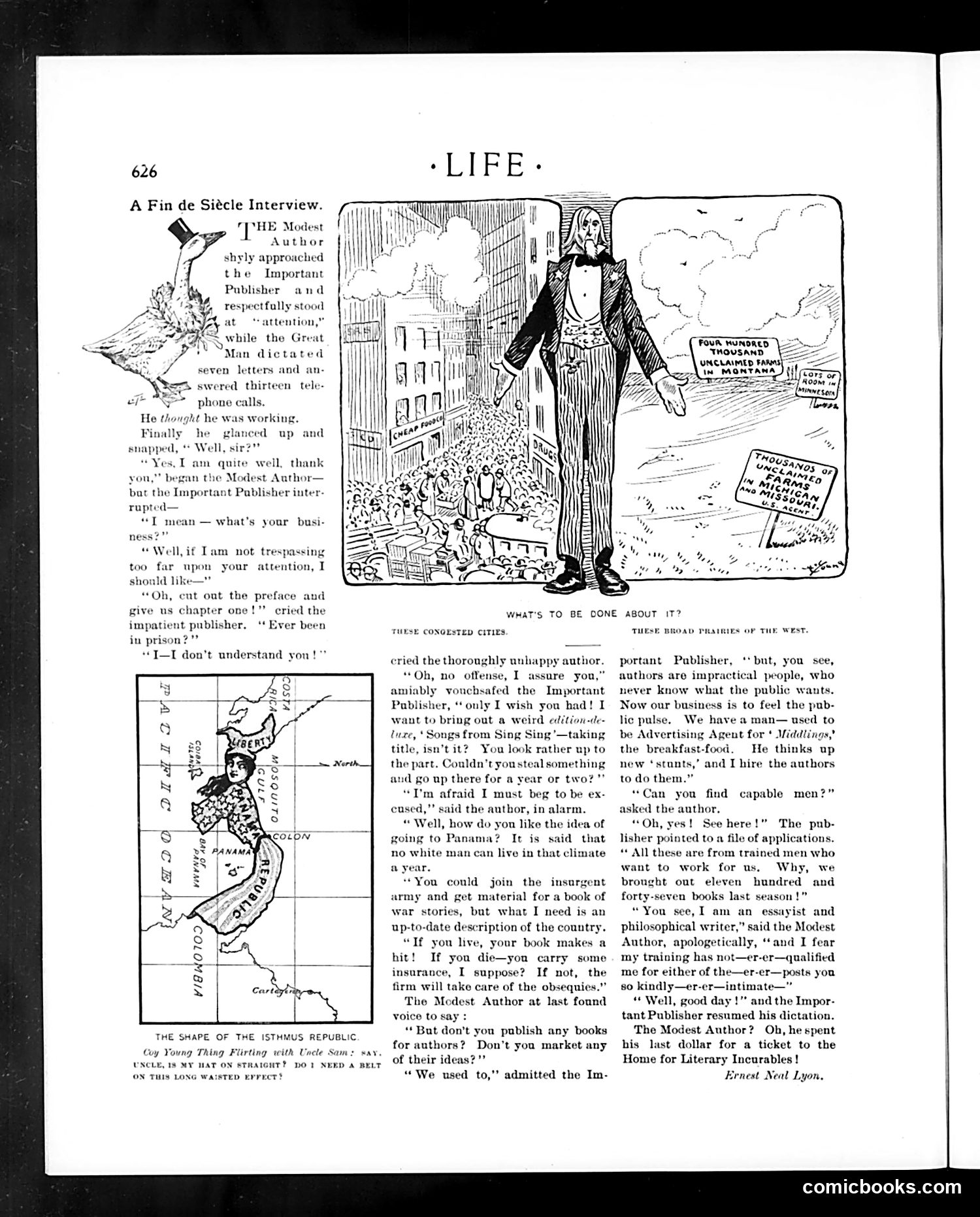
This page satirizes the publishing industry through a dialogue between "The Modest Author" and an "Important Publisher." The author pitches various exotic book ideas—including one set in Panama and another about insurgent armies—hoping for publication. The publisher dismisses these concepts as impractical, revealing that Life magazine's actual business model relies on advertising agents and marketing books about advertisers themselves rather than publishing authors' original work. The accompanying map cartoon mocks geographical ignorance, showing a comically distorted map labeled "The Shape of the Isthmus Republic," satirizing confusion about Central American geography during the Panama Canal era. The satire critiques fin-de-siècle publishing's commercialism: publishers care more about marketable concepts than literary merit or author welfare.
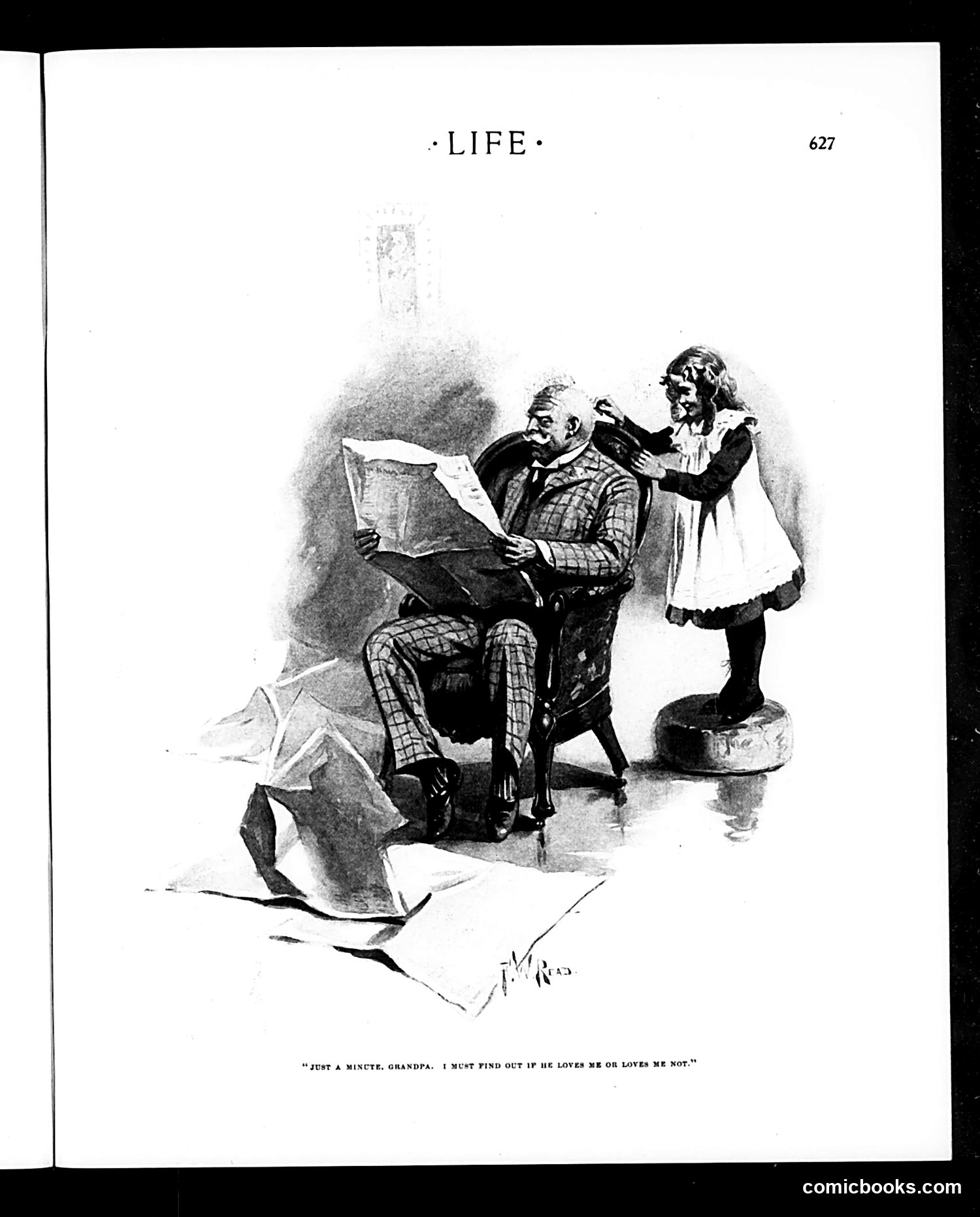
This illustration from *Life* magazine (page 627) depicts a domestic scene of uncertain romantic resolution. An older man in plaid clothing sits reading a newspaper while a young girl stands beside him, adjusting or removing his collar. The caption reads: "Just a minute, grandpa. I must find out if he loves me or loves me not." The humor appears to stem from the girl's childlike method of divination—plucking petals from a flower (visible on the floor)—applied to a serious romantic question. The cartoon satirizes the contrast between innocent, superstitious love-testing and genuine adult relationships. The grandfather's obliviousness while reading suggests generational disconnect. Without additional context, the specific romantic scenario remains unclear, but the joke centers on youthful naiveté about matters of the heart.
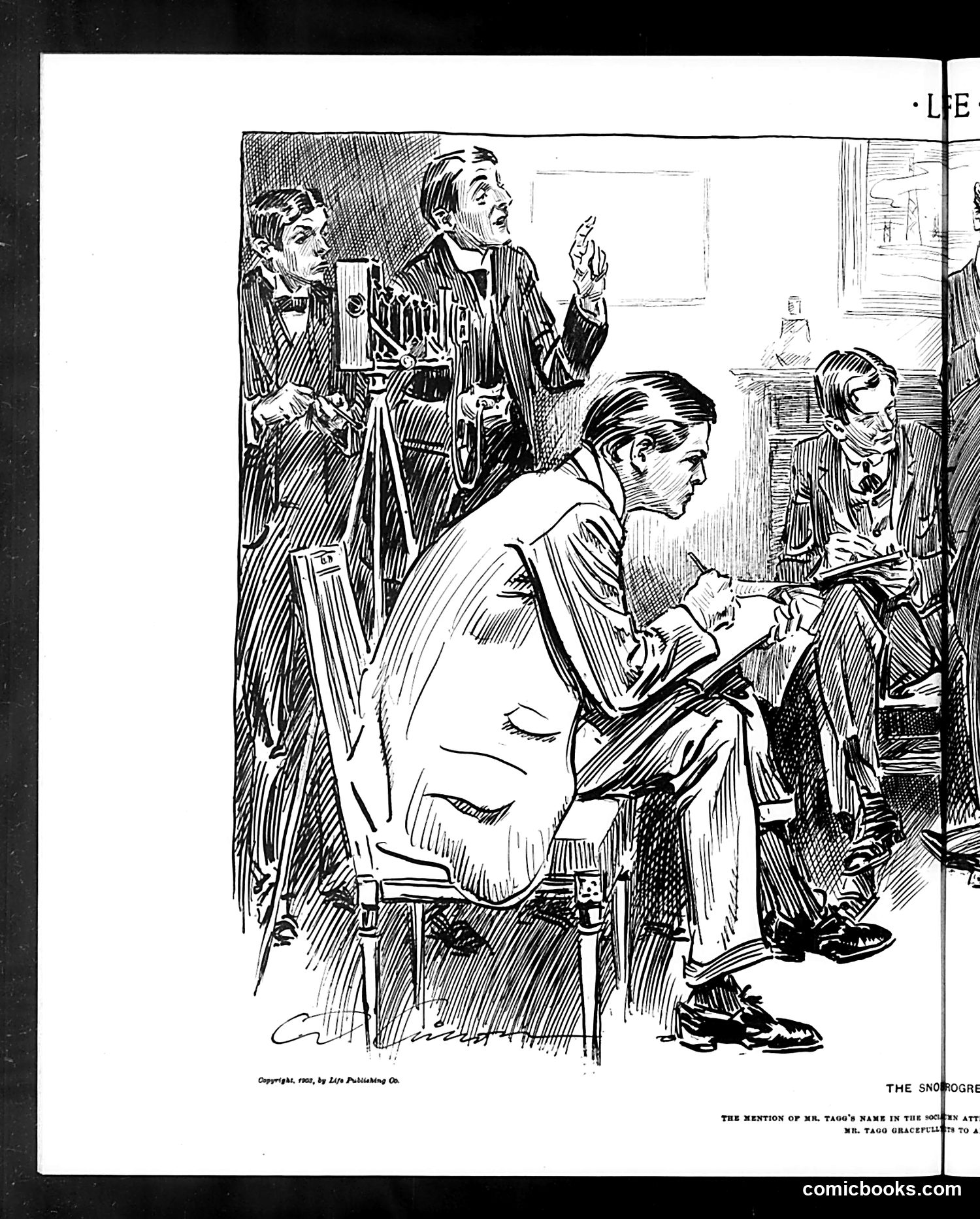
This cartoon depicts a social satire about snobbery and pretension. The central figure is a large-headed man seated prominently, appearing self-satisfied while reading or writing. His exaggerated facial features suggest pomposity. Around him are several other figures—some in the background appearing to defer to or observe him, others at right seemingly engaged in their own activities. The caption references "Mr. Yago's name" being mentioned "in the same breath" as someone, with a note that "Mr. Yago characterizes it to a..." (text cuts off). This appears to satirize social climbing or status-seeking behavior—the joke being that Mr. Yago, despite pretensions, is grouped with undesirable company. The "Snobbogre" title suggests a monstrous or grotesque embodiment of snobbish behavior, mocking artificial class consciousness.
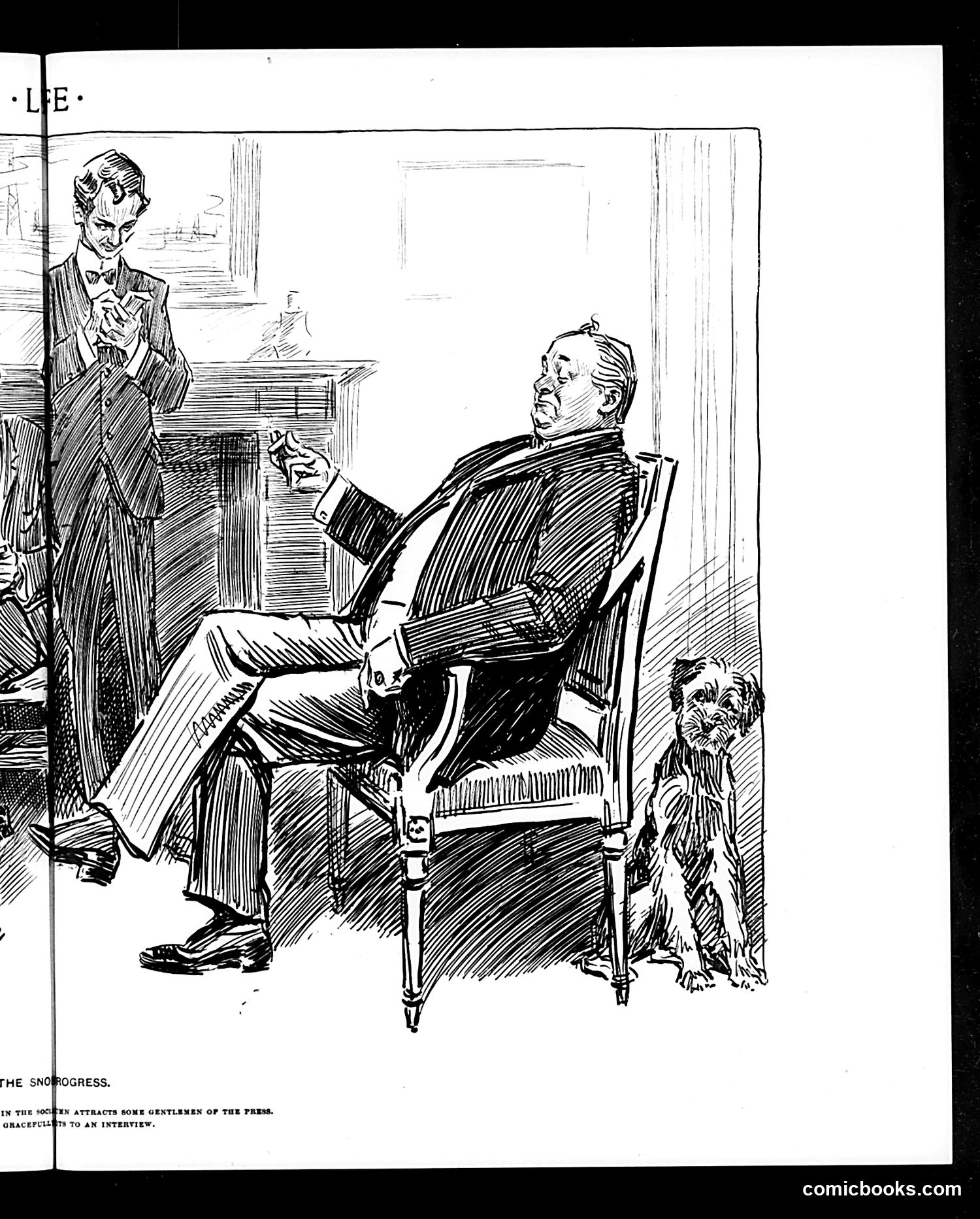
This cartoon satirizes the "Northern attracts more gentlemen of the press" to an interview, as indicated by the caption text at the bottom. The image shows two men in a formal interior setting: one seated comfortably in a chair with a small dog beside him, the other standing nearby. The seated man appears to be a subject of journalistic interest—likely a prominent public figure or politician being interviewed. The standing man represents a member of the press. The cartoon's humor appears to stem from contrasting the dignified interview scenario with the dog's humble presence, suggesting either irony about who commands attention or commentary on the absurdity of journalistic fascination with certain subjects. Without additional context about the specific historical moment or individuals depicted, the precise satirical target remains unclear, though it evidently mocks contemporary press practices or a particular newsworthy figure.
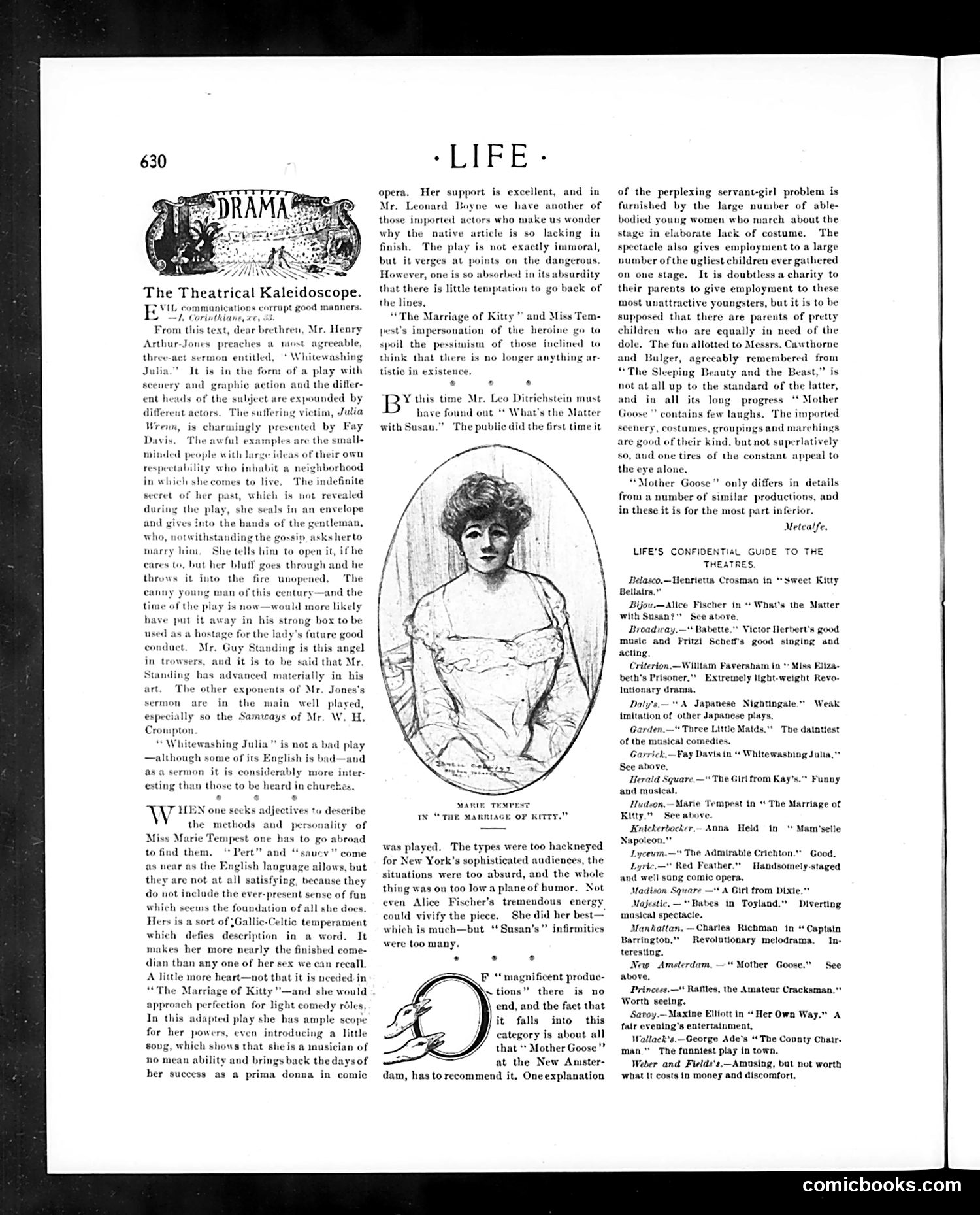
This page features theater reviews under "The Theatrical Kaleidoscope" section. The central image is a portrait sketch of **Marie Tempest** in "The Marriage of Kitty." The text discusses various Broadway productions, critiquing their artistic merit and casting. Key points include: - Praise for **Arthur Jones's** play "Whitewashing Julia" for its engaging premise, though critics note it has some plot weaknesses - Commentary on **Leo Dirrichstein's** "What's the Matter with Susan?" as the first public performance of that work - Reviews of other shows like "The Sleeping Beauty and the Beast" and "Mother Goose," criticizing their spectacle-heavy approach over substance The page serves as contemporary theater criticism, evaluating acting quality, plot construction, and entertainment value for Life's educated readership interested in theatrical culture.
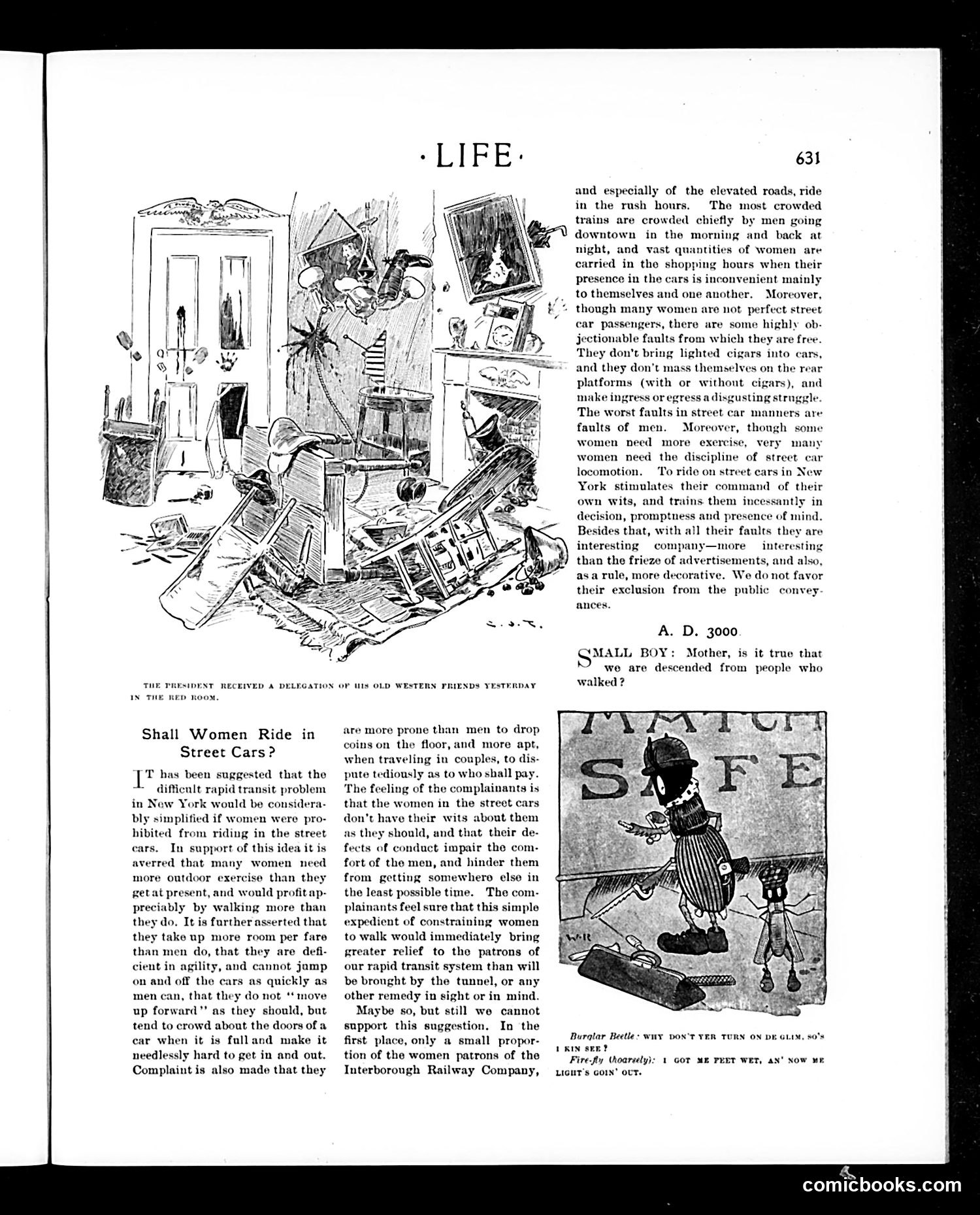
This page satirizes a serious proposal to ban women from New York street cars to ease transit congestion. The article argues against excluding women, using both practical and social reasoning. **The Satire's Point:** The piece mocks male complainants who blame women for transit problems—claiming women take up space, move slowly, drop coins, and argue about fares. Life counters that men actually cause worse disruptions (smoking cigars, crowding platforms) and that women riders aren't primarily present during rush hours anyway. **Social Context:** This reflects early-1900s tensions over women's increasing public presence and mobility. The article defends women's right to use public transportation while acknowledging some do need "discipline" and "presence of mind"—a backhanded compliment typical of the era. **The Cartoons:** Small illustrations joke about future generations ("descended from people who walked") and a burglar firefly, providing light satirical relief. The piece essentially argues: don't exclude women—improve transit infrastructure instead.
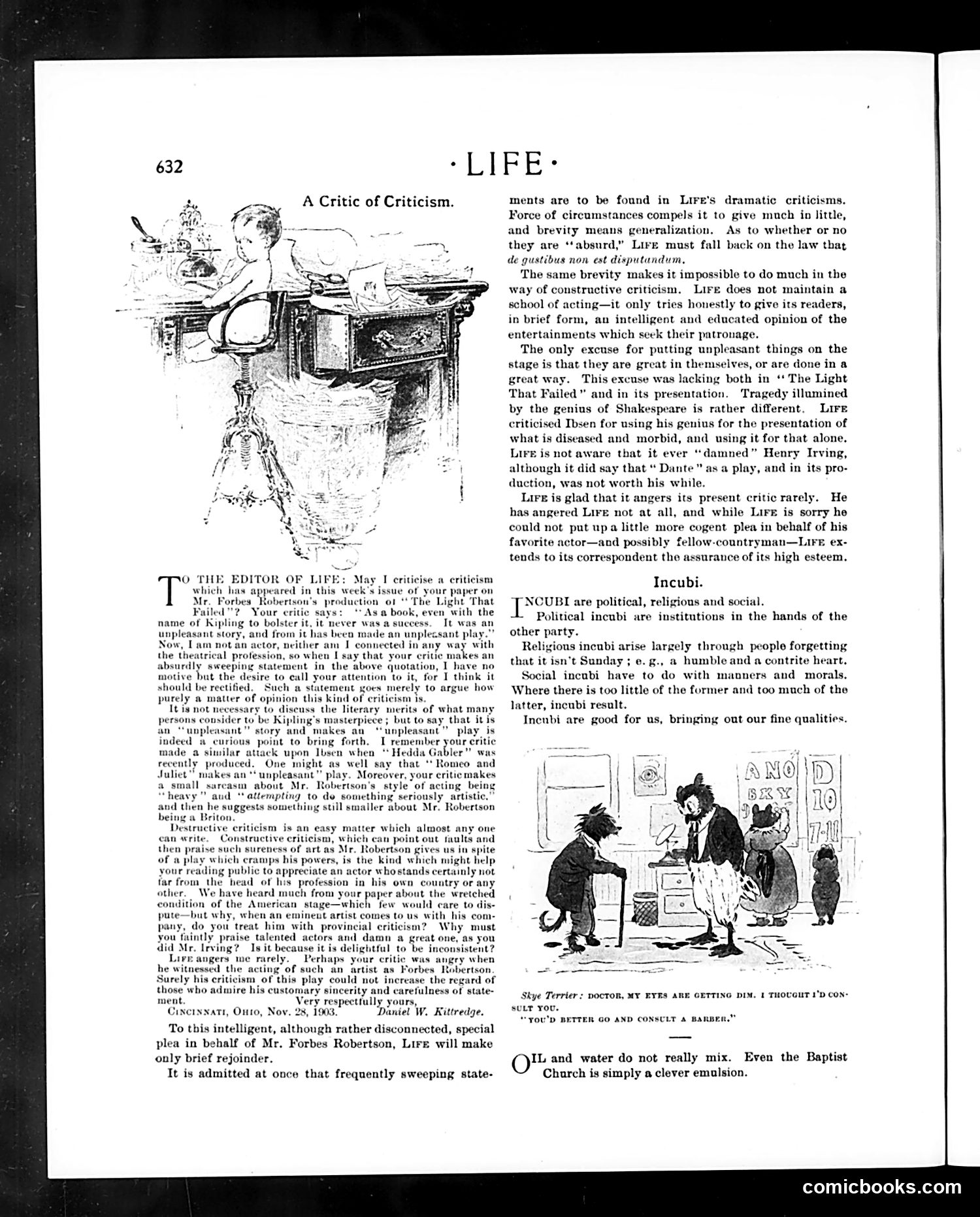
This page presents a letter-to-editor debate about dramatic criticism. A reader, Daniel W. Kittredge, defends actor Forbes Robertson's production of "The Light That Failed" (adapted from Kipling's novel), arguing that *Life* magazine's critic was unfairly destructive rather than constructive. **The Key Issue:** Kittredge complains the critic dismissed the play as inherently "unpleasant," comparing this to past attacks on Ibsen and even Shakespeare's tragedies. He argues *Life* praises lesser actors while damning talented ones like Robertson and Henry Irving, questioning the magazine's consistency. **Life's Response:** The magazine acknowledges using broad generalizations due to space constraints, but defends its position that unpleasant subject matter requires either inherent greatness or superior execution—neither present in this production. They deny ever "damning" Irving. The cartoon (lower right) shows a terrier at a doctor's office, apparently unrelated satire about medical consultation.
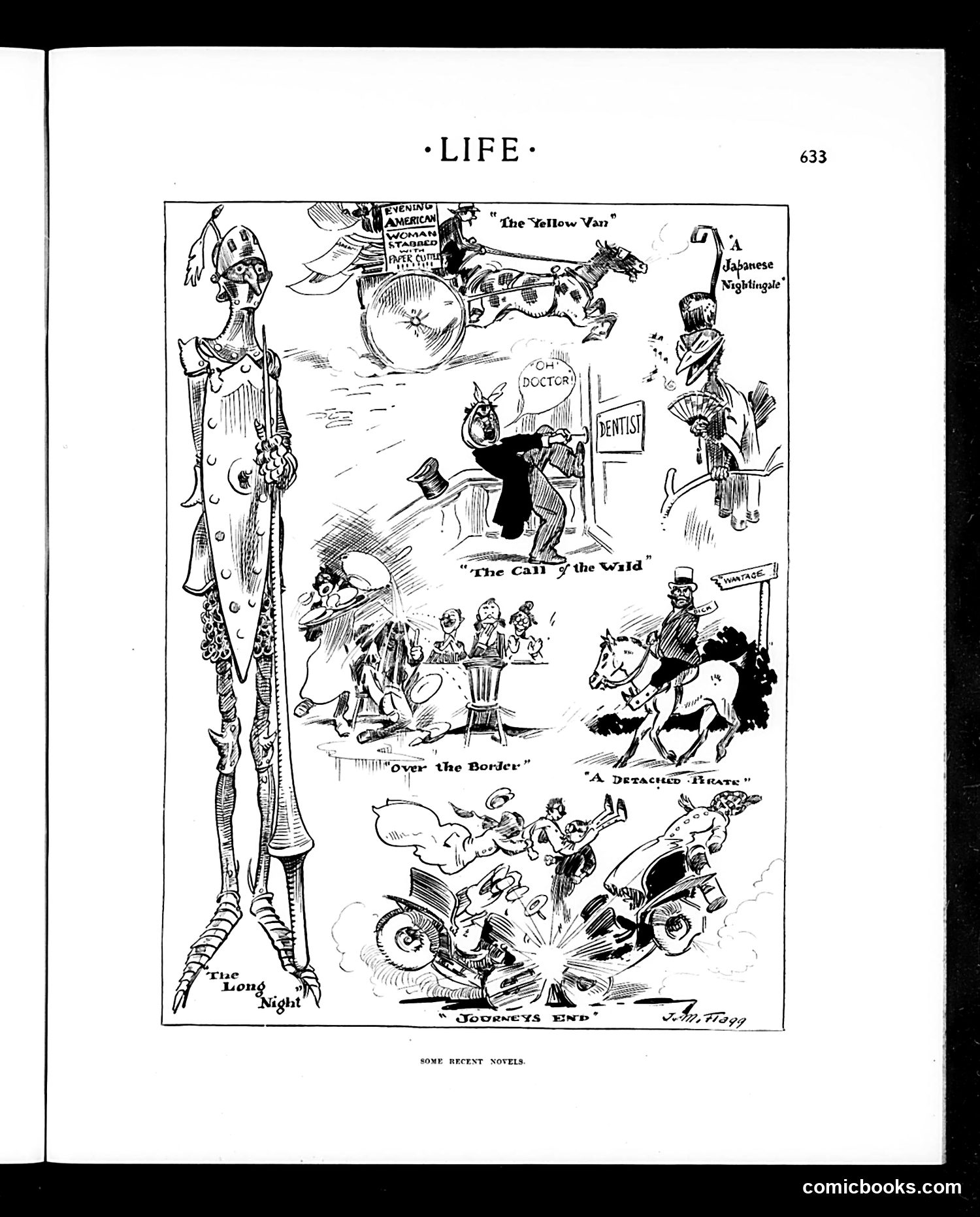
This page illustrates "Some Recent Novels" through a satirical composite cartoon. On the left stands an extremely tall, skeletal figure labeled "The Long Night," representing a tedious or overly lengthy book. The surrounding vignettes mock popular fiction genres of the era: - "The Yellow Peril" and "Japanese Nightingale" reference sensationalist adventure stories - "The Call of the Wild" shows a dentist scene, likely mocking Jack London's novel - "Over the Border," "Detached," and "Journeys End" depict other contemporary books The cartoonist ridicules these novels' melodrama and predictable plots through exaggerated, absurd illustrations. The satire targets both publishers' marketing of exotic tales and readers' appetite for sensationalist popular fiction. The artist's signature appears at bottom right.
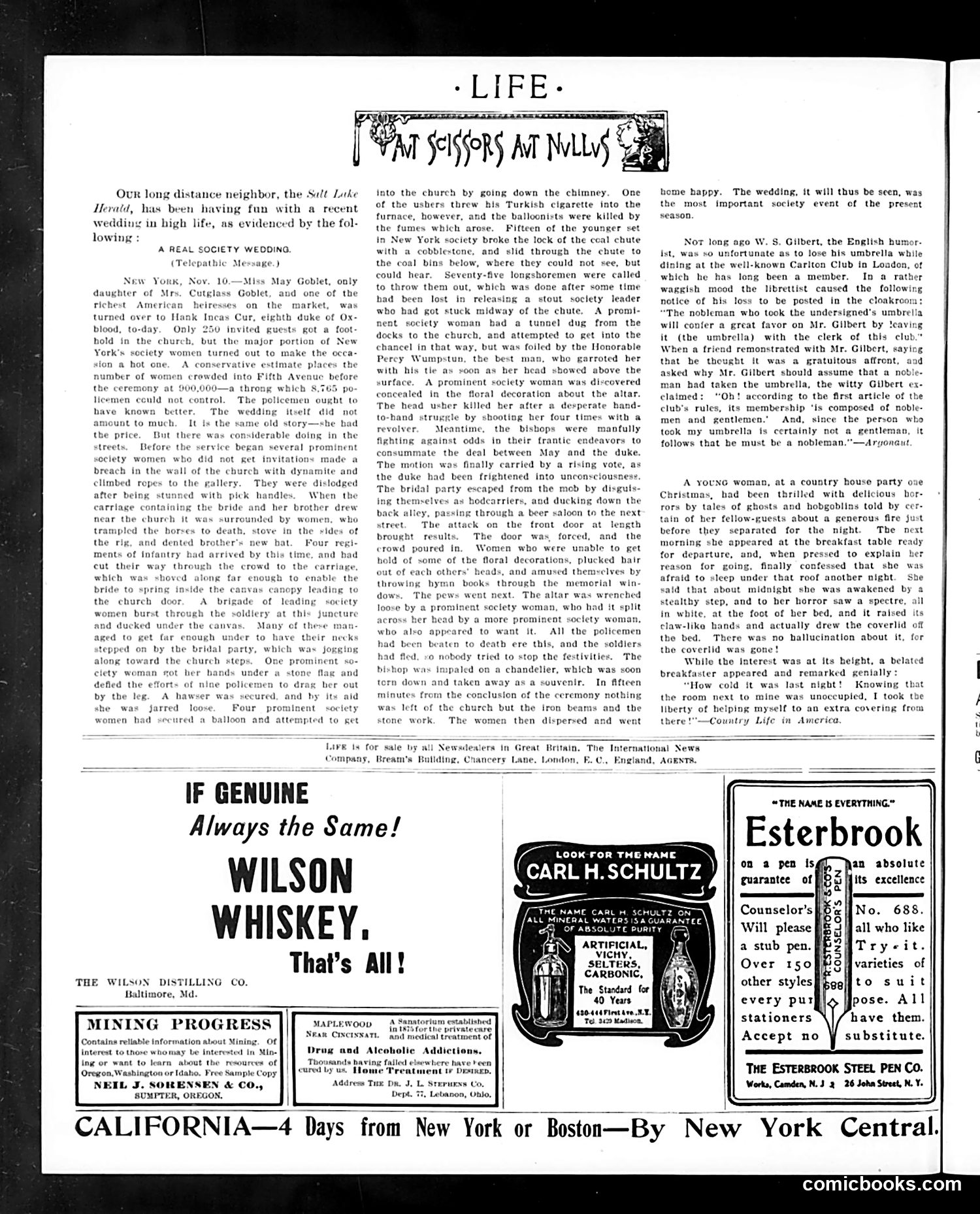
This page satirizes high-society weddings of the era through a mock "telepathic message" describing the wedding of heiress May Goblet to the Duke of Oxblood. The humor lies in absurdist exaggeration: society women resort to violence and chaos—breaking into churches via chimneys and coal chutes, fighting over decorations, destroying church property—to attend the exclusive event. The satire mocks the era's upper-class obsession with exclusive social access and the triviality of wealth-based marriages ("she had the price"). The cascading disasters (deaths, destroyed hymn books, wrenched altars) escalate ridiculously, suggesting that high society's desperation for status is inherently destructive. The page is primarily this satirical story with period advertisements below (Wilson Whiskey, Esterbrook pens). The cartoon is textual rather than visual—satire through narrative rather than drawings.
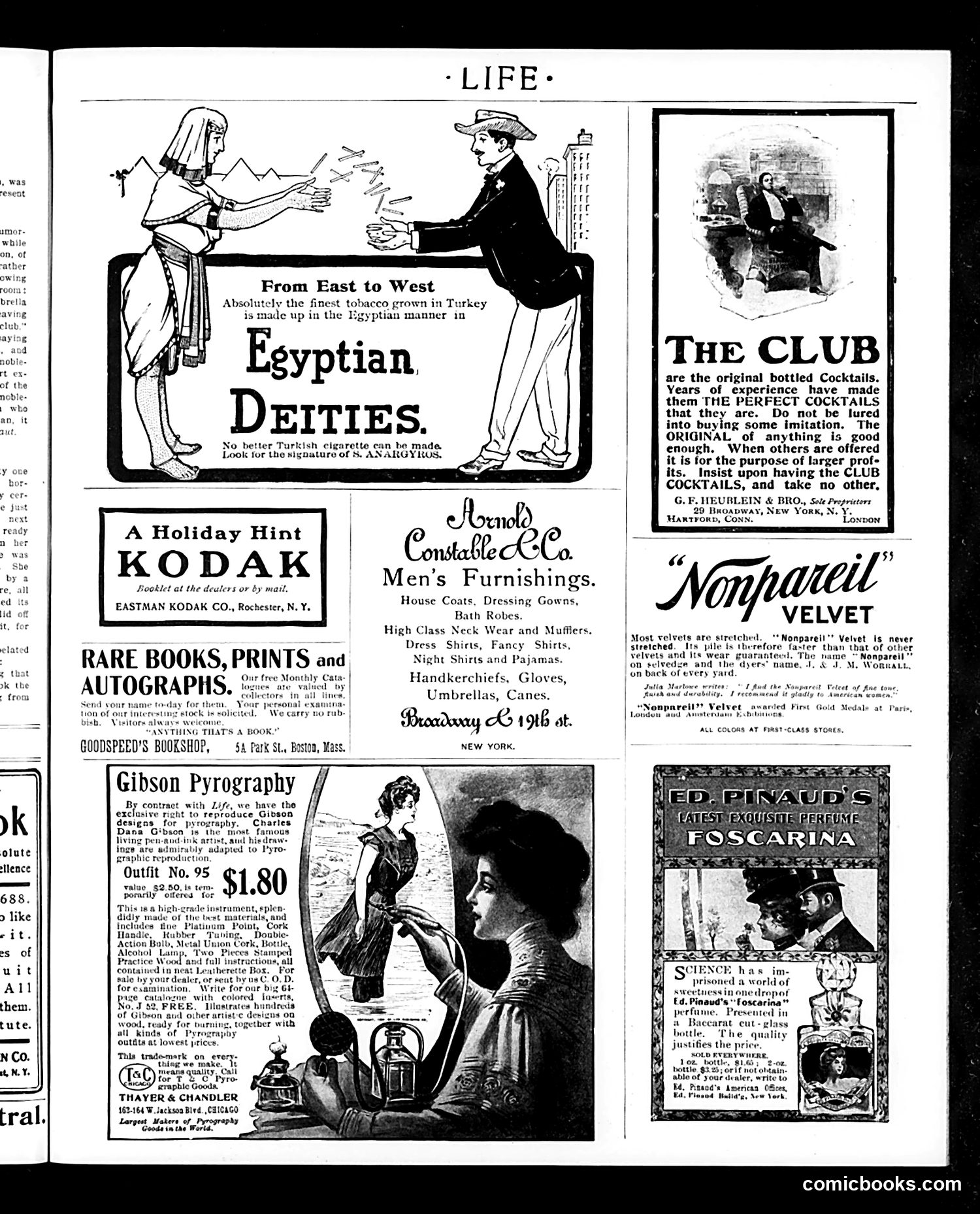
The main cartoon, titled "From East to West," depicts a commercial exchange between two Western businessmen representing the cigarette trade. One figure (left) dressed in Egyptian/Turkish costume hands tobacco to a suited gentleman (right), symbolizing the international tobacco commerce of the era. The satire mocks the marketing practice of exoticizing foreign products—specifically Turkish cigarettes branded as "Egyptian Deities"—to appeal to American consumers seeking sophistication and worldliness. The joke critiques how Western companies appropriated Oriental imagery and mystique to sell luxury goods, with the "Egyptian manner" production serving purely as marketing rather than authentic craftsmanship. It's satirizing early 20th-century orientalism and consumer culture's appetite for exotic branding. The page is otherwise dominated by period advertisements for cameras, men's clothing, books, pyrography kits, and perfumes—typical of Life's revenue model as a magazine.
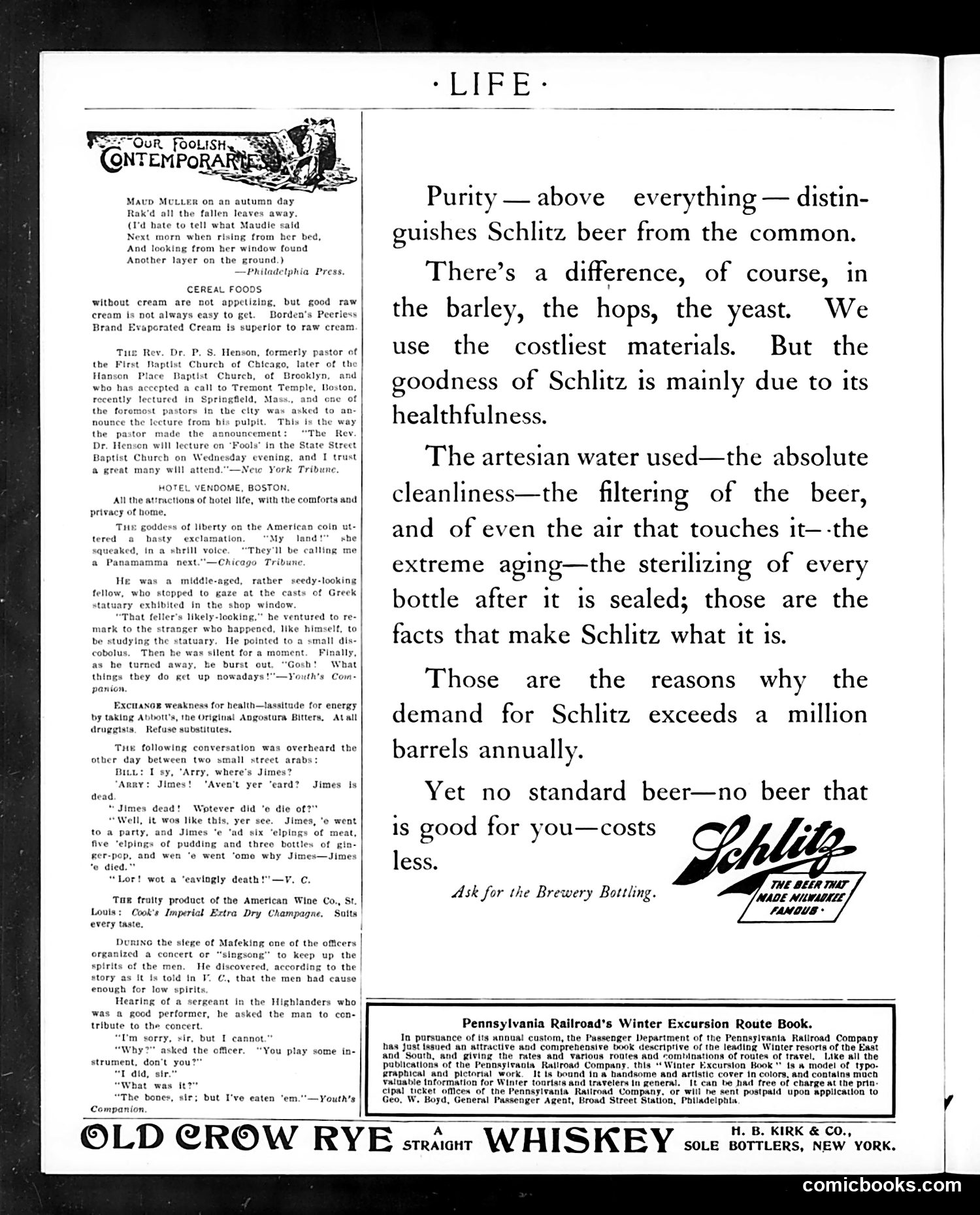
This page is primarily **advertising**, featuring a large Schlitz beer advertisement dominating the right side. The ad emphasizes "purity" and "healthfulness" as Schlitz's distinguishing qualities, contrasting it with unnamed competitors by highlighting its use of artesian water, filtering processes, aging, and sterilization. The left column contains "Our Foolish Contemporaries"—short satirical items mocking various topics: a poem about Maud Muller, absurd advice about cereal and cream, a pastor's announcement, observations about hotel life and American coins, and humorous street dialogue (using exaggerated working-class dialect) about a boy named James who apparently died from overeating at a party. These snippets represent typical Life magazine humor: mild social observation, puns, and gentle ridicule of contemporary mores and speech patterns. The bottom advertises Old Crow Rye whiskey and mentions a Pennsylvania Railroad excursion guide. The overall tone is lighthearted satire mixed with period advertising.
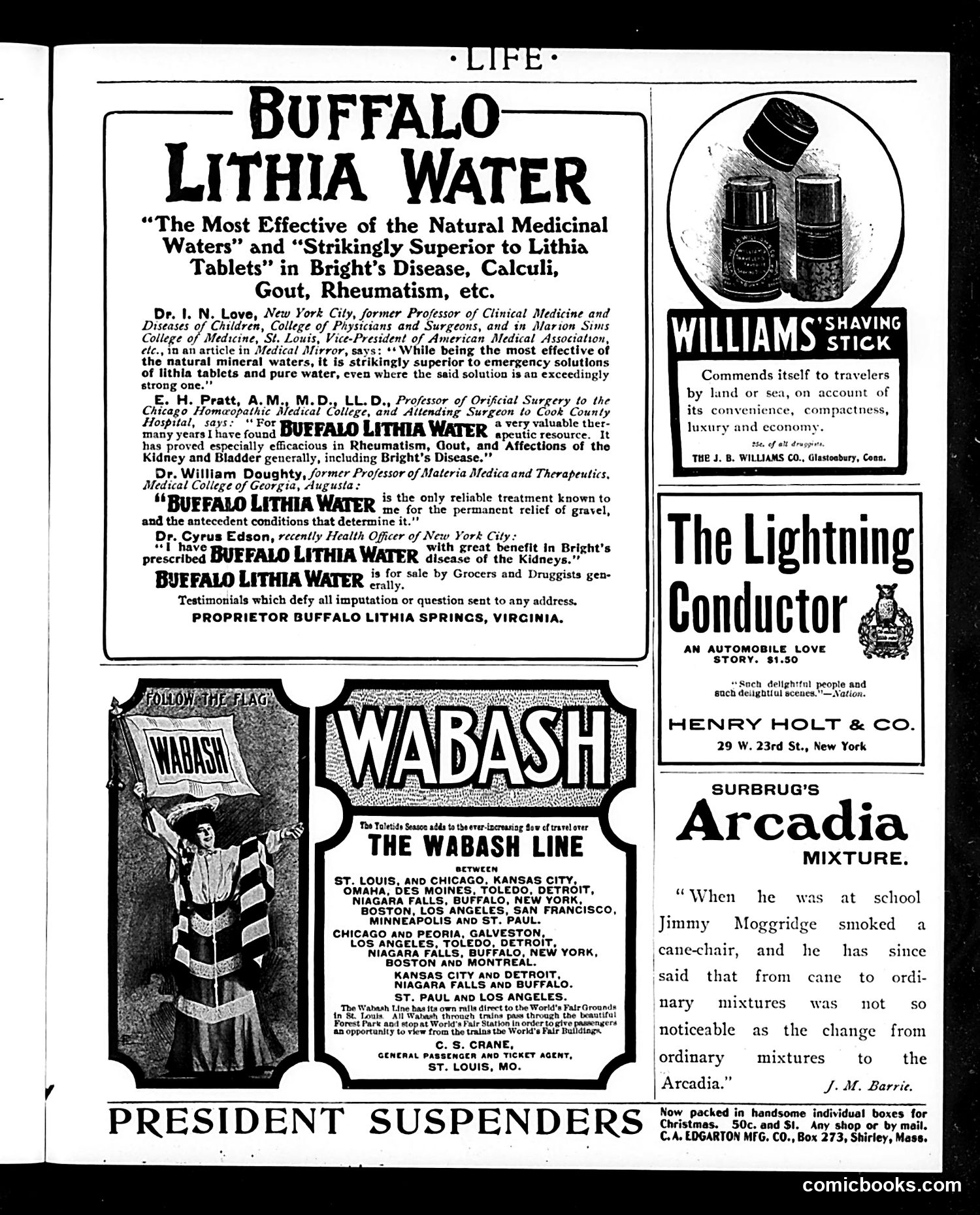
This is primarily an **advertising page** rather than a satirical cartoon page. It contains testimonial-based product ads typical of early 20th-century magazines. The dominant advertisement is for **Buffalo Lithia Water**, a mineral water treatment claiming to cure Bright's Disease, gout, rheumatism, and kidney ailments. It features endorsements from prominent medical figures (professors, a former NYC Health Officer)—a marketing strategy that lent false scientific credibility to patent medicines. This reflects the **pre-FDA regulation era** when such unsubstantiated health claims were legal. Other ads include railroad travel (Wabash Line), Williams Shaving Stick, "The Lightning Conductor" (an automobile romance novel), Surburg's Arcadia tobacco mixture, and President Suspenders. **For modern readers:** These ads reveal how companies exploited medical authority and lack of consumer protection to market dubious "cures" to the public. The prominent doctor testimonials were common advertising tactics that wouldn't pass today's regulatory standards.
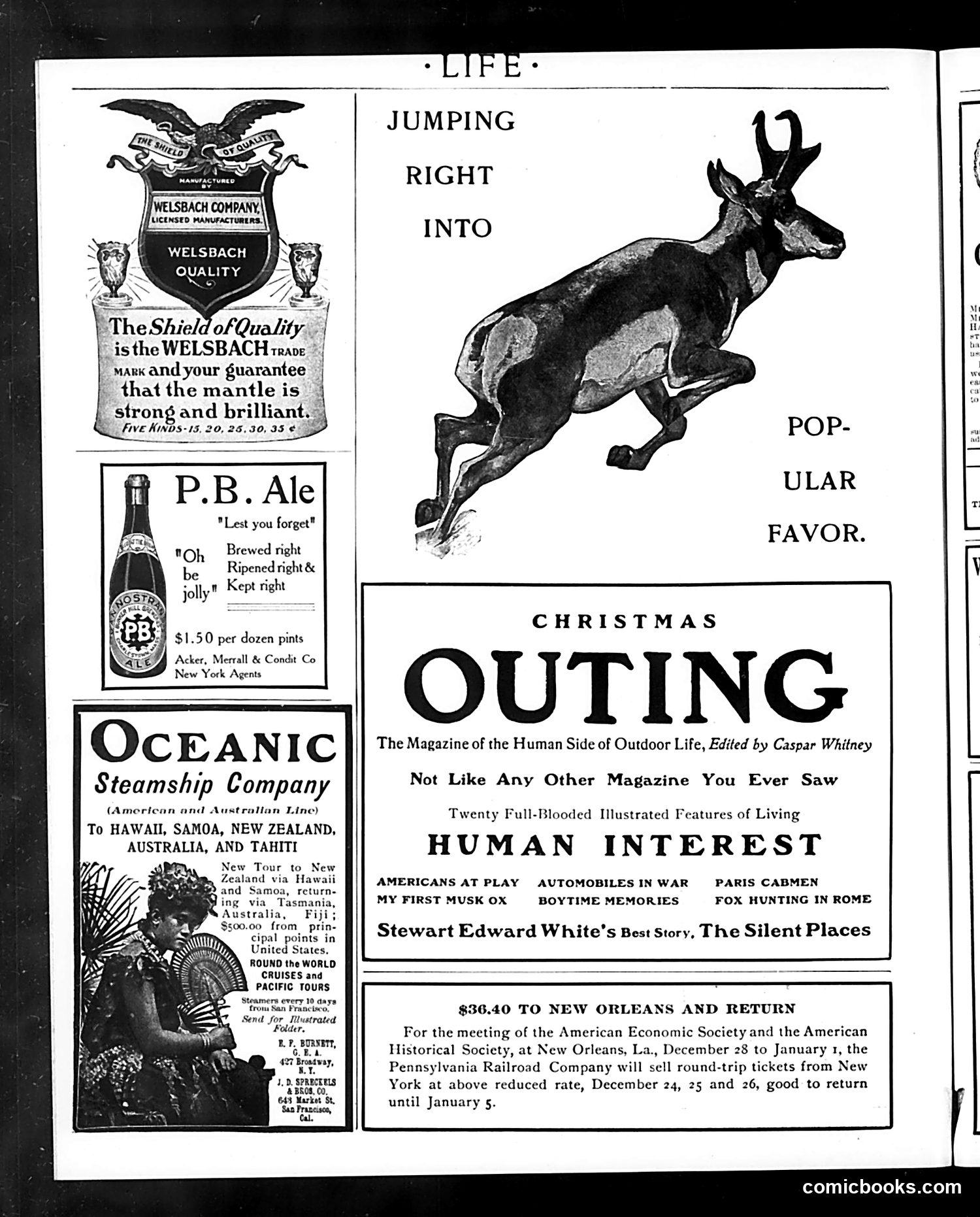
This page is primarily **advertising and promotional content**, not political satire. The main elements are: **Central Image**: A leaping deer illustrates "Outing" magazine's Christmas issue, promoting the publication as a popular choice for holiday gifts. **Advertisements**: The page features four commercial ads—Welsbach lamp mantles (emphasizing quality), P.B. Ale beer, Oceanic Steamship Company (cruise vacations), and Pennsylvania Railroad (holiday travel deals to New Orleans). **Editorial Content**: "Outing" advertises its upcoming Christmas issue, promising "Twenty Full-Blooded Illustrated Features" covering outdoor activities and adventure stories, including Stewart Edward White's "The Silent Places." **Historical Context**: The pricing and offerings reflect early 20th-century leisure pursuits—ocean cruises, fox hunting, automobiles, and adventure literature—aimed at wealthy American readers. There is no apparent satire or political commentary on this page.
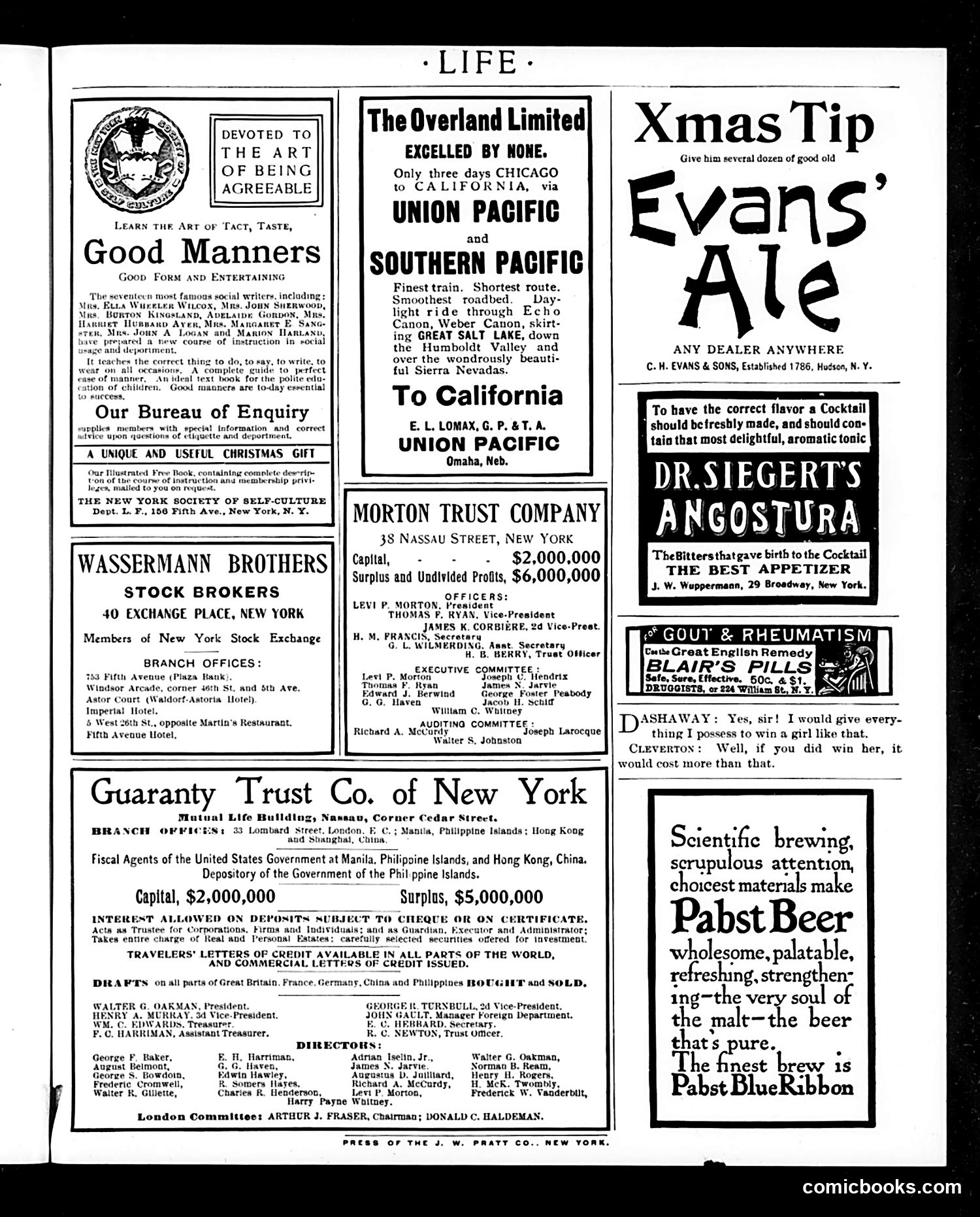
This page is primarily **advertisements** rather than satirical content. However, the small dialogue at bottom-right contains a light joke: **DASHAWAY and CLEVERTON** exchange a quip about romantic prospects. Dashaway claims he'd "give everything" to win a certain girl; Cleverton replies that if he actually *did* win her, the relationship would cost him even more than "everything"—a cynical joke about the expenses of courtship and marriage, likely mocking both romantic idealism and women as financially costly. The page features ads for financial services (stock brokers, trust companies), transportation (Union Pacific Railroad), alcohol (Evans' Ale, Pabst Beer, Angostura Bitters), and etiquette instruction. The "Good Manners" course at top-left reflects early-1900s anxiety about maintaining proper social standing during America's industrial expansion. No specific political figures or events are referenced.
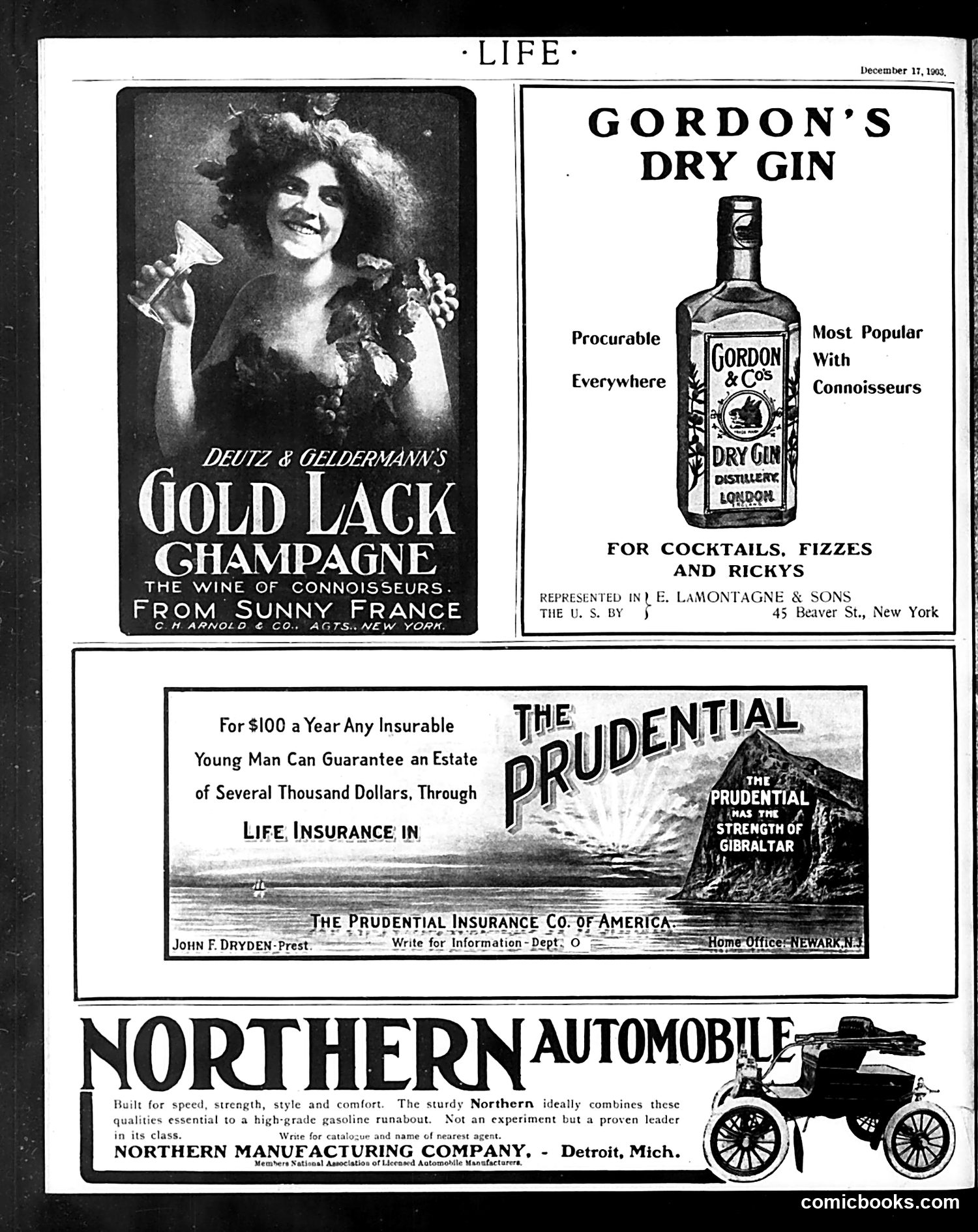
This is primarily an **advertising page** rather than satirical content. It contains four commercial advertisements typical of early 1900s American magazines: 1. **Gold Lack Champagne** (top left): Features an attractive woman—a marketing approach common for luxury beverages, positioning the product as refined and associated with sophistication. 2. **Gordon's Dry Gin** (top right): A straightforward spirits advertisement emphasizing the product's popularity among "connoisseurs." 3. **Prudential Insurance** (center): Promotes life insurance as financial security, using the Rock of Gibraltar as a metaphor for strength and stability—a famous Prudential slogan of that era. 4. **Northern Automobile** (bottom): Markets an early motorcar as combining "speed, strength, style and comfort," appealing to the emerging auto market. The page reflects 1909 consumer culture: alcohol advertising was unrestricted, life insurance was a growing middle-class concern, and automobiles represented modern aspiration. There is no apparent political satire or commentary present.