
Life, 1903-12-17 · page 14 of 22
Life — December 17, 1903 — page 14: what you’re looking at
What you’re looking at
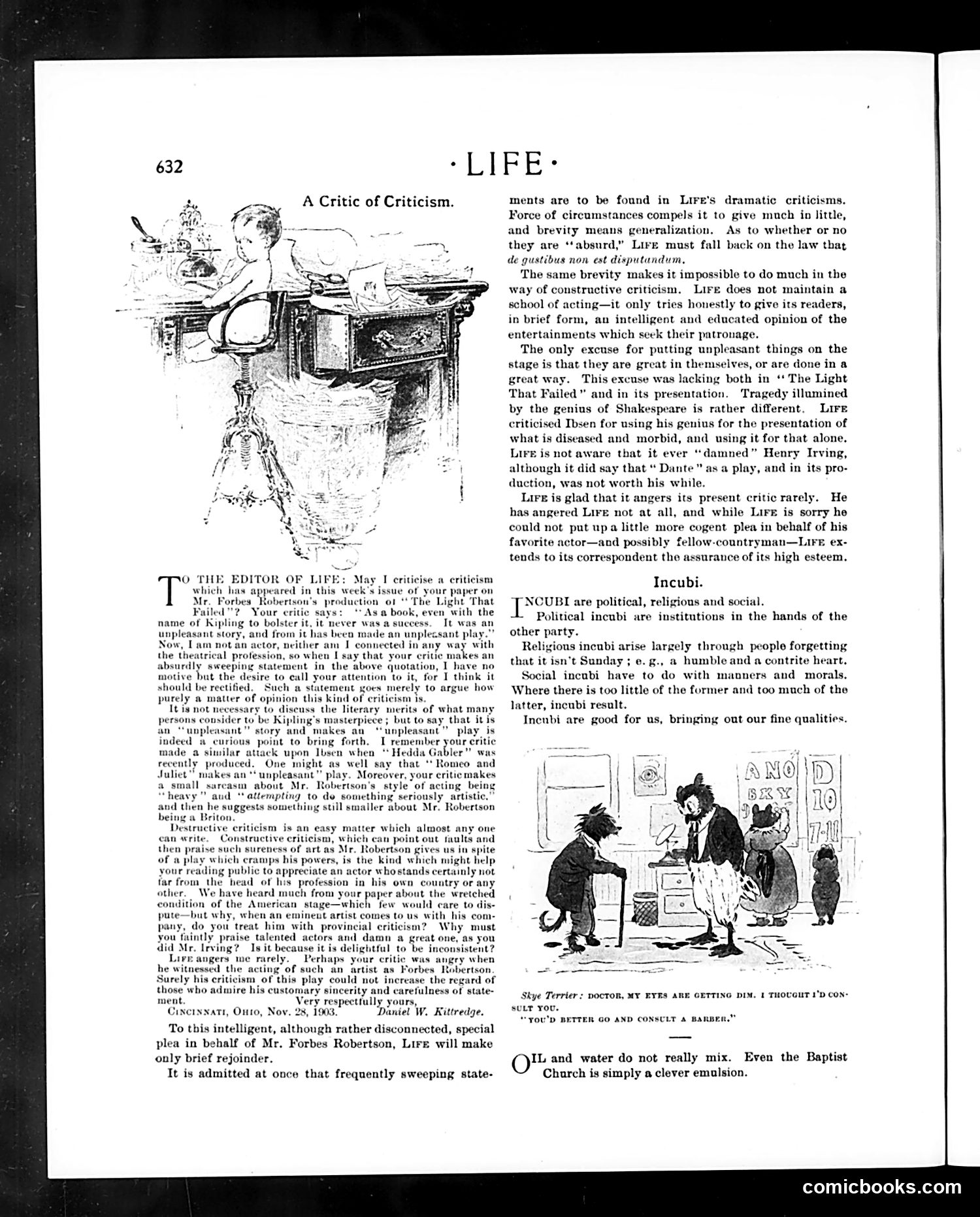
This page presents a letter-to-editor debate about dramatic criticism. A reader, Daniel W. Kittredge, defends actor Forbes Robertson's production of "The Light That Failed" (adapted from Kipling's novel), arguing that *Life* magazine's critic was unfairly destructive rather than constructive. **The Key Issue:** Kittredge complains the critic dismissed the play as inherently "unpleasant," comparing this to past attacks on Ibsen and even Shakespeare's tragedies. He argues *Life* praises lesser actors while damning talented ones like Robertson and Henry Irving, questioning the magazine's consistency. **Life's Response:** The magazine acknowledges using broad generalizations due to space constraints, but defends its position that unpleasant subject matter requires either inherent greatness or superior execution—neither present in this production. They deny ever "damning" Irving. The cartoon (lower right) shows a terrier at a doctor's office, apparently unrelated satire about medical consultation.
📄 Transcribed text from this page (OCR, searchable)
Machine-transcribed from the original scan — historical spelling and the odd misread are preserved.
*LIP'E* A Critic of Criticism. EDITOR OF LI icise a criticism O THE d which has appeared in this week's issue of your paper on Mr. Forbes Robertson's production ot * Light ‘That Failec Your critic says: ‘Asa book, even with the name of Kipl 1g to bolster it, it never was a success. It was an and from it has been made an unplecsant pls ow, actor, neither am I connected in any way with the theatrical profession, so when I say that your eritic mak; absurdly sweeping statement in the above quotation, motive but the desir call your attention to it, for I think it should be rectified, Such a statement yoex merely to argue how purely a matter of opinion this kind of criticism is, It ig not nee to discuss the literary merits of what mar persons consider t iS 3 but to say that it npleasant”” story and makes an“ unpleasa play_is indeed a curious point to bring forth. : Four.critle made a similar attack upon Ibsen when * ler” was recently produced. One might as well say that ‘Romeo and Juliet’ makes an‘ unpleasant” play. Mores a small sarcasm about Mr. Robertson's style of acting being “heavy " aud “attempting to do something seriously artistic, and then he suggests something still smaller about Mr, Robertson being a Briton, Destructive criticism is an easy matter which almost any one can write. istructive criticism, which can point out fault then praise such sureness of art as Mr. Robertson gives us in of a play which cramps his powers, is the kind which might h your reading public to appreciate an actor who stands certainly not iar from the head of his profession in his own country of any other. We have heard much from your paper about the wretched ition of the Am 1 stage—which few would care to dis- r eut artist comes to us with his com- with provincial criticism? Why must y tly praise talented actors and damn a great one, as you did Mr. Irving? Is it because it is delightful to be inconsistent? Lire angers we rarely. Perhaps your critic was angry when acting of such an artist as Forbes Robertson Surely his criticism of this play could not increase the regard of those who admire his customary sincerity and carefulness of state- ment. Very respecttully yours, Cincinnati, Onto, Nov. 28, 1903. Daniel W. Kittredge. To this intelligent, although rather disconnected, special plea in behalf of Mr. Forbes Robertson, Lire will make only brief rejoinder. It is admitted at once that frequently sweeping state- ments are to be found in Lire's dramatic criticisms. Force of circumstances compels it to give much in litte, and brevity means generalization, As to whether or no they are ‘‘absurd,” Lire must fall back on the law that de gustibus non est disputandum, ‘The same brevity makes it impossible to do much in the way of constructive criticism, Lire does not maintain a school of acting—it only tries honestly to give its readers, in brief form, an intelligent and educated opinion of the entertainments which seek their patronage. The only excuse for putting unpleasant things on the stage is that they are great in themselves, or are done in a great way. This excuse was lacking both in “ The Light That Failed” and in its presentation. Tragedy illumined by the genius of Shakespeare is rather different. Lire criticised Ibsen for using his genius for the presentation of what is diseased and morbid, and using it for that alone. Lire is not aware that it ever “damned” Henry Irving, although it did say that “ Dante” as a play, and in its pro- duction, was not worth his while. Lire is glad that it angers its present critic rarely. He has angered Lire not at all, and while Lire is sorry he could not put upa little more cogent plea in behalf of his favorite actor—and possibly fellow-countryman—LirE ex- tends to its correspondent the assurance of its high esteem. Incubi. I ‘CUBI are political, religious and social. Political incubi are institutions in the hands of the other party. Religious incubi arise largely through people forgetting that it isn’t Sunday; e. g., a humble and a contrite heart, Social incubi have to do with manners and morals, Where there is too little of the former and too much of the latter, incubi result. Incnbi are good for us, bringing out our fine qualities. Skye Terrier: pocTOR, MY EYRS ANE GETTING DIM, 1 THOUGUT I'D CON- svLt Yo “You'D BETTER GO AND CONSULT 4 BARBER.” IL and water do not really mix. Even the Baptist Charch is simply a clever emulsion. comicbooks.com