
Life, 1903-12-17 · page 7 of 22
Life — December 17, 1903 — page 7: what you’re looking at
What you’re looking at
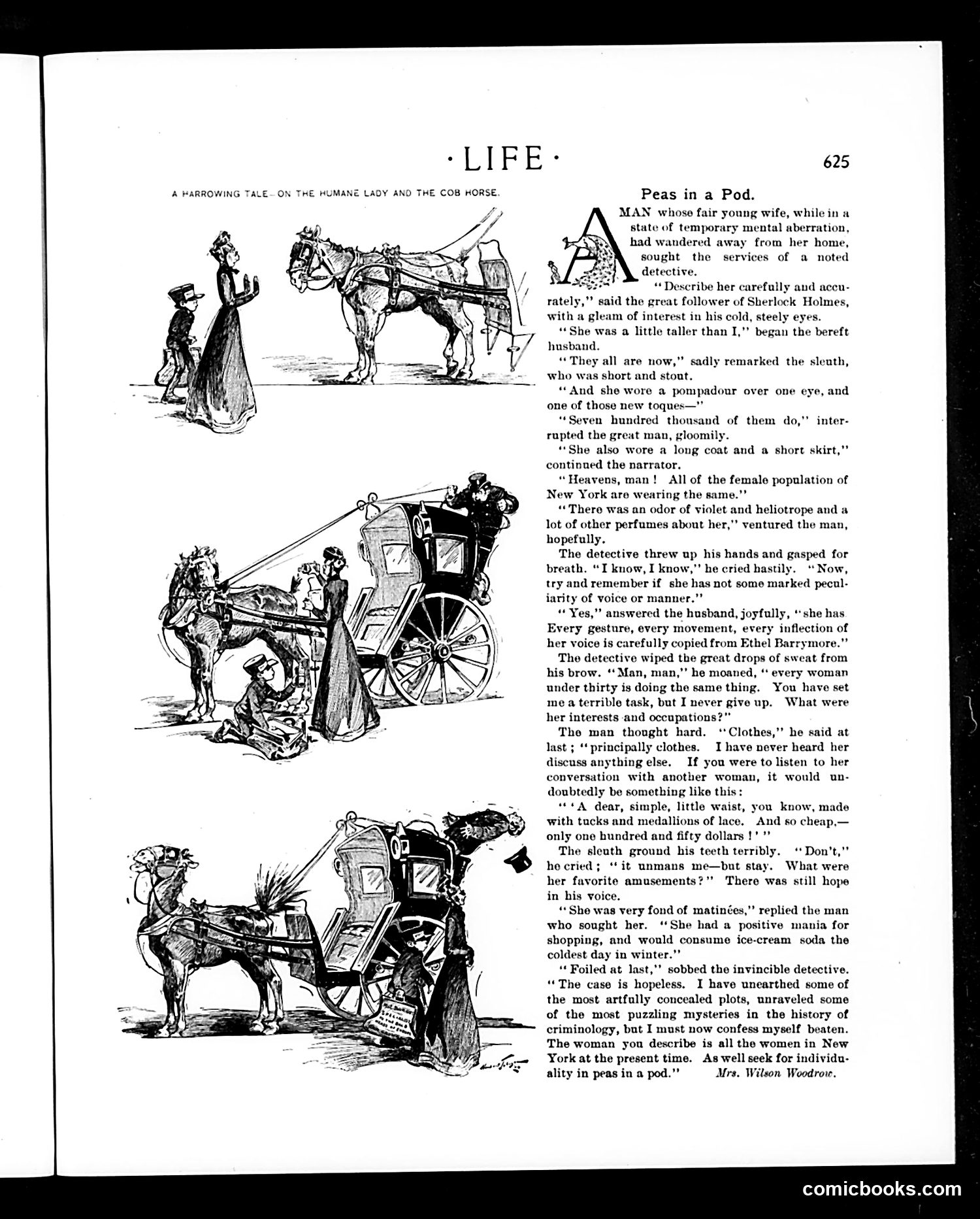
This page satirizes the uniformity of fashionable women in New York. The three illustrations show identical horse-drawn carriages with women dressed in nearly identical outfits—long coats, short skirts, pompadors, and perfume. The story mocks a detective hired to locate a missing wife. He discovers she's indistinguishable from every other fashionable woman in the city, all wearing identical clothes and accessories. The satire targets: - **Fashion conformity**: Women blindly copying Ethel Barrymore's style - **Consumer culture**: Their obsession with shopping and appearances - **Lack of individuality**: The impossibility of identifying anyone by clothing alone The joke's punchline: finding one specific woman among identical-looking others is impossible—"individuality in peas in a pod." This reflects turn-of-century anxieties about mass production homogenizing society.
📄 Transcribed text from this page (OCR, searchable)
Machine-transcribed from the original scan — historical spelling and the odd misread are preserved.
-LIFE: 625 A HARROWING TALE ON THE HUMANE LADY ANO THE COB HORSE: Peas in a Pod. Jy MAN whose fair young wife, while in a fo state of temporary mental aberration, had wandered away from her home, sought the services of a noted detective. “ Describe her carefully aud accu- rately,”’ said the great follower of Sherlock Holmes, with a gleam of interest in his cold, steely eyes. «She was a little taller than I,"’ began the bereft husband. ‘They all are now,” sadly remarked the sleuth, who was short and stout. “And she wore a pompadour over one eye, and one of those new toques—"’ “Seven hundred thousand of them do,"’ inter- rupted the great man, gloomily. ‘She also wore a long coat and a short skirt,”’ continued the narrator. “Heavens, man! All of the female population of New York are wearing the same.” “There was an odor of violet and heliotrope and a lot of other perfumes about her,” ventured the man, hopefully. The detective threw up his hands and gasped for breath. “I know, I know,” he cried hastily. “ Now, try and remember if she has not some marked pecul- iarity of voice or manner.” “Yes,” answered the husband, joyfully, ‘she has Every gesture, every movement, every inflection of her voice is carefully copied from Ethel Barrymore.” The detective wiped the great drops of sweat from his brow. ‘Man, man," he moaned, “ every woman under thirty is doing the same thing. You e set me a terrible task, but I never give up. What were her interests and occupations?” Tho man thought hard. ‘Clothes,’’ he said at last ; “principally clothes. I have never heard her discuss anything else. If you were to listen to her conversation with another woman, it would un- doubtedly be something like this : ““*A dear, simple, little waist, you know, made with tucks and medallions of lace. And so cheap,— only one hundred and fifty dollars!" The sleuth ground his teeth terribly. ‘* Don’t,"” he cried; ‘it unmans me—but stay. What were her favorite amusements?’ There was still hope in his voice. “She was very fond of matinées,” replied the man who sought her. ‘She had a positive mania for shopping, and would consume ice-cream soda the coldest day in winter.” ‘Foiled at last,’’ sobbed the invincible detective. “The case is hopeless. I have unearthed some of the most artfully concealed plots, unraveled some of the most puzzling mysteries in the history of criminology, but I must now confess myself beaten. The woman you describe is all the women in New York at the present time. As well seek for individu- ality in peas in a pod.” Mrs. Wilson Woodrow. comicbooks.com