
Life, 1903-12-17 · page 4 of 22
Life — December 17, 1903 — page 4: what you’re looking at
What you’re looking at
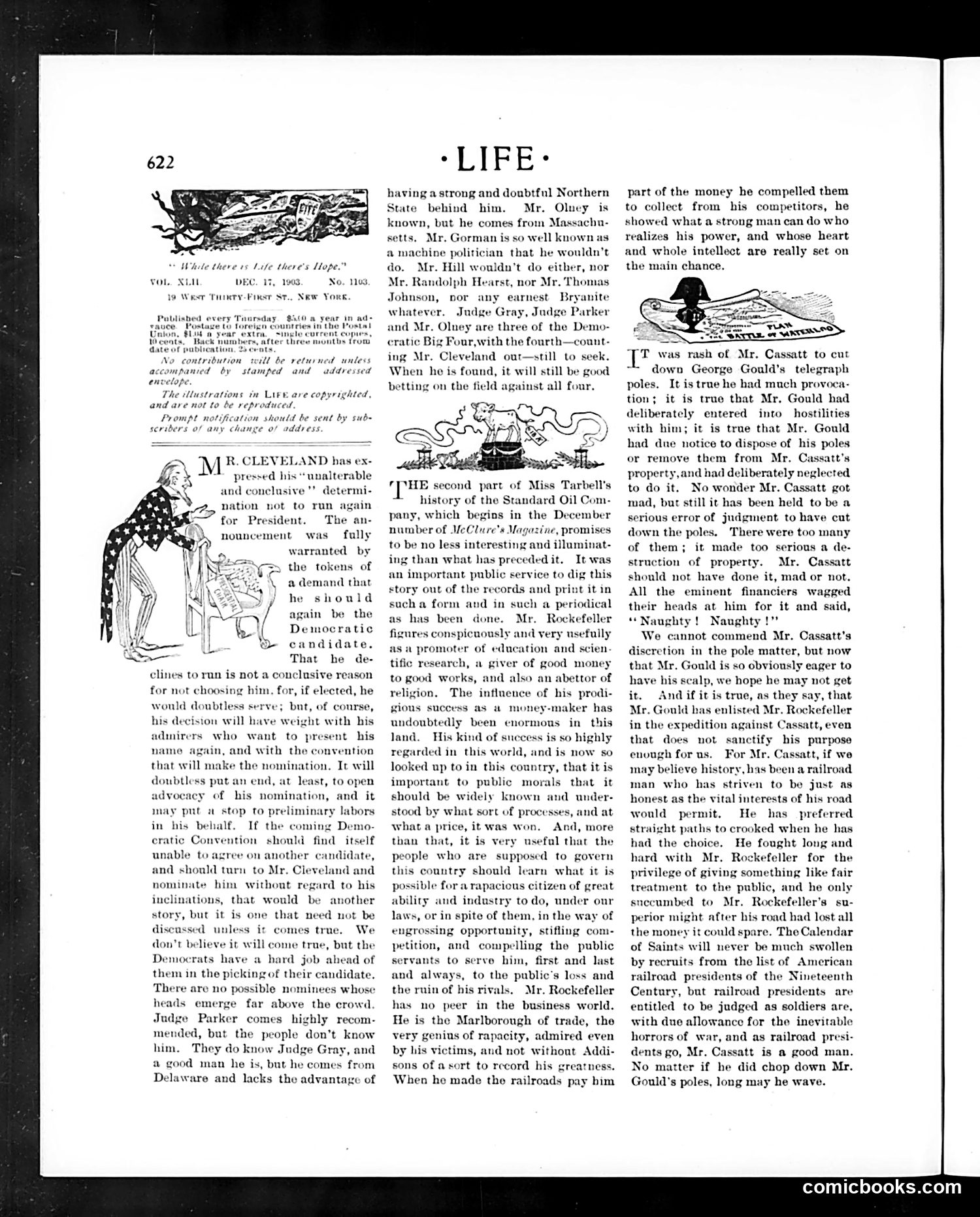
This page contains political commentary about the 1892 Democratic presidential nomination. The text discusses Mr. Cleveland's potential re-nomination, critiquing various Democratic candidates including Judge Gray, Judge Parker, and Mr. Olney as alternatives. The left illustration depicts an elderly, somewhat frail figure (likely representing Cleveland) being supported or examined, suggesting concerns about his fitness for office. The right cartoon shows a man cutting telegraph poles, apparently referencing George Gould's telegraph infrastructure and a controversy involving Mr. Cassatt's handling of railroad property disputes. The satire criticizes hasty judgments about this matter and suggests Mr. Rockefeller might intervene. The overall tone mocks internal Democratic Party divisions and questions about leadership competency during this election cycle.
📄 Transcribed text from this page (OCR, searchable)
Machine-transcribed from the original scan — historical spelling and the odd misread are preserved.
VOL. Xiat bE lo Weer THnety- Pixs St. New Yore. Paoli ery Thursday & sauce. Postaze to foreign countet Union, $U0 n year extra. single current ts. Back 1 fs, after three month nf publication, 29 cents Vo contribution accompanied by envelope. The illustrations in Lark: are copy and are not to be reproduced. Prompt notification should be sent by sub- scribers of any change of address M R. CLE , = roill be returned unless stamped and addres yYELAND has ex- pressed his “unalterable and conclusive’? determi- nation not to run a for President. The an- nouncement s fully warranted by the a demand that he should again be the Democ ic candidate, That he de- clines to run is not a conclusive reason for not choosing him. for, if elected, he would doubtless se tokens of rve; but, of course, his decision will have weight with his admirers who want to present his name again, and with the convention will make the nomination. It will doubtless put an end, at least, to open advocacy of his nomination, and it may put a stop to preliminary labors in his behalf. If the coming Demo- cratic Convention should find itself unable to agree on another candidate, and should turn to Mr. Cleveland and nominate him without regard to his inclinations, that would be other story, but it is one that need not be discussed true. We don’t believe it will come true, but the Democrats have a hard job ahead of them in the picking of their candidate. There are no possible nominees whos heads far above the crowd. Judge Parker comes highly recom- mended, but the people don’t know him. They do know Judge Gray, and a good man he is, but he comes from Delaware and lacks the advantage of unless come emerge “LIFE having a strong and doubtful Northern ate behind him. Mr. Oluey is known, but he comes from Massacha- setts, Mr, Gorman is so well known as ine politician that he wouldn't Mr. Hill wouldn't do either, nor rst, nor Mr. Thomas bor any earnest Bryanite whatever. Judge Gray, Judge Parker and Mr. Olney are three of the Demo- cratic Big Four,with the fourth—count- ing Mr. Cleveland out—still to seek. When he is found, it will still be good betting on the field inst all four, ama do. Mr. Randolph He: Johnson, YHE second part of Miss Tarbell’s history of the Standard Oil Com- pany, which begins in the December number of MeClure's Magazine, promises to be no less interesting and illuminat- ing than what has preceded it. It was an important public service to dig this story out of the records and print it in such a form and in such a periodical as has been done. Mr. Rockefeller figures conspicuously and yery usefully as a promoter of education and scien- tific research, a giver of good money to good works, and also an abettor of religion. The influence of his prodi- gious success as a money-maker has undoubtedly been enormous in this Jand. His kind of success is so highly regarded in this world, and is now so looked up to in this country, that it is important to public morals that it should be widely known and under. stood by what sort of processes, and a what a price, it was won, And, more than that, it is very usefal that the people who are supposed to govern this country should learn what it is possible fc pacious citizen of grea ability and industry to do, under our laws, or in spite of them, in the way of engrossing opportunity, stifling com- petition, and compelling the public servants to serve him, first and last and always, to the public’s loss and the ruin of his rivals, Mr. Rockefeller has no peer in the business world. He is the Marlborough of trade, the very genius of rapacity, admired even by his victims, and not without Addi- sons of a sort to record his gre: When he made the railroads ness. ay bim part of the money he compelled them to collect from his competitors, he showed what a strong man can do who realizes his power, and whose heart and whole intellect are really set on the main chance, Tt was rash of Mr. Cassatt to cut +t aown George Gould’s telegraph poles, It is true he had mach provoca- tion; it is true that Mr. Gould had deliberately entered into hostilities with him; it is trae that Mr. Gould had due notice to dispose of his poles or remove them from Mr, Cassatt's property,and had deliberately neglected to do it. No wonder Mr. Cassatt got mad, but still it has been held to be a serious error of judgment to have cut down the poles. There were too many of them; it made too serious a de- struction of property. Mr. Cassatt should not have done it, mad or not. All the eminent financiers wagged their heads at him for it and said, “Naughty! Naughty!’ We cannot commend Mr. Cassatt's discretion in the pole matter, but now that Mr. Gould is so obviously eager to scalp, we hope he may not get it. And if it is true, as they say, that r. Gould has enlisted Mr. Rockefeller in the expedition against Cassatt, even that does not sanctify his purpose enough for us. For Mr. Cassatt, if we may believe history, has been a railroad man who has striven to be just as honest as the vital interests of his road would permit. He has preferred straight paths to crooked when he has had the choice. He fought long and d with Mr. Rockefeller for the privilege of giving something like fair treatment to the public, and he only succumbed to Mr. Rockefeller’s su- perior might after his road had lost all the money it could spare. The Calendar of Saints will never be much swollen by recruits from the list of American railroad presidents of the Nineteenth Century, but railroad presidents are entitled to be judged as soldiers are, with due allowance for the inevitable horrors of war, and as railroad presi- dents go, Mr. Cassatt is a good man. No matter if he did chop down Mr. Gould's poles, long may he wave. comicbooks.com