
A complete issue · 22 pages · 1903
Life — November 19, 1903
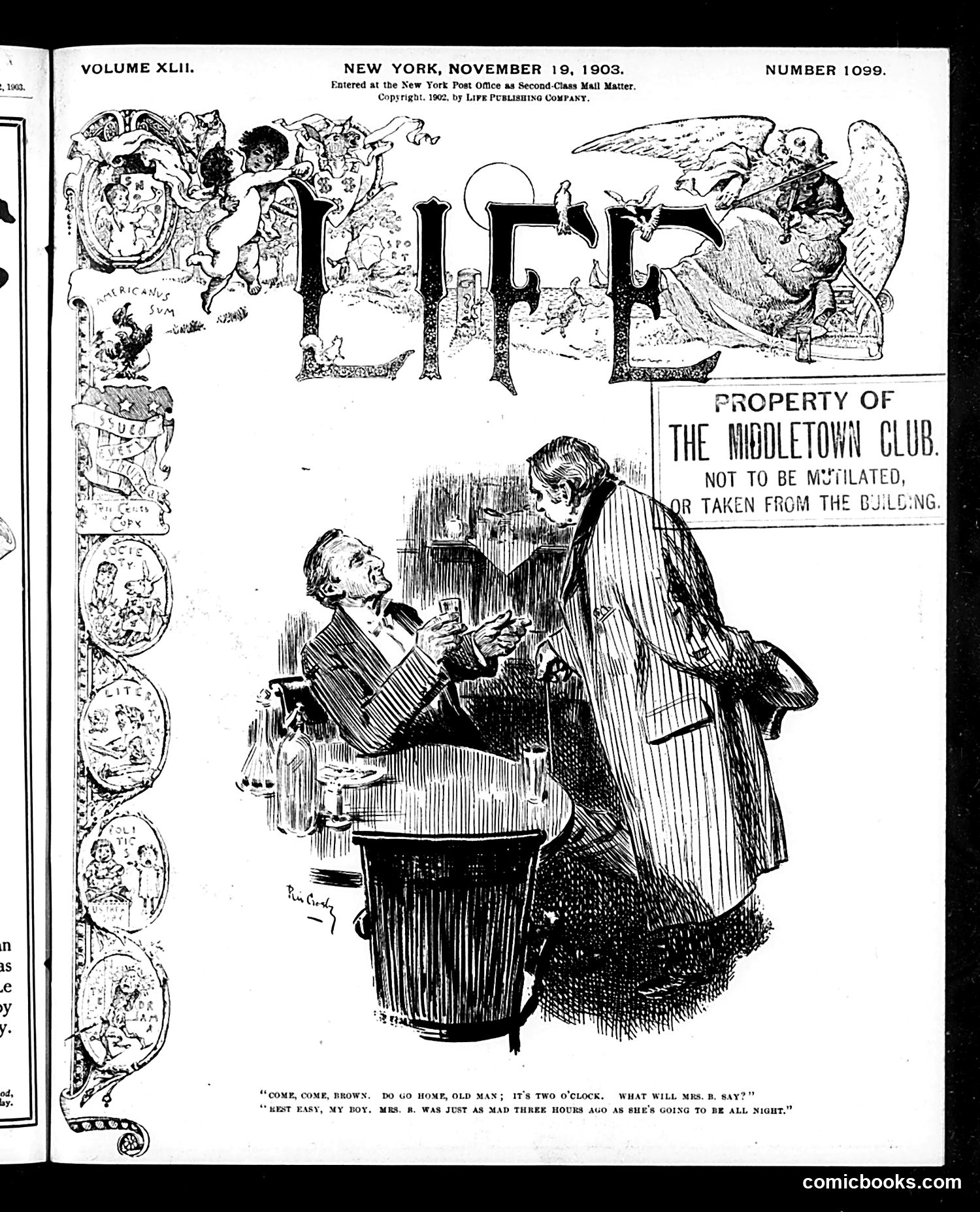
This is the cover illustration for *Life* magazine. The main cartoon depicts two men in what appears to be a domestic dispute: one seated man looking distressed while another man stands over him in an aggressive posture. The caption reads: "Come, come, Brown. Do go home, old man; it's two o'clock. What will Mrs. B. say?" followed by "Rest easy, my boy. Mrs. B. was just as mad three hours ago as she's going to be all night." The joke concerns a man named Brown arriving home very late (2 AM), with the implication his wife is already furious, so further delay won't worsen matters. It's domestic humor typical of *Life*'s era—satirizing marital discord and the consequences of late-night socializing.
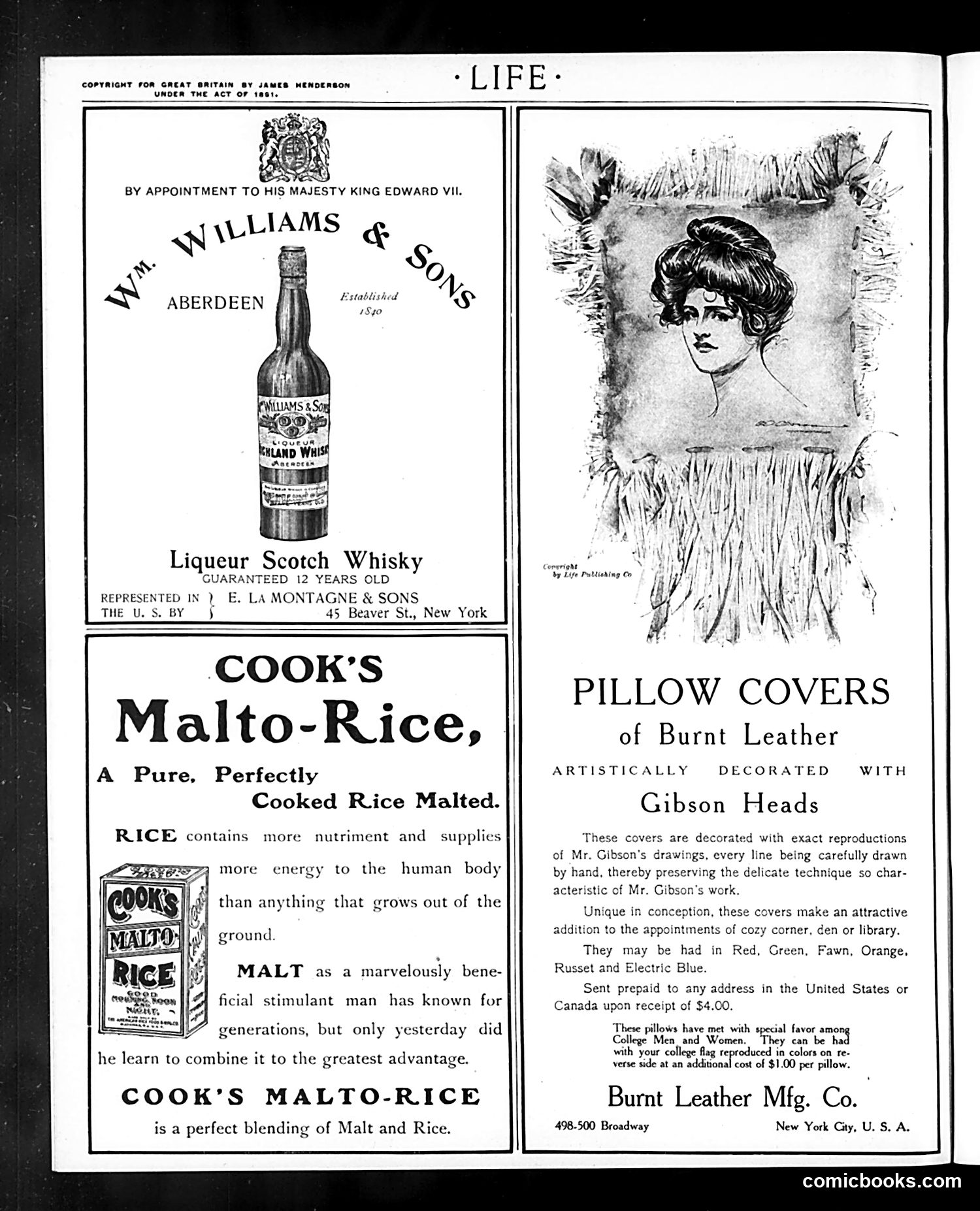
This page contains **advertisements, not political satire or cartoons**. The left side advertises Williams & Sons Highland Whisky (established 1830), a Scotch liqueur distributed in New York, emphasizing its 12-year aging. Below that, Cook's Malto-Rice promotes a rice-malt product claiming superior nutrition and energy benefits. The right side features pillow covers from Burnt Leather Manufacturing Company, decorated with "Gibson Heads"—illustrations in the style of Charles Dana Gibson's famous "Gibson Girl" drawings. These appear to be decorative home goods marketed to college students and young professionals, available in multiple colors for $4.00 prepaid. The page reflects early 20th-century consumer advertising targeting educated, affluent audiences through brand prestige and artistic appeal.
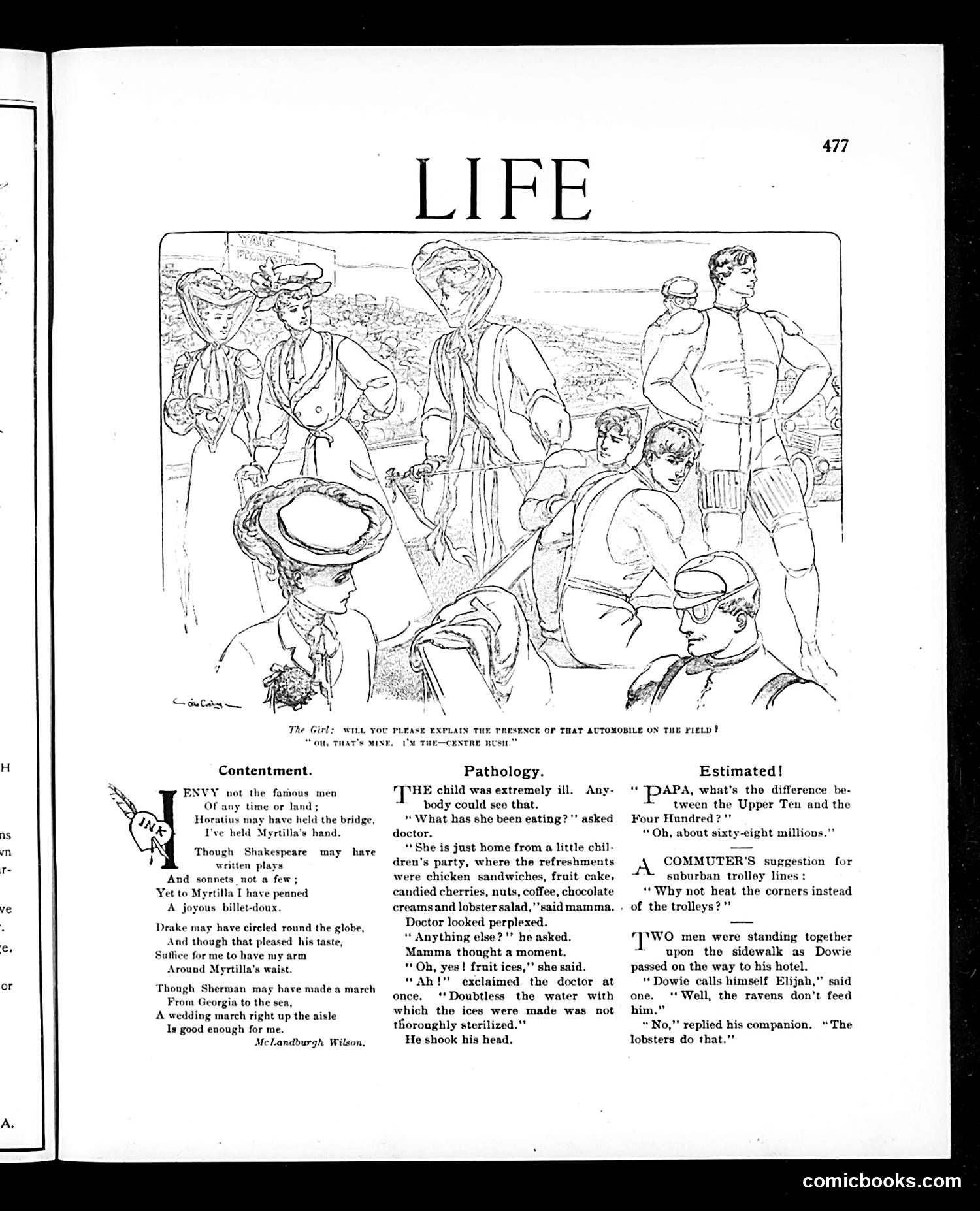
The main cartoon depicts a social scene at what appears to be a sporting event or public gathering. A woman asks a man to "explain the presence of that automobile on the field" — the humor derives from the novelty and incongruity of an automobile appearing in a context where it doesn't belong, likely a cricket or baseball field. Below are three brief satirical pieces: "Contentment" mocks famous men (Horace, Shakespeare, Drake, Sherman) as less accomplished than the author; "Pathology" jokes about a child's poor digestion from excessive party foods; and "A Commuter's Suggestion" puns on replacing trolley line corners with lobsters. The humor reflects early 20th-century concerns about technology, consumption, and urban life.
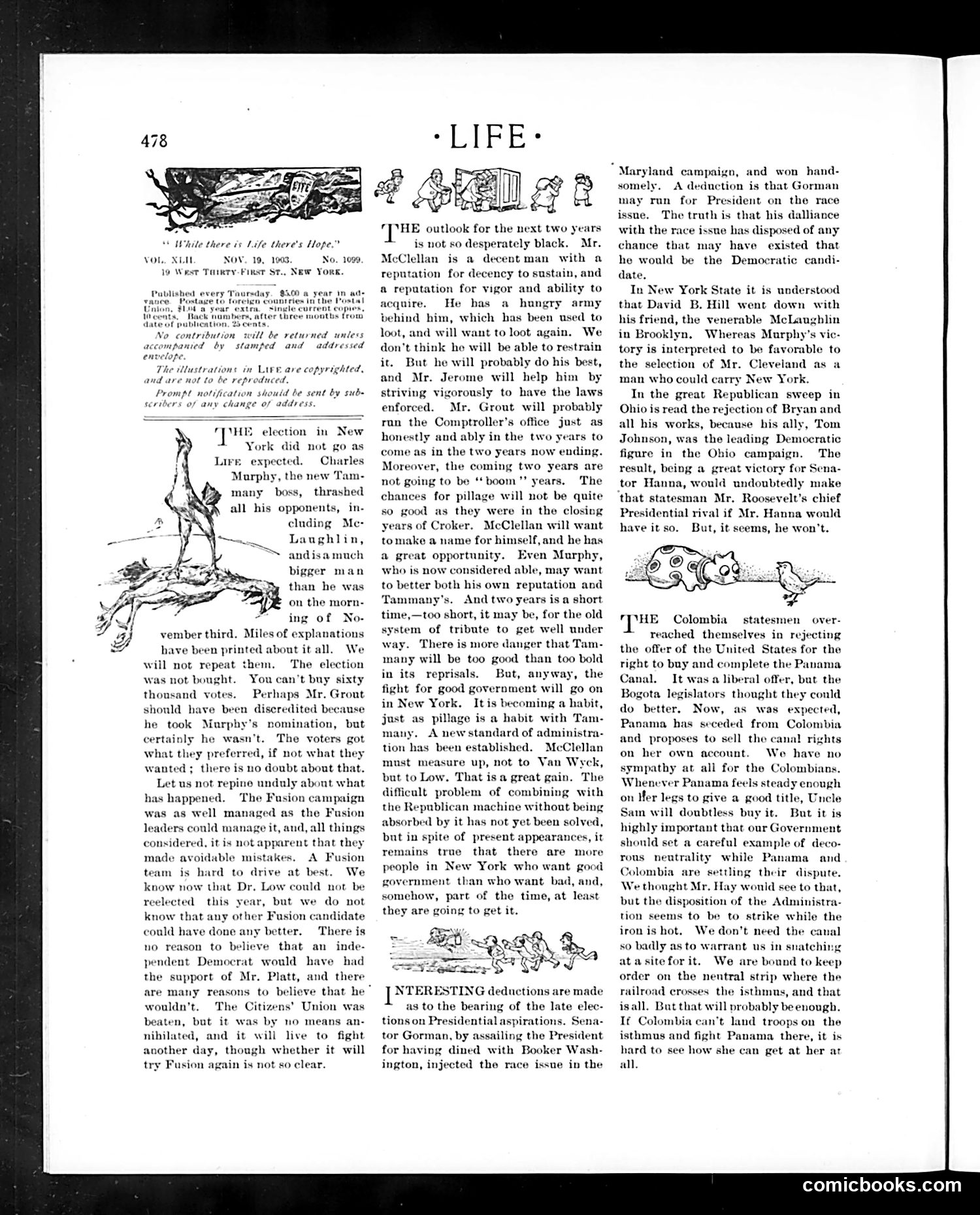
The page contains three political cartoons and editorial commentary about the 1902 elections and political figures. The top cartoon appears satirical regarding political maneuvering, though specific figures are unclear from the image alone. The middle cartoon shows a figure standing triumphantly on a pedestal, likely depicting a successful political candidate or movement, though the specific identity isn't entirely clear. The bottom cartoon depicts figures in what appears to be a contentious political or social situation. The text discusses McClellan's prospects as a Democratic candidate, New York politics, and mentions figures like Murphy and Tammany Hall. It also addresses the Panama Canal dispute with Colombia and broader Republican political dominance. The overall tone suggests satirizing Democratic political challenges and Republican electoral success during this period.
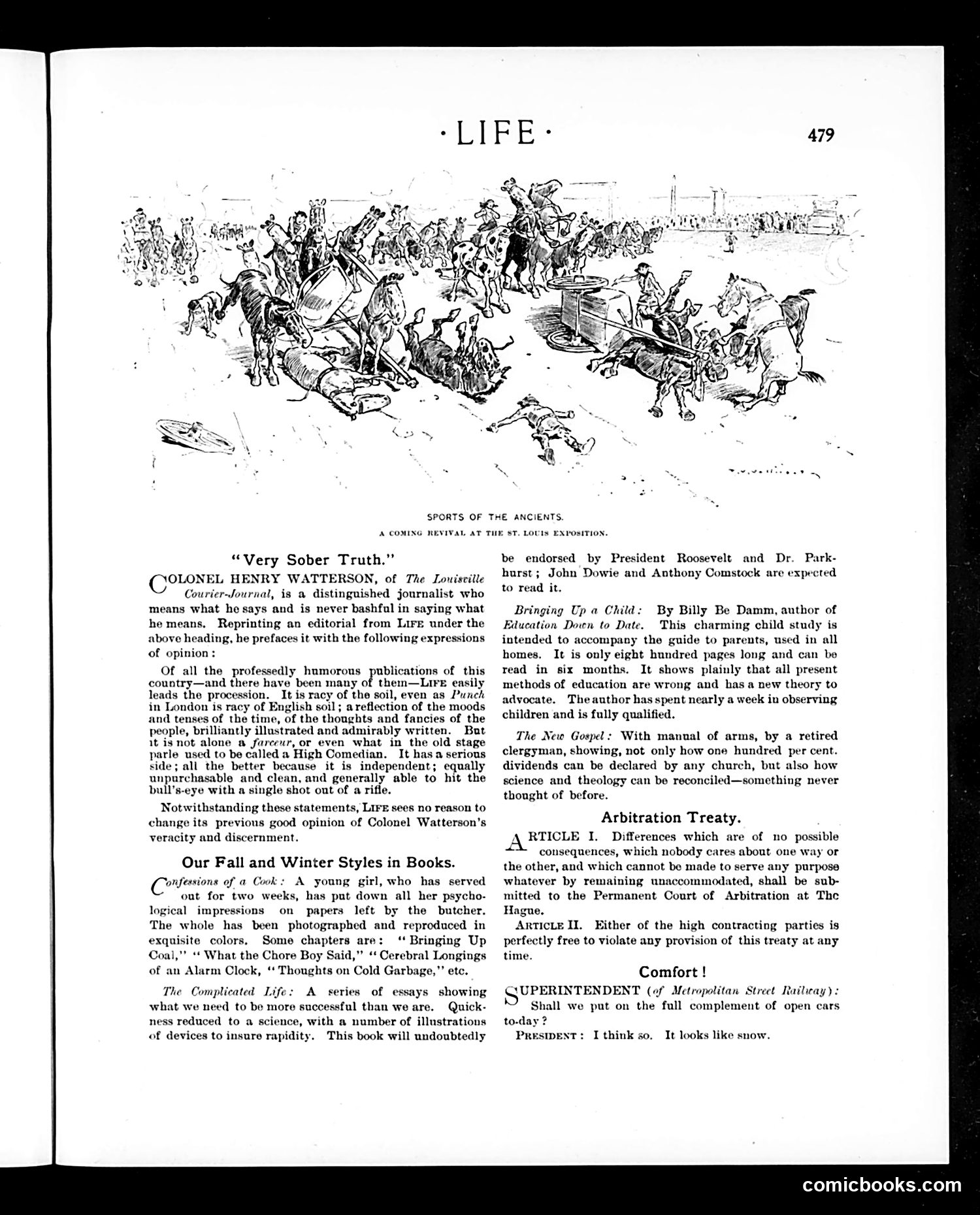
This sketch satirizes a "coming revival" of ancient sports at the St. Louis Exposition (1904 World's Fair). The chaotic scene depicts various classical athletic competitions—wrestling, chariot racing, and combat—rendered in deliberately crude, violent, and comedic fashion. The satire likely mocks the Exposition's romanticized recreation of ancient Olympic games and classical culture. Rather than depicting dignified athletic competition, the cartoonist shows pandemonium: overturned chariots, tangled combatants, and general disorder. This undercuts the high-minded cultural aspirations of such "revival" events, suggesting that actual ancient sports were messy, barbaric spectacles rather than the refined competitions the Exposition's promoters wanted to celebrate.
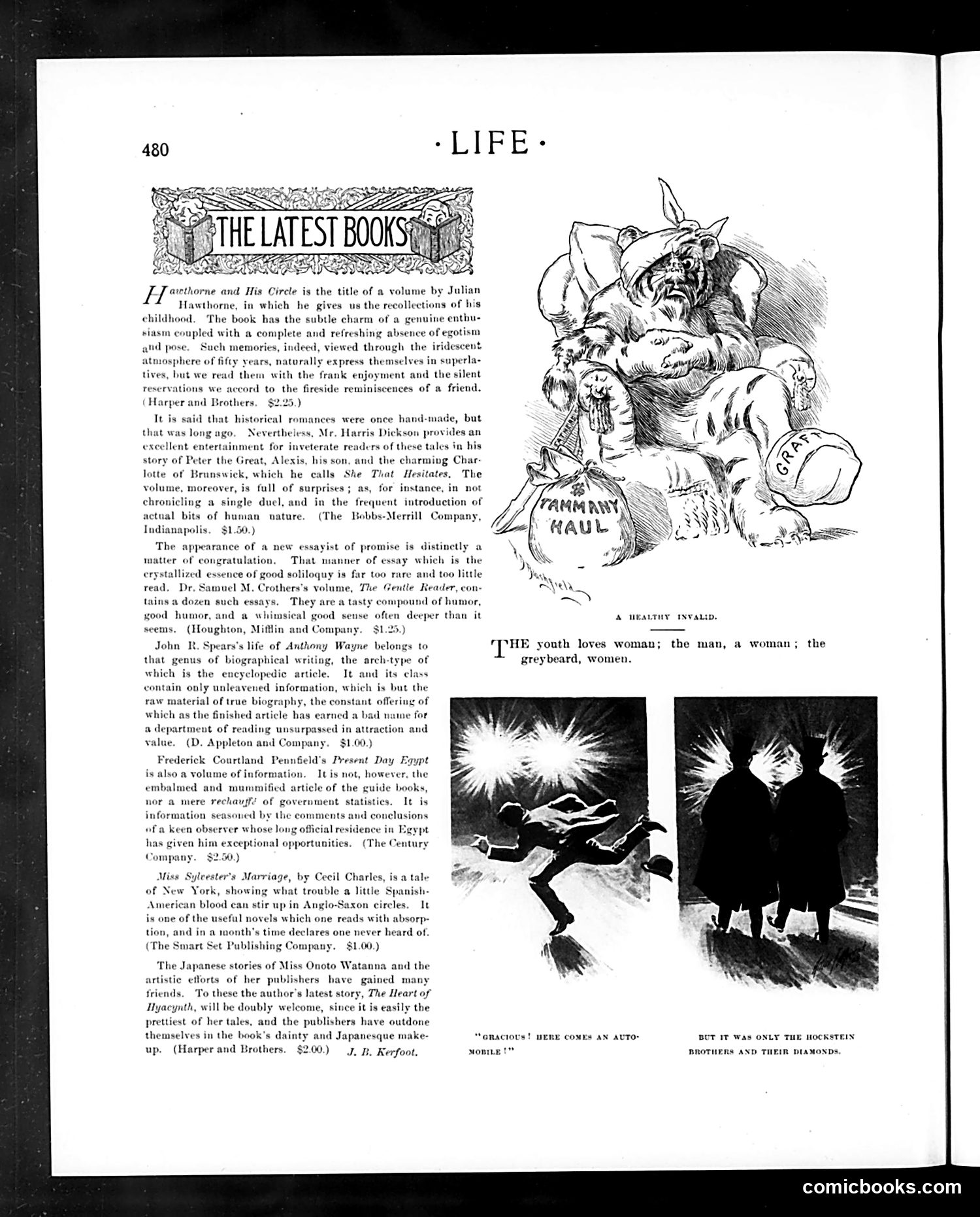
This page from *Life* magazine presents book reviews under "The Latest Books" header. The two illustrations appear to be accompanying editorial cartoons rather than advertisements. The top illustration titled "A HEALTHY INVALID" depicts a grotesque goblin-like creature surrounded by sacks labeled "FARM AND HAUL," suggesting satirical commentary on agricultural or commercial practices. The bottom illustration, captioned "GRACIOUS! HERE COMES AN AUTO-MOBILE!" and "BUT IT WAS ONLY THE HOCKSTEIN BROTHERS AND THEIR DIAMONDS," appears to mock nouveau-riche characters (the "Hockstein Brothers") and early automobile culture, likely satirizing Jewish immigrants' rapid wealth accumulation and their conspicuous consumption—a common *Life* magazine stereotype of the era. The cartoons reflect period prejudices alongside book reviews of works by Hawthorne, Dickens, and others.
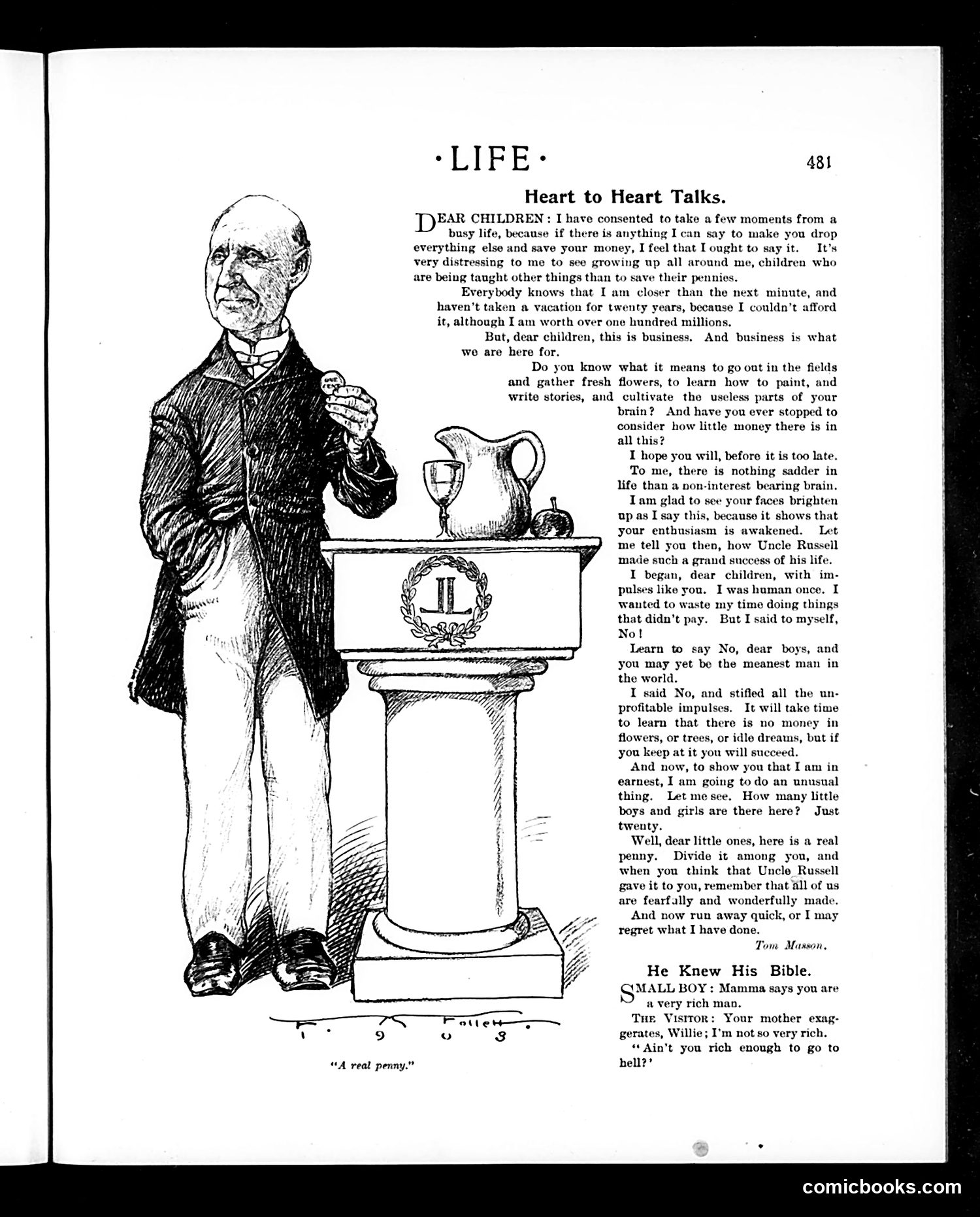
This page contains two separate pieces: **"Heart to Heart Talks"** is a moral essay addressed to children, attributed to Tom Masson. The author (an older man, illustrated) lectures children about the importance of saving money and avoiding wasteful pursuits like art, flowers, and "idle dreams." He uses Uncle Russell as an exemplar of financial success. The piece advocates for practical moneymaking over creative or leisurely activities—a reflection of late-19th/early-20th-century American capitalist values emphasizing thrift and productivity. **"He Knew His Bible"** is a brief comic dialogue where a visitor challenges a boy's mother about her wealth, sardonically suggesting that if she's truly rich, shouldn't she be "rich enough to go to hell?"—a dark joke implying moral corruption accompanies wealth. Both pieces critique materialism, though from different angles: the first promotes it, the second mocks it.
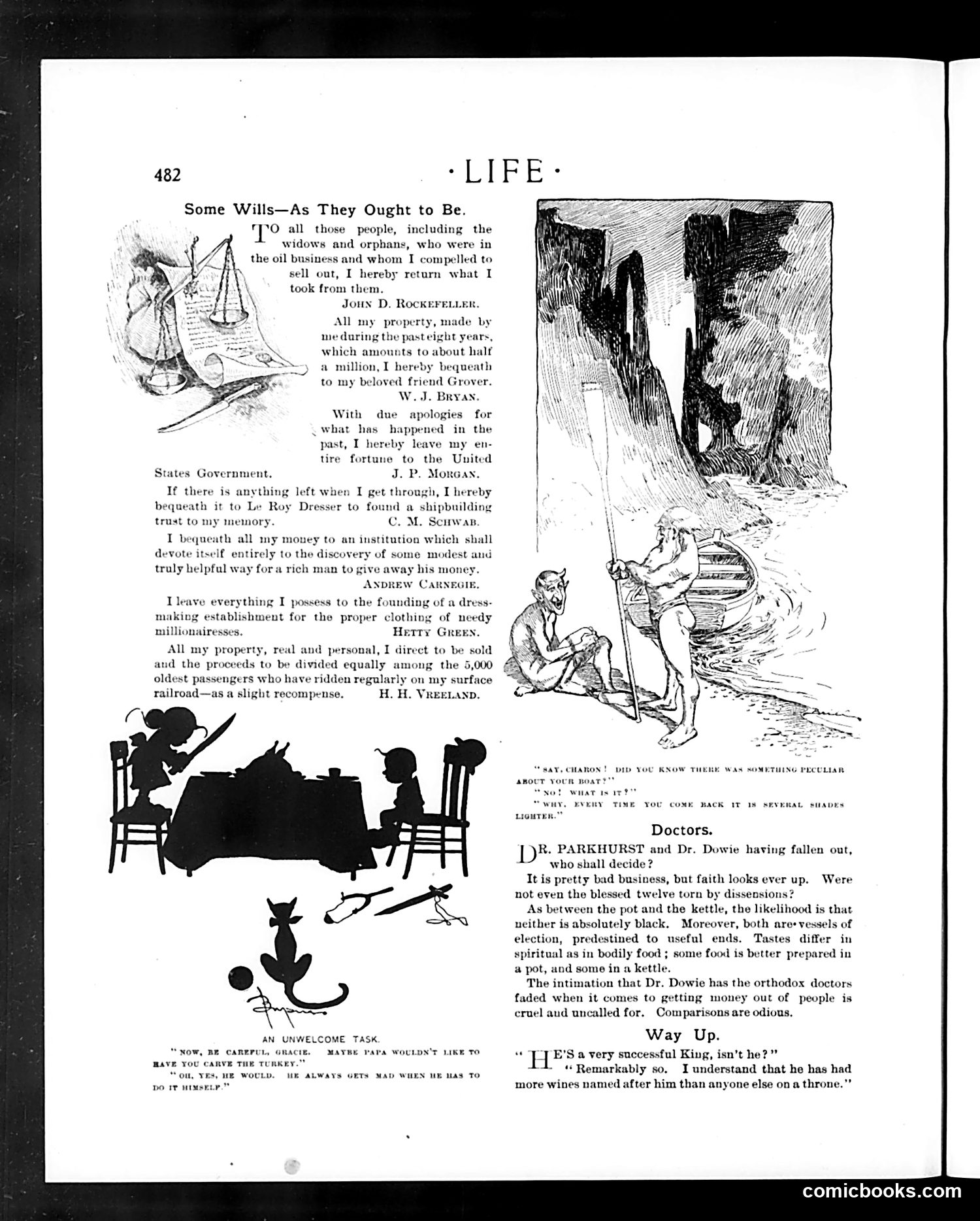
This page contains satirical "wills" from wealthy industrialists (Rockefeller, Bryan, Morgan, Schwar, Carnegie, Vreeland) humorously bequeathing their fortunes to public causes—a commentary on wealthy philanthropists' actual charitable practices. The illustrations mock domestic and social life: a silhouette shows a couple dining while their cat and dog fight beneath the table, captioned about a husband's turkey-carving anxiety. Below, another cartoon depicts fishing, with dialogue suggesting a boat has mysterious peculiar qualities that "several shades lighter" each visit—likely implying the boat's value depreciates. The "Doctors" section satirizes a dispute between Dr. Parkhurst and Dr. Dowie over money-raising methods, mocking theological disagreements presented as petty squabbling. "Way Up" presents a brief joke about a successful king with many wives—a reference to polygamy or dynasty-building.
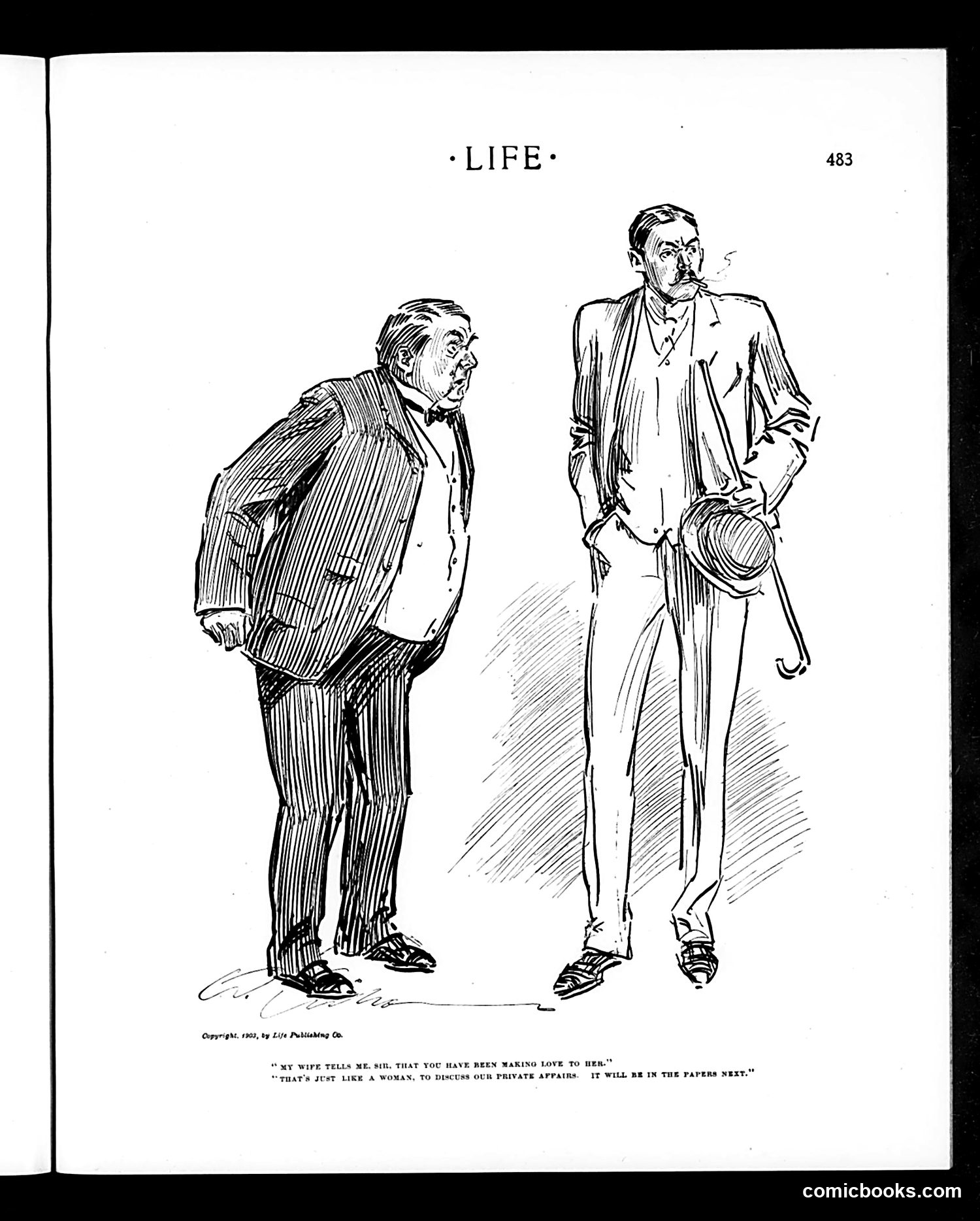
This is a single satirical cartoon depicting two well-dressed men in conversation. The figure on the left (shorter, stouter) appears distressed, while the taller man on the right stands more composed, holding a hat. The dialogue reads: "My wife tells me, sir, that you have been making love to her." The taller man responds: "That's just like a woman, to discuss our private affairs. It will be in the papers next." The satire targets the casual infidelity and moral indifference of upper-class men of the era. Rather than defending himself or showing shame, the accused man's primary concern is that the scandal might become public knowledge—mocking the priorities and hypocrisy of wealthy society. The cartoon comments on how such men valued reputation over actual morality.
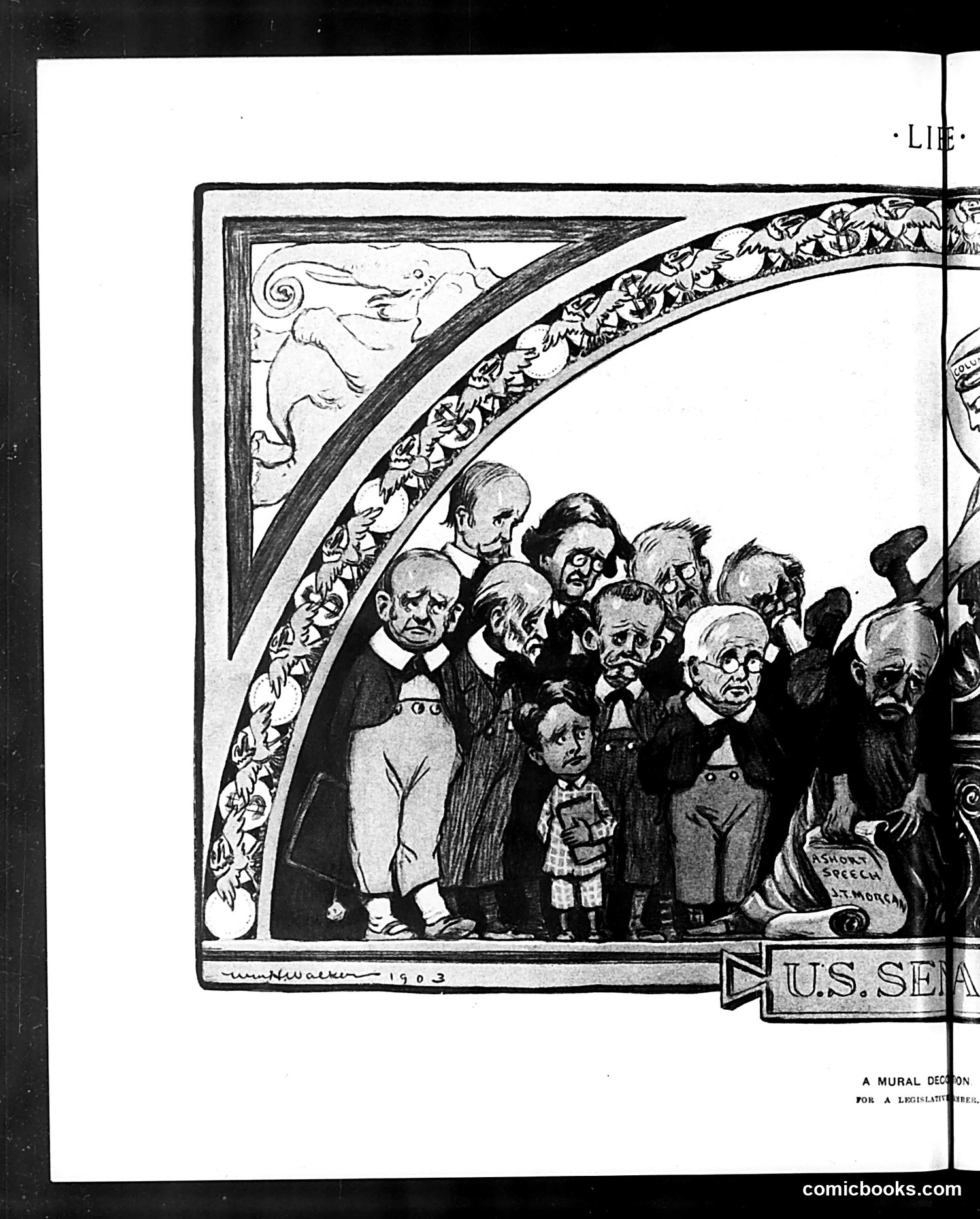
This Clifford Berryman cartoon satirizes corrupt politicians gathering under an ornate arch. The exaggerated caricatures—depicting men with harsh, morally compromised features—suggest venality and dishonesty in legislative bodies. The phrase "Ashcan Speech" visible on a document at lower right likely references muckraking journalism exposing political corruption, a major issue of the Progressive Era. The arch's decorative ornament contrasts sharply with the unsavory characters below, implying a gap between democratic ideals and actual legislative practice. The 1903 date places this during Theodore Roosevelt's presidency, when anti-corruption sentiment and calls for government reform were prominent. The cartoon mocks the notion of dignifying a legislative chamber with such morally questionable representatives.
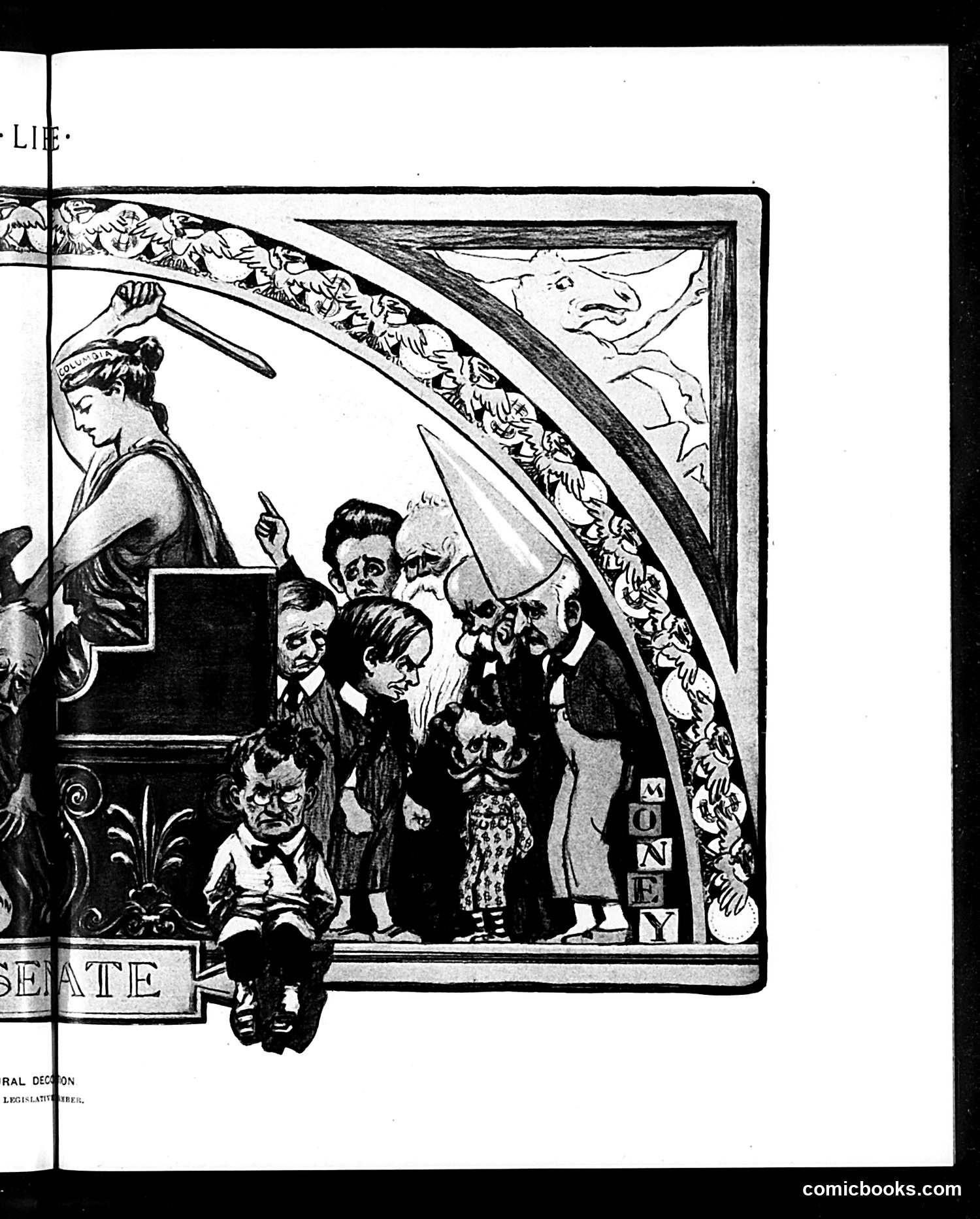
This appears to be a satirical cartoon from *Life* magazine depicting a Senate scene. The image shows senators (drawn as exaggerated caricatures) gathered beneath an ornate ceiling with classical decoration. A woman figure presides above, likely representing Lady Justice or legislative authority. The men below display various expressions of concern or scheming. The cartoon likely satirizes Senate proceedings—possibly related to legislation, debates, or political maneuvering of its era. The formal architectural setting emphasizes the dignity of the institution being mocked. The caricatured expressions and body language suggest the satirist is criticizing senators' behavior, motives, or competence during some specific legislative moment. Without clearer text or date attribution visible, the exact political context remains unclear.
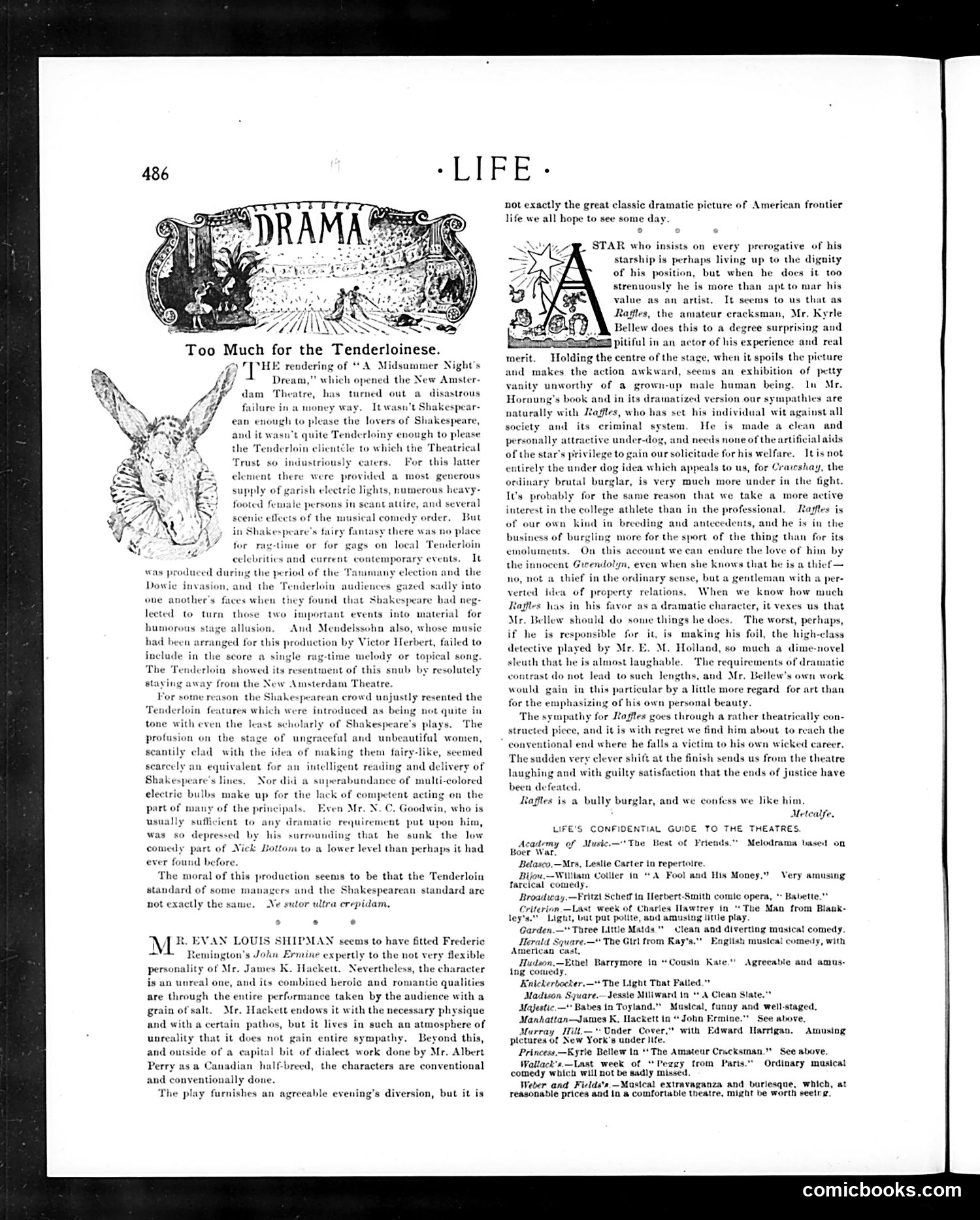
This page contains theatrical reviews rather than political cartoons. The main content criticizes a production of "A Midsummer Night's Dream" at the New Amsterdam Theatre for being overly elaborate and failing to serve Shakespeare's text. The reviewer argues the theatrical spectacle—featuring "ungested and unbeautiful women" and excessive stage machinery—undermines the play's merit. The text also reviews other theatrical productions, including works by Mr. Evan Louis Shipman. The page includes "Life's Confidential Guide to the Theatres," listing current shows with brief commentary. The decorative header labeled "DRAMA" frames the theatrical column. This appears to be a standard arts and entertainment section rather than satirical commentary on contemporary politics or social issues.
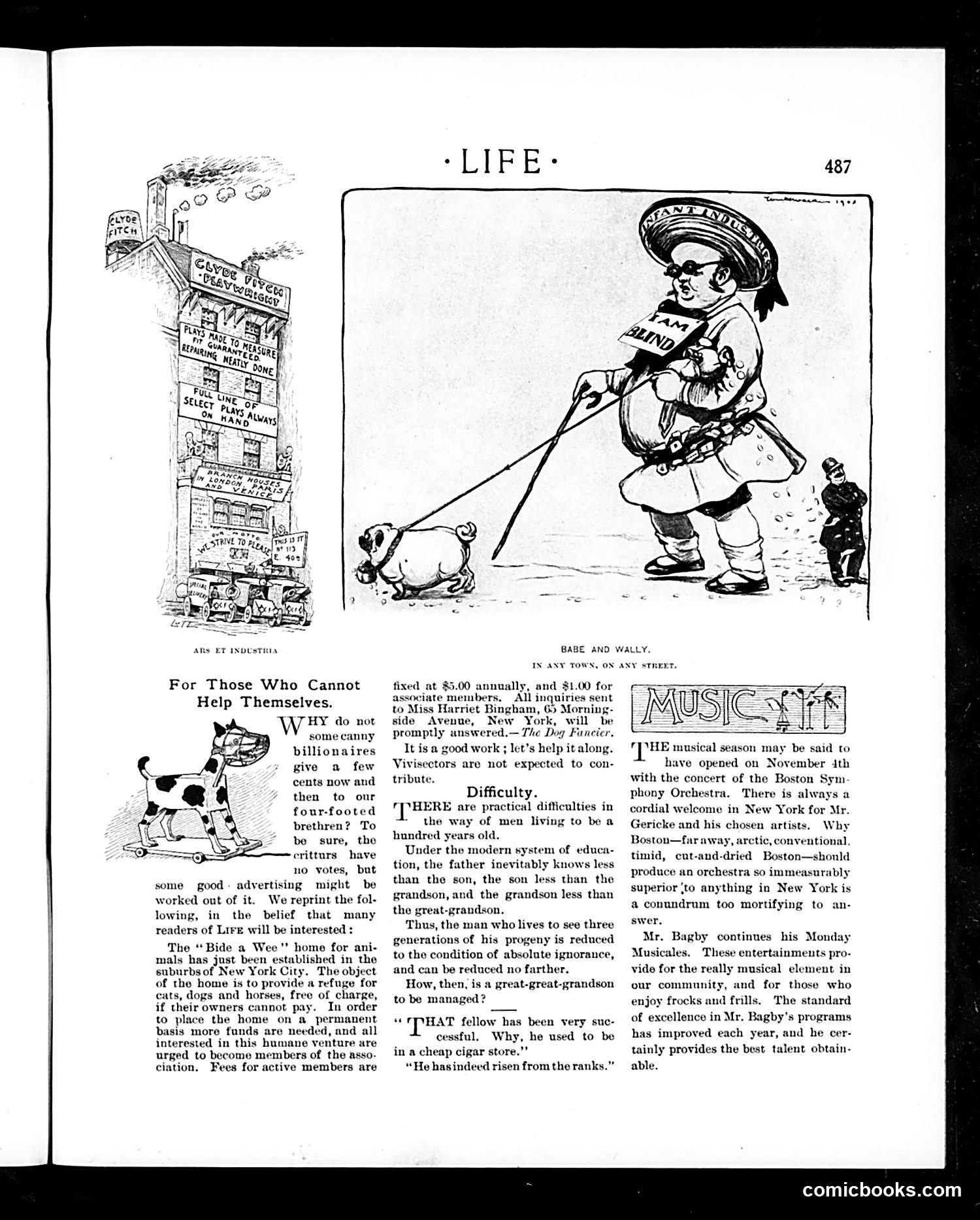
**Left cartoon ("For Those Who Cannot Help Themselves"):** This promotes the "Bide a Wee" animal shelter in New York City suburbs. The satire mocks wealthy industrialists ("canny billionaires") for not donating to animal welfare, suggesting they could benefit from the positive publicity. The accompanying dog illustration emphasizes the charitable pitch. The sarcastic closing—"Vivisectors are not expected to contribute"—jabs at scientists who performed experiments on live animals, a controversial practice of the era. **Right cartoon ("Babe and Wally"):** Shows a child playing with a dog on a street. The caption emphasizes universal relatability ("in any town, on any street"), likely celebrating childhood innocence or animal companionship as democratically available experiences. **Text sections** include brief social commentary on generational knowledge gaps and brief music reviews praising Boston's Symphony Orchestra and Mr. Bagby's Monday performances.
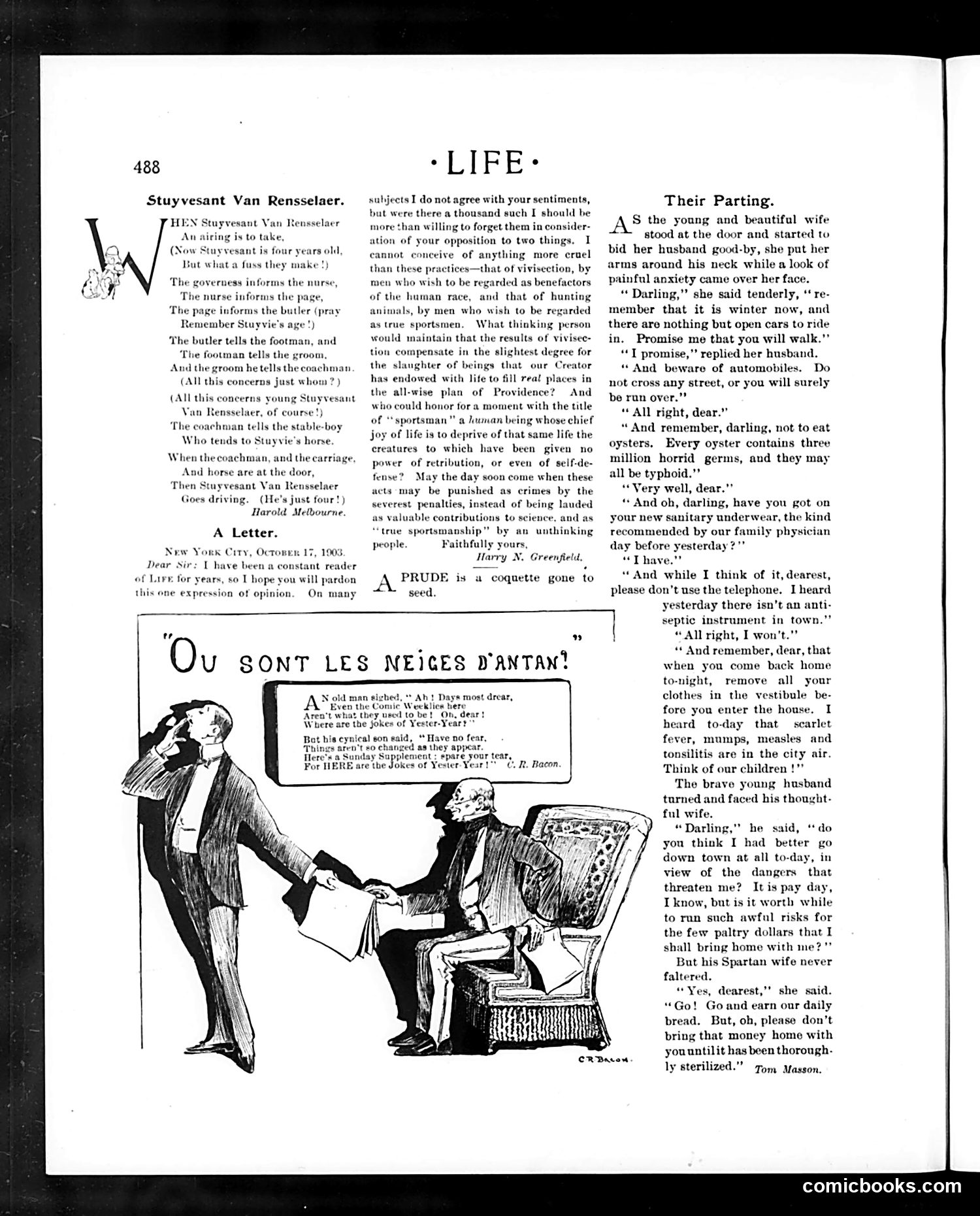
This page contains three satirical pieces typical of Life's social commentary: **"Stuyvesant Van Rensselaer"** mocks wealthy families' obsession with their young children, showing how household staff gossip about a four-year-old boy's activities—the joke being that vast household machinery attends to a toddler. **"A Letter"** presents reader criticism of vivisection (animal testing) and hunting, sarcastically framed as "sportsmen"—reflecting early 1900s animal welfare activism. **"Their Parting"** satirizes obsessive health anxiety. A wife bombards her husband with absurd hygiene warnings (oyster germs, telephone contamination, scarlet fever in the air) before he goes to work on payday. The humor lies in the contradiction: she demands he earn money despite her invented dangers—mocking contemporary germaphobia and anxious wives. The cartoon "Ou sont les neiges d'antan?" (Where are yesteryear's snows?) appears to reference nostalgic loss of the past, though context is unclear.
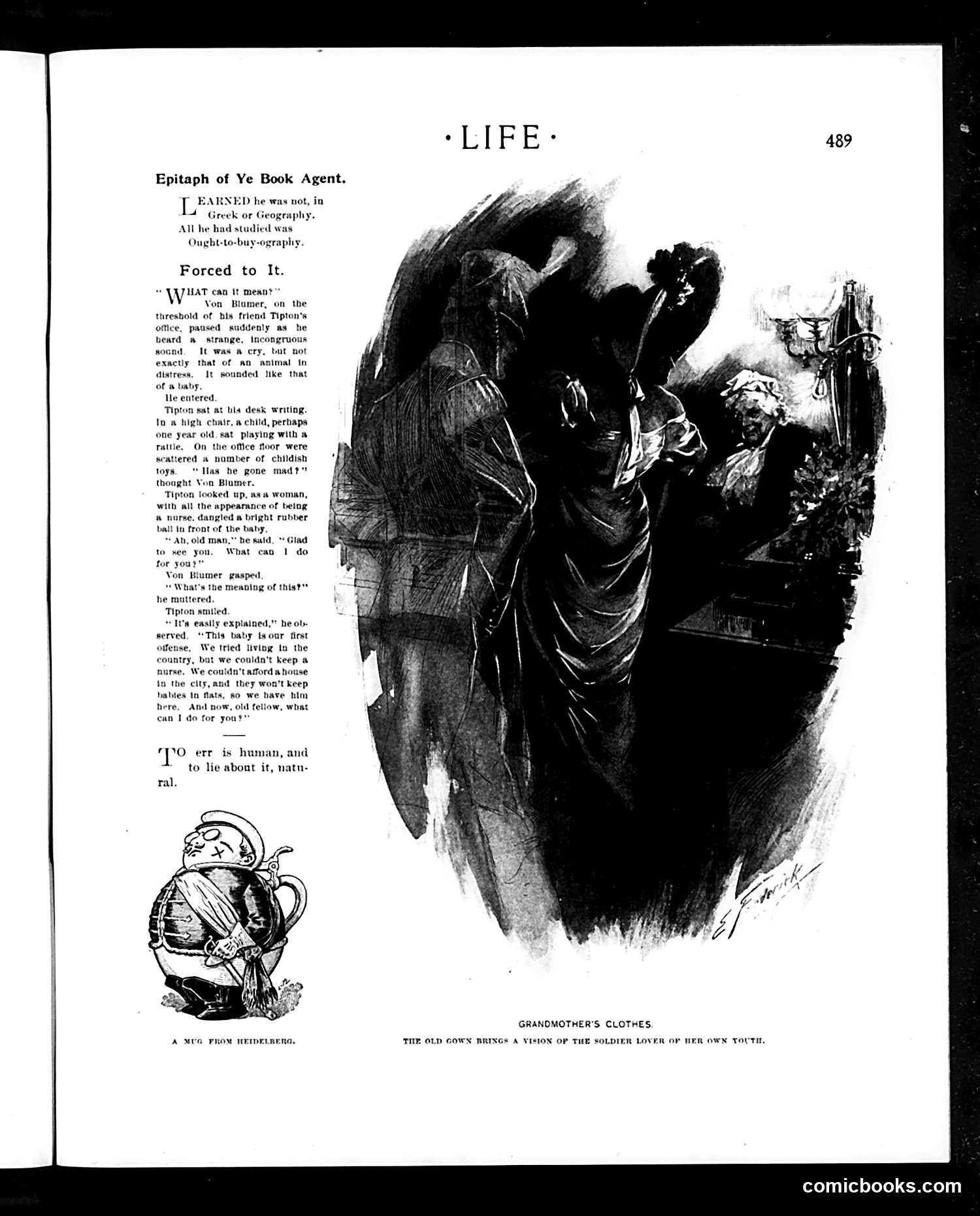
This page contains two separate satirical pieces from Life magazine: **"Epitaph of Ye Book Agent"** (top left): A brief, mocking epitaph for a book agent who was uneducated—knowing nothing of Greek or Geography, only "Ought-to-buy-ography" (a pun on the agent's single skill: convincing people to buy books). **"Forced to It"** (main story): A humorous domestic narrative about a man named Tipton who, unable to afford proper childcare in the city or a house in the country, has brought his one-year-old baby to his office. The joke satirizes the impracticality of urban professional life and the desperation of middle-class working men trying to manage family obligations while maintaining employment. Von Blumer's shock at finding an office converted into a nursery drives the comedic point about the absurdity of the situation. **"Grandmother's Clothes"** (illustration, bottom right): An accompanying sketch showing an elderly woman in old-fashioned garments, described as bringing her a nostalgic vision of a soldier lover from her youth—likely sentimental rather than satirical.
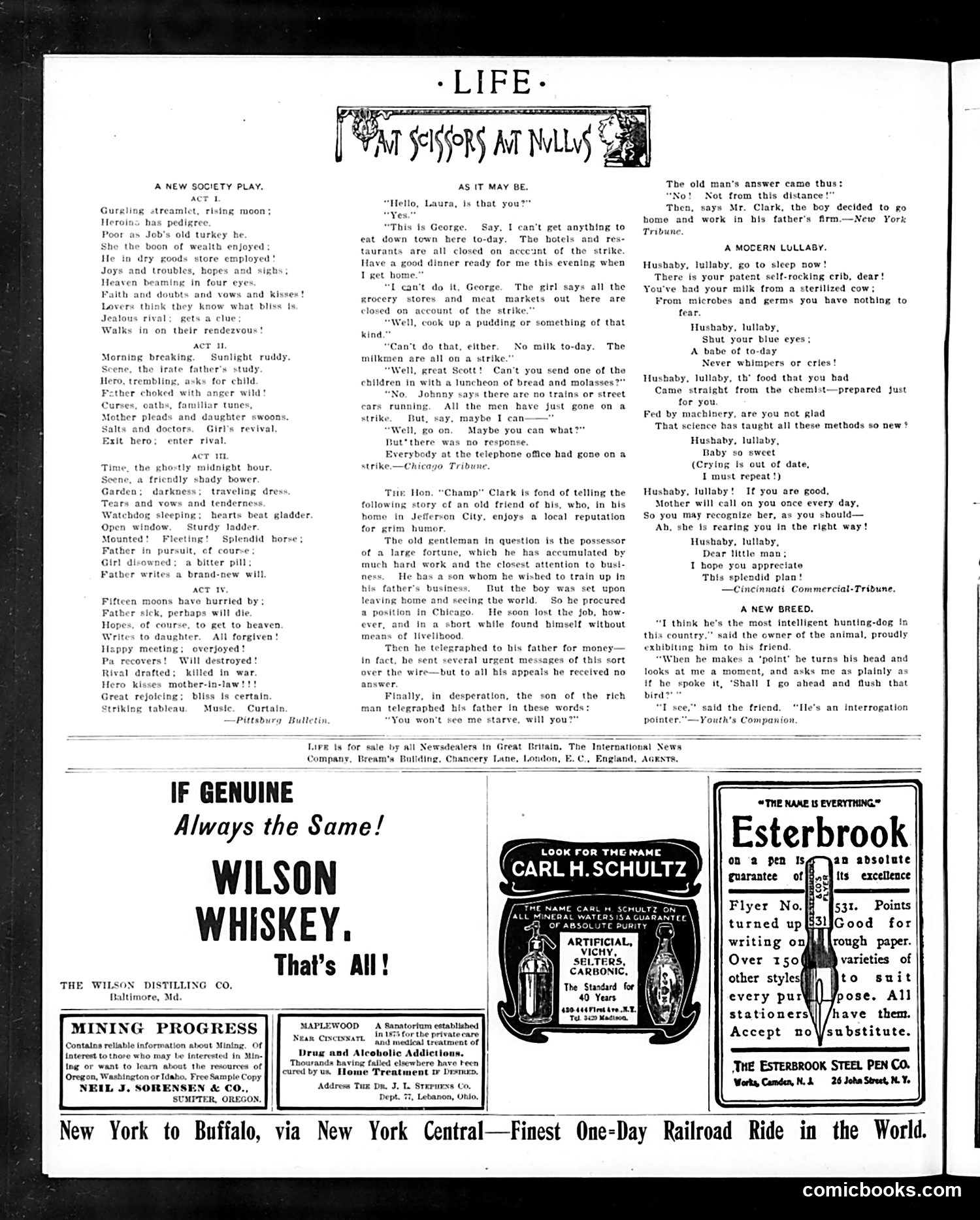
This page from *Life* magazine presents **three satirical pieces** mocking contemporary American life circa 1910s: 1. **"A New Society Play"** (top): A mock theatrical synopsis satirizing predictable melodrama plots—poor hero, rich heroine, jealous rival, angry father, elopement, and convenient reconciliation. The joke targets audiences' appetite for formulaic sentimentality. 2. **"As It May Be"** (center): A dialogue between spouses during a widespread strike showing the cascading collapse of urban services—restaurants, stores, trains, and even telephone operators all striking. The humor derives from the absurdity of total social paralysis and the wife's helpless responses to her husband's increasingly desperate requests. 3. **"A Modern Lullaby"** (right): Dark satire on contemporary parenting obsessed with scientific/mechanical solutions—sterilized milk, patent cribs, chemically-prepared food, machinery-controlled feeding. It mocks the era's faith that technology and science eliminate all childhood problems and natural emotion. The advertisements below are period-specific (Wilson Whiskey, Carl H. Schultz mineral waters, Esterbrook pens).
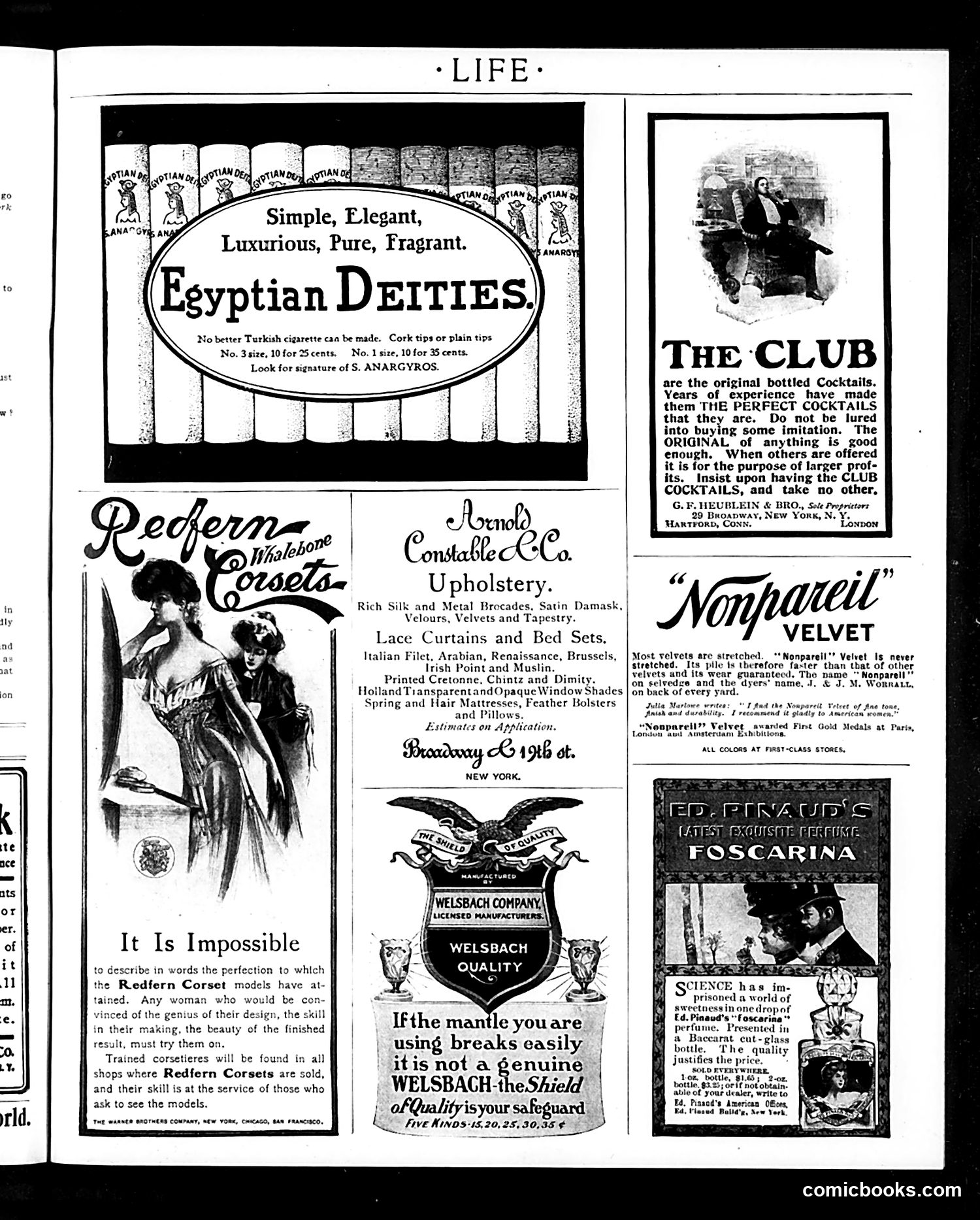
This is primarily an **advertising page**, not satirical content. It features luxury product advertisements typical of early 20th-century Life magazine: **Key advertisements:** - **Egyptian Deities cigarettes** by S. Anargyros—Turkish cigarettes marketed as superior quality - **The Club cocktails**—bottled cocktails emphasizing originality and warning against imitations - **Redfern corsets**—high-end women's corsetry with trained fitting specialists - **Constable upholstery**—luxury fabrics and home furnishings - **Nonpareil velvet**—fabric guaranteed not to stretch - **Welsbach mantles**—lamp components - **Pirkauds Foscarina perfume**—luxury fragrance The page reflects **Gilded Age consumer culture**: emphasis on authenticity, quality, luxury materials (silk damask, Italian filet), and the guarantee that "originals" are superior to imitations. The refined imagery and lengthy descriptions target affluent readers. There's no political satire—this is straightforward period advertising showcasing products and social aspirations of wealthy Americans.
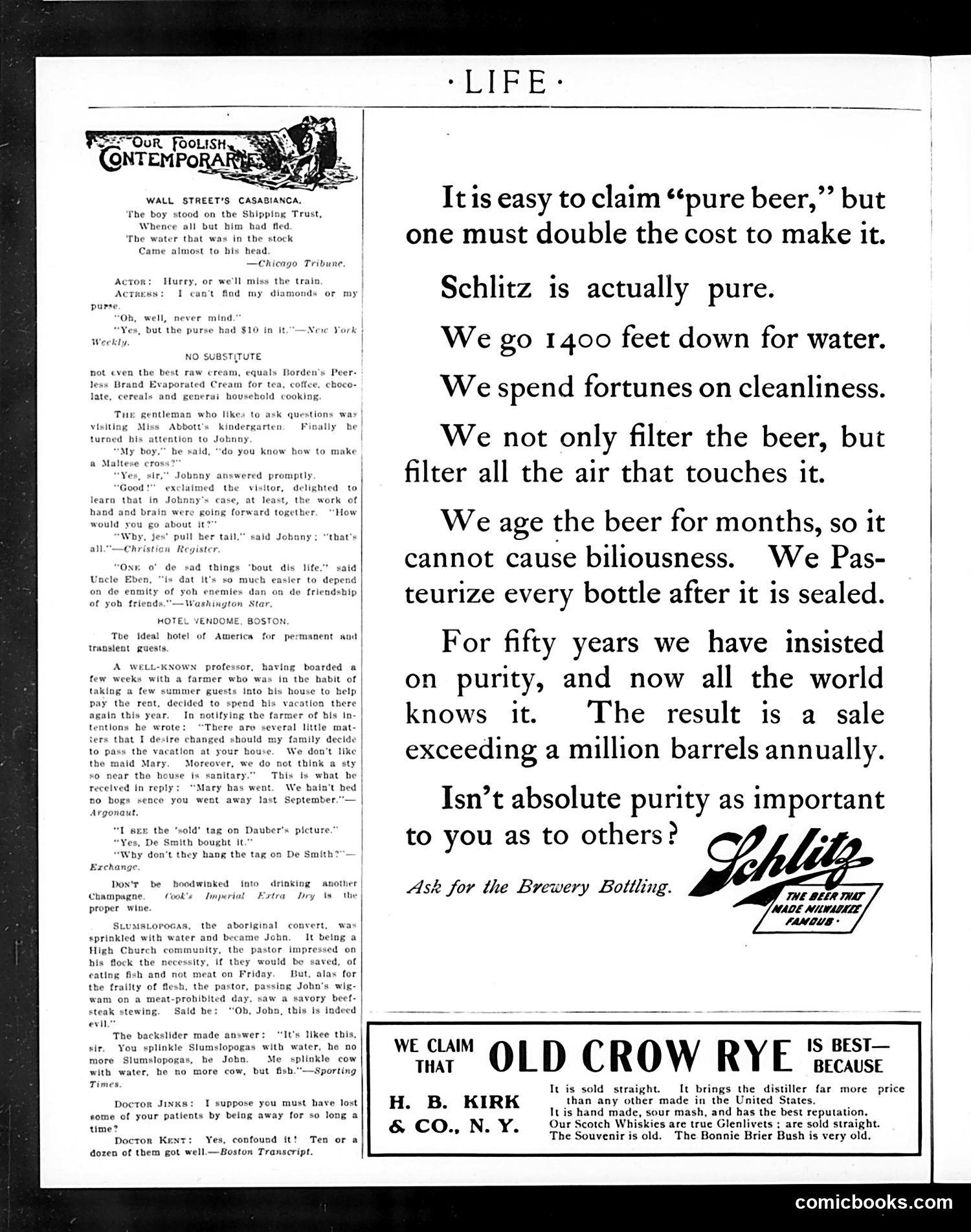
This page from *Life* magazine combines satirical humor with period advertising. The left column contains brief humorous anecdotes mocking various social situations—a Wall Street financier standing alone amid financial collapse (referencing the "Shipping Trust"), theatrical mishaps, and misunderstandings between social classes. These short jokes reflect *Life*'s satirical tradition of critiquing wealth, pretension, and miscommunication. The right side features two substantial beer and whiskey advertisements. The Schlitz ad emphasizes "purity" as a selling point, detailing elaborate purification processes (deep water sources, filtering, pasteurization, aging). The Old Crow Rye ad similarly stresses quality through hand-made production and reputation. These ads reflect early 20th-century advertising before Prohibition, when breweries and distilleries marketed products emphasizing safety and quality—concerns likely driven by public health anxieties about contaminated beverages and unregulated production standards of the era.
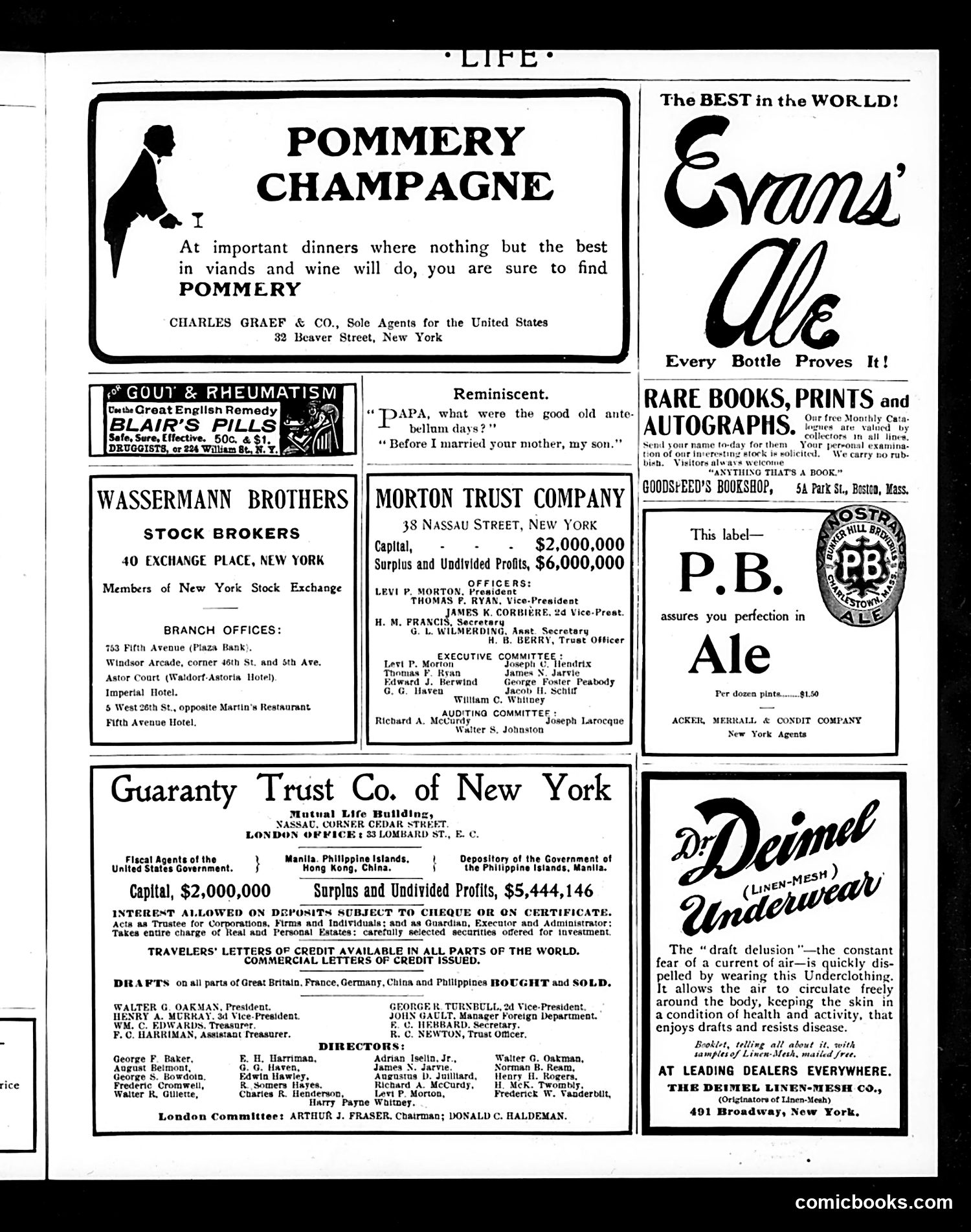
This is primarily a **financial and commercial advertisement page** from Life magazine, not a satirical cartoon page. The single humor item is a brief "Reminiscent" joke: a father tells his son that the "good old antebellum days" (pre-Civil War South) were better—specifically because he hadn't yet married the boy's mother. It's gentle domestic humor playing on the common trope of husbands joking about married life being restrictive. The rest of the page consists of corporate advertisements for major New York financial institutions (Wassermann Brothers stock brokers, Morton Trust Company, Guaranty Trust), plus consumer product ads (Pommery Champagne, Blair's Pills for gout, P.B. Ale, Dr. Deimel underwear, and Goodspeed's rare books). These ads showcase the wealth and commercial activity of early 20th-century America and the magazine's affluent readership.
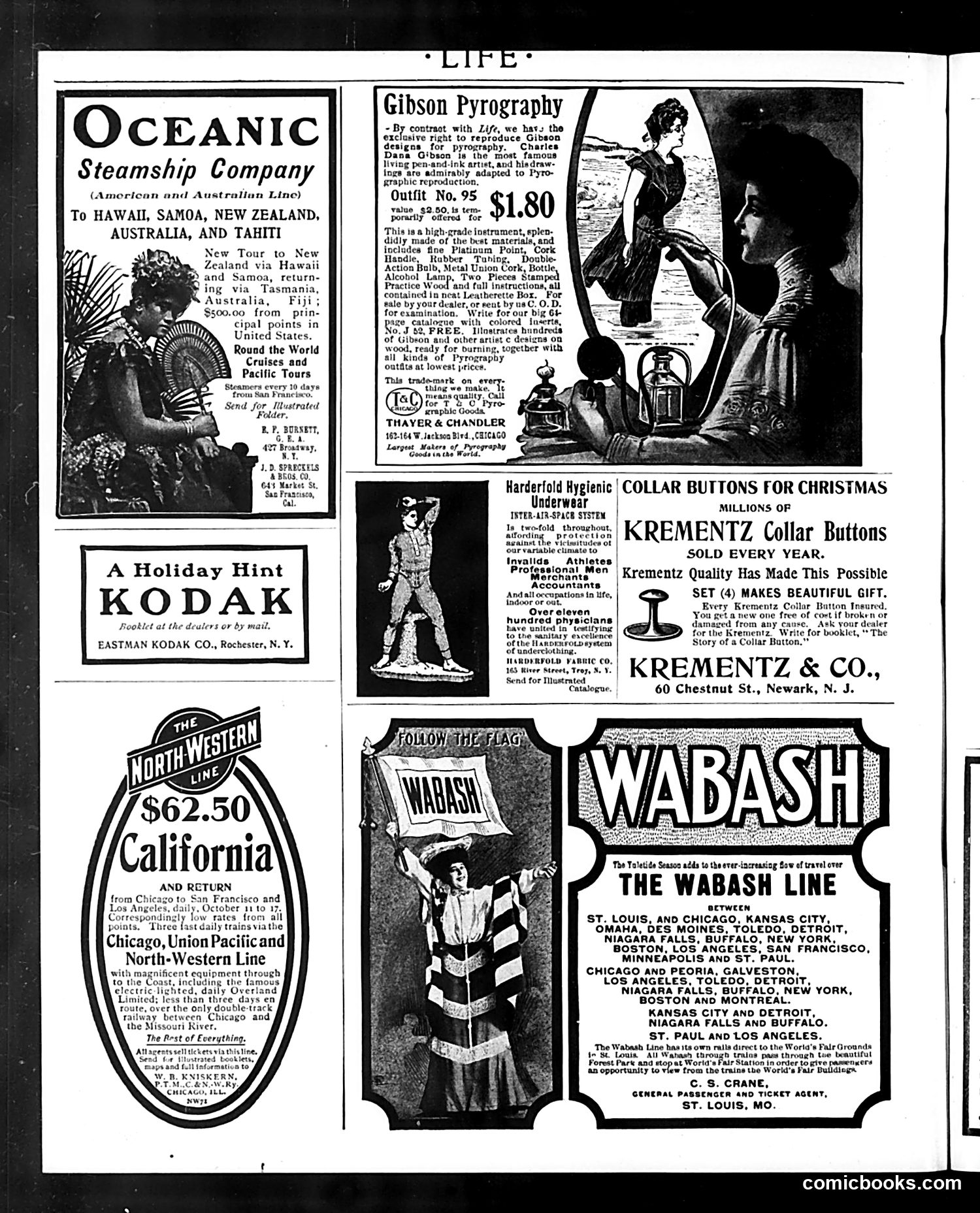
This page is primarily **advertising**, not satirical content. It consists of commercial advertisements for travel, photography, clothing, and accessories typical of an early 1900s American magazine. The ads include: - **Oceanic Steamship Company**: Pacific cruises to Hawaii, Samoa, New Zealand, and Australia - **Kodak**: Holiday gift cameras - **North-Western Line**: $62.50 California train tickets from Chicago - **Gibson Pyrography**: Wood-burning art kits featuring Charles Dana Gibson's designs - **Krementz Collar Buttons**: Mass-produced fashion accessories advertised as durable gifts - **Wabash Line**: Railroad routes emphasizing access to the 1904 World's Fair in St. Louis The only imagery with potential social commentary is the **Gibson Pyrography section**, which reproduces Gibson's famous "Gibson Girl" illustrated designs—reflecting early 1900s ideals of fashionable femininity—for hobbyist wood-burning reproduction. Otherwise, this reflects consumer culture and leisure travel interests of wealthy early-20th-century Americans.
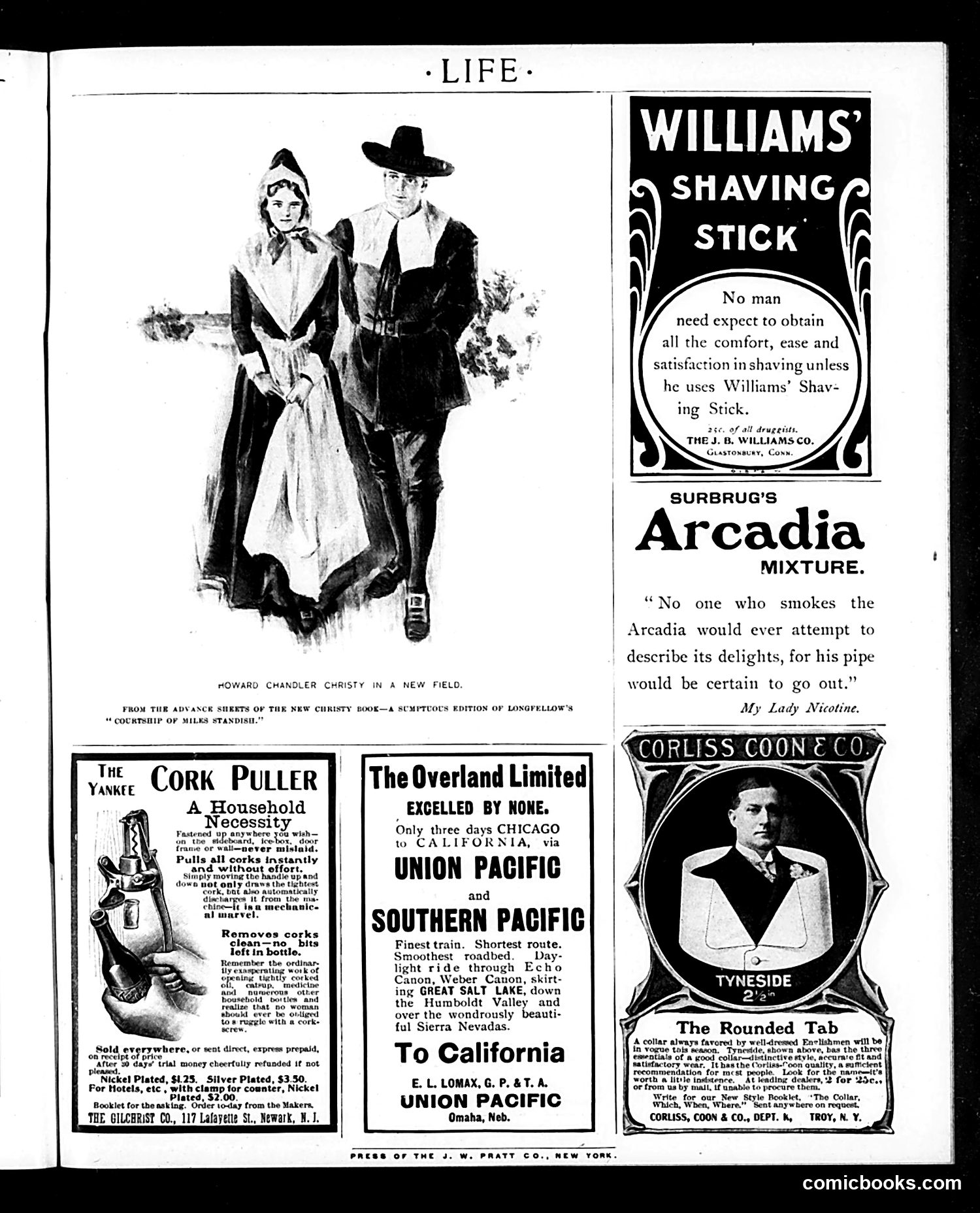
This page is primarily **advertising**, not political satire. The main content is a illustration by Howard Chandler Christy depicting a scene from Longfellow's "Courtship of Miles Standish"—showing a Pilgrim-era couple in period costume. The surrounding advertisements are typical early-20th-century products: a cork puller ("household necessity"), railroad travel to California via Union Pacific, Williams' shaving stick, Arcadia pipe tobacco, and Corliss Coon collar shirts. Each ad uses period marketing language emphasizing comfort, convenience, and quality. The Christy illustration appears designed to add cultural cachet to the magazine—pairing high literary content (Longfellow) with contemporary commercial messaging. There is no discernible political cartoon or satire on this page; it's a straightforward example of how Life magazine monetized its pages through advertising while featuring popular illustrators and literary references.
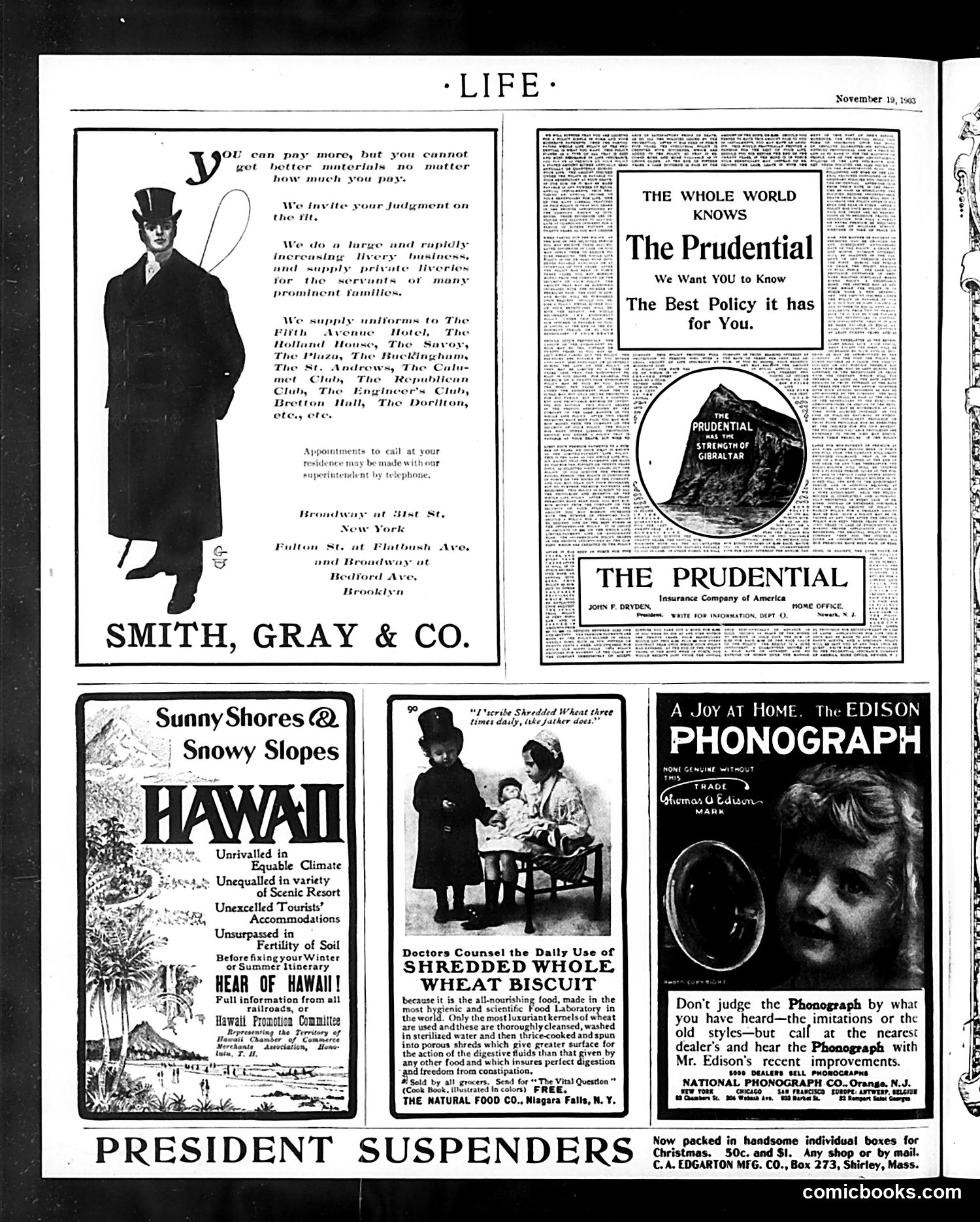
This is primarily a **commercial advertising page** rather than satirical content. The layout features various period advertisements typical of early 1960s magazines: **Notable ads include:** - Smith, Gray & Co. (livery uniforms for servants) - The Prudential Insurance Company (center spread) - Hawaii tourism promotion - Edison Phonograph - Shredded Wheat cereal - "President Suspenders" (bottom) **Historical context:** The date (November 19, 1963) is **one day before President Kennedy's assassination**, though this appears coincidental rather than intentional—the "President Suspenders" product name is simply a brand, not political satire. The page reflects **early 20th-century class dynamics**: advertisements for servant uniforms and high-end club memberships indicate a magazine marketed to wealthy readers. The Prudential ad's "Rock of Gibraltar" imagery emphasizes financial security—a recurring insurance company theme of the era. This is fundamentally a **commercial page**, not a satirical one.