
Life, 1903-11-19 · page 12 of 22
Life — November 19, 1903 — page 12: what you’re looking at
What you’re looking at
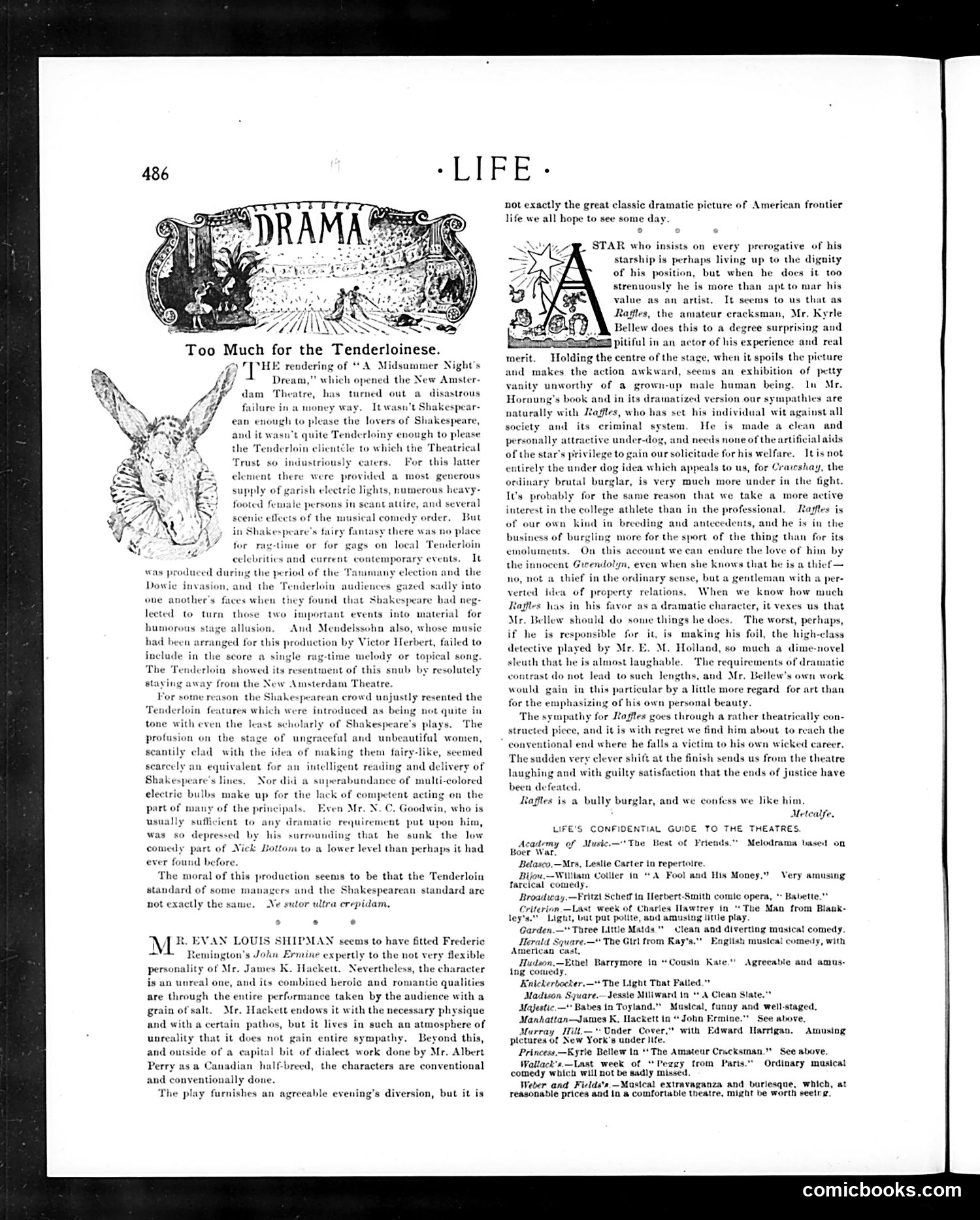
This page contains theatrical reviews rather than political cartoons. The main content criticizes a production of "A Midsummer Night's Dream" at the New Amsterdam Theatre for being overly elaborate and failing to serve Shakespeare's text. The reviewer argues the theatrical spectacle—featuring "ungested and unbeautiful women" and excessive stage machinery—undermines the play's merit. The text also reviews other theatrical productions, including works by Mr. Evan Louis Shipman. The page includes "Life's Confidential Guide to the Theatres," listing current shows with brief commentary. The decorative header labeled "DRAMA" frames the theatrical column. This appears to be a standard arts and entertainment section rather than satirical commentary on contemporary politics or social issues.
📄 Transcribed text from this page (OCR, searchable)
Machine-transcribed from the original scan — historical spelling and the odd misread are preserved.
-LIFE- Too Much for the Tenderloinese. fy (PHE rendering of “A. Midsua Ji Dream,” which opened the New Amster- dam Theatre, has turned out a disastrous failure i It wasn’t Shakespear- ers of Shakespeare, ny enough to please ch the Theatrical Trust so industriously caters. atter a money way ean enough to please the and it wasn’t quite Tenderle the Tenderloin elientéle to w clement there were provided a most generous supply of garish elcetric lights, numerous heavy- footed female persons in scant attire, and several scenic effects of the musical comedy order, But in Shakespeare's fairy fantasy there was no place ray-time or for gags on local Tenderloin celebrities and current contemporary events. It nd the in audiences gazed sadly into nd that Shakespe: t events into mate Aud Mendelss for this production by Victor Herbert, failed to include in the score a single rag was produced during the period of the Tanmany election Dowie invasion, and the Tend ther's faces when they fi turn those two impor humorous stage allusion so, whose music had been arrang elody or topical so: The Tenderloin showed its resentment of this snub by resolutel staying away from the New Amsterdam Theatre. For some reason the Shakespearean crowd unjustly resented the Tenderloin features which were introduced as being not quite in tone with even the least scholarly of Shakespeare's plays. ‘The fasion on the stage of ungraceful and unbeautiful women, scantily clad with the idea of making them fair: scarcely an equivalent for an intelligent reading ke, seemed nd delivery of Shakespeare's lines, ance of multi lored 1 the Even Mr. N.C. Goodwin, who is usually suflicient to any dramatic requirement put upon him, was so depressed by his surrounding that he sunk the low comedy part of Nick Bottom to a lower level than perhaps it had ever found before. ¢ did a superabu electric bulbs make up for the lack of competent acting part of many of the principals. The moral of this production seems to be that the Tenderloin standard of some managers and the Shakespearean stan not exactly the same. dare Ne sutor ultra crepidam, ® ° e EVAN LOUIS SHIPMAN seems to have fitted Frederi 's Jolin Ermine expertly to the not very flexible personality of Mr. James K. Hackett. Nevertheless, the character is an unreal one, and its combined heroic and romantic qualities are through the entice performance taken by the audience with a grain of salt. Mr, Hackett endows it with the necessary physique and with a certain pathos, but it lives in such an atmosphere of unreality that it does not gain entire sympathy. Beyond this, and outside of a capital bit of dialect work done by Mr. Albert Perry as a Canadian half-breed, the characters are conventional and conventionally The play furnishes an agreeable evening's diversion, but it is not exactly the great classic dramatic picture of American frontier life we all hope to see some day : . STAR who insists on every prerogative of his starship is perhaps living up to the dignity of his position, but when he docs it too strenuously he is more than apt to mar his value as an artist. It seems to us that as Ragles, the amateur cracksman, Mr. Kyrle Bellew does this to a degree surprising and pitiful in an actor of his experience and real merit. Holding the centre of the stage, when it spoils the picture and makes the action awkward, seems an exhibition of petty vanity unworthy of a grown-up male human being. In Mr. Horoung’s book and in its dramatized version our sympathies are naturally with Ragles, who has set his indiv society and its criminal system. He is made a clean and personally nd needs none of the artificial aids of the star’s privilege to gain our solicitude for his welfare. It is not ppeals to us, for ordinary brutal burglar, is very much more under in the fight. I's probably for the same reason that we take a more active interest in the college athlete than in the professional. of our own kind business of burgling more for the sport of the thing thai jual wit against all tractive under-d entirely the under dog idea whict Lasfles is breeding and antecedents, and he is in the for its On this account we can endure the love of him by the innocent Gwendolyn, even when she knows that he is a thief— no, not a thief in the ordinary sense, but a gentleman with a per- verted idea When we know how much Ragiles has in his favor asa dramatic character, it vexes us that Mr. Bellew should do some things he does. if he is responsible for it, is mak detective played by Mr. E. M. th that he is almost laughable ast do not lead to such len emoluments. of property relations. The worst, perl g his foil, the high-class Holland, so much a dime-novel ‘The requirements of dramatic nd Mr, Bellew’s own work le more regard. for art than of his own personal beauty The sympathy for Ragftes goes through a rather theatrically con- structed piece, and itis with regret we find him about to reach the conventional end where he falls a victim to his own wicked career. ‘The sudden very clever shift at the finish sends us from the theatre laughing and with guilty satisfaction that the ends of justice have been defeated. Raffles is a bully burglar, and we confess we like hie Metcalfe, LIFE'S CONFIDENTIAL GUIDE TO THE THEATRES Academy of Music.—*The lest of Friends. Boer War. Belasco.—Mrs, Leslie Carter in repertoire. Bijou. —Wilitam Collier in “A Fool and His Money.” farcical comedy. Broadway.—Feitz\ Scheif tn Herbert-Smith comic opera, * Babette."* Criterion —Last week of Charles Hawtrey in “The Man from Blauk- ley's." Light, but put polite, aud amusing little play. Garden.—* Three Little Matds "Clean and diverting masical comedy. Herald Square.—" The Girl from Ray's." English musica! comedy, with American cast, Hudaon,.—Ethe! Barrymore in “Cousin Kate.” ing comedy Knickerbocker.—* The Light That Fatled." Madison Syware.— Jessie Millward tn ** A Clean State.” Majestic. —** Babes in Toyland.” Mustcal, funny and well-staged, Mankattan—James K. Hackett in “John Ermine.’ See above, Murray Hilt.—* Under Cover,” with Edward Harrigan. pictures of New York's under life. Princess,—Kyrtie Bellew In ‘The Amateur Cracksman.”? See above. Wallack's.—Last week of “Peggy from Parts.” Ordinary musical comedy which will not be sadly missed, Weter and Fistds's—Masical extravaganza and burlesque, which, at reasonable prices and fn # comfortable theatre, might be worth seetrg. Melodrama based on Very amusing Agrecable aud amus- Amusing comicbooks.com