
A complete issue · 38 pages · 1903
Life — November 5, 1903
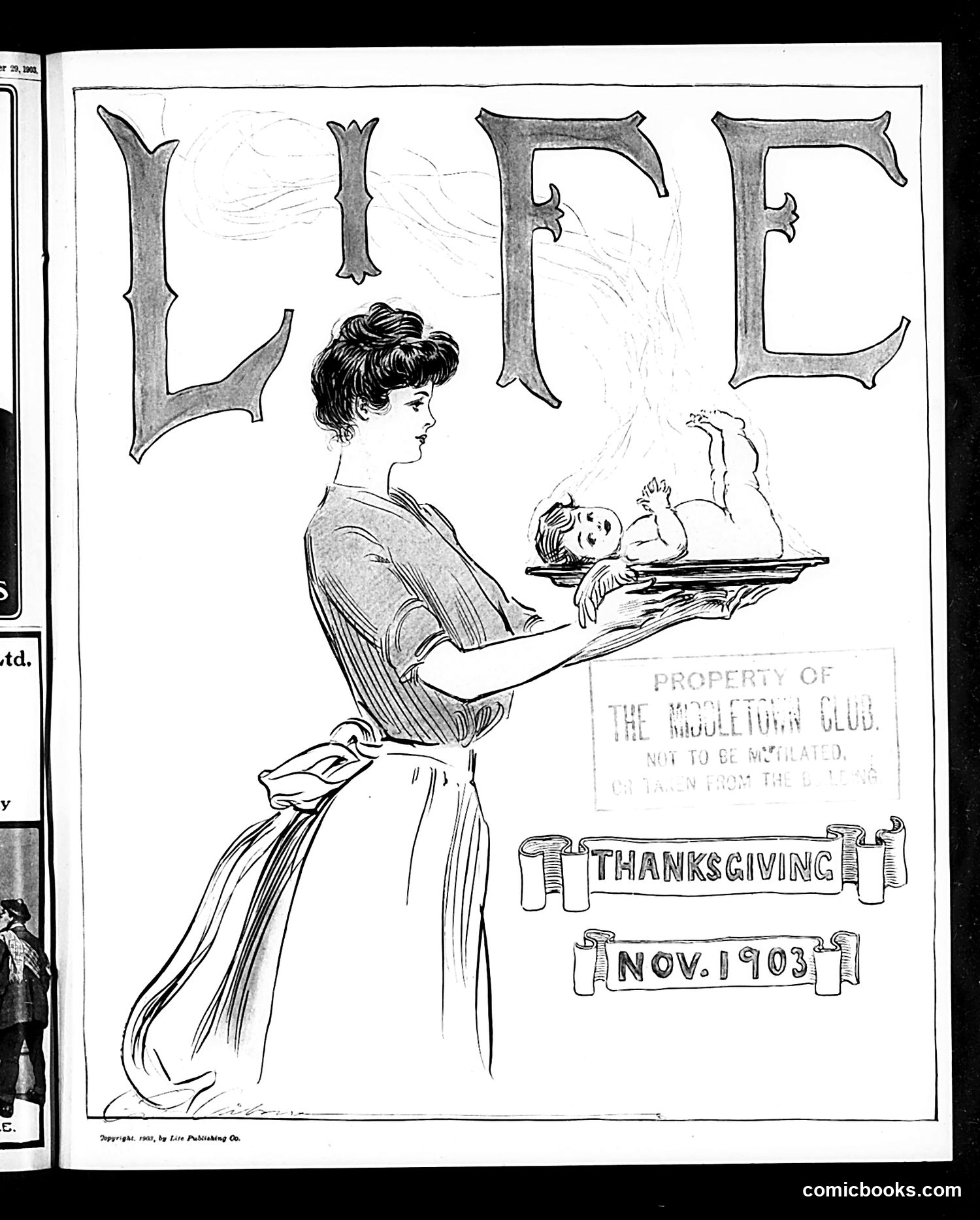
This is a **Thanksgiving cover** from Life magazine dated November 1903. The illustration depicts a woman holding an infant, with decorative text reading "LIFE" at the top and "THANKSGIVING NOV. 1903" at the bottom. The image appears to be a straightforward seasonal illustration rather than political satire—it celebrates motherhood and the holiday season. The woman is dressed in early 1900s clothing, and the baby is rendered in a cherubic style typical of the era. The stamp reading "PROPERTY OF THE MIDDLETOWN CLUB" indicates this was a library copy. Without additional context or captions explaining satirical intent, this appears to be decorative cover art rather than commentary, though Life was primarily a satirical publication.
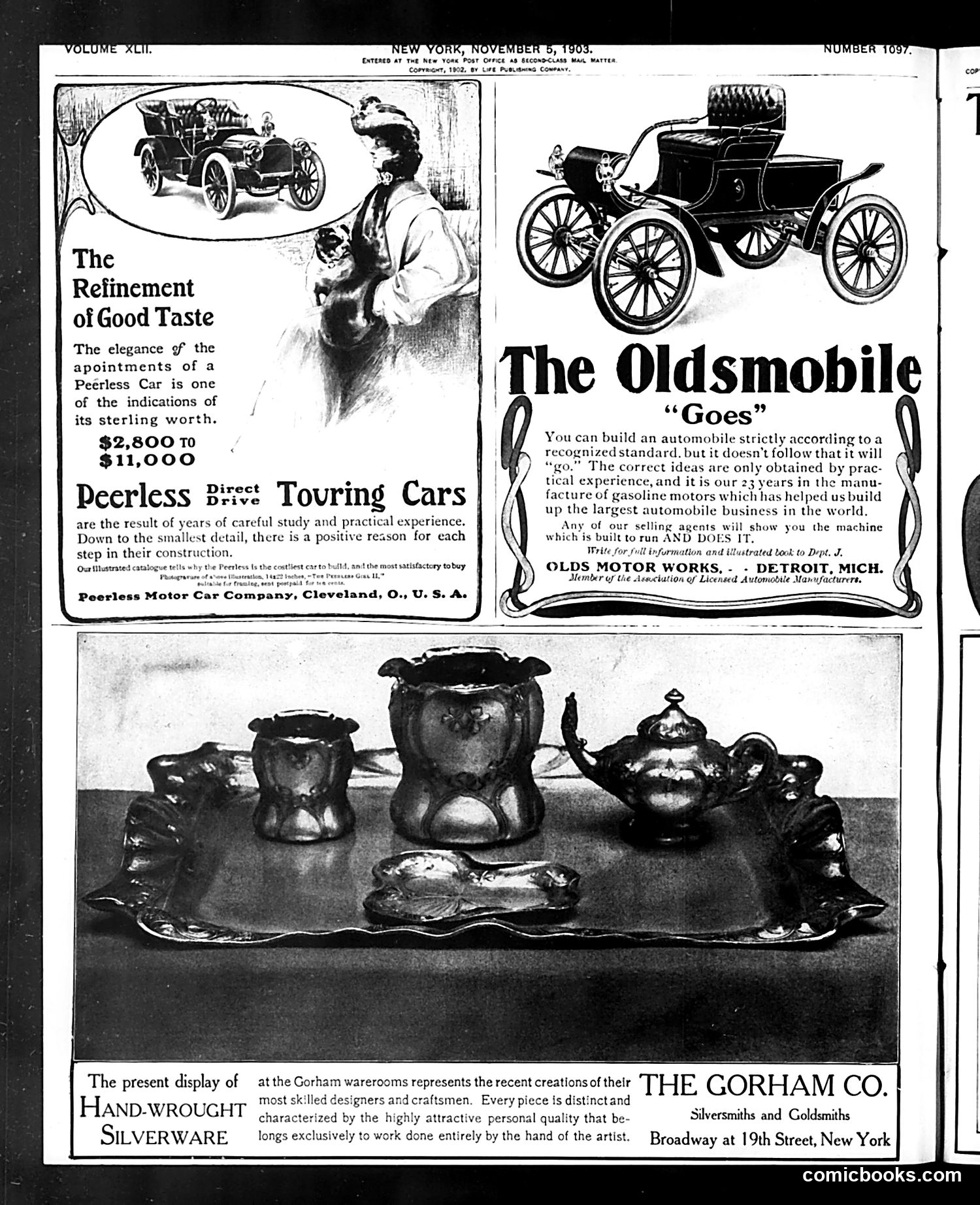
This page contains **three separate advertisements** rather than political cartoons or satire. **Top left**: Peerless Motor Car Company advertises touring cars priced $2,800-$11,000, emphasizing "refinement of good taste" and careful engineering. **Top right**: Oldsmobile advertisement claims their cars "go" reliably, boasting 23 years manufacturing experience and the largest automobile business worldwide. **Bottom**: The Gorham Company showcases hand-wrought silverware displays at their New York showroom, emphasizing artisanal craftsmanship. All three ads target affluent consumers, reflecting early 1900s luxury goods marketing. The automobile ads particularly reveal the nascent auto industry's competition for upper-class buyers through claims of quality, experience, and prestige rather than price.
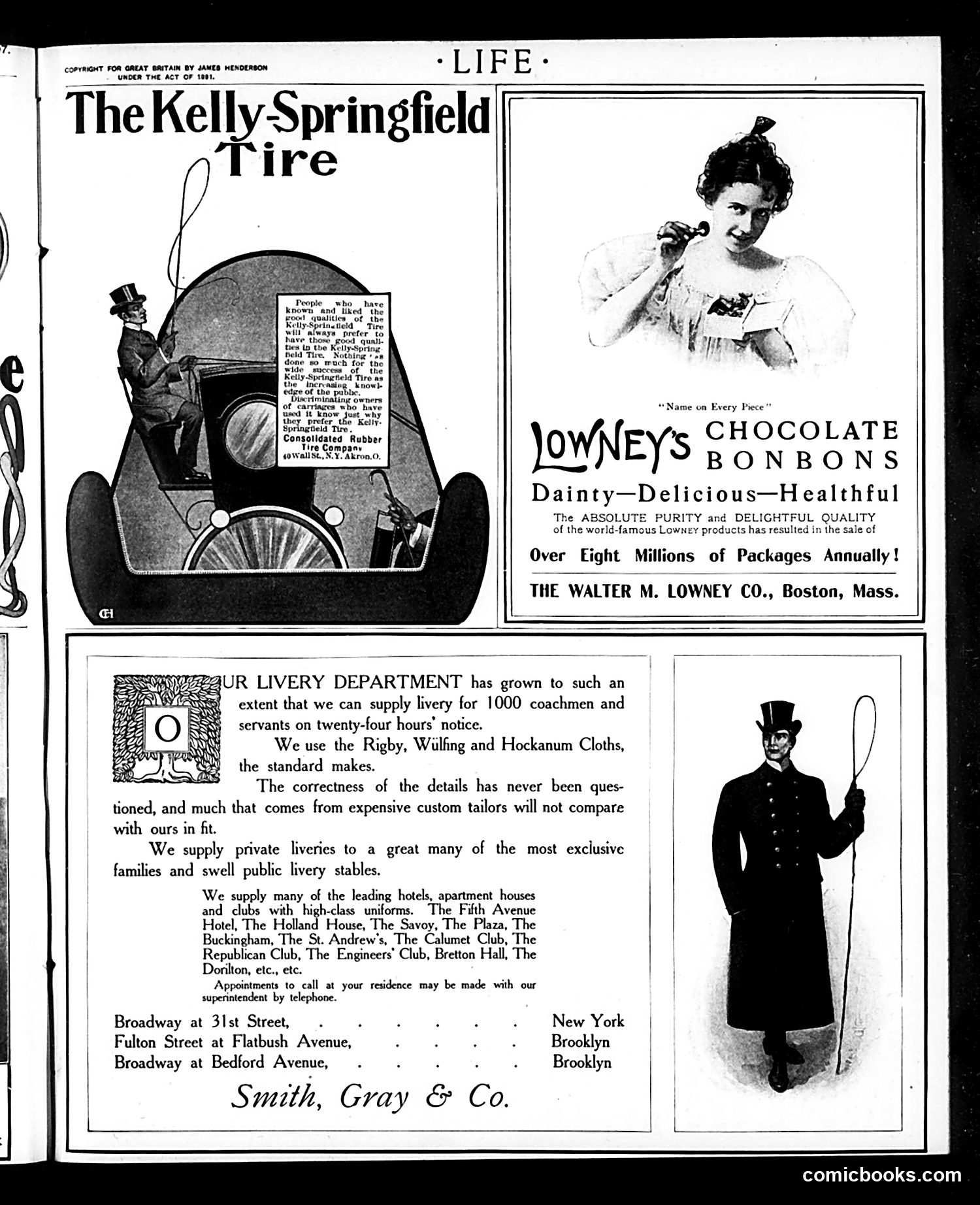
This page is **primarily advertising** with minimal editorial content. The three advertisements are: 1. **Kelly-Springfield Tire**: Shows a jovial man emerging from a giant tire, promoting the product with a testimonial text box. 2. **Lowney's Chocolate Bonbons**: Features a woman's portrait advertising "dainty-delicious-healthful" candies, claiming over eight million packages sold annually. 3. **Smith, Gray & Co. Livery**: Describes their horse-drawn carriage services for high-class clientele, listing prestigious NYC hotels and clubs they supply, with a well-dressed coachman illustrated. The page reflects early 20th-century American consumer culture and service industries. No political satire or social commentary is evident—it's straightforward commercial content typical of Life's advertising pages.
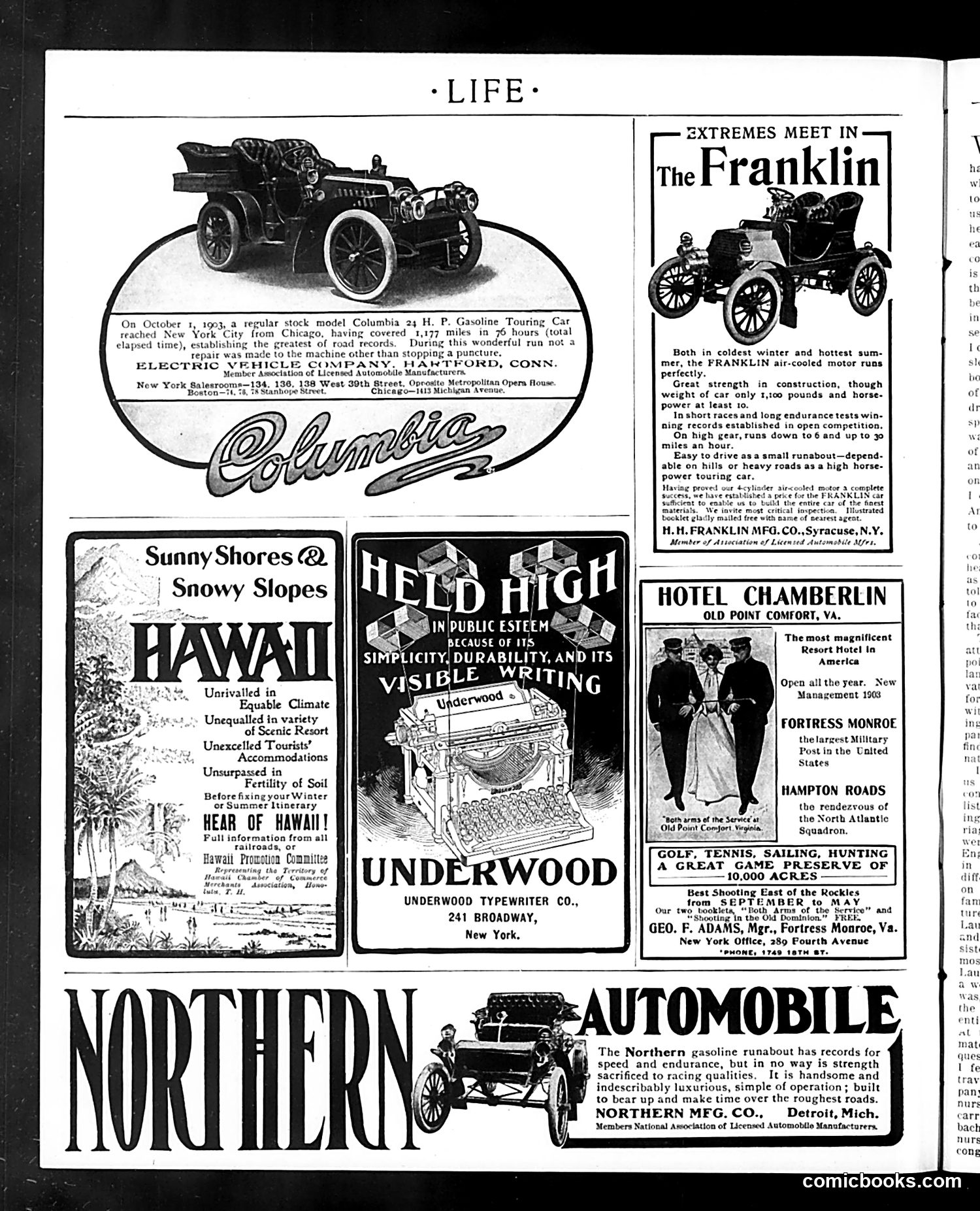
This page is primarily **advertising**, not political satire. It contains several early 1900s commercial advertisements: - **Columbia automobile**: Advertises a gasoline touring car that set a road record in 1903 - **The Franklin automobile**: Highlights its air-cooled engine and durability in extreme weather - **Hawaii tourism**: Promotes travel accommodations and scenic attractions - **Underwood typewriter**: Emphasizes the machine's durability and visibility of writing - **Hotel Chamberlain**: Advertises a Virginia resort hotel - **Northern automobile**: Boasts speed and endurance records The page reflects early automotive industry competition and the leisure travel industry of the era. There is **no political cartoon or satire present**—it's a standard advertising section from Life magazine's revenue-generating content.
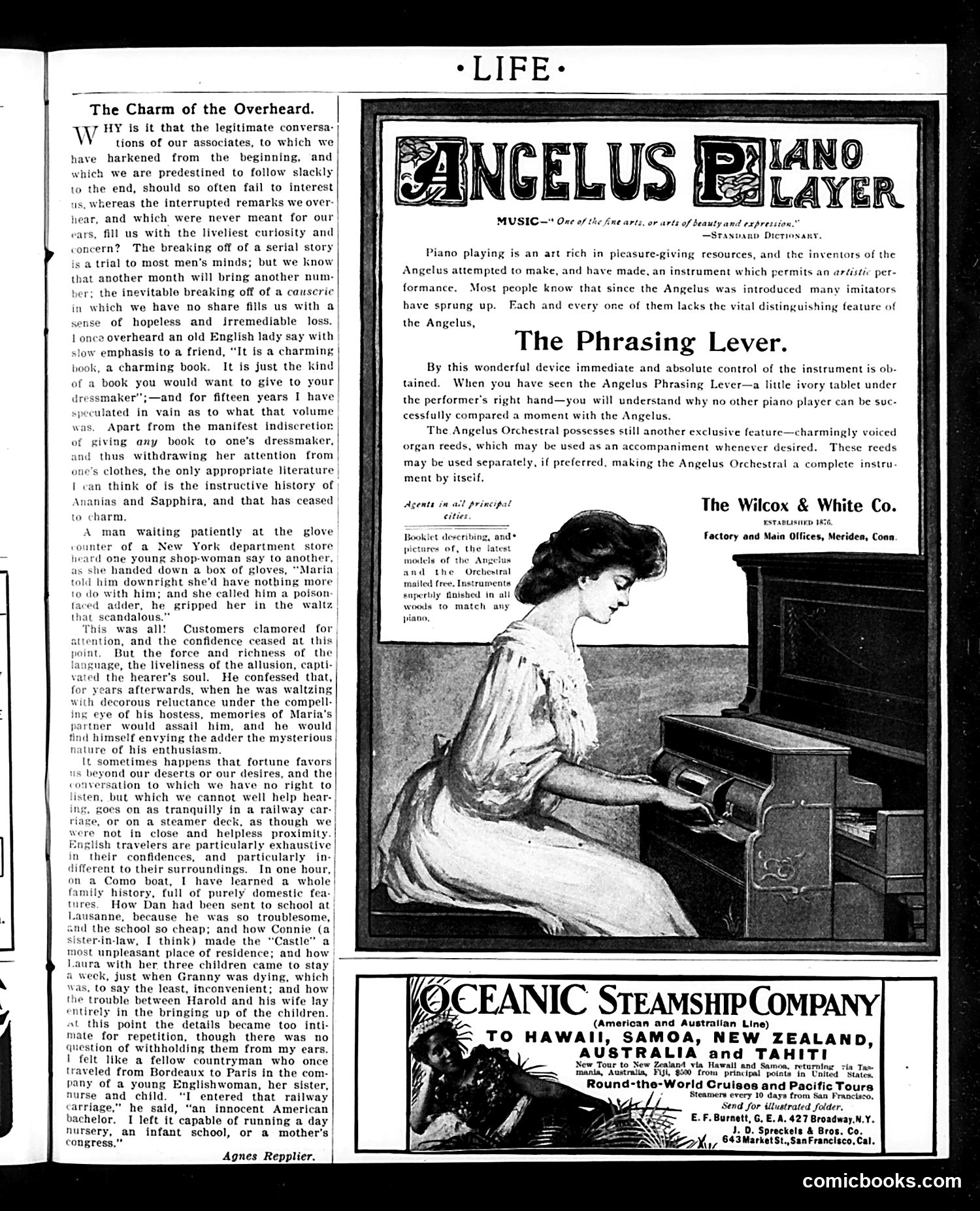
This page is **primarily advertising**, not satirical content. The dominant features are three advertisements: 1. **Angelus Piano Player** - promoting a mechanical piano device with "The Phrasing Lever" feature, claiming superior control compared to competitors 2. **Wilcox & White Co.** - advertising pianos and organs from their Connecticut factory 3. **Oceanic Steamship Company** - promoting Pacific travel to Hawaii, Samoa, New Zealand, and Australia The left column contains "The Charm of the Overheard" by Agnes Repplier—a humorous essay about overhearing strangers' conversations on trains and boats, not political satire. **No political cartoons appear on this page.** It represents early 20th-century Life magazine as a vehicle for consumer advertising alongside light entertainment and essays.
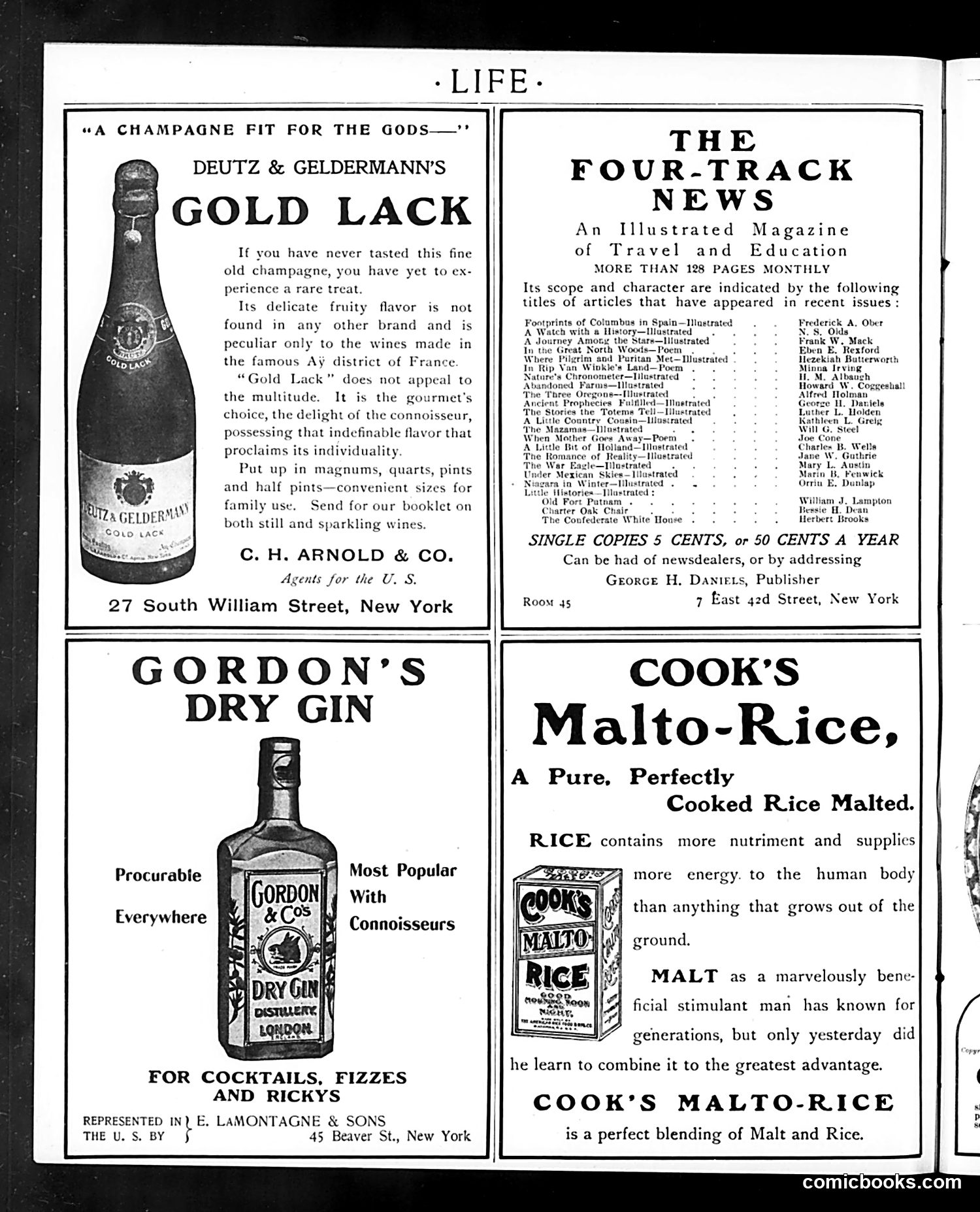
This is **not a cartoon page** but rather an **advertising page** from Life magazine. It contains four product advertisements: 1. **Deutz & Geldermann's Gold Lack** champagne—marketed as a French wine for connoisseurs 2. **The Four-Track News**—a travel and education magazine listing contributor names 3. **Gordon's Dry Gin**—promoted as "procurable everywhere" and popular with connoisseurs, for cocktails 4. **Cook's Malto-Rice**—a rice malt product claiming nutritional and energetic benefits The page reflects early 20th-century advertising conventions and consumer products. There is no political satire, caricature, or social commentary present—it is straightforward commercial promotion typical of Life magazine's revenue model during this period.
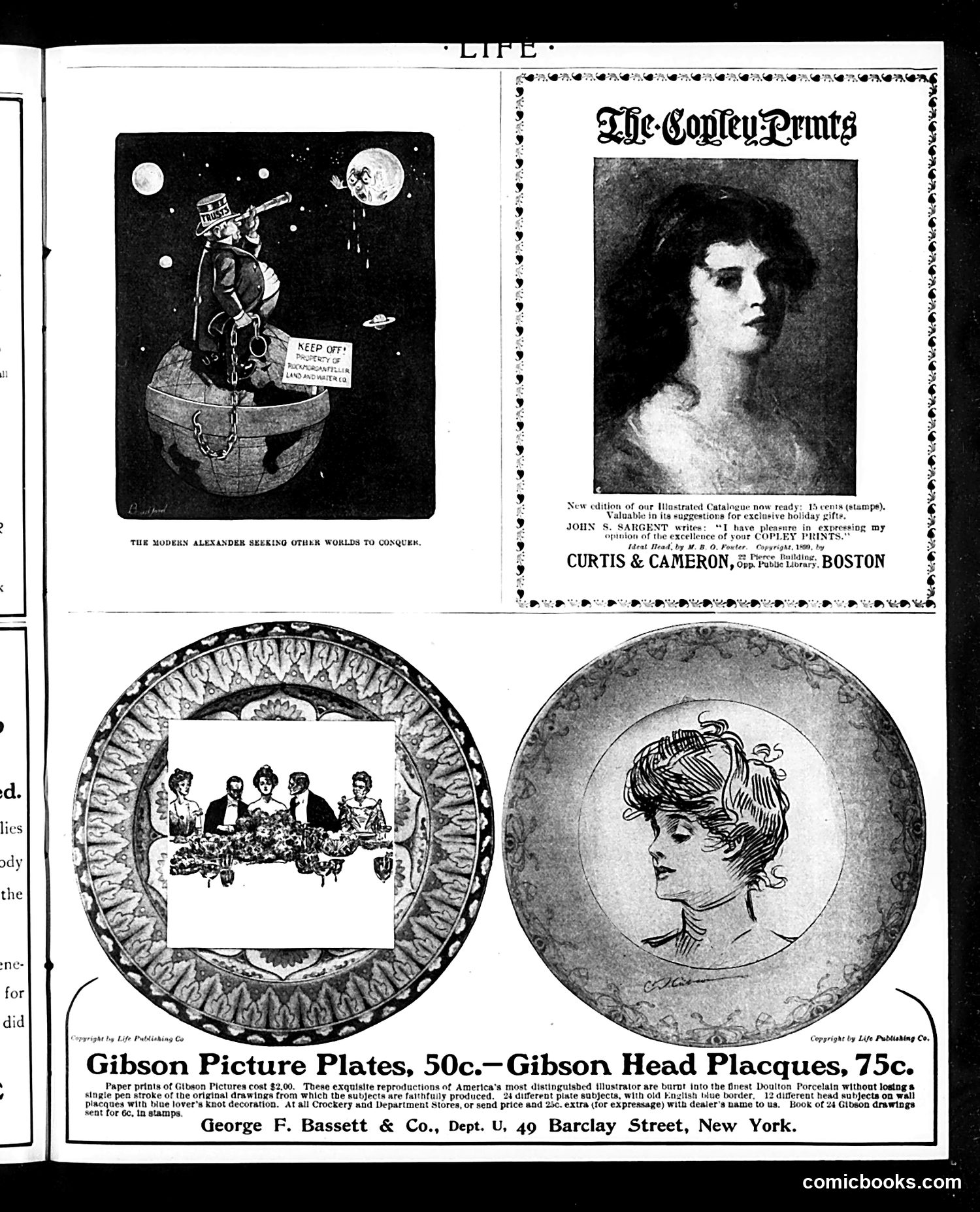
This page is primarily **advertising**, not editorial content. The top left shows a satirical illustration titled "The Modern Alexander Seeking Other Worlds to Conquer"—a figure with a telescope on a globe, referencing Alexander the Great's historical ambitions. The joke appears to comment on expansionist impulses or imperial ambition, though the specific target remains unclear without additional context. The right side advertises "Copley Prints" and features a portrait of a woman. Below are two circular decorative plates from Gibson Picture Plates and Gibson Head Plaques, sold by George F. Bassett & Co. in New York. These were popular home decorative items featuring illustrations, likely by Charles Dana Gibson (the "Gibson Girl" artist), whose work was widely commercialized during this era.
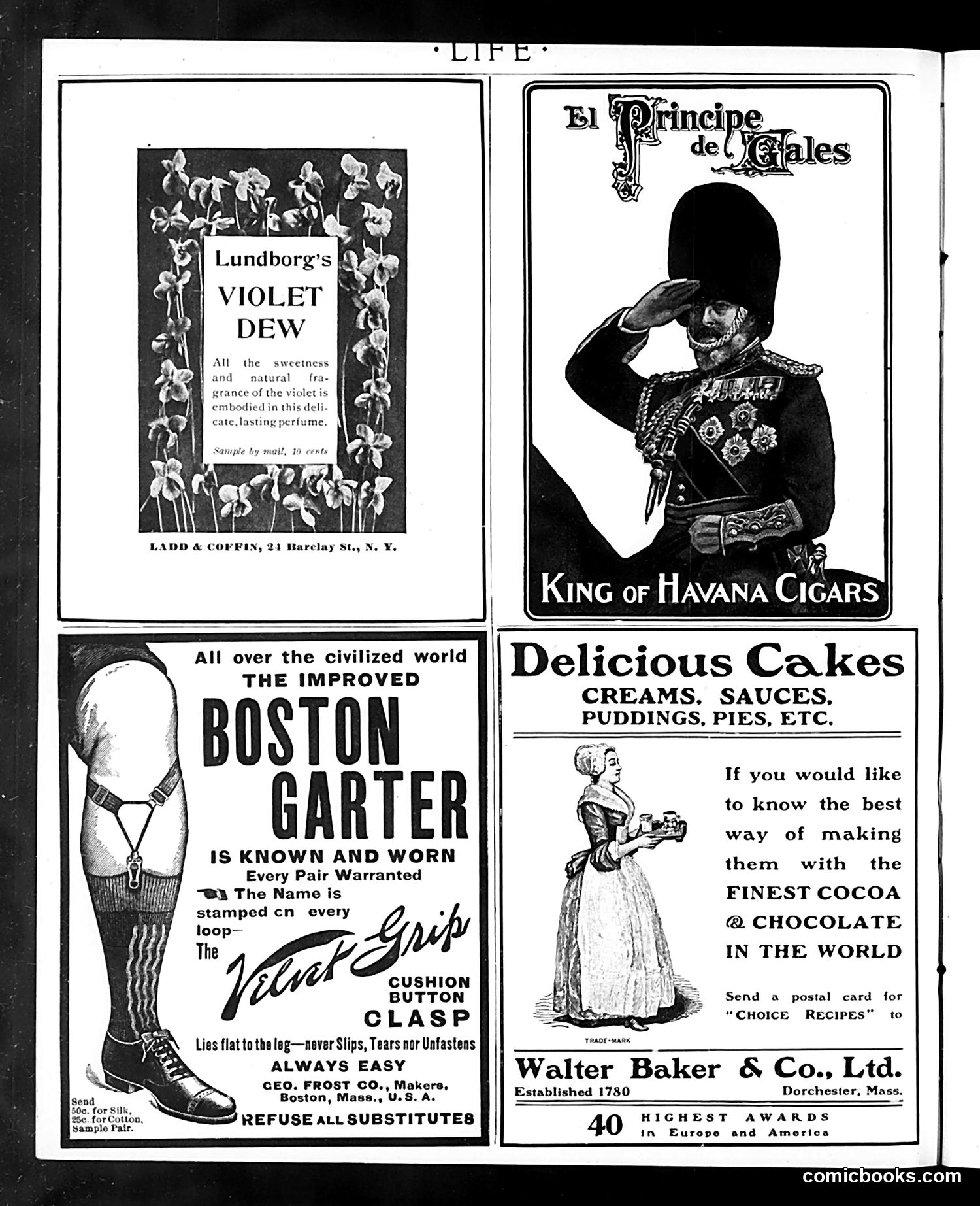
This is a **page of advertisements**, not political satire. The page contains four product ads typical of early 20th-century Life magazine: 1. **Lundborg's Violet Dew** perfume - emphasizes natural floral fragrance 2. **El Príncipe de Cetales** cigars - features a military officer in formal dress, likely referencing a Cuban or Spanish dignitary (the ornate uniform and medals suggest high rank) 3. **Boston Garter** - advertises men's garters with the "Velvet Grip" feature, promising comfort and durability 4. **Walter Baker & Co.** cocoa and chocolate - promotes baking ingredients with recipe booklet offer These are straightforward commercial advertisements with no apparent political commentary or satire. The military figure in the cigar ad appears designed primarily to convey sophistication and prestige to consumers.
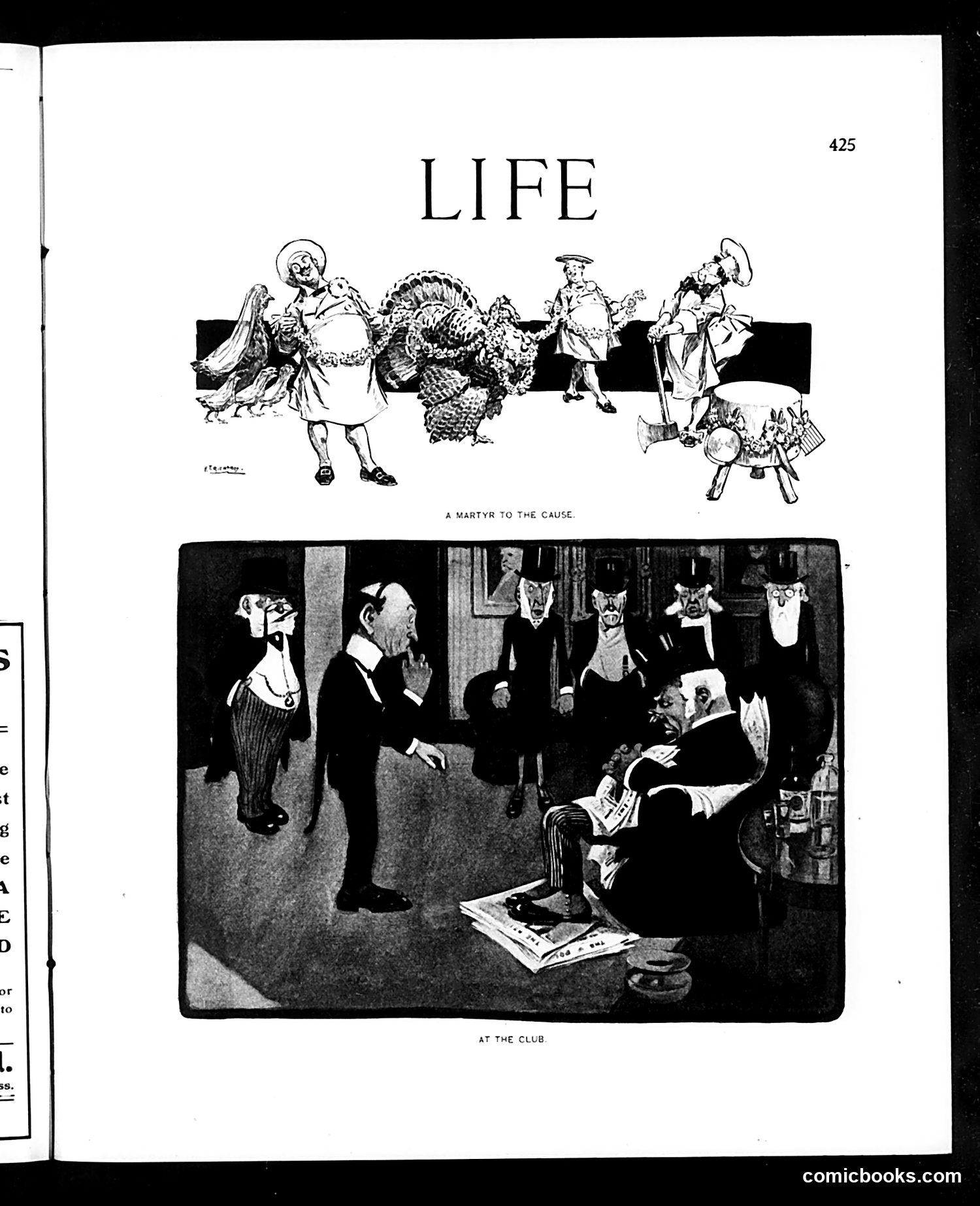
This page contains two satirical illustrations from Life magazine's humor section. **Top cartoon ("A Martyr to the Cause"):** Shows various figures—including what appears to be a woman, a large turkey, and other characters—arranged around a black horizontal band. The caption suggests commentary on someone making sacrifices for a cause, though the specific political or social reference isn't entirely clear from the image alone. **Bottom cartoon ("At the Club"):** Depicts a social scene where well-dressed men in formal attire gather around a seated, portly gentleman reading a newspaper. The exaggerated caricatures and their expressions suggest satirical commentary on upper-class social behavior or clubroom culture, likely mocking pretension or gossip among the wealthy. Both illustrations use caricature and exaggeration typical of early 20th-century satirical humor.
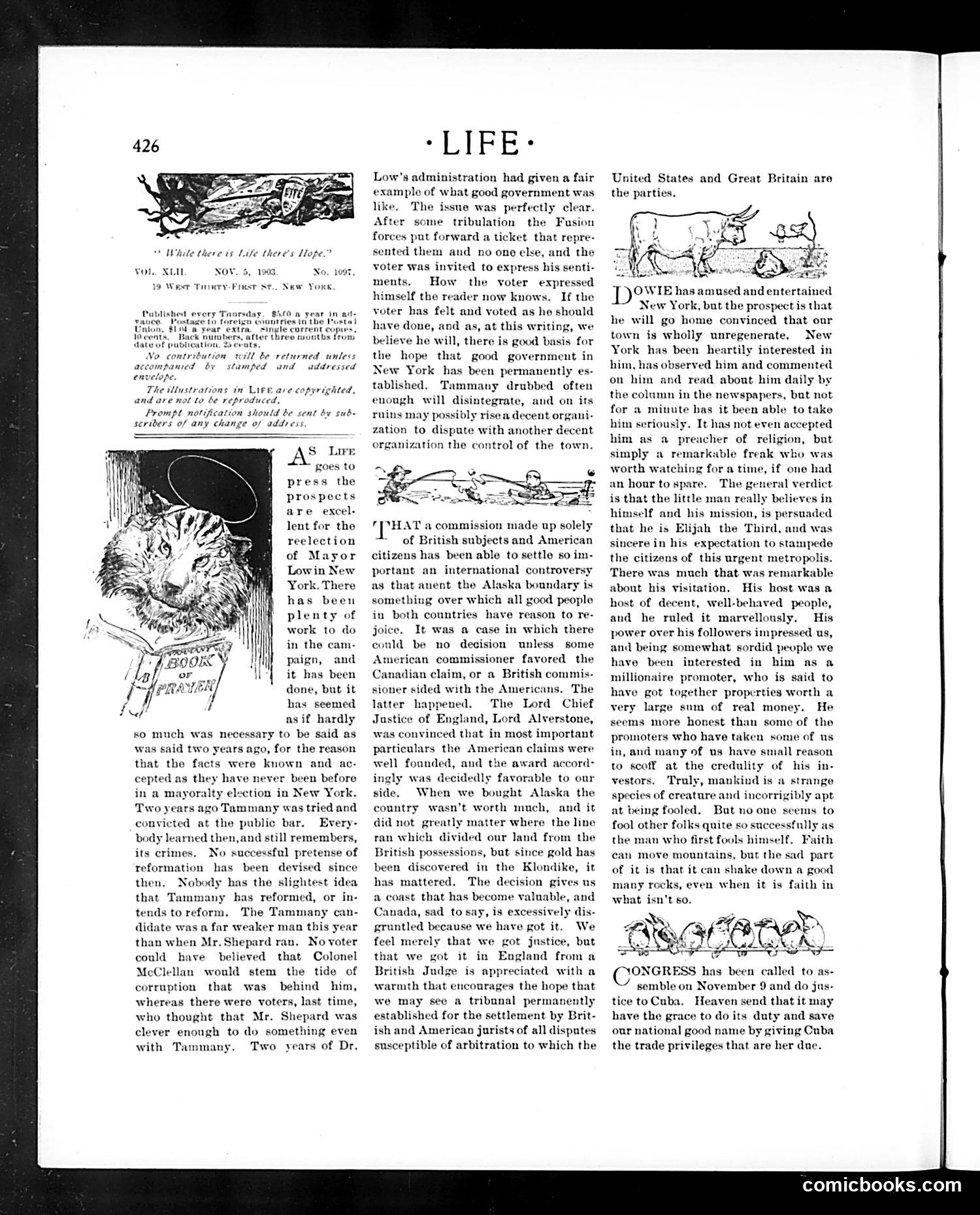
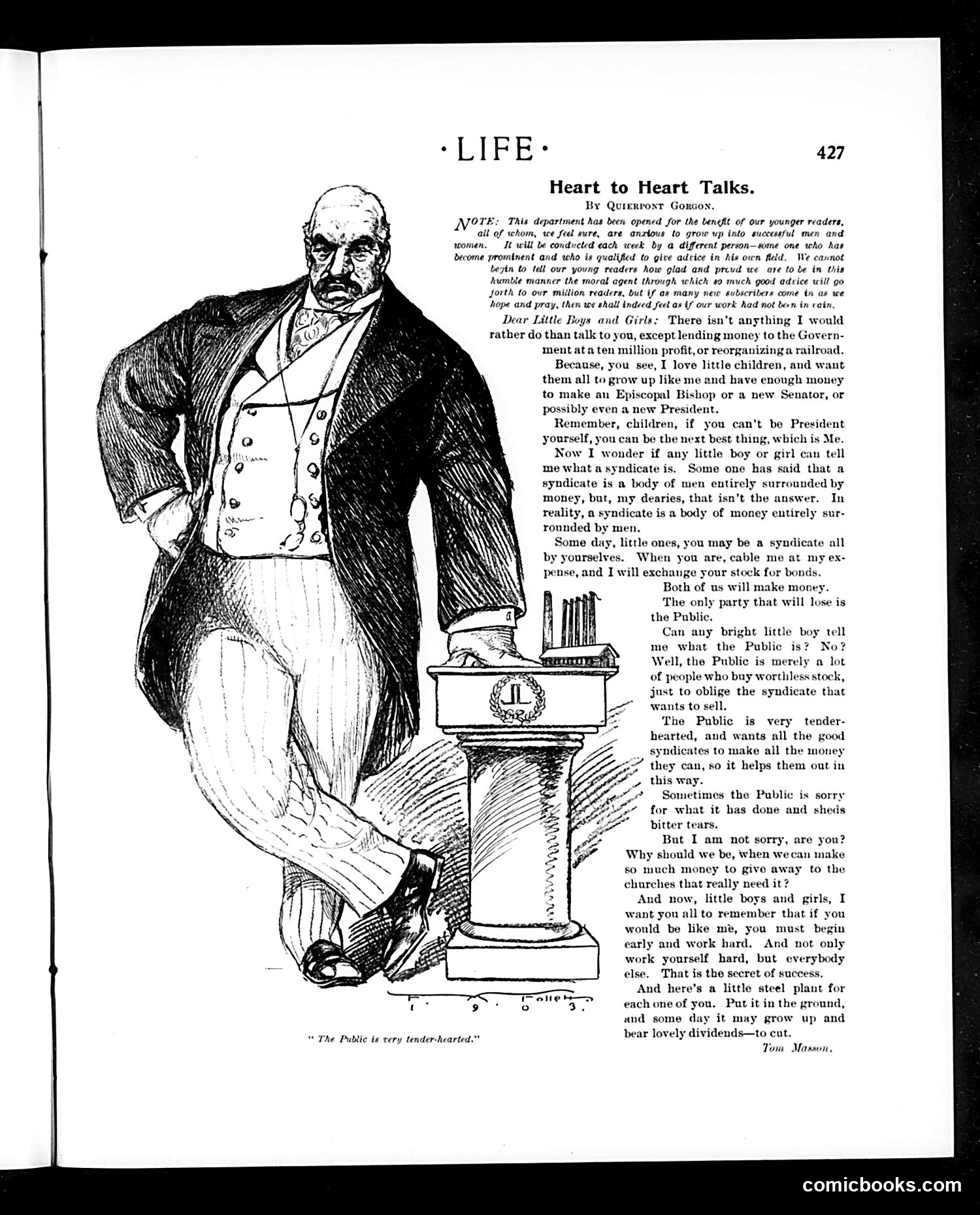
This page features a satirical column by Quierpoint Gorgon addressing wealthy children about financial morality. The accompanying caricature depicts a portly, well-dressed gentleman (identified by the caption as "The Public is very tender-hearted") standing beside a pedestal labeled with a seal. The satire targets **syndicates**—groups of wealthy investors who pool money to manipulate stock markets and exploit the public. The author argues that syndicates are "bodies of money entirely surrounded by men," implying greed drives them. The piece ironically advises children that becoming successful syndicate members means the public—depicted as naive and sentimental—will lose money. The underlying message critiques how the wealthy exploit ordinary people's trust while claiming moral superiority.
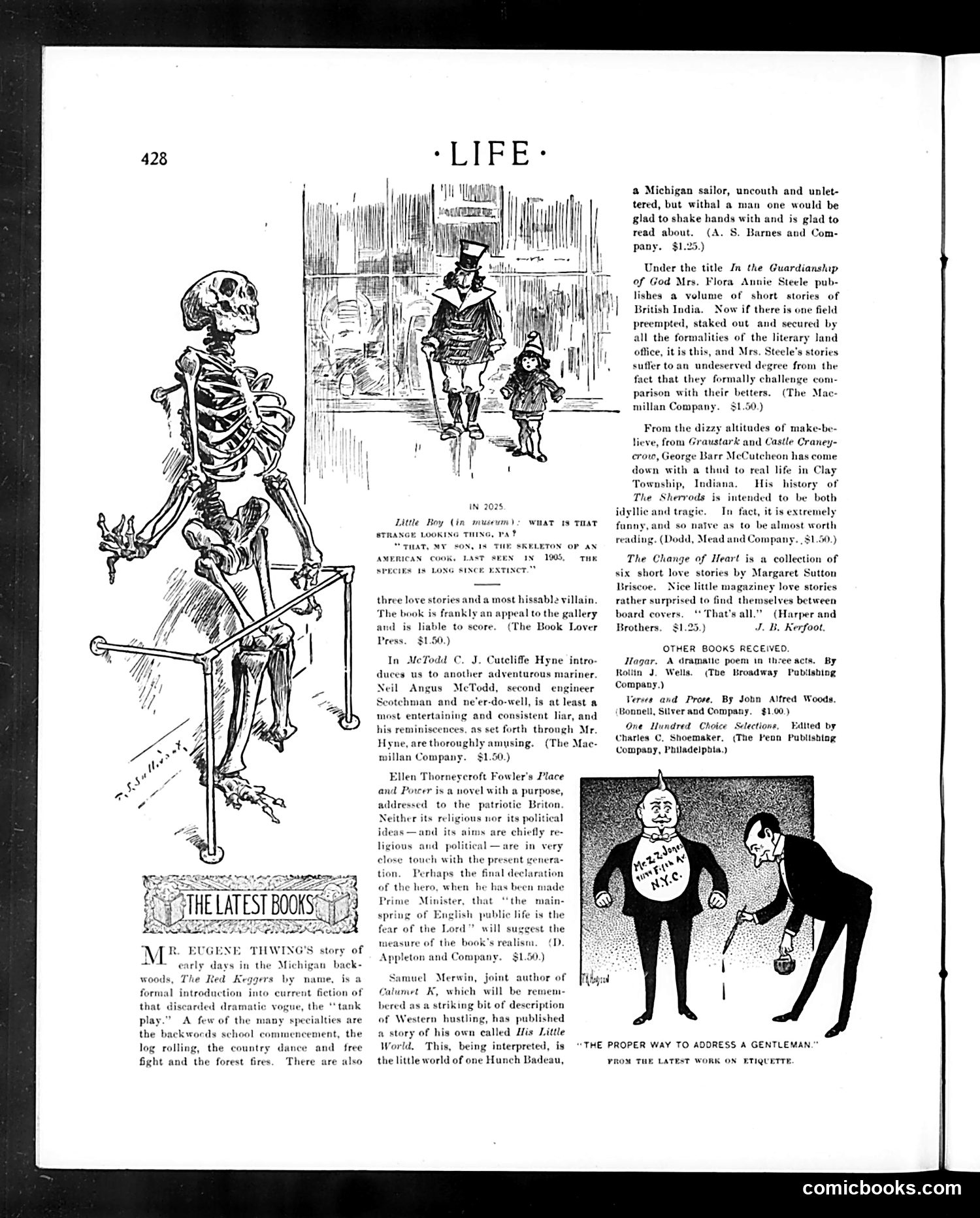
This page reviews recent books rather than presenting political cartoons. The skeleton illustration on the left appears to be decorative artwork accompanying book reviews. The bottom cartoon, titled "The Proper Way to Address a Gentleman," shows two men in formal dress. One appears to be instructing the other on etiquette, likely satirizing proper social conventions or formality of the era. The caption references "the latest work on etiquette," suggesting the joke concerns absurd or overly rigid rules of gentlemanly conduct. The page primarily consists of book reviews discussing titles like *The Red Rangers*, *Neil Angus McTodd*, and *Ellen Thorneycroft Fowler's Place and Power*—various adventure and social novels of the period. The reviews provide context about contemporary American and British literature rather than political commentary.
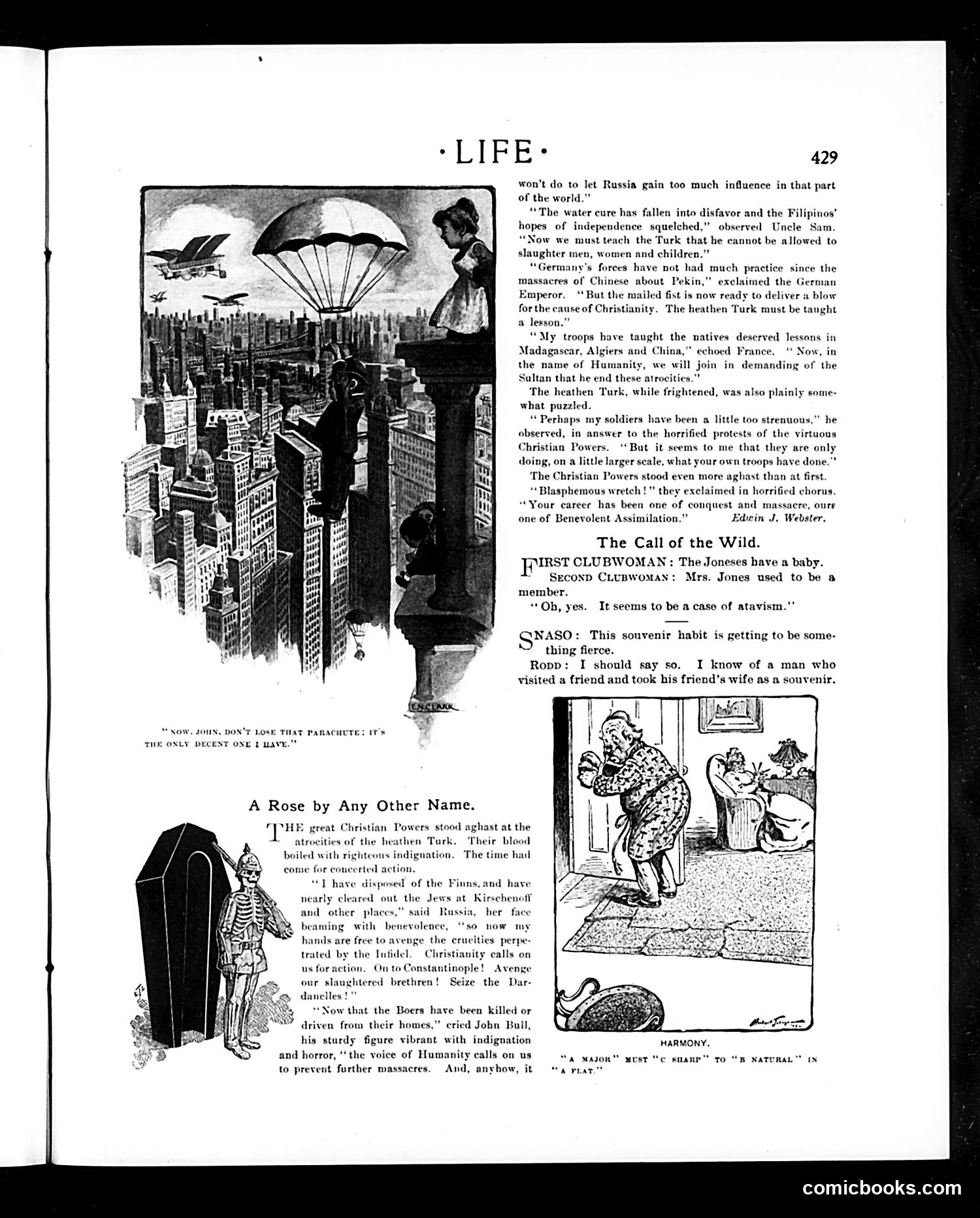
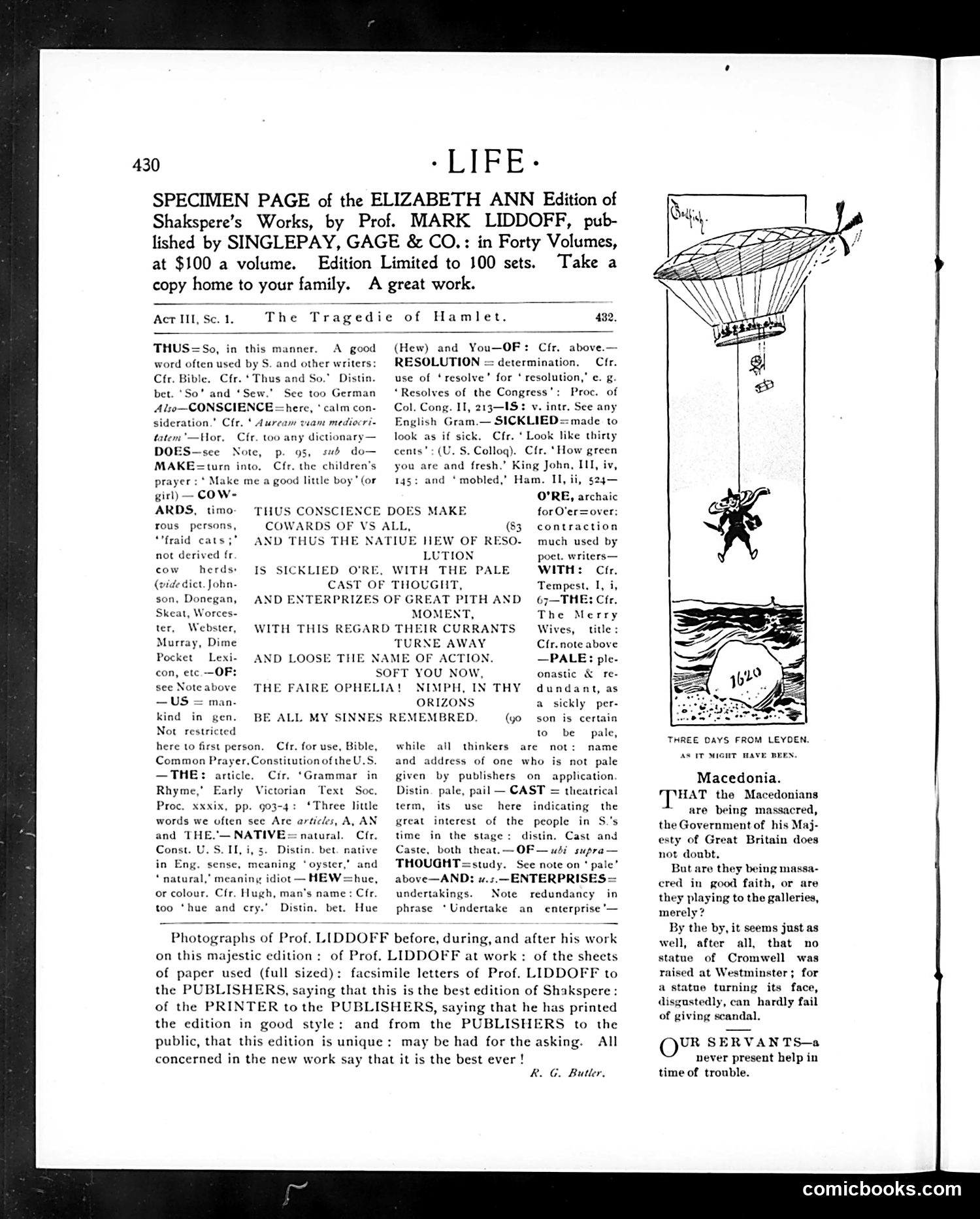
This is primarily an advertisement disguised as editorial content, satirizing overblown scholarly editions. Life mocks the "ELIZABETH ANN Edition" of Shakespeare by Prof. Mark Liddoff—a fictional, absurdly expensive ($100/volume, 40 volumes) scholarly work that exhaustively annotates even basic words like "thus" and "cow." The joke is the pedantic overkill: dozens of cross-references, etymologies, and tangential notes for elementary vocabulary, presented as if groundbreaking scholarship. The cartoons on the right appear unrelated: an airship, a falling figure, and an 1620 date marker. Below, a brief satirical piece titled "Macedonia" questions whether reported Macedonian massacres are genuine suffering or theatrical performance for public sympathy—likely referencing early 20th-century Balkan conflicts and skepticism about atrocity reports. The page satirizes both academic pretension and journalistic sensationalism.
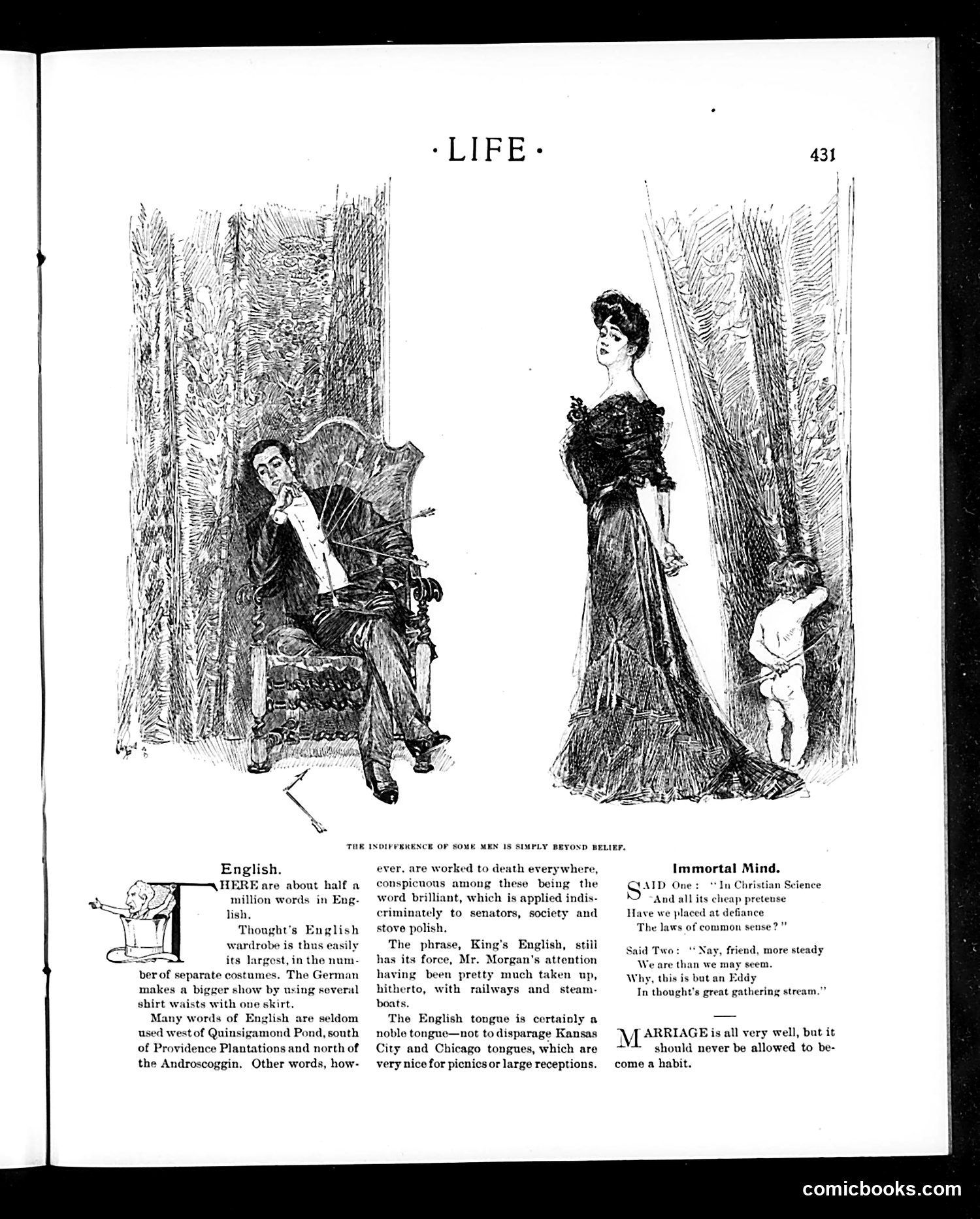
The top cartoon, captioned "The Indifference of Some Men is Simply Beyond Belief," depicts a man seated indifferently while a woman stands nearby with a child—satirizing male detachment from domestic or family responsibilities. The "English" section is a humorous essay mocking American regional speech and pretension. It jokes that English has "half a million words" but Americans overuse certain terms like "brilliant" (applied indiscriminately to senators, society, and stove polish). It also contains xenophobic jabs at German speakers and dismisses Kansas City and Chicago speech as suitable only for "picnics or large receptions." "Immortal Mind" appears to be satire of Christian Science's claim to transcend "common sense" through thought alone. The final aphorism mocks marriage becoming routine habit rather than a conscious choice. The page reflects early 20th-century American satirical magazine sensibilities: domestic comedy, linguistic snobbery, and gentle mockery of contemporary movements like Christian Science.
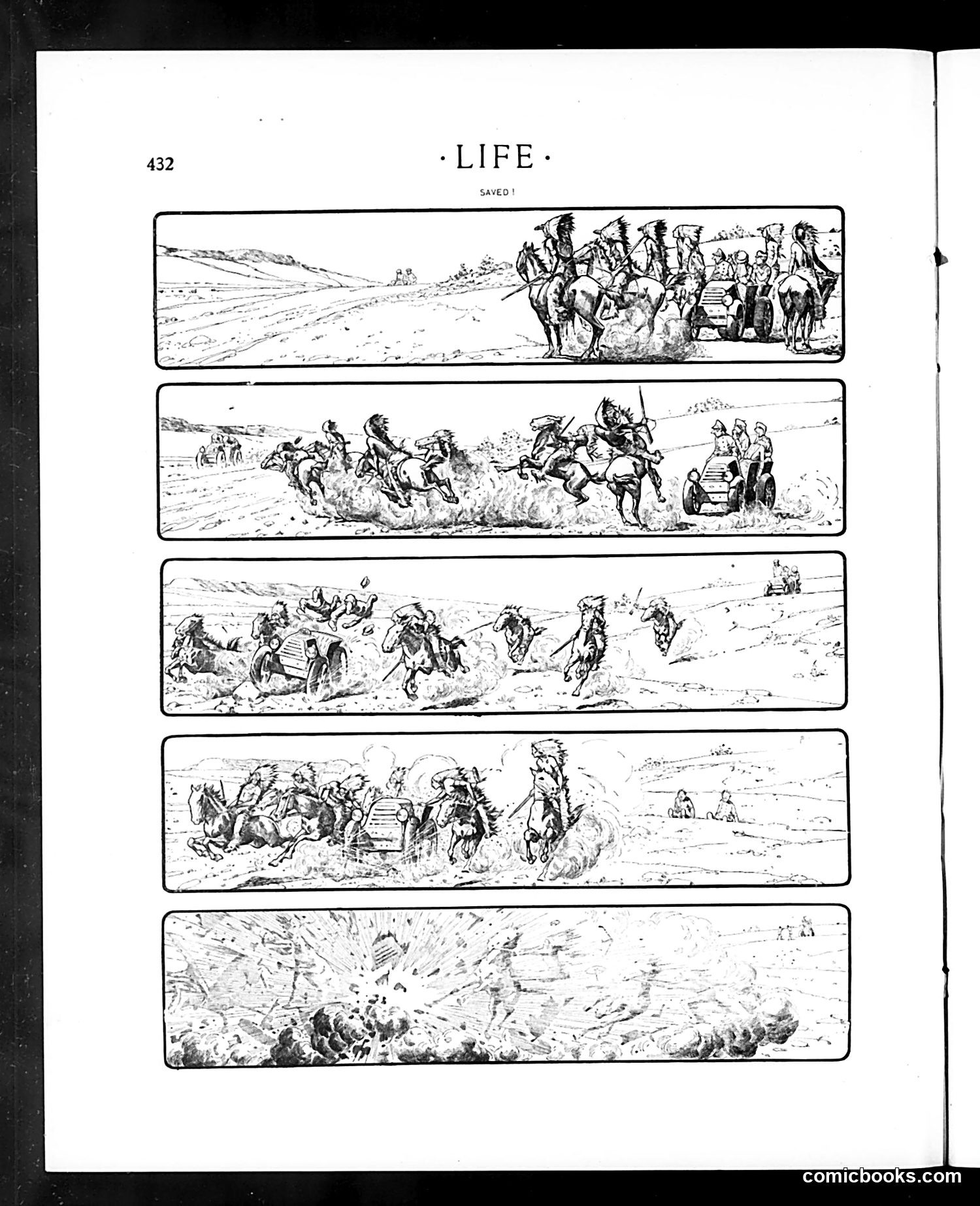
This page from *Life* magazine is titled "SAVED!" and consists of five sequential comic strip panels depicting what appears to be a Western narrative. The panels show a group of mounted riders pursuing across desert terrain, with what looks like a stagecoach or wagon being chased or rescued. Without additional context or caption text visible in the image, I cannot definitively identify which specific historical event, political figure, or social commentary this satirizes. The Western setting and "saved" title suggest either a narrative about rescue during frontier conflict or possibly satire of a contemporary political/military situation using Wild West imagery as metaphor. The OCR text only shows the website source, providing no interpretive information. More context would be needed to explain the specific satire intended.
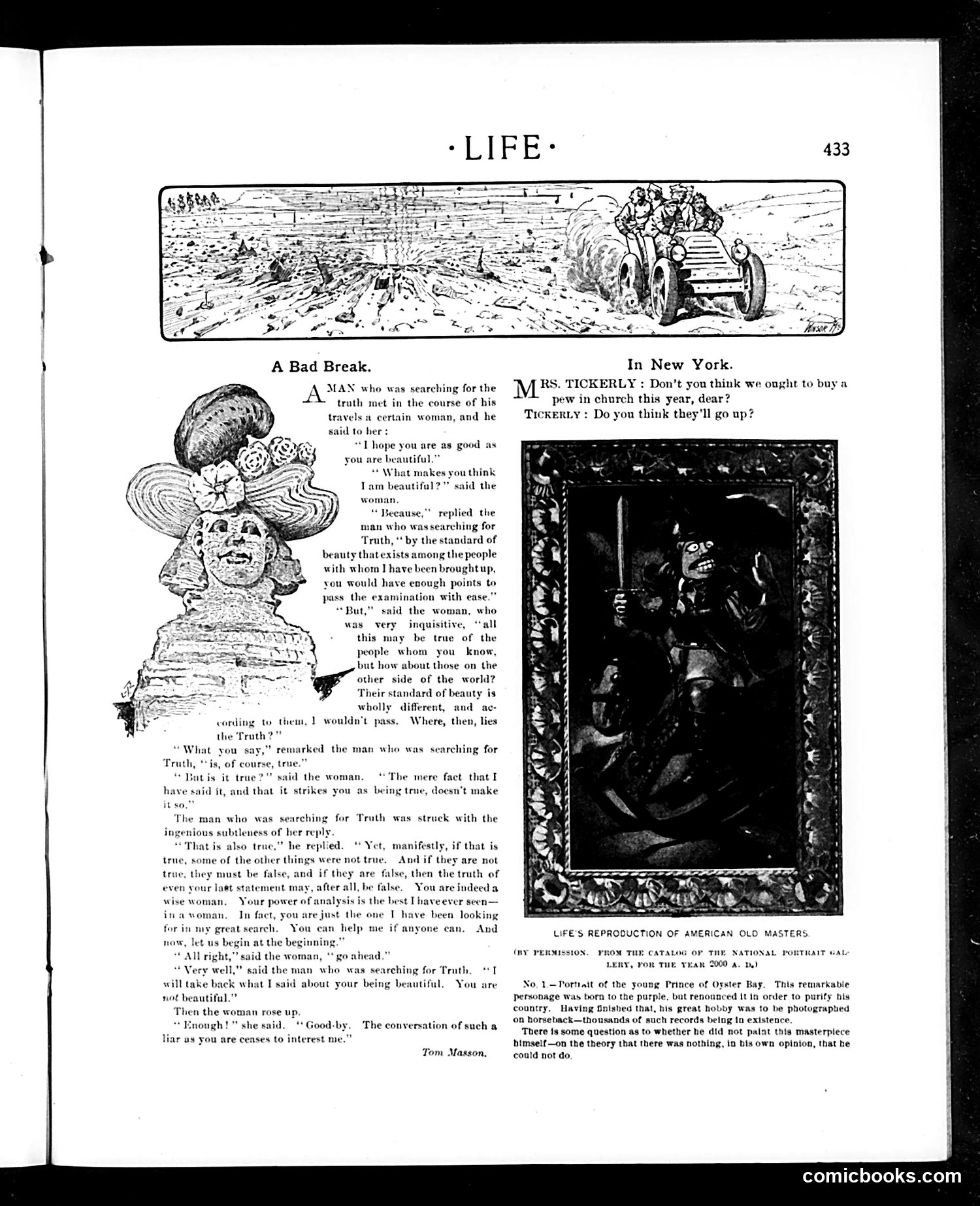
**"A Bad Break"** (left): A philosophical dialogue satirizing pedantic argumentation. A man searching for absolute "Truth" compliments a woman's beauty, then gets trapped in circular logic when she questions whether beauty standards are universal. The joke: his attempt to flatter backfires when she exposes the relativity of aesthetic judgment. He retreats by calling her "not beautiful," ending the conversation—the satire mocks how rigorous logical debate can destroy social pleasantries. **"In New York"** (right): A brief joke about wealthy New Yorkers' materialism. Mrs. Tickerly asks about buying a church pew; Mr. Tickerly responds by asking if pew prices will "go up"—treating religious participation as a financial investment rather than spiritual commitment. The satire critiques treating church membership as a commodity. **The Old Masters reproduction** references an apparent caricature of Theodore Roosevelt ("Prince of Oyster Bay"), mocking his vanity and tendency toward self-promotion through constant photography and his conviction that he excelled at everything.
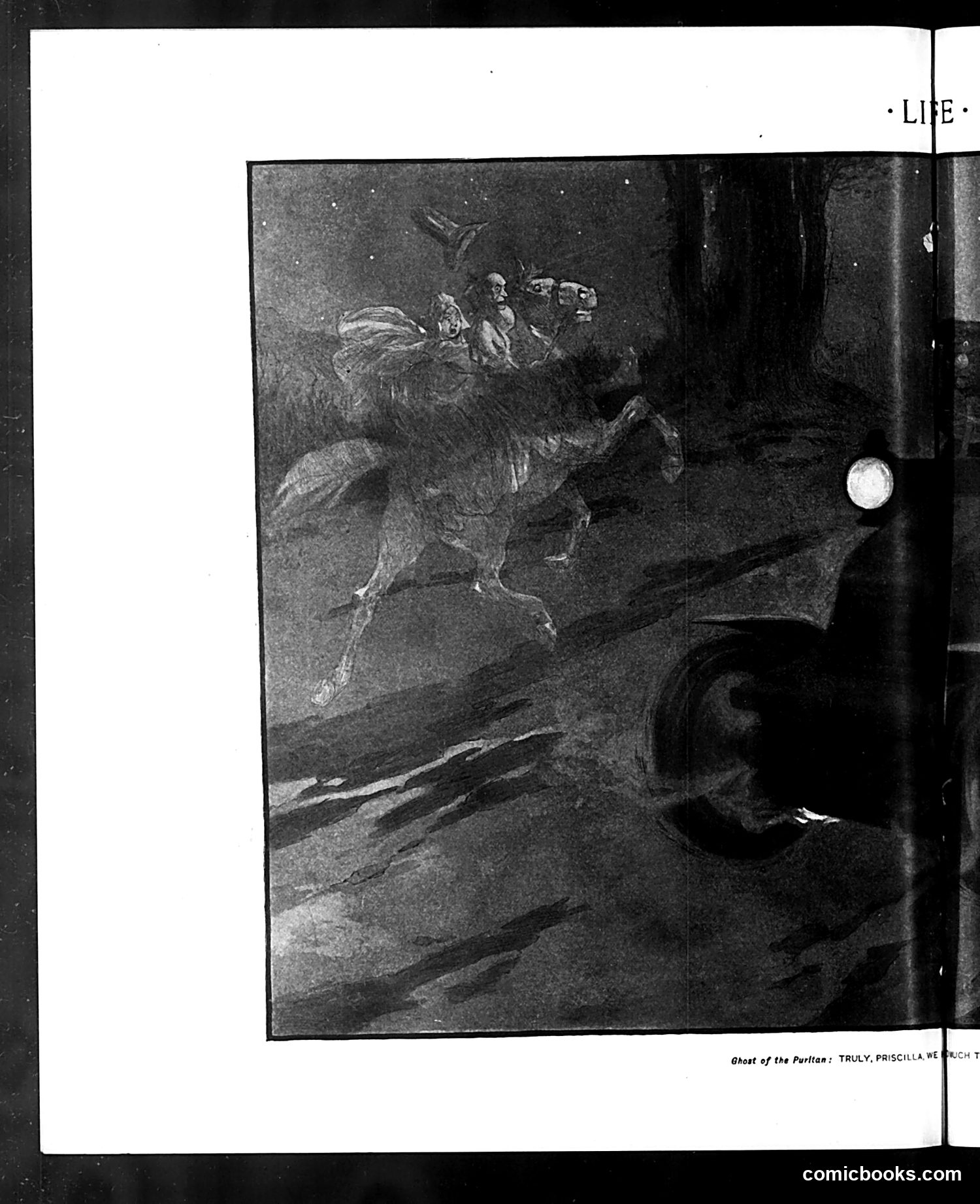
This appears to be a satirical illustration titled "Ghost of the Puritan," referencing the historical Puritan settlement at Plymouth (invoking Priscilla Mullins, a Mayflower passenger). The image shows a supernatural figure on horseback, seemingly disapproving of something below—likely representing how modern America has departed from strict Puritan moral values. The incomplete OCR text suggests commentary on contemporary social behavior that would shock the original Puritans. Without the full caption, the exact target of satire is unclear, but Life magazine frequently used this device—invoking America's founding religious principles to critique current permissiveness in entertainment, fashion, or social conduct during the early-to-mid 20th century. The ghostly Puritan serves as a moral authority figure, implicitly judging modern society's choices.

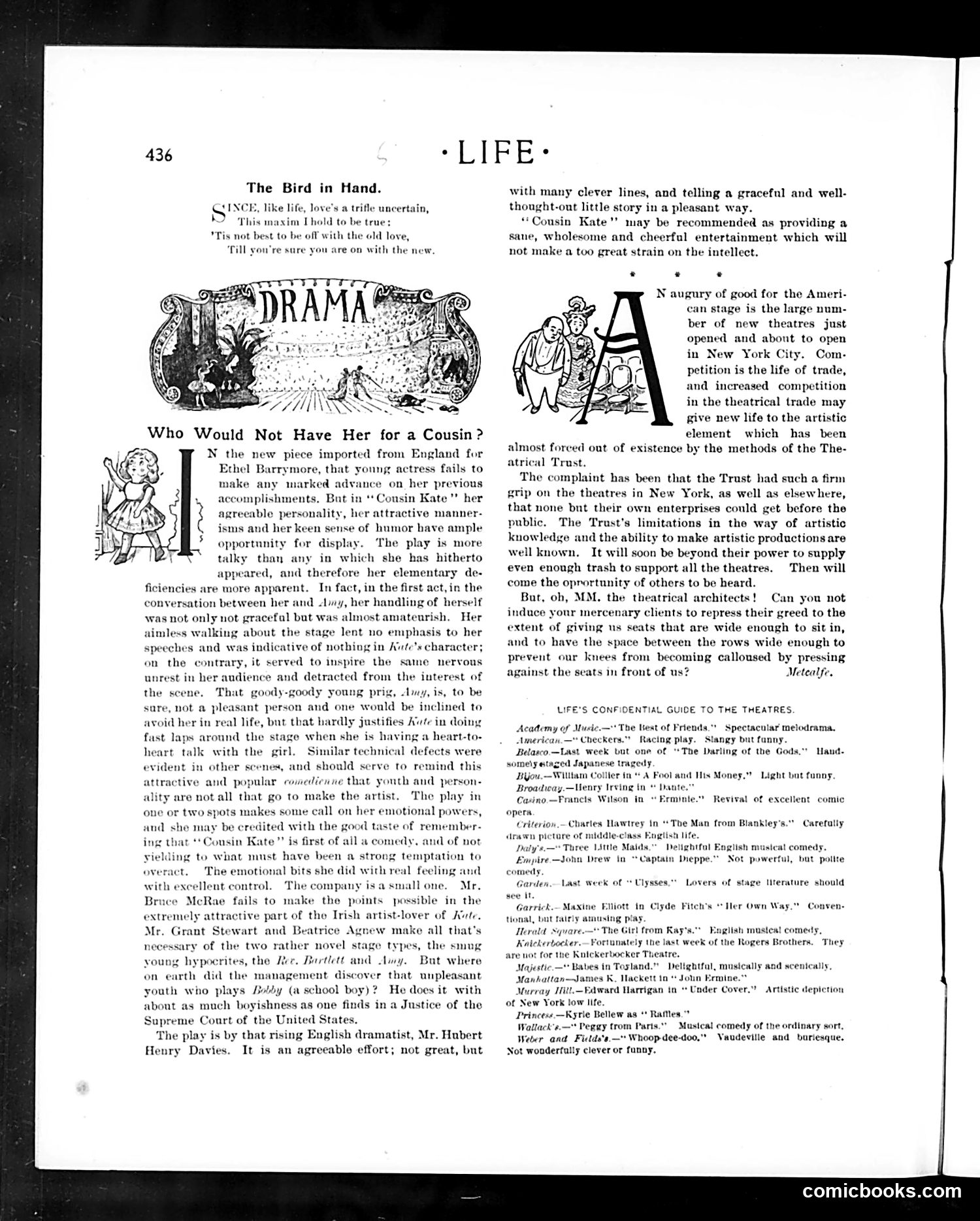
This page reviews the English import "Cousin Kate," starring actress Ethel Barrymore. The critic praises the play's pleasant story and clever dialogue but criticizes Barrymore's performance—particularly her awkward stage movement and "amateurish" handling in early scenes, suggesting she relies too much on personality rather than genuine artistry. The second section celebrates the opening of new theaters in New York City, arguing this breaks the stranglehold of the "Theatrical Trust" (a monopoly controlling theatrical venues). The critic argues competition will force higher artistic standards beyond the Trust's typical "trash," though he humorously complains that theater architects are gouging clients with expensive seating designs. The satirical point: theatrical monopolies suppress artistry; competition improves quality—a Progressive Era argument against corporate consolidation applied to entertainment.
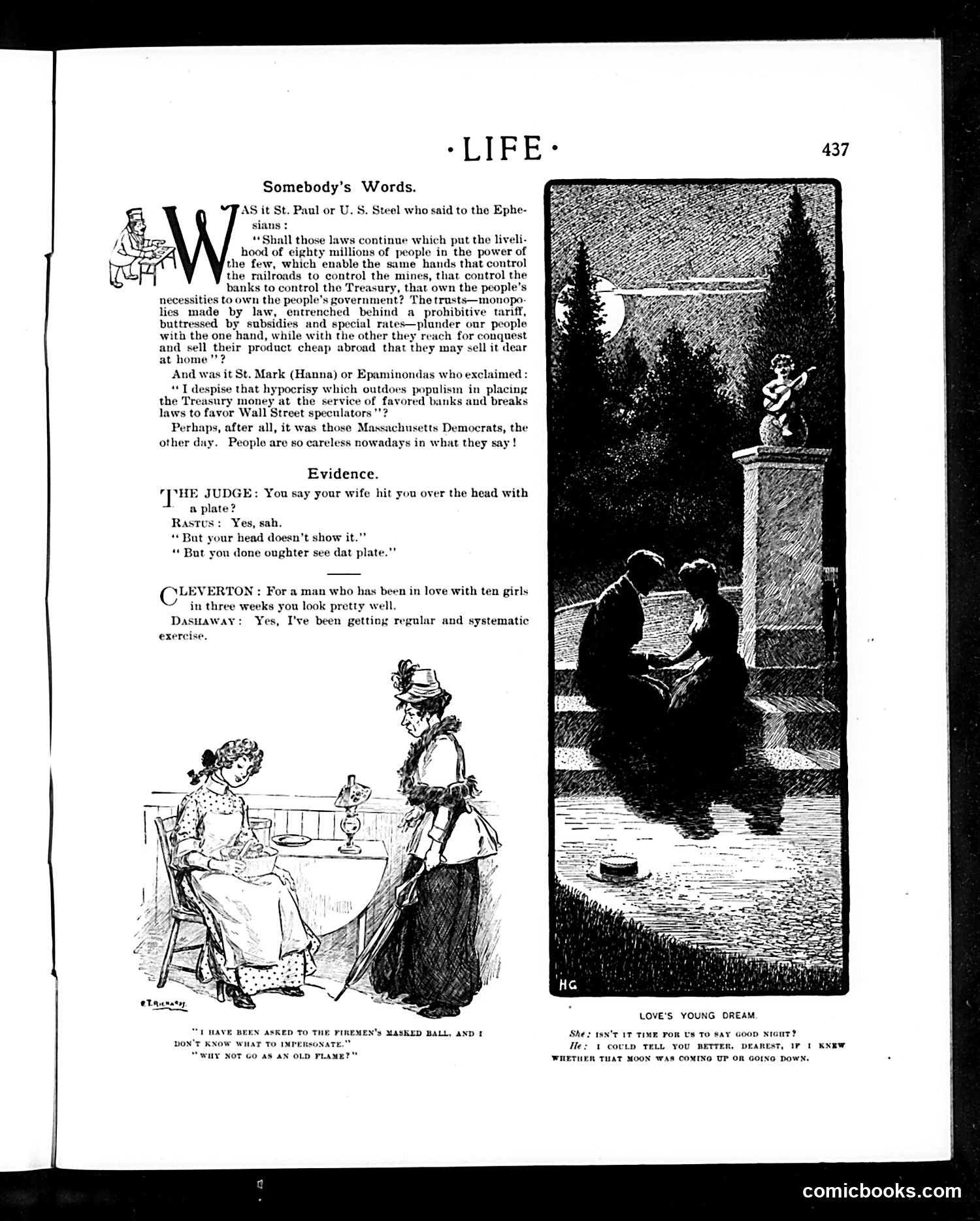
This page contains early 20th-century American satirical content. The lead article "Somebody's Words" mocks wealthy industrialists and trust monopolies by sarcastically attributing anti-trust rhetoric to them. It references St. Paul, "St. Mark (Hanna)" (likely Mark Hanna, a prominent Republican political operative), and Massachusetts Democrats—treating their words ironically, suggesting the wealthy contradict their own stated principles through actions benefiting banks and corporate interests via tariffs and subsidies. The three comic vignettes below use wordplay and visual humor typical of the era: 1. **"Evidence"**: A judge dismisses domestic violence claims because the victim lacks visible injury—humor from the absurdity. 2. **"Firemen's Ball"**: Wordplay on "old flame" (romantic past vs. actual fire). 3. **"Love's Young Dream"**: A romantic couple's moment interrupted by astronomical ignorance—gentle mockery of sentimentality. The page balances sharp political critique with lighthearted social humor.
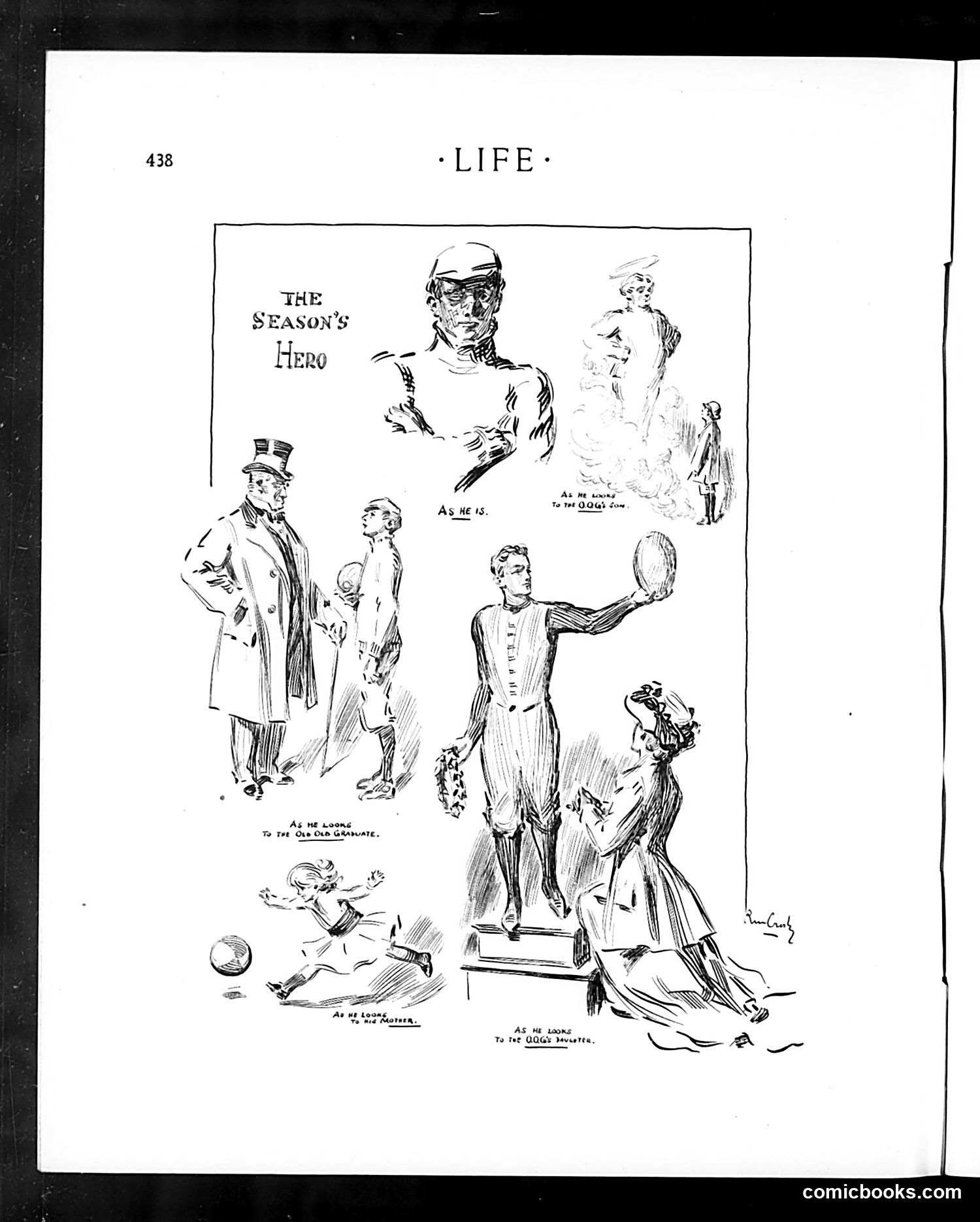
This page presents a satirical sketch collection titled "The Season's Hero," showing various figures labeled with captions like "As he looks to the old graduate," "As he is," and "As he looks to the village maidens." The central figure appears to be a young man in athletic wear holding a ball, depicted in multiple poses representing how different audiences perceive him. The surrounding sketches—including a man in a top hat, children, and admiring women—suggest this celebrates someone of temporary social prominence, likely a sports star or college athlete. The satire mocks the inflated public perception and hero-worship of this seasonal celebrity, contrasting his actual self with idealized versions projected by various social groups. The caricatured admirers emphasize how public figures are constructed differently depending on their audience's perspective and aspirations.
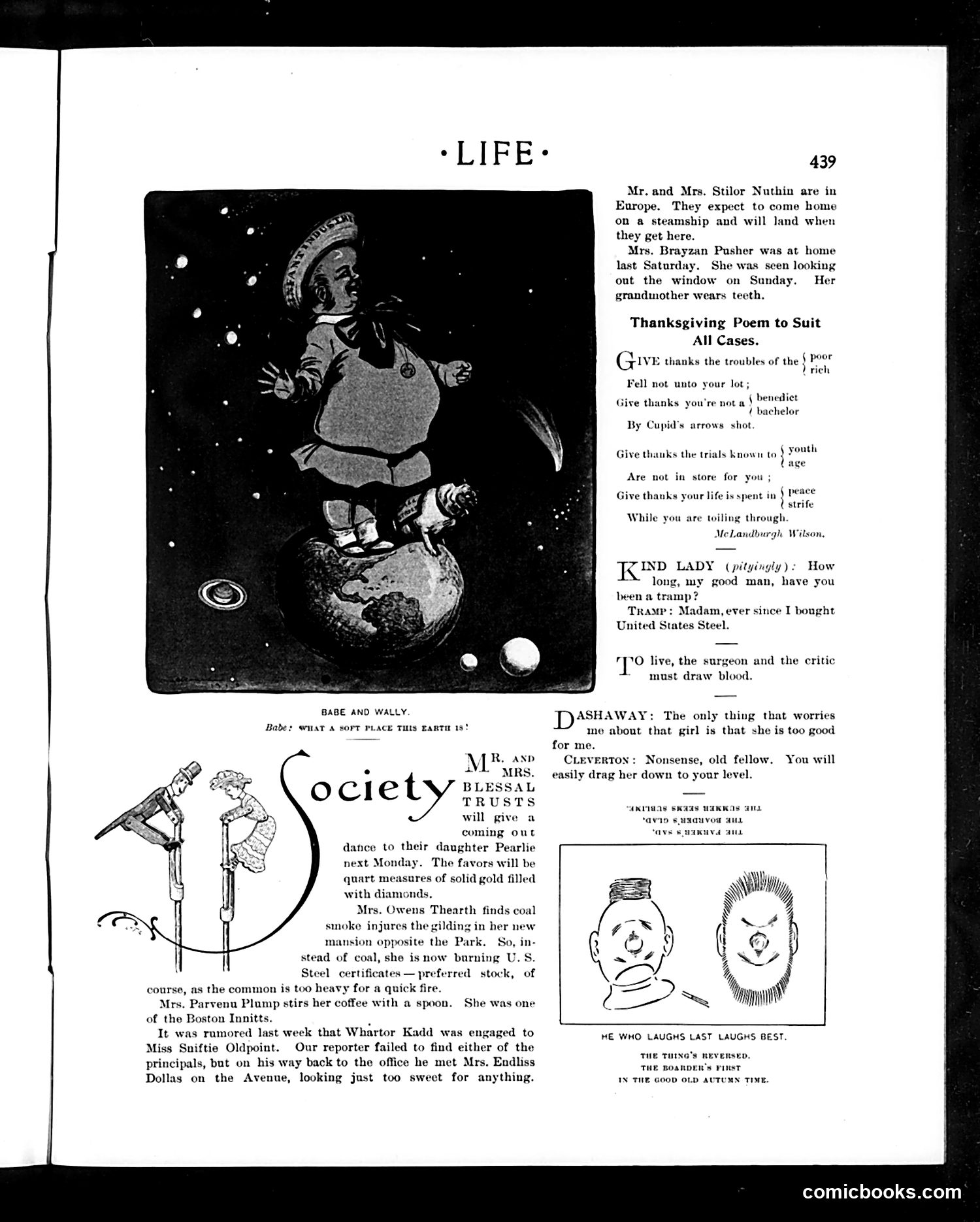
This page mocks wealthy American society and nouveau-riche pretension. The "Babe and Wally" cartoon shows a baby marveling at Earth's softness—likely satirizing the sheltered, frivolous concerns of the rich. The "Society" section parodies absurd wealthy behavior: Mrs. Thearth burns U.S. Steel stock certificates instead of coal to avoid smoke damage to her mansion's gilding; Mrs. Parvenu Plump stirs coffee with a spoon (suggesting affected manners); wealthy families give extravagant debutante balls with gold-filled favors. The "Thanksgiving Poem" offers ironic verses for "all cases"—rich and poor alike—suggesting hollow gratitude across class lines. The tramp joke plays on 1920s financial anxiety: a man became homeless after investing in U.S. Steel, once considered the safest investment. Overall, the page satirizes both nouveau-riche excess and the fragility of wealth, targeting American high society's superficiality and economic precariousness during the prosperous but unstable 1920s era.
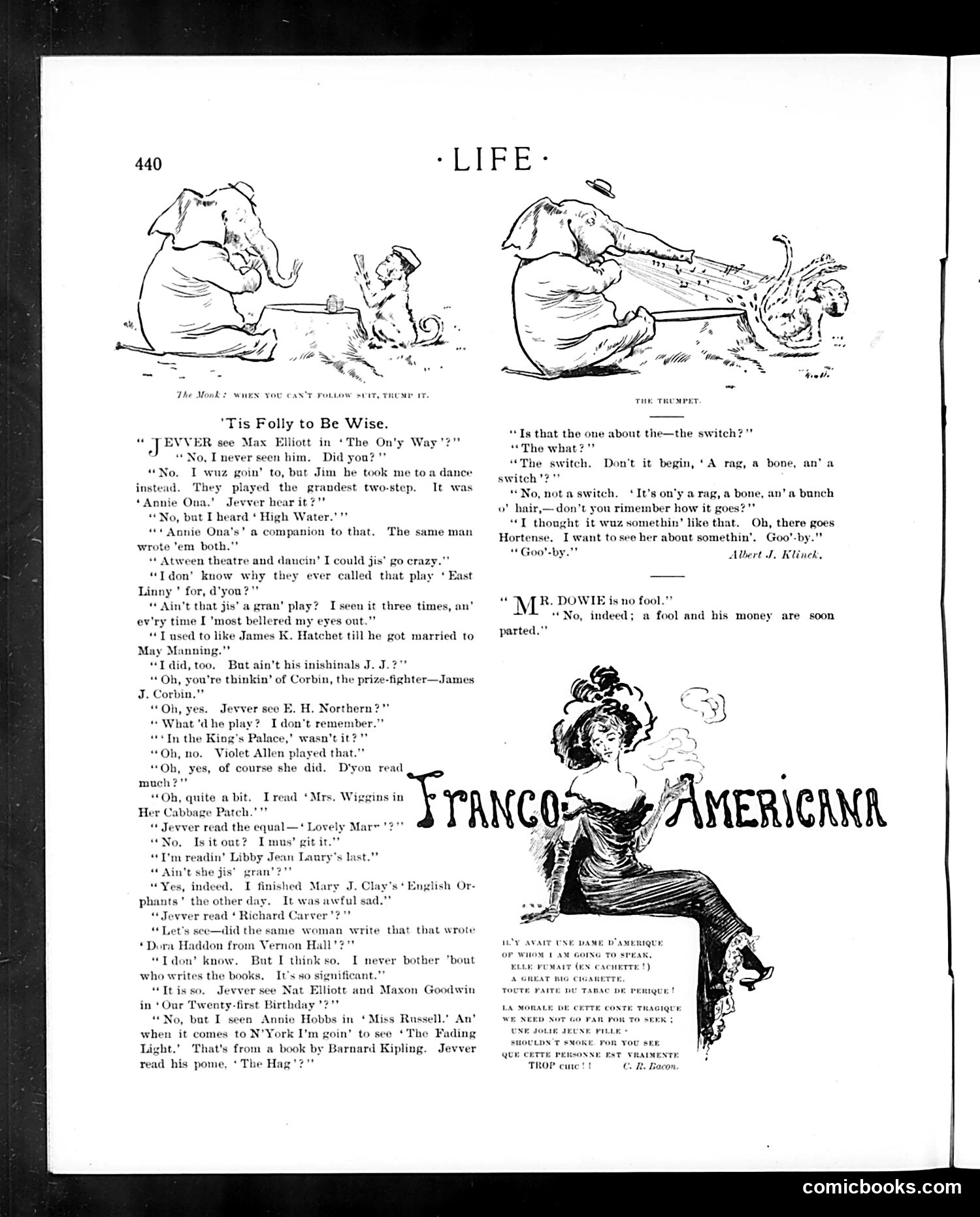
This page satirizes American popular culture of the early 1900s through two cartoons and accompanying dialogue. **"'Tis Folly to Be Wise"** depicts two women gossiping about theater and literature, repeatedly confusing names, titles, and details. The satire targets the pretentiousness of casual theatergoers and readers who discuss cultural works without actually understanding them—mixing up actors (Max Elliott, James K. Hatchet), plays (mixing "The Only Way" with dance halls), and books (conflating popular authors). The joke mocks how people performatively discuss culture to appear cultured. **"The Trumpet"** shows similar confusion about a song, with characters misremembering its opening lyrics ("a rag, a bone, and a switch" versus the actual "rag, a bone, and a bunch of hair"). The **"Tango Americana"** section at right appears to be satirical commentary on dance crazes and their moral concerns—the French text suggests contemporary anxieties about the tango's propriety. Overall, the page satirizes American cultural pretension and the public's superficial engagement with entertainment.
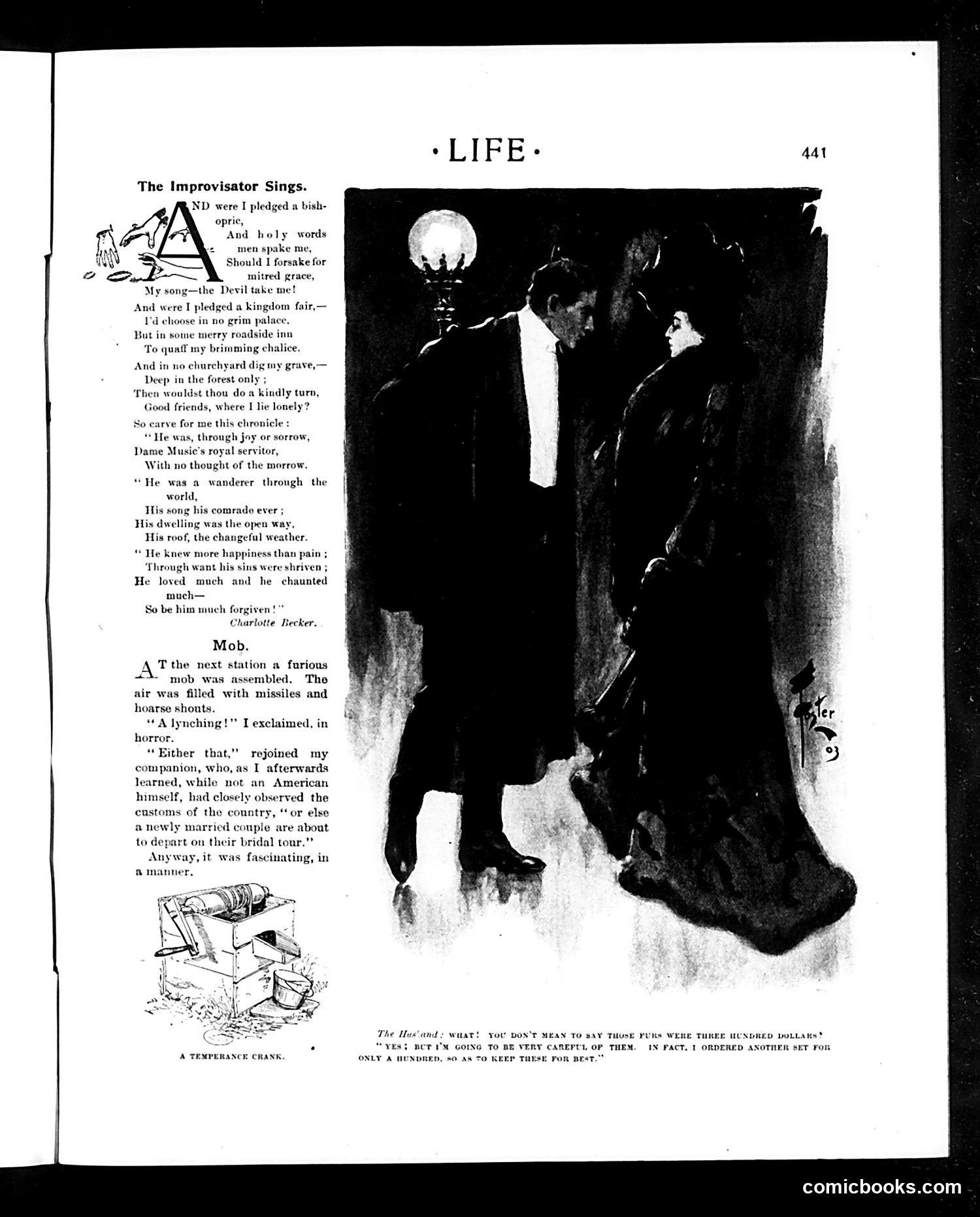
This page contains three separate satirical pieces: **"The Improvisator Sings"** (poem by Charlotte Becker): A romantic celebration of a wandering musician who chooses artistic freedom and tavern life over bishops' ranks and kingdoms, ultimately seeking forest burial rather than churchyard respectability. It mocks pretentious religious and social conventions. **"Mob"** (short narrative): Satirizes American social customs by presenting a scene where a narrator cannot distinguish between a lynch mob and a crowd celebrating newlyweds departing on their honeymoon—both apparently involving similar chaos and violence. This appears to be dark social commentary on American wedding customs and mob violence. **"A Temperance Crank"** (cartoon caption): A husband and wife discuss expensive furs; the wife reveals she ordered a *second set* (another hundred dollars worth) to preserve the first set. This mocks both excess consumption and the absurdity of hoarding luxury goods, while also satirizing the "temperance crank" type—moralistic do-gooders who ironically indulge in hypocrisy. All three pieces employ irony and exaggeration to critique social pretension and excess.
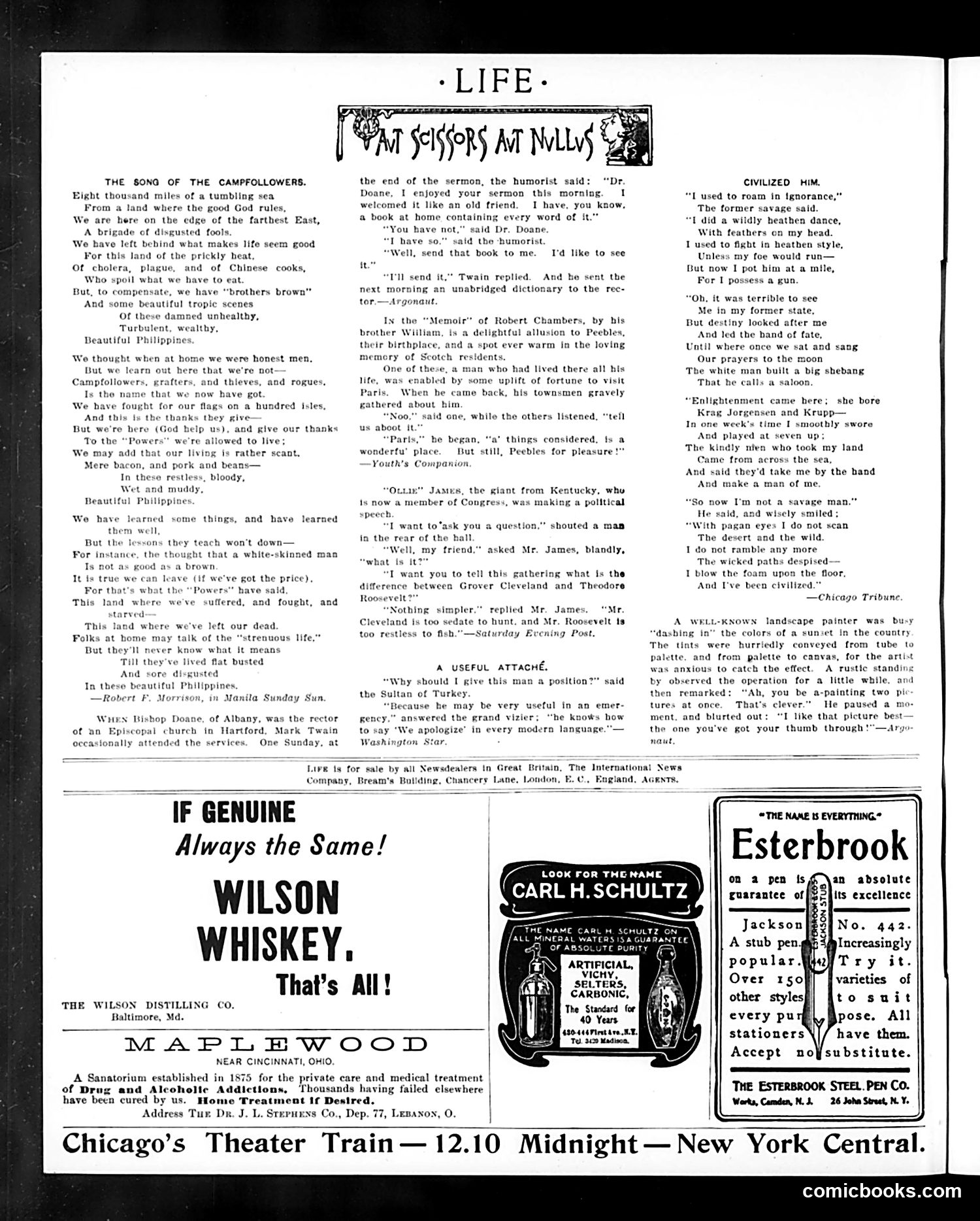
This page primarily contains **satirical poetry and humorous anecdotes** rather than political cartoons. The main content is "The Song of the Campfollowers," a poem criticizing American soldiers in the Philippines. It exposes the contradiction between idealistic claims about the "strenuous life" and colonial mission versus the soldiers' actual experience: disease, poor food, moral corruption ("grafters and thieves"), and senseless suffering. The poem sarcastically praises "Beautiful Philippines" while detailing its horrors. The other pieces are brief humor items mocking: - **Mark Twain's retort** to a bishop (dictionary as reply) - **Dialect humor** about a Scotsman visiting Paris - **Political joke** distinguishing Cleveland (sedate) from Roosevelt (restless) - **Ottoman satire** about diplomatic apologies The overall page reflects **anti-imperialist sentiment** common in American satirical magazines of the Philippine-American War era (1899-1902), questioning the moral justification for overseas military intervention.
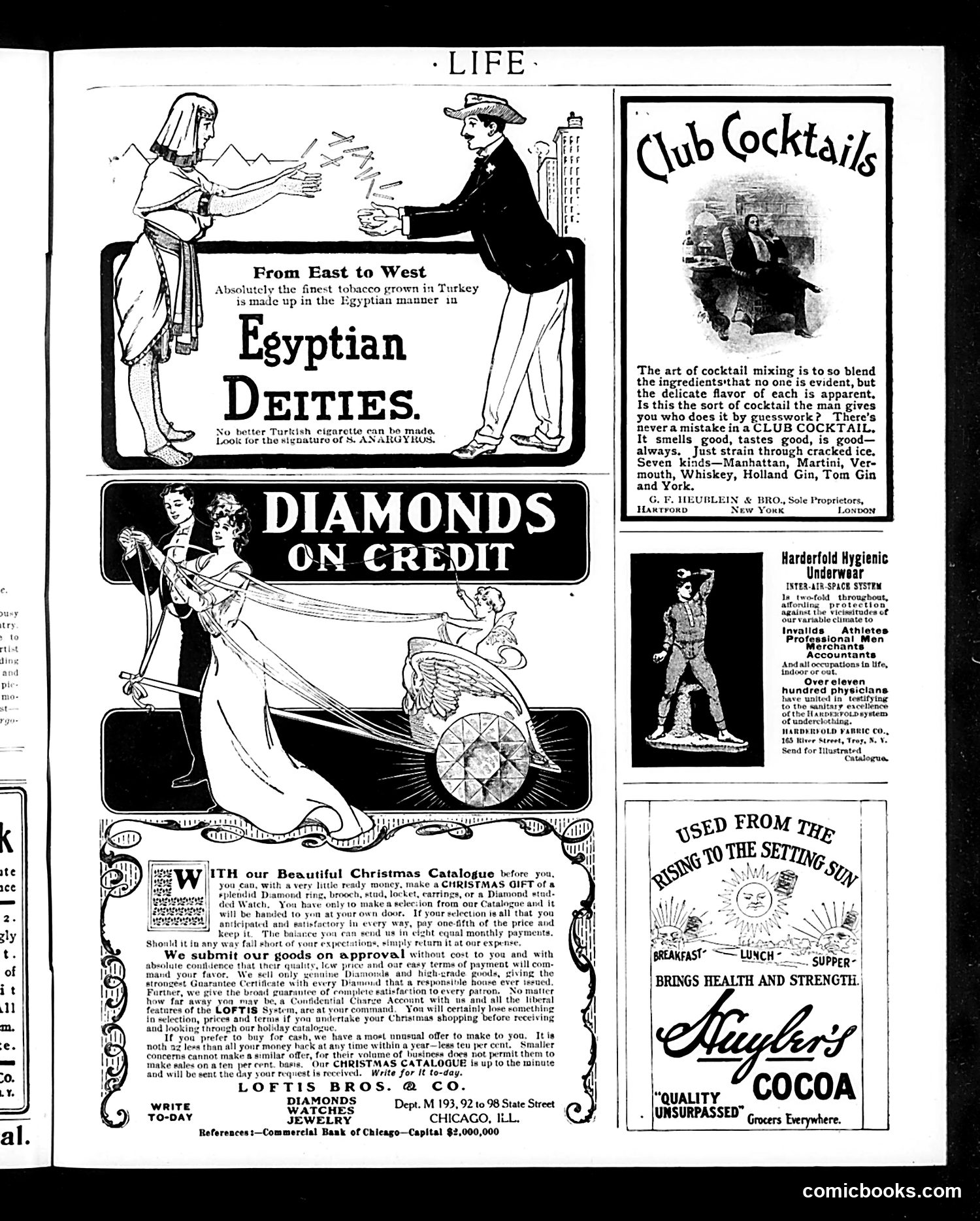
This page is primarily **advertising**, not satirical content. The cartoons serve as commercial illustrations rather than political commentary. The top cartoon depicts a Turkish/Egyptian figure offering cigarettes labeled "Egyptian Deities" to a Western man—a common advertising trope playing on exotic "Oriental" appeal to sell tobacco products. The "Diamonds on Credit" illustration shows a couple in formal dress with an angel figure, using romantic imagery to market jewelry on installment plans. The remaining advertisements promote cocktail mixing kits, underwear, cocoa, and a mail-order diamond business offering payment plans. The **social context**: Early 1900s consumer culture emphasized installment buying as new and appealing. Advertisers used orientalist imagery and romantic fantasy to market luxury goods. The Club Cocktails ad suggests cocktail culture was becoming mainstream American entertainment. This reflects pre-WWI American consumer capitalism and advertising's growing sophistication in creating desire through imagery rather than product information alone.
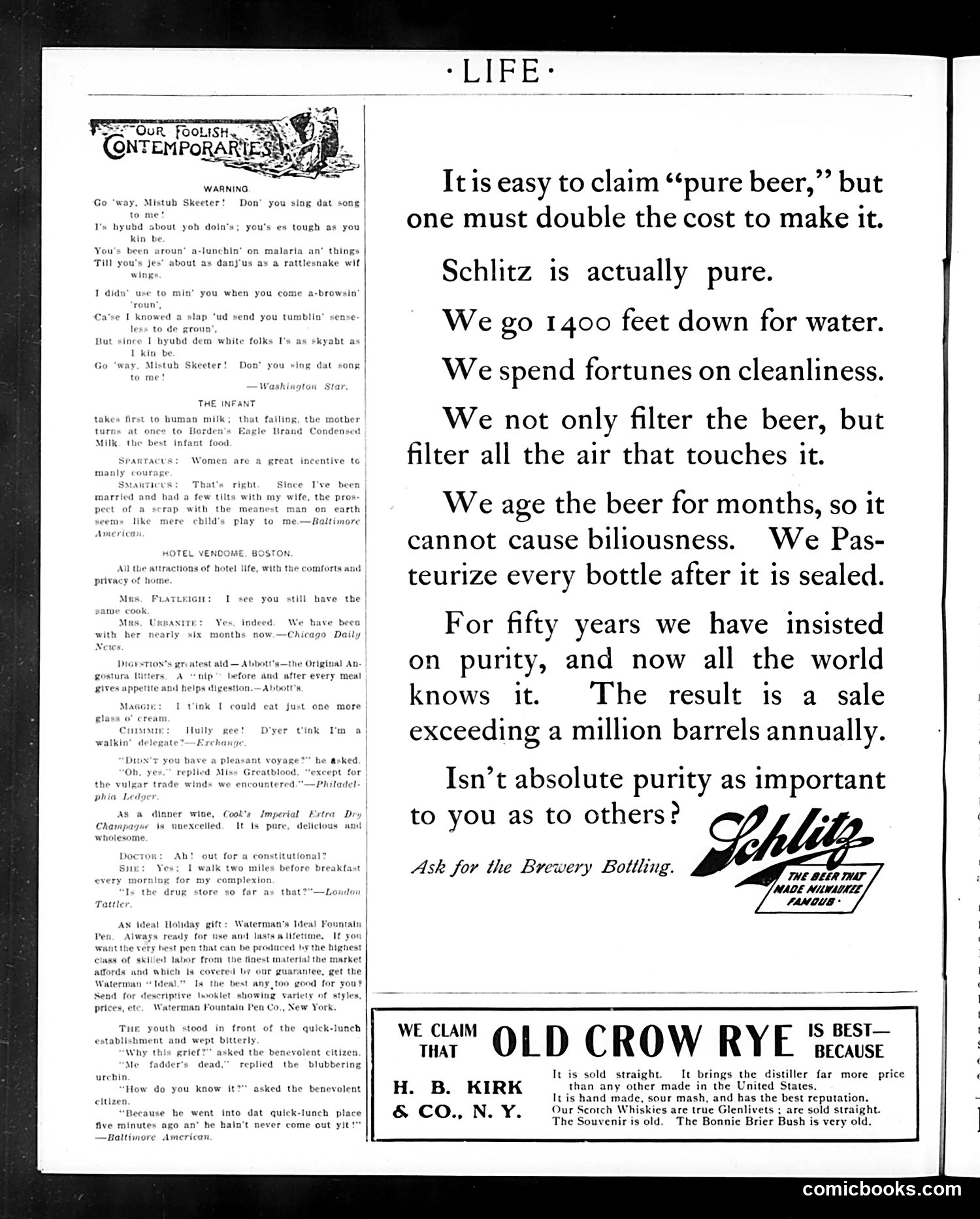
This page contains **primarily advertisements** for beer and whiskey, with a small satirical comic strip in the upper left. **The Comic Strip ("Our Foolish Contemporaries"):** A brief dialogue between two characters—"Mistub Sketer" and another speaker—appears to mock someone's affected or pretentious speech patterns and behavior. The humor targets dialect and social affectation, typical of Life's satirical approach to contemporary social types. **The Advertisements:** The dominant content consists of three ads: **Schlitz beer** (center), emphasizing purity through deep-well water, filtration, and pasteurization; **Old Crow Rye whiskey** (bottom right); and smaller alcohol ads. These ads are notable for making detailed **purity and quality claims**—suggesting these were competitive selling points in early 20th-century alcohol marketing, likely during or shortly before Prohibition concerns. The page reflects an era when magazines blended entertainment with commercial content, and when alcohol manufacturers actively advertised product "purity" as a premium feature.
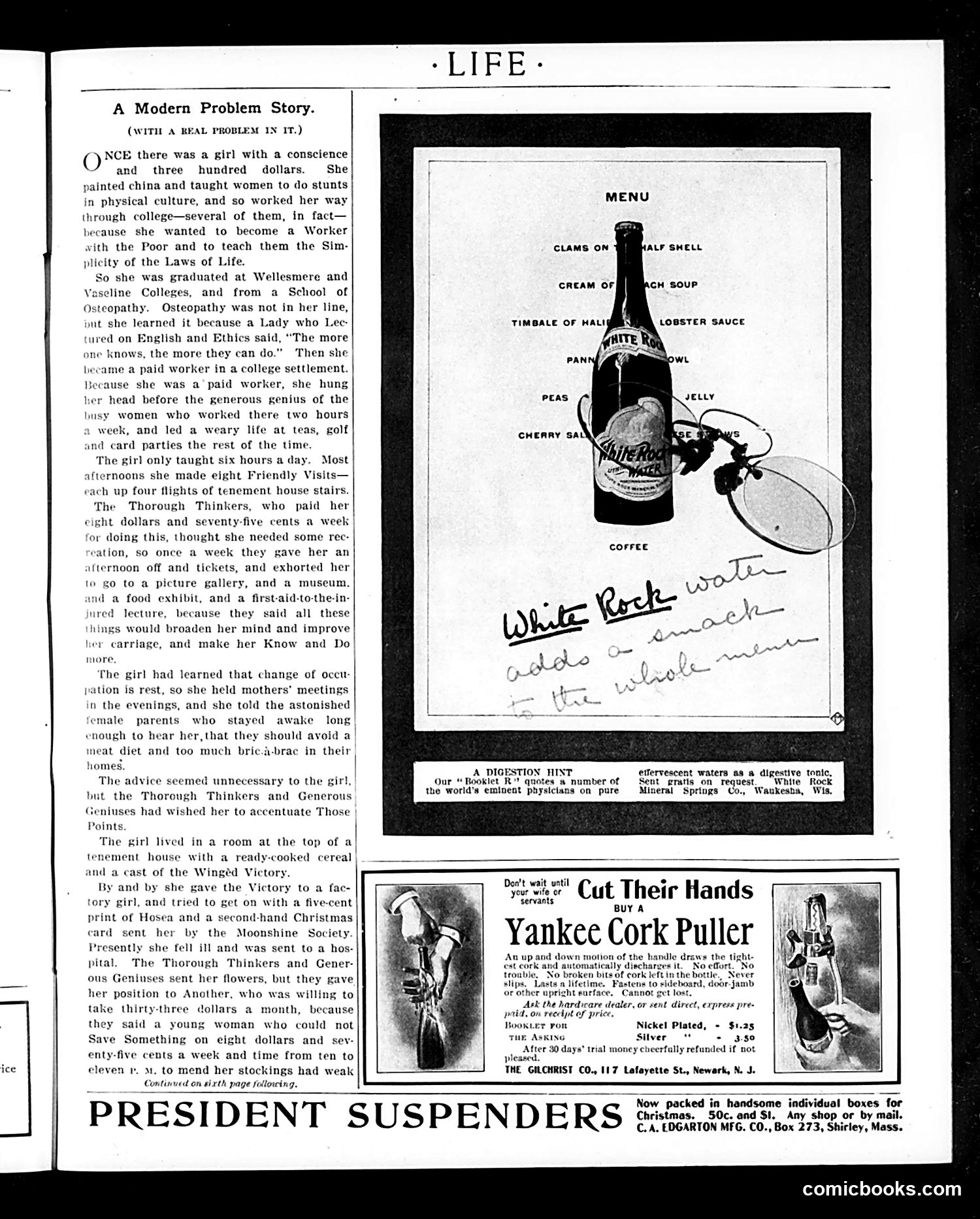
This satirical story critiques the contradiction between Progressive-era idealism and economic reality. The unnamed protagonist is a well-educated, conscientious young woman who sacrifices to work with the poor—yet her employers, wealthy "Thorough Thinkers and Generous Geniuses," pay her only $8.75 weekly while expecting her to live ascetically and improve her mind through unpaid cultural activities (museums, lectures). The satire's point: these privileged patrons expect her to survive on pittance while they work only two hours weekly, then blame her for falling ill and being unable to save money. When she becomes sick, they replace her with someone willing to accept even less ($33/month). Life magazine is mocking the hypocrisy of Progressive reformers who champion "the Laws of Life" and helping the poor while exploiting their own workers through inadequate wages and moral pressure to constantly self-improve. The accompanying advertisements for White Rock water and other luxury goods underscore the magazine's ironic contrast between the heroine's poverty and the consumer culture surrounding her.
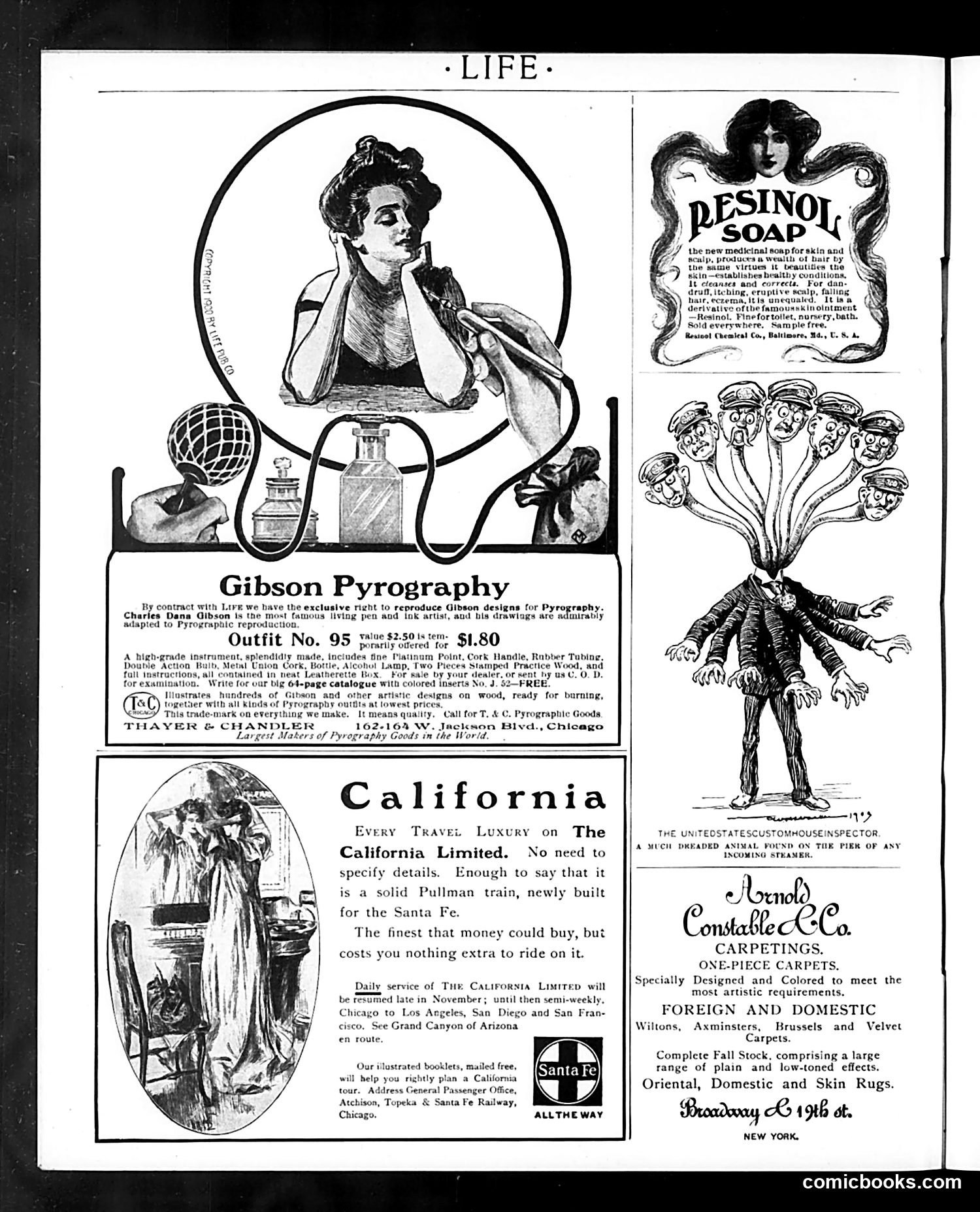
This page is primarily **advertising**, not political satire. It contains four commercial advertisements: 1. **Gibson Pyrography** (top left): Promotes a wood-burning art kit featuring designs by Charles Dana Gibson, the famous illustrator of the "Gibson Girl." The kit allows consumers to reproduce his artwork. 2. **Resinol Soap** (top right): Advertises a medicinal soap claiming to cure scalp and hair problems. 3. **California Limited** (center-bottom): Santa Fe Railway promotes its luxury Pullman train service to California destinations. 4. **Arnold Constable & Co.** (bottom right): Department store advertisement for carpets and rugs, featuring a small satirical cartoon of a U.S. Customs House Inspector discovering a "dreaded animal" at the pier—likely a humorous jab at bureaucratic absurdity. The page reflects early 20th-century consumer culture, with Gibson's artistic celebrity being leveraged for commercial products. The sole satirical element is the minor customs inspector cartoon.
This page is primarily **advertising** with no political cartoons or satirical content. The ads feature financial institutions and consumer products typical of early 20th-century America: steamship travel to Jamaica by United Fruit Company (naming ships after American naval admirals Dewey, Schley, Sampson, Farragut); stock brokers and trust companies (Morton Trust, Guaranty Trust, Wassermann Brothers); and consumer goods (Evans Ale and Dr. Jaeger underwear with "science" marketing claims about health benefits). The only visual elements are product illustrations and a steamship engraving. The page reflects period commercial interests—tropical tourism, financial services, and patent medicine-style health product promotion—with no satirical commentary visible. It's essentially a business-oriented section from Life magazine rather than its famous comedic or political content.
This is primarily an **advertising page** from an early 20th-century American magazine, not a satirical cartoon page. The page contains mostly commercial advertisements with one small illustrated story. The only narrative content is "Thrilling Adventures of the Washburn Babies"—a whimsical illustrated vignette showing children lost in the forest being calmed by Washburn musical instruments (mandolins and guitars). This appears to be a lighthearted advertisement for Washburn instruments, using the conceit that music can "soothe the savage breast" (a classical reference). The remaining content consists of genuine product advertisements: ranch partnerships, underwear, medications for gout and colds, train tickets to California, musical instruments, and corrugated cans. These reflect typical turn-of-the-century consumer goods and services aimed at middle-class readers. There is **no political satire or social commentary** evident on this page.
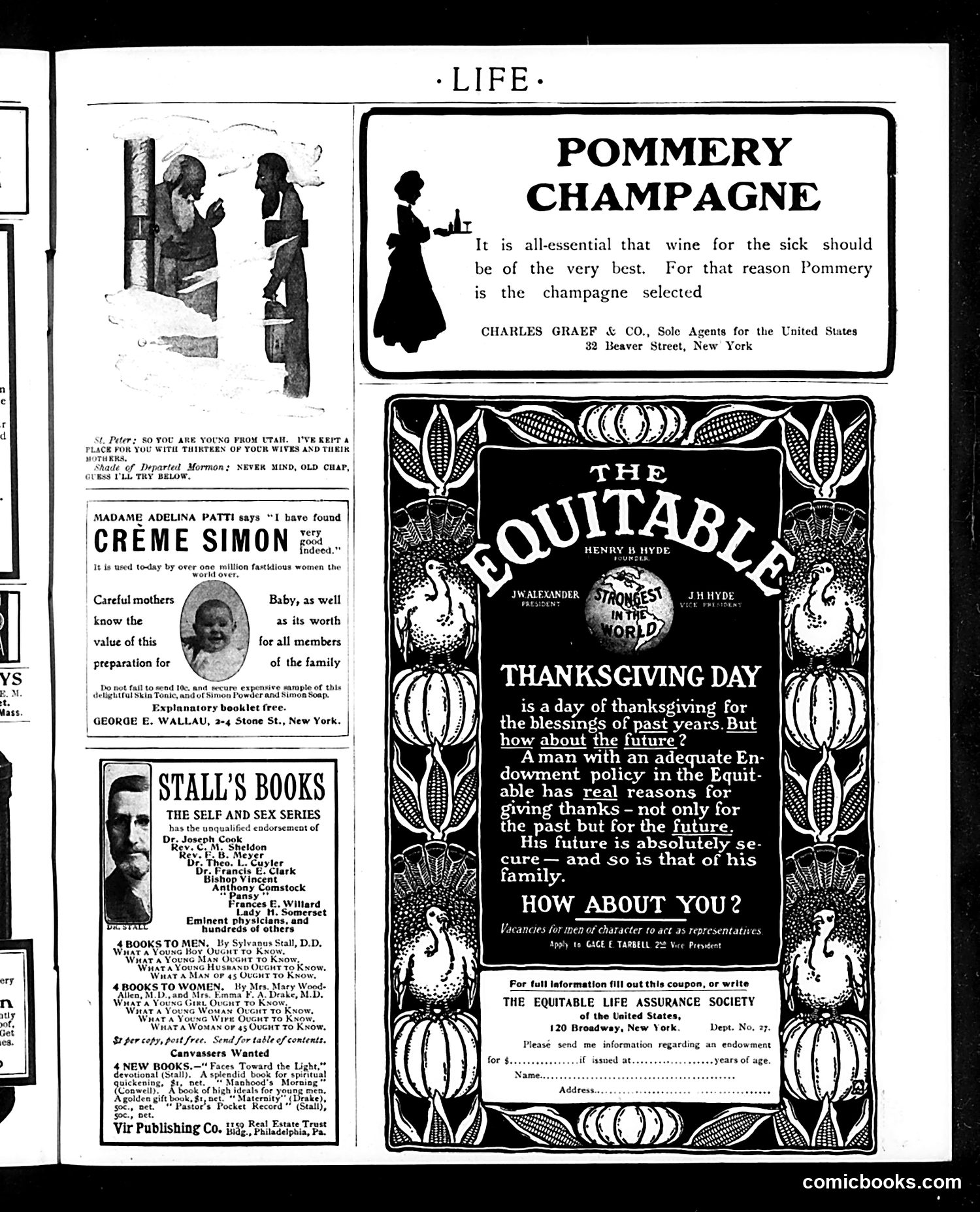
This page combines **satirical cartoons with period advertisements**, primarily aimed at early 20th-century American audiences. ## The Cartoon The top-left cartoon depicts **St. Peter at heaven's gate greeting a young Mormon man from Utah**. The joke references the *historical practice of polygamy among early Mormons*—St. Peter quips he has reserved a place for the man "with thirteen of your wives." A "shade of a departed Mormon" responds, suggesting even the afterlife accommodates polygamous arrangements. This satirizes the *notorious association between Mormonism and plural marriage*, a major point of social controversy and ridicule in mainstream American culture of this era. ## The Advertisements The remainder of the page contains typical period advertising: beauty products (Creme Simon), educational books on sexual/marital topics (Stall's Books), champagne, and life insurance. These reflect contemporary concerns about propriety, health, and family security. **Historical context needed**: Understanding this requires awareness that polygamy was deeply controversial and a defining characteristic of early Mormon identity in American public consciousness.
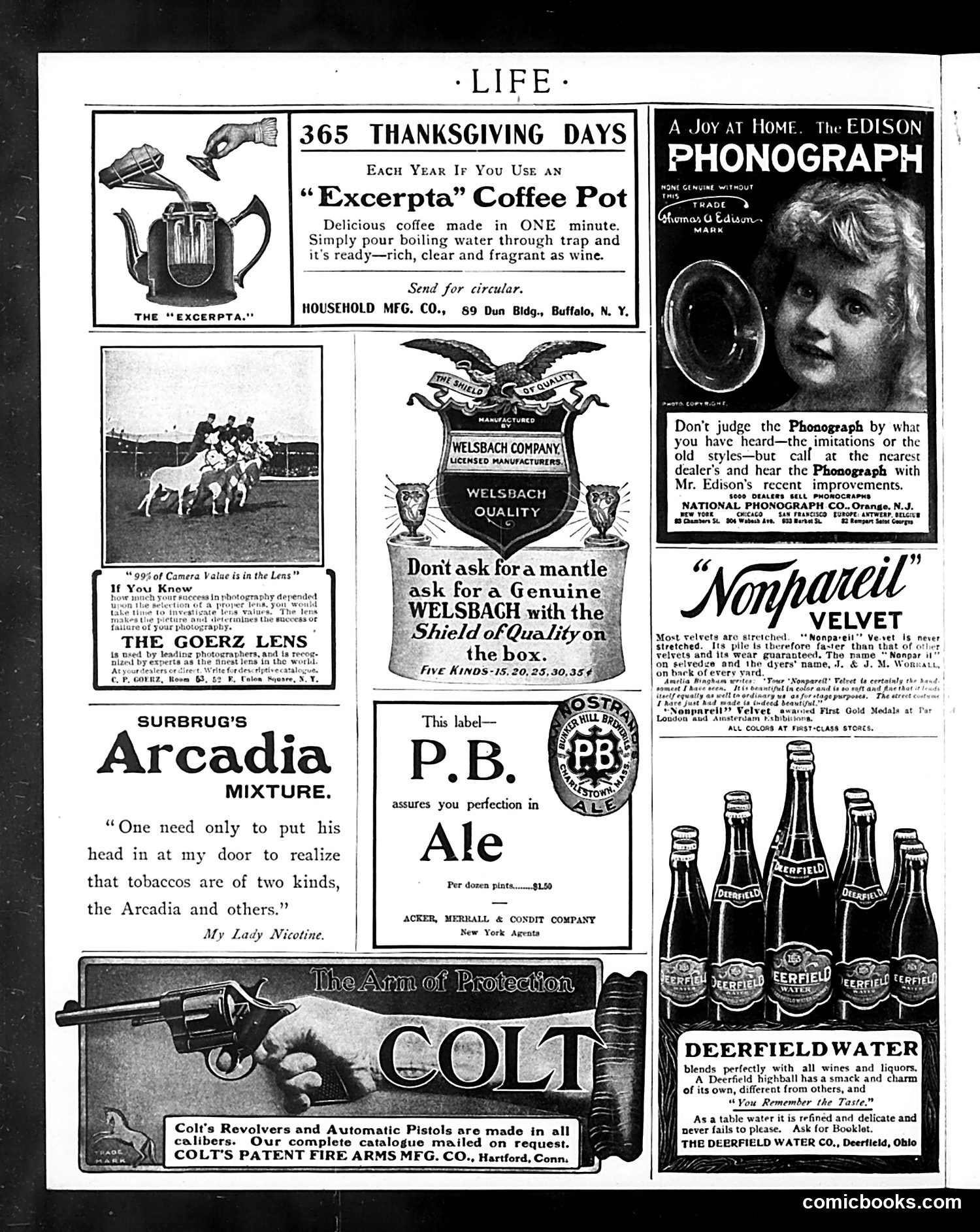
This is primarily an **advertising page**, not a satirical cartoon. It contains multiple product advertisements typical of early 20th-century American consumer magazines. The ads promote everyday household items: an "Excerpta" coffee pot (promising one-minute coffee), Edison phonographs (with a note dismissing inferior imitations), Welsbach gas mantles, Surburg's Arcadia tobacco mixture, P.B. ale, Colt revolvers, "Nonpareil" velvet fabric, and Deerfield bottled water. One small item uses mild satire: a quote attributed to "My Lady Nicotine" about tobacco types, personifying nicotine addiction as a refined woman—a common literary device of the era. The Colt advertisement emphasizes availability in multiple calibers, reflecting turn-of-the-century firearm marketing. **No political content is evident.** The page reflects consumer culture and brand-building in an era when Life magazine relied heavily on paid advertising, and manufacturers competed through detailed product claims and endorsements.
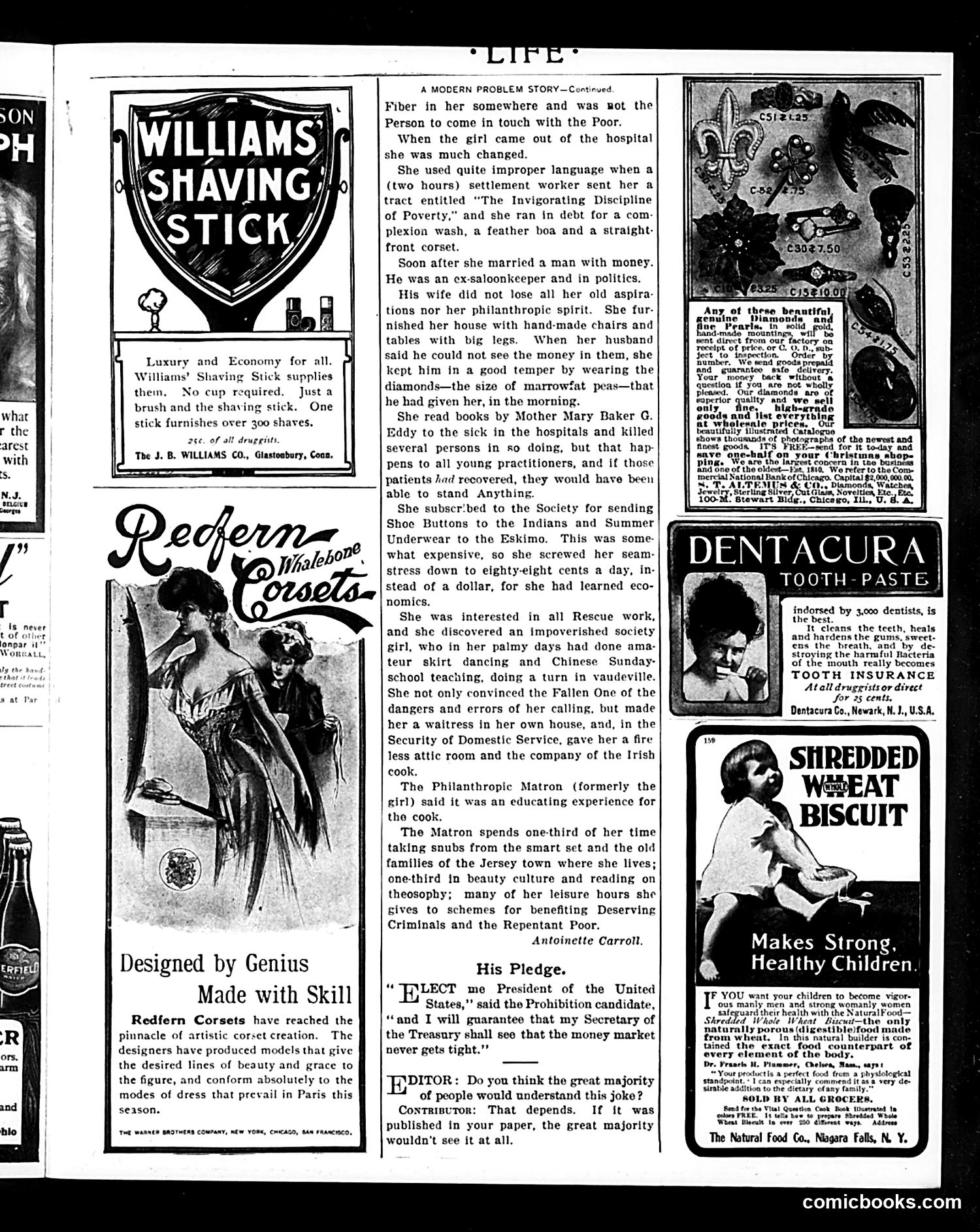
This page contains **"A Modern Problem Story"** — a serialized satire mocking upper-class philanthropic hypocrisy. The narrative follows a poor girl who, after hospitalization, becomes wealthy through marriage to a former saloonkeeper-turned-politician. Now a "Philanthropic Matron," she performs charity work while: - Underpaying her seamstress (88 cents instead of $1 daily) - Wearing expensive diamonds while preaching economy - Reading Mary Baker Eddy to hospital patients (implying Christian Science practice) - "Rescuing" a fallen chorus girl by relegating her to servant status in an attic room The satire targets wealthy women's performative charity—their self-righteous "rescue" efforts that reinforce class hierarchies rather than genuinely helping the poor. The protagonist embodies the contradiction: philanthropic in public gesture, exploitative in practice. The page also includes period advertisements (corsets, shaving products, tooth paste) typical of Life's format.
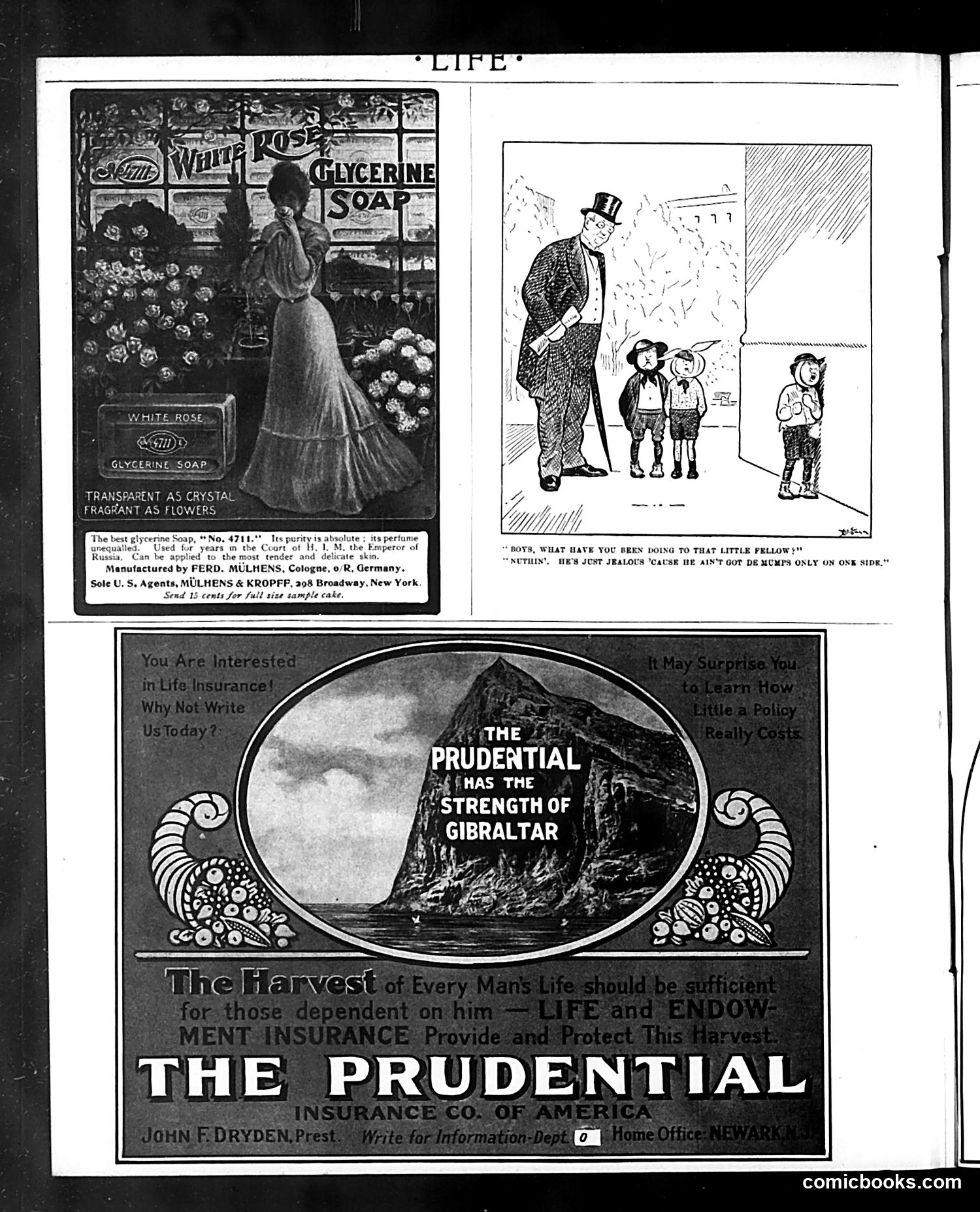
This page contains three distinct advertisements and one cartoon. **Top Left**: A soap advertisement for "White Rose Glycerine Soap" (No. 4711), manufactured in Germany. The ad shows a woman admiring flowers and uses luxury-language typical of early 20th-century cosmetic marketing. **Top Right**: A cartoon showing a well-dressed man in a top hat confronting children, with the caption about a boy being "jealous" because he's "not got the mumps only on one side." This appears to be simple humor about childhood ailments and sibling rivalry—no political content. **Bottom**: A full-page insurance advertisement for The Prudential Insurance Company, using the famous "Gibraltar" imagery (their corporate symbol meaning strength and stability). The ad appeals to men's sense of responsibility for dependents through life and endowment insurance. The page is primarily **commercial advertising** rather than satirical editorial content, typical of Life's revenue model during this era.
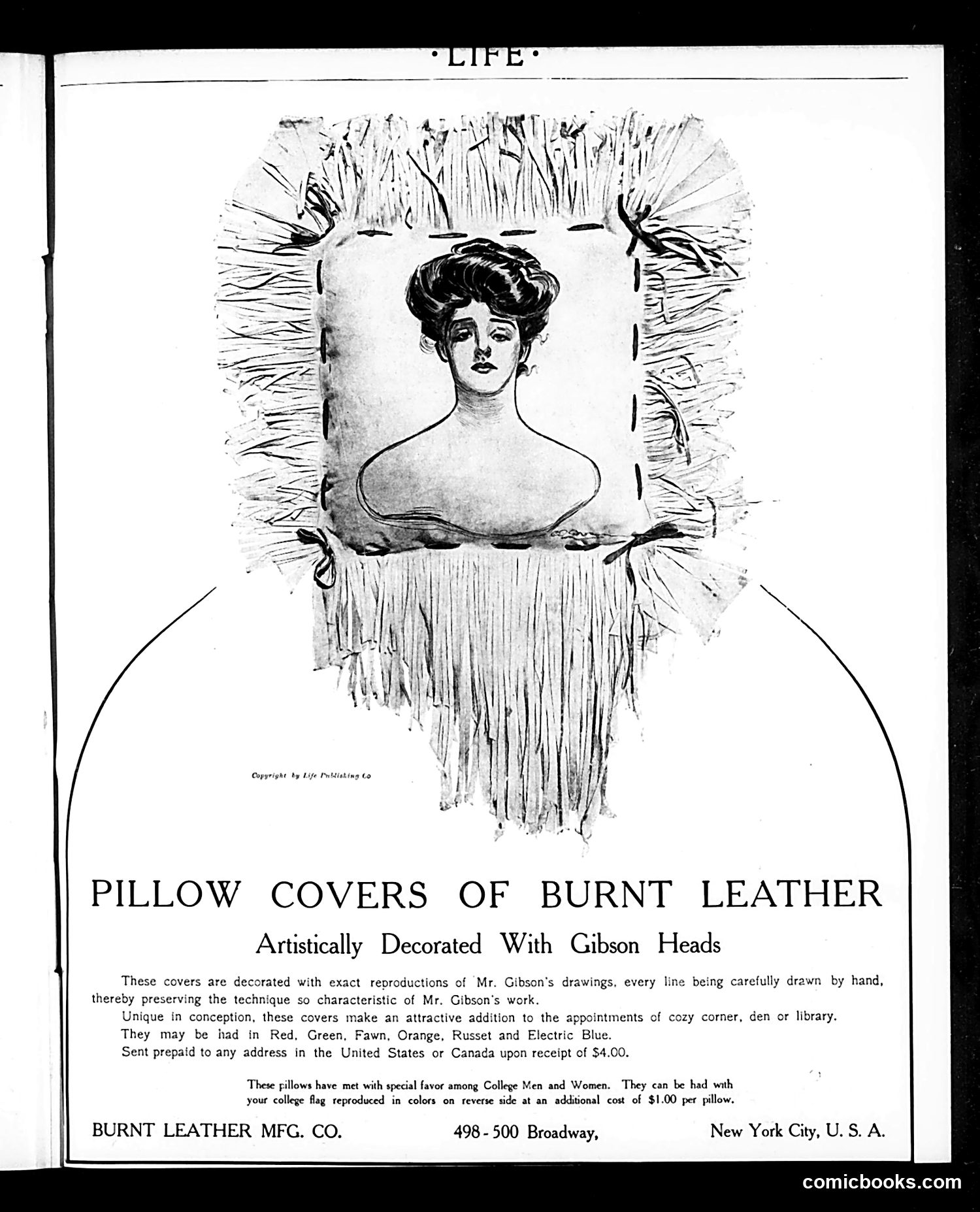
This is primarily **advertising**, not satire or political commentary. The page promotes decorative pillow covers manufactured by Burnt Leather MFG. Co., featuring reproductions of artwork by **Charles Dana Gibson**—the famous illustrator known for his "Gibson Girl" drawings of idealized, fashionable women. The central illustration shows a Gibson Girl bust portrait, framed by decorative fringe, exemplifying the product being sold. The text emphasizes that designs are hand-drawn reproductions preserving Gibson's distinctive technique. For modern readers: Gibson Girls represented early 1900s ideals of feminine beauty and sophistication among the upper-middle class. These pillow covers marketed to "College Men and Women" as tasteful home décor—similar to today's merchandise featuring celebrity or artist imagery. The premium price ($4.00, plus $1.00 for college flags) and emphasis on artistic authenticity suggest this was a luxury item for affluent consumers. This reflects early 20th-century consumer culture and Gibson's tremendous cultural influence.
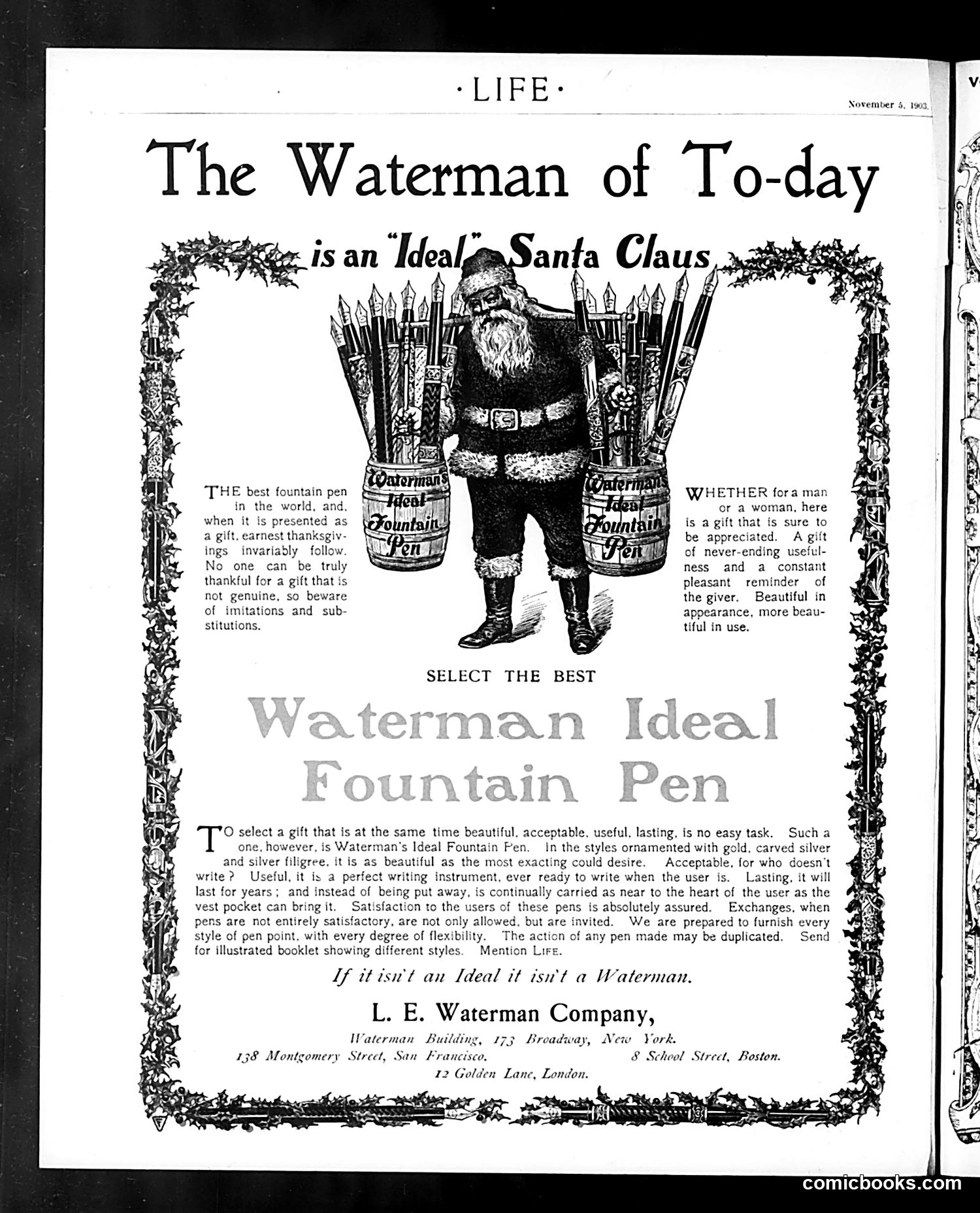
This is primarily a **holiday advertisement**, not political satire. The page uses a clever visual pun: it depicts Santa Claus holding two oversized Waterman fountain pens instead of toys, with the heading "The Waterman of To-day is an 'Ideal' Santa Claus." The joke conflates the brand name ("Waterman's Ideal Fountain Pen") with Santa's traditional role as gift-giver. The implication is that a Waterman pen **is** the ideal modern gift—practical, beautiful, and long-lasting—making it as reliable and satisfying as Santa himself. The advertising copy emphasizes the pen's quality, durability, and exchange guarantee. The tagline "If it isn't an Ideal it isn't a Waterman" reinforces brand identity. This reflects early 1900s consumer culture, where fountain pens were luxury items appropriate for serious holiday gifting. The Santa imagery taps into emerging American Christmas commercialism.