
Life, 1903-11-05 · page 20 of 38
Life — November 5, 1903 — page 20: what you’re looking at
What you’re looking at
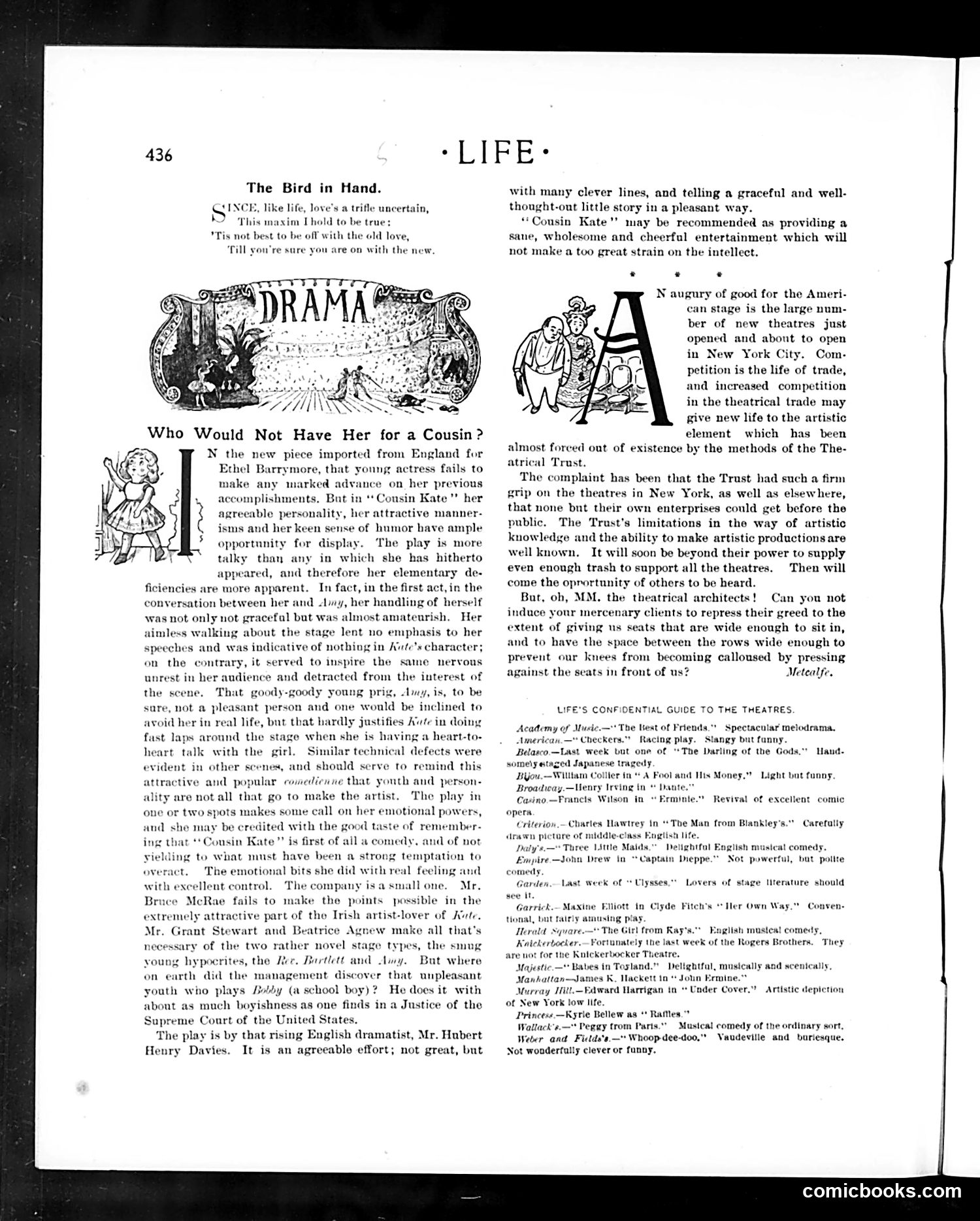
This page reviews the English import "Cousin Kate," starring actress Ethel Barrymore. The critic praises the play's pleasant story and clever dialogue but criticizes Barrymore's performance—particularly her awkward stage movement and "amateurish" handling in early scenes, suggesting she relies too much on personality rather than genuine artistry. The second section celebrates the opening of new theaters in New York City, arguing this breaks the stranglehold of the "Theatrical Trust" (a monopoly controlling theatrical venues). The critic argues competition will force higher artistic standards beyond the Trust's typical "trash," though he humorously complains that theater architects are gouging clients with expensive seating designs. The satirical point: theatrical monopolies suppress artistry; competition improves quality—a Progressive Era argument against corporate consolidation applied to entertainment.
📄 Transcribed text from this page (OCR, searchable)
Machine-transcribed from the original scan — historical spelling and the odd misread are preserved.
*LIFE* The Bird in Hand. GINCE, Tike lif This in m 1 : ‘Tis not best to be off with the old love, ve's a trifle uncertain, nid to be tru sure you are on with the new. Who Would Not Have Her for a Cousin ? N the new piece imported from England for Ethel Barrymore, that young actress fails to make any marked advance on her previous accomplishments. But in ‘* Cousin Kate "’ her agreeable personality, her attractive manner- isms and her keen sense of humor have ample opportunity for display. The play is more talky than any in which she has hitherto appeared, and therefore her elementary de- ficiencies are more apparent. In fact, in the first act,in the conversation between her and Aimy, her handling of herself was not only not gracefal but was almost amateurish, Her aimless walking about the stage lent no emp! s to her speec nd was indicative of nothing in Aufe’s character; on the contrary, it served to inspire the same nervous unrest in her audience and detracted from the interest of the scene, That goody-goody young prig, Amy, is, to be sare, not a pleasant person and one would be inclined to avoid her in real life, but that hardly justifies Awfe in doing st lay round the stage when she is having a heart-to- heart talk with the girl. Similar technical defe evident in other scenes, and should serve to remind this were attractive and popular romedienne that youth and person- ality are not all that go to make the artist. The play in one or two spots makes some call on her emotional powers, and she may be credited with the good taste of remember- ing that ‘* Cousin Kate”? is first of all a comedy, and of not yielding to what must have b ove . The emotional bits she did with r n a strong temptation to r al feeling with excellent control. company is a small one. Bruce McRae fails to make the points possible in the ttractive part of the Irish artist-lover of Aute. Mr. Grant Stewart and Beatri p all that's necessary of the two rather novel stage types, the smug young hypocrites, the Rec. Bartlett and Amy. on earth did the management discover that unpleasant youth who plays Solty (a school boy)? He does it with about as much boyishness as one finds in a Justice of the Supreme Court of the United State: The play is by that rising English dram Henry Davies. It is an agreeable effor But where , Mr. Hubert not great, but with many clever lines, and telling a graceful and well- thought-out little story in a pleasant way. “Cousin Kate’? may be recommended as providing a sane, wholesome and cheerful entertainment which will not make a too great strain on the intellect. * . N augury of good for the Ameri- can stage is the large num- ber of new theatres just opened and about to open in New York City. Com- petition is the life of trade, and increased competition in the theatrical trade may give new life to the artistic element which has been almost forced out of existence by the methods of the The- atrical Trust. The complaint has been that the Trust had such a firm grip on the theatres in New York, as well as elsewhere, that none but their own enterprises could get before the public. The Trust's limitations in the way of artistic knowledge and the ability to make artistic productions are well known. It will soon be beyond their power to supply even enough trash to support all the theatres. Then will come the oprortunity of others to be heard. But, oh, MM, the theatrical architects! Can you not induce your mercenary clients to repress their greed to the extent of giving us seats that are wide enough to sit in, and to have the space between the rows wide enough to prevent our knees from becoming calloused by pressing against the seats nm front of us? Metealfe. LIFES CONFIDENTIAL GUIDE TO THE THEATRES. Academy of Music.—* The lest of Friends. Spectacular melodrama. sAmerican.—" Checkers.” Racing play. Slangy but fanny. Belasco —Last week but one of “The Darling of the Gods.” somety staged Japanese tragedy. BYow.—Willtam Colter tn A Fool and His Money.” Light bot funny. Broadway.—Uenry Irving in * Daute Casino —Francts Wilson in * Erminte. opera. Criterion.- Chaties Hawtrey In The Man from Blankley’s." Carefully dirawn picture of middle-class Engtist life. fy's.—"Turee Little Maids.” Delightfal English m pire—John Drew in “Captain Dieppe.” Not Maud. Revival of excellent comic eal comedy, ‘erful, but pollte neds Garden. Last week of “ Ulysses." Lovers of stage literature should see tt. Garrick. Maxine Eliott in Clyde Fitch's Her Own Way," Conven- nal, but fairly amusing play Herald Square.— The Girl from Ray’ Kaickerbocker.— Fortunately the last wet ot for the Knickerbocker Theatre, Majestic. —* Babes in Tosland.” Delightful, musically and scenteally, Manhattan—James K. Hackett to Joun Ermtn Murray Hilt.—Kaward Harrigan tn “Under Cover.” Artistic depiction of New York low life. Princess Kyrie Bellew as “ Rames.” Watlack’s.—" Peggy trom Parts." Mustcal comedy of ine ordinary sort, Weber and Fictds's.—* Whoop dee-doo,” Vaudeville and buriesque. Not wouderfally clever or funny, English musteal comedy, f the Rogers Brothers. They comicbooks.com