
Life, 1903-11-05 · page 24 of 38
Life — November 5, 1903 — page 24: what you’re looking at
What you’re looking at
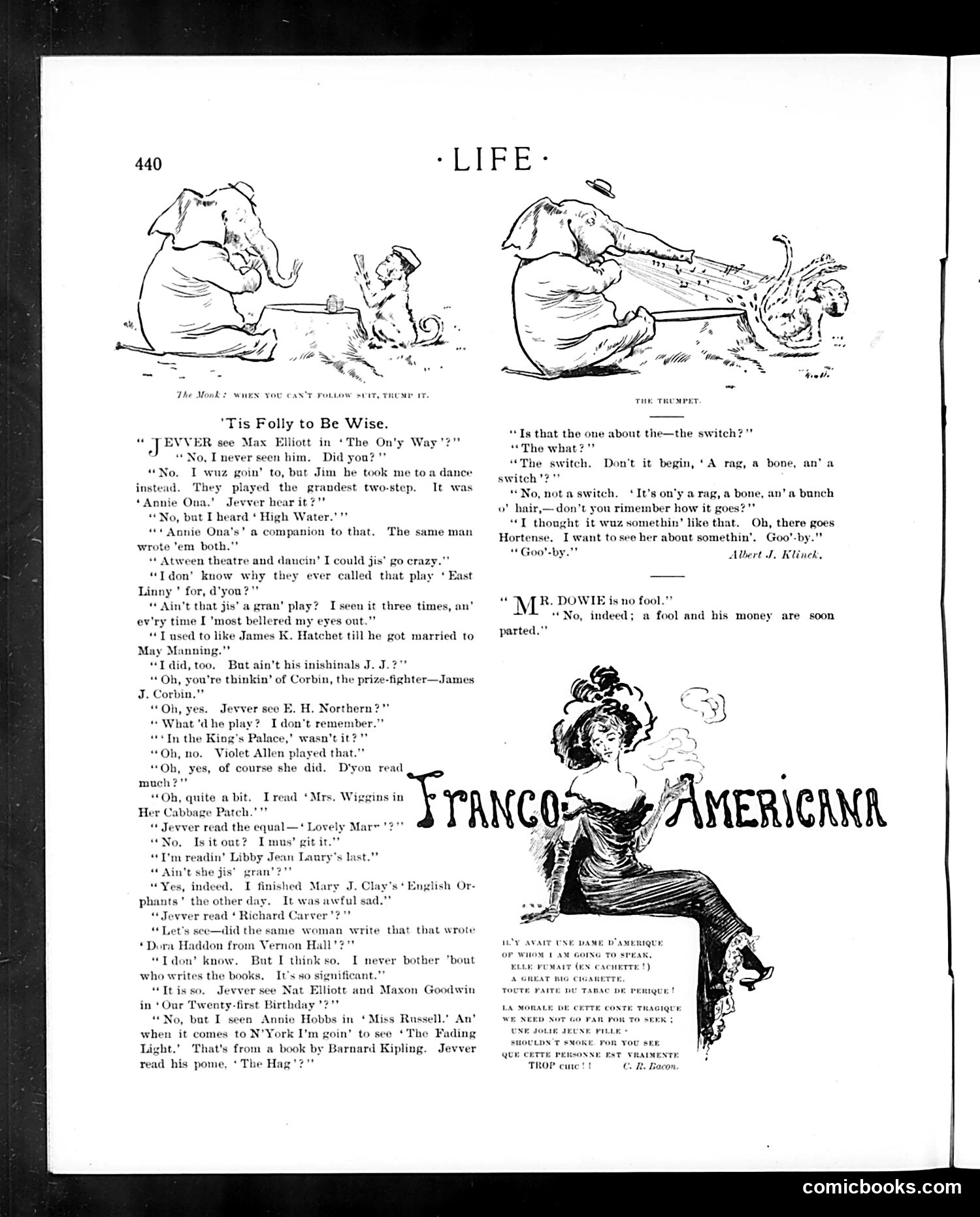
This page satirizes American popular culture of the early 1900s through two cartoons and accompanying dialogue. **"'Tis Folly to Be Wise"** depicts two women gossiping about theater and literature, repeatedly confusing names, titles, and details. The satire targets the pretentiousness of casual theatergoers and readers who discuss cultural works without actually understanding them—mixing up actors (Max Elliott, James K. Hatchet), plays (mixing "The Only Way" with dance halls), and books (conflating popular authors). The joke mocks how people performatively discuss culture to appear cultured. **"The Trumpet"** shows similar confusion about a song, with characters misremembering its opening lyrics ("a rag, a bone, and a switch" versus the actual "rag, a bone, and a bunch of hair"). The **"Tango Americana"** section at right appears to be satirical commentary on dance crazes and their moral concerns—the French text suggests contemporary anxieties about the tango's propriety. Overall, the page satirizes American cultural pretension and the public's superficial engagement with entertainment.
📄 Transcribed text from this page (OCR, searchable)
Machine-transcribed from the original scan — historical spelling and the odd misread are preserved.
The Monks WuEN You CAN'T FOLLOW surT, THEME 17. ‘Tis Folly to Be Wise. EVVER see Max Elliott in ‘The On'y Way’?” “No, I never seen him. Did you?” “No. I wuz goin’ to, but Jim he took me toa dance instead. Thi ed the grandest two-step. nie Ou Jevver hear i , but I heard ‘High Water.’ “Annie Ona's’ a companion to that. wrote ’em both."’ “ Atween theatre and dancin’ I could jis’ go craz; “Tdon’ know why they ever called that play ast Linny ’ for, d’you?"" « Ain’t that jis’ a gran’ play? I seen it three times, an’ ev'ry time I ’most bellered my eyes out.”” “LT used to like James K. Hatchet till he got married to May Manning.” I did, too, But ain’t his inishinals ad “Oh, you're thinkin’ of Corbin, the priz J. Corbin.” “Oh, yes. Jevver see E. H. Norther: “ What ‘dhe play? I don’t remembe! “In the King’s Palace,’ wasn’t i “Oh, no. Violet Allen played that. “Oh, yes, of course she did. D'you read much?" “Oh, quite abit. Tread Her Cabbage Patch.’"’ evver read the equal—‘ Lo No, Isitout? Imus’ giti “I'm readin’ Libby Jean Laury’s last.” “ Ain't she jis’ gran’?”’ “Yes, indeed. I finished Mary J. C phants’ the other ¢ wful sad, ** Jevver read ¢ Rich a r’?"? “Let's see—did the same won Tt was The same man ghter—James ‘Mrs, Wiggins in ly Marv *?"* ‘English Or- n write that that wrote * Dora Haddon from Vernon Hall'?”* “Tdon’ know. But I think so. who writes the books. It’s so significant.” “Itisso. Jevver see Nat Elliott and Maxon Goodwin in ‘Our Twenty-first Birthday ’?"” “No, bat I seen Annie Hobbs in ‘Miss Russell.’ An’ when it comes to N’York I'm goin’ to see ‘The Fading Light.’ That's from a book by Barnard Kipling. read his pome, ‘ The Hag’?"? I never bother ‘bout Jevver rie TRUMPET “Is that the one about the—the switch?” “The what?” “The switch. switch’? >, not a switch. ‘It’s ony a rag, a bone, an’ a bunch ©’ hair,—don't you rimember how it goes?” “I thought it wuz somethin’ like that. Ob, there goes Hortense. I want to see her about somethin’, Goo’-by.”” **Goo’-by."" Albert J, Klinck, Don't it begin, ‘A rag, a bone, an’ a “ NM R. DOWIE is no fool.”” “No, indeed; a fool and his money are soon parted,” y WHOM LAM GOING TO SPE ELLE PEMALT (EN CxcHETTE !) A GREAT BIG CIGARETTE, LA MORALE WE NEED UNE gout SHOULDN'T SMOKE. POR You QUE CETTE PERSONNE EST TROP ¢ comicbooks.com