
A complete issue · 20 pages · 1903
Life — October 22, 1903
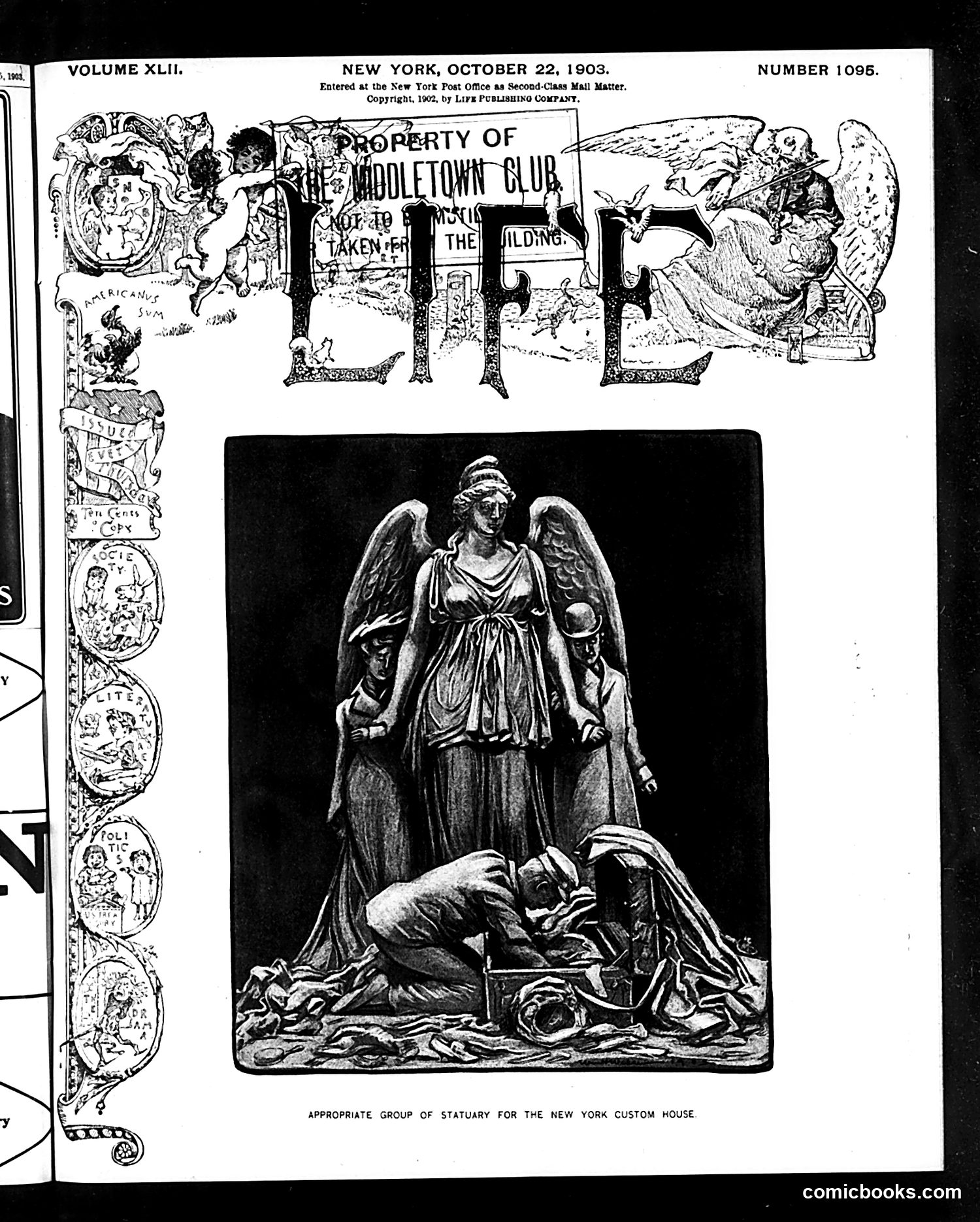
This page features a satirical engraving titled "Appropriate Group of Statuary for the New York Custom House." The image shows an allegorical female figure (likely representing Justice or Commerce) with wings, standing over prone or fallen figures amid scattered debris and destruction. The satire targets corruption at the New York Custom House. The symbolic composition suggests that official negligence or malfeasance has caused ruin—the fallen figures and wreckage imply financial loss or moral collapse within the institution. By proposing this grim "statuary," Life mocks the Custom House's actual state while ironically suggesting such a monument would fittingly represent its condition. The decorative header proclaims this is "Property of the Middletown Club," a satirical ownership claim emphasizing institutional corruption.
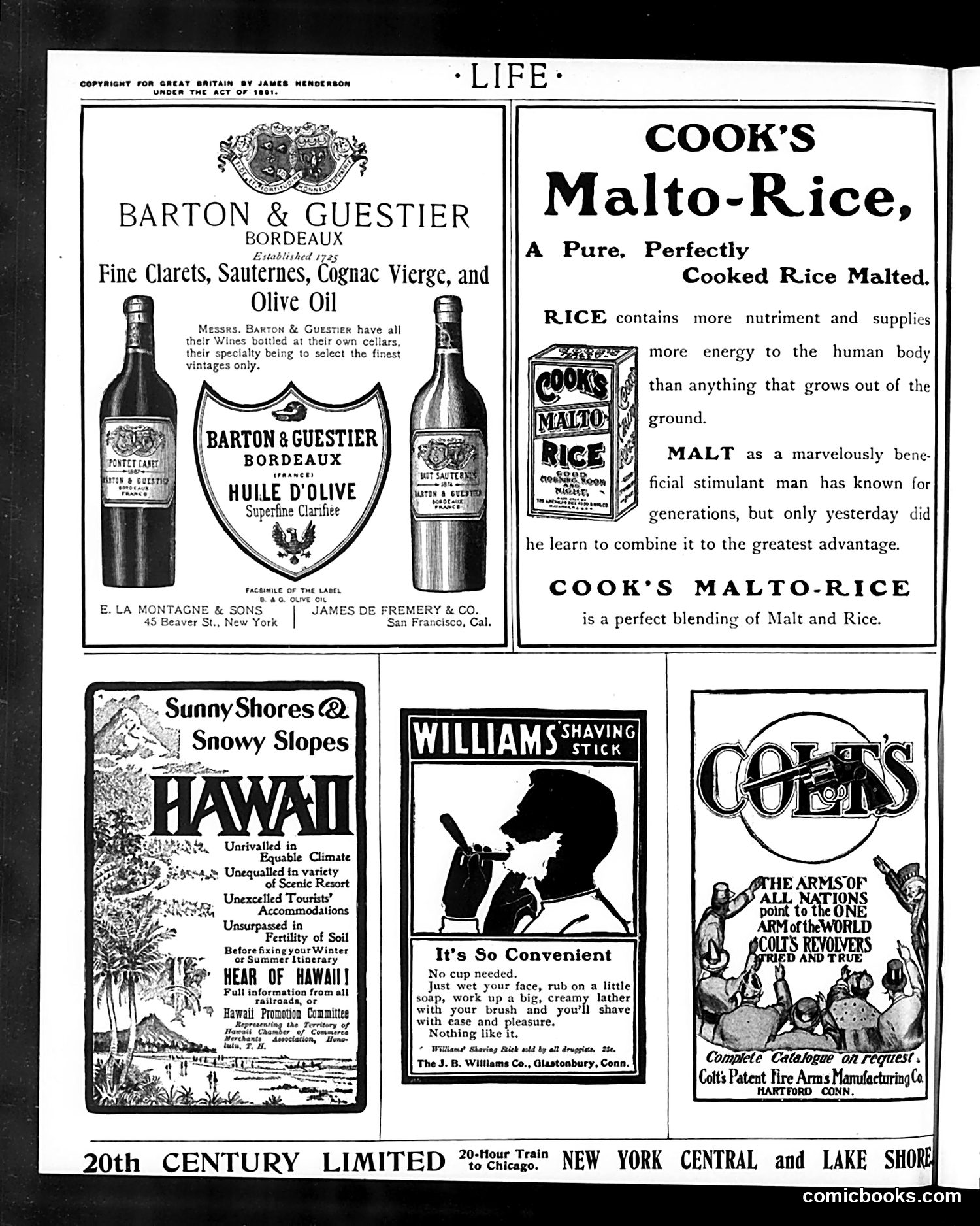
This page is **primarily advertisements**, not political satire or commentary. The five ads promote: 1. **Barton & Guestier wines** (Bordeaux olive oil and wines) — luxury imports 2. **Cook's Malto-Rice** — a nutritional drink combining malt and rice 3. **Hawaii tourism** — promoting travel to the islands 4. **Williams Shaving Stick** — grooming product 5. **Colt's firearms** — weapons manufacturing The only potentially notable element is the **Colt's ad**, which uses patriotic imagery ("The Arms of All Nations point to the Union Arm of the World") to market firearms. However, this appears straightforward product promotion rather than satire. The page represents early 20th-century *Life* magazine functioning as a vehicle for consumer advertising alongside any editorial content—common for the era.
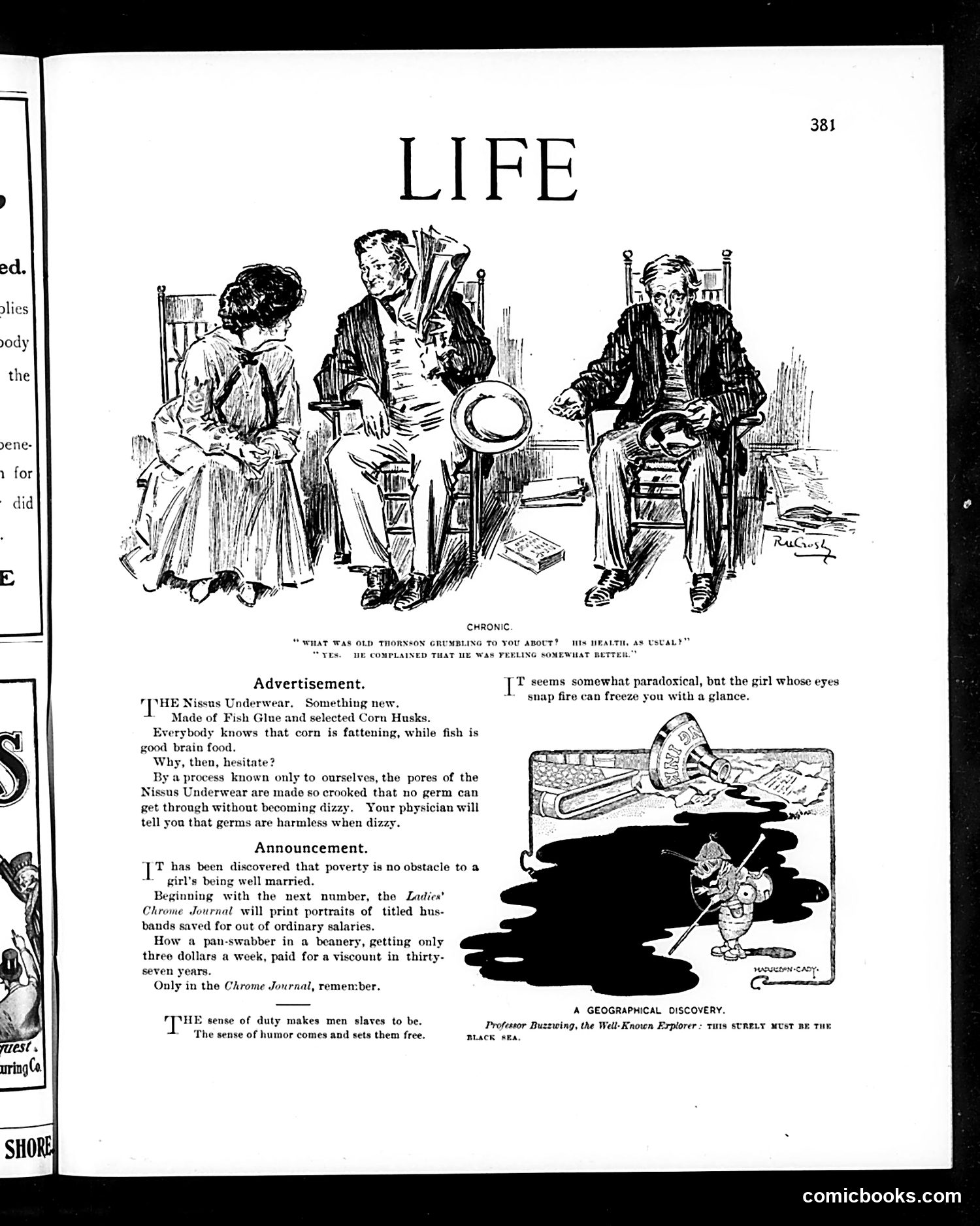
**Top Cartoon ("Chronic"):** Three men sit discussing someone's health complaint. The caption reads: "What was old Thorson grumbling to you about?" / "His health, as usual" / "Yes—he complained that he was feeling somewhat better." This is a joke about a chronically complaining hypochondriac who finds something to grumble about even when his condition improves. It satirizes people who are addicted to illness narratives. **Lower Content:** The page contains advertisements (Nissus Underwear) and announcements about the *Ladies' Chrome Journal* and poverty. A small cartoon titled "A Geographical Discovery" appears below, though its specific meaning is unclear from this image.
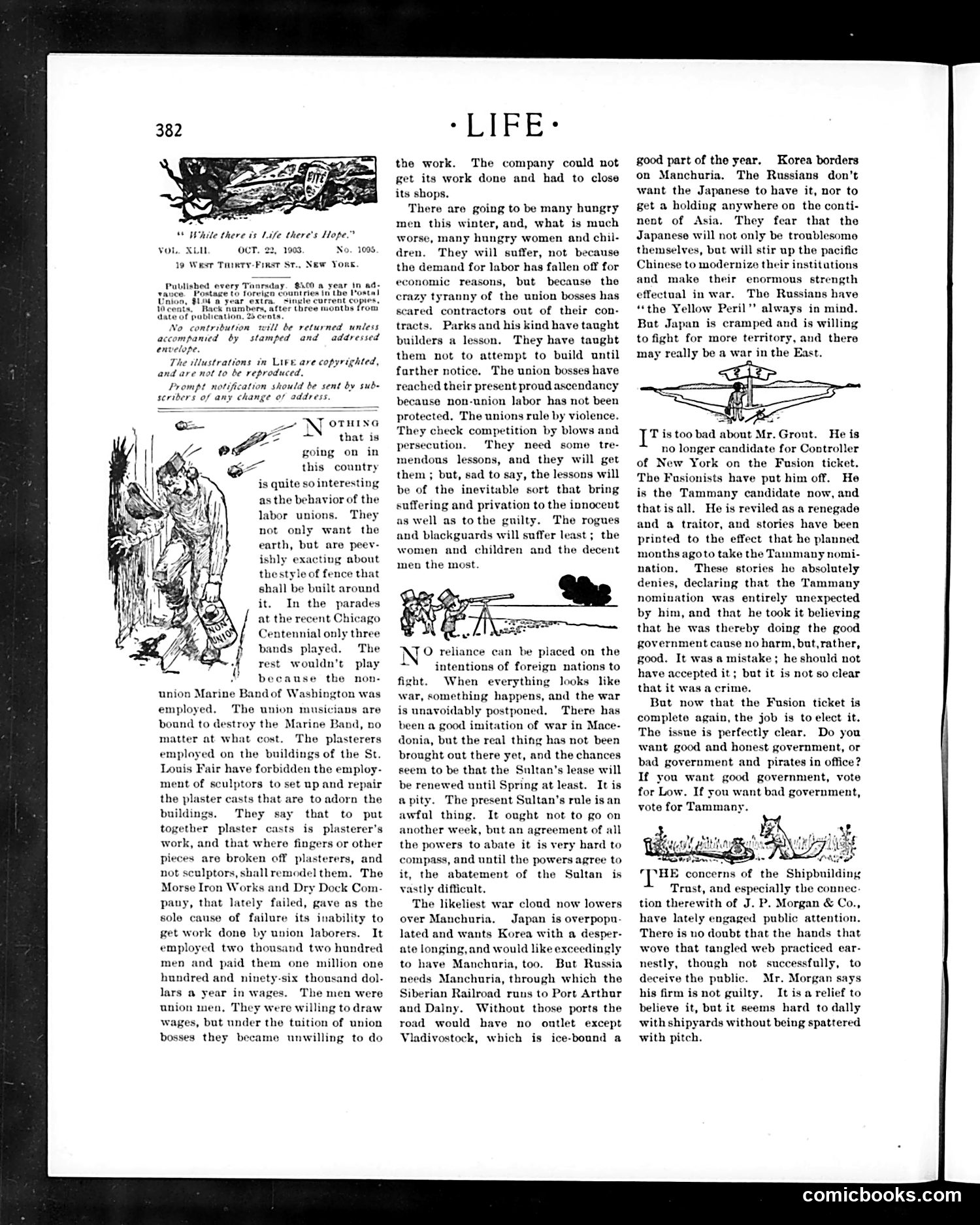
This page from *Life* (October 22, 1903) contains editorial commentary on labor disputes and union politics rather than traditional political cartoons. The left illustration depicts a figure opposing union demands, satirizing resistance to organized labor. The text criticizes union bosses for using "violence" and "blows" to enforce strikes, while acknowledging workers' legitimate grievances about wages and conditions. The right section discusses Mr. Gront's removal as New York Comptroller candidate on the "Fusion ticket"—a reform coalition. The author suggests Gront was rejected as a "renegade and traitor" by Tammany Hall (the Democratic political machine), implying internal political maneuvering. The final section addresses J.P. Morgan & Co.'s shipbuilding interests, suggesting corporate influence on public opinion regarding labor matters.
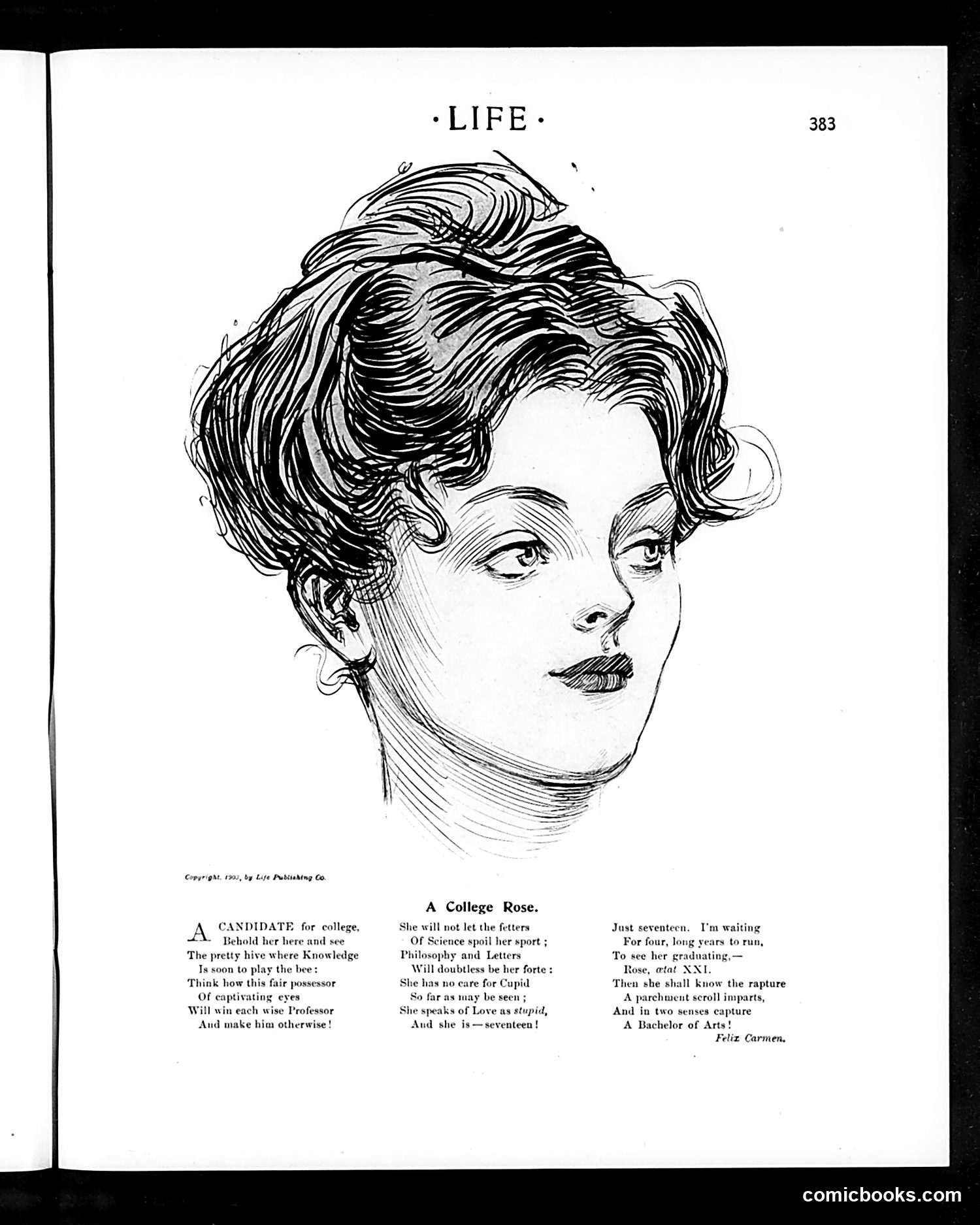
This page features a portrait illustration and accompanying poem by Feliz Carmen satirizing a young woman college student. The poem mockingly describes a "candidate for college" who is seventeen, pretty, and confident she'll charm her professors with her "captivating eyes." The satire targets early 20th-century attitudes about women's higher education—particularly the assumption that female students would rely on beauty and charm rather than serious academic engagement. The poem's tone is dismissive, suggesting she'll pursue "Science" and "Philosophy and Letters" superficially, while remaining primarily focused on romance ("speaks of Love as stupid"). The portrait's refined style contrasts with the poem's sardonic critique of this stereotype.
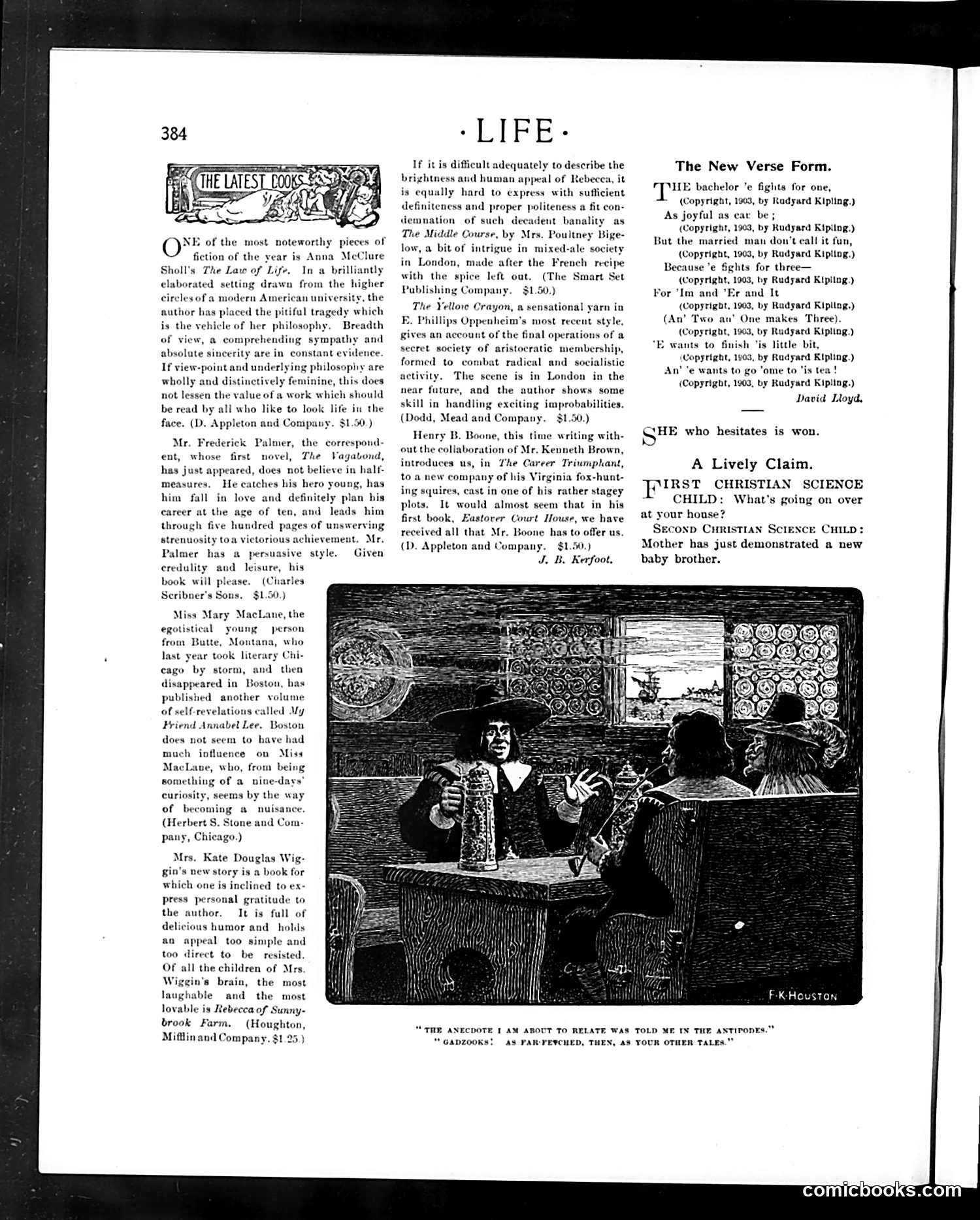
This page features a single cartoon by F.K. Houston showing two figures in what appears to be a Victorian-era interior. One man in period dress gestures animatedly while speaking to another figure. The caption reads: "The anecdote I am about to relate was told me in the antiques." / "Garçooks; as far fetched, then, as your other tales." The humor appears to target the social pretension of antique dealers and collectors who fabricate elaborate provenance stories for their wares. The joke mocks how such dealers claim their items come with colorful historical "anecdotes," implying these narratives are as unreliable as the dealer's other tall tales. It's satire on the credulity required to believe antique merchants' claims about their goods' origins and significance.
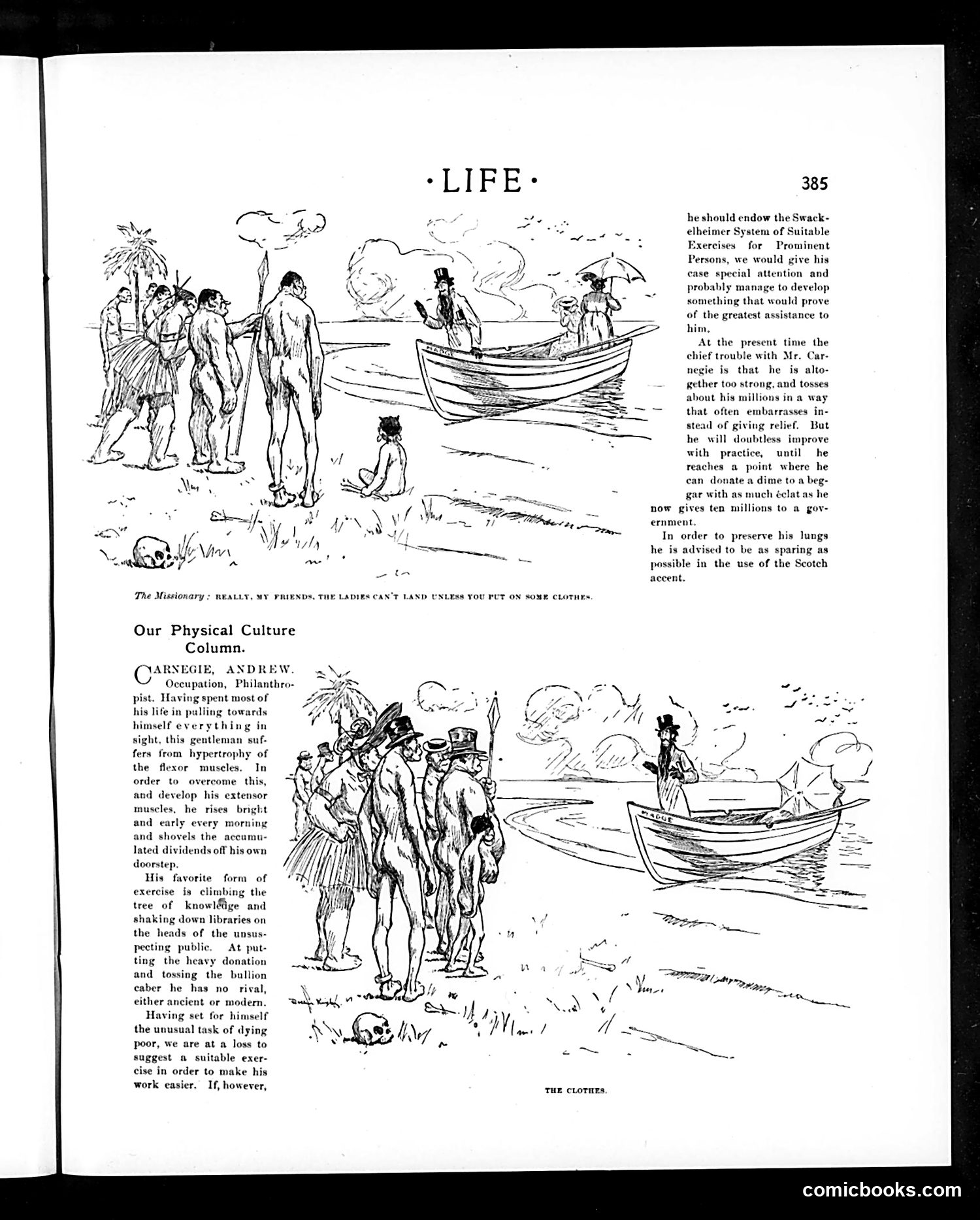
This page contains satirical commentary on **Andrew Carnegie**, the wealthy philanthropist and industrialist. The text criticizes Carnegie's approach to charity, suggesting he is "too strong" and loses money "in a way that often embarrasses him instead of giving relief." The cartoon titled **"The Clothes"** depicts poorly clothed, thin figures on a beach. The caption reads: "The Missionary: Really, my friends, the ladies can't land unless you put on some clothes"—satirizing the disconnect between Carnegie's massive charitable donations and the actual need among poor populations. The piece suggests Carnegie should practice more modest, effective giving rather than large public gestures, and humorously recommends he preserve his health by avoiding Scottish dialect, poking fun at his ethnic identity.
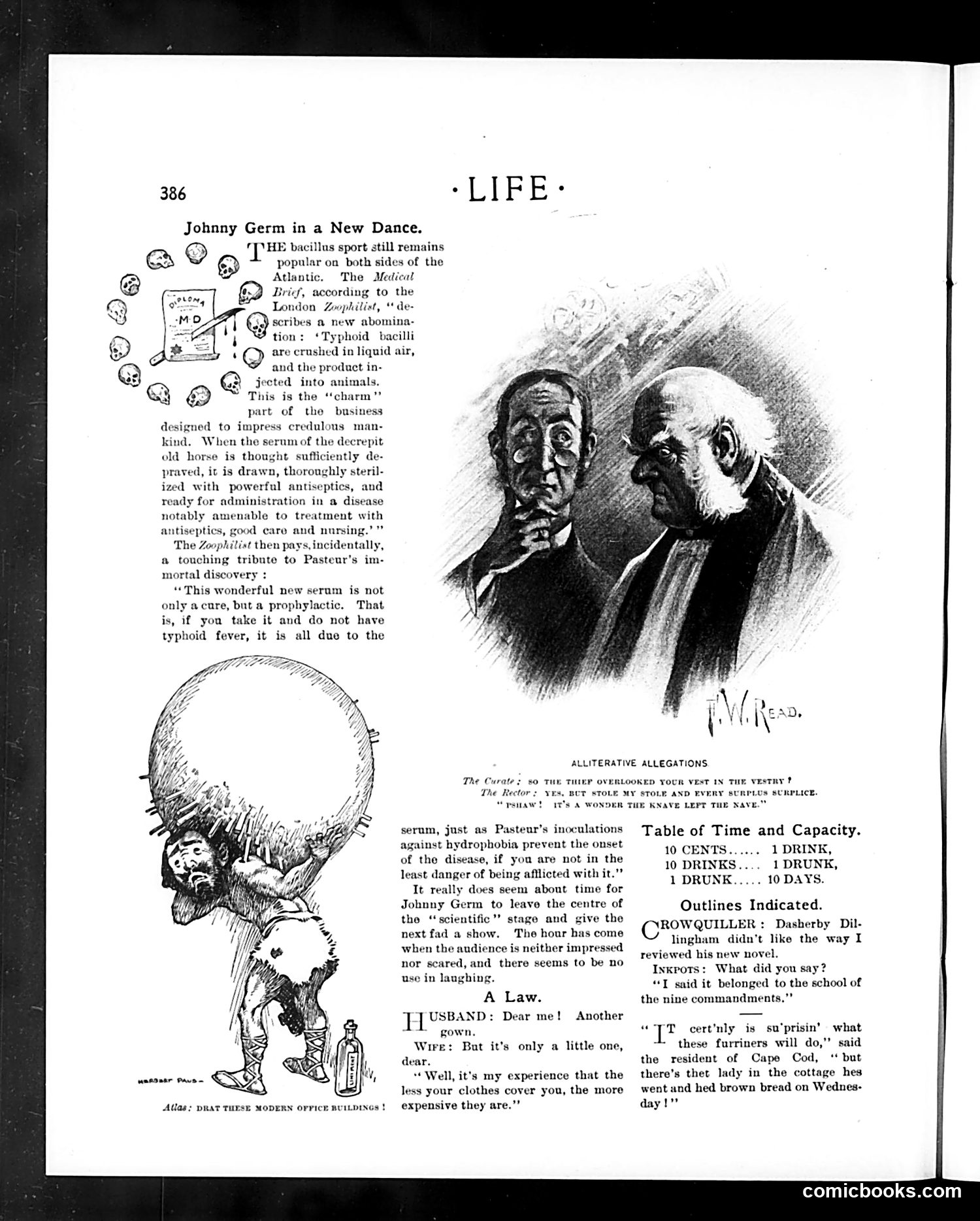
This page from *Life* magazine satirizes medical quackery and the public's gullibility. The main article, "Johnny Germ in a New Dance," mocks a fraudulent "typhoid bacillus serum" marketed as both a cure and preventative. The text quotes the *London Zoophilist* describing how the serum works—a clear parody of legitimate scientific claims, likely referencing actual patent medicine scams of the era. The cartoon illustrations show victims of this deception. The bottom cartoon captioned "Alias: DRAFT THESE MODERN OFFICE BUILDINGS!" depicts a man being crushed by enormous weight, suggesting the financial burden of purchasing such fake remedies. The satire targets both unscrupulous medicine-sellers and credulous consumers who believed pseudo-scientific claims without evidence—a common target of *Life*'s social commentary.
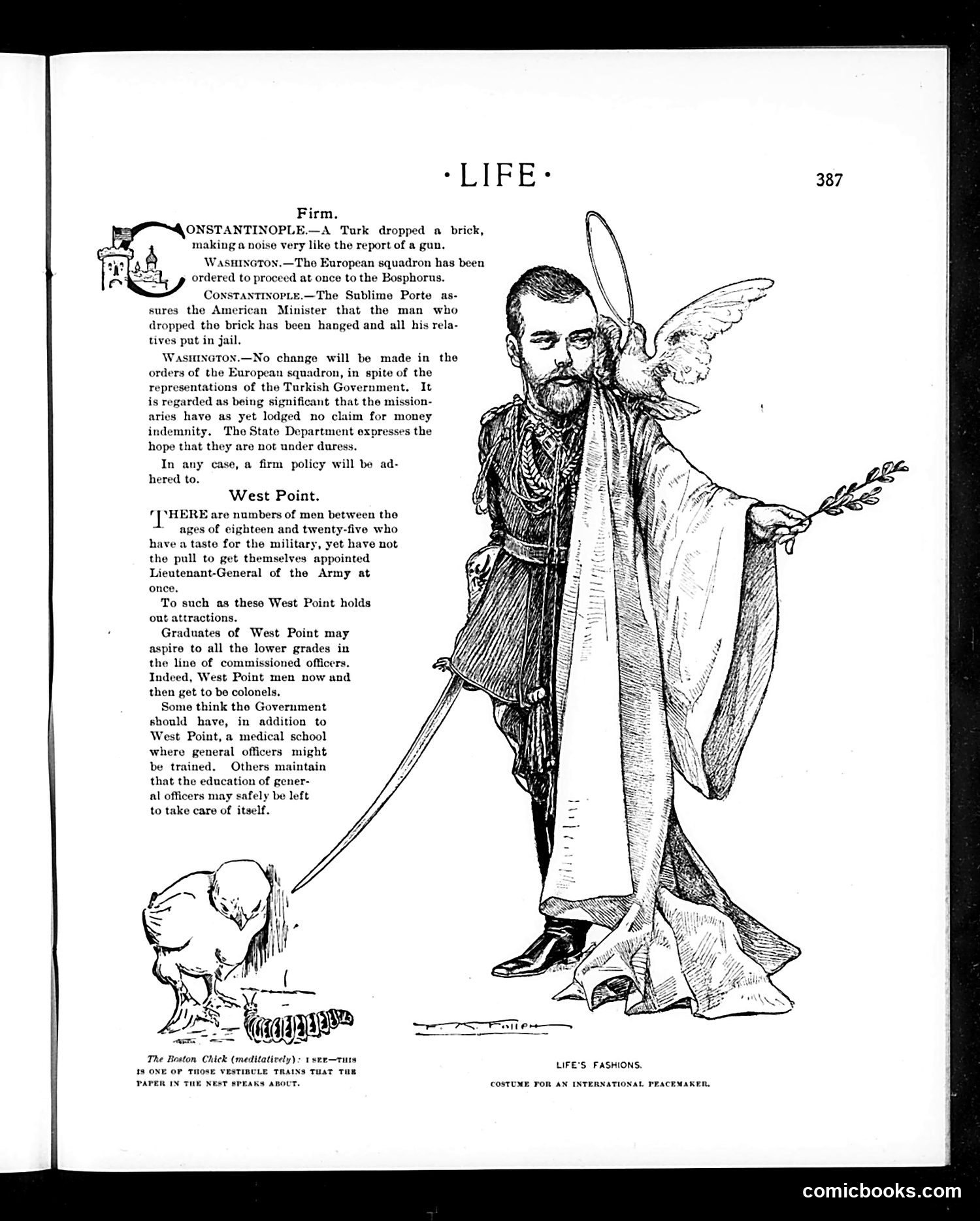
This page contains three separate news items with political commentary. The main illustration shows a figure in diplomatic robes with angel wings, labeled "Costume for an International Peacemaker." The cartoon satirizes peace negotiations, likely referencing early 1900s diplomatic efforts. The figure's angelic costume suggests idealistic but impractical peacemaking — the joke being that achieving international peace requires an almost divine or unrealistic approach. The text discusses Constantinople, West Point military academy, and American foreign policy matters. The "Boston Chick" illustration below appears unrelated, possibly satirizing urban life. The overall tone mocks both diplomatic pretensions and American military/governmental ambitions, typical of Life magazine's satirical approach to contemporary politics.
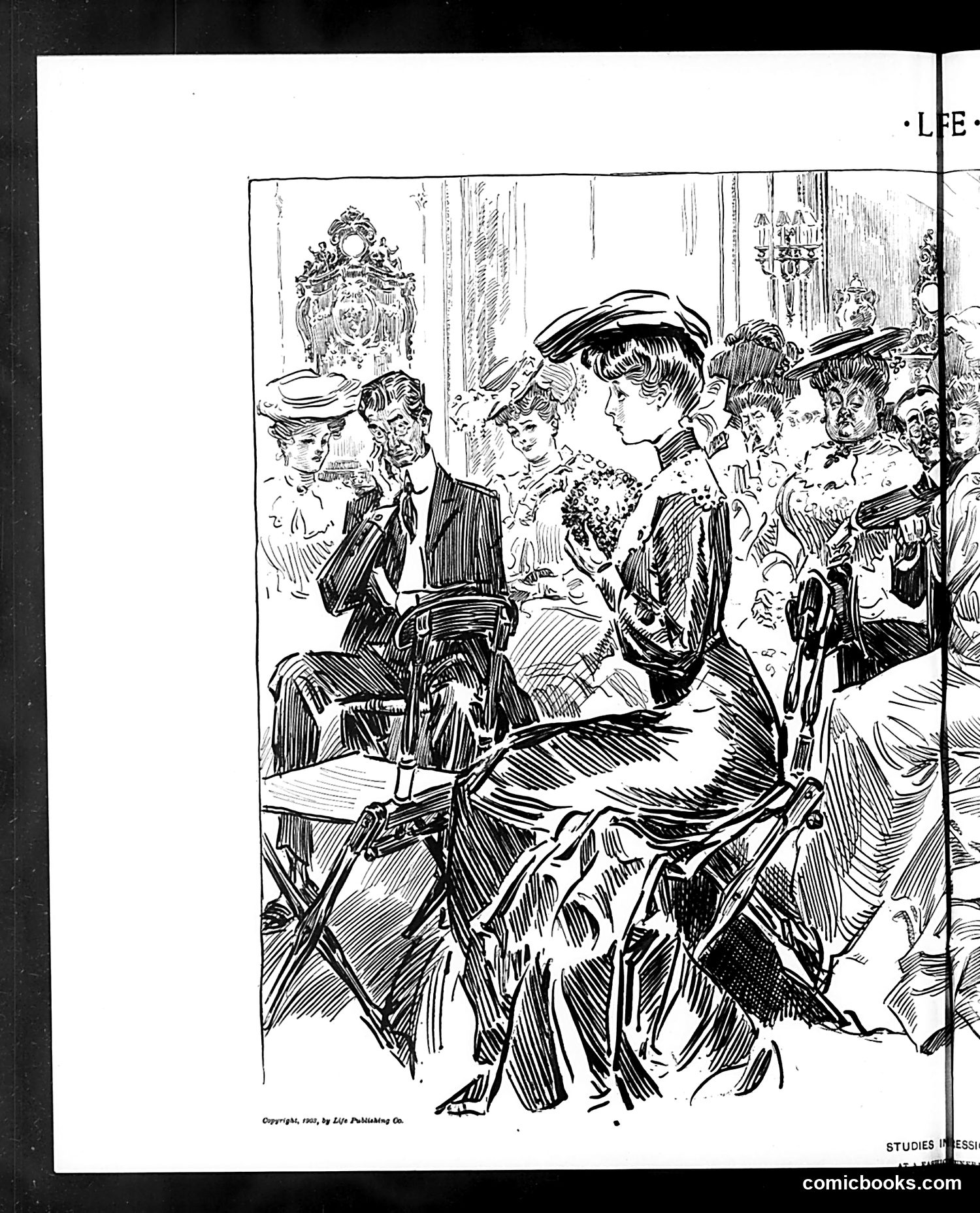
This is a sketch depicting an elegant early 20th-century social gathering, showing well-dressed men and women in an ornate interior with decorative wall panels. The figures wear fashionable period attire including hats and formal clothing typical of the Edwardian era. The caption indicates this is titled "STUDIES IN ESSION" (possibly "SESSION"), and the copyright reads "1900, by Life Publishing Co." Without clearer text identifying specific political figures or events, the cartoon appears to be social satire about high-society gatherings rather than political commentary. It likely mocks the formal rituals, fashions, or pretensions of upper-class social events of the period. The detailed cross-hatching and careful composition suggest this was meant as observational humor about contemporary aristocratic or wealthy society, though the specific targets remain unclear from the visible information.
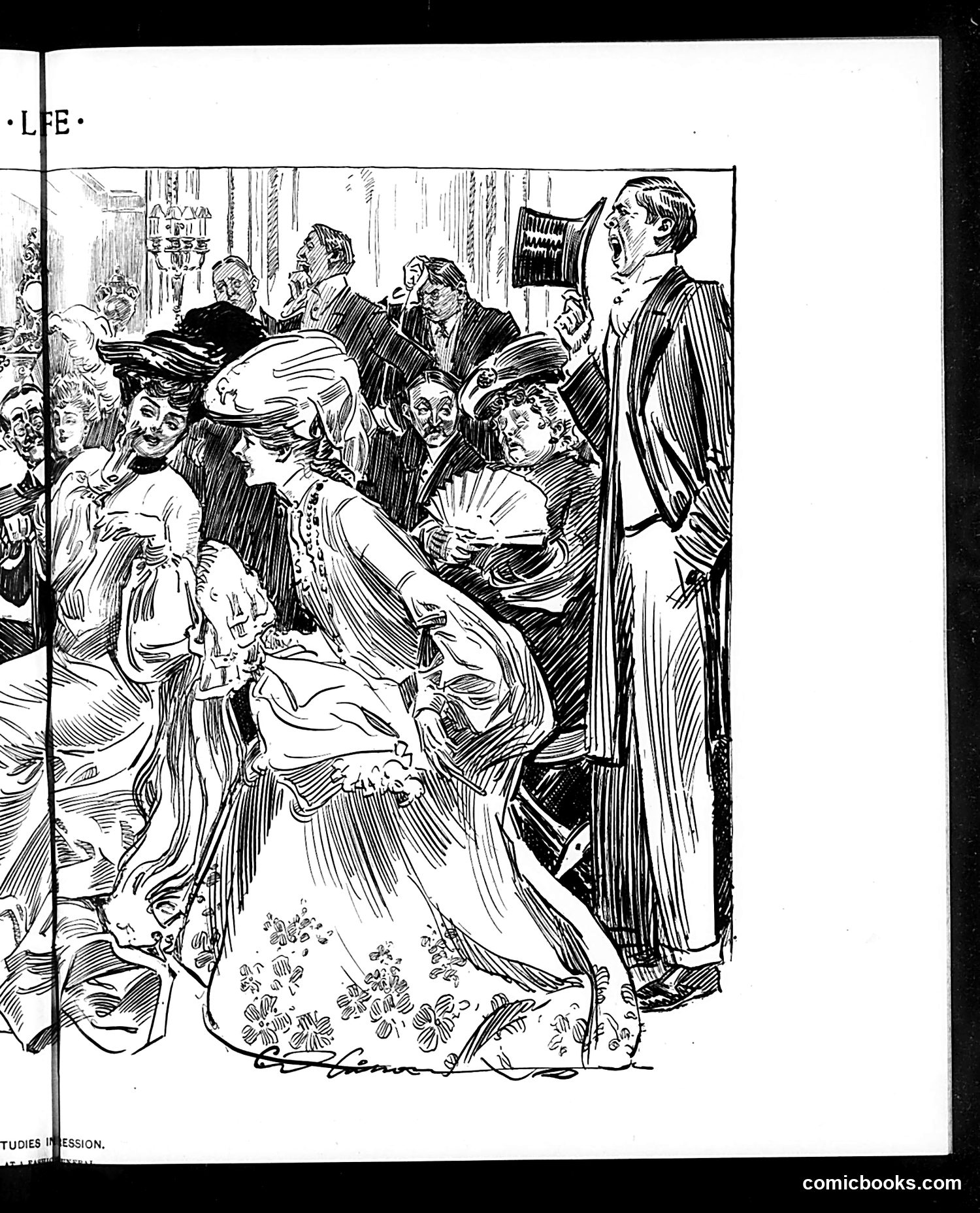
This appears to be a satirical scene from early 20th-century Life magazine depicting a formal social gathering or reception. A tall man on the right, wearing formal attire and holding a megaphone or speaking trumpet, appears to be making an announcement or proclamation to an assembled crowd of well-dressed women and men in period clothing. The satire likely mocks either: - Social pretension at high-society events - A specific public figure making grandiose announcements - The contrast between formal etiquette and dramatic interruption The megaphone suggests someone imposing their voice forcefully on a genteel setting. Without visible text identifying specific individuals or events, the exact political reference remains unclear, though the scene critiques upper-class social conventions or a particular contemporary figure's behavior.
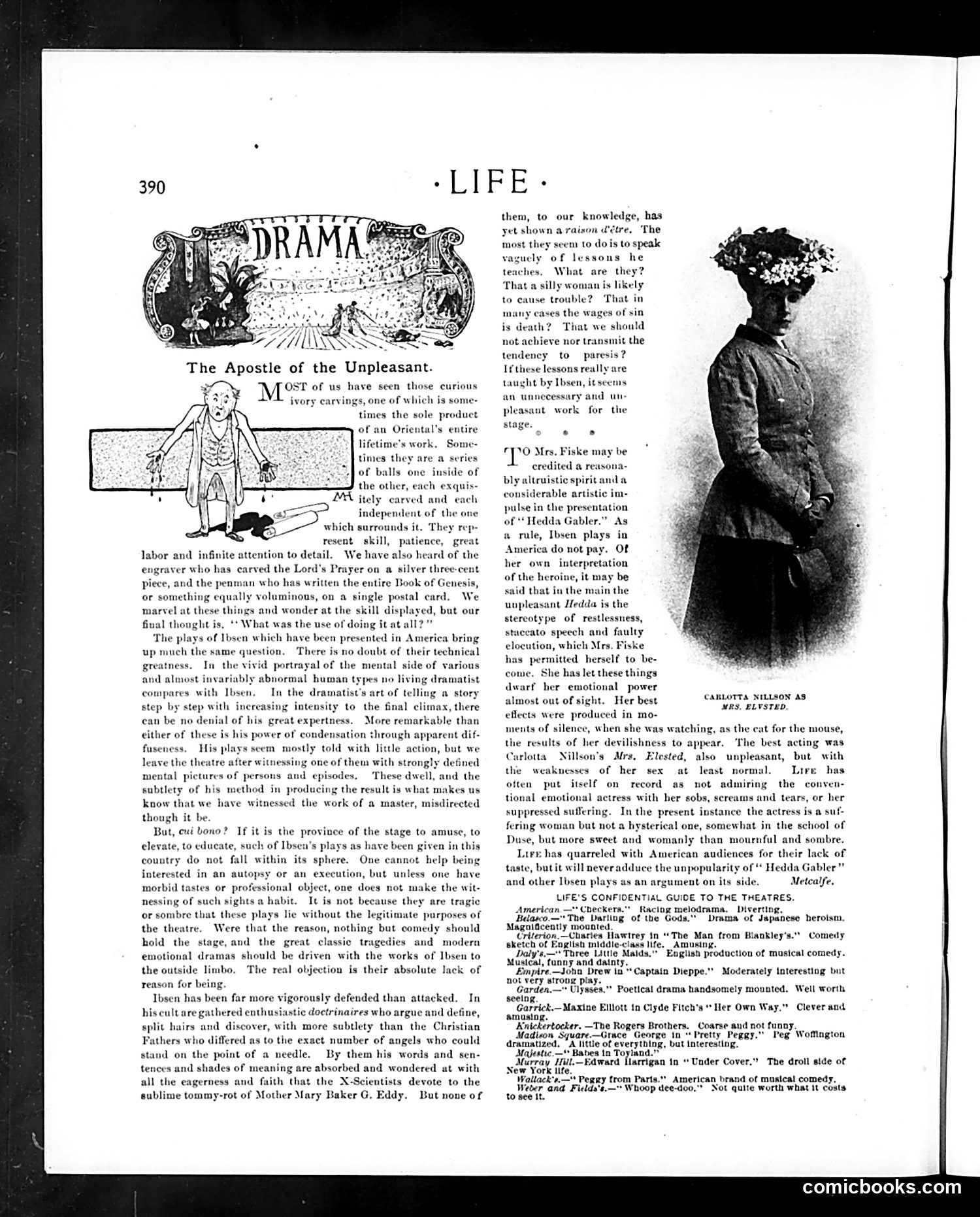
This page features a drama criticism section titled "The Apostle of the Unpleasant," discussing Henrik Ibsen's theatrical influence in America. The accompanying illustration shows an elderly bearded man in period dress—likely Ibsen himself—demonstrating the anatomical detail characteristic of ivory carvings (referencing the opening analogy about intricate craftsmanship). The critic argues that while Ibsen's plays showcase technical brilliance and psychological depth, they raise a fundamental question: "What was the use of doing it all?" The text critiques American productions of Ibsen's works, particularly praising Carlotta Nilsson's performance as Mrs. Elvsted while discussing how Ibsen's deliberately "unpleasant" dramas challenge conventional theatrical entertainment values. The satire targets both Ibsen's approach and American audiences' discomfort with serious dramatic content.
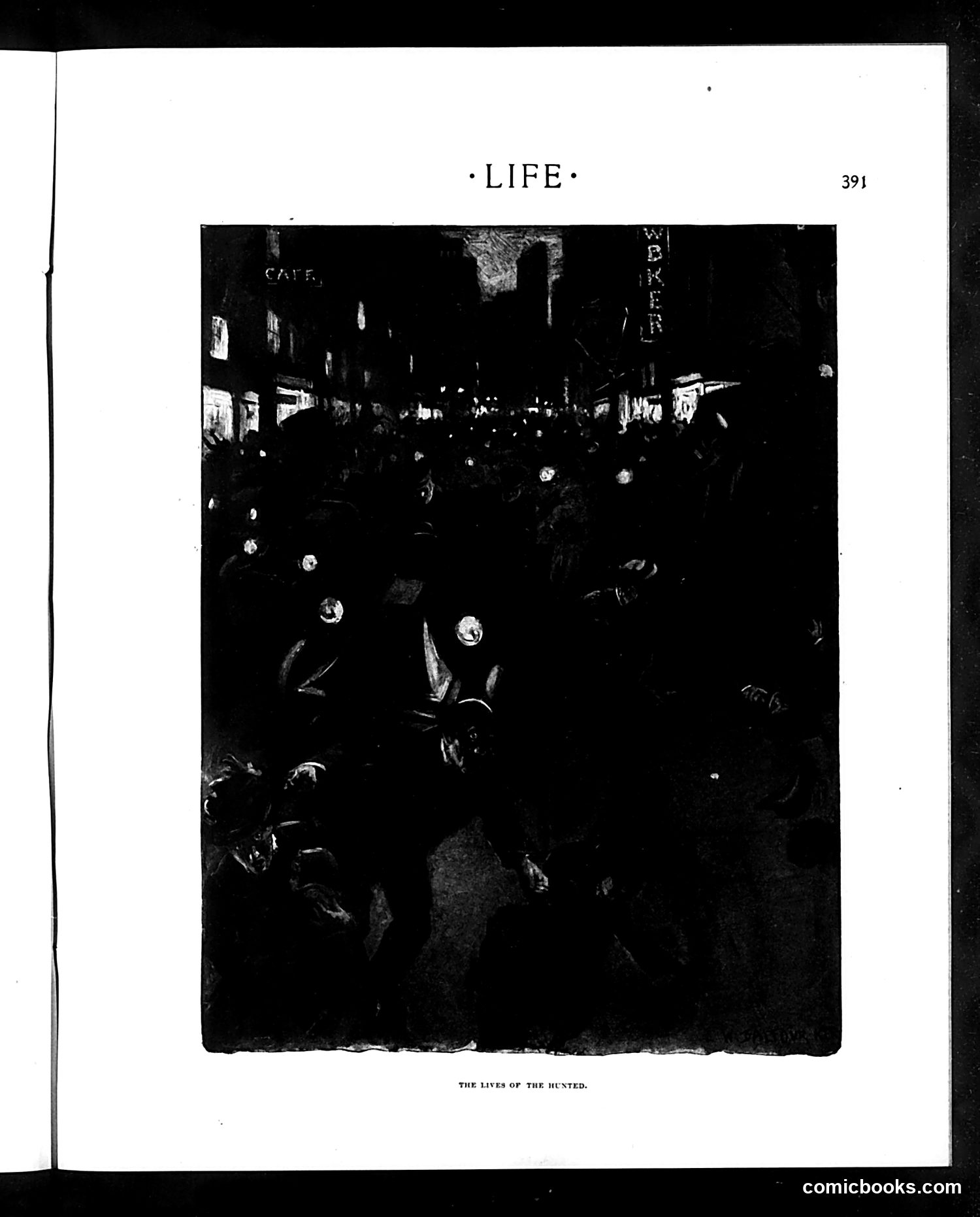
This page from *Life* magazine (page 391) features a dark, nighttime street scene captioned "The Lives of the Hunted." The image shows a crowded urban street at night with storefronts (including what appears to be a "CAFE" sign and "BAKER" sign visible), illuminated by street lamps. Large crowds of people fill the street. The caption's title suggests social commentary on people living difficult or precarious existences—likely referring to urban working-class or poor populations navigating city life. The nocturnal setting and dense crowds emphasize the harsh, anonymous nature of urban survival. Without additional context or visible artist attribution, the specific political target remains unclear, though the satirical tone typical of *Life* magazine suggests criticism of contemporary social conditions or inequality.
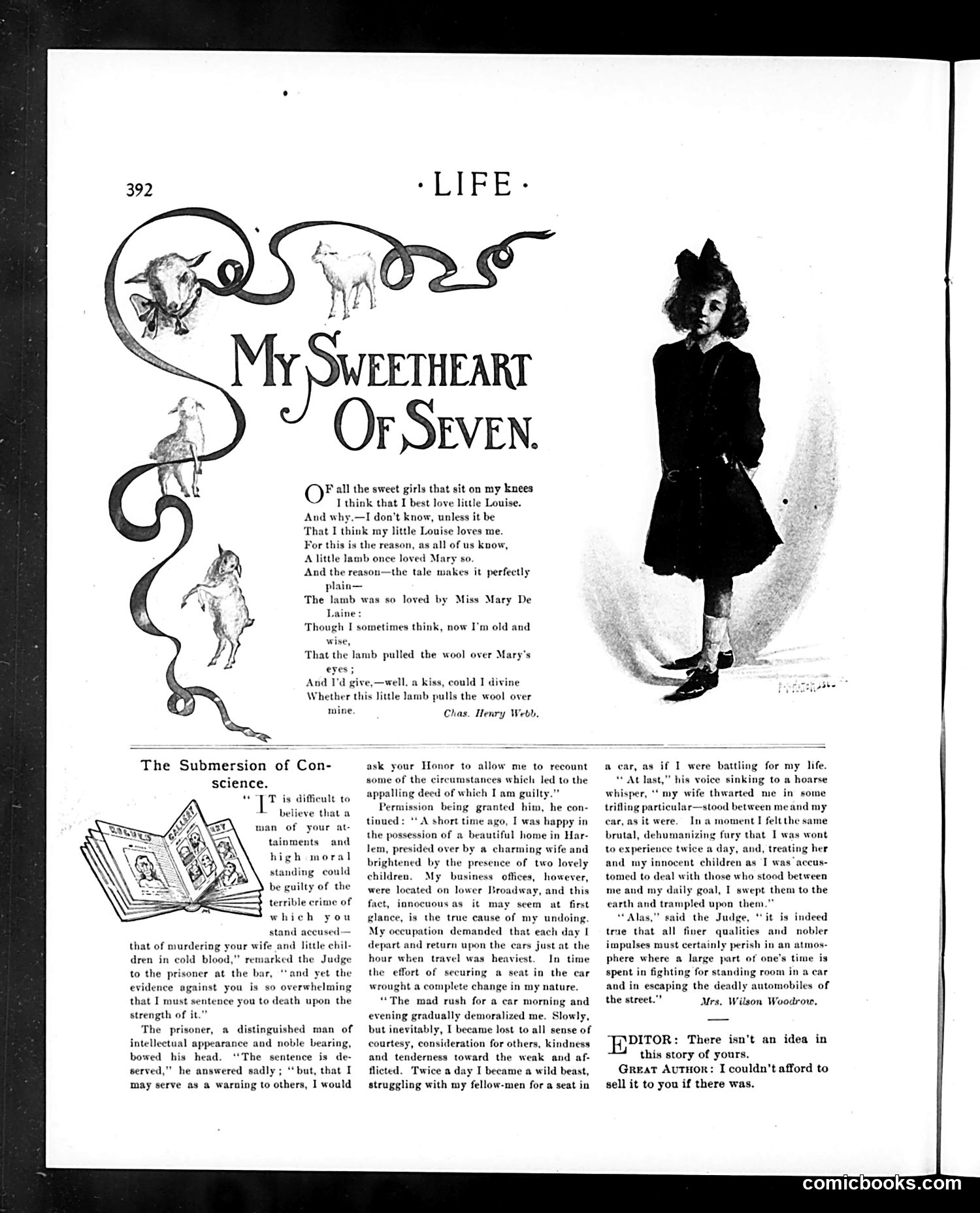
This page contains two satirical pieces critiquing urban life in turn-of-the-century America. **"My Sweetheart of Seven"** is a sentimental poem by Chas. Henry Webb about childhood affection, accompanied by an illustration of a young girl. It's primarily nostalgic content. **"The Submersion of Conscience"** is the sharper satire. A distinguished man confesses to murdering his wife and children, but blames his crime on commuter rage—specifically, the daily brutality of fighting for seats on crowded public transportation ("lower Broadway"). The satirist argues that the dehumanizing stress of urban commuting stripped away his moral character and civility, transforming him into a "wild beast" twice daily. The joke/critique: This absurdly exaggerates how modern urban life corrupts decent people, suggesting commuter culture itself is the real villain. It mocks both the prisoner's self-pitying excuse-making and implicitly critiques how industrialized city living dehumanizes its inhabitants. The editor's quip at bottom is unrelated editorial humor.
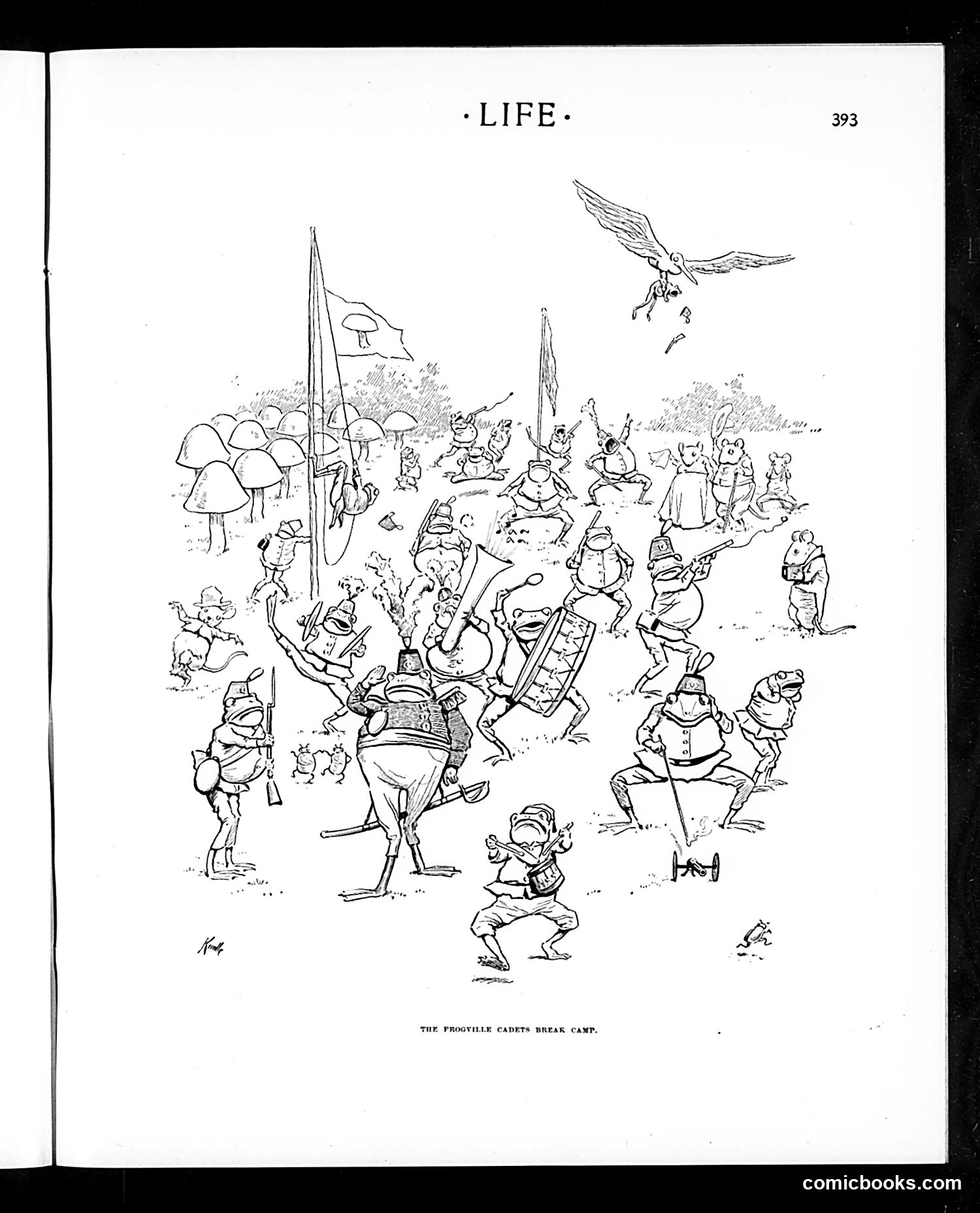
This is a whimsical illustration depicting anthropomorphic frogs conducting a military encampment. The frogs are dressed as soldiers with uniforms, helmets, and weapons, performing various camp activities—marching, carrying supplies, and organizing formations. A bird flies overhead, and mushroom-shaped tents dot the landscape. The satire appears to mock military organization and discipline by applying it absurdly to frogs. This likely references contemporary military practices or possibly a specific militia or cadet program of the era. The humor derives from the incongruity of taking small amphibians seriously as soldiers. The detailed, orderly composition contrasts amusingly with the ridiculous subject matter. Without knowing the specific publication date or political context, the precise target remains unclear, but the cartoon likely satirizes military pomposity or regimentation through this farcical lens.
This page contains three separate humorous pieces typical of Life's satirical content: 1. **"The Vernacular"**: A dialogue joke between two gum-chewing girls using exaggerated slang and dropped g's ("Gotcher money?", "Howbout?"). The humor relies on mockery of working-class speech patterns. 2. **"Football Days"**: A poem satirizing college football's violence, describing players being beaten, having teeth knocked out, and crowds of spectators injured. It mocks both the brutality of the sport and spectators' enthusiasm for witnessing such carnage. 3. **"A Butcher's Lad"**: An anecdote about a delivery boy confronting a fierce dog, with a moral about courage. The page also contains advertisements for Wilson Whiskey, a sanatorium for "Drug and Alcoholic Addictions," Esterbrook pens, and Carl H. Schultz mineral waters. **Context for modern readers**: Life magazine (1883-1936) was primarily satirical, mocking contemporary American manners, speech, and social behaviors through humor and light verse.
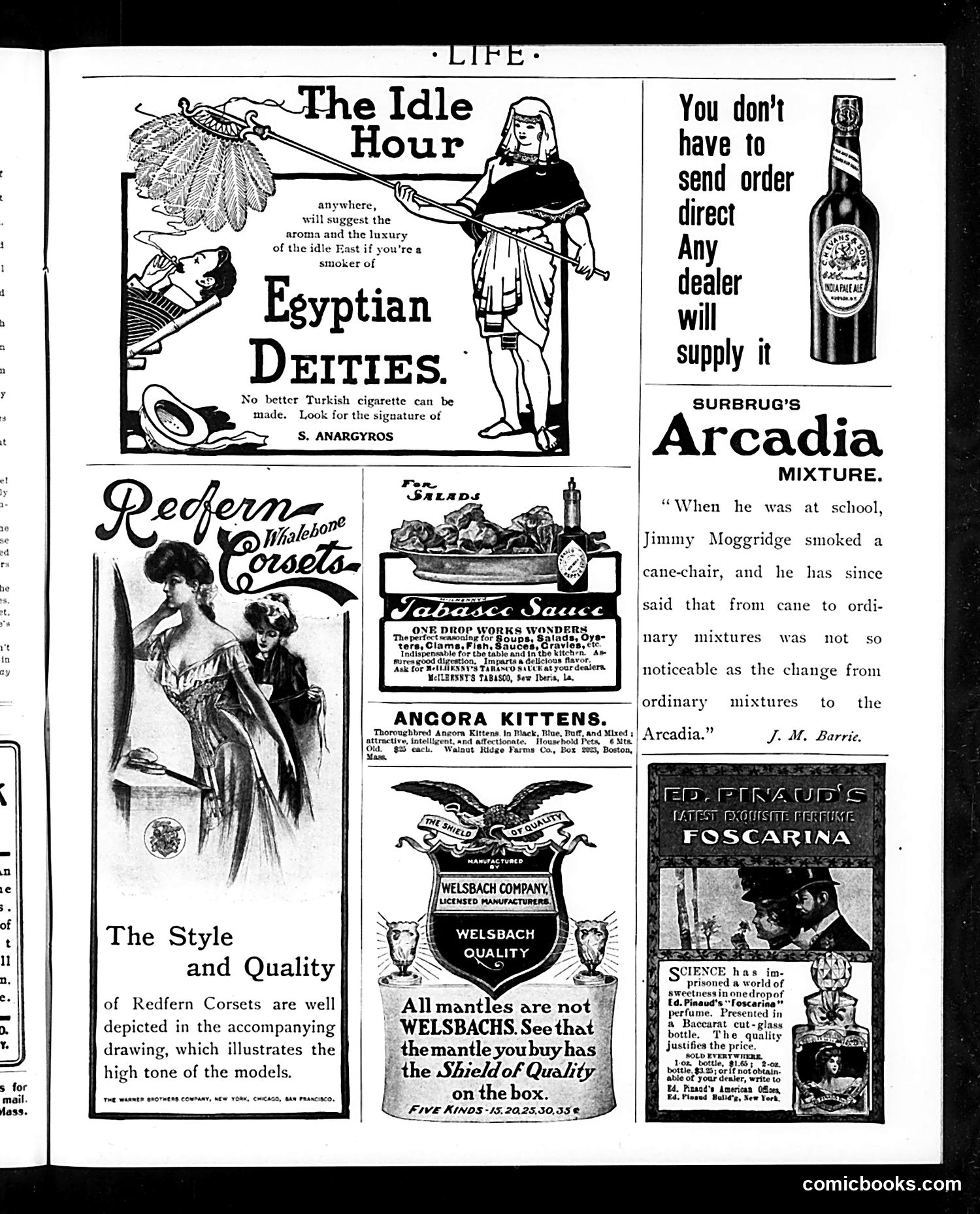
This page is primarily **advertising**, not political satire. It contains six product advertisements typical of early 20th-century magazines: 1. **Egyptian Deities cigarettes** - marketed with orientalist imagery (pharaoh figure, fan) to evoke luxury and exoticism 2. **Redfern Corsets** - using fashion illustration to suggest elegance 3. **Tabasco sauce** - emphasizing culinary quality 4. **Angora kittens** - a pet breeder advertisement 5. **Welsbach mantles** - gas lamp components with quality guarantee 6. **Surbrugh's Arcadia Mixture** tobacco and **Foscarina perfume** - the latter featuring a testimonial from writer J.M. Barrie The page reflects period attitudes toward consumption, colonialism (Egyptian/Oriental mystique), and product endorsement by celebrities. There is no apparent satirical commentary—this appears to be a standard revenue page from *Life* magazine featuring paid advertisements designed to appeal to affluent readers.
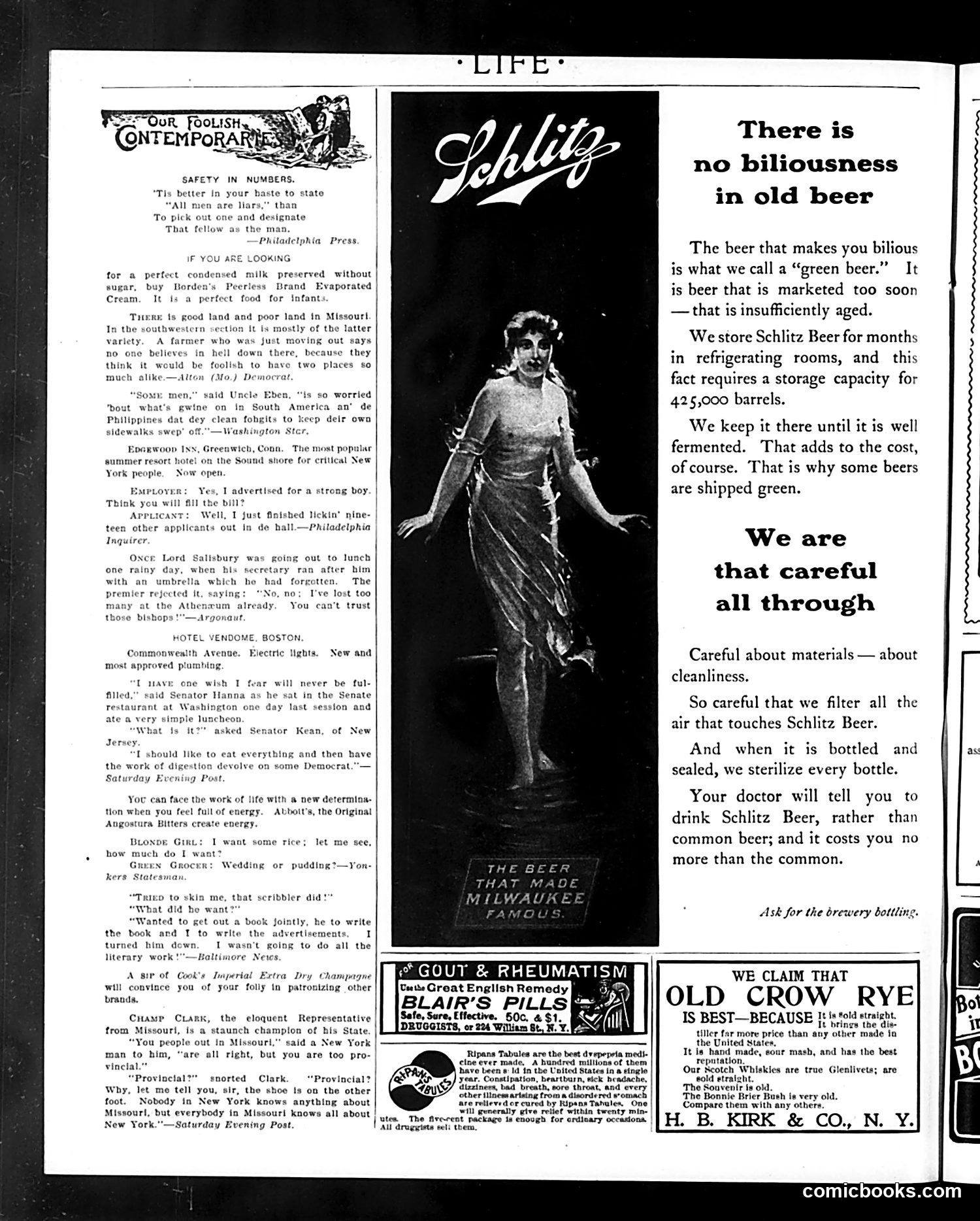
This page from Life magazine contains **satirical commentary and advertisements rather than political cartoons**. The main content consists of: **"Our Foolish Contemporaries"** — a humor column featuring short, disconnected anecdotes mocking various contemporary figures and situations. These include jibes at politicians (Lord Salisbury), regional stereotypes (Missourians), and social pretension. The humor relies on wordplay and ironic observations about everyday life. **Schlitz Beer Advertisement** (center-right) — the dominant paid content, emphasizing the beer's careful aging, cleanliness standards, and medical endorsement. This reflects early 20th-century advertising that appealed to health-consciousness. The page also includes advertisements for other products (Borden's milk, Ripans Tabules, Blair's Pills, Old Crow Rye), typical of Life's revenue model. **Context for modern readers:** This represents Life as a **humor and lifestyle magazine** (pre-dating its later photojournalism focus), where advertising subsidized satirical content targeting educated, urban American audiences.
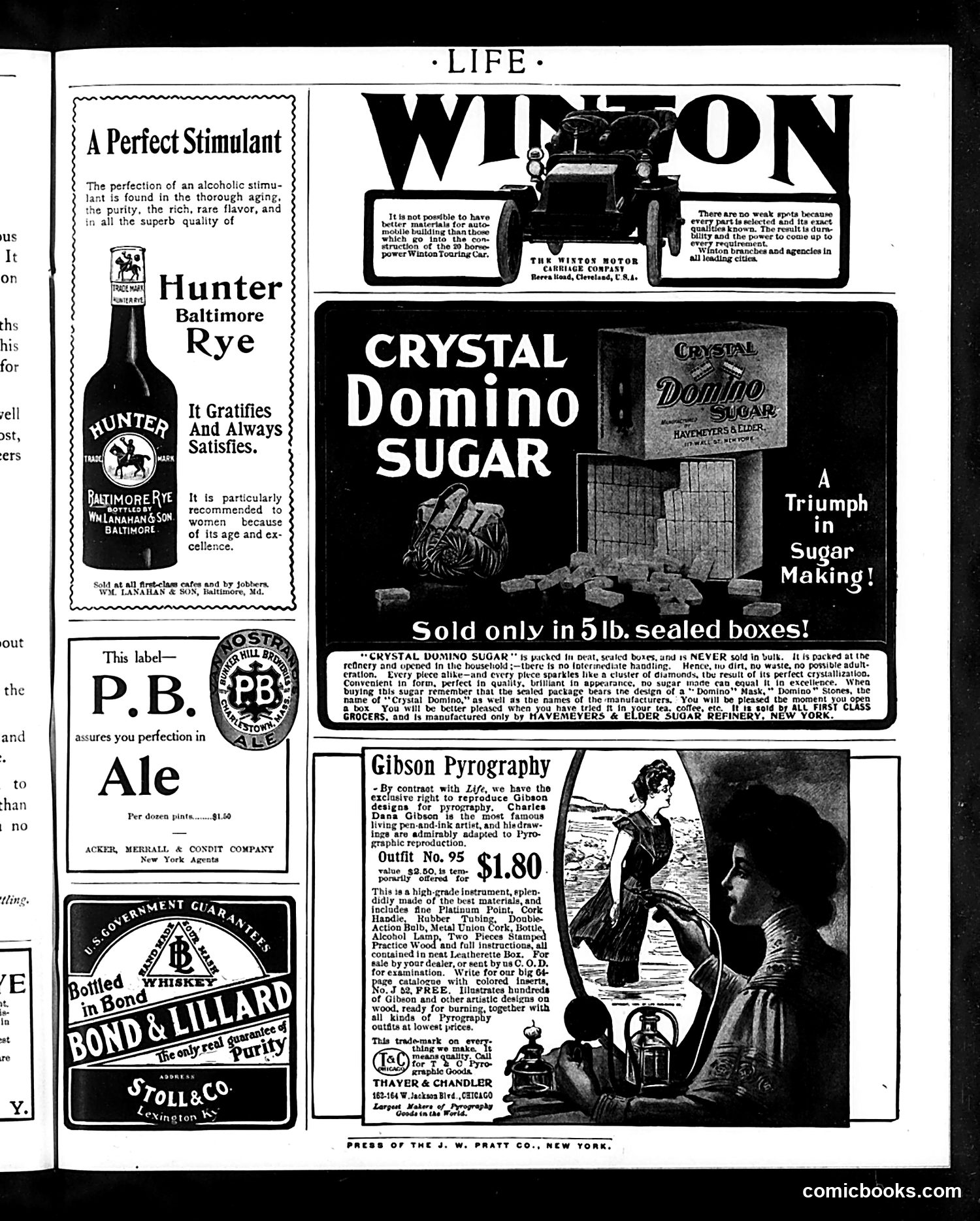
This page is primarily **advertising**, not editorial or satirical content. It contains four distinct product advertisements from the early 20th century: 1. **Hunter Baltimore Rye** - whiskey marketed as a "perfect stimulant," notably promoted to women for its "age and excellence" 2. **Winton Motor Car** - automobile advertisement claiming superior power and reliability across branches nationwide 3. **Crystal Domino Sugar** - sugar sold in sealed boxes, emphasizing purity and crystalline perfection 4. **Gibson Pyrography Outfit** - a woodburning craft kit featuring designs by Charles Dana Gibson (the famous "Gibson Girl" illustrator), priced at $1.80 The advertisements reflect period marketing conventions: appeals to quality, exclusivity, and consumer respectability. The liquor ads are notably direct—alcoholic products were legally advertised before Prohibition (1920). Gibson's celebrity endorsement represents early commercial use of famous artists' names. No political satire is present; this is straightforward commercial messaging typical of Life's revenue model.
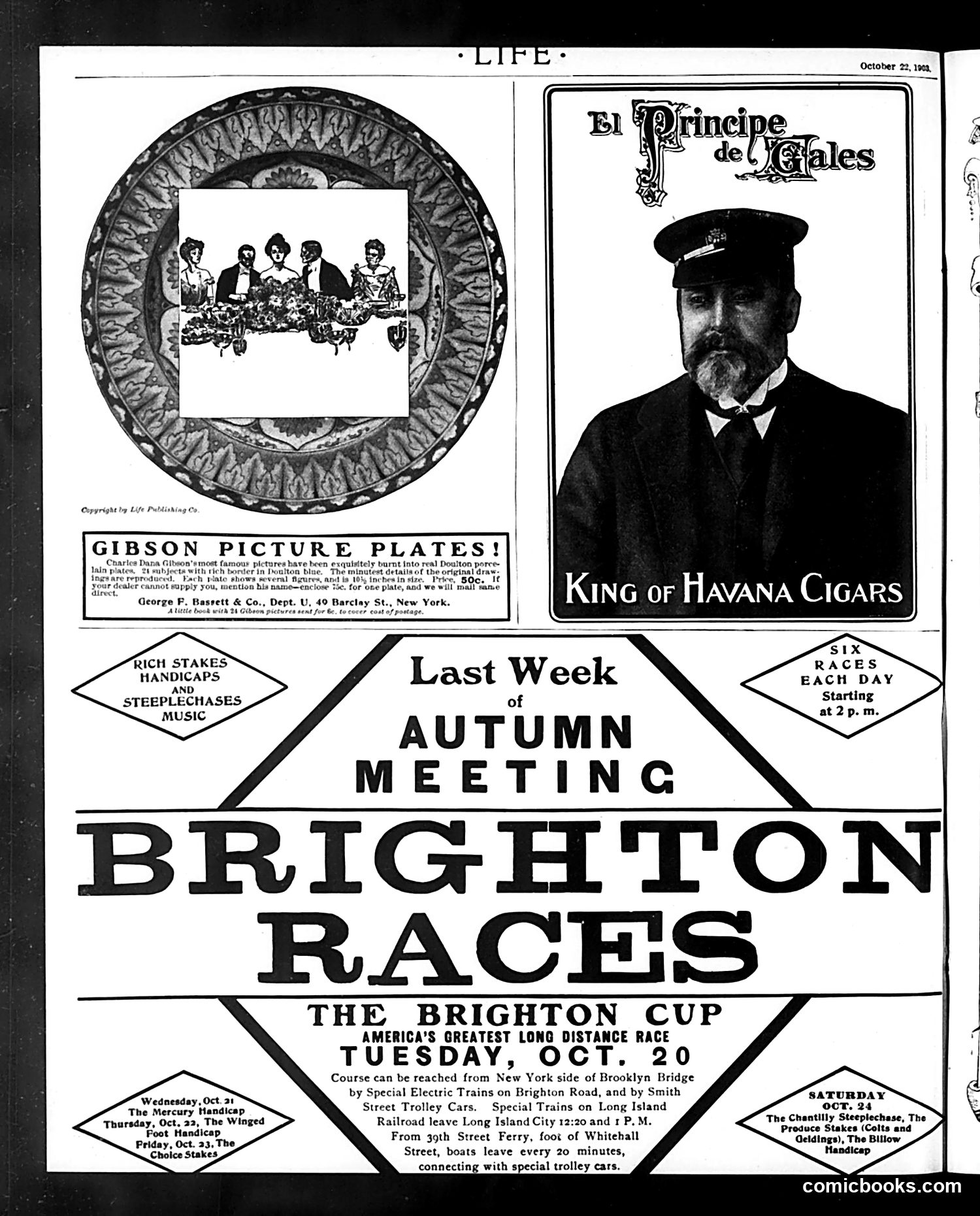
This October 22, 1903 *Life* magazine page is primarily **advertising**, not political satire. The upper half contains two ads: Gibson Picture Plates (decorative Doulton porcelain featuring Charles Dana Gibson's famous "Gibson Girl" illustrations) and El Príncipe de Gales cigars, featuring a bearded man in naval uniform labeled "King of Havana Cigars." The dominant feature is a large advertisement for **Brighton Races**, promoting the Autumn Meeting at Brighton Beach, Brooklyn—specifically "The Brighton Cup," described as "America's Greatest Long Distance Race" on Tuesday, October 20. The ad includes detailed transportation information (electric trains, trolleys, ferries from Manhattan) and lists various races throughout the week with their schedules and types (handicaps, steeplechases). There is **no political cartoon or satire** on this page—it's a commercial publication showcasing period leisure activities (horse racing, decorative arts, cigars) and early 1900s transportation infrastructure.