
Life, 1903-10-22 · page 6 of 20
Life — October 22, 1903 — page 6: what you’re looking at
What you’re looking at
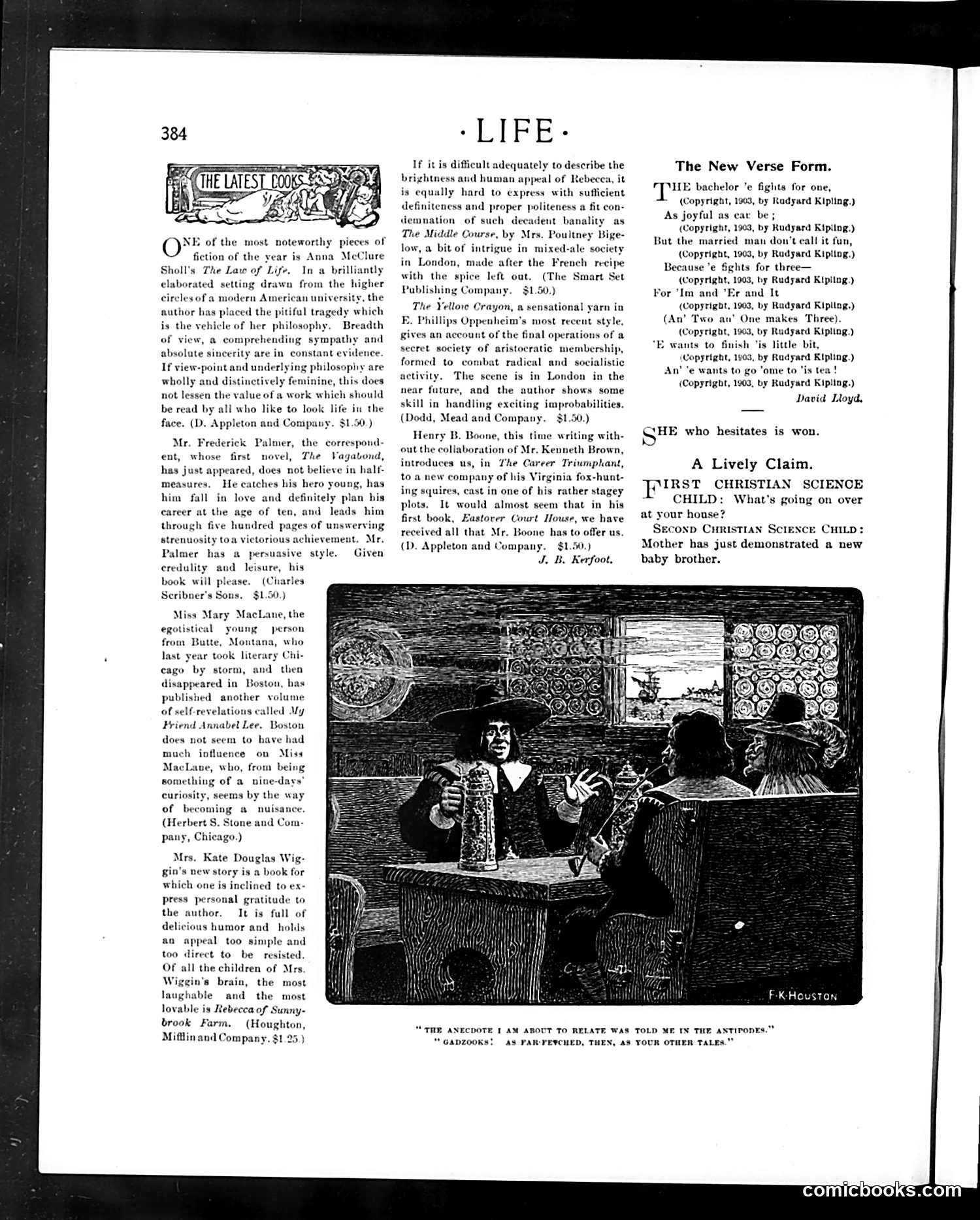
This page features a single cartoon by F.K. Houston showing two figures in what appears to be a Victorian-era interior. One man in period dress gestures animatedly while speaking to another figure. The caption reads: "The anecdote I am about to relate was told me in the antiques." / "Garçooks; as far fetched, then, as your other tales." The humor appears to target the social pretension of antique dealers and collectors who fabricate elaborate provenance stories for their wares. The joke mocks how such dealers claim their items come with colorful historical "anecdotes," implying these narratives are as unreliable as the dealer's other tall tales. It's satire on the credulity required to believe antique merchants' claims about their goods' origins and significance.
📄 Transcribed text from this page (OCR, searchable)
Machine-transcribed from the original scan — historical spelling and the odd misread are preserved.
NE of the most noteworthy. pieces of fiction of the year is Ani McClure Sholl's The Law of Life. In a brilliantly aborated setting drawn from the higher circles of a modern American university, the author has placed the pitiful tragedy which is the vehicle of her philosophy. Breadth of view, a comprehending sympathy and absolute sincerity are in constant evidence If view-point and underlying philosophy are wholly and distinctivel inine, this does not lessen the value of a work which should be read by all who like to look life in the face. (D. Appleton and Compauy. $1.50.) Mr. Frederick Palmer, the correspond- ent, first The Vagabond, has just appeared, does not believe in halt- measures. He catches his hero young, has him fall in love and definitely plan his career at the age of ten, and leads him through five hundred pages of unswerving strenuosity toa victorious achievement. Me. Palmer has a persuasive style. Given credulity and leisure, his book will please. (Charles Scribner's Sons. $1.50.) Miss Mary M. egotistical young from Butte, Montana, who Chi- whose vel, ‘Lane, the person last year took literary cago by storm, and then disappeared in Boston, has another volume velations called My Boston publishe¢ of self-r Friend Annabel Lee. vem to have had Miss ne, Who, from being does not much influence on M something of a nine-days’ curiosity, seems by the way of becoming a nuisan (Herbert pany, Chicago.) tone and C Mrs. Kate Douglas Wig- a book for 8 new story i which one is inclined to ex- press personal gratitude to the author. It is full of delicious humor and holds an appeal too simple and too direct to. be Of all the children of Mrs Wiggin’s brain, the most laughable and the lovable is Rebecca of Sunny- brook Farm. (Houghton, Mifllin and Company. $1.25.) resisted most -LIFE- If it is difficult adequately to describe the brightness and human appeal of Rebecea, it is equally hard to express with sufficient definiteness and proper politeness a fit con- nation of such decadent banality as The Middle Course, by Mrs. Poultney Bige- low, a bit of intrigue in mixed-a ety in London, made after the French recipe with the spice left out. (The Smart Set Publishing Company. $1.50.) le soc’ The Yellow Crayon, a sensational yarn in E. Phillips Oppenheim’ i ‘ives an account of the final operations of a society of aristocratic membership, formed to combat radical and socialistic tivity. The scene is in London in the near future, and the author shows some skill in handling exciting improbabilities. (Dodd, Mead and Company. $1.50.) most recent sty Henry B. Boone, this time writing with- out the collaboration of Mr. K th Brown, introduces us, in The Career Triumphant, to a new company of his Virginia fox-hunt- ing squires, cast in one of his rather stagey plots, It would almost seem that in his first book, Eastover Court House, we have received all that Mr. Boone has to offer us. (D. Appleton and Company. $1.50.) . B. Kerfoot, The New Verse Form. HE bachelor ‘e fights for one, (Copyright, 1903, by Radsard Kipling.) As joyful as be; (Copyright, 1903, by Rudgard Kipilng.) But the married man don't call it fun, (Copsright, 1903, by Rudyard Kipling.) Because ’e Sghts for three— (Copsright, 1903, by Rudyard Ktpilng.) For ‘Im and ’Er and It (Copyright, 1903, by Radyard Kipling.) (An’ Two au’ One makes Three). (Copyright, 1963, by Rudyard Kipling.) ‘E wants to finish ‘is little bit, Copyright, 1903, by Rudyard Kipling.) An’ ‘e wants to go ‘ome to ‘is tea! (Copyright, 1903, by Rudyard Kipling.) David Lloyd, SHE who hesitates is won. A Lively Claim. FIRst CHRISTIAN SCIENCE CHILD: What's going on over at your house? Seconp Cristian ScteNce CHILD: Mother has just demonstrated a new baby brother. “THE ANECDOTE f AM ABOUT TO RELATE WAS TOLD ME IN THE ANTIPODES.” AS TARPEYCHED, THEN, 48 YOUR OTHER TALES.” “ GapzooKs!