
Life, 1903-10-22 · page 14 of 20
Life — October 22, 1903 — page 14: what you’re looking at
What you’re looking at
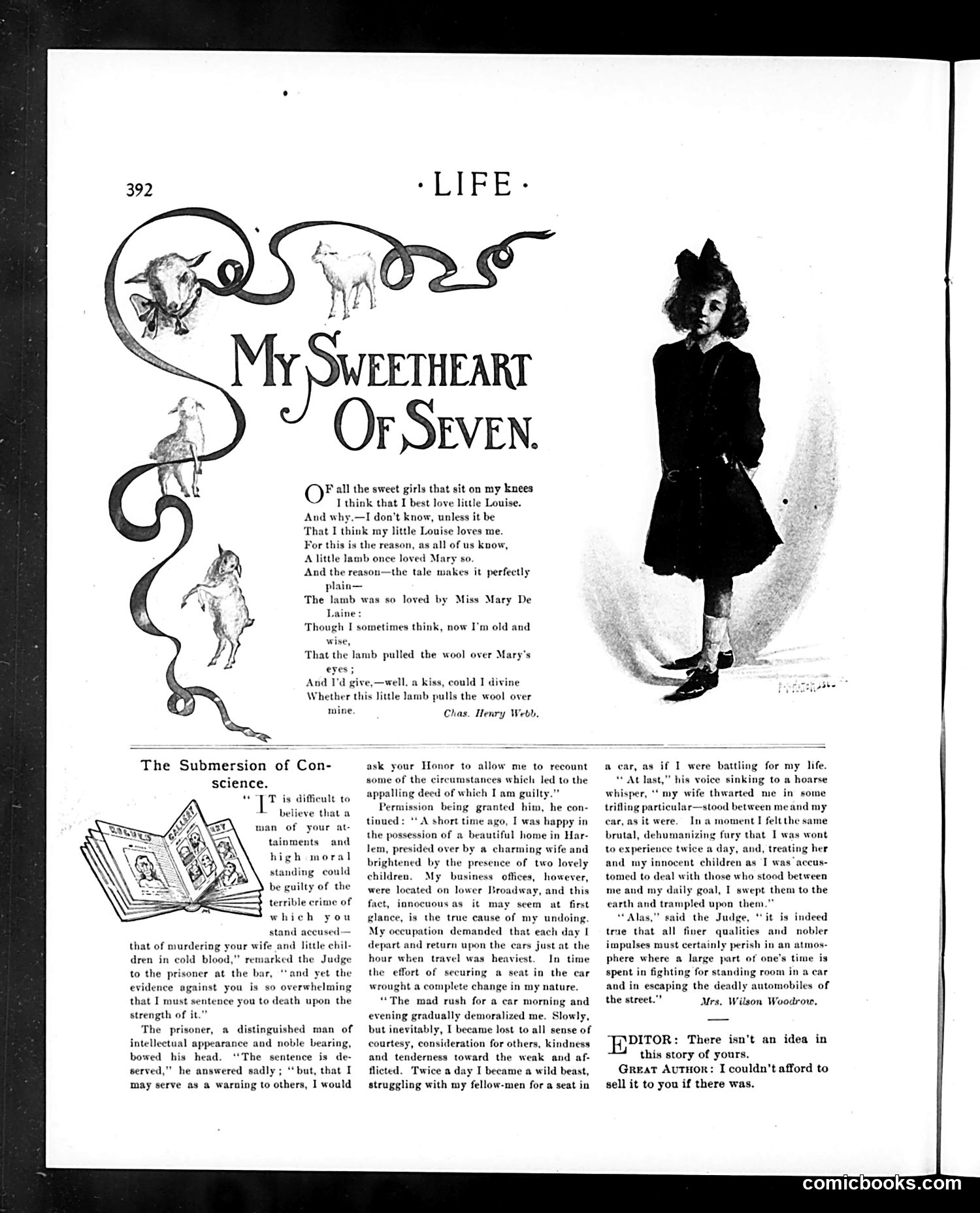
This page contains two satirical pieces critiquing urban life in turn-of-the-century America. **"My Sweetheart of Seven"** is a sentimental poem by Chas. Henry Webb about childhood affection, accompanied by an illustration of a young girl. It's primarily nostalgic content. **"The Submersion of Conscience"** is the sharper satire. A distinguished man confesses to murdering his wife and children, but blames his crime on commuter rage—specifically, the daily brutality of fighting for seats on crowded public transportation ("lower Broadway"). The satirist argues that the dehumanizing stress of urban commuting stripped away his moral character and civility, transforming him into a "wild beast" twice daily. The joke/critique: This absurdly exaggerates how modern urban life corrupts decent people, suggesting commuter culture itself is the real villain. It mocks both the prisoner's self-pitying excuse-making and implicitly critiques how industrialized city living dehumanizes its inhabitants. The editor's quip at bottom is unrelated editorial humor.
📄 Transcribed text from this page (OCR, searchable)
Machine-transcribed from the original scan — historical spelling and the odd misread are preserved.
My SweetHeart all the sweet girls that sit on my knees I think that I best love little Louise. And why.—I don’t know, unless it be I think my little Louise loves me. ‘or this is the reason, as all of us know, A little lamb once loved Mary so. And the reasou—the tale makes it perfectly plain— The lamb was so loved by Miss Mary De Laine: Though I sometimes think, now I'm old and jamb pulled the wool over Mary's And I'd gi Whether this mine, 1. a kiss, could I divine mb pulls the wool over The Submersion of Con- science. ficult to “TT I believe th: man of your at- tainments and high standing could moral be guilty of the terrible crime of which you stand accused— that of murdering your wife and little chil- dren in cold blood,” remarked the Judge to the prisoner at the bar, “and yet the evidence against you is so overwhelming that I must sentence you to death upon the strength of it The prisoner, a distinguished man of intellectual appearance and noble beari bowed his head. ‘The sentence served,” he answered sadly ; “but, that I may serve as a warning to others, I would Chas. Henry Webb, ask your Honor to allow me to recount some of the circumstances whicl led to the appalling deed of which I am guilty.” Permission being granted him, he con- tinued: “A short time ago, I was happy in the possession of a beautiful home in Har- lem, presided over by a charming wife and brightened by the presence of two lovely children. My business offices, however, were located on lower Iro nd this fact, innocuous as it may seem at first glance, is the true cause of my undoing My occupation demanded that each day I depart and return upon the cars just at the hour when travel was he In time the effort of securing a seat in the car wrought a complete change in my nature. “The mad rush for a car morning and evening gradually demoralized me. Slowly, but inevitably, I became lost to all sense of courtesy, consideration for others, kindness and tenderness toward the weak and af- flicted. Twice a day I became a wild beast, struggling with my fellow-men for a seat in viest. a car, as if I were battling for my life. At last,” his voice sinking to a hoarse whisper, “my wife thwarted m trifling particular—stood between meand my as it were. Ina moment! feltthe same brutal, dehumanizing fury that I was wont to experi y, and, treating her and my innocent children as TI was’ accus- tomed to deal with those who stood between me and my daily goal, I swept them to the earth and trampled upon them.” “Alas,” said the Judgs it is indeed true that all finer qualities and impulses must certainly perish in an atmos- phere where a large part of one’s time is spent in fighting for standing room in a car and in escaping the deadly automobiles of the street.” in some nob! Mrs. Wilson Woodrow. BPrror: There isn't an idea in this story of yours. Great AvutHor: I couldn't afford to sell it to you if there was. comicbooks.com