
Life, 1903-10-22 · page 4 of 20
Life — October 22, 1903 — page 4: what you’re looking at
What you’re looking at
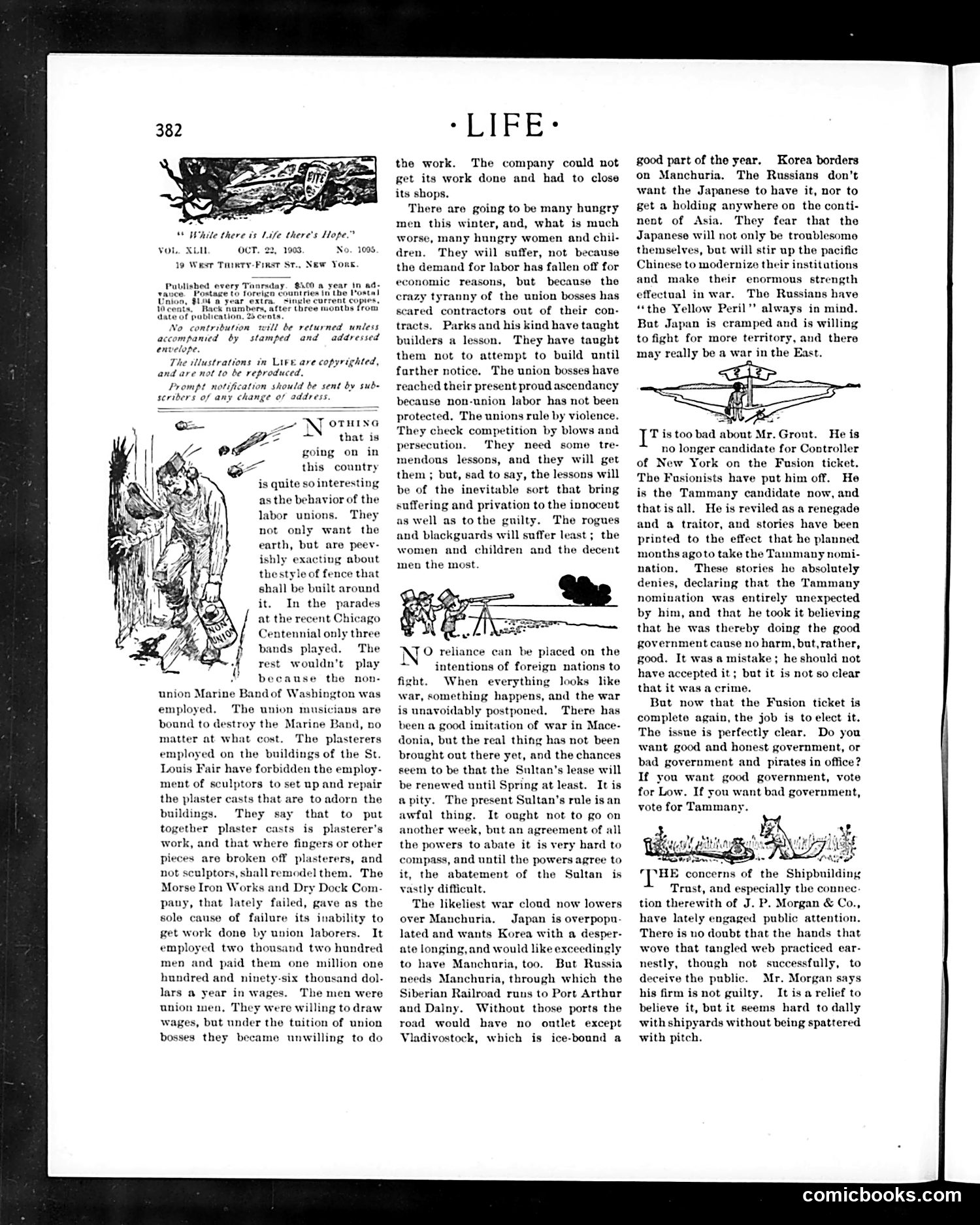
This page from *Life* (October 22, 1903) contains editorial commentary on labor disputes and union politics rather than traditional political cartoons. The left illustration depicts a figure opposing union demands, satirizing resistance to organized labor. The text criticizes union bosses for using "violence" and "blows" to enforce strikes, while acknowledging workers' legitimate grievances about wages and conditions. The right section discusses Mr. Gront's removal as New York Comptroller candidate on the "Fusion ticket"—a reform coalition. The author suggests Gront was rejected as a "renegade and traitor" by Tammany Hall (the Democratic political machine), implying internal political maneuvering. The final section addresses J.P. Morgan & Co.'s shipbuilding interests, suggesting corporate influence on public opinion regarding labor matters.
📄 Transcribed text from this page (OCR, searchable)
Machine-transcribed from the original scan — historical spelling and the odd misread are preserved.
“\ While there is Life there's Hope.” vou. XM OCT. 22, 1903 N No. 1098. 19 West Truety-Finsr St., New Yous. $400 a year In ad- Countries In the rosea vr after three months from No contribution will be returned unless accompanied by stamped and addressed envelope. The illustrations in Like are copyrighted, and are not to be reproduced. mpt notification should be sent by sub- eof address. OTHING that is going on in this country is quite so interesting as the behavior of the labor unions. They not only want the earth, but are peev- ishly exacting about the style of fence that shall be built around it. In the parades at the recent Chicago Centennial only three bands played. The rest wouldn't play ’ because the non- union Marine Bandof Washington was employed. The union musicians are bound to destroy the Marine Band, no matter at what cost. The plasterers employed on the buildings of the St. Louis Fair have forbidden the employ- ment of sculptors to set up and repair the plaster casts that are to adorn the buildings. They say that to put together plaster casts is plasterer's work, and that where fingers or other pieces are broken off plasterers, and not sculptors, shall remodel them. The Morse Iron Works and Dry Dock Com- pany, that lately failed, gave as the sole cause of failure its inability to get work done by union laborers. It employed two thousand two hundred men and paid them one million one hundred and ninety-six thousand dol- lars a year in wages. The men were union men, They were willing to draw wages, but under the tuition of union bosses they became unwilling to do *LIPE= the work. The company could not get its work done and had to close its shops. There are going to be many hungry men this winter, and, what is much worse, many hungry women and chil- dren. They will suffer, not because the demand for labor has fallen off for economic reasons, but because the crazy tyranny of the union 3 has scared contractors out of their con- tracts. Parks and his kind have taught builders a lesson. They have taught them not to attempt to build until farther notice. The union bosses have reached their present proud ascendancy because non-union labor has not been protected. The unions rule by violence. They check competition by blows and persecution. ‘They need some tre- mendous lessons, and they will get them ; but, sad to say, the lessons will be of the inevitable sort that bring suffering and privation to the innoceut as well as tothe guilty. The rogues and blackguards will suffer least ; the women and children and the decent men the most N70 reliance can be piaced on the am intentions of foreign nations to fight. When everything looks like war, something happens, and the war is unavoidably postponed. There has been a good imitation of war in Mace- donia, but the real thing has not been brought out there yet, and the chances seem to be that the Sultan's lease will be renewed until Spring at least. It is apity. The present Sultan’s rule is an awfal thing. It ought not to go on nother week, but an agreement of all the powers to abate it is very hard to compass, and until the powers agree to it, the abatement of the Saltan is vastly difficult. The likeliest war cloud now lowers over Manchuria. Japan is overpopu- lated and wants Korea with a desper- ate longing, and would like exceedingly to have Manchnria, too. But Russia needs Manchuria, through which the Siberian Railroad runs to Port Arthur and Dalny. Without those ports the road would have no ontlet except Viadivostock, which is ice-bound a good part of the year. Korea borders on Manchuria. The Russians don’t want the Japanese to have it, nor to get a holding anywhere on the conti- nent of Asia. They fear that the Japanese will not only be troublesome themselves, bat will stir up the pacific Chinese to modernize their institations and make their enormous strength effectual in war. The Russians have “the Yellow Peril’? always in mind. But Japan is cramped and is willing to fight for more territory, and there may really be a war in the East. T is too bad about Mr.Grout. He is no longer candidate for Controller of New York on the Fusion ticket. The Fasionists have put him off. He is the Tammany candidate now, and thatisall. He is reviled as a renegade and a traitor, and stories have been printed to the effect that he planned months agoto take the Tammany nomi- nation. These stories he absolutely denies, declaring that the Tammany nomination was entirely unexpected by him, and that he took it believing that he was thereby doing the good government cause no harm, but,rather, good. It was a mistake; he should not have accepted it; but it is not so clear that it was a crime. But now that the Fusion ticket is complete again, the job is to elect it. The issue is perfectly clear. Do you want good and honest government, or bad government and pirates in office? If you want good government, vote for Low. If you want bad government, vote for Tammany. i Nig concerns of the Shipbuilding Trust, and especially the conn tion therewith of J. P. Morgan & Co., have lately engaged public attention. There is no doubt that the hands that wove that tangled web practiced ear- nestly, though not successfully, to deceive the public. Mr. Morgan says his firm is not guilty, It is a relief to believe it, but it seems hard to dally with shipyards without being spattered with pitch. comicbooks.com