
Life, 1903-10-22 · page 12 of 20
Life — October 22, 1903 — page 12: what you’re looking at
What you’re looking at
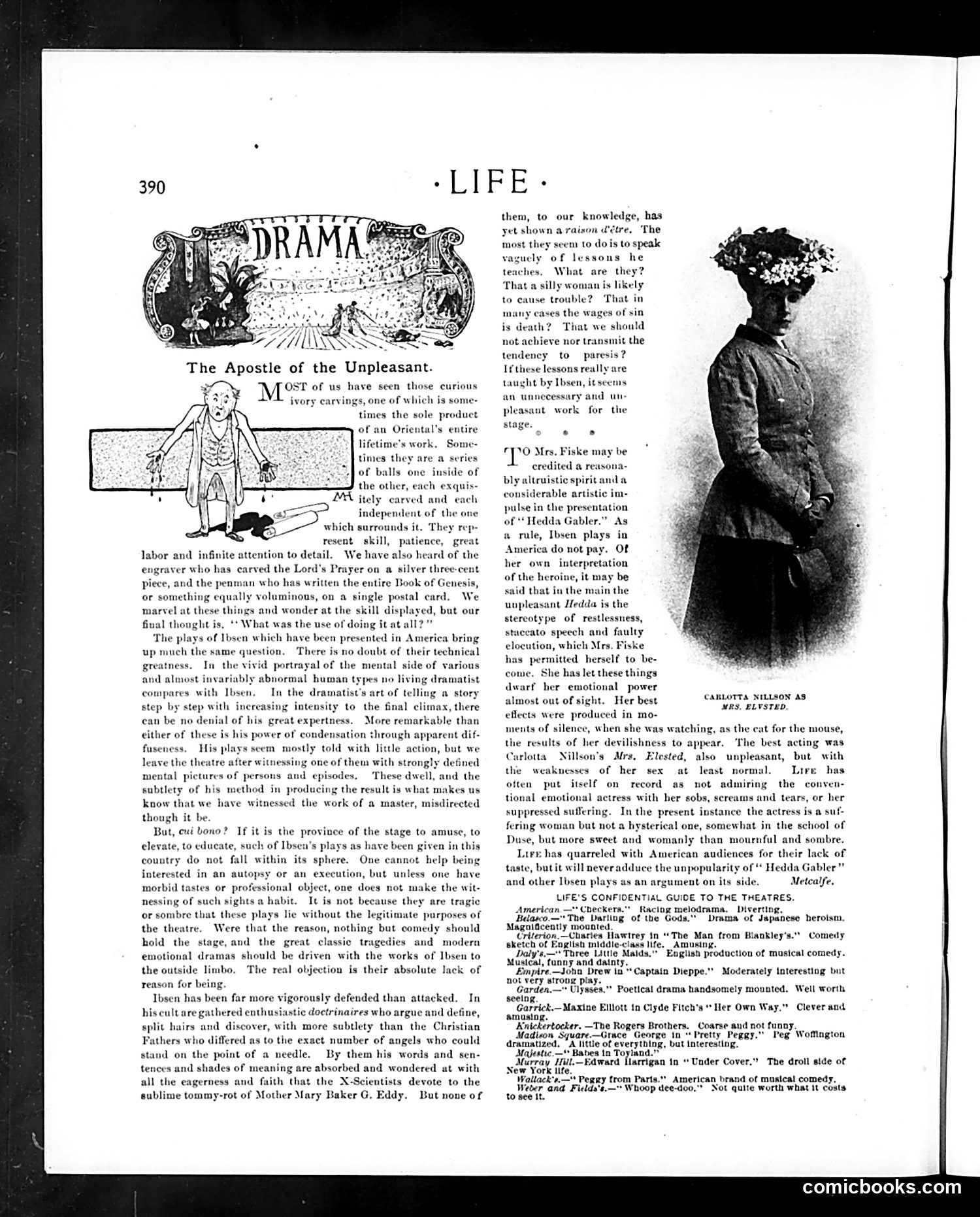
This page features a drama criticism section titled "The Apostle of the Unpleasant," discussing Henrik Ibsen's theatrical influence in America. The accompanying illustration shows an elderly bearded man in period dress—likely Ibsen himself—demonstrating the anatomical detail characteristic of ivory carvings (referencing the opening analogy about intricate craftsmanship). The critic argues that while Ibsen's plays showcase technical brilliance and psychological depth, they raise a fundamental question: "What was the use of doing it all?" The text critiques American productions of Ibsen's works, particularly praising Carlotta Nilsson's performance as Mrs. Elvsted while discussing how Ibsen's deliberately "unpleasant" dramas challenge conventional theatrical entertainment values. The satire targets both Ibsen's approach and American audiences' discomfort with serious dramatic content.
📄 Transcribed text from this page (OCR, searchable)
Machine-transcribed from the original scan — historical spelling and the odd misread are preserved.
MOST of us have seen those curious B\ ivory carvings, one of which is some- times the sole product of an Oriental’s entire lifetime's work, Some- times they are a series of balls one inside of the other, each exquis- 2M itely carved and each independent of the one which surrounds it. They rep- resent skill, patience, great labor and infinite attention to detail. We have also heard of the engraver who has carved the Lord's Prayer on a silver three-cent piece, and the penman who has written the entire Book of Genesis, or something equally voluminous, on a single postal card. We marvel at these things and wonder at the skill displayed, but our final thought is, ‘* What was the use of doing it at all? The plays of Ibsen which have been presented in America bring up much the same question, ‘There is no doubt of their technical greatness. In the vivid portrayal of the mental side of various and almost invariably abnormal human types compares with Ibsen. ing dramatist In the dramatist’s art of telling a story step by step with increasing intensity to the final climax, there can be no denial of his great expertness. More remarkable than either of these is his power of condensation through apparent dif- His plays seem mostly told with little action, but we leave the theatre ing one of them with strongly defined mental pictures of persons and episodes, These dwell, and the subtlety of his method in producing the result is what makes us know that we have witnessed the work of a master, misdirected though it be. But, cui bono? If it is the province of the stage to amuse, to elevate, to educate, such of Ibsen's plays as have been given in this country do not fall within its sphere. One cannot help being interested in an autopsy or an execution, but unless one have 1 object, one does not make the wit- nessing of such sights a habit. It is not because they are tragic or sombre that these plays lie without the legitimate purposes of the theatre, Were that the reason, nothing but comedy should hold the stage, and the great classic tragedies and modern emotional dramas should be driven with the works of Ibsen to the outside limbo. The real objection is their absolute lack of reason for being Ibsen has been far more vigorously defended than attacked. In his cult are gathered enthusiastic doctrinaires who argue and define, split hairs and discover, with more subtlety than the Christian Fathers who differed as to the exact number of angels who could stand on the point of a needle. By them his words and sen- tences and shades of meaning are absorbed and wondered at with all the eagerness aud faith that the X-Scientists devote to the sublime tommy-rot of Mother Mary Baker G. Eddy. But none of fuseness. ter witne: morbid tastes or professic them, to our knowledge, has yet shown a raison d'étre, The to speak of lessons he What are they? ‘That a silly woman is likely to cause trouble? That in y cases the wages of sin th? That we should not achieve nor transmit the tendency to paresis? If these lessons really are taught by Ibsen, itseems most they seem to doi an unnecessary and wn- pleasant work for the ny pe Mrs. Fiske may be credited a reasona- bly altruistic spirit and a considerable artistic im- pulse in the presentation of “Hedda Gabler.” As a rule, Ibsen plays in America do not pay. Of her own interpretation of the heroine, it may be said that in the main the unpleasant Hedda is the stereotype of restlessness, staccato speech and faulty elocution, which Mrs. Fiske has permitted herself to be- come. She has let these things dwarf her emotional power almost out of sight. Her best effects were produced in mo- ments of silence, when she was watching, as the cat for the mouse, the results of her devilishness to appear. The best acting was Carlotta Nillson’s Mrs, Elested, also unpleasant, but with the weaknesses of her sex at least normal. Lire has often put itself on not admiring the conven- tional emotional actress with her sobs, screams and tears, or her suppressed suffering. Inthe present instance the actress is a suf- fering woman but not a hysterical one, somewhat in the school of Duse, but more sweet and womanly than mournful and sombre. Lire has quarreled with American audiences for their lack of taste, but it will never adduce the unpopularity of “* Hedda Gabler” Metcalfe, LIFE’S CONFIDENTIAL GUIDE TO THE THEATRES. American — Checkers." Racing melodrama. Diverting, Bdaso.—"The Darling of the Gods.” Drama of Japanese heroism. Magnificently mounted. Criterion.—Chaties Hawtrey in “The Man from Blankley’s." Comedy sketch of English middle-class life. Amusing. Daly's.—* Three Little Maids.” “English production of musical comedy. Musical, fanny and dainty. Empire —Jonn Drew in“ Captain Dieppe.” Moderately interesting but not very strong piay. Garden.— Ulysses.” Poetical drama handsomely mounted. Well worth seeing. Garrick.—Maxine Ellott tn Clyde Fitch's * Her Own Way.” Clever and amusing. Knickertocker. —The Rogers Brothers. Coarse aud not funny. Madison Square —Grace George in “Pretty Peggy.” Peg Woflagton dramatized, A litde of everything, but interesting. Majestic. —** Babes tn Toyland.” Murray Hitt.—Eaward {Harrigan in “Under Cover.” The droll side of New York lite. Wallack's.—"* Pegay trom Paris."" American brand of musical comedy. Weber and Fields's.—* Whoop dee-doo,. Not quite worth what it costs to see it, CARLOTTA NILLSON AS. MRS, ELVSTED. record as and other Ibsen plays as an argument on its side. comicbooks.com