
A complete issue · 36 pages · 1903
Life — October 1, 1903
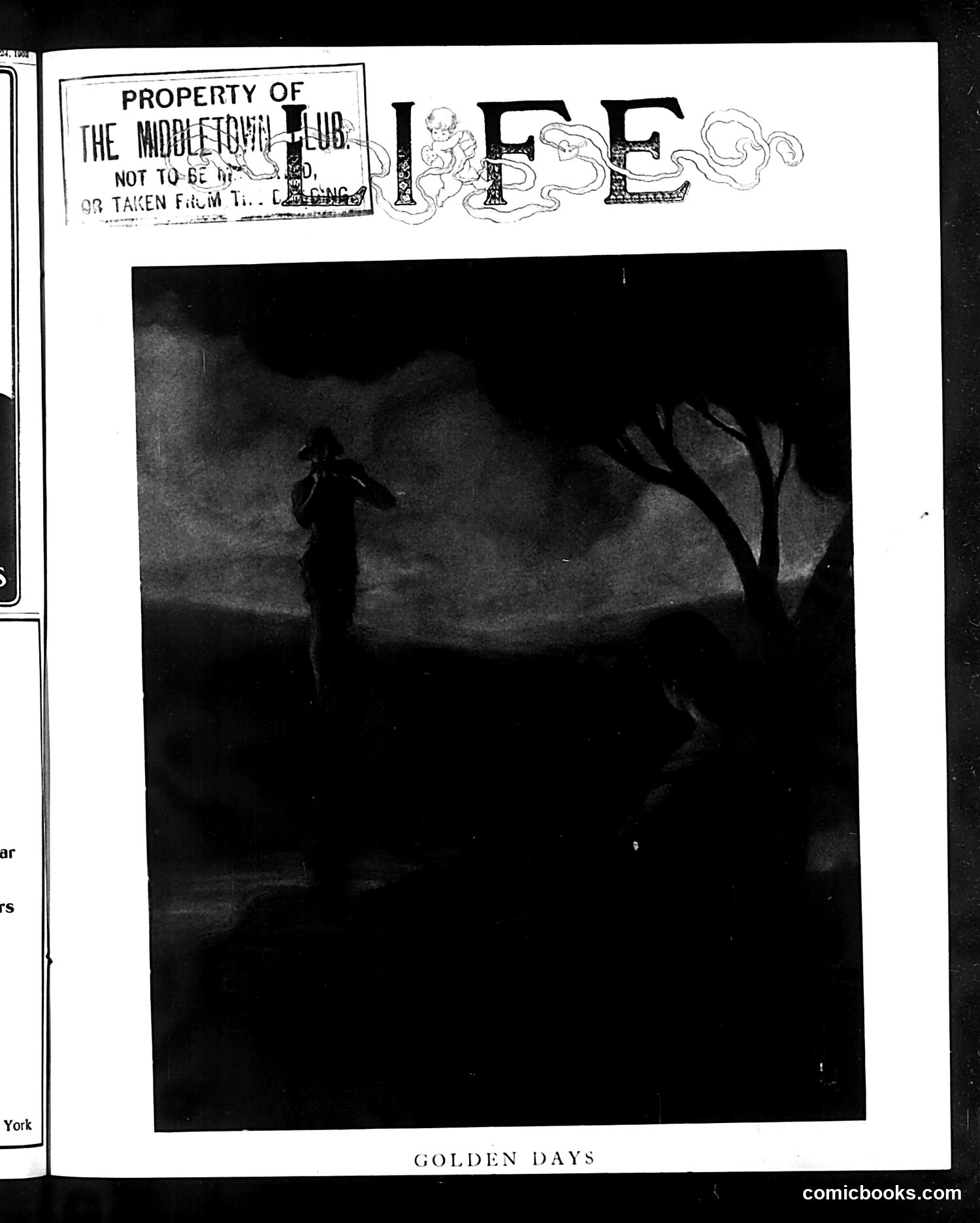
This page from the satirical magazine *Life* features the title "LIFE" with decorative cherub illustrations, and a dramatic silhouette image below labeled "GOLDEN DAYS." The silhouette depicts a solitary figure standing in a nighttime landscape with a bare tree, gazing toward a distant horizon. The image appears melancholic and introspective rather than celebratory, suggesting irony in the caption "GOLDEN DAYS." Without additional context or visible text explaining the specific reference, the cartoon likely satirizes nostalgia or romanticized views of the past. The contrast between the cheerful "golden days" phrase and the lonely, dark imagery suggests criticism of either false historical memory or disappointment with contemporary conditions. The exact political or social target remains unclear from this page alone.
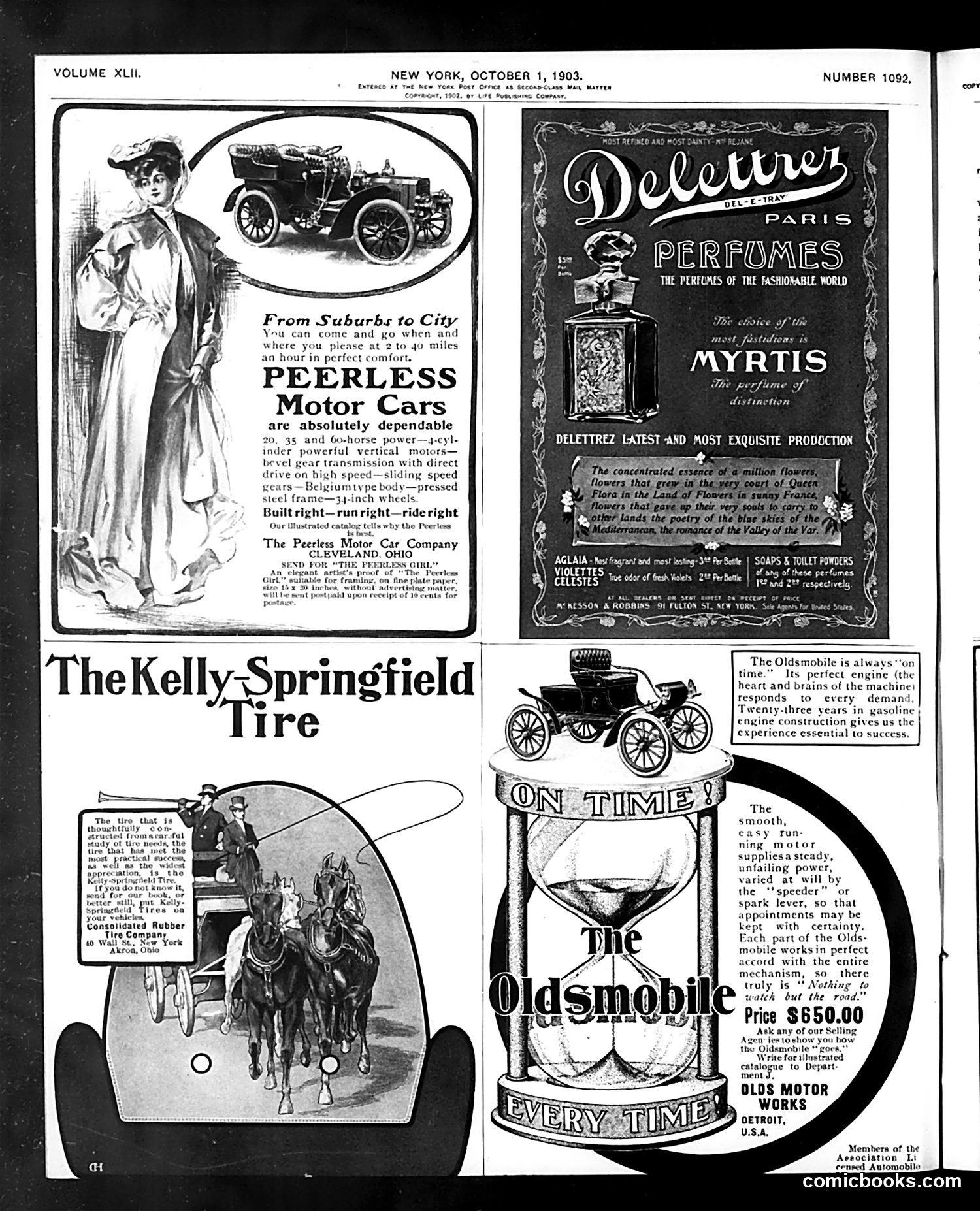
This page is primarily **advertising**, not political satire or editorial cartoons. The ads feature early 1900s automobiles and luxury goods: 1. **Peerless Motor Cars** - emphasizes reliability for suburban-to-city travel (20-40 miles) 2. **Delletrez Perfumes** - a Paris luxury brand highlighting "Myrtis" fragrance 3. **Kelly-Springfield Tire** - shows horses and carriages, suggesting tires suitable for both vehicles 4. **Oldsmobile** - priced at $650, marketed as dependable with proven engine design The humor is implicit rather than satirical: horses appear alongside automobiles, reflecting the transitional moment when motor cars were replacing horse-drawn transport. There are no identifiable political figures or sharp social commentary—just period advertising reflecting early automotive industry competition and luxury goods marketing to wealthy readers.
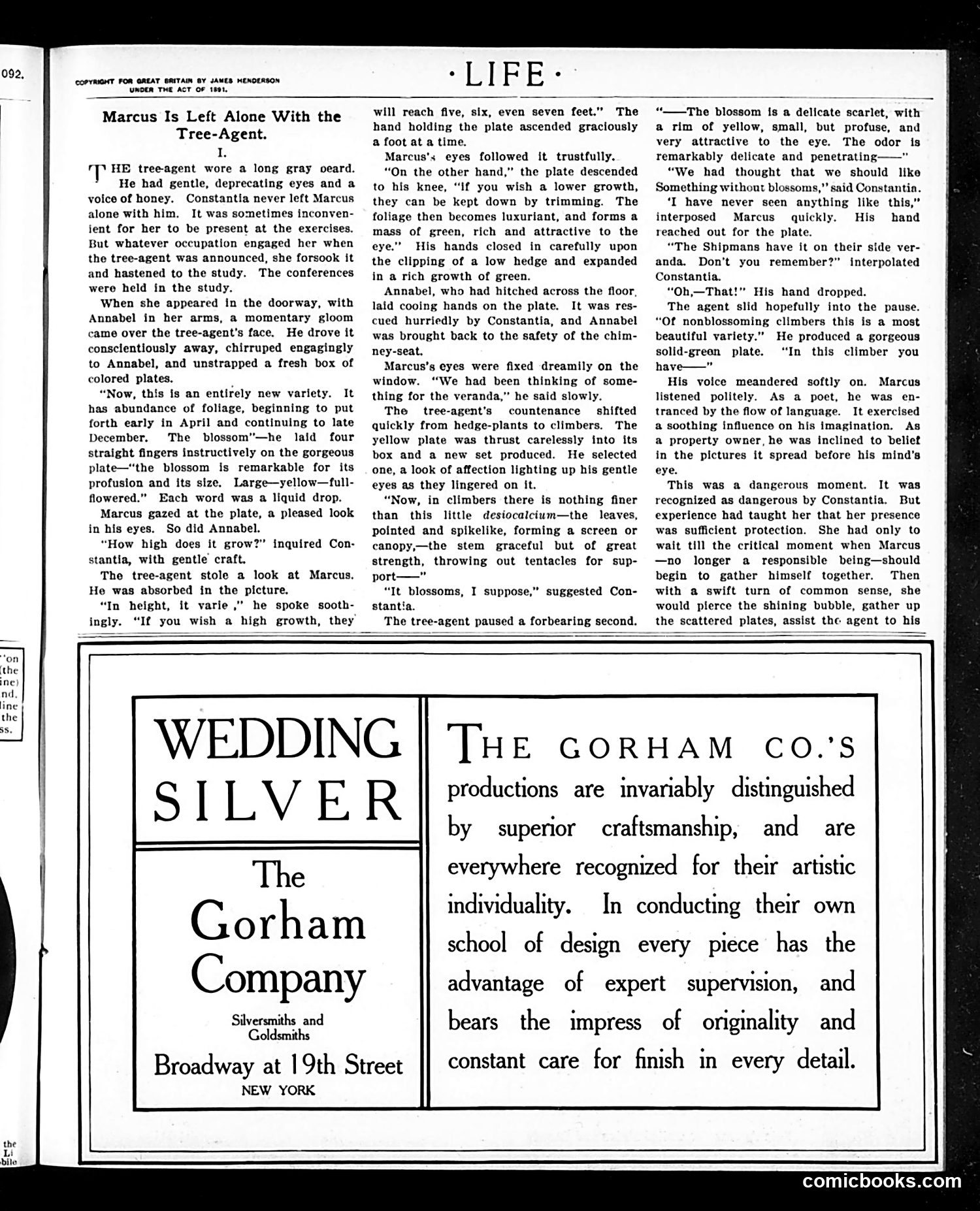
This page contains a short story titled "Marcus Is Left Alone With the Tree-Agent," featuring a narrative about a tree-agent (apparently a salesman or horticulturist) discussing plant varieties with characters named Marcus, Annabel, and Constantia. The story focuses on selecting and cultivating decorative plants, particularly discussing a "desioscelacium" plant with spiked leaves. The main content is a fictional narrative rather than political satire or editorial cartooning. The accompanying advertisement for The Gorham Company (a silversmith and goldsmith business located on Broadway at 19th Street, New York) occupies the lower portion. This appears to be a light entertainment/lifestyle piece rather than satirical commentary on contemporary political or social issues.
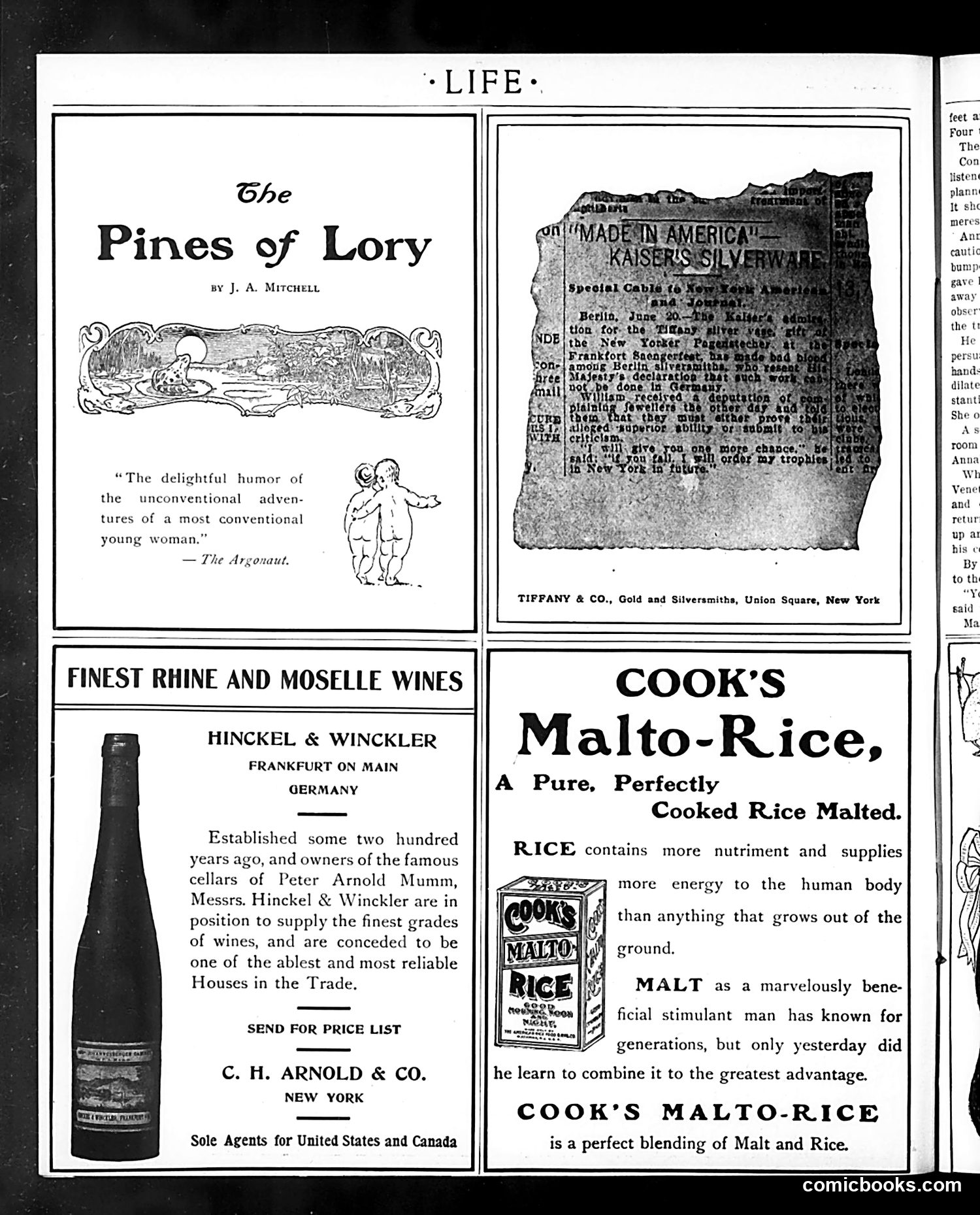
This page is primarily **advertising**, not satirical content. The top left features a book advertisement for "The Pines of Lory" by J.A. Mitchell, described as humorous fiction about a conventional young woman. The top right shows a "Made in America" Kaiser's Silverware advertisement—a German product marketed during an era when "Made in America" labeling was common. The bottom half contains two product ads: Hinckkel & Winckler Rhine and Moselle wines (German imports distributed by C.H. Arnold & Co.), and Cook's Malto-Rice, a nutritional rice-malt product claiming superior energy content. There are no political cartoons or satirical content visible. The page represents typical early 20th-century Life magazine advertising alongside book promotion.
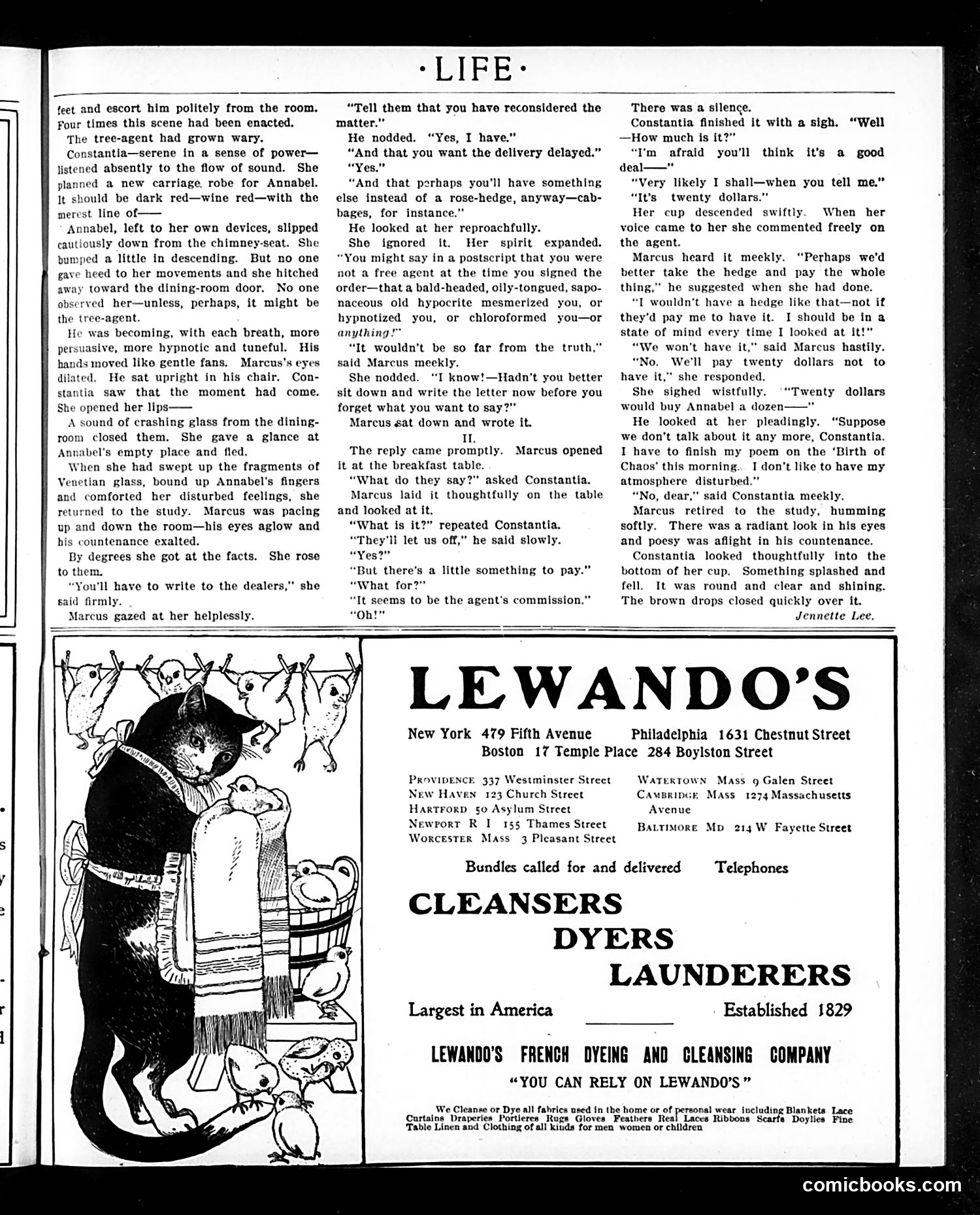
This page contains a short story titled "Life" (top) and a full-page advertisement for Lewando's cleaning service (bottom). The story depicts a domestic dispute between Marcus and Constantia over a business matter—seemingly an agent's commission on a delayed rose-hedge delivery. The narrative focuses on marital negotiation: Constantia wants Marcus to write to dealers about the matter, while Marcus deflects by claiming he's busy with poetry. Eventually, they negotiate: Marcus agrees to address the issue if Constantia pays him twenty dollars. The Lewando's advertisement features an anthropomorphic bear carrying laundry bundles surrounded by small animals. It advertises dry cleaning, dyeing, and laundering services across multiple American cities, claiming to be "Largest in America" and "Established 1829." Neither contains political satire or commentary—the story is domestic humor, the ad is straightforward commercial promotion.
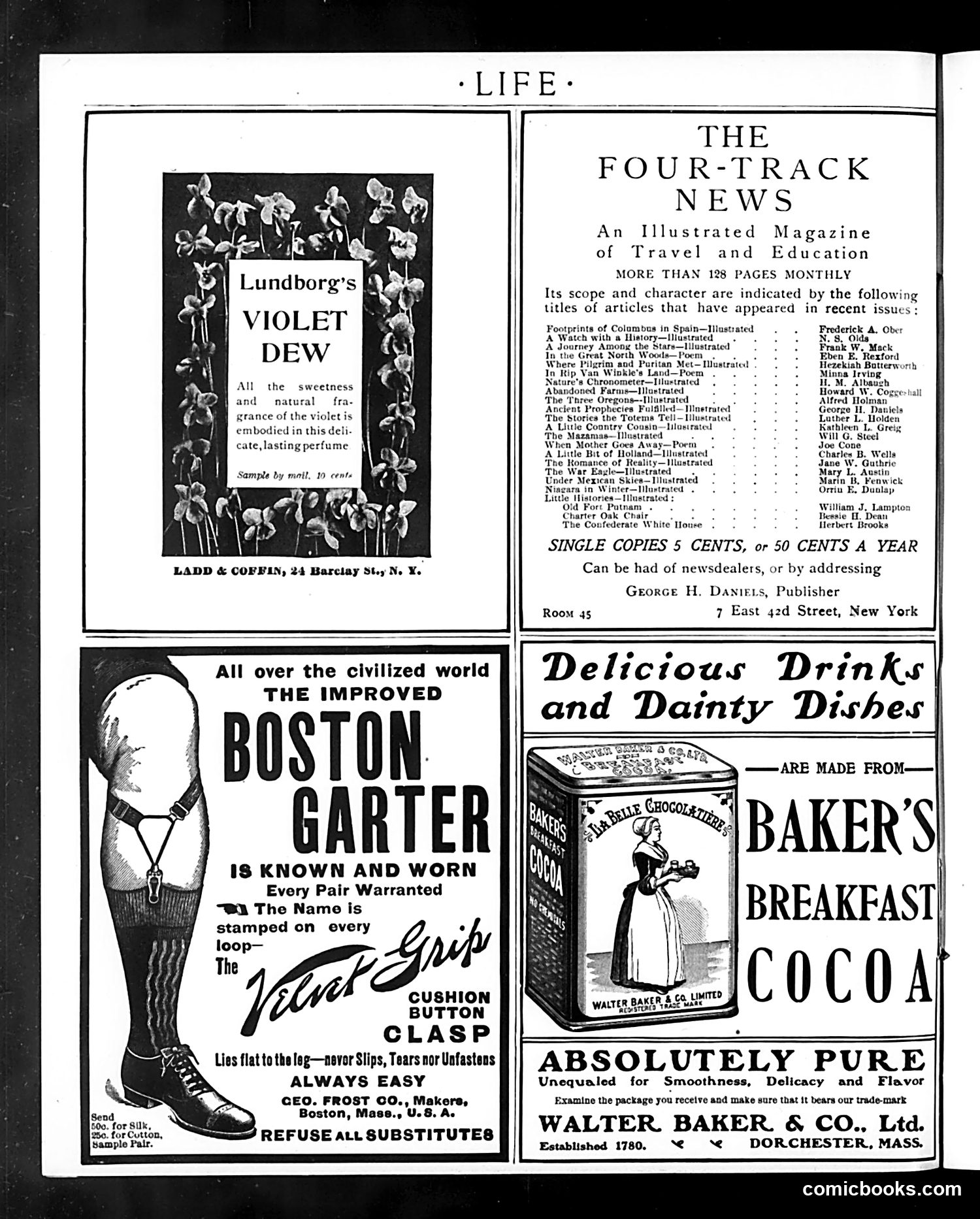
This page contains **advertisements only**, not editorial cartoon or satirical content. The four ads promote: 1. **Lundborg's Violet Dew** perfume—emphasizing natural fragrance 2. **The Four-Track News**—a travel and education magazine listing article topics like "Footprints of Columbus in Spain" and "The Three Graces" 3. **Boston Garter**—men's hosiery with a "Velvet Grip" cushion button clasp, claiming superiority and guaranteeing no slipping or tearing 4. **Baker's Breakfast Cocoa**—established 1780, emphasizing purity and flavor The Boston Garter ad includes an illustration of a man's leg/foot in a garter, while the cocoa ad shows a product tin. These are straightforward commercial pitches typical of early 20th-century Life magazine advertising, with no satirical content present.
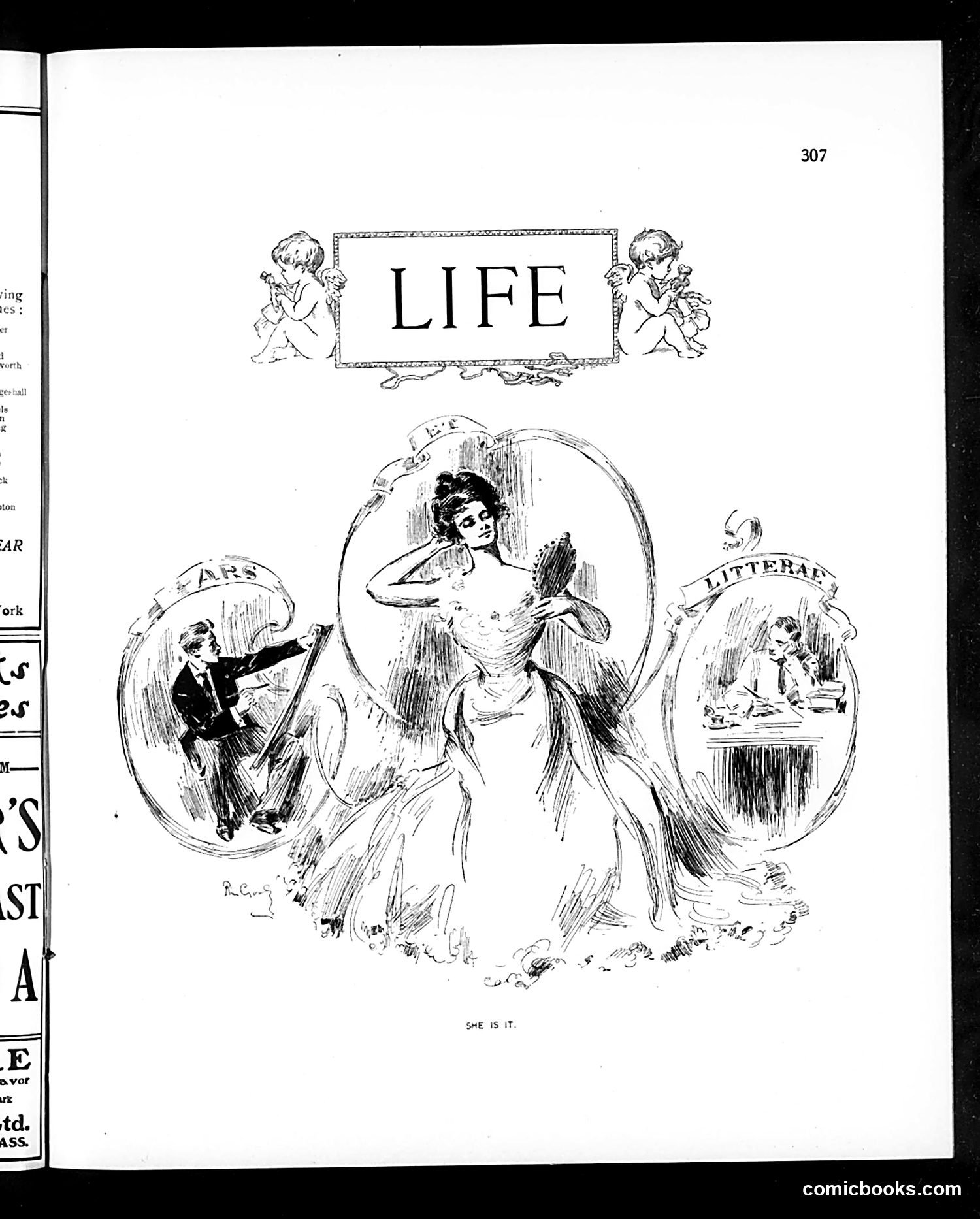
This is a satirical illustration titled "She Is It," depicting a woman as the central figure of "Life" itself. She is flanked by two circular vignettes representing different aspects of existence: on the left, "Arts" (showing a man engaged in artistic or creative pursuits), and on the right, "Literature" (showing a man at a desk, presumably writing). The cartoon satirizes early 20th-century attitudes about women and culture. The central female figure embodies "Life" while the male figures represent formal cultural achievements—suggesting that women represented vitality and living experience, while men monopolized the serious pursuits of arts and literature. The caption "She Is It" implies women are the essence of life itself, though likely with ironic undertones about gender roles and cultural authority of the era.
This 1903 *Life* magazine page debates whether Jerome should run for Mayor of New York City. The text identifies "Jerome" as someone with "charm, sporting blood, red corpuscles, audacity" who was "the hero of the campaign two years ago." The satirical argument presents both sides: Jerome has qualities needed for Mayor, but the writer questions whether he'd actually want the job, given a President can't easily travel or accept railroad favors without controversy. The page contrasts Jerome favorably with Dr. Dowie (a religious cult leader) and discusses Chicago's centennial, suggesting broader municipal governance concerns of the era. Without additional context identifying Jerome precisely, the piece critiques mayoral ambitions and executive constraints during the Progressive Era.
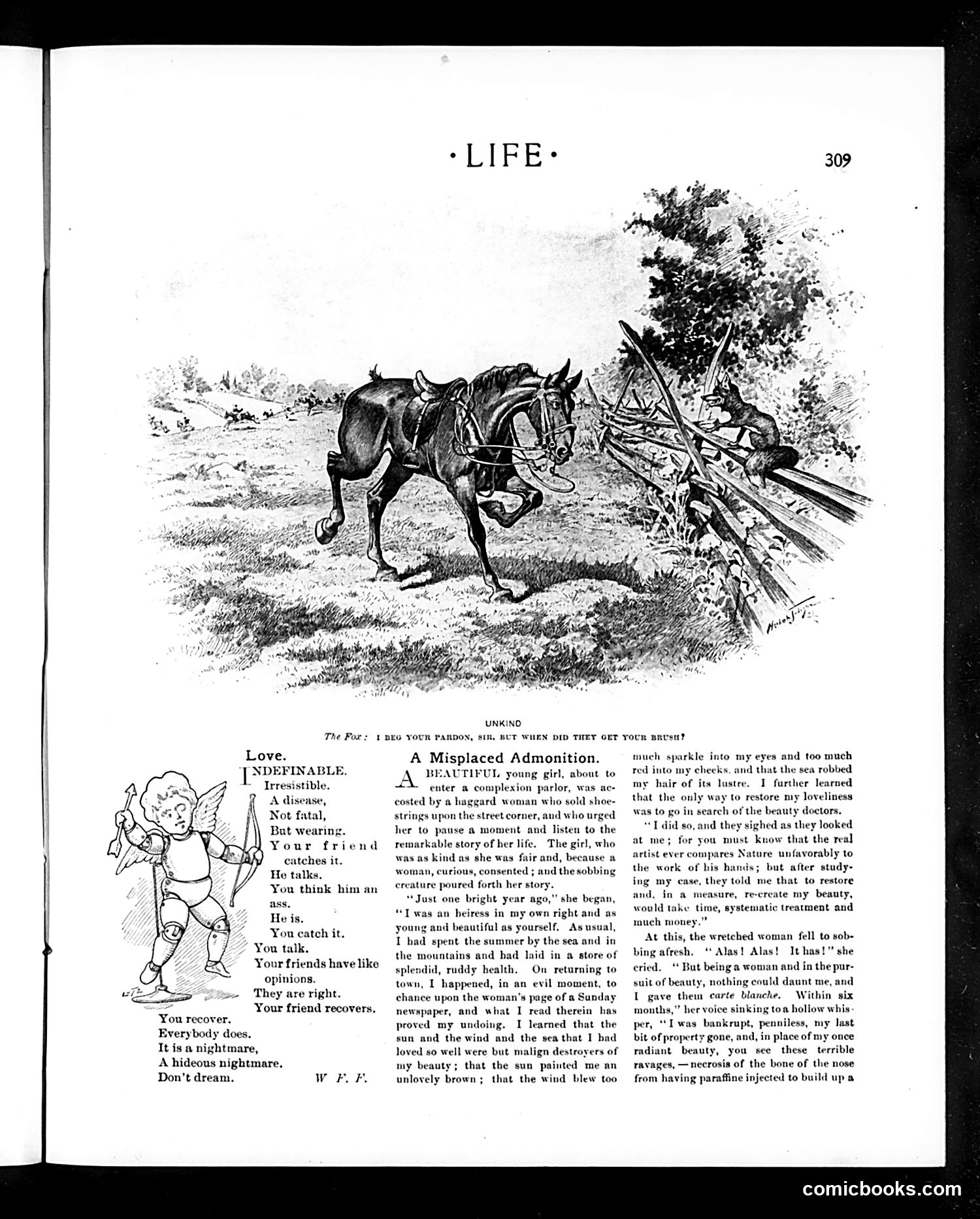
This page contains a satirical illustration titled "Unkind" showing a horse pulling a plow with the caption "The Fox: 'I beg your pardon, sir, but when did they get your brush?'" The cartoon appears to be social satire about beauty and vanity. A fox addresses a horse, questioning when the horse lost its "brush" (tail). The joke likely mocks someone who has lost their attractiveness or dignity—the "brush" serving as a metaphor for beauty or status. The left side features poetry about love, describing it as "irresistible" and "a disease" among friends. The right side contains "A Misplaced Admonition," a prose piece about a young woman whose beauty was destroyed by scandal, warning against vanity and the destructive nature of lost reputation. The combined elements suggest satire about superficial beauty and social standing.
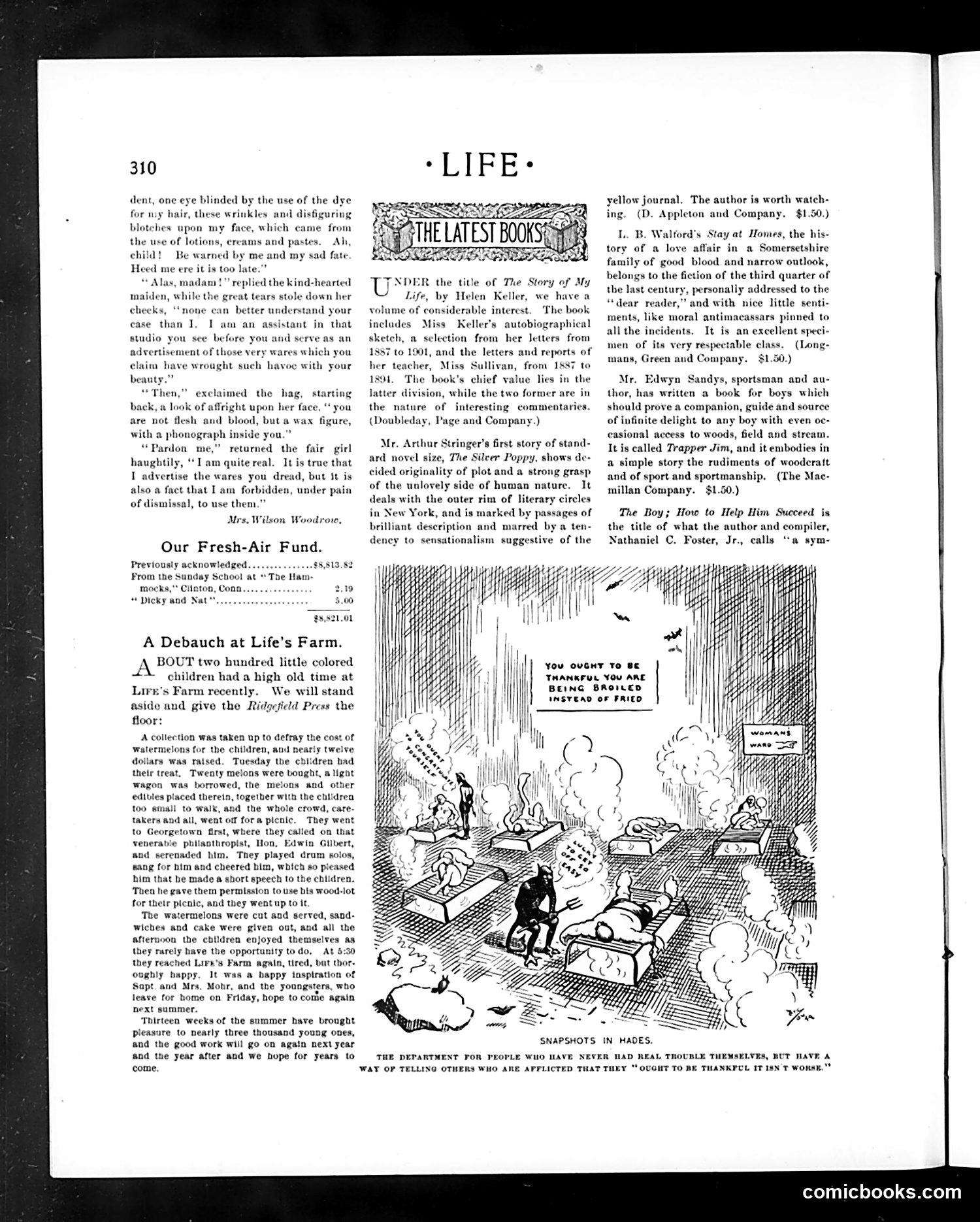
This cartoon satirizes self-righteous hypocrisy. The caption reads: "The Department for People Who Have Never Had Real Trouble Themselves, But Have a Way of Telling Others Who Are Afflicted That They 'Ought to Be Thankful It Isn't Worse.'" The illustration depicts a figure in formal dress lecturing someone suffering in hellish flames, with the speech bubble: "You Ought to Be Thankful You Are Being Broiled Instead of Fried." The satire targets people who offer patronizing, minimally comforting advice to those in genuine distress—suggesting their comments are so absurd they belong in "Hades" (hell itself). It's social commentary on tone-deaf privilege: those without serious hardship criticizing others for insufficient gratitude about their misfortunes. The cartoon mocks this specific form of callous insensitivity as essentially demonic behavior.
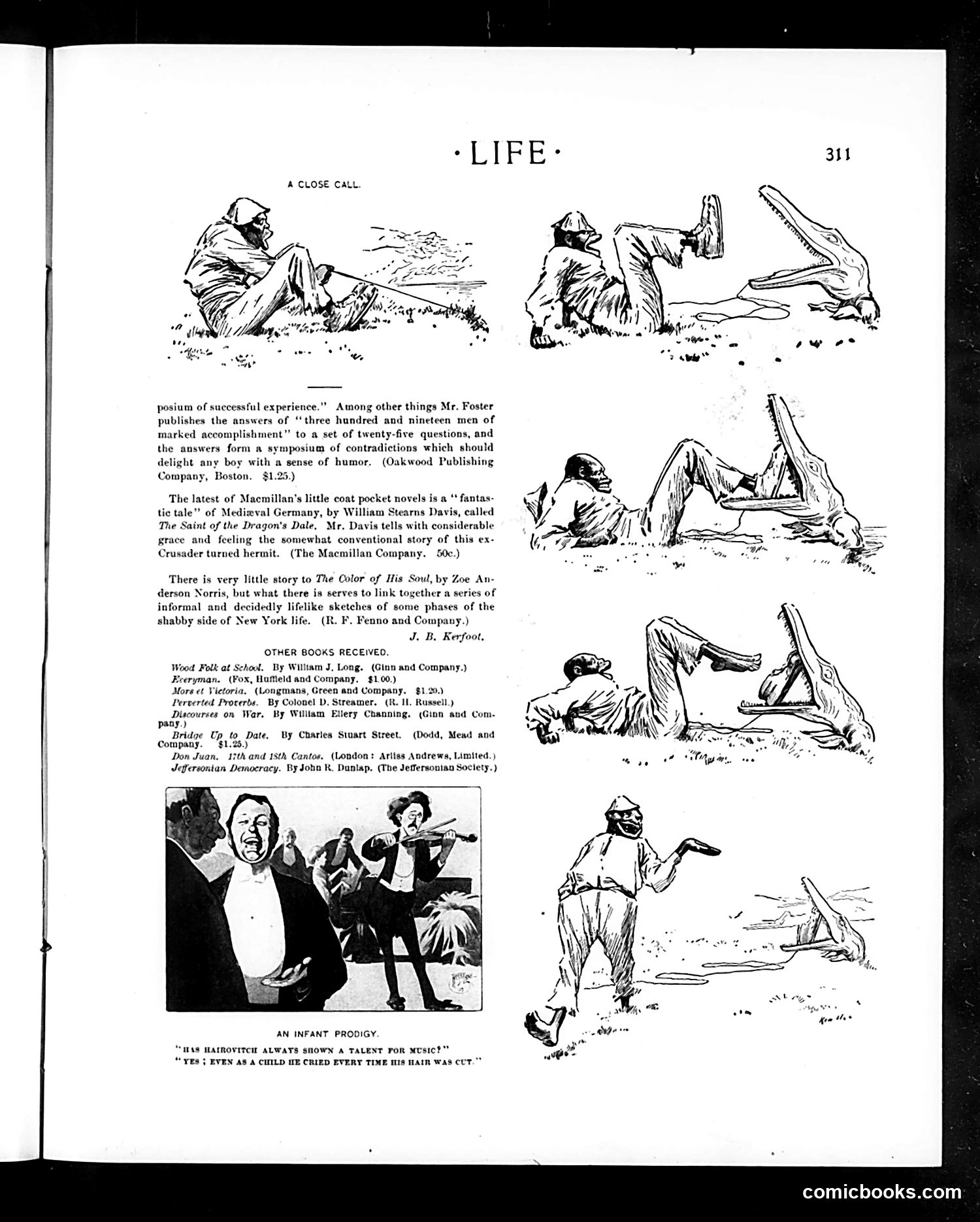
This page contains editorial content and book reviews rather than political cartoons. The main visual is labeled "A Close Call" at top—a series of sketches showing a person in various perilous situations with what appears to be a crocodile or alligator, illustrating near-death escapes. Below is a photograph captioned "An Infant Prodigy" depicting what appears to be a child prodigy musician, with the caption: "His Hairovitch Always Shown a Talent for Music / Yes; Even as a Child He Cried Every Time His Hair Was Cut." The page primarily reviews recently published books on various topics. The humor is gentle and domestic rather than political—the "infant prodigy" caption uses wordplay (hair/Hairovitch) to create mild comedy about a musical child.
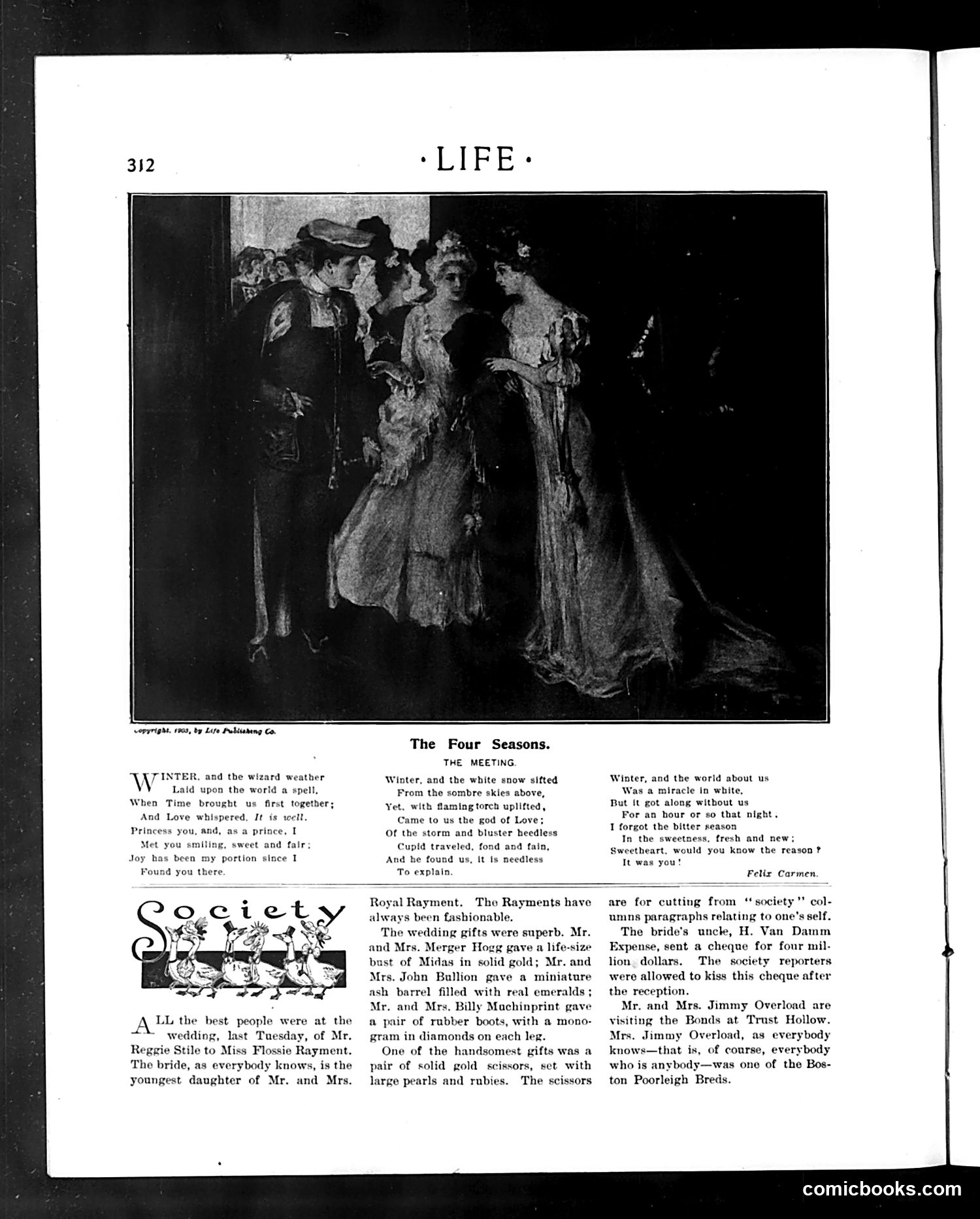
This page contains a **society column** rather than political satire. The top image shows an elegant formal gathering, illustrating "The Four Seasons" with accompanying poetry about winter and romance. The main content is a **society wedding announcement** for the marriage of Flossie Rayment (daughter of Mr. and Mrs. Reggie Stile) to Royal Rayment. The text humorously catalogs expensive wedding gifts from prominent families—solid gold busts, diamond-adorned rubber boots, and gold scissors set with pearls and rubies. The satire targets **wealthy society's excess and conspicuous consumption**: the absurdity of the gift choices (rubber boots with diamonds) mocks both the gift-givers' pretension and the institution's superficiality. This reflects Life magazine's regular critique of the American upper class's ostentatious displays.
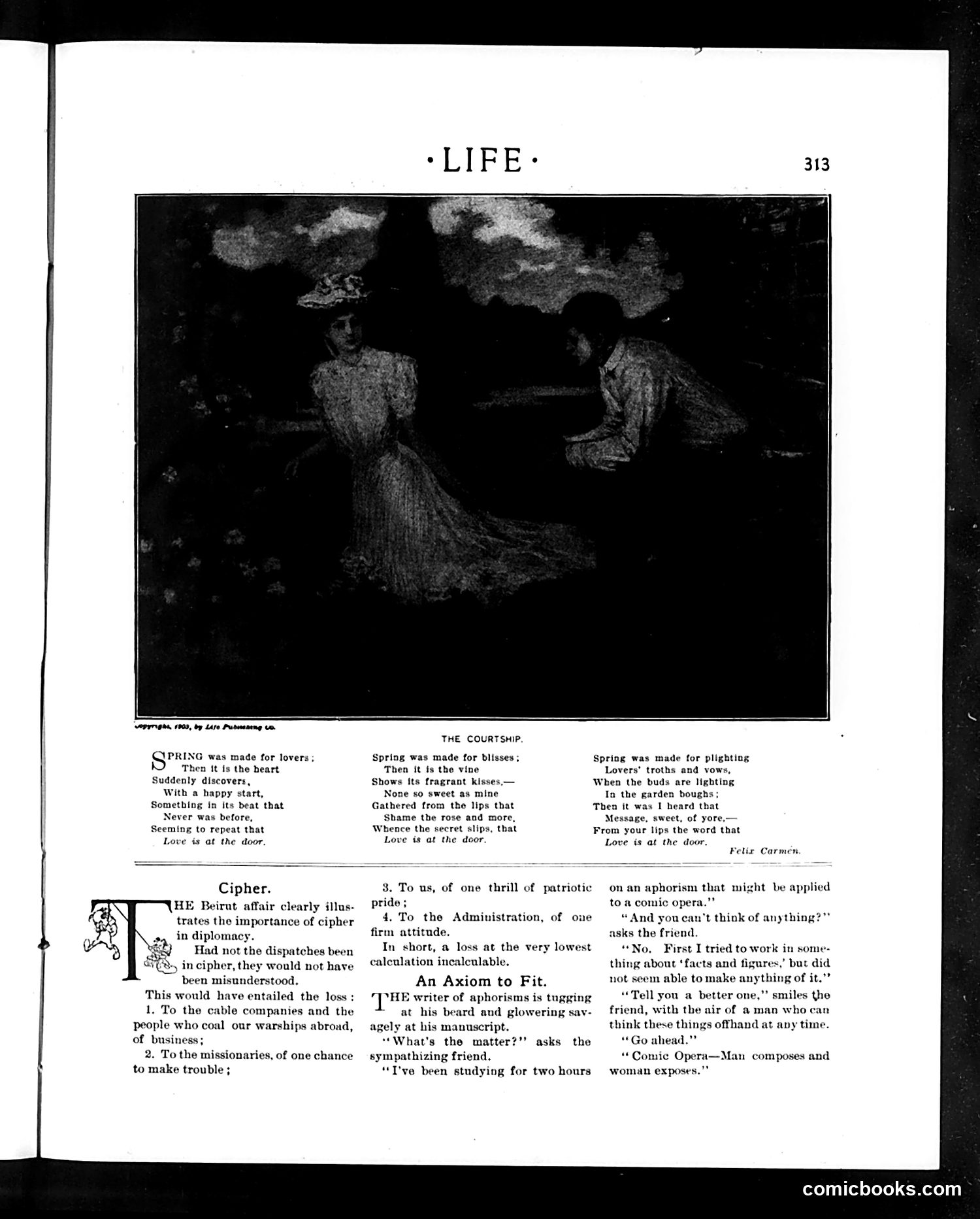
This Life magazine page contains three distinct pieces of satirical humor: **"The Courtship"** (top): A romantic poem/illustration about spring and love, with traditional sentimental verses. It appears straightforward romantic content rather than satire. **"Cipher"** (left column): A satirical commentary on the "Beirut affair"—apparently a diplomatic incident where encoded messages were misunderstood. The joke lists absurd consequences of this misunderstanding: cable companies lose business, missionaries lose "one chance to make trouble," and the Administration loses "firm attitude." The satire mocks how governments and institutions overstate the importance of such incidents while also gently ribbing missionaries for their troublemaking tendencies. **"An Axiom to Fit"** (right column): A brief humorous exchange where a struggling aphorism-writer can't devise a witty saying about comic opera. A friend offers: "Comic Opera—Man composes and woman exposes," playing on the double meaning of "exposes" (reveals/performs). This is gentle gender-based humor typical of the era. The page blends romantic poetry with political and social satire characteristic of Life magazine's approach.
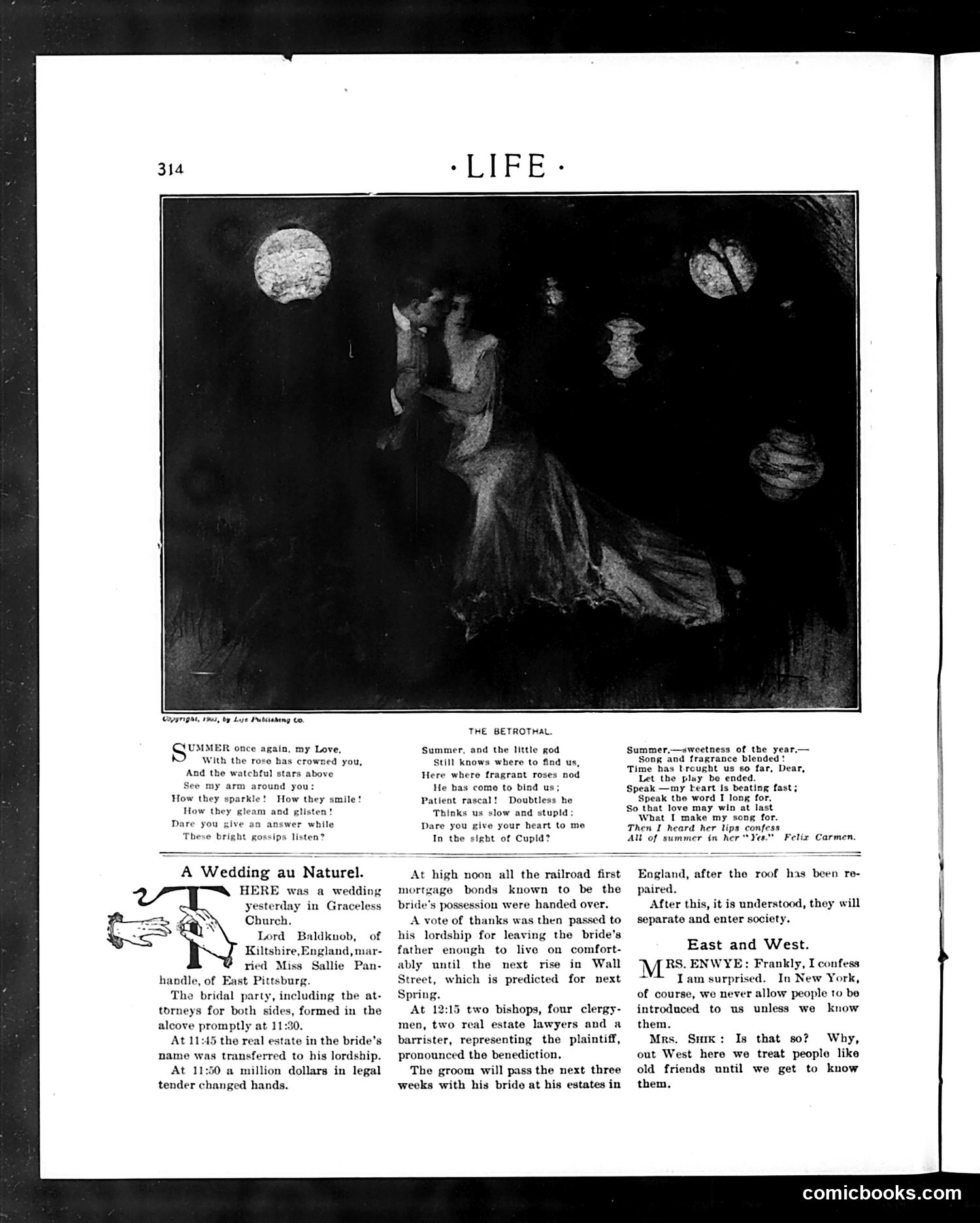
This page contains two satirical pieces from early 20th-century *Life* magazine: **"The Betrothal"** (top): A romantic poem and illustration about summer courtship, with Cupid as a matchmaker. It's sentimental verse typical of the era—not particularly satirical. **"A Wedding au Naturel"** (bottom): Sharp satire mocking wealthy marriages as purely financial transactions. The joke is that the "wedding" is really a business deal: real estate transfers at 11:45, legal tender at 11:50, railroad bonds at noon, and bishops/lawyers conducting proceedings. The groom leaves the bride's father "enough to live on comfortably until the next rise in Wall Street"—implying the father-in-law's survival depends on stock market gains. The final line, that they'll "separate and enter society" after the honeymoon, suggests the marriage itself is merely a formality masking financial self-interest. **"East and West"**: A brief dialogue contrasting New York snobbery (only socializing with the properly introduced) against Western friendliness (treating strangers as friends).
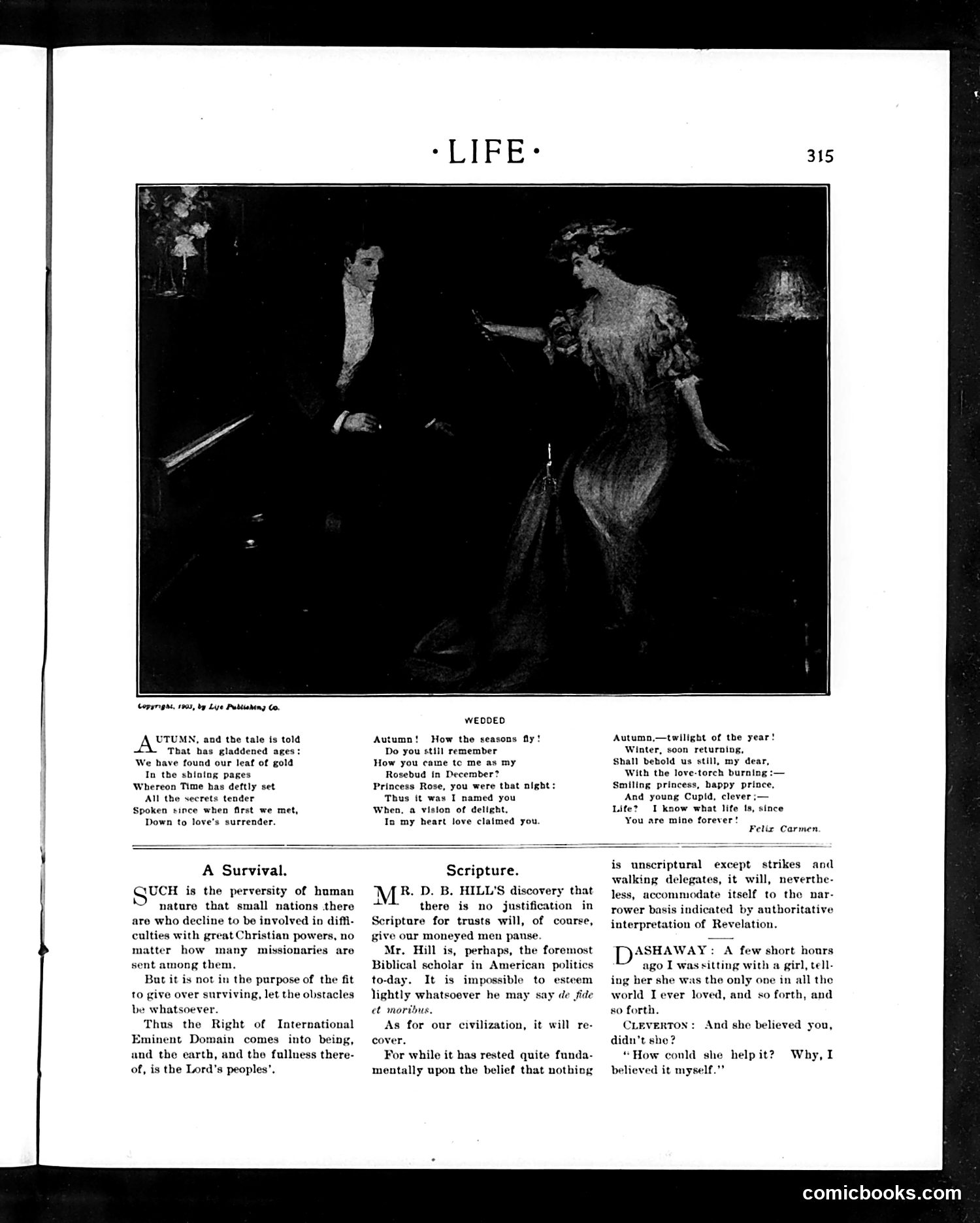
This page from *Life* magazine (1905) contains three distinct pieces of satirical content: **"Wedded"** (top): A sentimental poem celebrating autumn romance, appearing straightforward with no obvious satire. **"A Survival"** (left column): Sharp political satire mocking Western imperial expansion. It satirizes how Christian nations justify colonizing "small nations" by invoking the "Right of International Eminent Domain"—essentially claiming divine right to seize foreign lands and resources. The phrase "the earth, and the fullness thereof, is the Lord's peoples'" mockingly inverts Scripture to justify imperialism and exploitation, despite sending missionaries to these same regions. **"Scripture"** and **"Dashaway"** (right columns): Two brief satirical pieces. "Scripture" mocks Biblical scholars who conveniently find no scriptural objection to trusts and monopolies while opposing labor strikes—selective religious interpretation serving the wealthy. "Dashaway" jokes about a man's insincere romantic declarations. The page's primary satirical target is hypocrisy: Western powers using Christianity to justify colonialism, and the wealthy manipulating religion to protect their financial interests while opposing workers' rights.
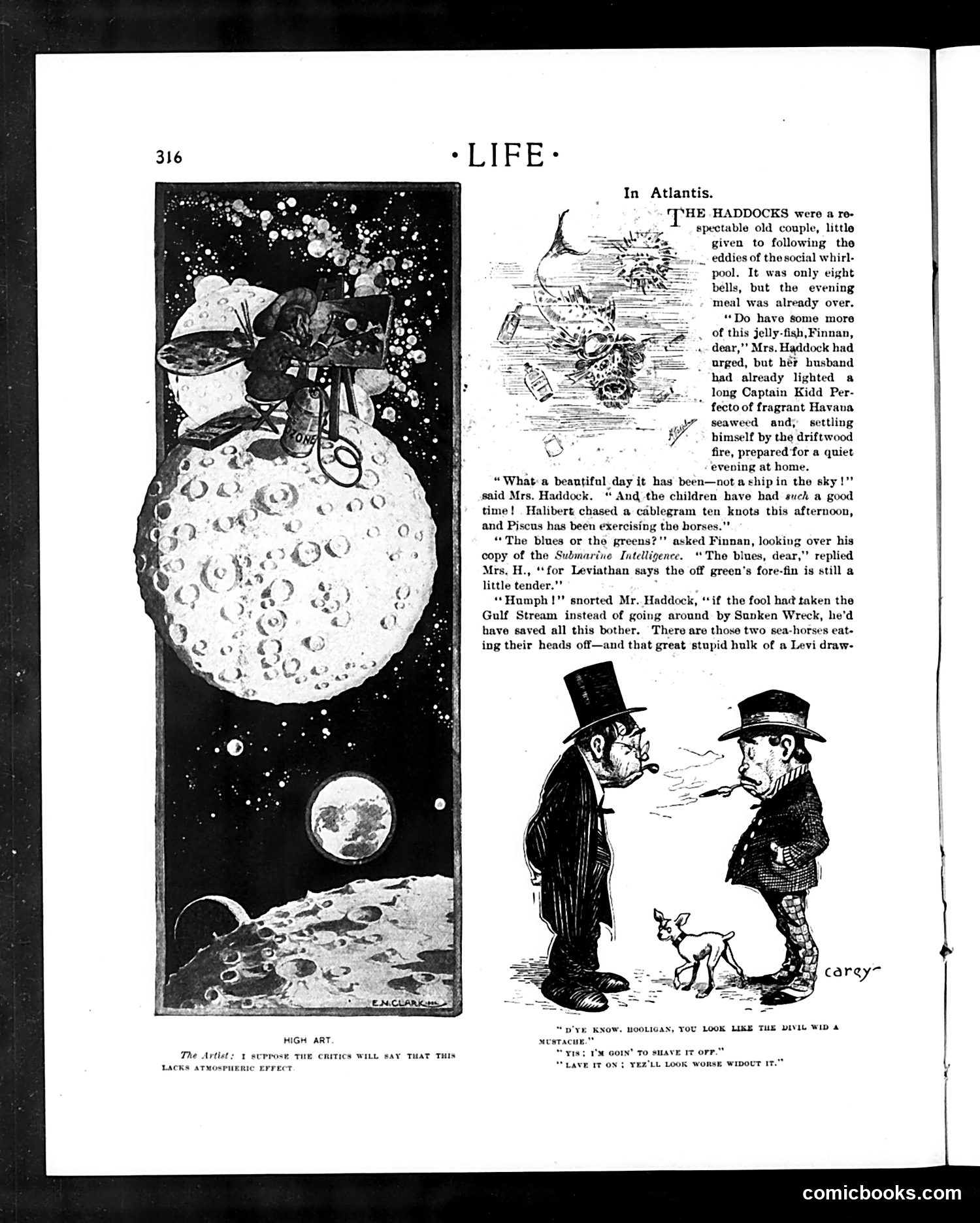
This page contains two distinct pieces of satirical humor: **"In Atlantis"** (top): A whimsical fantasy story about underwater fish society. The Haddocks are an anthropomorphized couple living in an underwater civilization with social conventions mirroring human life—they smoke cigars, read newspapers (the "Submarine Intelligence"), keep pets ("sea-horses"), and discuss their children's activities. The satire gently mocks middle-class domesticity by transplanting it to an absurd setting. The children's activities (chasing cables, exercising horses) are humorous because they're normal upper-middle-class pursuits rendered ridiculous in an ocean context. **Bottom cartoon**: Two working-class Irish men (identifiable by dialect: "'D'ye know, hooligan"; "I'm goin' to shave it off") discuss a mustache. One advises keeping it despite its rough appearance, predicting it will look worse without it. This is a simple joke about vanity and grooming, likely poking fun at Irish working-class stereotypes popular in early 20th-century American humor. Both pieces are light, non-political satire typical of *Life* magazine's entertainment content.
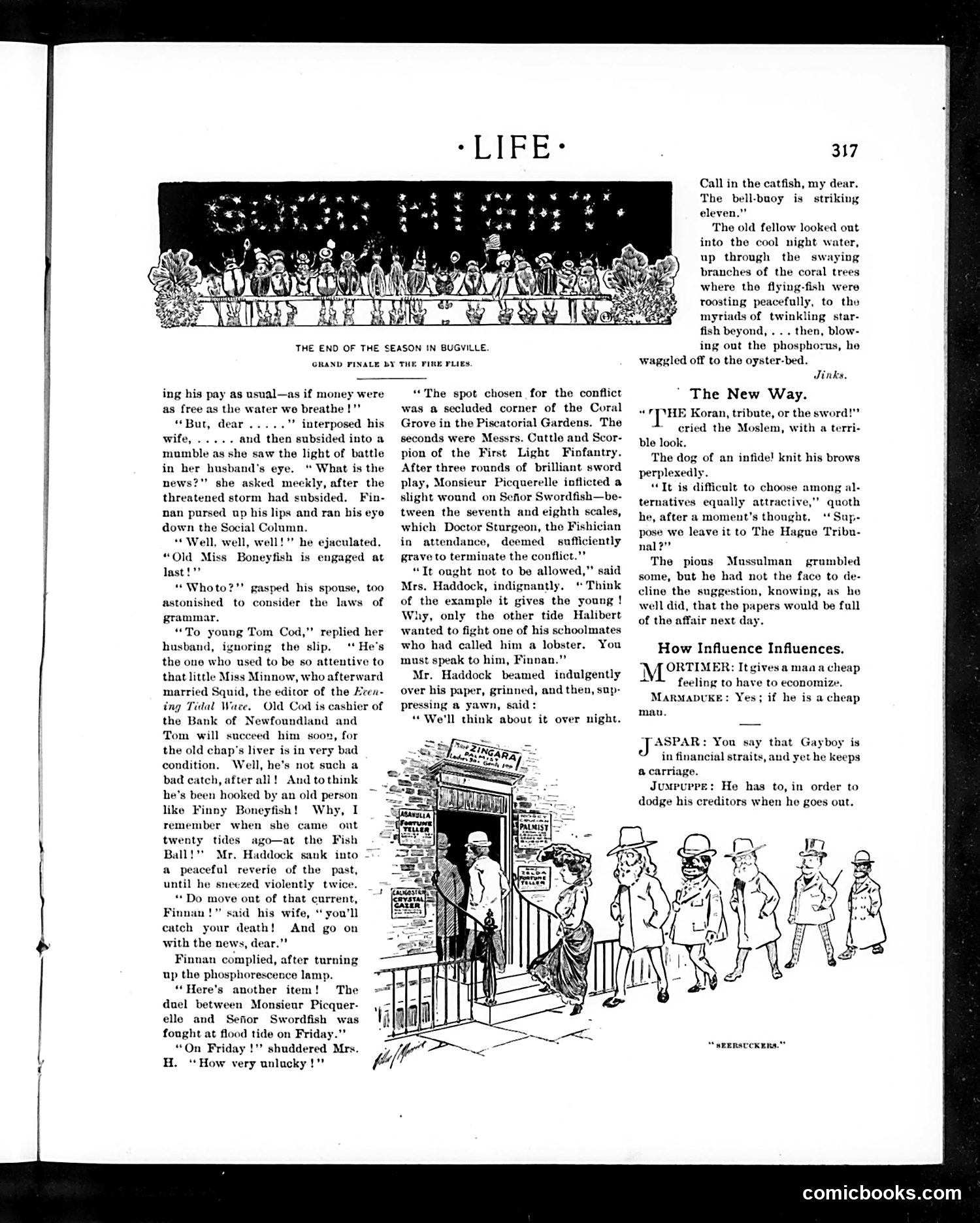
This page contains **anthropomorphic fish characters** in a humorous parody of human society. The main narrative, "The End of the Season in Bugville," depicts fish gossip and social drama—Mr. Haddock reading society news to his wife about engagements, duels, and scandals in the undersea world. The satire mocks **Victorian-era social pretension** through absurd fish equivalents: duels over honor, arranged marriages, and concern for respectability. The smaller comic strips below parody contemporary issues: "The New Way" satirizes **The Hague Tribunal** (established 1899), suggesting international arbitration is preferred even by fictional Muslims. "How Influence Influences" mocks **financial hypocrisy**—a man maintains appearances (a carriage) while in debt, relying on creditors' pursuit to avoid them. The overall humor targets **human vanity and social absurdity** by rendering it in miniature through talking aquatic creatures following identical social conventions.
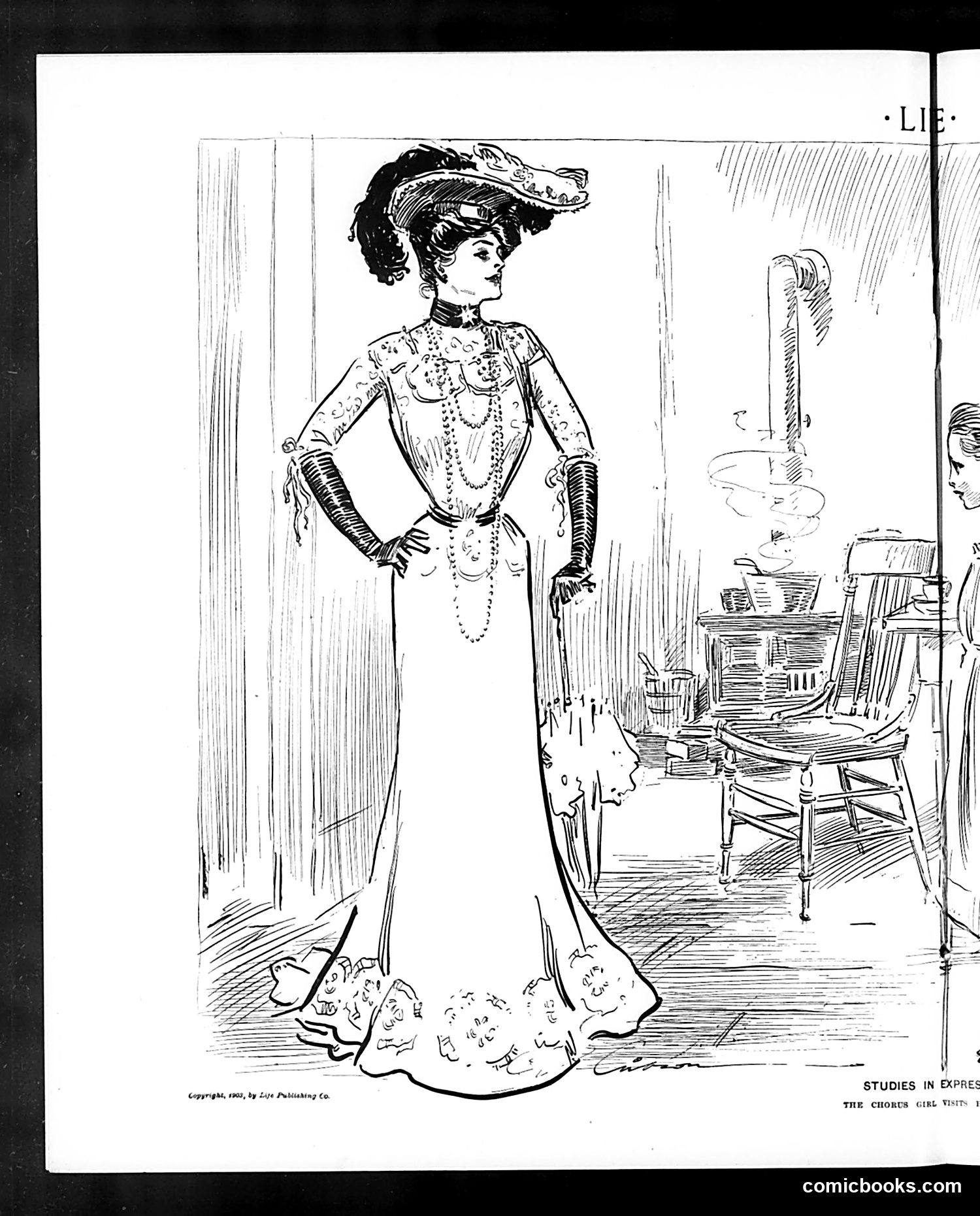
This appears to be a satirical illustration from Life magazine depicting a fashionable woman in an elegant Edwardian-era dress, likely representing a "chorus girl" (a performer in theatrical productions). The drawing emphasizes her striking pose and elaborate attire—including a decorative hat, beaded gown with long train, and long gloves—suggesting commentary on theatrical fashion and vanity. The title "Studies in Expression" indicates the piece examines social types or personality through visual caricature, a common Life magazine feature. The setting appears domestic, with furniture visible behind her, possibly satirizing the pretensions or affected mannerisms of stage performers in everyday situations. The work critiques early 20th-century theater culture and the social status aspirations of entertainers.
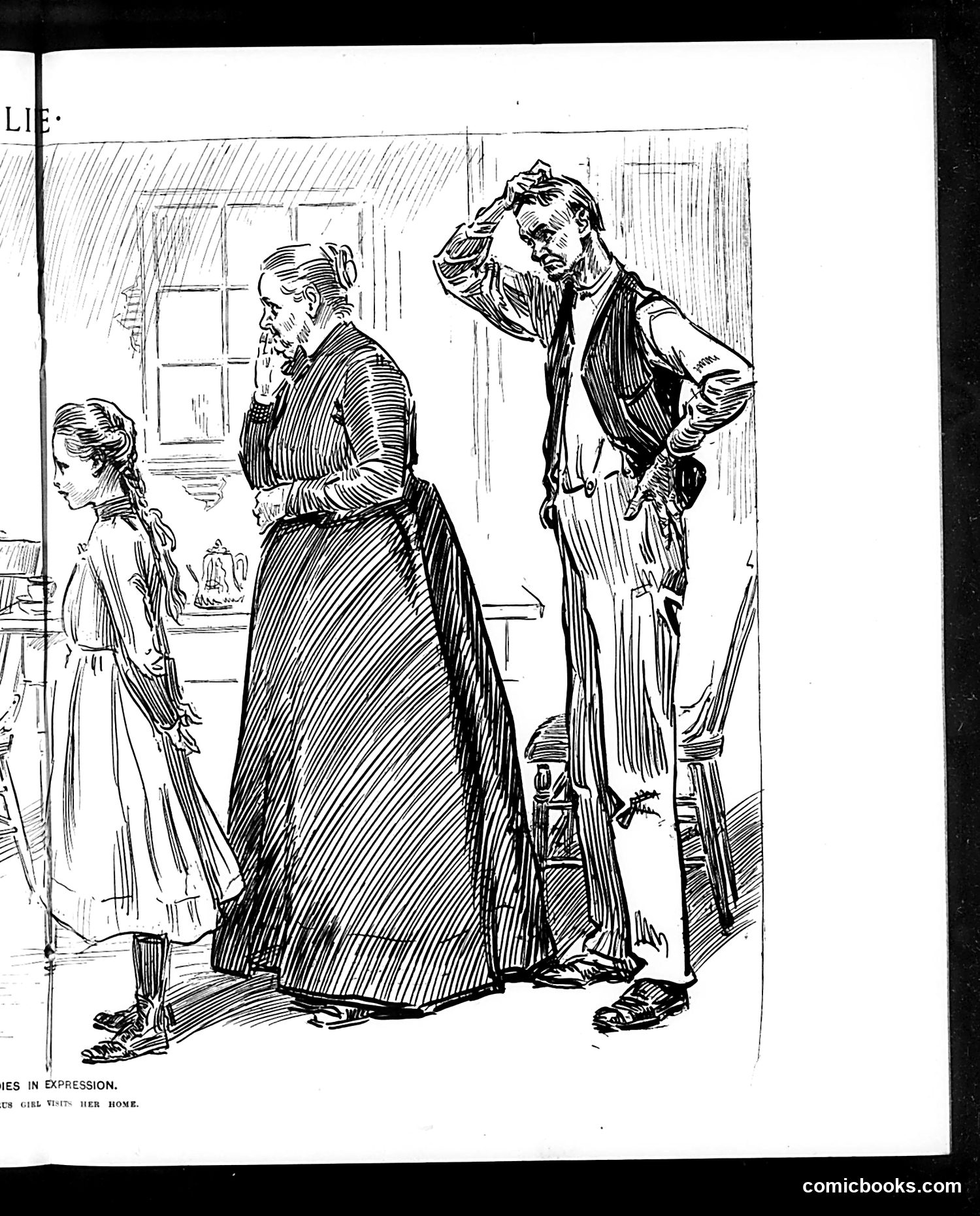
This page shows a Victorian-era domestic scene with three figures in a parlor. The visible text fragments reference "EXPRESSION" and "GIRL VISITS HER HOME," suggesting this illustrates a narrative about a young woman returning home. The sketch depicts what appears to be a tense family moment: a young woman (left), an older woman in dark dress (center), and a man in casual attire (right) with his hand to his head in a gesture suggesting distress or exasperation. Without clearer OCR text or the cartoon's caption, the specific social commentary remains unclear. However, given Life magazine's satirical tradition, this likely mocks Victorian family dynamics, domestic tensions, or contemporary social expectations around women's behavior or independence. The man's gesture suggests the "joke" involves his bewildered or disapproving reaction to something.
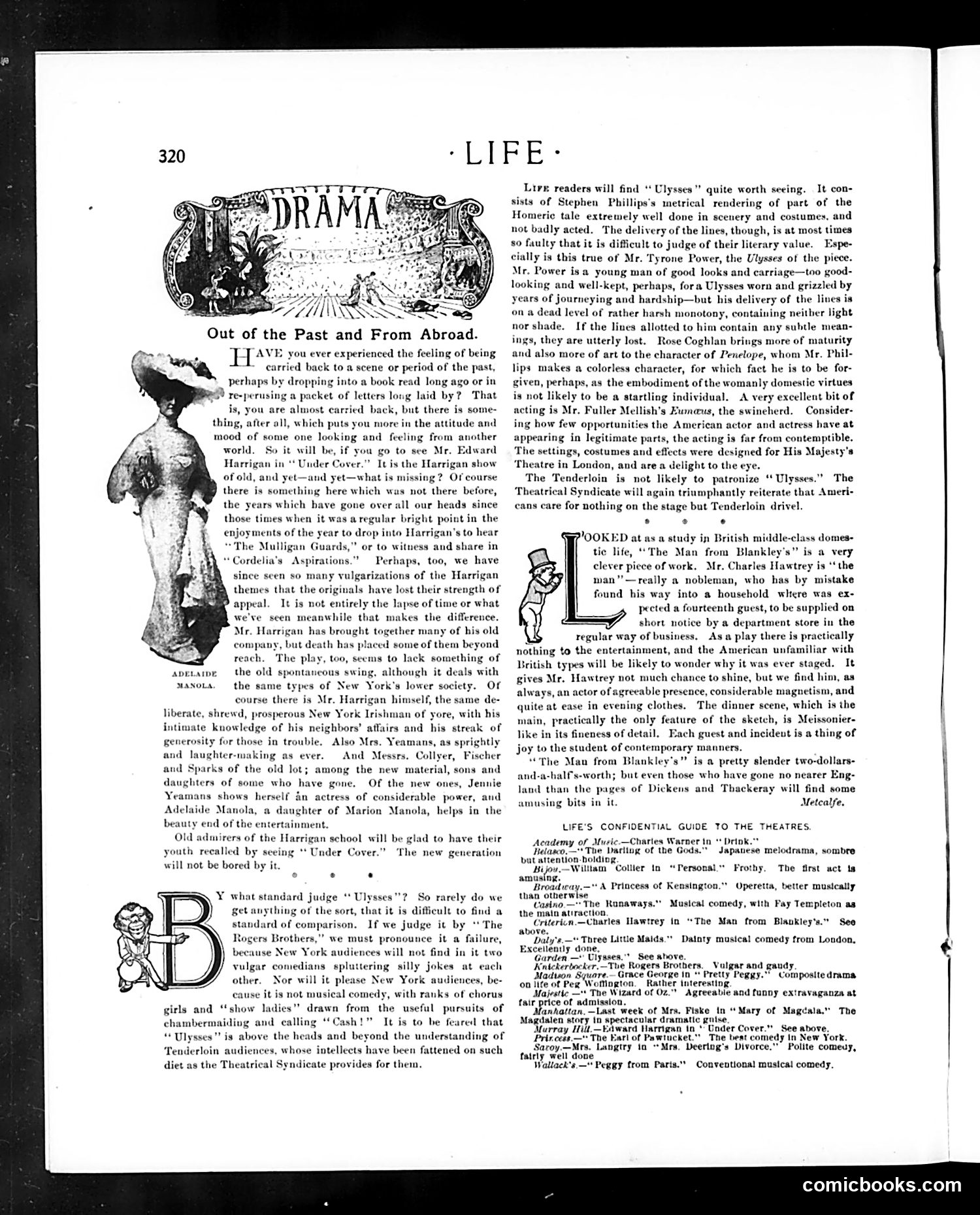
This page reviews two theatrical productions: Edward Harrigan's "Under Cover" and a production of "Ulysses" (Stephen Phillips's adaptation of Homer). The **Harrigan review** is nostalgic but disappointed. Harrigan was a celebrated 19th-century playwright known for comedies about New York's working-class Irish immigrants. The critic notes that while Harrigan himself and veteran cast members remain excellent, the production lacks the spontaneity of earlier shows—some original performers have died, and subsequent imitations have diluted the original appeal. New talent includes Jennie Yeamans and Adelaide Manola. The **"Ulysses" review** is sharply critical. The critic suggests the production is too intellectually ambitious for typical theater audiences (dismissively called the "Tenderloin"—a red-light district). Actor Tyrone Power, though handsome, delivers lines in monotonous, expressionless fashion that obscures any literary merit in Phillips's verse adaptation. Both reviews reflect period anxieties about theatrical taste and cultural decline.
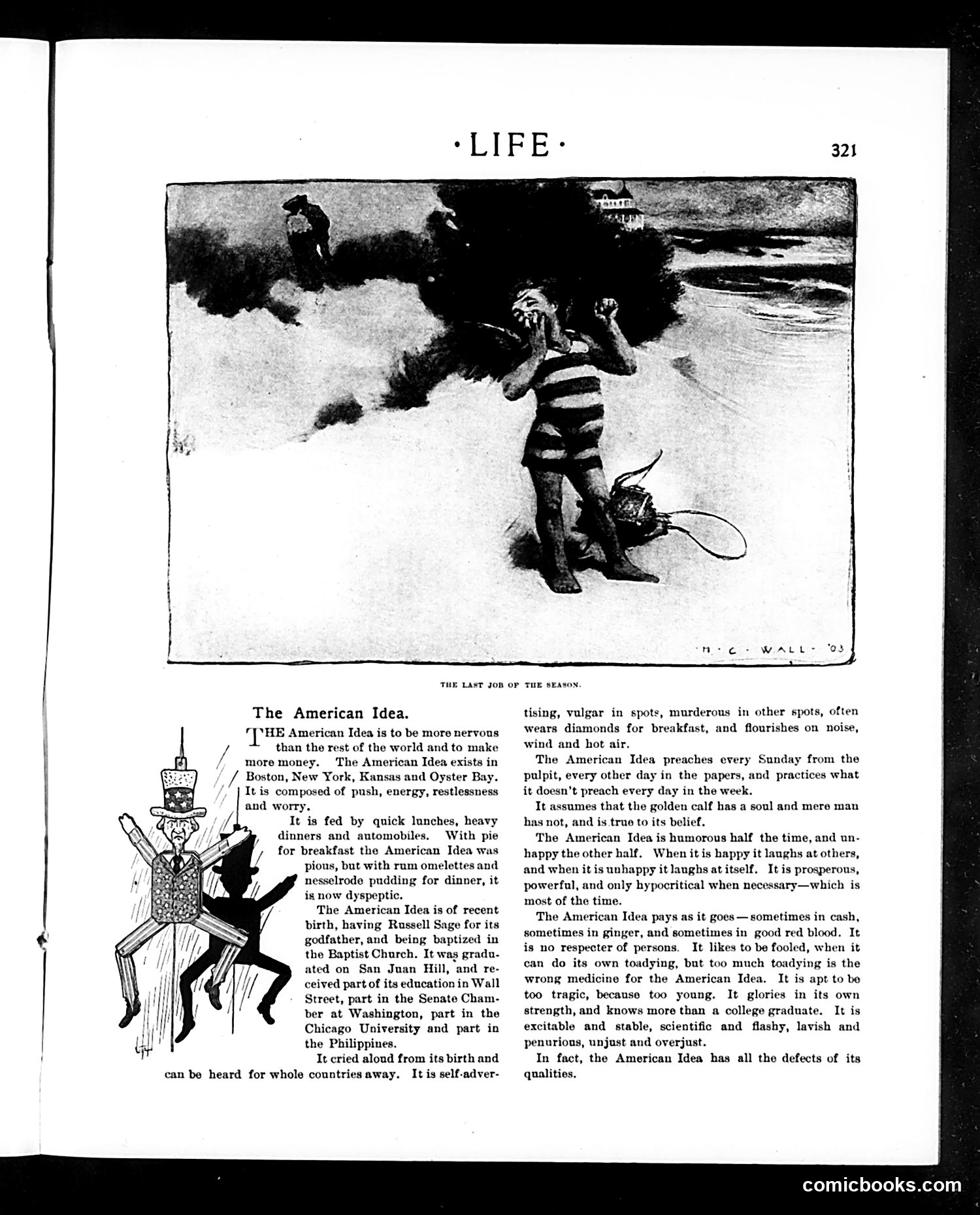
This page contains a biting satirical essay on American character and values, paired with a cartoon titled "The Last Job of the Season" (showing a beach laborer). The text mocks what the author calls "the American Idea"—a bundle of contradictions: nervousness masked as ambition, materialism disguised as energy, hypocrisy presented as pragmatism. The essay catalogs specific targets: wealthy financiers (Russell Sage), imperialist militarism (San Juan Hill reference), corrupt politics (Wall Street, Senate), and colonial ventures (Philippines). The satire suggests Americans are simultaneously pious and gluttonous, powerful yet shallow, laughing at others while secretly insecure. The piece particularly criticizes American capitalism's worship of money ("golden calf") over human dignity, and the culture's relentless self-promotion. The tone is caustic but clever—Life magazine positioned itself as intellectual social commentary for educated readers skeptical of Gilded Age excess and American imperial expansion.
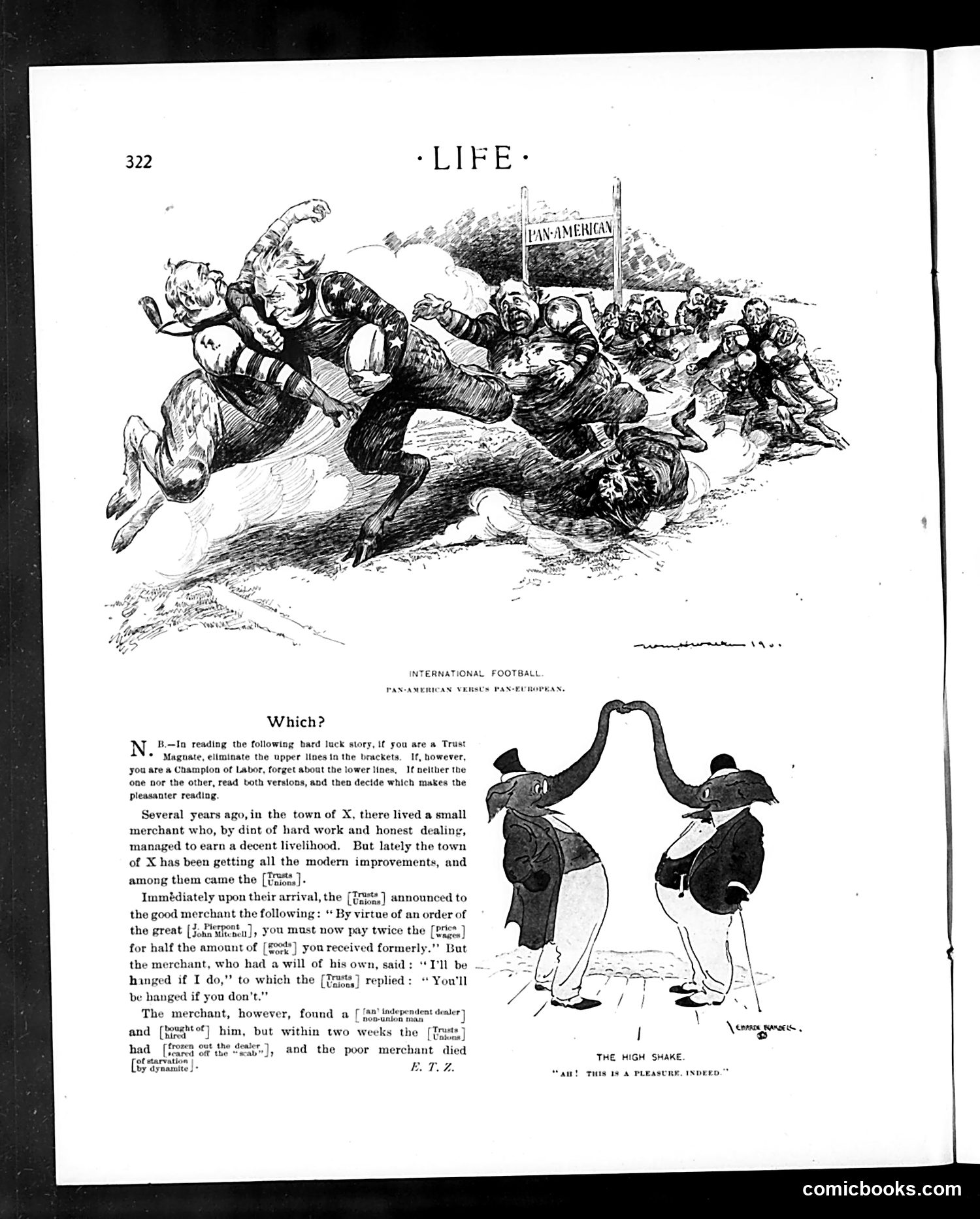
**Top cartoon** ("International Football"): Shows a chaotic rugby match labeled "Pan-American versus Pan-European," depicting business competition between continents as violent sport. The "Pan-American" side appears to be winning or dominating. **Bottom story and cartoon** ("The High Shake"): This is dual-narrative satire targeting both monopolistic business trusts AND labor unions. Readers are instructed to delete either the upper or lower bracketed text depending on their political sympathies—Trust supporters or Labor champions would each see a different villain. The story shows a small honest merchant destroyed: Trust Magnates force him to pay more for less; Labor unions (if that version is read) similarly exploit him. Either way, the independent merchant dies. The accompanying cartoon shows two figures in a "high shake"—suggesting collusion between opposing forces. **The satire's point**: Both organized capital AND organized labor harm the ordinary working person caught between them, leaving no good outcome regardless of which side one favors.
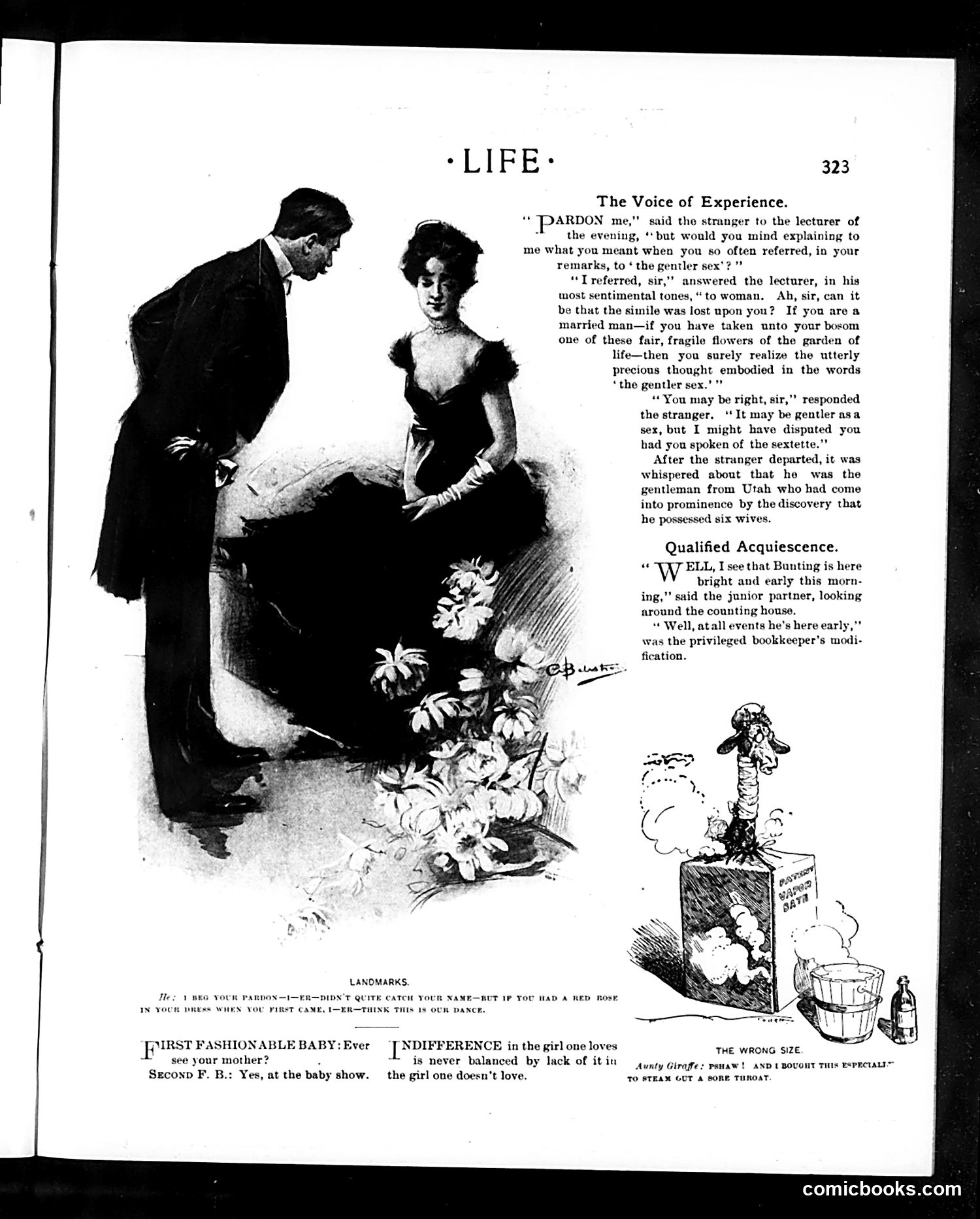
This page contains multiple short satirical pieces typical of early 20th-century American humor: **"The Voice of Experience"**: A lecturer romanticizes women as "the gentler sex." A stranger challenges him, revealing he's a Utah gentleman with **six wives**—a reference to polygamy practiced by the LDS church. The joke mocks both the lecturer's sentimentality and polygamists by implying six wives disprove the "gentler" characterization. **"Qualified Acquiescence"**: Office humor about punctuality. The bookkeeper's careful distinction—Bunting is "here early" but perhaps not reliably diligent—pokes fun at workplace pretense and careful language. **"Landmarks," "First Fashionable Baby," and "The Wrong Size"**: Brief joke comics about romantic misunderstandings, motherhood, and a giraffe's medical mishap, representing typical early-20th-century domestic and animal humor without specific political references. The page reflects period attitudes toward gender, marriage, and workplace dynamics.
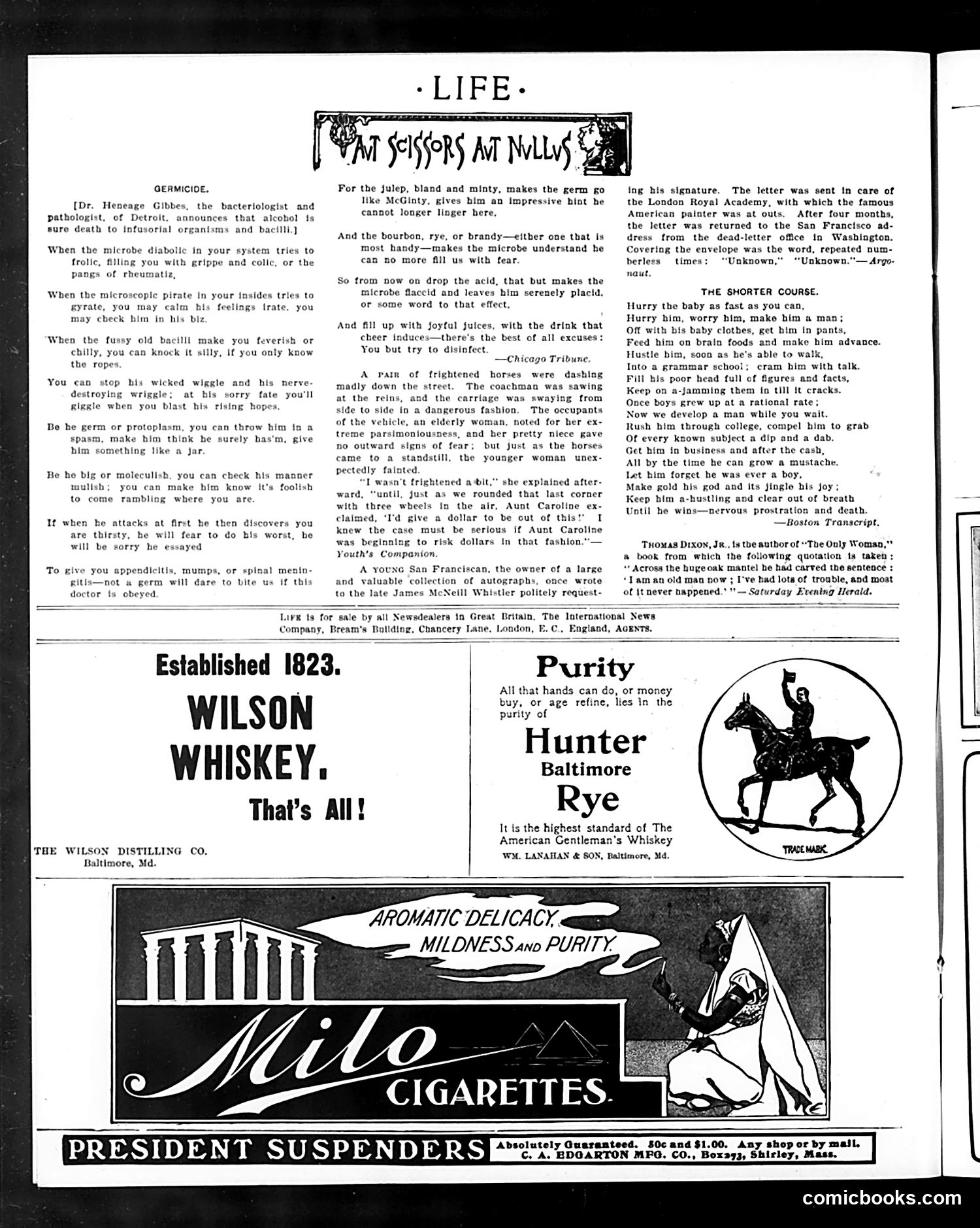
This page is primarily **advertising and light humor** from Life magazine. The main content includes: **"Germicide" article and poem**: A tongue-in-cheek piece (attributed to Dr. Heneage Gibbes) claiming alcohol kills bacteria. The poem humorously suggests drinking bourbon, rye, or brandy as medical treatment—a satirical jab at the pseudo-scientific justifications people used to justify drinking, particularly relevant during the Prohibition era's debates. **Three humorous anecdotes**: Short comic stories about frightened horses, Whistler's refusal to sign an autograph, and the modern pressure to rush children into adulthood. **Advertisements**: For Wilson Whiskey, Hunter Baltimore Rye, Milo Cigarettes, and President Suspenders—typical period advertisements. The satire targets medical quackery and alcohol rationalization rather than specific political figures. The page reflects early 20th-century anxieties about modernization and parenting practices, delivered through gentle humor typical of Life's satirical approach.
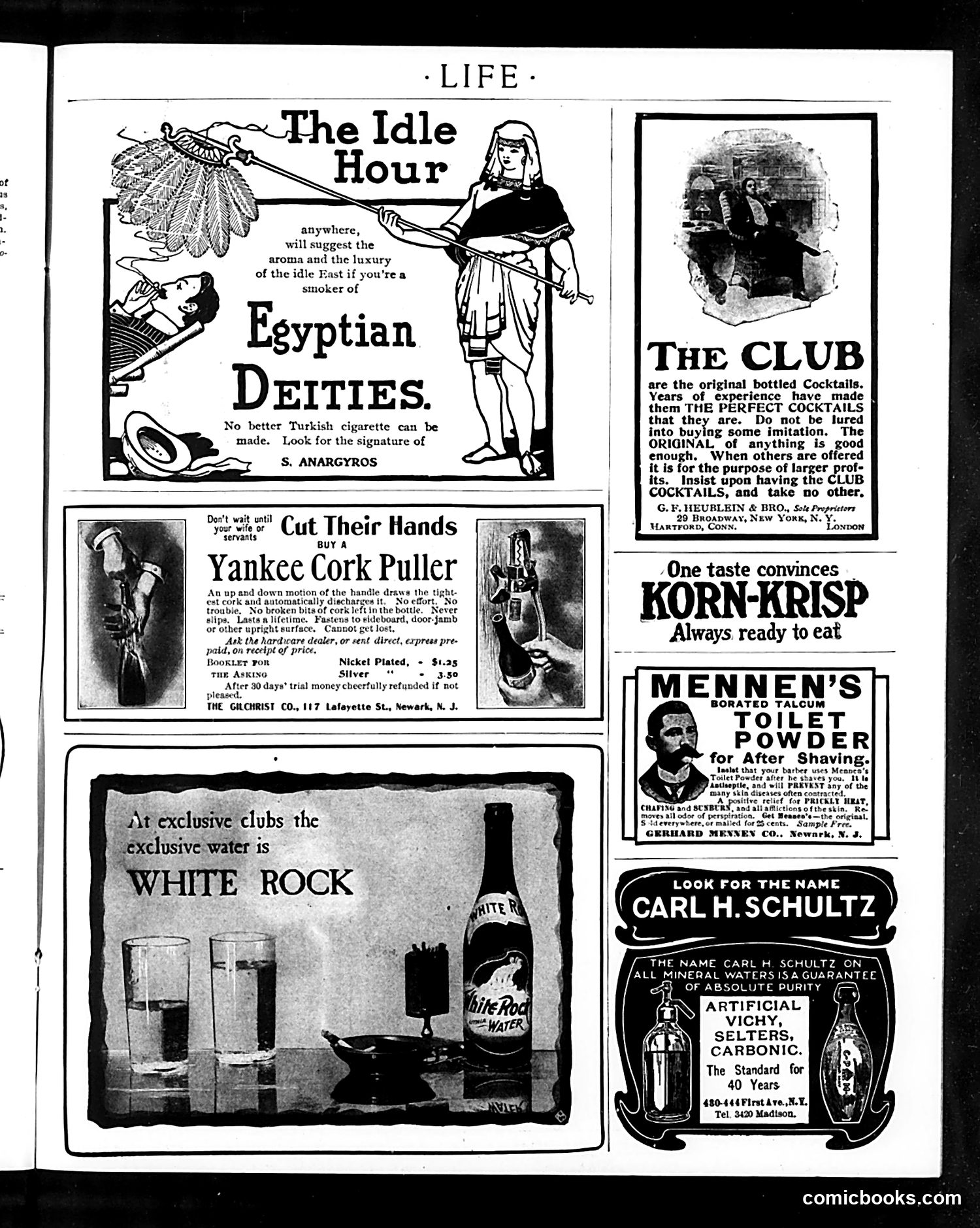
This page is primarily **advertising**, not political satire. It contains early 20th-century product advertisements for luxury and everyday goods. Key advertisements include: - **Egyptian Deities cigarettes**: Appeals to wealthy consumers with exotic "idle East" imagery - **Yankee Cork Puller**: A practical kitchen device for removing wine corks - **White Rock mineral water**: Positioned as exclusive, served at high-end clubs - **Club Cocktails**: Claims superiority as the "original" bottled cocktail - **Korn-Krisp cereal**, **Mennen's talcum powder**, and **Carl H. Schultz mineral waters**: Standard consumer products The page reflects early 1900s consumer culture and marketing strategies: appeals to exclusivity and status (clubs, "East"), product reliability claims, and brand differentiation ("original"). The Egyptian Deities ad uses Orientalist imagery common to the era. Overall, this is a historical snapshot of period advertising rather than editorial commentary.
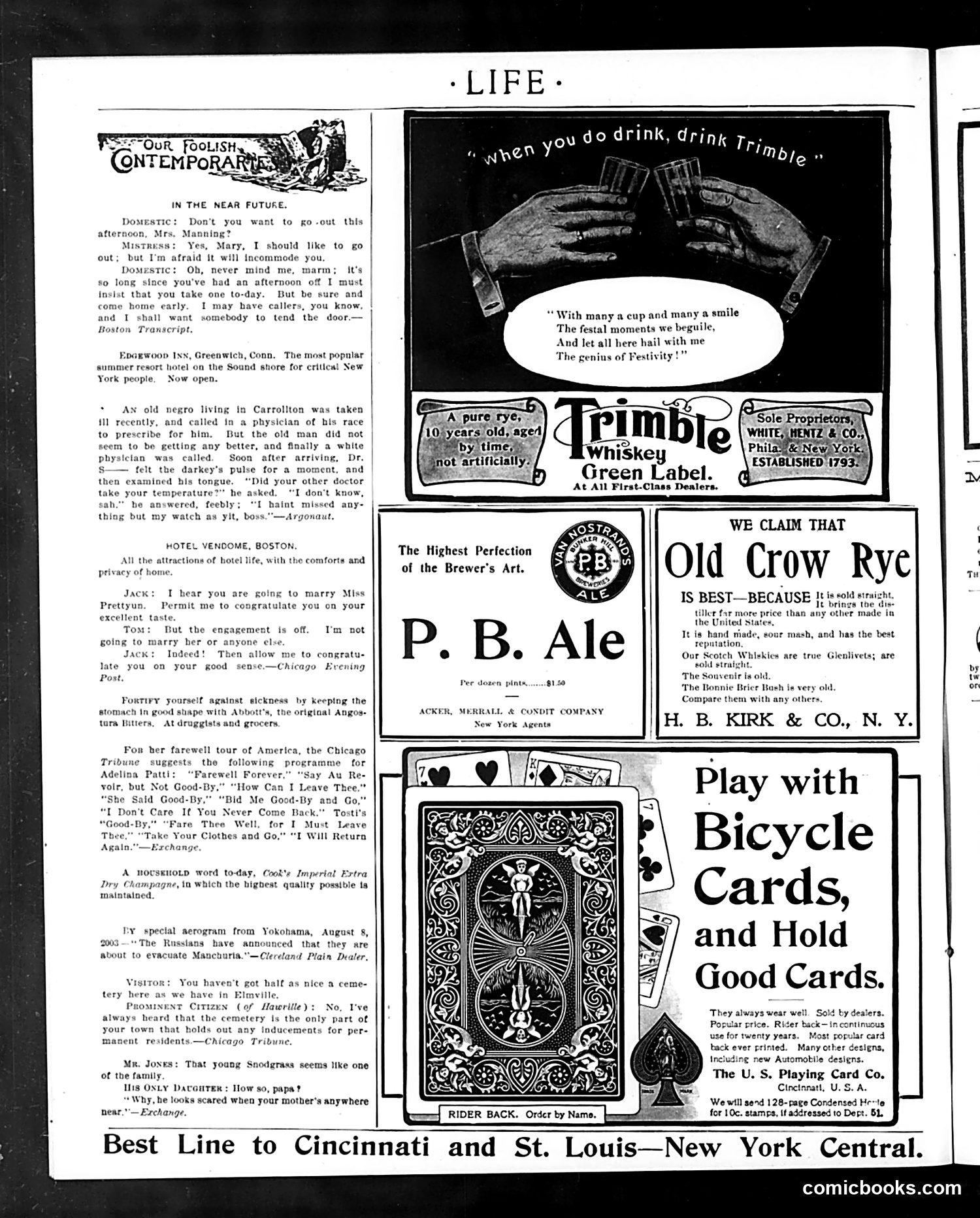
This page combines short satirical pieces with period advertisements (circa early 1900s). The cartoons mock social conventions and emerging changes: **"In the Near Future"** satirizes the reversal of domestic service roles—a maid insists her employer take an afternoon off, claiming she needs to entertain callers. The joke reflects anxiety about shifting class boundaries and servant independence. **Other brief jokes** include racial stereotypes typical of the era (a Black man's misplaced watch), and commentary on courtship/engagement etiquette. **The advertisements**—for Trimble Whiskey, P.B. Ale, Old Crow Rye, and Bicycle Playing Cards—represent standard early-1900s marketing, emphasizing quality and tradition. These ads were revenue sources for the magazine. The page reflects Life's format: lighthearted social commentary paired with consumer advertising, aimed at educated, affluent readers. The "foolish contemporary" header suggests ironic commentary on modern life's absurdities, though by modern standards some content relies on offensive stereotypes now considered deeply inappropriate.
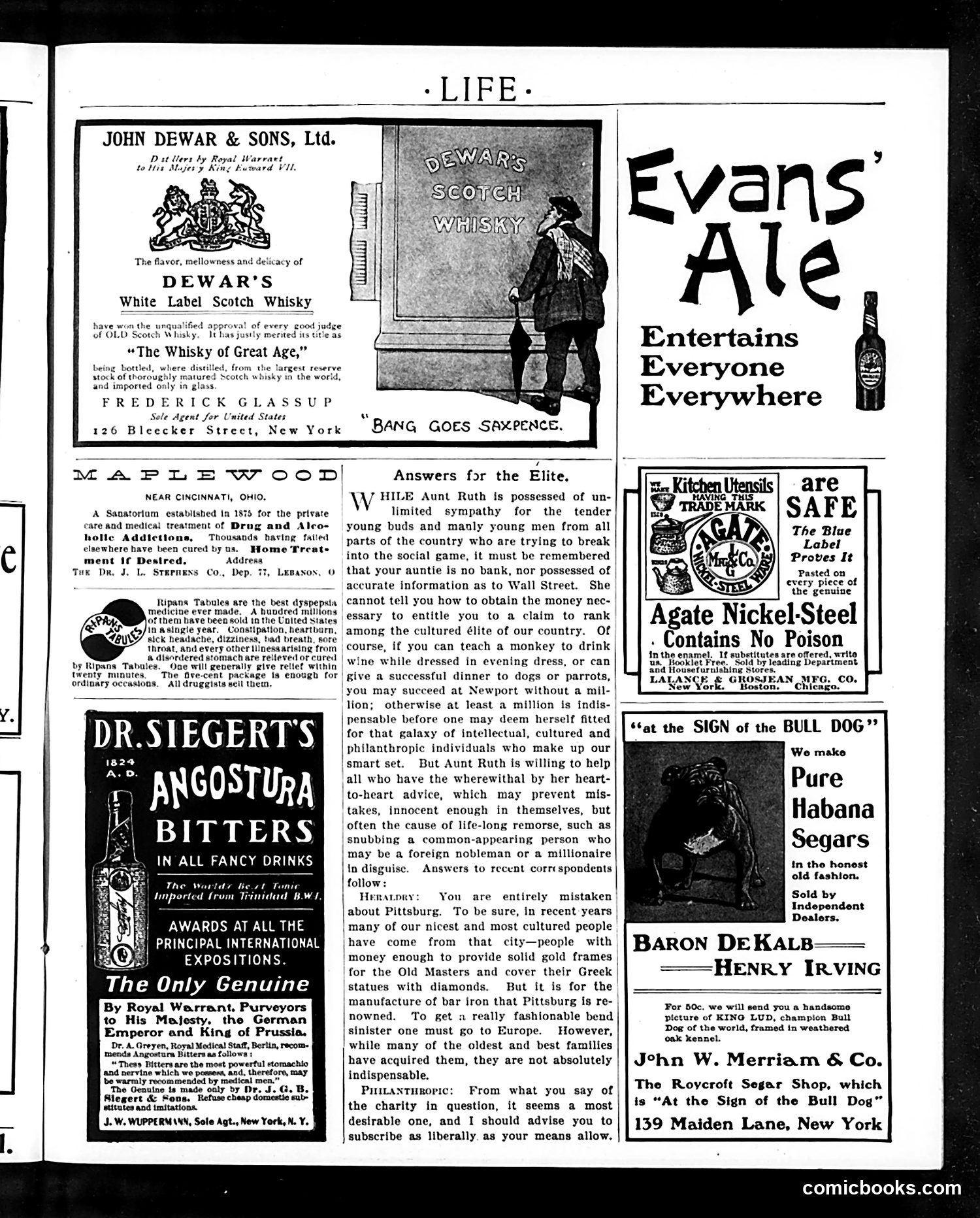
This page is primarily **advertising**, not political satire. It features multiple product advertisements from the early 20th century, including Dewar's Scotch Whisky, Evans' Ale, Dr. Siegert's Angostura Bitters, and Agate Nickel-Steel cookware. The only narrative content is "Answers for the Elite," an advice column where "Aunt Ruth" addresses wealthy readers' social anxieties. The satire here is genteel and domestic rather than political: it gently mocks the insecurity of the rich, suggesting that social status requires either teaching monkeys to drink wine in evening dress or hosting dinner parties for dogs—absurd scenarios highlighting how arbitrary upper-class pretensions are. The cartoon imagery (like "Bang Goes Sixpence") appears to be period trade advertising rather than editorial commentary.
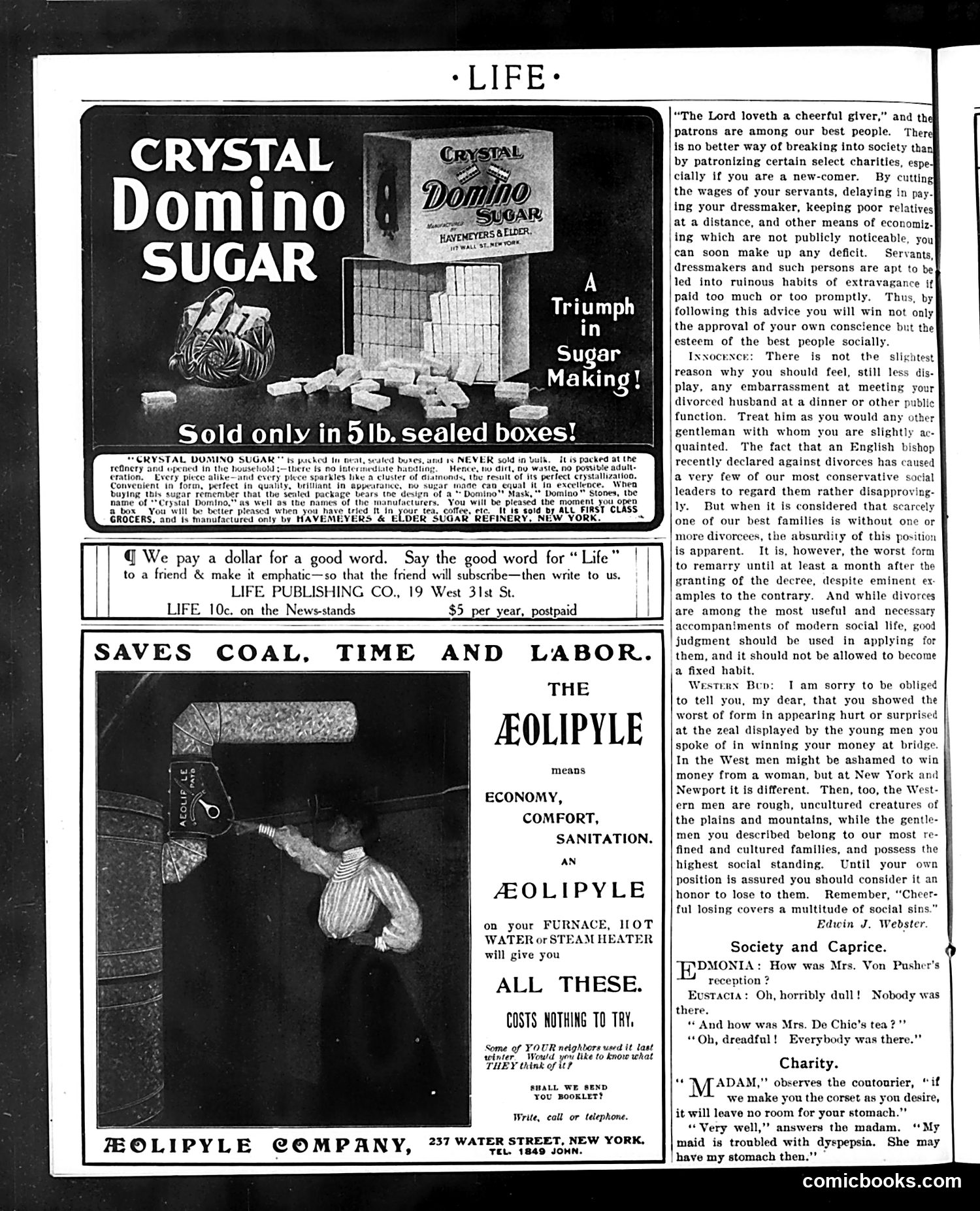
This page is primarily **advertisements and advice columns** rather than political cartoons. The satirical content appears in the **"Society and Caprice" advice section**, which mocks wealthy upper-class hypocrisy through mock-earnest etiquette guidance. The advice mockingly suggests that new-money socialites can "break into society" by underpaying servants and delaying bills to charities—a jab at the fraudulent virtue-signaling of the wealthy. Similarly, the column normalizes divorce among the elite while advising women it's "honorable to lose" money at bridge to wealthy men, satirizing how the privileged class applies different moral standards to themselves versus working people. The brief "Society and Caprice" dialogue jokes about the tedium of high-society gatherings. The page also carries straightforward **product advertisements** for Crystal Domino Sugar and Æolipyle heating systems, representing typical early-20th-century magazine content. No specific political figures or events are referenced.
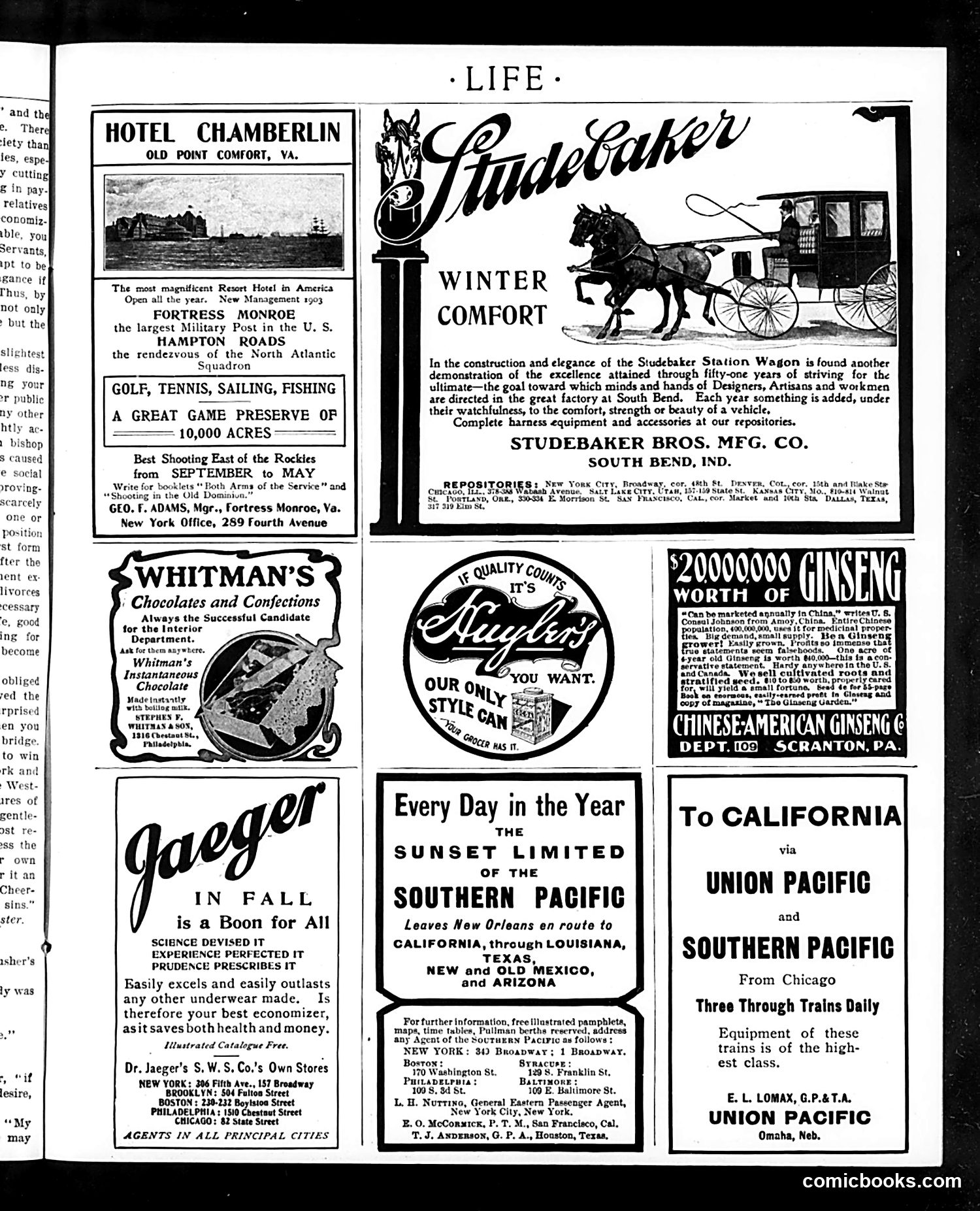
This is **not a cartoon or satirical content page** — it's a collection of commercial advertisements from an early 1900s issue of *Life* magazine. The page features period product and service ads including: - **Hotel Chamberlin** (Virginia resort) - **Studebaker Station Wagon** (horse-drawn vehicles) - **Whitman's Chocolates** - **Jaeger Underwear** (thermal wear) - **Chinese-American Ginseng** (patent medicine) - **Railroad services** (Union Pacific, Southern Pacific, Sunset Limited train) These ads reflect early 20th-century consumer culture: leisure travel, luxury goods, patent medicines (ginseng was marketed as a cure-all), and the emerging importance of railroads for transportation. The *Life* magazine business model relied heavily on advertising revenue, making such pages common filler between editorial content.
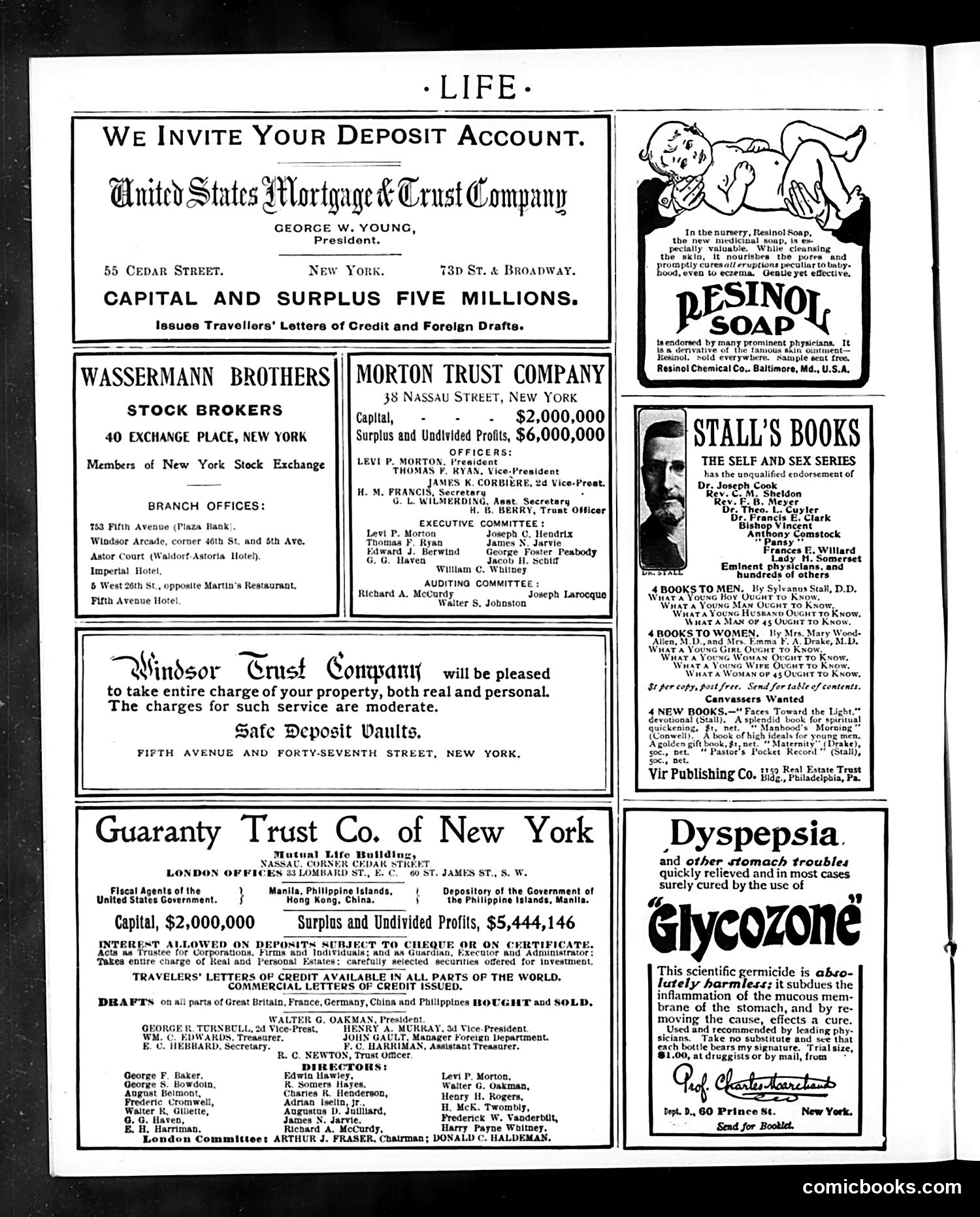
This is primarily an **advertising page** from early-20th-century *Life* magazine. There is **no political cartoon or satire visible**. The page consists entirely of financial and commercial advertisements aimed at wealthy readers, including: - **Banking/Trust companies**: United States Mortgage & Trust Company, Morton Trust Company, Windsor Trust Company, and Guaranty Trust Co. of New York—all offering deposit accounts, property management, and investment services - **Stock brokerage**: Wassermann Brothers - **Patent medicines**: Resinol Soap (medicinal soap claiming to cure skin conditions) and Glycozone (marketed as a "scientific germicide" for stomach troubles) - **Books**: Stall's self-help series about sex and life guidance, marketed with medical endorsements The page reflects the era's advertising conventions: grandiose claims, prestigious institutional endorsements, and targeting of affluent, educated audiences. Nothing satirical is evident—this appears to be standard commercial content from the period.
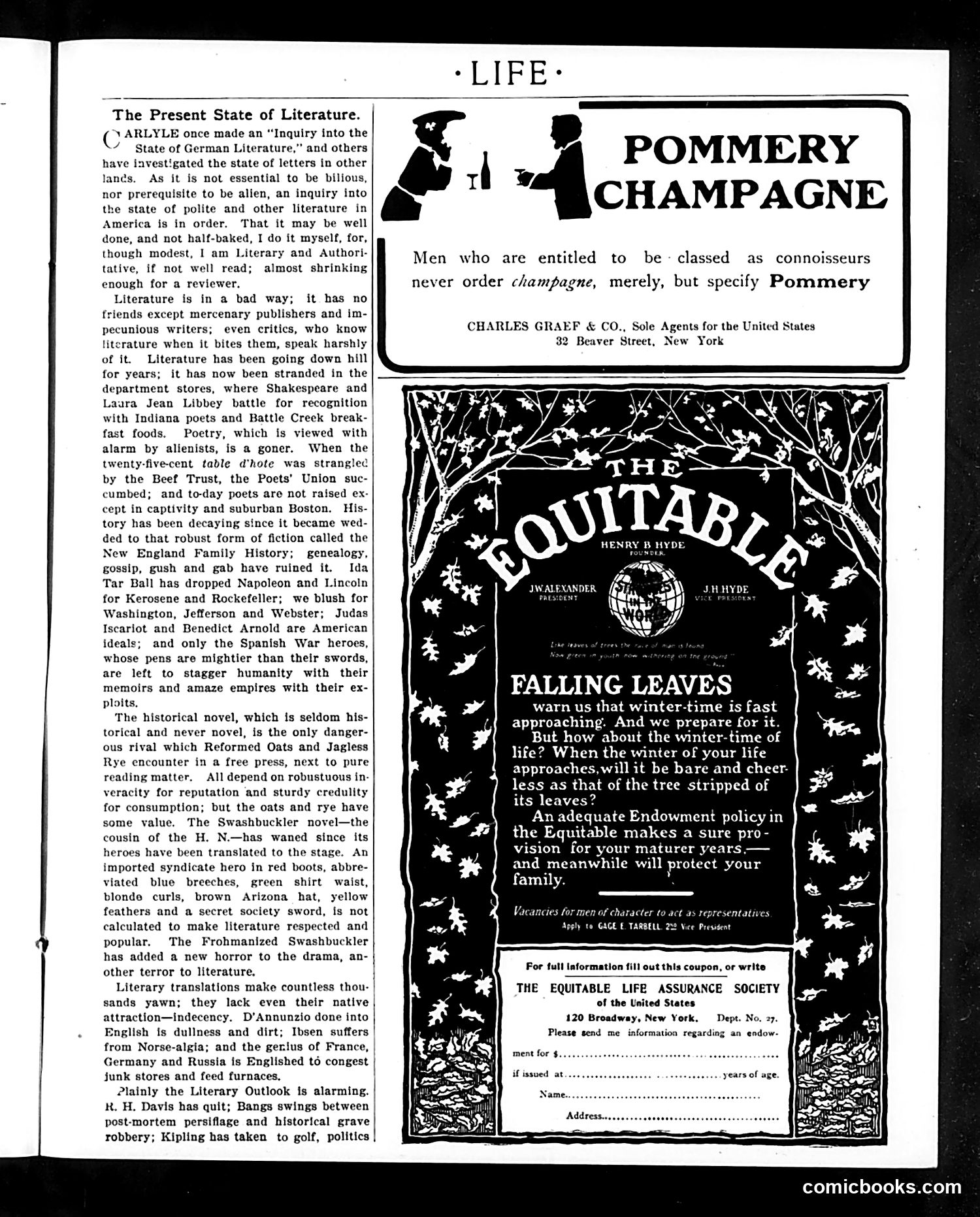
This page presents a satirical essay attacking the decline of American letters. The author (identified as "K.H. Davis" in the text) argues that literature has become commercialized and debased, now competing with cereal advertisements and mass-market fiction in department stores rather than standing as serious art. The specific targets include: popular historical novels (called "Swashbuckler" fiction), genealogy books marketed as history, and literary translations that render great foreign works (Ibsen, D'Annunzio, French/German/Russian literature) dull or incomprehensible in English. The author mocks how serious writers (Shakespeare, Washington, Jefferson) are displaced by commercial products and sensationalism. The page also contains period advertisements for Pommery Champagne and Equitable Life Assurance—standard commercial content that ironically underscores the essay's complaint about literature drowning in marketplace demands.
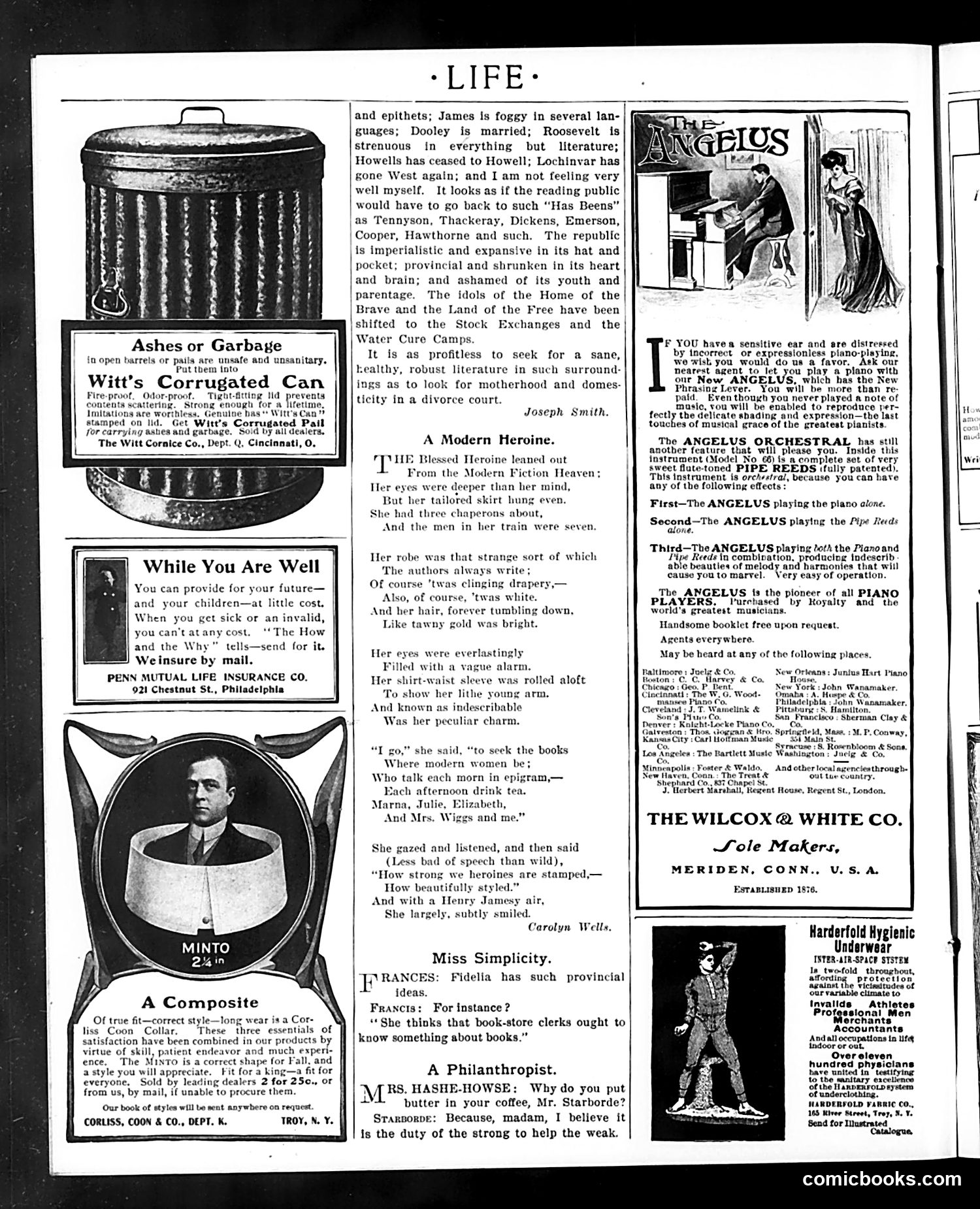
This page is primarily **advertising and light satirical commentary** rather than political cartooning. The main elements include: **Advertisements** dominate: Witt's garbage cans, Penn Mutual Life Insurance, Corliss Coon Collars, and the Angelus player piano occupy substantial space with product illustrations. **Satirical content** includes brief pieces mocking contemporary American literature and society. A commentary by "Joseph Smith" criticizes modern American authors (James, Dooley, Roosevelt, Howells) as inferior to classics like Dickens and Hawthorne, suggesting American culture has become "provincial and shrunken in its heart and brain." **Light humor** pieces like "A Modern Heroine" parody the stock character of sentimental fiction—a vaguely alarmed heroine with tumbling hair and mysterious charm—and "Miss Simplicity" jokes about provincial attitudes. The page reflects early 20th-century Life magazine's mix of **product promotion and genteel social satire** targeting educated, middle-class readers concerned with propriety, literature, and consumer goods.
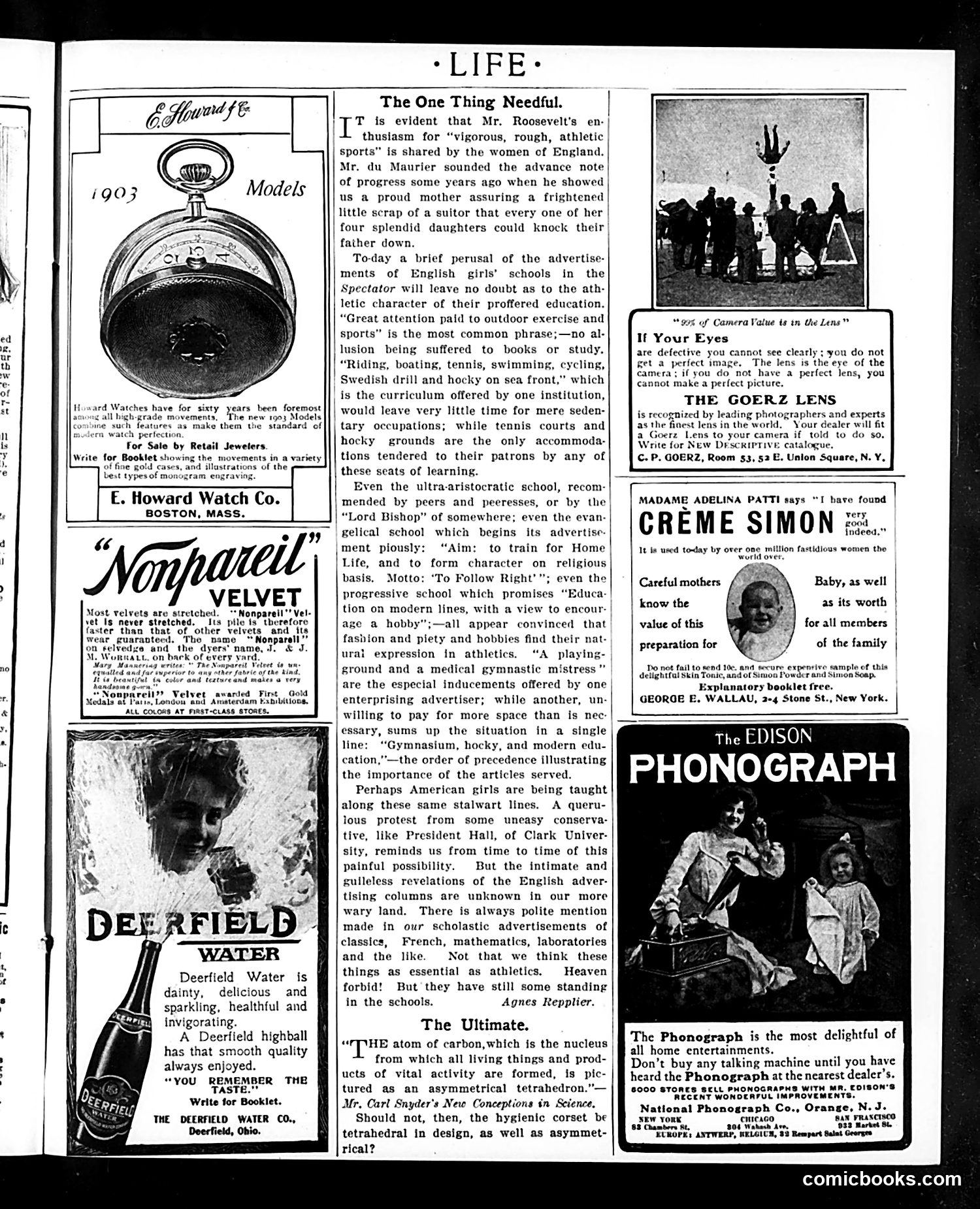
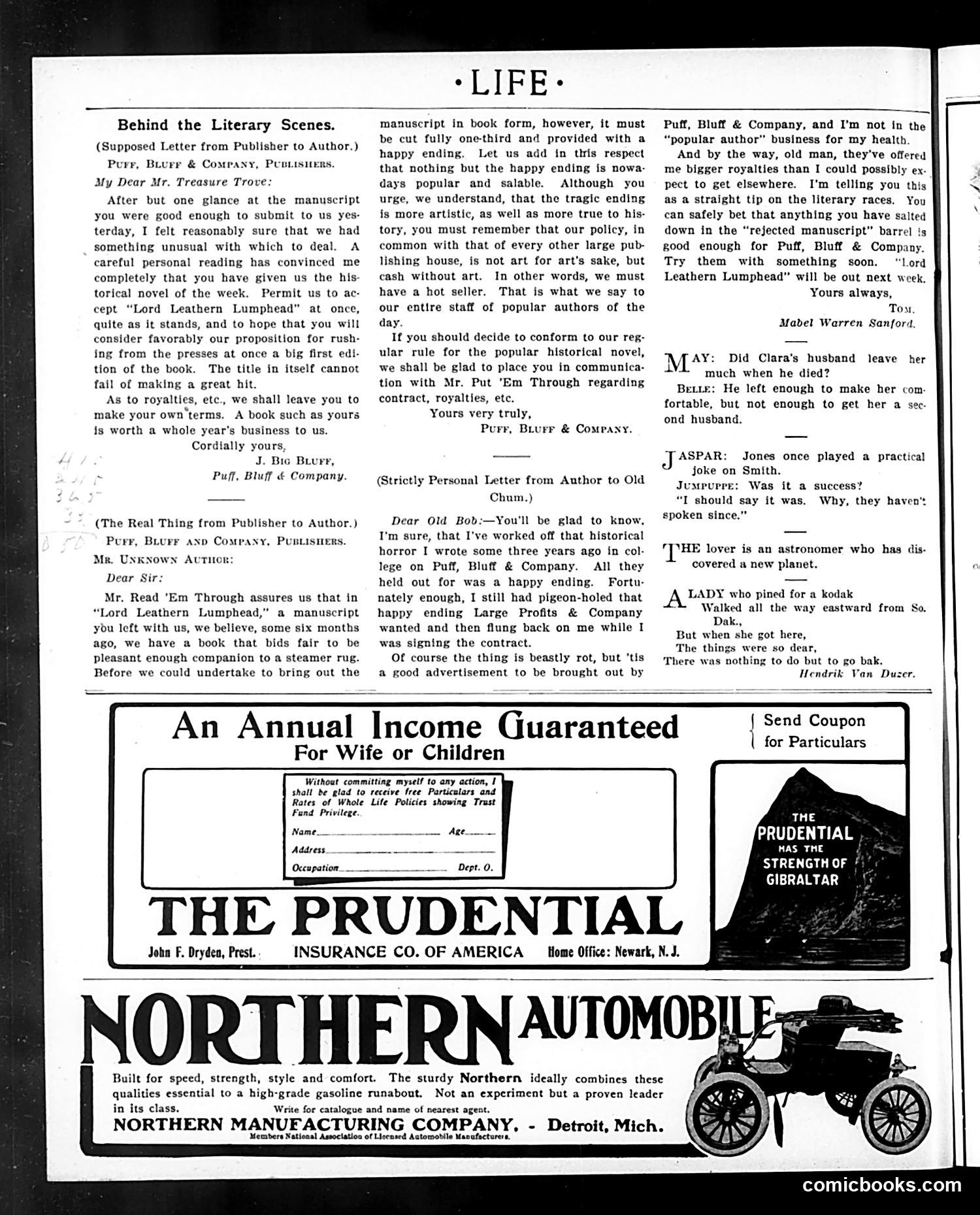
This page satirizes the publishing industry's commercialism versus artistic merit. The humor lies in three contrasting letters about the same manuscript, "Lord Leathern Lumphead": **The Setup:** A publisher's effusive acceptance letter praising the work as "the historical novel of the week" is immediately undercut by the actual rejection letter from the same firm (Puff, Bluff & Company—itself a mocking name). **The Reality:** The publisher demands the author cut one-third of the text, replace the "artistic" tragic ending with a happy one, and accept that their policy is "cash without art"—not artistic merit but commercial viability ("hot seller"). **The Punchline:** The author's private letter reveals he cynically complied, admitting the book is "beastly rot" but accepts it as good "advertisement" and lucrative regardless of quality. The satire targets early 1900s publishing houses that prioritized profit over literature, forcing authors to compromise artistic vision for commercial appeal and happy endings over historical accuracy.
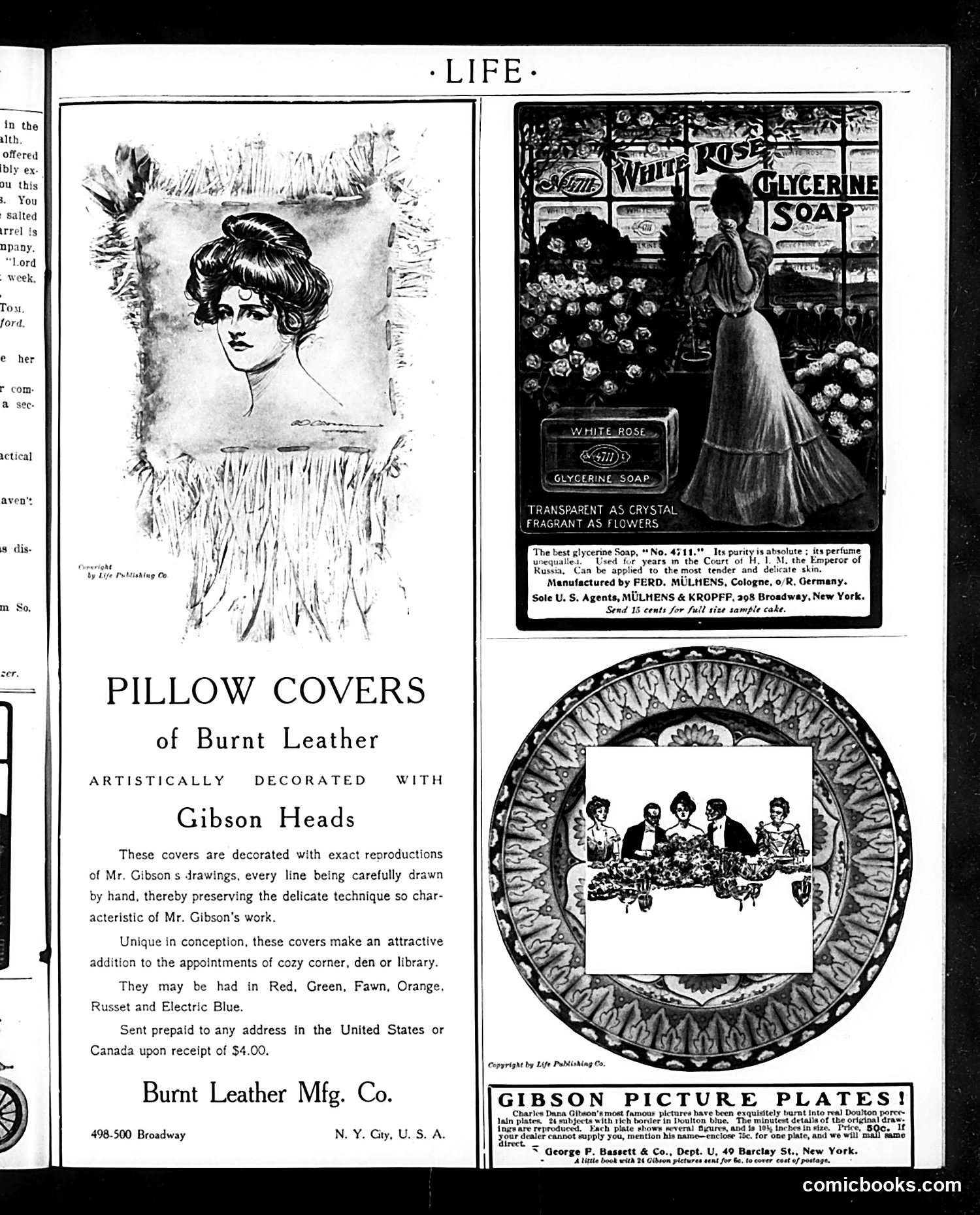
This page consists entirely of **advertisements**, not editorial content or satire. It features three product promotions tied to the popularity of **Charles Dana Gibson** and his "Gibson Girl" illustrations, which were enormously fashionable in the early 1900s. The ads promote: 1. **Burnt leather pillow covers** decorated with Gibson Head reproductions—hand-drawn copies of Gibson's distinctive portrait sketches, available in multiple colors for $4.00 2. **White Rose Glycerine Soap #4711**—a German product marketed with an illustration of a woman admiring a flower shop window 3. **Gibson Picture Plates**—Doulton pottery plates with Gibson illustrations burned into the ceramic All three capitalize on Gibson's cultural cachet as the arbiter of American feminine beauty and taste. The "Gibson Girl" was aspirational imagery that manufacturers eagerly licensed for home décor and luxury goods, targeting middle and upper-class consumers.
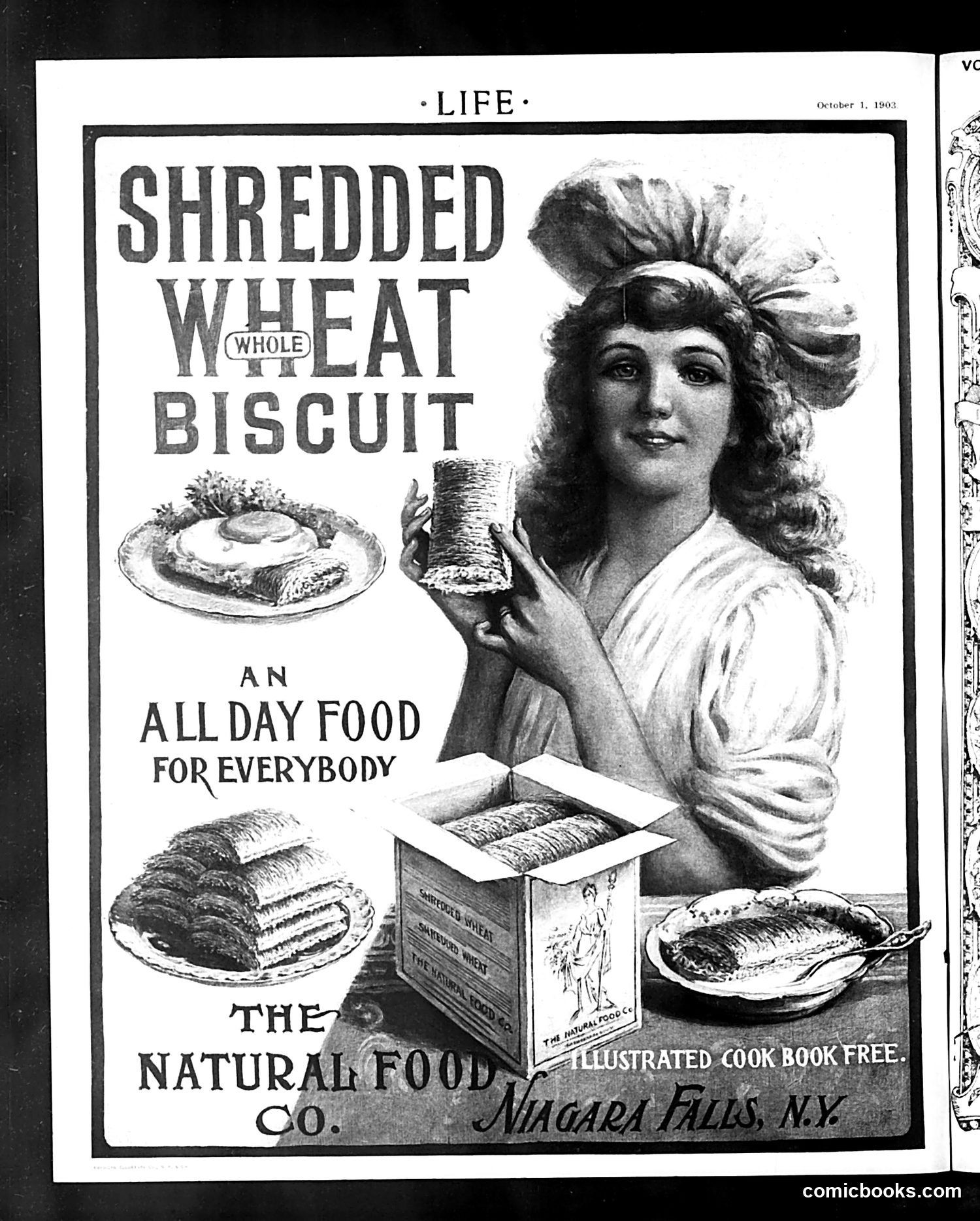
This is a **product advertisement**, not political satire. It promotes Shredded Wheat biscuits manufactured by The Natural Food Co. in Niagara Falls, N.Y., appearing in Life magazine on October 1, 1902. The ad features an idealized Gibson Girl-type woman (popular beauty standard of the era) displaying the product and serving suggestions. The marketing emphasizes the biscuit as a convenient, wholesome "all day food" suitable for all people—reflecting early 1900s consumer culture and the growing market for packaged, shelf-stable foods. The inclusion of an "illustrated cook book free" was a common promotional strategy of the period. There is no political commentary; this is straightforward commercial advertising targeting middle-class American consumers interested in modern, convenient foods.