
Life, 1903-10-01 · page 20 of 36
Life — October 1, 1903 — page 20: what you’re looking at
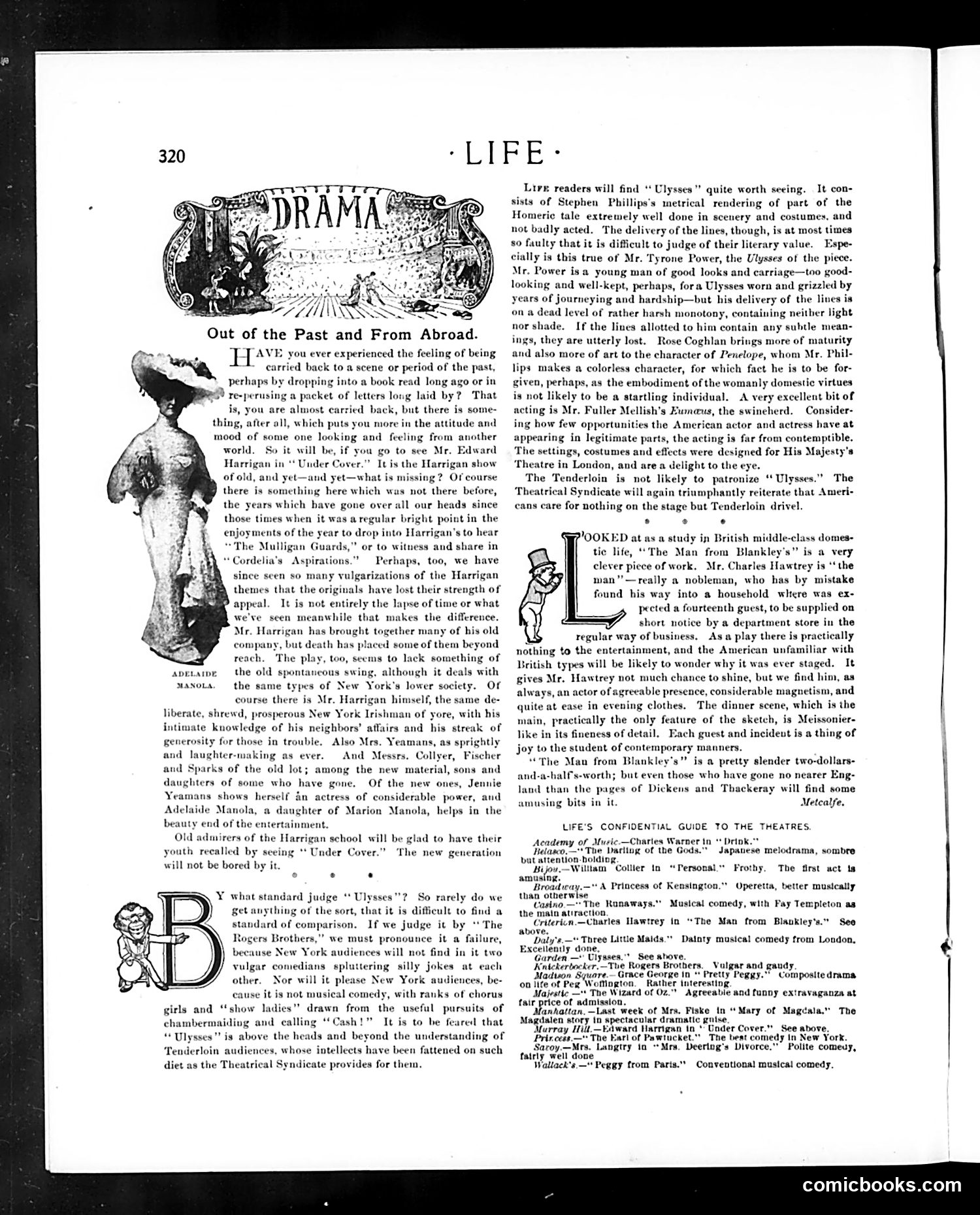
What you’re looking at
This page reviews two theatrical productions: Edward Harrigan's "Under Cover" and a production of "Ulysses" (Stephen Phillips's adaptation of Homer). The **Harrigan review** is nostalgic but disappointed. Harrigan was a celebrated 19th-century playwright known for comedies about New York's working-class Irish immigrants. The critic notes that while Harrigan himself and veteran cast members remain excellent, the production lacks the spontaneity of earlier shows—some original performers have died, and subsequent imitations have diluted the original appeal. New talent includes Jennie Yeamans and Adelaide Manola. The **"Ulysses" review** is sharply critical. The critic suggests the production is too intellectually ambitious for typical theater audiences (dismissively called the "Tenderloin"—a red-light district). Actor Tyrone Power, though handsome, delivers lines in monotonous, expressionless fashion that obscures any literary merit in Phillips's verse adaptation. Both reviews reflect period anxieties about theatrical taste and cultural decline.
📄 Transcribed text from this page (OCR, searchable)
Machine-transcribed from the original scan — historical spelling and the odd misread are preserved.
ae i BS % ALIN Sn Out of the Past and From Abroad. Qe ELAVE you ever experienced the feeling of being ha’ N carried back to a scene or period of the past, perhaps by dropping into a book read long ago or in 2 re-perusing a packet of letters long laid by? That is, you are almost carried back, but there is some- thing, after all, which puts you more in the attitude and mood of some one looking and feeling from another world. So it will be, if you go to see Mr. Edward Harrigan in “Under Cover.” It is the Harrigan show nd yet—and yet—what isn somet sing? Or course jing here which was not there before, the years which have gone over all our heads since those times when it was a regular bright point in the enjoy ments of the year to drop into Harrigan’s to hear “The Mulligan Guards,” or to witness and share in “Cordelia's Aspirations.” Perhaps, too, we have since seen so many vulgarizations of the Harrigan themes that the origin: t their strength of appeal. It is not entirely the lapse of time or what we've seen meanwhile that makes the difference. Mr. Harrigan has brought together many of his old company, but death has placed some of them beyond reach. The play, too, seems to lack something of apetaipe — the old spontaneous swing, although it deals with MaxoLs. the same types of New York's lower society. Of course there is Mr. Harrigan himself, the same de- liberate, shrewd, prosperous New York Irishman of yore, with his intimate knowledge of his neighbors’ affairs and his streak of generosity for those in trouble. Also Mrs. Yeamans, as sprightly and laughter-making as ever. And Messrs. Collyer, Fischer and Sparks of the old lot; among the new material, sons and daughters of some who have gone. Of the new ones, Jennie Yeamans shows herself An actress of considerable power, and ughter of Marion Manola, helps in the beauty end of the entertainment. Old admirers of the Harrig: youth recalled by seeing will not be bored by it. s have | Adelaide Manola, a ¢ n school will be glad to have their Under Cover.” The new generation what standard judge ‘ Ulysses get any 8 "2 So rarely do we hing of the sort, that it is difficult to find a ndard of comparison. If we judge it by “The Rogers Brothers,” we must pronounce it a failure, because New York audiences will not find in it two vulgar comedians spluttering silly jokes at each other. Nor will it please New York audiences, be- ly, with ranks of chorus girls and ‘show ladies” drawn from the useful pursuits of chambermaiding and calling “Cash!” It is to be feared that “Ulysses” is above the heads and beyond the understanding of Tenderloin audi tened on such diet as the Theatrical Syndicate provides for them. cause it is not musical com es, whose intellects have been LIPS * Live readers will find “ Ulysses" quite worth seeing. It con- sists of Stephen Phillips's metrical rendering of part of the Homeric tale extremely well done in scenery and costumes, and not badly acted. The delivery of the lines, though, is at most times so faulty that it is difficult to judge of their literary value. Espe- ially is this true of Mr. Tyrone Power, the Ulysses of the piece. Mr. Power isa young man of good looks and carriage—too good- looking and well-kept, perhaps, fora Ulysses worn and grizzled by years of journeying and hardship—but his delivery of the lines is on a dead level of rather harsh monotony, containing neither light nor shade. If the lines allotted to him contain any subtle mean- ings, they are utterly lost. Rose Coghlan brings more of maturity and also more of art to the character of Penelope, whom Mr. Phil- lips makes a colorless character, for which fact he is to be for- given, perhaps, as the embodiment of the womanly domestic virtues is not likely to be a startling individual. A very excellent bit of acting is Mr. Fuller Mellish’s Ewnaus, the swineherd. Consider- ing how few opportunities the American actor and actress have at appearing in legitimate parts, the acting is far from contemptible. The settings, costumes and effects were designed for His Majesty's Theatre in London, and are a delight to the eye. The Tenderloin is not likely to patronize Ulysses.” The ‘Theatrical Syndicate will again triumphantly reiterate that Ameri- cans care for nothing on the stage but Tenderloin drivel. * ° ° ?OOKED at as a study in British middl tie life, “1 ss domes The Man from Blankley’s” is a very clever piece of work. Mr. Charles Hawtrey is “the man"—really a nobleman, who has by mistake und his way into @ household where was ex- pected a fourteenth guest, to be supplied on short notice by a department store in the \ regular way of business. As a play there is practically nothing to the entertainment, and the American unfamiliar with Sritish types will be likely to wonder why it was ever staged. It gives Mr, Hawtrey not much chance to shine, but we find him, as always, an actor of agreeable presence, considerable magnetism, and quite at ease in evening clothes. The dinner scene, which is the main, practically the only feature of the sketch, is Meissonier- like in its fineness of detail, Each guest and incident is a thing of joy to the student of contemporary manners. “The Mau from Blankley’s"” is a pretty slender two-dollars- and-a-half's-worth; but even those who have gone no nearer Eng- land than the pages of Dickens and Thackeray will find some using bits in it. Metcalfe, LIFE'S CONFIDENTIAL GUIDE TO THE THEATRES. Academy of Music—Chartes Warner tn“ Drink.” elaxco.—* The Datiing of the Gods." Japanese melodrama, sombre but attention-bolding. Bijou—Willtam Collier tn “Personal. Frot amusing. Broadway.—" A Princess of Kensington.” Operetta, better musically than otherwise Casino. —" The Ranaways." Musical comedy, with Pay Templeton as the matn atiraction, Critericn.—Charles Hawtrey in “The Man from Blaukley‘s.” Seo above. Daly'e.—" Three Little Mai Exceilently done, Garden —" Ulysses." See above. Knickerbocker,—The Rogers Brothers. Valgar and gaudy. ‘Madvon Square. Grace George in * Pretty Peggy.” Compositedrama, on lite of Peg WoMogton. Rather interesting. Majestic —* The Wizard of Oz." Agreeat fair price of admission. fanhattan,—Last week of Mra. Fiske in “Mary of Magdala. Magdalen story in spectacular dramatic gutse. Murray Hill,—Eaward Harrigan to * Under Cover." See above, Prirceas—" The Earl of Pawtucket."” The beat comedy In New York. Saroy—Mrs. Langtry a Mrs, Deering’s Divorce.” Polite comedy, fatrly well done Wallack's,—* Peggy from Paris." Conventional musical comedy. hy. The frst act is Dainty musical comedy from London, and funny extravaganza at The comicbooks.com