
Life, 1903-10-01 · page 21 of 36
Life — October 1, 1903 — page 21: what you’re looking at
What you’re looking at
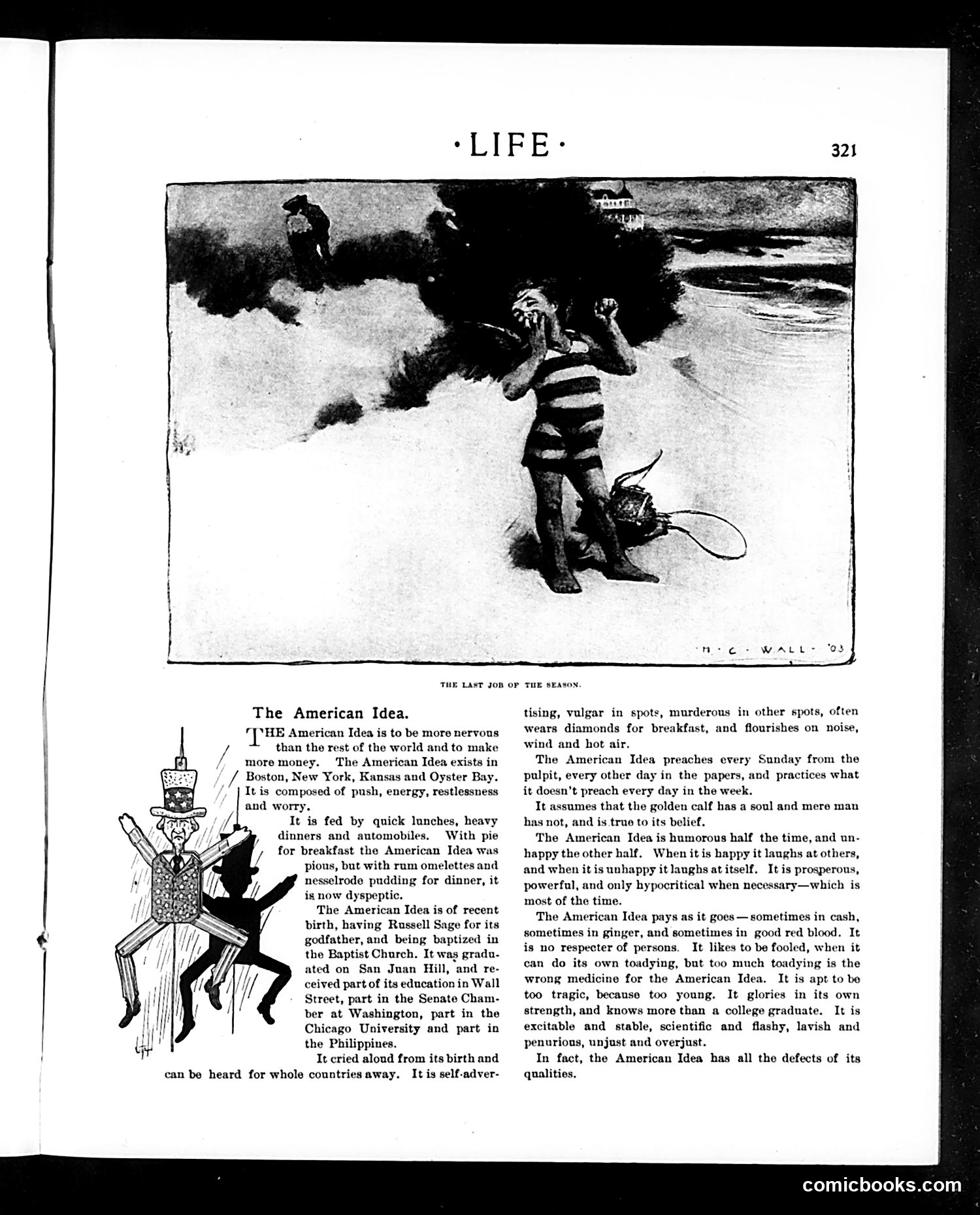
This page contains a biting satirical essay on American character and values, paired with a cartoon titled "The Last Job of the Season" (showing a beach laborer). The text mocks what the author calls "the American Idea"—a bundle of contradictions: nervousness masked as ambition, materialism disguised as energy, hypocrisy presented as pragmatism. The essay catalogs specific targets: wealthy financiers (Russell Sage), imperialist militarism (San Juan Hill reference), corrupt politics (Wall Street, Senate), and colonial ventures (Philippines). The satire suggests Americans are simultaneously pious and gluttonous, powerful yet shallow, laughing at others while secretly insecure. The piece particularly criticizes American capitalism's worship of money ("golden calf") over human dignity, and the culture's relentless self-promotion. The tone is caustic but clever—Life magazine positioned itself as intellectual social commentary for educated readers skeptical of Gilded Age excess and American imperial expansion.
📄 Transcribed text from this page (OCR, searchable)
Machine-transcribed from the original scan — historical spelling and the odd misread are preserved.
~—— = The American Idea. T= American Idea is to be more nervous / than the rest of the world and to make more money. The American Idea exists in / Boston, New York, Kansas and Oyster Bay. It is composed of push, energy, restlessness and worry. It is fed by quick lunches, heavy dinners and automobiles. With pie for breakfast the American Idea was pious, but with rum omelettes and nesselrode pudding for dinner, it is now dyspeptic. The American Idea is of recent birth, having Russell Sage for its godfather, and being baptized in the Baptist Church. It was gradu- ated on San Juan Hill, and re- ceived part of its education in Wall Street, part in the Senate Cham- ber at Washington, part in the Chicago University and part in the Philippines. It cried aloud from its birth and can be heard for whole countries away. It is self-adver- THE LAST JOB OP THE SEASON. tising, vulgar in spots, murderous in other spots, often wears diamonds for breakfast, and flourishes on noise, wind and hot air. The American Idea preaches every Sunday from the pulpit, every other day in the papers, and practices what it doesn’t preach every day in the week. It assumes that the golden calf has a soul and mere man has not, and is true to its belief. The American Idea is humorous half the time, and un- happy the other half. When it is happy it laughs at others, and when it is unhappy it laughs at itself. It is prosperous, powerful, and only hypocritical when necessary—which is most of the time. The American Idea pays as it goes — sometimes in cash, sometimes in ginger, and sometimes in good red blood. It is no respecter of persons. It likes to be fooled, when it can do its own toadying, but too much toadying is the wrong medicine for the American Idea. It is apt to be too tragic, because too young. It glories in its own strength, and knows more than a college graduate. It is excitable and stable, scientific and flashy, lavish and penurions, unjust and overjust. In fact, the American Idea has all the defects of its qualities. comicbooks.com