
Life, 1903-10-01 · page 10 of 36
Life — October 1, 1903 — page 10: what you’re looking at
What you’re looking at
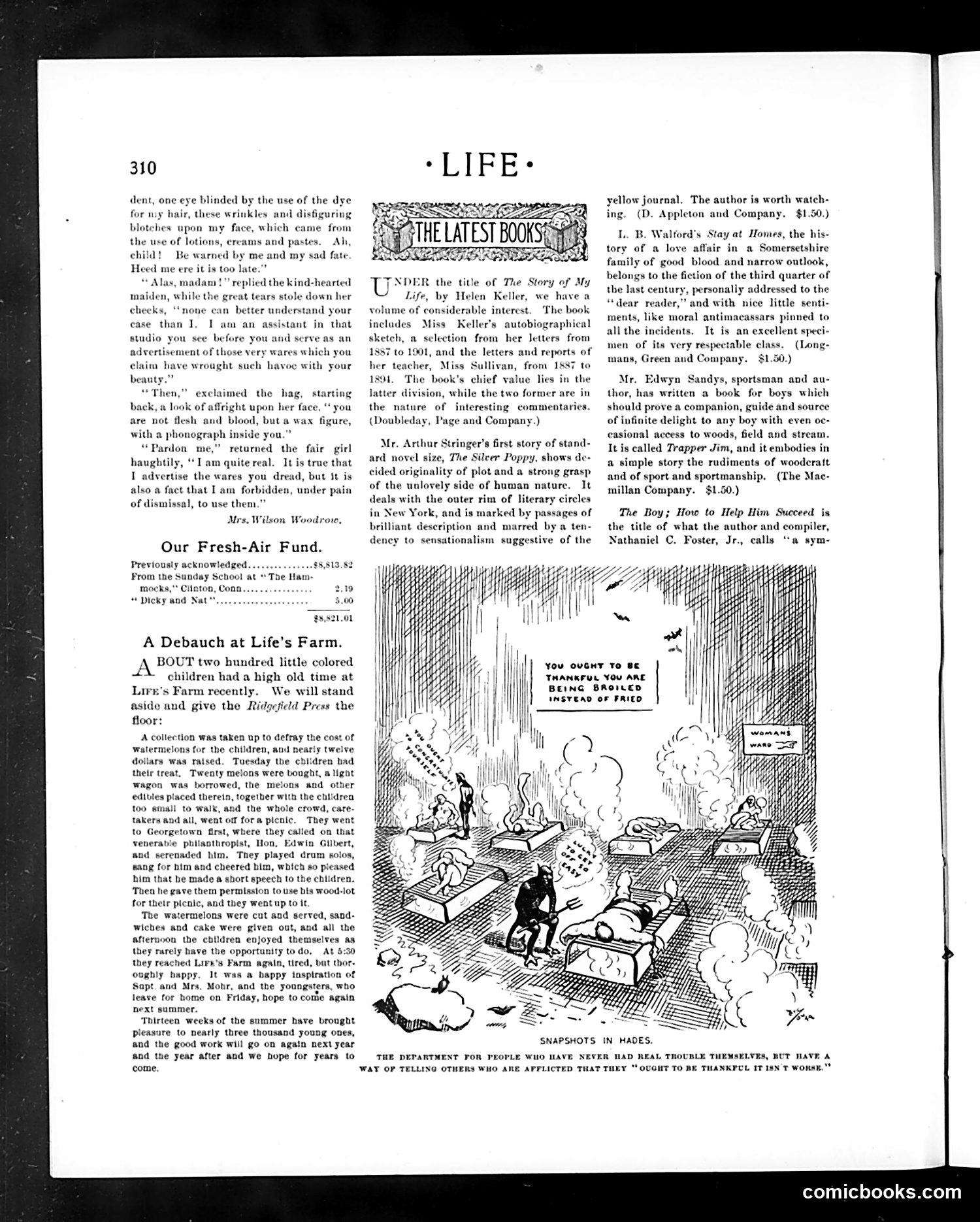
This cartoon satirizes self-righteous hypocrisy. The caption reads: "The Department for People Who Have Never Had Real Trouble Themselves, But Have a Way of Telling Others Who Are Afflicted That They 'Ought to Be Thankful It Isn't Worse.'" The illustration depicts a figure in formal dress lecturing someone suffering in hellish flames, with the speech bubble: "You Ought to Be Thankful You Are Being Broiled Instead of Fried." The satire targets people who offer patronizing, minimally comforting advice to those in genuine distress—suggesting their comments are so absurd they belong in "Hades" (hell itself). It's social commentary on tone-deaf privilege: those without serious hardship criticizing others for insufficient gratitude about their misfortunes. The cartoon mocks this specific form of callous insensitivity as essentially demonic behavior.
📄 Transcribed text from this page (OCR, searchable)
Machine-transcribed from the original scan — historical spelling and the odd misread are preserved.
310 dent, one eye blinded by the use of the dye for wy hair, the: kles and disfiguring blotches upe from the use of Ie Ah, Be w me and my sad fate. stes. Alas, madam !" replied the len, while the grea ind-hearted tears sto! lown her cheeks, “none can better understand your than I, I am an assistant in that studio you see before you and serve as an advertisement of those very wares which you ase claim have wrought such havoc with your beauty. exclaimed the hag, sta . a look of affright upon her face, * you are not flesh and blood, but a wax figure, with a phonograph inside you.” “Pardon returned the fair girl haughtily, “Iam quite real. It is true that I advertise the wares you dread, but Jt is also a fact that I am fort of dismissal, to use them.” me,” den, under pain Mrs, Wilson Woodrow, Our Fresh-Air Fund. Previously acknowledged......... From the Sunday School at “Tbe Ham- mocks,” Clinton, Conn, . . 219 “ Dicky and Nat 8,813.82 5.00 8821.01 A Debauch at Life’s Farm. BOUT two hundred little colored +X children had a high old time at Lire’s Farm recently. We will stand aside and give the Ridgefield Press the floor: A collection was taken up to defray the cos watermelons for the children, and nearly twelve dollars was raised. Tuesday the cbiidren bad thelr treat, Twenty meions were bought, alight Wagon was borrowed, the melons and other tates placed therein, fogetber with the cbildrea too email to walk, and the whole crowd, care: takers and all, went off fora picnic. They went to Georgetown first, where they called on that venerable philanthropist, Hon, Edwin Gtibert, and serenaded him. They played dram solos, sang for him and cheered bim, which so pleased him that be made a short speech to the children. ‘Then he gave them permission to use bis wood-lot for their plenic, and they went up to it The watermelons were cut and served, sand- wiches and cake were given out, and all the Afternoon the children enjoyed themselves as they rarely have the opportunity todo. At 6:30 they reached Life's Farm agaln, tired, bat thor- oughly happy. It was a happy inspiration of Supt. and Mrs. Mobr, and the youngsters, who leave for home on Friday, hope to come again next eommer. ‘Thirteen weeks of the summer have brought pleasure to nearly three thousand young ones, and the good work will go on again next year ‘and the year after and we hope for years to come, JTNDER the title of The Story of Life, by Melen Keller, we have volume of considerable interest. The bo« Miss Keller's autobiog ch, a selection from her letters from 1887 to 1901, and the letters and reports of her teacher, Miss Sullivan, from 1887 to 1891. The book's chief value lies in the latter division, while the two former are in the nature of interesting commentaries. (Doubleday, Page and Company.) cludes: Mr. Arthur Stringer’s first story of stand- ard novel size, The Silver Poppy, shows de- cided originality of plot and a strong grasp of the unloyely side of human nature. It deals with the outer rim of literary circles in New York, and is marked by passages of brilliant description and marred by a ten- dency to sensationalism suggestive of the a \| eae Marz You ovGuy vo ec THANKFUL Vou ARE BEING BROILED INSTEAD OF FRIED yellow journal. The author is worth wateh- ing. (D. Appleton and Company. $1.50.) L. B. Waltord’s Stay at Homes, the his- tory of a love affair in a Somersetshire family of good blood and narrow outlook, belongs to the fiction of the third quarter of the last century, personally addressed to the “dear reader,” and with nice little senti- ments, like moral antimacassars pinned to all the incidents. It is an excellent speci- men of its very respectable class. (Long: mans, Green and Company. $1.50.) Mr. Edwyn Sandys, sportsman and au- thor, has written a book for boys which should prove a companion, guide and source of infinite delight to any boy with even oc- casional access to woods, field and stream. It is called Trapper Jim, and it embodies in a simple story the rudiments of woodcratt and of sport and sportmanship. (The Mac- millan Company. $1.50.) The Boy; How to Help Him Succeed is the title of what the author and compiler, Nathaniel C. Foster, Jr., calls “a sym- SSS SSS SSS SS = SNAPSHOTS IN HADES. THE DEPARTMENT FOR PEOPLE WHO MAY! NEVER NAD REAL TROUBLE THEMSELVES, BUT NAVE A WAY OP TELLING OTHERS WHO ARE AFFLICTED THAT THEY "OUGHT TO BE THANKFUL IT 1 comicbooks.com